REVIEW 3 major objections 4 minor 90 references
Efficient and scalable inter-module switching for distributed quantum computing architectures
T0 review · 3 major / 4 minor · reviewed 2026-08-05 · deepseek-v4-flash
Pith's one-line read This paper aims to show that generalized Mach-Zehnder interferometers, normally treated as blocking switches, can be arranged in decentralized networks that provide simultaneous any-to-any connectivity between quantum computing modules with
desk verdict Useful GMZI quantum characterization, but the Spanke resource comparison is ambiguous and needs a clean count. read the letter →
The pith
A machine-rendered reading of the paper's core claim, the machinery that carries it, and where it could break.
The reading
What carries the argument
The object doing the work is the GMZI unitary S_phi = W-dagger D(phi) W, where W is the N-mode quantum Fourier transform (a passive network of 50/50 beam splitters) and D(phi) is a middle layer of phase shifters. The analysis tracks how D(phi) acts inside each SU(2) representation labeled by photon number, using the small Wigner d-matrices for beam splitters. Type-consistent phase strings—where at every nesting level the two halves of phi are either equal or bitwise inverted—are shown to convert the phase layer into a signed permutation on Fock space; the resulting permutation sigma is read off from the phase string, and the sign from the last phase. That signed-permutation action is the mec
What would settle it
Take an 8x8 GMZI with W as the 8-mode quantum Fourier transform and the type-consistent phase string (0 pi pi 0 pi 0 0 pi) from Eq. (30), and compute the full Fock-space unitary on the input |1,1,1,1,0,0,0,0>. Equation (45) predicts a signed permutation with permutation (18)(27)(36)(45) and global sign + (four photons, last phase pi); a direct Wigner-matrix calculation either confirms this or falsifies the induction on which the resource claims rest.
Extended reading notes
Core claim
The central technical discovery is Eq. (45) of Appendix A: for an N-by-N GMZI with N a power of two, passive layers W and W-dagger realizing the quantum Fourier transform, and phase vector phi whose entries are 0 or pi in a type-consistent pattern, the switching unitary S_phi acts on any Fock state as (-1)^{n_tot phi(N)/pi} times the same state with modes permuted by sigma. In plain terms, the GMZI routes photons like classical distinguishable particles: the output is the same permutation of modes regardless of how the photons are distributed among inputs, and only a global phase records their bosonic character. The same analysis gives a complete bijection between allowed phase strings and p
Load-bearing premise
The load-bearing premise is the unstated induction in Appendix A that the signed-permutation identity, proven for Fock states with at most two occupied modes, holds for arbitrary occupation numbers; if that generalization fails, the multi-photon resource counts for the schemes in Figs. 4-7 are unsupported.
Editorial extensions
If this is right
- Each module needs N-1 GMZIs rather than 2N for direct entanglement schemes, with active depth two and four fiber couplers per photon instead of four and eight.
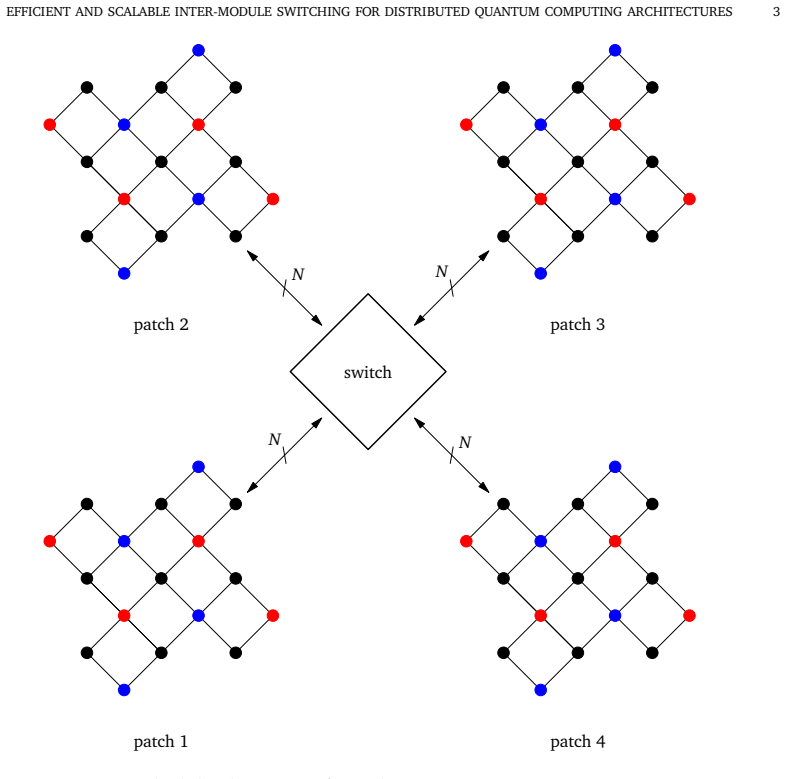
- A four-GMZI, 4-to-12 scheme implements a transversal CNOT between any two [4,1,2] surface-code patches simultaneously, halving the lossy components relative to the 16-to-16 Spanke network.
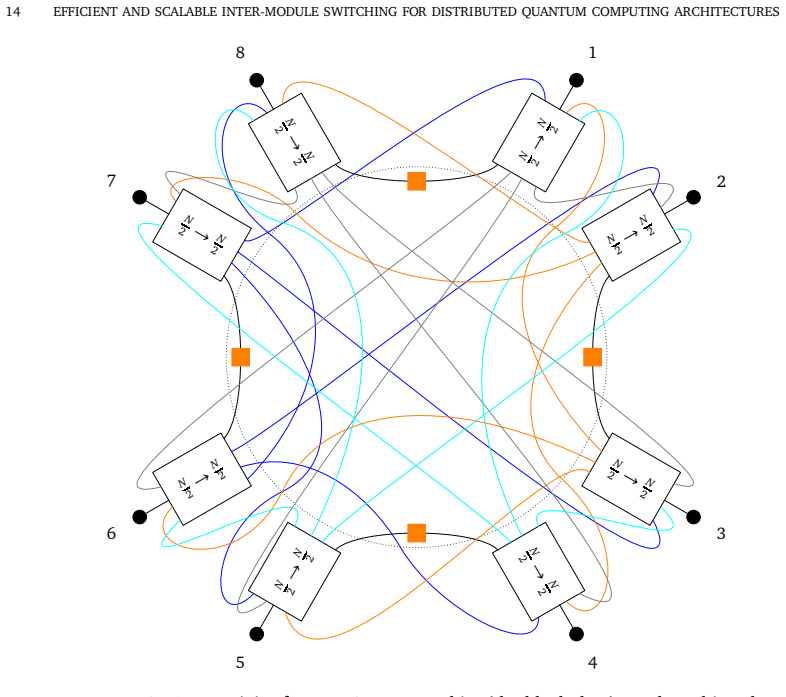
- For probabilistic entanglement, placing the Bell-state gadget between module and GMZI and doubling the GMZI inputs (N to 2N) preserves sa2a and an active depth of two; an alternative graph-theoretic wiring for N=2k modules uses only N/2-to-N/2 GMZIs and reaches any pair in at most three GMZI passes.
- The same switches give a constant active depth of two for CSS stabilizer readout and for sending magic states from a factory to k modules via an N-to-kN GMZI.
- The switch is insensitive to the relative arrival times of photons, so routing succeeds whether or not photons arrive simultaneously.
Reading between the lines
- Extension: the unproved induction after Eq. (45) is the spot to probe first; a direct Fock-space simulation of an 8x8 GMZI with three or four photons would either confirm the signed-permutation rule or invalidate the multi-photon resource counts.
- Extension: the phase redundancy in Table 2 (several equivalent configurations per module pair) could be repurposed as fault tolerance, steering around a faulty GMZI port or fiber, an optimization the paper only hints at.
- Extension: because the GMZI's routing action is independent of photon arrival times, the switching schemes could be combined with the temporal or frequency multiplexing the paper sets aside, raising entanglement attempt rates without adding active depth.
- Extension: the graph-theoretic construction of Fig. 9 should generalize beyond even N by using longer directed cycles instead of 3-cycles, giving bounded-depth sa2a fabrics for arbitrary module counts at the cost of larger GMZIs.
Editorial analysis
A structured set of objections, weighed in public.
Referee Report
Summary. The manuscript proposes several decentralized switching schemes based on Generalized Mach-Zehnder Interferometers (GMZIs) to provide simultaneous any-to-any (sa2a) connectivity between modules of a distributed quantum computer. The central technical claim, developed in Appendix A, is that a GMZI with a QFT passive structure and 'type-consistent' {0,π} phase settings acts on arbitrary Fock states as a signed permutation of the input modes. The paper then uses this to construct direct and probabilistic entanglement-routing schemes that, it claims, halve the active depth and the number of fiber-to-chip couplers relative to a GMZI-based Spanke network. Case studies cover transversal CNOT and lattice-surgery merge operations for [4,1,2] surface-code patches and an MBQC architecture.
Significance. If the central routing claim is correct, the paper offers a genuinely useful resource reduction for optical switching in modular fault-tolerant quantum computing, and the Wigner-d-matrix characterization of GMZI switching is a valuable theoretical contribution. The work is parameter-free, contains explicit worked examples (Table 1, Eqs. (21)-(31)), and provides concrete phase configurations for case studies (Table 2). The main results, however, rest on two load-bearing points that need attention: the multi-photon generalization of the signed-permutation action is asserted rather than proved, and the resource baseline for the Spanke comparison is defined inconsistently.
major comments (3)
- [Appendix A, Eq. (45)] The generalization from single-photon/single-mode inputs to arbitrary multi-mode Fock states is not proved. Eq. (45) states the signed-permutation action for two occupied modes, and the text says 'exactly the same expression as in Eq. (40) follows by induction,' but the induction step is never shown. In particular, the displayed factorization Sφ(|0,...,ni,...,0>)⊗Sφ(|0,...,nj,...,0>) is not justified, since Sφ acts on the full N-mode Hilbert space and not separately on disjoint two-mode subspaces. Because all schemes in Figs. 4-8 rely on simultaneous multi-photon inputs (e.g., |1,1,1,1>), this gap is load-bearing. Please supply the missing argument, for example by deriving U a_i† U† = α a_{σ^{-1}(i)}† from the single-photon result and then extending to multi-photon creation operators, or by giving an explicit induction.
- [Sec. 2 / Fig. 3 / Sec. 3, Fig. 4] The active-depth baseline for the GMZI-based Spanke network is inconsistent. The paper defines active depth as 'the number of active optical components a single photon has to pass through' (Sec. 2). Under that definition, a photon in a GMZI-based Spanke path passes through exactly one 1→M GMZI and one N→1 GMZI, i.e., two active layers, and a photon in the Fig. 4 direct scheme passes through one 1→M GMZI, i.e., one active layer. The reported 'four to two' and 'eight to four' numbers correspond instead to per-entangling-attempt counts involving two photons. This ambiguity affects the headline resource comparison, the Fig. 6 counts ('active depth four' vs. 'active depth two'), and the Fig. 8 claim of 'active depth three.' Please restate all resource counts with an explicit per-photon or per-attempt definition and use that definition consistently; if per-photon counts are adopted, the Fig. 8
- [Sec. 2, paragraph after Fig. 3] The text contains a direct internal contradiction about the Spanke baseline: it first says substituting GMZIs into the Spanke network 'reduce[s] the active optical depth to two [31],' and then the next sentence claims the resulting schemes 'imply an active depth four.' The same network is assigned both values. This is not merely a typo, because the subsequent comparisons ('halving from four to two') depend on which value is meant. Please resolve the contradiction by defining the counting convention precisely and applying it to every scheme compared.
minor comments (4)
- [Footnote 4] The tacit rounding of non-power-of-two port numbers to the nearest power of two changes the passive-layer count and coupler count. A sentence quantifying the resulting overhead would help the scalability discussion.
- [Sec. 2, Eq. (1)] The falling-factorial notation in Eq. (1) is concise but the displayed formula 'min[(M)_M, (M)_N]' is easy to misread; adding a short explanation or an example would improve clarity.
- [Throughout] There are several typographical slips ('algortihms', 'as a remainder' for 'as a reminder', 'respectivelly'), and the Figure 3 caption repeats the 'active depth four' claim that conflicts with the main text. A careful proofreading pass is needed.
- [Appendix A, Eq. (41)] The Hilbert-space decomposition in Eq. (41) is introduced rather abruptly. Since it is used in the sign argument, a short explanation of why the pivot sector determines the sign for all sectors would make the derivation easier to follow.
Circularity Check
No load-bearing circularity: the GMZI switching action is derived from first principles; the flagged weaknesses are an unproved induction and an inconsistent baseline count, neither of which is circular.
full rationale
I walked the derivation chain. The central technical result, Eq. (45), is obtained in Appendix A by direct calculation: S_phi = W† D(phi) W with W the QFT and D the phase operator, and the Wigner d-matrix identities (19), (20), (43), (44) are used to show that type-consistent phase layers act as identity or swap on two-mode Fock subspaces with sign (-)^(n_tot phi(N)/pi). This is a first-principles derivation from the stated model, not an import of the conclusion. The sa2a switching schemes in Sec. 3 are resource counts built on that derived permutation action; no parameter is fitted and no prediction is statistically forced. The Spanke baseline ('achieving a constant active depth four', Fig. 3 caption; 'reduce the active optical depth to two [31]... implies an active depth four') is attributed to the external reference [31], so the comparison is not self-referential. Self-citations [24] and [79] appear only in the GHZ-measurement MBQC case study and in a citation for flexible entangled-state generation; they are illustrative, not premises of the switching theorem. I therefore find no circular step. Two correctness risks are nevertheless flagged. First, after Eq. (45) the text says 'and exactly the same expression as in Eq. (40) follows by induction', but the displayed derivation covers states with at most two occupied modes and the induction for more than two occupied modes is not shown; the subsequent linearity/complete-basis remark does not close the gap because a multi-occupied Fock basis state is not a superposition of two-occupied-mode states. This matters for the multi-photon schemes in Figs. 4-8. Second, the text counts the same Spanke circuit as active depth two and then four without a path-by-path definition; this is an accounting inconsistency, not a reduction to inputs. Neither issue raises the circularity score under the stated rubric.
Assumptions & free parameters
assumptions (5)
- domain assumption The GMZI unitary is W-dagger D(phi) W with W the N-mode quantum Fourier transform for N a power of two
- standard math A beam splitter acting on n photons is described by the spin-j=n/2 Wigner d-matrix
- domain assumption Photon loss is dominated by active switching layers and fiber-to-chip couplers
- ad hoc to paper GMZIs with port numbers not powers of two can be treated by rounding up to the nearest power of two
- domain assumption Low-loss large-port-count GMZIs are manufacturable at the scale required
Cite this review
Pith. "Pith review of Efficient and scalable inter-module switching for distributed quantum computing architectures." pith.science (2026). https://pith.science/paper/7L7CYNJD
@misc{pith2026250819088,
  author       = {Pith},
  title        = {Pith review of: Efficient and scalable inter-module switching for distributed quantum computing architectures},
  year         = {2026},
  howpublished = {\url{https://pith.science/paper/7L7CYNJD}},
  note         = {Machine review of arXiv:2508.19088}
}
read the original abstract
Large-scale fault-tolerant quantum computers of the future will likely be modular by necessity or by design. Modularity is inevitable if the substrate cannot support the desired error-correction code due to its planar geometry or manufacturing constraints resulting in a limited number of logical qubits per module. Even if the computer is compact enough there may be functional requirements to distribute the quantum computation substrate over distant regions of varying scales. In both cases, matter-based quantum information, such as spins, ions or neutral atoms, is the most conveniently transmitted or mediated by photonic interconnects. To avoid long algorithm execution times and reduce errors, each module of a universal quantum computer should be dynamically interconnected with as many other modules as possible. This task relies on an optical switching network providing any-to-any or sufficiently high simultaneous connectivity. In this work we construct several novel and decentralized switching schemes based on the properties of the Generalized Mach-Zehnder Interferometer (GMZI) that are more economic and less noisy compared to commonly considered alternatives while achieving the same functionality.
Figures


Figures from the paper (13 more)




Reference graph
Works this paper leans on
-
[31]
Switch networks for photonic fusion-based quantum computing.arXiv preprint arXiv:2109.13760, 2021
Sara Bartolucci, Patrick Birchall, Damien Bonneau, Hugo Cable, Mercedes Gimeno-Segovia, Konrad Kieling, Naomi Nickerson, Terry Rudolph, and Chris Sparrow. Switch networks for photonic fusion-based quantum computing.arXiv preprint arXiv:2109.13760, 2021
arXiv 2021
-
[1]
Logical computation demonstrated with a neutral atom quantum processor.arXiv e-prints, pages arXiv–2411, 2024
Ben W Reichardt, Adam Paetznick, David Aasen, Ivan Basov, Juan M Bello-Rivas, Parsa Bon- derson, Rui Chao, Wim van Dam, Matthew B Hastings, Andres Paz, et al. Logical computation demonstrated with a neutral atom quantum processor.arXiv e-prints, pages arXiv–2411, 2024
2024
-
[2]
Quantum error correction below the surface code threshold
Google Quantum AI and Collaborators. Quantum error correction below the surface code threshold. Nature, 638(8052):920–926, February 2025
2025
-
[3]
Experimental demonstration of logical magic state distillation.arXiv preprint arXiv:2412.15165, 2024
Pedro Sales Rodriguez, John M Robinson, Paul Niklas Jepsen, Zhiyang He, Casey Duckering, Chen Zhao, Kai-Hsin Wu, Joseph Campo, Kevin Bagnall, Minho Kwon, et al. Experimental demonstration of logical magic state distillation.arXiv preprint arXiv:2412.15165, 2024
arXiv 2024
-
[4]
High-fidelity teleportation of a logical qubit using transversal gates and lattice surgery.Science, 385(6715):1327–1331, 2024
C Ryan-Anderson, NC Brown, CH Baldwin, JM Dreiling, C Foltz, JP Gaebler, TM Gatterman, N Hewitt, C Holliman, CV Horst, et al. High-fidelity teleportation of a logical qubit using transversal gates and lattice surgery.Science, 385(6715):1327–1331, 2024
2024
-
[5]
Marco Valentini, Martin W van Mourik, Friederike Butt, Jakob Wahl, Matthias Dietl, Michael Pfeifer, Fabian Anmasser, Yves Colombe, Clemens Rössler, Philip Holz, et al. Demonstration of two-dimensional connectivity for a scalable error-corrected ion-trap quantum processor archi- tecture. arXiv preprint arXiv:2406.02406, 2024
arXiv 2024
-
[6]
Logical quantum processor based on reconfigurable atom arrays.Nature, 626(7997):58–65, 2024
Dolev Bluvstein, Simon J Evered, Alexandra A Geim, Sophie H Li, Hengyun Zhou, Tom Manovitz, Sepehr Ebadi, Madelyn Cain, Marcin Kalinowski, Dominik Hangleiter, et al. Logical quantum processor based on reconfigurable atom arrays.Nature, 626(7997):58–65, 2024
2024
-
[7]
Demonstrationofquantum computation and error correction with a tesseract code
Ben W Reichardt, David Aasen, Rui Chao, Alex Chernoguzov, Wim van Dam, John P Gaebler, DanGresh,DominicLucchetti,MichaelMills,StevenAMoses,etal. Demonstrationofquantum computation and error correction with a tesseract code. arXiv preprint arXiv:2409.04628, 2024
arXiv 2024
Show all 90 references
-
[8]
Large-scale modular quantum-computer architecture with atomic memory and photonic interconnects.Physical Review A, 89(2):022317, 2014
Christopher Monroe, Robert Raussendorf, Alex Ruthven, Kenneth R Brown, Peter Maunz, L-M Duan, and Jungsang Kim. Large-scale modular quantum-computer architecture with atomic memory and photonic interconnects.Physical Review A, 89(2):022317, 2014
2014
-
[9]
Spin qubit performance at the error correction threshold: Advancing quantum information processing above 700 mk.arXiv preprint arXiv:2412.01920, 2024
S Amitonov, A Apra, M Asker, R Bals, B Barry, I Bashir, E Blokhina, P Giounanlis, M Harkin, P Hanos-Puskai, et al. Spin qubit performance at the error correction threshold: Advancing quantum information processing above 700 mk.arXiv preprint arXiv:2412.01920, 2024
2024
-
[10]
Semicon- ductor spin qubits.Reviews of Modern Physics, 95(2):025003, 2023
Guido Burkard, Thaddeus D Ladd, Andrew Pan, John M Nichol, and Jason R Petta. Semicon- ductor spin qubits.Reviews of Modern Physics, 95(2):025003, 2023
2023
-
[11]
Scaling silicon-based quantum computing using cmos technology
MF Gonzalez-Zalba, S De Franceschi, E Charbon, Tristan Meunier, M Vinet, and AS Dzu- rak. Scaling silicon-based quantum computing using cmos technology. Nature Electronics, 4(12):872–884, 2021
2021
-
[12]
Scalable fault-tolerant quantum technologies with silicon color centers
Stephanie Simmons. Scalable fault-tolerant quantum technologies with silicon color centers. PRX quantum, 5(1):010102, 2024
2024
-
[13]
A spin-optical quantum computing architecture.Quantum, EFFICIENT AND SCALABLE INTER-MODULE SWITCHING FOR DISTRIBUTED QUANTUM COMPUTING ARCHITECTURES 35 8:1423, 2024
Grégoire de Gliniasty, Paul Hilaire, Pierre-Emmanuel Emeriau, Stephen C Wein, Alexia Salavrakos, and Shane Mansfield. A spin-optical quantum computing architecture.Quantum, EFFICIENT AND SCALABLE INTER-MODULE SWITCHING FOR DISTRIBUTED QUANTUM COMPUTING ARCHITECTURES 35 8:1423, 2024
2024
-
[14]
Breakingevenwithmagic: demon- stration of a high-fidelity logical non-clifford gate.arXiv preprint arXiv:2506.14688, 2025
Shival Dasu, Simon Burton, Karl Mayer, David Amaro, Justin A Gerber, Kevin Gilmore, Dan Gresh,DavideDelVento,AndrewCPotter,andDavidHayes. Breakingevenwithmagic: demon- stration of a high-fidelity logical non-clifford gate.arXiv preprint arXiv:2506.14688, 2025
2025 arXiv
-
[15]
Quantumcomputingwithneutralatoms
Loïc Henriet, Lucas Beguin, Adrien Signoles, Thierry Lahaye, Antoine Browaeys, Georges- OlivierReymond, andChristopheJurczak. Quantumcomputingwithneutralatoms. Quantum, 4:327, 2020
2020
-
[16]
Quantumfastfouriertransformandquantumcomputation by linear optics.Journal of the Optical Society of America B, 24(2):231–240, 2007
RonenBarakandYacobBen-Aryeh. Quantumfastfouriertransformandquantumcomputation by linear optics.Journal of the Optical Society of America B, 24(2):231–240, 2007
2007
-
[17]
Repeat-until-success quantum computing using stationary and flying qubits.Physical Review A—Atomic, Molecular, and Optical Physics, 73(1):012304, 2006
Yuan Liang Lim, Sean D Barrett, Almut Beige, Pieter Kok, and Leong Chuan Kwek. Repeat-until-success quantum computing using stationary and flying qubits.Physical Review A—Atomic, Molecular, and Optical Physics, 73(1):012304, 2006
2006
-
[18]
Resource-efficient linear optical quantum computation
Daniel E Browne and Terry Rudolph. Resource-efficient linear optical quantum computation. Physical Review Letters, 95(1):010501, 2005
2005
-
[19]
Experimental demonstration of memory-enhanced quantum communication.Nature, 580(7801):60–64, 2020
Mihir K Bhaskar, Ralf Riedinger, Bartholomeus Machielse, David S Levonian, Christian T Nguyen, Erik N Knall, Hongkun Park, Dirk Englund, Marko Lončar, Denis D Sukachev, et al. Experimental demonstration of memory-enhanced quantum communication.Nature, 580(7801):60–64, 2020
2020
-
[20]
Fault tolerant quantum computation with very high threshold for loss errors.Physical review letters, 105(20):200502, 2010
Sean D Barrett and Thomas M Stace. Fault tolerant quantum computation with very high threshold for loss errors.Physical review letters, 105(20):200502, 2010
2010
-
[21]
Fault-tolerantquantumcomputationwithnondeterministicentanglinggates
James M Auger, Hussain Anwar, Mercedes Gimeno-Segovia, Thomas M Stace, and Dan E Browne. Fault-tolerantquantumcomputationwithnondeterministicentanglinggates. Physical Review A, 97(3):030301, 2018
2018
-
[22]
Fault tolerant quantum computation with nondeterministic gates.Physical review letters, 105(25):250502, 2010
Ying Li, Sean D Barrett, Thomas M Stace, and Simon C Benjamin. Fault tolerant quantum computation with nondeterministic gates.Physical review letters, 105(25):250502, 2010
2010
-
[23]
Fusion- based quantum computation.Nature Communications, 14(1):912, 2023
Sara Bartolucci, Patrick Birchall, Hector Bombin, Hugo Cable, Chris Dawson, Mercedes Gimeno-Segovia, Eric Johnston, Konrad Kieling, Naomi Nickerson, Mihir Pant, et al. Fusion- based quantum computation.Nature Communications, 14(1):912, 2023
2023
-
[24]
High-photon-loss threshold quantum computing using ghz-state measurements.Physical Review Letters, 133(5):050604, 2024
Brendan Pankovich, Angus Kan, Kwok Ho Wan, Maike Ostmann, Alex Neville, Srikrishna Omkar, Adel Sohbi, and Kamil Brádler. High-photon-loss threshold quantum computing using ghz-state measurements.Physical Review Letters, 133(5):050604, 2024
2024
-
[25]
Distributed quantum computing: a survey
Marcello Caleffi, Michele Amoretti, Davide Ferrari, Jessica Illiano, Antonio Manzalini, and Angela Sara Cacciapuoti. Distributed quantum computing: a survey. Computer Networks, 254:110672, 2024
2024
-
[26]
Scalable quantum computing with optical links.arXiv preprint arXiv:2505.00542, 2025
MJ Weaver, G Arnold, H Weaver, S Gröblacher, and R Stockill. Scalable quantum computing with optical links.arXiv preprint arXiv:2505.00542, 2025
2025 arXiv
-
[27]
Distributed quantum error correction based on hyperbolic floquet codes.arXiv preprint arXiv:2501.14029, 2025
Evan Sutcliffe, Bhargavi Jonnadula, Claire Le Gall, Alexandra E Moylett, and Coral M West- oby. Distributed quantum error correction based on hyperbolic floquet codes.arXiv preprint arXiv:2501.14029, 2025
2025
-
[28]
Scalable networkingofneutral-atomqubits: Nanofiber-basedapproachformultiprocessorfault-tolerant quantum computers.PRX Quantum, 6(1):010101, 2025
Shinichi Sunami, Shiro Tamiya, Ryotaro Inoue, Hayata Yamasaki, and Akihisa Goban. Scalable networkingofneutral-atomqubits: Nanofiber-basedapproachformultiprocessorfault-tolerant quantum computers.PRX Quantum, 6(1):010101, 2025
2025
-
[29]
Development of quantum interconnects (quics) for next-generation information technologies.Prx Quantum, 2(1):017002, 2021
David Awschalom, Karl K Berggren, Hannes Bernien, Sunil Bhave, Lincoln D Carr, Paul Davids, Sophia E Economou, Dirk Englund, Andrei Faraon, Martin Fejer, et al. Development of quantum interconnects (quics) for next-generation information technologies.Prx Quantum, 2(1):017002, 2021
2021
-
[30]
Universal fault-tolerant measurement-based quantum computation
Benjamin J Brown and Sam Roberts. Universal fault-tolerant measurement-based quantum computation. Physical Review Research, 2(3):033305, 2020. 36 EFFICIENT AND SCALABLE INTER-MODULE SWITCHING FOR DISTRIBUTED QUANTUM COMPUTING ARCHITECTURES
2020
-
[32]
Thegeneralizedmach-zehnderinterferometerusingmultimodeinterference couplers for optical communications networks
NeilSatishLagali. Thegeneralizedmach-zehnderinterferometerusingmultimodeinterference couplers for optical communications networks. 2000
2000
-
[33]
Architectures for large nonblocking optical space switches.IEEE Journal of quantum electronics, 22(6):964–967, 1986
R Spanke. Architectures for large nonblocking optical space switches.IEEE Journal of quantum electronics, 22(6):964–967, 1986
1986
-
[34]
A manufacturable platform for photonic quantum computing.Nature, pages 1–3, 2025
2025
-
[35]
Architectures for multinode superconducting quantum computers.(2022).arXiv preprint arXiv:2212.06167, 2022
James Ang, Gabriella Carini, Yanzhu Chen, Isaac Chuang, Michael Austin DeMarco, Sophia E Economou, Alec Eickbusch, Andrei Faraon, Kai-Mei Fu, Steven M Girvin, et al. Architectures for multinode superconducting quantum computers.(2022).arXiv preprint arXiv:2212.06167, 2022
2022 arXiv
-
[36]
Quantum codes on a lattice with boundary.arXiv preprint quant-ph/9811052, 1998
Sergey B Bravyi and A Yu Kitaev. Quantum codes on a lattice with boundary.arXiv preprint quant-ph/9811052, 1998
1998 arXiv
-
[37]
Surface code quan- tum computing by lattice surgery.New Journal of Physics, 14(12):123011, 2012
Dominic Horsman, Austin G Fowler, Simon Devitt, and Rodney Van Meter. Surface code quan- tum computing by lattice surgery.New Journal of Physics, 14(12):123011, 2012
2012
-
[38]
A study of non-blocking switching networks
Charles Clos. A study of non-blocking switching networks. Bell System Technical Journal, 32(2):406–424, 1953
1953
-
[39]
Algebraic and topological properties of connecting networks.Bell System Technical Journal, 41(4):1249–1274, 1962
VE Beneš. Algebraic and topological properties of connecting networks.Bell System Technical Journal, 41(4):1249–1274, 1962
1962
-
[40]
N-stage planar optical permutation network.Applied Optics, 26(7):1226–1229, 1987
Ron A Spanke and VE Beneš. N-stage planar optical permutation network.Applied Optics, 26(7):1226–1229, 1987
1987
-
[41]
Dilated networks for photonic switching.IEEE transactions on communications, 35(12):1357–1365, 1987
Krishnan Padmanabhan and Arun Netravali. Dilated networks for photonic switching.IEEE transactions on communications, 35(12):1357–1365, 1987
1987
-
[42]
Silicon photonic switch fabrics: Technology and archi- tecture
Benjamin G Lee and Nicolas Dupuis. Silicon photonic switch fabrics: Technology and archi- tecture. Journal of Lightwave Technology, 37(1):6–20, 2018
2018
-
[43]
Recent advances in optical technologies for data centers: a review.Optica, 5(11):1354–1370, 2018
Qixiang Cheng, Meisam Bahadori, Madeleine Glick, Sébastien Rumley, and Keren Bergman. Recent advances in optical technologies for data centers: a review.Optica, 5(11):1354–1370, 2018
2018
-
[44]
High-rate and high-fidelity modular interconnects between neu- tral atom quantum processors.PRX Quantum, 5(2):020363, 2024
Yiyi Li and Jeff D Thompson. High-rate and high-fidelity modular interconnects between neu- tral atom quantum processors.PRX Quantum, 5(2):020363, 2024
2024
-
[45]
Hierarchical surface code for network quantum computing with modules of arbitrary size.Physical Review A, 94(4):042303, 2016
Ying Li and Simon C Benjamin. Hierarchical surface code for network quantum computing with modules of arbitrary size.Physical Review A, 94(4):042303, 2016
2016
-
[46]
Experimental realiza- tion of any discrete unitary operator.Physical review letters, 73(1):58, 1994
Michael Reck, Anton Zeilinger, Herbert J Bernstein, and Philip Bertani. Experimental realiza- tion of any discrete unitary operator.Physical review letters, 73(1):58, 1994
1994
-
[47]
Distributed quantum computing across an optical network link.Nature, pages 1–6, 2025
D Main, P Drmota, DP Nadlinger, EM Ainley, A Agrawal, BC Nichol, R Srinivas, G Araneda, and DM Lucas. Distributed quantum computing across an optical network link.Nature, pages 1–6, 2025
2025
-
[48]
Compact, low-loss and low-power 8× 8 broadband silicon optical switch.Optics express, 20(17):18977–18985, 2012
Long Chen and Young-kai Chen. Compact, low-loss and low-power 8× 8 broadband silicon optical switch.Optics express, 20(17):18977–18985, 2012
2012
-
[49]
Modular architecture for fully non-blocking silicon photonic switch fabric.Microsystems & nanoengineering, 3(1):1–9, 2017
Dessislava Nikolova, David M Calhoun, Yang Liu, Sébastien Rumley, Ari Novack, Tom Baehr- Jones, Michael Hochberg, and Keren Bergman. Modular architecture for fully non-blocking silicon photonic switch fabric.Microsystems & nanoengineering, 3(1):1–9, 2017
2017
-
[50]
Measurement of subpicosecond time inter- vals between two photons by interference.Physical review letters, 59(18):2044, 1987
Chong-Ki Hong, Zhe-Yu Ou, and Leonard Mandel. Measurement of subpicosecond time inter- vals between two photons by interference.Physical review letters, 59(18):2044, 1987
-
[51]
Freely scalable quantum technologies using cells of 5-to-50 qubits with very lossy and noisy photonic links.Physical Review X, 4(4):041041, 2014
Naomi H Nickerson, Joseph F Fitzsimons, and Simon C Benjamin. Freely scalable quantum technologies using cells of 5-to-50 qubits with very lossy and noisy photonic links.Physical Review X, 4(4):041041, 2014. EFFICIENT AND SCALABLE INTER-MODULE SWITCHING FOR DISTRIBUTED QUANTUM...
2014
-
[52]
Photonicarchitectureforscalablequantuminformationprocessingindiamond
Kae Nemoto, Michael Trupke, Simon J Devitt, Ashley M Stephens, Burkhard Scharfenberger, Kathrin Buczak, Tobias Nöbauer, Mark S Everitt, Jörg Schmiedmayer, and William J Munro. Photonicarchitectureforscalablequantuminformationprocessingindiamond. PhysicalReview X, 4(3):031022, 2014
2014
-
[53]
Code deformation and lattice surgery are gauge fixing.New Journal of Physics, 21(3):033028, 2019
Christophe Vuillot, Lingling Lao, Ben Criger, Carmen García Almudéver, Koen Bertels, and Barbara M Terhal. Code deformation and lattice surgery are gauge fixing.New Journal of Physics, 21(3):033028, 2019
2019
-
[54]
Efficienthigh-fidelityquantumcomputationusingmatterqubits and linear optics
SeanDBarrettandPieterKok. Efficienthigh-fidelityquantumcomputationusingmatterqubits and linear optics. Physical Review A—Atomic, Molecular, and Optical Physics, 71(6):060310, 2005
2005
-
[55]
Fault-tolerant optical interconnects for neutral-atom arrays.Physical Review Research, 7(1):013313, 2025
Josiah Sinclair, Joshua Ramette, Brandon Grinkemeyer, Dolev Bluvstein, Mikhail D Lukin, and Vladan Vuletić. Fault-tolerant optical interconnects for neutral-atom arrays.Physical Review Research, 7(1):013313, 2025
2025
-
[56]
High-rate, high- fidelity entanglement of qubits across an elementary quantum network.Physical review letters, 124(11):110501, 2020
LJ Stephenson, DP Nadlinger, BC Nichol, Shuoming An, P Drmota, Timothy G Ballance, K Thirumalai, Joseph Francis Goodwin, David M Lucas, and CJ Ballance. High-rate, high- fidelity entanglement of qubits across an elementary quantum network.Physical review letters, 124(11):110501, 2020
2020
-
[57]
Quantum gate teleportation between separated qubits in a trapped-ion processor.Science, 364(6443):875– 878, 2019
Yong Wan, Daniel Kienzler, Stephen D Erickson, Karl H Mayer, Ting Rei Tan, Jenny J Wu, Hilma M Vasconcelos, Scott Glancy, Emanuel Knill, David J Wineland, et al. Quantum gate teleportation between separated qubits in a trapped-ion processor.Science, 364(6443):875– 878, 2019
2019
-
[58]
Deterministic high-rateentanglementdistillationwithneutralatomarrays
Thomas A Hahn, Ryan White, Hannes Bernien, and Rotem Arnon-Friedman. Deterministic high-rateentanglementdistillationwithneutralatomarrays. arXivpreprintarXiv:2503.00445 , 2025
2025 arXiv
-
[59]
Constant-overhead fault-tolerant bell-pair distillation using high-rate codes
JAtaides, HengyunZhou, QianXu, GefenBaranes, BikunLi, MikhailDLukin, andLiangJiang. Constant-overhead fault-tolerant bell-pair distillation using high-rate codes. arXiv preprint arXiv:2502.09542, 2025
2025
-
[60]
Optimized noise- resilient surface code teleportation interfaces.arXiv preprint arXiv:2503.04968, 2025
Mohamed A Shalby, Renyu Wang, Denis Sedov, and Leonid P Pryadko. Optimized noise- resilient surface code teleportation interfaces.arXiv preprint arXiv:2503.04968, 2025
2025 arXiv
-
[61]
Analysis of multipartite entanglement dis- tribution using a central quantum-network node.Physical Review A, 107(1):012609, 2023
Guus Avis, Filip Rozpędek, and Stephanie Wehner. Analysis of multipartite entanglement dis- tribution using a central quantum-network node.Physical Review A, 107(1):012609, 2023
2023
-
[62]
Fast quantum interconnects via constant-rate entanglement distillation
Christopher A Pattison, Gefen Baranes, J Ataides, Mikhail D Lukin, and Hengyun Zhou. Fast quantum interconnects via constant-rate entanglement distillation. arXiv preprint arXiv:2408.15936, 2024
2024 arXiv
-
[63]
Mini- mally complex ion traps as modules for quantum communication and computing.New Journal of Physics, 18(10):103028, 2016
Ramil Nigmatullin, Christopher J Ballance, Niel De Beaudrap, and Simon C Benjamin. Mini- mally complex ion traps as modules for quantum communication and computing.New Journal of Physics, 18(10):103028, 2016
2016
-
[64]
Entanglement distillation between solid-state quantum network nodes.Sci- ence, 356(6341):928–932, 2017
Norbert Kalb, Andreas A Reiserer, Peter C Humphreys, Jacob JW Bakermans, Sten J Kamer- ling, Naomi H Nickerson, Simon C Benjamin, Daniel J Twitchen, Matthew Markham, and Ronald Hanson. Entanglement distillation between solid-state quantum network nodes.Sci- ence, 356(6341):928...
2017
-
[65]
Lattice surgery-based logical state teleportation via noisy links.arXiv preprint arXiv:2504.15747, 2025
Áron Márton, Luis Colmenarez, Lukas Bödeker, and Markus Müller. Lattice surgery-based logical state teleportation via noisy links.arXiv preprint arXiv:2504.15747, 2025
2025
-
[66]
Multiplexed entan- glement of multi-emitter quantum network nodes.Nature, pages 1–6, 2025
A Ruskuc, C-J Wu, E Green, SLN Hermans, W Pajak, J Choi, and A Faraon. Multiplexed entan- glement of multi-emitter quantum network nodes.Nature, pages 1–6, 2025
2025
-
[67]
An optical interconnect for modular quantum computers.arXiv preprint arXiv:2412.09299, 2024
Daisuke Sakuma, Amin Taherkhani, Tomoki Tsuno, Toshihiko Sasaki, Hikaru Shimizu, Ken- taro Teramoto, Andrew Todd, Yosuke Ueno, Michal Hajdušek, Rikizo Ikuta, et al. An optical interconnect for modular quantum computers.arXiv preprint arXiv:2412.09299, 2024. 38 EFFICIENT AND SC...
2024
-
[68]
Network requirements for distributed quantum computation.arXiv preprint arXiv:2504.08891, 2025
Hugo Jacinto, Élie Gouzien, and Nicolas Sangouard. Network requirements for distributed quantum computation.arXiv preprint arXiv:2504.08891, 2025
2025
-
[69]
Computing efficiently in qldpc codes.arXiv preprint arXiv:2502.07150, 2025
Alexander J Malcolm, Andrew N Glaudell, Patricio Fuentes, Daryus Chandra, Alexis Schotte, Colby DeLisle, Rafael Haenel, Amir Ebrahimi, Joschka Roffe, Armanda O Quintavalle, et al. Computing efficiently in qldpc codes.arXiv preprint arXiv:2502.07150, 2025
2025
-
[70]
High-threshold and low-overhead fault-tolerant quantum memory.Nature, 627(8005):778–782, 2024
Sergey Bravyi, Andrew W Cross, Jay M Gambetta, Dmitri Maslov, Patrick Rall, and Theodore J Yoder. High-threshold and low-overhead fault-tolerant quantum memory.Nature, 627(8005):778–782, 2024
2024
-
[71]
Entanglement of nanophotonic quantum memory nodes in a telecom network.Nature, 629(8012):573–578, 2024
Can M Knaut, Aziza Suleymanzade, Y-C Wei, Daniel R Assumpcao, P-J Stas, Yan Qi Huan, Bartholomeus Machielse, Erik N Knall, Madison Sutula, Gefen Baranes, et al. Entanglement of nanophotonic quantum memory nodes in a telecom network.Nature, 629(8012):573–578, 2024
2024
-
[72]
Topological fault-tolerance in cluster state quantum computation.New Journal of Physics, 9(6):199, 2007
Robert Raussendorf, Jim Harrington, and Kovid Goyal. Topological fault-tolerance in cluster state quantum computation.New Journal of Physics, 9(6):199, 2007
2007
-
[73]
Foliated quantum error-correcting codes
A Bolt, G Duclos-Cianci, D Poulin, and TM Stace. Foliated quantum error-correcting codes. Physical review letters, 117(7):070501, 2016
2016
-
[74]
Tailoring fusion-based error correction for high thresholds to biased fusion failures.Physical Review Letters, 131(12):120604, 2023
Kaavya Sahay, Jahan Claes, and Shruti Puri. Tailoring fusion-based error correction for high thresholds to biased fusion failures.Physical Review Letters, 131(12):120604, 2023
2023
-
[75]
High-threshold quantum computing by fusing one- dimensional cluster states.Physical Review Letters, 131(12):120603, 2023
Stefano Paesani and Benjamin J Brown. High-threshold quantum computing by fusing one- dimensional cluster states.Physical Review Letters, 131(12):120603, 2023
2023
-
[76]
Quantum error correcting subsystem codes from two classical linear codes.arXiv preprint quant-ph/0610088, 2006
Dave Bacon and Andrea Casaccino. Quantum error correcting subsystem codes from two classical linear codes.arXiv preprint quant-ph/0610088, 2006
2006 arXiv
-
[77]
Ultrafast fault-tolerant long-distance quantum communi- cation with static linear optics.Physical Review A, 95(1):012327, 2017
Fabian Ewert and Peter Van Loock. Ultrafast fault-tolerant long-distance quantum communi- cation with static linear optics.Physical Review A, 95(1):012327, 2017
2017
-
[78]
Fundamental building block for all- optical scalable quantum networks.Physical Review A, 100(5):052303, 2019
Seung-Woo Lee, Timothy C Ralph, and Hyunseok Jeong. Fundamental building block for all- optical scalable quantum networks.Physical Review A, 100(5):052303, 2019
2019
-
[79]
Flexibleentangled-stategenerationinlinearoptics
Brendan Pankovich, Alex Neville, Angus Kan, Srikrishna Omkar, Kwok Ho Wan, and Kamil Brádler. Flexibleentangled-stategenerationinlinearoptics. PhysicalReviewA ,110(3):032402, 2024
2024
-
[80]
From three- photongreenberger-horne-zeilingerstatestoballisticuniversalquantumcomputation
Mercedes Gimeno-Segovia, Pete Shadbolt, Dan E Browne, and Terry Rudolph. From three- photongreenberger-horne-zeilingerstatestoballisticuniversalquantumcomputation. Physical review letters, 115(2):020502, 2015
2015
-
[81]
Encoded-fusion-based quantum computation for high thresholds with linear optics
Wooyeong Song, Nuri Kang, Yong-Su Kim, and Seung-Woo Lee. Encoded-fusion-based quantum computation for high thresholds with linear optics. Physical Review Letters, 133(5):050605, 2024
2024
-
[82]
Lattice surgery on the raussendorf lattice.Quantum Science and Technology, 3(3):035011, 2018
Daniel Herr, Alexandru Paler, Simon J Devitt, and Franco Nori. Lattice surgery on the raussendorf lattice.Quantum Science and Technology, 3(3):035011, 2018
2018
-
[83]
High-fidelity multiphoton- entangled cluster state with solid-state quantum emitters in photonic nanostructures.Physical Review A, 105(3):L030601, 2022
Konstantin Tiurev, Martin Hayhurst Appel, Pol Llopart Mirambell, Mikkel Bloch Lauritzen, Alexey Tiranov, Peter Lodahl, and Anders Søndberg Sørensen. High-fidelity multiphoton- entangled cluster state with solid-state quantum emitters in photonic nanostructures.Physical Review ...
2022
-
[84]
Loss-tolerant architecture for quan- tum computing with quantum emitters.Quantum, 8:1302, 2024
Matthias C Löbl, Stefano Paesani, and Anders S Sørensen. Loss-tolerant architecture for quan- tum computing with quantum emitters.Quantum, 8:1302, 2024
2024
-
[85]
Fault-tolerant quantum computation
Peter W Shor. Fault-tolerant quantum computation. InProceedings of 37th conference on foun- dations of computer science, pages 56–65. IEEE, 1996
1996
-
[86]
Active stabilization, quantum computation, and quantum state synthesis
Andrew M Steane. Active stabilization, quantum computation, and quantum state synthesis. Physical Review Letters, 78(11):2252, 1997. EFFICIENT AND SCALABLE INTER-MODULE SWITCHING FOR DISTRIBUTED QUANTUM COMPUTING ARCHITECTURES 39
1997
-
[87]
Quantum computing with realistically noisy devices.Nature, 434(7029):39– 44, 2005
Emanuel Knill. Quantum computing with realistically noisy devices.Nature, 434(7029):39– 44, 2005
2005
-
[88]
Low-distance surface codes under realistic quantum noise
Yu Tomita and Krysta M Svore. Low-distance surface codes under realistic quantum noise. Physical Review A, 90(6):062320, 2014
2014
-
[89]
Lawrence C Biedenharn, James D Louck, and Peter A Carruthers.Angular momentum in quan- tum physics: theory and application. 1984
1984
-
[90]
Entanglement by a beam splitter: Nonclassi- cality as a prerequisite for entanglement.Physical Review A, 65(3):032323, 2002
MS Kim, W Son, Vladimír Bužek, and PL Knight. Entanglement by a beam splitter: Nonclassi- cality as a prerequisite for entanglement.Physical Review A, 65(3):032323, 2002
2002
Reviewed August 5, 2026 · model on record in the stance chip above.
Discussion (0). Sign in to comment.