REVIEW 4 major objections 4 minor 121 references
Machine learning assisted canonical sampling (MLACS)
T0 review · 4 major / 4 minor · reviewed 2026-08-11 · deepseek-v4-flash
Pith's one-line read The MLACS package claims a self-consistent MLIP loop samples the Born-Oppenheimer surface as accurately as AIMD, with a ~50x reduction in DFT cost and energies within ~1 meV/atom.
desk verdict A useful MLACS software release with strong AIMD sampling benchmarks, but the meV-level free energy claims rest on an in-sample correction that needs independent validation. read the letter →
The pith
A machine-rendered reading of the paper's core claim, the machinery that carries it, and where it could break.
The reading
What carries the argument
The load-bearing object is the self-consistent parameter update for a linear surrogate potential $\tilde V_\gamma(R)=\sum_k \tilde D_k(R)\gamma_k$. Minimizing the Kullback-Leibler divergence between the surrogate and DFT distributions gives the fixed-point equation $\gamma = \langle \tilde D^T \tilde D \rangle^{-1} \langle \tilde D^T V \rangle$; using forces and stresses through the Fisher divergence gives the analogous equation with $\nabla_\eta \tilde D$ and $\nabla_\eta V$. The averages are taken with respect to the surrogate distribution itself, which is why the solve is circular and is iterated as an active-learning loop. The second load-bearing component is MBAR reweighting, which assigns weights so that configurations generated under earlier surrogate potentials remain valid samples for the current one; this reuse is what makes the small database sufficient and keeps the fit from being dominated by off-target configurations.
What would settle it
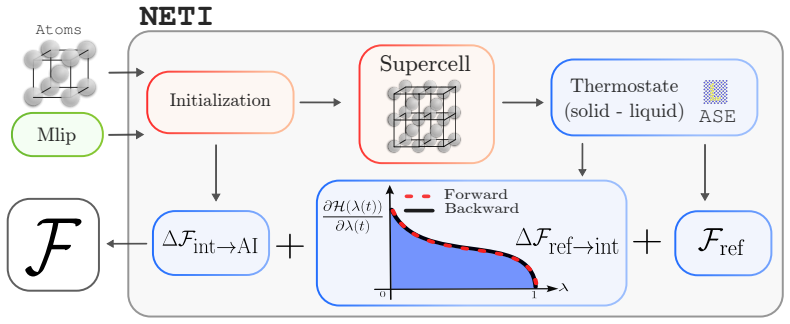
Run MLACS on a strongly anharmonic or liquid system with a known multimodal canonical distribution, for example liquid water or a high-temperature bcc metal, and compare the reweighted energy histogram, pair distribution functions, and free energy against a long AIMD trajectory and an independent thermodynamic-integration reference. If the histogram misses a second peak, the pair distribution functions deviate beyond the AIMD statistical error, or the free energy drifts by more than about 1 meV/atom, the expressiveness assumption is falsified; a cheaper diagnostic is the second-order cumulant correction $\Delta F_{\mathrm{int}\to\mathrm{AI}}$, which should stay below 1 meV/atom on a converged loop.
Extended reading notes
Core claim
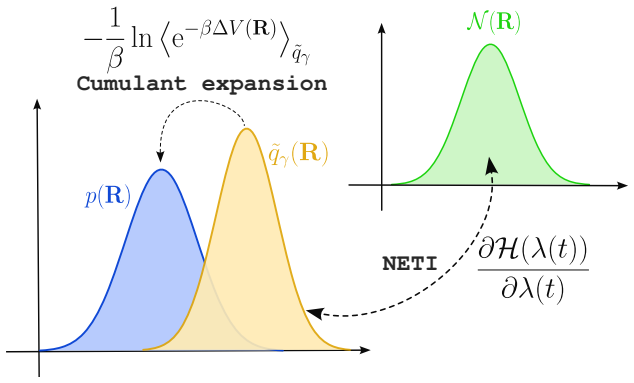
On the paper's own terms, the central discovery is that the surrogate distribution should approximate the DFT canonical distribution at a single thermodynamic point rather than the Born-Oppenheimer surface globally, and that this approximation problem is exactly a variational-inference problem. The authors show that minimizing the Kullback-Leibler divergence $D_{\mathrm{KL}}(q_{\gamma}\Vert p)$ is equivalent to minimizing the Gibbs-Bogoliubov free energy, so the optimal surrogate parameters solve the self-consistent least-squares system $\gamma = \langle \tilde D^T \tilde D \rangle^{-1} \langle \tilde D^T V \rangle$, with a corresponding force- and stress-based equation obtained from the Fisher divergence. Iterating this solve with short surrogate molecular dynamics runs, adding one DFT-evaluated configuration per cycle, and reweighting the full database by MBAR yields a weighted configuration set that reproduces the DFT canonical ensemble. The demonstrated consequence is that phonon spectra, free energies, and phase boundaries are obtained with near-DFT accuracy, about 1 meV/atom, at one to two orders of magnitude lower DFT cost, including a factor of about fifty for bcc-gold phonon frequencies.
Load-bearing premise
The load-bearing premise is that the chosen family of linear machine-learning potentials, built from the selected descriptors, is expressive enough to closely approximate the true quantum-mechanical distribution at the thermodynamic point of interest; if those descriptors cannot represent the relevant energy landscape, the self-consistent loop converges to a biased ensemble no matter how well it converges.
Editorial extensions
If this is right
- Finite-temperature phonon spectra of anharmonic and dynamically unstable crystals can be computed at AIMD accuracy with roughly fifty times fewer DFT steps, as demonstrated for bcc gold.
- Free-energy differences and phase diagrams over hundreds of thermodynamic points become feasible at about 1 meV/atom accuracy, because only the cheap surrogate is driven through nonequilibrium thermodynamic integration.
- Geometry relaxation and minimum-energy-path searches on large cells converge several times faster than direct DFT optimization and reproduce DFT excess enthalpies, volumes, and migration barriers.
- Liquid-state sampling works when delta-learning corrections are added, with the water example reproducing AIMD pair distribution functions over a much longer trajectory.
- The same self-consistent loop converts approximate MLIP databases into reweighted ab initio-quality ensembles, so the package can serve as a data-generation engine for building larger training sets.
Reading between the lines
- Because MBAR reweighting also works when applied a posteriori to an existing configuration database, the same machinery could mine previously computed DFT trajectories for new thermodynamic conditions without additional ab initio runs; the paper demonstrates the reweighting but not this large-scale reuse.
- A nonlinear machine-learning potential could replace the linear model inside the same self-consistent loop, but the closed-form least-squares update would be lost and the optimization would no longer be a single matrix solve; this is a natural testbed for whether the expressiveness limitation identified here is the real bottleneck.
- The current theory treats nuclei classically; combining the variational loop with path-integral sampling would extend the same KL-minimization idea to quantum nuclear fluctuations, which are relevant for light elements and hydrogen-rich materials.
- The second-order cumulant free-energy difference could serve as an on-the-fly convergence criterion, since it measures exactly how far the surrogate distribution is from the target; the package now relies on user-chosen property thresholds instead.
Editorial analysis
A structured set of objections, weighed in public.
Referee Report
Summary. The paper presents MLACS, a Python package that accelerates ab initio canonical sampling by replacing AIMD with a self-consistent variational loop. A linear MLIP (SNAP, MTP, or ACE) is iteratively trained on actively selected DFT energies, forces, and stresses, with MBAR reweighting used to account for the evolving surrogate distribution and to compute canonical averages. The package also implements free-energy calculations via nonequilibrium thermodynamic integration from an Einstein crystal or Uhlenbeck-Ford reference, followed by a cumulant-expansion correction for the residual difference between the MLIP and the DFT target. Applications include canonical sampling of Mg, phonon spectra and a phase diagram for Au, geometry optimization of AuCu alloys, NEB-based vacancy diffusion in Ag, liquid water at 400 K, and UO2 phonons. The central claims are that the self-consistent MLIP sampling reproduces AIMD distributions at roughly a 50-fold reduction in DFT single-point calculations, and that free energies are obtained with ab initio accuracy of about 1 meV/atom.
Significance. The empirical part of the paper is strong and practically valuable. The Mg benchmark compares MLACS directly with AIMD and shows agreement within statistical uncertainty; the Au phonon comparison at two thermodynamic states demonstrates the claimed acceleration; and the AuCu excess-enthalpy results agree with direct DFT optimizations. The open-source package, tutorials, and tests are a further strength. However, the theoretical derivation has two uncontrolled steps, and the meV-level free-energy claim rests on an in-sample cumulant correction rather than on an externally validated error estimate. The paper is likely to be useful to the computational materials community once the free-energy validation and the derivation gaps are addressed.
major comments (4)
- [Section 1.1, Eq. (7)] The derivation of Eq. (7) is incomplete as written. The condition <V>_{\tilde V} = <\tilde V>_{\tilde V} is not a consequence of the preceding gradient calculation; it is imposed 'without loss of generality' because adding a constant to \tilde V leaves the canonical distribution unchanged. This invariance argument requires that the linear parameterization in Eq. (2) actually contains an adjustable constant (or an equivalent projection), and it must be reconciled with the fact that the fixed point of Eq. (7) is otherwise not constrained to satisfy the offset condition. Please state the constant-offset assumption explicitly and show that Eq. (7) follows from the full stationarity condition of the KLD under that assumption.
- [Section 1.1, Eqs. (11)-(12)] The gradient of the Fisher divergence is truncated by dropping the second term on the right-hand side of Eq. (11) with the justification that it is quadratic in the force (or stress) error and therefore small near the fixed point. This is an uncontrolled approximation for a linear MLIP whose force and stress errors do not vanish at the fixed point, and the magnitude of the dropped term is nowhere quantified or tested. Since Eq. (12) is the actual fitting rule used in Algorithm 1 for force and stress data, the authors should either retain the term, bound it, or provide a numerical check, for example by comparing fits with and without the term on a representative system.
- [Section 2.1, Eqs. (33)-(36) and Fig. 11] The free-energy correction DeltaF_int_to_AI is computed from a second-order cumulant expansion using the same DFT data that were actively selected for fitting the MLIP. The data are therefore in-sample: the active-learning fit minimizes the weighted energy residuals, so the empirical mean and variance of DeltaV = V - \tilde V understate the true surrogate-to-DFT discrepancy. The near-zero values in Fig. 11 are not independent evidence of 1 meV/atom free-energy accuracy, and no test of Gaussianity of DeltaV is provided for the extreme Au thermodynamic states. The meV-level claim should be supported by out-of-sample evaluation, for example hold-out configurations or independent thermodynamic-integration calculations at a few state points, and by a check of the cumulant truncation.
- [Section 1.1 and abstract] The statement that the method 'prove[s] that a self-consistent active learning strategy using a MLIP enables to sample the BO surface as accurately as using AIMD simulations' overstates what the derivation establishes. The variational calculation shows that the KLD-optimal distribution within the chosen linear family is a fixed point of Eq. (7), but it does not by itself bound the residual KLD or the error of canonical averages. The accuracy claims rest on the empirical benchmarks, which are convincing for the tested systems, but the theoretical wording should be qualified accordingly.
minor comments (4)
- [Section 5.1, Table 3] Reporting RMSE and MAE values to sub-meV and sub-meV/A precision without statistical error bars or the number of samples is potentially misleading; adding error estimates or at least the database size for each weighting policy would help.
- [Section 4.4] The main object is described as 'Mlas' in one place; this should read 'Mlacs'. The same section also contains the phrase 'Funtions', which should be 'Functions'.
- [Figure 10 caption] The caption contains the typo 'pannel' in 'Left pannel' and 'Right panel'; please correct it.
- [Section 2.1] The sentence 'the free energy of the anharmonic surrogate system Fint (which is exacly the same quantity as eF0)' contains the typo 'exacly' and should read 'exactly'.
Circularity Check
MeV-level free-energy claims for the gold phase diagram rest on an in-sample cumulant correction that the MLIP fit itself minimizes; external AIMD benchmarks support the phonon sampling but not the full free-energy accuracy.
-
fitted input called prediction
[Sec. 2.1, Eq. (36); Sec. 5.3, Fig. 11]
"Consequently, this second-order cumulant free energy difference gives not only a correction to the Gibbs–Bogoliubov free energy, but also measures the accuracy of Mlacs. The better the sampling done by Mlacs, the smaller ∆Fint→AI. ... In conclusion, by building a local and optimal MLIP potential for each thermodynamic point, Mlacs demonstrates its ability to maintain an ab initio accuracy on free energies (≤ 1 meV/atom) in a large range of pressures and temperatures."
Eq. (36) evaluates ∆Fint→AI from the first two cumulants of ∆V = V − eV over the MBAR-reweighted database of DFT configurations. Those same configurations and weights are precisely the training data used in Eq. (17), bγγγN = (X^T W X)^−1 X^T W Y, to fit the linear MLIP by weighted least squares. The fit therefore minimizes the weighted energy/force residual on the very configurations on which Eq. (36) measures it, and the MLACS loop actively adds configurations until the reweighted observable stops changing. The near-zero values in Fig. 11 (10^-4 meV/atom below 2000 K, ~1 meV/atom at the extremes) are consequently in-sample measures of how well the surrogate fits its own training set, not an external confirmation that the total free energy F is within 1 meV/atom of DFT.
full rationale
The derivation of the MLACS variational equations (Sec. 1) is self-contained: the KL and Fisher divergences, the Gibbs–Bogoliubov inequality, and the least-squares fixed-point equations are standard mathematical identities re-derived in the paper, not imported by citation. The central sampling capability is also checked against external AIMD: Mg at 300 K (Fig. 9), Au phonons at 1000 and 8000 K (Fig. 10), water g(r) (Fig. 15), and the NETI implementation against published EAM/coarse-grained free energies (Table 2). These benchmarks provide genuine independent support, so the paper is not wholly circular. The one significant circular step concerns the meV-level free-energy claim for the gold phase diagram (Sec. 5.3, Fig. 11). The claimed 'ab initio accuracy on free energies' is supported by the smallness of ∆Fint→AI from Eq. (36), a second-order cumulant of ∆V evaluated on the MBAR-reweighted database that Eq. (17) used to fit the MLIP by weighted least squares. That quantity is an in-sample residual of the fit, so its smallness is partially forced by construction; it cannot by itself establish 1 meV/atom accuracy of the total free energy. Since this is a load-bearing accuracy claim for the phase diagram but the method also has external validation elsewhere, the paper earns a 6 rather than a higher circularity score. The self-citations to [1,107,28] are not treated as load-bearing because the variational theory is re-derived here and the cited works provide published, externally benchmarked results.
Assumptions & free parameters
free parameters (4)
- alpha_E, alpha_F, alpha_S weights in cost function (Eq 13)
- SNAP descriptor hyperparameters (rcut, twojmax/jmax) per system =
e.g., Mg rcut=4.2 A, j=2; Cu rcut=5 A, j=6
- Geometry optimization weighting exponent a (wi proportional to i^a)
- Uhlenbeck-Ford reference parameter p =
p in {1, 25, 50, 75, 100}
assumptions (6)
- domain assumption The DFT Born-Oppenheimer surface V(R) is the exact target and classical nuclei follow Boltzmann statistics.
- domain assumption The linear MLIP family eV = D*gamma can approximate V well enough at each thermodynamic point.
- domain assumption The matrix <D^T D> is invertible.
- ad hoc to paper The constant energy offset condition <V> = <eV> can be imposed without loss of generality.
- ad hoc to paper The discarded second term in the Fisher divergence gradient (Eq 11) is negligible.
- domain assumption The second-order cumulant expansion is accurate for the free energy correction DeltaF_int_to_AI.
Cite this review
Pith. "Pith review of Machine learning assisted canonical sampling (MLACS)." pith.science (2026). https://pith.science/paper/7LCYEJUP
@misc{pith2026241215370,
  author       = {Pith},
  title        = {Pith review of: Machine learning assisted canonical sampling (MLACS)},
  year         = {2026},
  howpublished = {\url{https://pith.science/paper/7LCYEJUP}},
  note         = {Machine review of arXiv:2412.15370}
}
read the original abstract
The acceleration of material property calculations while maintaining ab initio accuracy (1 meV/atom) is one of the major challenges in computational physics. In this paper, we introduce a Python package enhancing the computation of (finite temperature) material properties at the ab initio level using machine learning interatomic potentials (MLIP). The Machine-Learning Assisted Canonical Sampling (MLACS) method, grounded in a self-consistent variational approach, iteratively trains a MLIP using an active learning strategy in order to significantly reduce the computational cost of ab initio simulations. MLACS offers a modular and user-friendly interface that seamlessly integrates Density Functional Theory (DFT) codes, MLIP potentials, and molecular dynamics packages, enabling a wide range of applications, while maintaining a near-DFT accuracy. These include sampling the canonical ensemble of a system, performing free energy calculations, transition path sampling, and geometry optimization, all by utilizing surrogate MLIP potentials, in place of ab initio calculations. This paper provides a comprehensive overview of the theoretical foundations and implementation of the MLACS method. We also demonstrate its accuracy and efficiency through various examples, showcasing the capabilities of the MLACS package.
Figures


Figures from the paper (13 more)


Reference graph
Works this paper leans on
-
[1]
A. Castellano, F. Bottin, J. Bouchet, A. Levitt, G. Stoltz, ab initio canonical sampling based on variational inference, Phys. Rev. B 106 (2022) L161110. doi:10.1103/PhysRevB.106.L161110. URL https://link.aps.org/doi/10.1103/PhysRevB.106.L161110
-
[2]
URL https://github.com/mlacs-developers/mlacs/tree/main
MLACS github repository, first production version v1.0.1 (2024). URL https://github.com/mlacs-developers/mlacs/tree/main
2024
-
[3]
B. J. Alder, T. E. Wainwright, Phase transition for a hard sphere system, The Journal of Chemical Physics 27 (5) (1957) 1208–
1957
-
[4]
B. J. Alder, T. E. Wainwright, Studies in molecular dynamics. i. general method, The Journal of Chemical Physics 31 (2) (1959) 459–466. arXiv:https://pubs.aip.org/aip/jcp/article-pdf/31/ 2/459/18817177/459\_1\_online.pdf, doi:10.1063/1.1730376. URL https://doi.org/10.1063/1.1730376
-
[5]
B. J. Alder, T. E. Wainwright, Studies in molecular dynamics. ii. behavior of a small number of elastic spheres, The Journal of Chemical Physics 33 (5) (1960) 1439–1451. arXiv:https://pubs.aip.org/aip/ jcp/article-pdf/33/5/1439/18820030/1439\_1\_online.pdf, doi:10.1063/1.1731425. URL https://doi.org/10.1063/1.1731425
-
[6]
Rahman, Correlations in the motion of atoms in liquid argon, Phys
A. Rahman, Correlations in the motion of atoms in liquid argon, Phys. Rev. 136 (1964) A405–A411. doi:10.1103/PhysRev.136.A405. URL https://link.aps.org/doi/10.1103/PhysRev.136.A405
-
[7]
Rahman, F
A. Rahman, F. H. Stillinger, Molecular dynamics study of liq- uid water, The Journal of Chemical Physics 55 (7) (1971) 3336–
1971
-
[8]
G. Kresse, J. Hafner, Ab initio molecular dynamics for liquid metals, Phys. Rev. B 47 (1993) 558–561. doi:10.1103/PhysRevB.47.558. URL https://link.aps.org/doi/10.1103/PhysRevB.47.558
Show all 121 references
-
[9]
Kresse, J
G. Kresse, J. Hafner, Ab initio molecular dynamics for open-shell tran- sition metals, Phys. Rev. B 48 (1993) 13115–13118. doi:10.1103/ PhysRevB.48.13115. URL https://link.aps.org/doi/10.1103/PhysRevB.48.13115
1993 doi
-
[10]
Hohenberg, W
P. Hohenberg, W. Kohn, Inhomogeneous electron gas, Phys. Rev. 136 (1964) B864–B871. doi:10.1103/PhysRev.136.B864. URL https://link.aps.org/doi/10.1103/PhysRev.136.B864
1964 doi
-
[11]
W. Kohn, L. J. Sham, Self-consistent equations including exchange and correlation effects, Phys. Rev. 140 (1965) A1133–A1138. doi: 10.1103/PhysRev.140.A1133. URL https://link.aps.org/doi/10.1103/PhysRev.140.A1133 49
1965 doi
-
[12]
M. Born, R. Oppenheimer, Zur quantentheorie der molekeln, Annalen der Physik 389 (20) (1927) 457–484. doi:https://doi.org/10.1002/ andp.19273892002
1927
-
[13]
N. S. Gillis, N. R. Werthamer, T. R. Koehler, Properties of crystalline argon and neon in the self-consistent phonon approximation, Phys. Rev. 165 (3) (1968) 951–959. doi:10.1103/physrev.165.951. URL https://doi.org/10.1103/physrev.165.951
1968 doi
-
[14]
N. R. Werthamer, Self-consistent phonon formulation of anharmonic lattice dynamics, Phys. Rev. B 1 (2) (1970) 572–581. doi:10.1103/ physrevb.1.572. URL https://doi.org/10.1103/physrevb.1.572
1970 doi
-
[15]
Tadano, S
T. Tadano, S. Tsuneyuki, First-principles lattice dynamics method for strongly anharmonic crystals, J. Phys. Soc. Jpn. 87 (4) (2018) 041015. doi:10.7566/jpsj.87.041015. URL https://doi.org/10.7566/jpsj.87.041015
2018 doi
-
[16]
Esfarjani, Y
K. Esfarjani, Y. Liang, Thermodynamics of anharmonic lattices from first principles, in: Nanoscale Energy Transport, 2053-2563, IOP Pub- lishing, 2020, pp. 7–1 to 7–35. doi:10.1088/978-0-7503-1738-2ch7 . URL https://dx.doi.org/10.1088/978-0-7503-1738-2ch7
2020 doi
-
[17]
Shulumba, O
N. Shulumba, O. Hellman, A. J. Minnich, Intrinsic localized mode and low thermal conductivity of pbse, Phys. Rev. B 95 (2017) 014302. doi: 10.1103/PhysRevB.95.014302. URL https://link.aps.org/doi/10.1103/PhysRevB.95.014302
2017 doi
-
[18]
Bianco, I
R. Bianco, I. Errea, L. Paulatto, M. Calandra, F. Mauri, Second-order structural phase transitions, free energy curvature, and temperature- dependent anharmonic phonons in the self-consistent harmonic approx- imation: Theory and stochastic implementation, Phys. Rev. B 96 (1) (...
2017 doi
-
[19]
Monacelli, I
L. Monacelli, I. Errea, M. Calandra, F. Mauri, Pressure and stress ten- sor of complex anharmonic crystals within the stochastic self-consistent harmonic approximation, Phys. Rev. B 98 (2) (2018) 024106. doi: 50 10.1103/physrevb.98.024106. URL https://doi.org/10.1103/physrevb....
2018 doi
-
[20]
Monacelli, R
L. Monacelli, R. Bianco, M. Cherubini, M. Calandra, I. Errea, F. Mauri, The stochastic self-consistent harmonic approximation: Cal- culating vibrational properties of materials with full quantum and anharmonic effects, J. Phys.: Condens. Matter 33 (2021) 363001. doi:10.1088/13...
2021 doi
-
[21]
van Roekeghem, J
A. van Roekeghem, J. Carrete, N. Mingo, Quantum self-consistent ab- initio lattice dynamics, Comput. Phys. Commun. 263 (2021) 107945. doi:10.1016/j.cpc.2021.107945. URL https://doi.org/10.1016/j.cpc.2021.107945
2021
-
[22]
Bouchet, F
J. Bouchet, F. Bottin, Thermal evolution of vibrational properties of α-u, Phys. Rev. B 92 (2015) 174108. doi:10.1103/PhysRevB.92. 174108. URL https://link.aps.org/doi/10.1103/PhysRevB.92.174108
2015 doi
-
[23]
Bouchet, F
J. Bouchet, F. Bottin, High-temperature and high-pressure phase transitions in uranium, Phys. Rev. B 95 (5) (2017) 054113. doi: 10.1103/physrevb.95.054113. URL https://doi.org/10.1103/physrevb.95.054113
2017 doi
-
[25]
Anzellini, F
S. Anzellini, F. Bottin, J. Bouchet, A. Dewaele, Phase transitions and equation of state of zirconium under high pressure, Phys. Rev. B 102 (2020) 184105. doi:10.1103/PhysRevB.102.184105. URL https://link.aps.org/doi/10.1103/PhysRevB.102.184105
2020 doi
-
[26]
Castellano, F
A. Castellano, F. Bottin, B. Dorado, J. Bouchet, Thermodynamic sta- bilization of γ-u-mo alloys: Effect of mo content and temperature, Phys. Rev. B 101 (18) (2020) 184111. doi:10.1103/physrevb.101. 51 184111. URL https://doi.org/10.1103/physrevb.101.184111
2020 doi
-
[27]
Bouchet, F
J. Bouchet, F. Bottin, D. Antonangeli, G. Morard, Sound velocities and thermodynamical properties of hcp iron at high pressure and tem- perature, Journal of Physics: Condensed Matter 34 (34) (2022) 344002. doi:10.1088/1361-648X/ac792f. URL https://dx.doi.org/10.1088/1361-648X/ac792f
2022 doi
-
[28]
Bottin, R
F. Bottin, R. B´ ejaud, B. Amadon, L. Baguet, M. Torrent, A. Castel- lano, J. Bouchet, Huge anharmonic effects in delta plutonium, Phys. Rev. B 109 (2024) L060304. doi:10.1103/PhysRevB.109.L060304. URL https://link.aps.org/doi/10.1103/PhysRevB.109.L060304
2024 doi
-
[29]
Y. Zuo, C. Chen, X. Li, Z. Deng, Y. Chen, J. Behler, G. Cs´ anyi, A. V. Shapeev, A. P. Thompson, M. A. Wood, S. P. Ong, Performance and cost assessment of machine learning interatomic potentials, J. Phys. Chem. A 124 (4) (2020) 731–745. doi:10.1021/acs.jpca.9b08723. URL https:...
2020 doi
-
[30]
Behler, Perspective: Machine learning potentials for atomistic sim- ulations, J
J. Behler, Perspective: Machine learning potentials for atomistic sim- ulations, J. Chem. Phys. 145 (17) (2016) 170901. doi:10.1063/1. 4966192. URL https://doi.org/10.1063/1.4966192
2016 doi
-
[31]
A. P. Bart´ ok, M. C. Payne, R. Kondor, G. Cs´ anyi, Gaussian ap- proximation potentials: The accuracy of quantum mechanics, with- out the electrons, Phys. Rev. Lett. 104 (13) (2010) 136403. doi: 10.1103/physrevlett.104.136403. URL https://doi.org/10.1103/physrevlett.104.136403
2010 doi
-
[32]
Thompson, L
A. Thompson, L. Swiler, C. Trott, S. Foiles, G. Tucker, Spectral neigh- bor analysis method for automated generation of quantum-accurate interatomic potentials, J. Comput. Phys. 285 (2015) 316–330. doi: 10.1016/j.jcp.2014.12.018. URL https://doi.org/10.1016/j.jcp.2014.12.018
2015 doi
-
[33]
I. S. Novikov, K. Gubaev, E. V. Podryabinkin, A. V. Shapeev, The MLIP package: moment tensor potentials with MPI and active learn- ing, Mach. Learn.: Sci. Technol. 2 (2) (2021) 025002. doi:10.1088/ 52 2632-2153/abc9fe. URL https://doi.org/10.1088/2632-2153/abc9fe
2021 doi
-
[34]
P. Liu, C. Verdi, F. Karsai, G. Kresse, α−β phase tran- sition of zirconium predicted by on-the-fly machine-learned force field, Phys. Rev. Materials 5 (2021) 053804. doi: 10.1103/PhysRevMaterials.5.053804. URL https://link.aps.org/doi/10.1103/PhysRevMaterials.5. 053804
2021 doi
-
[35]
Y. Zhou, P. Srinivasan, F. K¨ ormann, B. Grabowski, R. Smith, P. God- dard, A. I. Duff, Thermodynamics up to the melting point in a tavcrw high entropy alloy: Systematic study aided by machine learning po- tentials, Physical Review B 105 (21) (Jun. 2022). doi:10.1103/ physrevb...
2022 doi
-
[36]
A. K. David M. Blei, J. D. McAuliffe, Variational inference: A re- view for statisticians, Journal of the American Statistical Associa- tion 112 (518) (2017) 859–877. arXiv:https://doi.org/10.1080/ 01621459.2017.1285773, doi:10.1080/01621459.2017.1285773. URL https://doi.org/1...
2017
-
[37]
Y. Yang, R. Martin, H. Bondell, Variational approximations using fisher divergence (2019). arXiv:1905.05284
2019 arXiv
-
[38]
Cajahuaringa, A
S. Cajahuaringa, A. Antonelli, Stochastic sampling of the isothermal- isobaric ensemble: Phase diagram of crystalline solids from molecular dynamics simulation, The Journal of Chemical Physics 149 (6) (2018) 064114. arXiv:https://pubs.aip.org/aip/jcp/article-pdf/ doi/10.1063/1...
2018 doi
-
[39]
Kobayashi, Y
K. Kobayashi, Y. Nagai, M. Itakura, M. Shiga, Self-learning hybrid monte carlo method for isothermal–isobaric ensemble: Application to liquid silica, The Journal of Chemical Physics 155 (3) (2021) 034106. arXiv:https://pubs.aip.org/aip/jcp/article-pdf/ doi/10.1063/5.0055341/13...
2021 doi
-
[40]
S. Lyu, Interpretation and generalization of score matching, in: Pro- ceedings of the Twenty-Fifth Conference on Uncertainty in Artificial Intelligence, UAI ’09, AUAI Press, Arlington, Virginia, USA, 2009, p. 359–366
2009
-
[41]
A. P. Thompson, H. M. Aktulga, R. Berger, D. S. Bolintineanu, W. M. Brown, P. S. Crozier, P. J. in ’t Veld, A. Kohlmeyer, S. G. Moore, T. D. Nguyen, R. Shan, M. J. Stevens, J. Tranchida, C. Trott, S. J. Plimp- ton, Lammps - a flexible simulation tool for particle-based materia...
2022
-
[42]
M. R. Shirts, J. D. Chodera, Statistically optimal analysis of sam- ples from multiple equilibrium states, J. Chem. Phys. 129 (12) (2008) 124105. doi:10.1063/1.2978177. URL https://doi.org/10.1063/1.2978177
2008 doi
-
[43]
M. R. Shirts, Reweighting from the mixture distribution as a better way to describe the multistate bennett acceptance ratio (2017). arXiv: 1704.00891
2017 arXiv
-
[45]
J., Price G
Alf` e D., Gillan M. J., Price G. D., The melting curve of iron at the pressures of the Earth’s core from ab initio calculations, Na- ture 401 (6752) (1999) 462–464. doi:https://doi.org/10.1038/ 4675810.1038/46758
1999
-
[46]
Voˇ cadlo, D
L. Voˇ cadlo, D. Alf` e, Ab initio melting curve of the fcc phase of alu- minum, Phys. Rev. B 65 (2002) 214105. doi:10.1103/PhysRevB.65. 214105. URL https://link.aps.org/doi/10.1103/PhysRevB.65.214105 54
2002 doi
-
[47]
Soubiran, B
F. Soubiran, B. Militzer, Anharmonicity and phase diagram of magnesium oxide in the megabar regime, Phys. Rev. Lett. 125 (2020) 175701. doi:10.1103/PhysRevLett.125.175701. URL https://link.aps.org/doi/10.1103/PhysRevLett.125. 175701
2020 doi
-
[48]
Della Pia, D
F. Della Pia, D. Alf` e,b1−b2 phase transition of ferropericlase at plan- etary interior conditions, Phys. Rev. B 105 (2022) 134109. doi: 10.1103/PhysRevB.105.134109. URL https://link.aps.org/doi/10.1103/PhysRevB.105.134109
2022 doi
-
[49]
doi:https://doi.org/10
Jung Jong Hyun, Srinivasan Prashanth, Forslund Axel, Grabowski Blazej, High-accuracy thermodynamic properties to the melting point from ab initio calculations aided by machine-learning potentials, npj Computational Materials 9 (1) (2023) 3. doi:https://doi.org/10. 1038/s41524-...
2023
-
[50]
Frenkel, A
D. Frenkel, A. J. C. Ladd, New monte carlo method to compute the free energy of arbitrary solids. application to the fcc and hcp phases of hard spheres, The Journal of Chemical Physics 81 (7) (1984) 3188–
1984
-
[51]
Frenkel, B
D. Frenkel, B. Smit, Understanding Molecular Simulation, 2nd Edition, Academic Press, 2002
2002
-
[52]
de Koning, A
M. de Koning, A. Antonelli, Einstein crystal as a reference system in free energy estimation using adiabatic switching, Phys. Rev. E 53 (1996) 465–474. doi:10.1103/PhysRevE.53.465. URL https://link.aps.org/doi/10.1103/PhysRevE.53.465
1996 doi
-
[53]
C. Vega, E. G. Noya, Revisiting the frenkel-ladd method to compute the free energy of solids: The einstein molecule ap- proach, The Journal of Chemical Physics 127 (15) (2007) 154113. arXiv:https://pubs.aip.org/aip/jcp/article-pdf/ doi/10.1063/1.2790426/15404454/154113\_1\_onl...
2007 doi
-
[54]
M. C. Abramo, C. Caccamo, D. Costa, P. V. Giaquinta, G. Malescio, G. Muna` o, S. Prestipino, On the determination of phase boundaries via thermodynamic integration across coexis- tence regions, The Journal of Chemical Physics 142 (21) (2015) 214502. arXiv:https://pubs.aip.org/...
2015 doi
-
[55]
J. Q. Broughton, G. H. Gilmer, Molecular dynamics in- vestigation of the crystal–fluid interface. I. Bulk properties, The Journal of Chemical Physics 79 (10) (1983) 5095–5104. arXiv:https://pubs.aip.org/aip/jcp/article-pdf/79/10/ 5095/18945094/5095\_1\_online.pdf, doi:10.1063/...
1983 doi
-
[57]
L.-F. Zhu, B. Grabowski, J. Neugebauer, Efficient approach to compute melting properties fully from ab initio with application to cu, Phys. Rev. B 96 (2017) 224202. doi:10.1103/PhysRevB.96.224202. URL https://link.aps.org/doi/10.1103/PhysRevB.96.224202
2017 doi
-
[58]
Alf` e, G
D. Alf` e, G. Kresse, M. J. Gillan, Structure and dynamics of liquid iron under earth’s core conditions, Phys. Rev. B 61 (2000) 132–142. doi:10.1103/PhysRevB.61.132. URL https://link.aps.org/doi/10.1103/PhysRevB.61.132
2000 doi
-
[59]
Alf` e, M
D. Alf` e, M. J. Gillan, G. D. Price, Ab initio chemical potentials of solid and liquid solutions and the chemistry of the earth’s core, The Journal of Chemical Physics 116 (16) (2002) 7127–7136. arXiv:https://pubs.aip.org/aip/jcp/article-pdf/116/16/ 7127/19149864/7127\_1\_onl...
2002 doi
-
[60]
Alf` e, G
D. Alf` e, G. D. Price, M. J. Gillan, Iron under earth’s core condi- tions: Liquid-state thermodynamics and high-pressure melting curve 56 from ab initio calculations, Phys. Rev. B 65 (2002) 165118. doi: 10.1103/PhysRevB.65.165118. URL https://link.aps.org/doi/10.1103/PhysRevB...
2002 doi
-
[61]
G. A. de Wijs, G. Kresse, M. J. Gillan, First-order phase transitions by first-principles free-energy calculations: The melting of al, Phys. Rev. B 57 (1998) 8223–8234. doi:10.1103/PhysRevB.57.8223. URL https://link.aps.org/doi/10.1103/PhysRevB.57.8223
1998 doi
-
[62]
J. K. Johnson, J. Zollweg, K. E. Gubbins, The lennard-jones equation of state revisited, Molecular Physics 78 (1993) 591–618. URL https://api.semanticscholar.org/CorpusID:53344759
1993
-
[63]
M. P. Allen, D. J. Tildesley, Computer Simulation of Liquids, Oxford University Press, 2017. doi:10.1093/oso/9780198803195.001.0001. URL https://doi.org/10.1093/oso/9780198803195.001.0001
2017
-
[64]
Uhlenbeck, G
G. Uhlenbeck, G. Ford, Studies in Statistical Mechanics – The Theory of Linear Graphs with Application to the Theory of the Virial Develop- ment of the Properties of Gases, North-Holland Publishing Company, 1962
1962
-
[65]
Paula Leite, R
R. Paula Leite, R. Freitas, R. Azevedo, M. de Koning, The Uhlenbeck-Ford model: Exact virial coefficients and appli- cation as a reference system in fluid-phase free-energy cal- culations, The Journal of Chemical Physics 145 (19) (2016) 194101. arXiv:https://pubs.aip.org/aip/j...
2016 doi
-
[66]
Paula Leite, P
R. Paula Leite, P. A. Santos-Fl´ orez, M. de Koning, Uhlenbeck-ford model: Phase diagram and corresponding-states analysis, Phys. Rev. E 96 (2017) 032115. doi:10.1103/PhysRevE.96.032115. URL https://link.aps.org/doi/10.1103/PhysRevE.96.032115
2017 doi
-
[67]
Paula Leite, M
R. Paula Leite, M. de Koning, Nonequilibrium free-energy calculations of fluids using lammps, Comput. Mater. Sci. 159 (2019) 316–326. doi:https://doi.org/10.1016/j.commatsci.2018.12.029. 57 URL https://www.sciencedirect.com/science/article/pii/ S0927025618308085
2019 doi
-
[68]
Watanabe, W
M. Watanabe, W. P. Reinhardt, Direct dynamical calculation of en- tropy and free energy by adiabatic switching, Phys. Rev. Lett. 65 (1990) 3301–3304. doi:10.1103/PhysRevLett.65.3301. URL https://link.aps.org/doi/10.1103/PhysRevLett.65.3301
1990 doi
-
[69]
Jarzynski, Nonequilibrium equality for free energy differences, Phys
C. Jarzynski, Nonequilibrium equality for free energy differences, Phys. Rev. Lett. 78 (14) (1997) 2690–2693. doi:10.1103/physrevlett.78. 2690. URL https://doi.org/10.1103/physrevlett.78.2690
1997 doi
-
[70]
Jarzynski, Equilibrium free-energy differences from nonequilibrium measurements: A master-equation approach, Phys
C. Jarzynski, Equilibrium free-energy differences from nonequilibrium measurements: A master-equation approach, Phys. Rev. E 56 (1997) 5018–5035. doi:10.1103/PhysRevE.56.5018. URL https://link.aps.org/doi/10.1103/PhysRevE.56.5018
1997 doi
-
[71]
M. de Koning, Optimizing the driving function for nonequilib- rium free-energy calculations in the linear regime: A variational approach, The Journal of Chemical Physics 122 (10) (2005) 104106. arXiv:https://pubs.aip.org/aip/jcp/article-pdf/ doi/10.1063/1.1860556/14731966/1041...
2005 doi
-
[72]
Freitas, M
R. Freitas, M. Asta, M. de Koning, Nonequilibrium free-energy calculation of solids using lammps, Computational Materials Science 112 (2016) 333–341. doi:https://doi.org/10.1016/j.commatsci. 2015.10.050. URL https://www.sciencedirect.com/science/article/pii/ S0927025615007089
2016 doi
-
[73]
Paula Leite, M
R. Paula Leite, M. de Koning, Nonequilibrium free-energy calculations of fluids using lammps, Computational Materials Science 159 (2019) 316–326. doi:https://doi.org/10.1016/j.commatsci.2018.12. 029. URL https://www.sciencedirect.com/science/article/pii/ S0927025618308085 58
2019 doi
-
[74]
J. M. Polson, E. Trizac, S. Pronk, D. Frenkel, Finite-size corrections to the free energies of crystalline solids, The Journal of Chemical Physics 112 (12) (2000) 5339–5342. arXiv:https://pubs.aip.org/aip/jcp/ article-pdf/112/12/5339/19273709/5339\_1\_online.pdf, doi: 10.1063/...
2000 doi
-
[75]
Navascu´ es, E
G. Navascu´ es, E. Velasco, Free-energy correction due to center-of-mass constraint in crystals, The Journal of Chemical Physics 132 (13) (2010) 134106. arXiv:https://pubs.aip.org/aip/jcp/article-pdf/ doi/10.1063/1.3372805/15938956/134106\_1\_online.pdf, doi:10.1063/1.3372805....
2010 doi
-
[76]
R. W. Zwanzig, High-temperature equation of state by a perturbation method. i. nonpolar gases, J. Chem. Phys. 22 (8) (1954) 1420–1426. doi:10.1063/1.1740409. URL https://doi.org/10.1063/1.1740409
1954 doi
-
[77]
Freitas, M
R. Freitas, M. Asta, M. de Koning, Nonequilibrium free-energy calcu- lation of solids using lammps, Comput. Mater. Sci. 112 (2016) 333–341. doi:https://doi.org/10.1016/j.commatsci.2015.10.050. URL https://www.sciencedirect.com/science/article/pii/ S0927025615007089
2016 doi
-
[78]
A. H. Larsen, J. J. Mortensen, J. Blomqvist, I. E. Castelli, R. Chris- tensen, M. Du lak, J. Friis, M. N. Groves, B. Hammer, C. Hargus, E. D. Hermes, P. C. Jennings, P. B. Jensen, J. Kermode, J. R. Kitchin, E. L. Kolsbjerg, J. Kubal, K. Kaasbjerg, S. Lysgaard, J. B. Maron- sso...
2017
-
[79]
Menon, Y
S. Menon, Y. Lysogorskiy, J. Rogal, R. Drautz, Automated free-energy calculation from atomistic simulations, Phys. Rev. Mater. 5 (2021) 103801. doi:10.1103/PhysRevMaterials.5.103801. 59 URL https://link.aps.org/doi/10.1103/PhysRevMaterials.5. 103801
2021 doi
-
[80]
Meyer, P
R. Meyer, P. Entel, Martensite-austenite transition and phonon dis- persion curves of fe 1−xnix studied by molecular-dynamics simulations, Phys. Rev. B 57 (1998) 5140–5147. doi:10.1103/PhysRevB.57.5140. URL https://link.aps.org/doi/10.1103/PhysRevB.57.5140
1998 doi
-
[81]
Jonsson, G
H. Jonsson, G. Mills, K. W. Jacobsen, Nudged elastic band method for finding minimum energy paths of transitions, pp. 385–404. arXiv:https://www.worldscientific.com/doi/pdf/10.1142/ 9789812839664_0016, doi:10.1142/9789812839664_0016. URL https://www.worldscientific.com/doi/abs...
-
[82]
Henkelman, B
G. Henkelman, B. P. Uberuaga, H. J´ onsson, A climbing im- age nudged elastic band method for finding saddle points and minimum energy paths, The Journal of Chemical Physics 113 (22) (2000) 9901–9904. arXiv:https://pubs.aip.org/aip/jcp/ article-pdf/113/22/9901/19259681/9901\_1...
2000 doi
-
[83]
Chipot, A
C. Chipot, A. Pohorille, Free Energy Calculations, Springer,
-
[84]
Darve, D
E. Darve, D. Rodr ´ ıguez-G´ omez, A. Pohorille, Adaptive bi- asing force method for scalar and vector free energy calcu- lations, The Journal of Chemical Physics 128 (14) (2008) 144120. arXiv:https://pubs.aip.org/aip/jcp/article-pdf/ doi/10.1063/1.2829861/13957267/144120\_1\_...
2008 doi
-
[85]
Leli` evre, M
T. Leli` evre, M. Rousset, G. Stoltz, Free Energy Computa- tions, Imperial College Press, 2010, Ch. 3. arXiv:https://www. worldscientific.com/doi/pdf/10.1142/p579, doi:10.1142/p579. URL https://www.worldscientific.com/doi/abs/10.1142/p579 60
2010 doi
-
[86]
T. D. Swinburne, M.-C. Marinica, Unsupervised calculation of free energy barriers in large crystalline systems, Phys. Rev. Lett. 120 (2018) 135503. doi:10.1103/PhysRevLett.120.135503. URL https://link.aps.org/doi/10.1103/PhysRevLett.120. 135503
2018 doi
-
[87]
Sprik, G
M. Sprik, G. Ciccotti, Free energy from constrained molecular dy- namics, The Journal of Chemical Physics 109 (18) (1998) 7737–
1998
-
[88]
Drautz, Atomic cluster expansion for accurate and transferable in- teratomic potentials, Phys
R. Drautz, Atomic cluster expansion for accurate and transferable in- teratomic potentials, Phys. Rev. B 99 (2019) 014104. doi:10.1103/ PhysRevB.99.014104. URL https://link.aps.org/doi/10.1103/PhysRevB.99.014104
2019 doi
-
[89]
Lysogorskiy, C
Y. Lysogorskiy, C. v. d. Oord, A. Bochkarev, S. Menon, M. Rinaldi, T. Hammerschmidt, M. Mrovec, A. Thompson, G. Cs´ anyi, C. Ortner, R. Drautz, Performant implementation of the atomic cluster expansion (pace) and application to copper and silicon, npj Computational Ma- terials...
2021 doi
-
[90]
Lysogorskiy, A
Y. Lysogorskiy, A. Bochkarev, M. Mrovec, R. Drautz, Active learning strategies for atomic cluster expansion models, Phys. Rev. Mater. 7 (2023) 043801. doi:10.1103/PhysRevMaterials.7.043801. URL https://link.aps.org/doi/10.1103/PhysRevMaterials.7. 043801
2023 doi
-
[91]
Podryabinkin, K
E. Podryabinkin, K. Garifullin, A. Shapeev, I. Novikov, MLIP- 3: Active learning on atomic environments with moment ten- sor potentials, The Journal of Chemical Physics 159 (8) (2023) 084112. arXiv:https://pubs.aip.org/aip/jcp/article-pdf/ doi/10.1063/5.0155887/18099231/084112...
2023 doi
-
[92]
Kresse, J
G. Kresse, J. Hafner, Ab initio molecular dynamics for liquid metals, Physical Review B 47 (1) (1993) 558–561. doi:10.1103/physrevb. 61 47.558. URL http://dx.doi.org/10.1103/PhysRevB.47.558
1993 doi
-
[93]
Kresse, J
G. Kresse, J. Furthm¨ uller, Efficiency of ab-initio total energy calcu- lations for metals and semiconductors using a plane-wave basis set, Computational Materials Science 6 (1) (1996) 15–50. doi:10.1016/ 0927-0256(96)00008-0. URL http://dx.doi.org/10.1016/0927-0256(96)00008-0
1996 doi
-
[94]
Kresse, J
G. Kresse, J. Furthm¨ uller, Efficient iterative schemes for ab initio total- energy calculations using a plane-wave basis set, Physical Review B 54 (16) (1996) 11169–11186. doi:10.1103/physrevb.54.11169. URL http://dx.doi.org/10.1103/PhysRevB.54.11169
1996 doi
-
[95]
Giannozzi, S
P. Giannozzi, S. Baroni, N. Bonini, M. Calandra, R. Car, C. Cavazzoni, D. Ceresoli, G. L. Chiarotti, M. Cococcioni, I. Dabo, A. Dal Corso, S. de Gironcoli, S. Fabris, G. Fratesi, R. Gebauer, U. Gerstmann, C. Gougoussis, A. Kokalj, M. Lazzeri, L. Martin-Samos, N. Marzari, F. Ma...
2009
-
[96]
Giannozzi, O
P. Giannozzi, O. Andreussi, T. Brumme, O. Bunau, M. Buon- giorno Nardelli, M. Calandra, R. Car, C. Cavazzoni, D. Ceresoli, M. Co- coccioni, N. Colonna, I. Carnimeo, A. Dal Corso, S. de Gironcoli, P. Delugas, R. A. DiStasio, A. Ferretti, A. Floris, G. Fratesi, G. Fugallo, R. Ge...
2017
-
[97]
Gonze, B
X. Gonze, B. Amadon, G. Antonius, F. Arnardi, L. Baguet, J.-M. Beuken, J. Bieder, F. Bottin, J. Bouchet, E. Bousquet, N. Brouwer, F. Bruneval, G. Brunin, T. Cavignac, J.-B. Charraud, W. Chen, M. Cˆ ot´ e, S. Cottenier, J. Denier, G. Geneste, P. Ghosez, M. Gi- antomassi, Y. Gil...
2020
-
[98]
A. H. Romero, D. C. Allan, B. Amadon, G. Antonius, T. Applencourt, L. Baguet, J. Bieder, F. Bottin, J. Bouchet, E. Bousquet, F. Bruneval, G. Brunin, D. Caliste, M. Cˆ ot´ e, J. Denier, C. Dreyer, P. Ghosez, M. Gi- antomassi, Y. Gillet, O. Gingras, D. R. Hamann, G. Hautier, F. ...
2020
-
[99]
Bottin, J
F. Bottin, J. Bieder, J. Bouchet, a-tdep: Temperature dependent ef- fective potential for abinit – lattice dynamic properties including an- harmonicity, Computer Physics Communications 254 (2020) 107301. doi:10.1016/j.cpc.2020.107301. URL http://dx.doi.org/10.1016/j.cpc.2020.107301
2020
-
[100]
Behler, Atom-centered symmetry functions for constructing high- dimensional neural network potentials, J
J. Behler, Atom-centered symmetry functions for constructing high- dimensional neural network potentials, J. Chem. Phys. 134 (7) (2011) 074106. doi:10.1063/1.3553717. URL https://doi.org/10.1063/1.3553717
2011 doi
-
[101]
S. De, A. P. Bart´ ok, G. Cs´ anyi, M. Ceriotti, Comparing molecules 63 and solids across structural and alchemical space, Phys. Chem. Chem. Phys. 18 (20) (2016) 13754–13769. doi:10.1039/c6cp00415f. URL https://doi.org/10.1039/c6cp00415f
2016 doi
-
[102]
M. A. Wood, A. P. Thompson, Extending the accuracy of the SNAP interatomic potential form, J. Chem. Phys. 148 (24) (2018) 241721. doi:10.1063/1.5017641. URL https://doi.org/10.1063/1.5017641
2018 doi
-
[103]
M. A. Cusentino, M. A. Wood, A. P. Thompson, Explicit multiele- ment extension of the spectral neighbor analysis potential for chemi- cally complex systems, J. Phys. Chem. A 124 (26) (2020) 5456–5464. doi:10.1021/acs.jpca.0c02450
2020 doi
-
[104]
Bochkarev, Y
A. Bochkarev, Y. Lysogorskiy, S. Menon, M. Qamar, M. Mrovec, R. Drautz, Efficient parametrization of the atomic clus- ter expansion, Phys. Rev. Mater. 6 (2022) 013804. doi: 10.1103/PhysRevMaterials.6.013804. URL https://link.aps.org/doi/10.1103/PhysRevMaterials.6. 013804
2022 doi
-
[105]
Ibrahim, Y
E. Ibrahim, Y. Lysogorskiy, M. Mrovec, R. Drautz, Atomic cluster expansion for a general-purpose interatomic poten- tial of magnesium, Phys. Rev. Mater. 7 (2023) 113801. doi:10.1103/PhysRevMaterials.7.113801. URL https://link.aps.org/doi/10.1103/PhysRevMaterials.7. 113801
2023 doi
-
[106]
Menon, Y
S. Menon, Y. Lysogorskiy, A. L. M. Knoll, N. Leimeroth, M. Poul, M. Qamar, J. Janssen, M. Mrovec, J. Rohrer, K. Albe, J. Behler, R. Drautz, J. Neugebauer, From electrons to phase diagrams with classical and machine learning potentials: automated workflows for materials science...
2024 arXiv
-
[107]
Richard, A
P. Richard, A. Castellano, R. B´ ejaud, L. Baguet, J. Bouchet, G. Geneste, F. Bottin, Ab initio phase diagram of gold in extreme conditions, Phys. Rev. Lett. 131 (2023) 206101. doi:10.1103/PhysRevLett.131.206101. URL https://link.aps.org/doi/10.1103/PhysRevLett.131. 206101 64
2023 doi
-
[108]
P. E. Bl¨ ochl, Projector augmented-wave method, Phys. Rev. B 50 (1994) 17953–17979. doi:10.1103/PhysRevB.50.17953. URL https://link.aps.org/doi/10.1103/PhysRevB.50.17953
1994 doi
-
[109]
Torrent, F
M. Torrent, F. Jollet, F. Bottin, G. Z´ erah, X. Gonze, Imple- mentation of the projector augmented-wave method in the abinit code: Application to the study of iron under pres- sure, Computational Materials Science 42 (2) (2008) 337–351. doi:https://doi.org/10.1016/j.commatsci...
2008 doi
-
[110]
J. P. Perdew, Y. Wang, Accurate and simple analytic representation of the electron-gas correlation energy, Phys. Rev. B 45 (1992) 13244– 13249. doi:10.1103/PhysRevB.45.13244. URL https://link.aps.org/doi/10.1103/PhysRevB.45.13244
1992 doi
-
[111]
˚Angqvist, W
M. ˚Angqvist, W. A. Mu˜ noz, J. M. Rahm, E. Fransson, C. Durniak, P. Rozyczko, T. H. Rod, P. Erhart, Icet – a python library for con- structing and sampling alloy cluster expansions, Advanced Theory and Simulations 2 (7) (May 2019). doi:10.1002/adts.201900015. URL http://dx.do...
2019 doi
-
[112]
Zunger, S.-H
A. Zunger, S.-H. Wei, L. G. Ferreira, J. E. Bernard, Special quasir- andom structures, Physical Review Letters 65 (3) (1990) 353–356. doi:10.1103/physrevlett.65.353. URL http://dx.doi.org/10.1103/PhysRevLett.65.353
1990 doi
-
[113]
Grimme, Semiempirical GGA-type density functional constructed with a long-range dispersion correction, J
S. Grimme, Semiempirical GGA-type density functional constructed with a long-range dispersion correction, J. Comput. Chem. 27 (15) (2006) 1787–1799. doi:10.1002/jcc.20495. URL https://doi.org/10.1002/jcc.20495
2006 doi
-
[114]
Dorado, G
B. Dorado, G. Jomard, M. Freyss, M. Bertolus, Stability of oxygen point defects in uo 2 by first-principles DFT + u calculations: Occupa- tion matrix control and jahn-teller distortion, Phys. Rev. B 82 (2010) 035114. doi:10.1103/PhysRevB.82.035114. URL https://link.aps.org/doi...
2010 doi
-
[115]
J. W. L. Pang, W. J. L. Buyers, A. Chernatynskiy, M. D. Lums- den, B. C. Larson, S. R. Phillpot, Phonon lifetime investigation of anharmonicity and thermal conductivity ofUO2by neutron scattering and theory, Phys. Rev. Lett. 110 (15) (2013) 157401. doi:10.1103/ physrevlett.110...
2013 doi
-
[116]
J. W. L. Pang, A. Chernatynskiy, B. C. Larson, W. J. L. Buyers, D. L. Abernathy, K. J. McClellan, S. R. Phillpot, Phonon density of states and anharmonicity ofUO2, Phys. Rev. B 89 (11) (2014) 115132. doi:10.1103/physrevb.89.115132. URL https://doi.org/10.1103/physrevb.89.115132
2014 doi
-
[117]
X. Yang, J. Tiwari, T. Feng, Reduced anharmonic phonon scat- tering cross-section slows the decrease of thermal conductivity with temperature, Materials Today Physics 24 (2022) 100689. doi:https://doi.org/10.1016/j.mtphys.2022.100689. URL https://www.sciencedirect.com/science/...
2022
-
[118]
Zhang, J
L. Zhang, J. Han, H. Wang, R. Car, W. E, Deep poten- tial molecular dynamics: A scalable model with the accuracy of quantum mechanics, Phys. Rev. Lett. 120 (2018) 143001. doi:10.1103/PhysRevLett.120.143001. URL https://link.aps.org/doi/10.1103/PhysRevLett.120. 143001
2018 doi
-
[119]
J. Zeng, D. Zhang, D. Lu, P. Mo, Z. Li, Y. Chen, M. Rynik, L. Huang, Z. Li, S. Shi, Y. Wang, H. Ye, P. Tuo, J. Yang, Y. Ding, Y. Li, D. Tisi, Q. Zeng, H. Bao, Y. Xia, J. Huang, K. Muraoka, Y. Wang, J. Chang, F. Yuan, S. L. Bore, C. Cai, Y. Lin, B. Wang, J. Xu, J.-X. Zhu, C. Lu...
2023
-
[1209]
URL https://doi.org/10.1063/1.1743957 48
arXiv:https://pubs.aip.org/aip/jcp/article-pdf/27/5/ 1208/18812897/1208\_1\_online.pdf, doi:10.1063/1.1743957. URL https://doi.org/10.1063/1.1743957 48
-
[2007]
arXiv:https://link.springer.com/content/pdf/10.1007/ 978-3-540-38448-9.pdf
-
[3193]
URL https://doi.org/10.1063/1.448024
arXiv:https://pubs.aip.org/aip/jcp/article-pdf/81/7/ 3188/18950036/3188\_1\_online.pdf, doi:10.1063/1.448024. URL https://doi.org/10.1063/1.448024
-
[3359]
URL https://doi.org/10.1063/1.1676585
arXiv:https://pubs.aip.org/aip/jcp/article-pdf/55/7/ 3336/18875667/3336\_1\_online.pdf, doi:10.1063/1.1676585. URL https://doi.org/10.1063/1.1676585
-
[7744]
URL https://doi.org/10.1063/1.477419
arXiv:https://pubs.aip.org/aip/jcp/article-pdf/109/ 18/7737/19114804/7737\_1\_online.pdf, doi:10.1063/1.477419. URL https://doi.org/10.1063/1.477419
Reviewed August 11, 2026 · model on record in the stance chip above.
Discussion (0). Continue with ORCID to comment.