REVIEW 1 minor 1 cited by
The paper expands the list of open problems and conjectures in axial algebras beyond a recent survey.
Reviewed by Pith at T0; open to challenge. T0 means a machine referee read the full paper against a public rubric. the ladder, T0–T4 →
T0 review · grok-4.3
2026-06-30 03:28 UTC pith:7LQGKDXN
load-bearing objection This is a curated list of open problems in axial algebras that expands an existing survey, with no new theorems or proofs.
Axial Algebras: Questions and Conjectures
The pith
A machine-rendered reading of the paper's core claim, the machinery that carries it, and where it could break.
Core claim
The authors significantly expand the list of interesting open problems in axial algebras and provide further discussion of related concepts and available results, complementing the recent survey.
What carries the argument
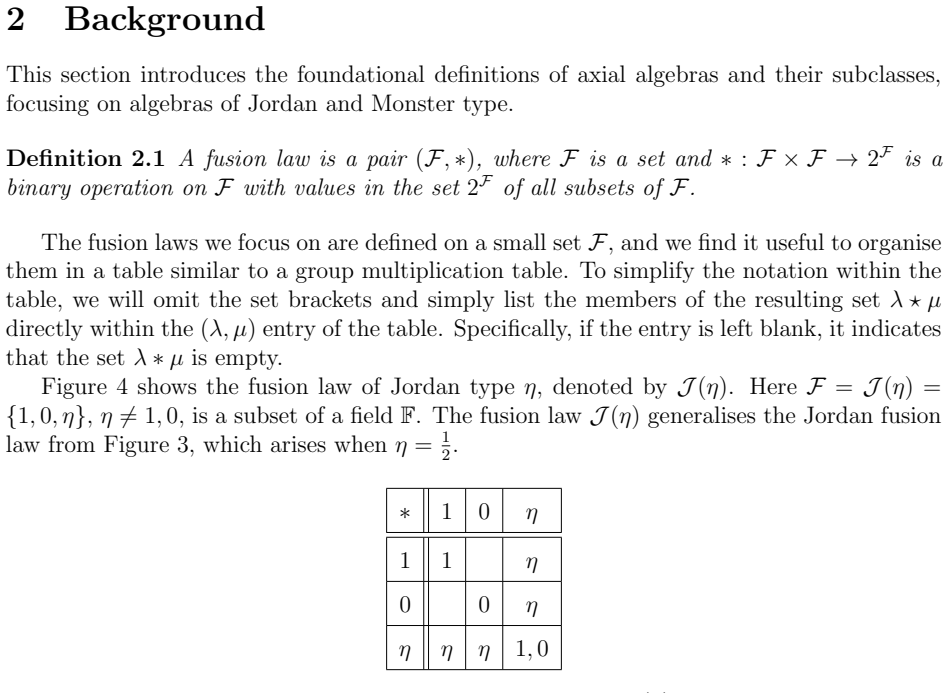
Axial algebra: non-associative algebra generated by idempotents (axes) whose adjoint action satisfies a fusion law, often yielding group automorphisms when the law is graded.
Load-bearing premise
The listed problems are genuinely open, significant to specialists, and accurately described relative to the prior survey.
What would settle it
A check showing that several listed problems have already been resolved in the literature would falsify the claim that the paper expands the set of open problems.
Editorial analysis
A structured set of objections, weighed in public.
Referee Report
Summary. The manuscript is a curated collection of open questions and conjectures in the theory of axial algebras. It complements the recent survey [ms] by expanding the list of interesting open problems suggested by specialists and providing further discussion of related concepts and available results. Axial algebras are defined as non-associative algebras generated by idempotents (axes) whose adjoint actions satisfy a fusion law; when graded, these induce automorphisms linking the algebras to groups.
Significance. This work provides a service to the axial algebra community by systematically expanding the catalog of open problems. If the listed items are accurately described as open and of interest to specialists, the manuscript can help direct future research in non-associative algebras and their connections to finite groups. No new theorems, proofs, or computational results are claimed, so the contribution rests on the utility of the curated list rather than on technical derivations.
minor comments (1)
- The abstract and introduction reference the survey as [ms] without a full bibliographic entry visible in the provided text; ensure the reference list includes the complete citation for [ms] to allow readers to locate the prior survey.
Simulated Author's Rebuttal
We thank the referee for their positive evaluation of the manuscript and for recommending acceptance. The report accurately captures the purpose of the work as a curated expansion of open questions to complement the recent survey.
Circularity Check
No circularity; paper is a curated list of open questions with no derivations
full rationale
The manuscript contains no theorems, proofs, equations, predictions, or fitted parameters. Its sole purpose is to expand a list of open problems complementing the cited survey [ms]. All references to prior work serve only to frame questions and are not load-bearing for any internal claim. No self-citation reduces a result to an unverified input, and the paper is self-contained as a non-technical survey of open items.
Axiom & Free-Parameter Ledger
Cite this review
Pith. "Pith review of Axial Algebras: Questions and Conjectures." pith.science (2026). https://pith.science/paper/7LQGKDXN
@misc{pith2026260630048,
  author       = {Pith},
  title        = {Pith review of: Axial Algebras: Questions and Conjectures},
  year         = {2026},
  howpublished = {\url{https://pith.science/paper/7LQGKDXN}},
  note         = {Machine review of arXiv:2606.30048}
}
read the original abstract
Axial algebras are non-associative algebras generated by idempotents, called axes, whose adjoint action satisfies a fusion law. When this fusion law is graded, axes naturally lead to automorphisms of the algebra, and so such axial algebras are inextricably linked with groups. This article is meant to complement the recent survey \cite{ms} by significantly expanding the list of interesting open problems suggested by the specialists in the field, and providing a further discussion of the related concepts and available results.
Figures




Forward citations
Cited by 1 Pith paper
-
Fusion rules from the Norton inequality
Norton inequality forces A0(e) and A1(e) to be subalgebras and A0(e)A1(e)subseteq A1/2(e) for non-degenerate Frobenius forms; a degenerate counter-example is given.
Reference graph
Works this paper leans on
-
[1]
Alharbi, Automorphism groups of Matsuo algebras , Ph.D
F. Alharbi, Automorphism groups of Matsuo algebras , Ph.D. thesis, University of Birmingham (2024)
2024
-
[2]
Alsaeedi, V
M. Alsaeedi, V. Bovdi, S. Shpectorov, Flip subalgebras in Matsuo algebras for extended symmetric groups , in preparation
-
[3]
Afanasev, On axial algebras with 3 eigenvalues , arXiv:2410.02034
V. Afanasev, On axial algebras with 3 eigenvalues , arXiv:2410.02034
-
[4]
Bergman, A note on growth functions of algebras and semigroups , mimeographed notes, University of California, Berkeley (1978)
G.M. Bergman, A note on growth functions of algebras and semigroups , mimeographed notes, University of California, Berkeley (1978)
1978
-
[5]
Bildanov, I
R. Bildanov, I. Gorshkov, On 3-generated axial algebras of Jordan type 1 2 , Commun. Math. 33 :3 (2025), Paper No. 4, 12 p
2025
-
[6]
Buekenhout, La géometrie des groupes de Fischer , preprint, Univ
F. Buekenhout, La géometrie des groupes de Fischer , preprint, Univ. Libre de Bruxelles
-
[7]
Cantarini, V
N. Cantarini, V. Kac, Classification of linearly compact simple rigid superalgebras , Int. Math. Res. Not. IMRN, 17 (2010), 3341--3393
2010
-
[8]
Cuypers, Graphs, axial algebras and their automorphism groups , arXiv:2603.03822
H. Cuypers, Graphs, axial algebras and their automorphism groups , arXiv:2603.03822
-
[9]
Cuypers, J.I
H. Cuypers, J.I. Hall, The 3-transposition groups with trivial center , J. Algebra 178 (1995), 149--193
1995
-
[10]
Centrone, Private communication
L. Centrone, Private communication
-
[11]
Chayet, S
M. Chayet, S. Garibaldi. A class of continuous non-associative algebras arising from algebraic groups including E_8 , Forum Math. Sigma 9 (2021)
2021
-
[12]
Conway, A simple construction for the Fischer-Griess monster group , Invent
J.H. Conway, A simple construction for the Fischer-Griess monster group , Invent. Math., 79 (1985), 513--540
1985
-
[13]
De Medts, F
T. De Medts, F. Rehren, Jordan algebras and 3 -transposition groups , J. Algebra 478 , (2017) 318--340
2017
-
[14]
De Medts, L
T. De Medts, L. Rowen, Y. Segev, Primitive 4 -generated axial algebras of Jordan type , Proc. Am. Math. Soc. 152 :2 (2024), 537--551
2024
-
[15]
De Medts, M
T. De Medts, M. Van Couwenberghe, Modules over axial algebras , Algebr. Represent. Theory 23 :1 (2020), 209--227
2020
-
[16]
Desmet, Non-associative aspects of algebraic groups , PhD thesis, University of Ghent, 2025
J. Desmet, Non-associative aspects of algebraic groups , PhD thesis, University of Ghent, 2025
2025
-
[17]
Desmet, Solid lines in axial algebras of Jordan-type 1 2 and Jordan algebras , Proc
J. Desmet, Solid lines in axial algebras of Jordan-type 1 2 and Jordan algebras , Proc. Am. Math. Soc. 153 :4 (2025), 1461--1479
2025
-
[18]
Desmet, Automorphism groups of Matsuo algebras , arXiv:2511.10084
J. Desmet, Automorphism groups of Matsuo algebras , arXiv:2511.10084
-
[19]
Desmet, In preparation
J. Desmet, In preparation
-
[20]
Desmet, S
J. Desmet, S. Shpectorov, Components in algebras of Jordan type half , in preparation
-
[21]
Etherington, Genetic algebras , Proc
I.M.H. Etherington, Genetic algebras , Proc. Roy. Soc. Edinburgh, 59 (1939), 242--258
1939
-
[22]
Fischer, Distributive Quasigruppen endlicher Ordnung , Mathematische Zeitschrift, 83 :4 (1964), 267--303
B. Fischer, Distributive Quasigruppen endlicher Ordnung , Mathematische Zeitschrift, 83 :4 (1964), 267--303
1964
-
[23]
Fischer, Finite groups generated by 3-transpositions , I
B. Fischer, Finite groups generated by 3-transpositions , I. Invent. Math. 13 (1971), 232-246
1971
-
[24]
Franchi, A
C. Franchi, A. Ivanov, M. Mainardis, Saturated Majorana representations of A_ 12 , Trans. Am. Math. Soc, 375 :8 (2022), 5753--5801
2022
-
[25]
Franchi, A
C. Franchi, A. Ivanov, M. Mainardis, Standard Majorana representations of the symmetric groups , J. Algebr. Comb. 44 :2 (2016), 265--292
2016
-
[26]
Franchi, M
C. Franchi, M. Mainardis, On subalgebras of the Griess algebra with alternating Miyamoto group , J. Algebra, 691 (2026), 811--854
2026
-
[27]
Franchi, M
C. Franchi, M. Mainardis, Classifying 2-generated symmetric axial algebras of Monster type , J. Algebra, 596 (2022), 200--218
2022
-
[28]
Franchi, M
C. Franchi, M. Mainardis, J. McInroy, Quotients of the Highwater algebra and its cover , J. Algebra 640 (2024), 432 -- 476
2024
-
[29]
The Classification of the 2-generated Primitive Axial Algebras of Monster Type
C. Franchi, M. Mainardis, J. McInroy, M. Turner, The Classification of the 2-generated Primitive Axial Algebras of Monster Type , arXiv:2605.18737
work page internal anchor Pith review Pith/arXiv arXiv
-
[30]
Franchi, M
C. Franchi, M. Mainardis, S. Shpectorov, An infinite-dimensional 2-generated primitive axial algebra of monster type , Ann. Mat. Pura Appl. 201 :4 (2022), 1279--1293
2022
-
[31]
Franchi, M
C. Franchi, M. Mainardis, S. Shpectorov, 2-generated axial algebras of Monster type (2 , ) , J. Algebra 636 (2023), 123--170
2023
-
[32]
Franchi, M
C. Franchi, M. Mainardis, S. Shpectorov, 2-generated axial algebras of Monster type , J. Algebra 683 (2025), 60--115
2025
-
[33]
A. Galt, V. Joshi, A. Mamontov, S. Shpectorov, A. Staroletov, Double axes and subalgebras of monster type in Matsuo algebras , Commun. Algebra 49 :10 (2021), 4208--4248
2021
-
[34]
The GAP Group, GAP – Groups, Algorithms, and Programming, Version 4.12.2; 2022, https://www.gap-system.org
2022
-
[35]
Guterman, D.K
A.E. Guterman, D.K. Kudryavtsev, Upper bounds for the length of non-associative algebras , J. Algebra 544 (2020), 483--497
2020
-
[36]
Griess Jr., The friendly giant , Ivent
R.L. Griess Jr., The friendly giant , Ivent. Math. 69 (1982), 1--102
1982
-
[37]
Gorshkov, A
I. Gorshkov, A. Mamontov, A. Staroletov, On Jordan algebras that are factors of Matsuo algebras , Int. Electron. J. Algebra 37 (2025), 70--90
2025
-
[38]
Gorshkov, J
I. Gorshkov, J. McInroy, T.M. Mudziiri Shumba, S. Shpectorov, Automorphism groups of axial algebras , J. Algebra 661 (2025), 657--712
2025
-
[39]
I. Gorshkov, S. Shpectorov, A. Staroletov, Solid subalgebras in algebras of Jordan type half , arXiv:2401.16218
-
[40]
Gorshkov, A
I. Gorshkov, A. Staroletov, On primitive 3-generated axial algebras of Jordan type , J. Algebra 563 (2020), 74--99
2020
-
[41]
J.I. Hall, F. Rehren, S. Shpectorov, Universal Axial Algebras and a Theorem of Sakuma , J. Algebra 421 (2015), 394--424
2015
-
[42]
J.I. Hall, F. Rehren, S. Shpectorov, Primitive axial algebras of Jordan type , J. Algebra 437 (2015), 379-–115
2015
-
[43]
J.I. Hall, Y. Segev, S. Shpectorov, Miyamoto involutions in axial algebras of Jordan type half , Israel J. Math. 223 (2018), 261--308
2018
-
[44]
J.I. Hall, Y. Segev, and S. Shpectorov, On primitive axial algebras of Jordan type , Bull. Inst. Math. Acad. Sin. (N.S.) 13 :4 (2018), 397--409
2018
-
[45]
Ivanov, The Monster Group and Majorana Involutions , Cambridge Tracts in Mathematics 176, Cambridge University Press, 2009
A.A. Ivanov, The Monster Group and Majorana Involutions , Cambridge Tracts in Mathematics 176, Cambridge University Press, 2009
2009
-
[46]
Ivanov, D.V
A.A. Ivanov, D.V. Pasechnik, A. Seress, S. Shpectorov, Majorana representations of the symmetric group of degree 4 , J. Algebra 324 :9 (2010) 2432--2463
2010
-
[47]
Joshi, Axial algebras of Monster type (2 , ) , Ph.D
V. Joshi, Axial algebras of Monster type (2 , ) , Ph.D. thesis, University of Birmingham (2020)
2020
-
[48]
Kantor, Certain generalizations of Jordan algebras (Russian) , Trudy Sem
I. Kantor, Certain generalizations of Jordan algebras (Russian) , Trudy Sem. Vektor. Tenzor. Anal., 16 (1972), 407--499
1972
-
[49]
Kantor, Some problems in L-functor theory , Trudy Inst
I. Kantor, Some problems in L-functor theory , Trudy Inst. Mat. (Novosibirsk), 16 (1989), Issled. po Teor. Kolets i Algebr, 54--75, 198
1989
-
[50]
Kaygorodov, C
I. Kaygorodov, C. Martín González, P. Páez-Guillán, Central extensions of axial algebras , J. Algebra 662 (2025), 797--831
2025
-
[51]
Khasraw, J
S.M.S. Khasraw, J. McInroy, S. Shpectorov, On the structure of axial algebras , Trans. Amer. Math. Soc. 373 :3 (2020), 2135--2156
2020
-
[52]
Krause, T.H
G. Krause, T.H. Lenagan, Growth of Algebras and Gelfand-Kirillov Dimension , Research Notes in Math. 116 (1985)
1985
-
[53]
Computer algebra system (CAS)
MAGMA. Computer algebra system (CAS). http://magma.maths.usyd.edu.au/magma/
-
[54]
A. Mamontov, S. Shpectorov, V. Zhelyabin, Radicals in primitive axial algebras , arXiv:2602.11984
-
[55]
Mamontov, A
A. Mamontov, A. Staroletov, Axial algebras of Monster type (2 , ) for D diagrams , Commun. Algebra 53 :8 (2025), 3218--3252
2025
-
[56]
Martinez, E
C. Martinez, E. Zelmanov, Jordan algebras of Gelfand-Kirillov dimension one , J. Algebra 180 :1 (1996), 211--238
1996
-
[57]
McInroy, S
J. McInroy, S. Shpectorov, An expansion algorithm for constructing axial algebras , J. Algebra, 550 (2020), 379--409
2020
-
[58]
McInroy, S
J. McInroy, S. Shpectorov, Axial algebras of Jordan and Monster type , London Math. Soc. Lecture Note Ser., 496 , Cambridge University Press, Cambridge (2025), 246--294
2025
-
[59]
Miyamoto, Griess algebras and conformal vectors in vertex operator algebras , J
M. Miyamoto, Griess algebras and conformal vectors in vertex operator algebras , J. Algebra 179 :2 (1996), 523--548
1996
-
[60]
Miyamoto, Vertex operator algebras generated by two conformal vectors whose -involutions generate S_3 , J
M. Miyamoto, Vertex operator algebras generated by two conformal vectors whose -involutions generate S_3 , J. Algebra 268 :2 (2003), 653--671
2003
-
[61]
Osborn, Identities of non-associative algebras , Canad
J.M. Osborn, Identities of non-associative algebras , Canad. J. Math. 19 :21 (1965), 78--92
1965
-
[62]
Parker, M
C. Parker, M. Turner, Almost simple and quasisimple groups of 6 -transpositions , in preparation
-
[63]
Peirce, Linear Associative Algebra , American Journal of Mathematics, 4 :1 (1881), 97--229
B. Peirce, Linear Associative Algebra , American Journal of Mathematics, 4 :1 (1881), 97--229
-
[64]
Rehren, Axial algebras ,Ph.D
F.G. Rehren, Axial algebras ,Ph.D. thesis, University of Birmingham, 2015
2015
-
[65]
Rehren, Generalised dihedral subalgebras from the Monster , Trans
F. Rehren, Generalised dihedral subalgebras from the Monster , Trans. Am. Math. Soc., 369 :10 (2017), 6953--6986
2017
-
[66]
Rowen, AXIAL IDENTITIES, arXiv:2508.16427
L. Rowen, AXIAL IDENTITIES, arXiv:2508.16427
-
[67]
Sakuma, 6-transposition property of -involutions of vertex operator algebras , Int
S. Sakuma, 6-transposition property of -involutions of vertex operator algebras , Int. Math. Res. Not. IMRN 9 (2007), 19 p
2007
-
[68]
R. D. Schafer, Inner derivations of non-associative algebras , Bull. Am. Math. Soc. 55 (1949), 769--776
1949
-
[69]
Segev, Half-axes in power associative algebras , J
Y. Segev, Half-axes in power associative algebras , J. Algebra 510 (2018), 1--23
2018
-
[70]
Shpectorov, B
S. Shpectorov, B. Welch, Classification of primitive 2 -generated axial algebras of type ( , ) , in preparation
-
[71]
Shi, Baric Axial Algebras of Jordan Type , Ph.D
Y. Shi, Baric Axial Algebras of Jordan Type , Ph.D. thesis, University of Birmingham, 2025
2025
-
[72]
Tkachev, The universality of one half in commutative nonassociative algebras with identities , J
V.G. Tkachev, The universality of one half in commutative nonassociative algebras with identities , J. Algebra 569 (2021), 466--510
2021
-
[73]
Turner, Skew axial algebras of Monster type , J
M. Turner, Skew axial algebras of Monster type , J. Algebra 652 (2024), 67--93
2024
-
[74]
Turner, Skew axial algebras of Monster type II , arXiv:2311.00520
M. Turner, Skew axial algebras of Monster type II , arXiv:2311.00520
-
[75]
Yabe, On the classification of 2 -generated axial algebras of Majorana type , J
T. Yabe, On the classification of 2 -generated axial algebras of Majorana type , J. Algebra, 619 (2023), 347--382
2023
-
[76]
Whybrow, Graded 2-generated axial algebras , arXiv:2005.03577
M. Whybrow, Graded 2-generated axial algebras , arXiv:2005.03577
discussion (0)
Sign in with ORCID, Apple, or X to comment. Anyone can read and Pith papers without signing in.