fitPALSpectra: Python fitting of positron annihilation lifetime spectra
Pith reviewed 2026-06-27 07:35 UTC · model grok-4.3
The pith
fitPALSpectra recovers ground-truth lifetimes, intensities, and resolution parameters from synthetic PALS spectra.
A machine-rendered reading of the paper's core claim, the machinery that carries it, and where it could break.
Core claim
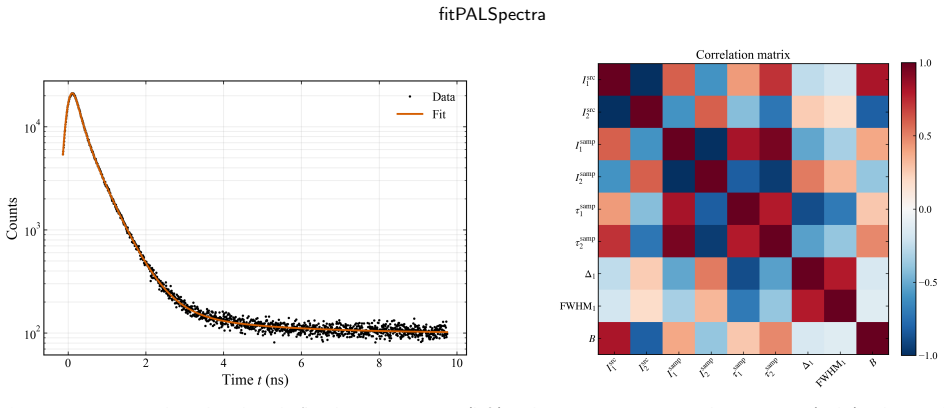
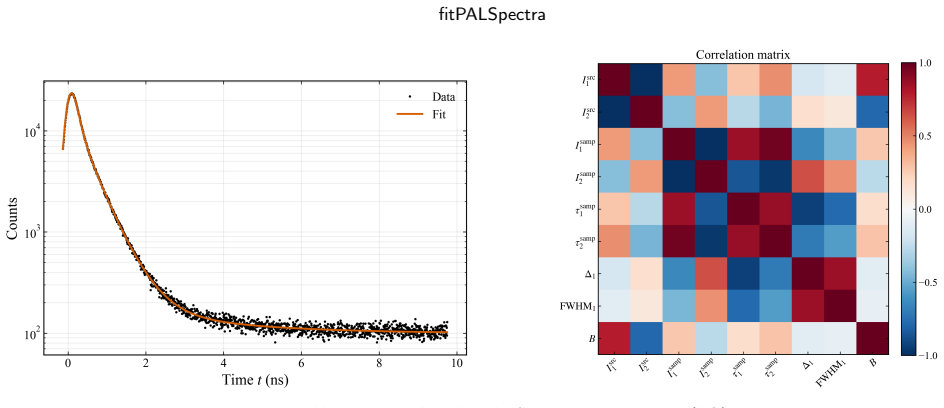
fitPALSpectra implements configurable PALS spectrum simulation, fitting, visualization, and reporting using an analytically integrated exponential-Gaussian response model, source and sample components, constrained optimization, optional least-squares refinement, and machine-readable output of fit results, correlation matrices, and fitted curves. Validation on fully synthetic spectra with known ground-truth parameters shows accurate recovery of the simulated lifetimes, intensities, detector full width at half maximum, prompt shift, and background.
What carries the argument
The analytically integrated exponential-Gaussian response model that convolves multi-exponential lifetime components with the detector resolution function.
If this is right
- The tool produces machine-readable correlation matrices and fitted curves that support downstream uncertainty analysis.
- Configurable source corrections allow users to adjust for known experimental artifacts before fitting.
- Constrained optimization reduces dependence on initial parameter guesses compared with unconstrained methods.
- Accurate recovery on synthetic data establishes a baseline for applying the same pipeline to measured spectra.
Where Pith is reading between the lines
- Users could extend the workflow to batch-process multiple spectra from the same experiment by reusing the same model settings.
- The open-source structure permits direct comparison of results against other PALS fitting codes on identical synthetic test cases.
- Adding support for user-defined resolution functions beyond the Gaussian would test the model's limits on real detector data.
Load-bearing premise
The chosen exponential-Gaussian convolution plus source and background corrections are enough to represent the spectra without extra unmodeled effects.
What would settle it
Create new synthetic spectra that include a non-Gaussian resolution tail or time-dependent background and test whether the fitted lifetimes and intensities still match the known inputs to within the reported precision.
Figures
read the original abstract
Positron annihilation lifetime spectroscopy (PALS) spectra are commonly analyzed by fitting multi-exponential lifetime models convoluted with the detector resolution function. In practice, this inverse problem is sensitive to initial parameter choices, parameter bounds, source corrections, and correlations between lifetime and intensity parameters. This paper presents fitPALSpectra, an open-source Python workflow for configurable PALS spectrum simulation, fitting, visualization, and reporting. The implementation uses an analytically integrated exponential--Gaussian response model, configurable source and sample components, constrained optimization, optional least-squares refinement, and machine-readable output of fit results, correlation matrices, and fitted curves. Validation on fully synthetic spectra with known ground-truth parameters shows accurate recovery of the simulated lifetimes, intensities, detector full width at half maximum, prompt shift, and background.
Editorial analysis
A structured set of objections, weighed in public.
Referee Report
Summary. The manuscript introduces fitPALSpectra, an open-source Python workflow for configurable simulation, fitting, visualization, and reporting of positron annihilation lifetime spectra. It implements an analytically integrated exponential-Gaussian response model together with source and background corrections, constrained optimization, and optional least-squares refinement. The central result is that the fitting routine accurately recovers the ground-truth lifetimes, intensities, detector FWHM, prompt shift, and background when applied to fully synthetic spectra generated from the identical forward model.
Significance. If the chosen forward model is adequate for experimental spectra, the package supplies a transparent, reproducible, and machine-readable alternative to existing PALS analysis tools. The explicit provision of synthetic-data generation and correlation-matrix output is a concrete strength that supports both methodological verification and educational use.
minor comments (2)
- [Abstract] Abstract: the phrase 'fully synthetic spectra' could be expanded to note that the test cases contain no added noise and are generated from the exact model used in the fit, thereby clarifying the scope of the validation.
- The manuscript would benefit from a short discussion (even if only one paragraph) of how the analytic integration is performed and any numerical safeguards employed when the lifetime components approach the resolution width.
Simulated Author's Rebuttal
We thank the referee for the careful reading of the manuscript, the positive summary of its contributions, and the recommendation to accept. No major comments were raised, so we have no points requiring response or revision.
Circularity Check
No significant circularity detected
full rationale
The paper describes an open-source fitting workflow for PALS spectra that employs an analytically integrated exponential-Gaussian model together with configurable corrections. Its central validation step generates fully synthetic spectra from the identical forward model using independently chosen ground-truth parameters and then recovers those parameters via the fitter. This is standard numerical verification of implementation correctness against known inputs and does not constitute a self-definitional loop, a fitted quantity renamed as a prediction, or any load-bearing self-citation chain. No equations or claims in the manuscript reduce the reported recovery to the fit by construction; the ground-truth values remain external to the optimization routine.
Axiom & Free-Parameter Ledger
axioms (1)
- domain assumption The exponential-Gaussian convolution accurately represents the detector response in PALS measurements.
Reference graph
Works this paper leans on
-
[1]
Dupasquier and P
A. Dupasquier and P. Hautojärvi (Eds.),Positrons in Solids, Springer- Verlag, Berlin, 1979
1979
-
[2]
Positron Annihilation Spectroscopy,
R. W. Siegel, “Positron Annihilation Spectroscopy,”Annual Review of Materials Science10(1), 393–425 (1980). doi:10.1146/annurev.ms.10.080180.002141
-
[3]
Y.C.Jean,“Positronannihilationspectroscopyforchemicalanalysis:A novel probe for microstructural analysis of polymers,”Microchemical Journal42, 72–102 (1990). doi:10.1016/0026-265x(90)90027-3
-
[4]
Positron annihilation as a method to characterize porous materials,
D. W. Gidley, H.-G. Peng, and R. S. Vallery, “Positron annihilation as a method to characterize porous materials,” Annual Review of Materials Research36, 49–79 (2006). doi:10.1146/annurev.matsci.36.111904.135144
-
[5]
Defectidentificationinsemiconductors withpositronannihilation:Experimentandtheory,
F.TuomistoandI.Makkonen,“Defectidentificationinsemiconductors withpositronannihilation:Experimentandtheory,”Reviews of Modern Physics85(4), 1583–1631 (2013). doi:10.1103/RevModPhys.85.1583
-
[6]
Neutron irradiatedtungstenbulkdefectcharacterizationbypositronannihilation spectroscopy,
C.N.Taylor,M.Shimada,J.M.Watkins,X.Hu,andY.Oya,“Neutron irradiatedtungstenbulkdefectcharacterizationbypositronannihilation spectroscopy,”Nuclear Materials and Energy26, 100936 (2021). doi:10.1016/j.nme.2021.100936
-
[7]
V. Chatzikos, K. Mergia, G. Bonny, D. Terentyev, D. Papadakis, G. E. Pavlou, and S. Messoloras, “Positron annihilation spectroscopy investigation of defects in neutron irradiated tungsten materials,” International Journal of Refractory Metals and Hard Materials105, 105838 (2022). doi:10.1016/j.ijrmhm.2022.105838
-
[8]
Postneutronirradiationannealinganddefectevolution in single crystal tungsten,
D. Papadakis, K. Mergia, E. Manios, V. Chatzikos, S. Dellis, and S.Messoloras,“Postneutronirradiationannealinganddefectevolution in single crystal tungsten,”Nuclear Materials and Energy34, 101357 (2023). doi:10.1016/j.nme.2022.101357
-
[9]
R. B. Gregory and Y. Zhu, “Analysis of positron annihilation lifetime data by numerical Laplace inversion with the program CONTIN,” Nuclear Instruments and Methods in Physics Research Section A 290(1), 172–182 (1990). doi:10.1016/0168-9002(90)90358-D
-
[10]
R. B. Gregory, “Free-volume and pore size distributions deter- mined by numerical Laplace inversion of positron annihilation life- time data,”Journal of Applied Physics70(9), 4665–4670 (1991). doi:10.1063/1.349057
-
[11]
Analysis of positron lifetime spectra using quantified maximum entropy and a general linear filter,
A. Shukla, M. Peter, and L. Hoffmann, “Analysis of positron lifetime spectra using quantified maximum entropy and a general linear filter,” Nuclear Instruments and Methods in Physics Research Section A335(1– 2), 310–317 (1993). doi:10.1016/0168-9002(93)90286-Q
-
[12]
POSITRONFIT: A versatile program for analysing positron lifetime spectra,
P. Kirkegaard and M. Eldrup, “POSITRONFIT: A versatile program for analysing positron lifetime spectra,”Computer Physics Communi- cations3(3), 240–255 (1972). doi:10.1016/0010-4655(72)90070-7
-
[13]
J. Kansy, “Microcomputer program for analysis of positron an- nihilation lifetime spectra,”Nuclear Instruments and Methods in Physics Research Section A374(2),235–244(1996).doi:10.1016/0168- 9002(96)00075-7
-
[14]
J. Dryzek and J. Kansy, “Comparison of three programs: Positronfit, ResolutionandLTusedfordeconvolutionofpositronlifetimespectra,” Nuclear Instruments and Methods in Physics Research Section A 380(3), 576–581 (1996). doi:10.1016/0168-9002(96)00586-4
-
[15]
A New Version of LT Program for Positron Lifetime Spectra Analysis,
D. Giebel and J. Kansy, “A New Version of LT Program for Positron Lifetime Spectra Analysis,”Materials Science Forum666, 138–141 (2010). doi:10.4028/www.scientific.net/msf.666.138
-
[16]
LT10 Program for Solving Basic Problems Connected with Defect Detection,
D. Giebel and J. Kansy, “LT10 Program for Solving Basic Problems Connected with Defect Detection,”Physics Procedia35, 122–127 (2012). doi:10.1016/j.phpro.2012.06.022
-
[17]
LT10 software homepage, accessed June 2026
2026
-
[18]
PALSfit: A new program for the evaluation of positron life- time spectra,
J. V. Olsen, P. Kirkegaard, N. J. Pedersen, and M. Eldrup, “PALSfit: A new program for the evaluation of positron life- time spectra,”physica status solidi (c)4(10), 4004–4006 (2007). doi:10.1002/pssc.200675868. Page 5 of 6 fitPALSpectra
-
[19]
Analysisofpositronlifetime spectra using the PALSfit3 program,
J.V.Olsen,P.Kirkegaard,andM.Eldrup,“Analysisofpositronlifetime spectra using the PALSfit3 program,” inInternational Conference on Science and Applied Science (ICSAS) 2019, AIP Conference Proceedings2202, 040005 (2019). doi:10.1063/1.5135837
-
[20]
PALSfit3 software homepage, accessed June 2026
2026
-
[21]
Official PALSfit3 report, accessed June 2026
2026
-
[22]
Advanced fitting algorithms for analysing positron annihilation lifetime spectra,
C. Pascual-Izarra, A. W. Dong, S. J. Pas, A. J. Hill, B. J. Boyd, and C. J. Drummond, “Advanced fitting algorithms for analysing positron annihilation lifetime spectra,”Nuclear Instruments and Methods in Physics Research Section A603(3), 456–466 (2009). doi:10.1016/j.nima.2009.01.205
-
[23]
PAScual software project, accessed June 2026
2026
-
[24]
G. E. Pavlou, fitPALSpectra software repository,https://github.com/ gepavlou/fitPALSpectra, accessed June 2026
2026
-
[25]
Generalized Simulated Annealing for Global Optimization: The GenSA Package,
Y. Xiang, S. Gubian, B. Suomela, and J. Hoeng, “Generalized Simulated Annealing for Global Optimization: The GenSA Package,” The R Journal5(1), 13–28 (2013). doi:10.32614/RJ-2013-002
-
[26]
E. G. Birgin and J. M. Martínez,Practical Augmented La- grangian Methods for Constrained Optimization, Society for In- dustrial and Applied Mathematics (SIAM), Philadelphia, PA, 2014. doi:10.1137/1.9781611973365
-
[27]
G. E. Pavlou, V. Pavlidou, and V. Harmandaris, Reconstructing the Magnetic Field in an Arbitrary Domain via Data-Driven Bayesian Methods and Numerical Simulations,Computation13, 37 (2025). 10.3390/computation13020037
-
[28]
A. Yabuuchi, “Inverse change in positron lifetimes of vacancies in tungsten by binding of interstitial impurity atoms to a vacancy: A first-principles study,”Nucl. Mater. Energy34, 101364 (2023). doi:10.1016/j.nme.2023.101364 Page 6 of 6
discussion (0)
Sign in with ORCID, Apple, or X to comment. Anyone can read and Pith papers without signing in.