REVIEW 4 major objections 5 minor 44 references
Phase-Apodized-Pupil Lyot Coronagraphs for Arbitrary Telescope Pupils
T0 review · 4 major / 5 minor · reviewed 2026-08-14 · deepseek-v4-flash
Pith's one-line read Phase-only aperture apodization plus a Lyot stage—the PAPLC—reaches inner working angles of 1.4λ/D at 10⁻¹⁰ contrast with >75% throughput, including on realistic segmented and obstructed telescope pupils up to 30% central obscuration.
desk verdict A promising coronagraph design method with an honest parameter study, but the headline broadband performance rests on a suspect achromatization argument and an unproven phase-only relaxation. read the letter →
The pith
A machine-rendered reading of the paper's core claim, the machinery that carries it, and where it could break.
The reading
What carries the argument
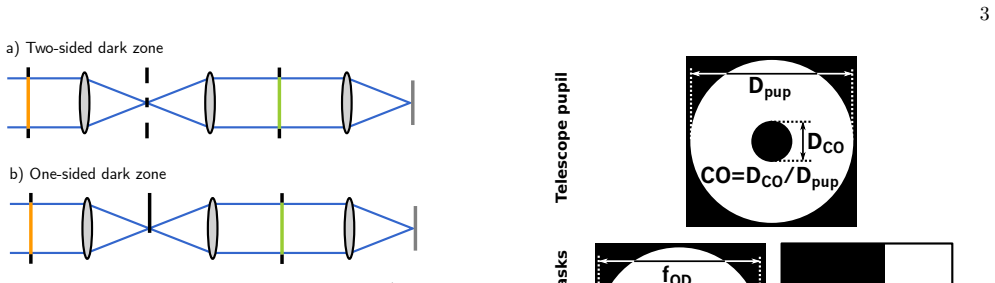
The load-bearing device is the convex optimization of the complex transmission of the pre-apodizer. The apodizer is written as $A(x)(X(x)+iY(x))$, the phase-only constraint is relaxed to $|X(x)+iY(x)|\le 1$, and the objective is the real part of the on-axis non-coronagraphic field, which removes the piston degeneracy while keeping the problem convex. Because the electric field in the post-coronagraphic focal plane is a linear map of the apodizer transmission (Fourier propagation through the pupil, knife-edge mask, and Lyot stop), the stellar-leakage contrast constraints become convex inequalities; a linearized tip-tilt constraint prevents the optimizer from sneaking a centroid shift into the phase solution. The same machinery yields the point-symmetric designs as a real-valued special case. For one-sided dark zones, a wavelength-dependent phase tilt added to the apodizer centers the growing PSF on the knife-edge over the band, giving theoretical achromatization.
What would settle it
Run the paper's relaxed convex optimization problem for the LUVOIR-A pupil and check whether the optimal complex transmission has any region with $|X+iY|<1$; if it does, the physical phase-only apodizer cannot match the optimized contrast. Independently, simulate the broadband LUVOIR-A knife-edge design at 2.2λ/D over a 10% band with the wavelength-dependent tilt applied and look for any dark-zone pixel above 10⁻¹⁰ raw contrast.
Extended reading notes
Core claim
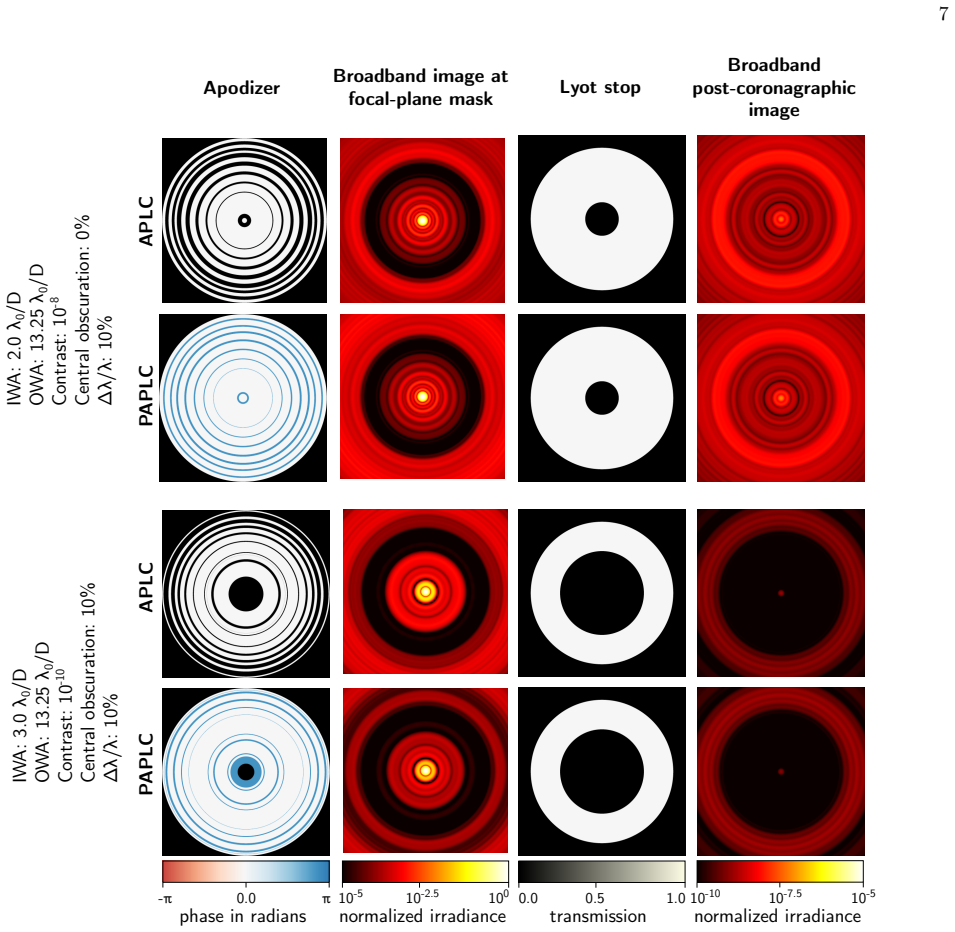
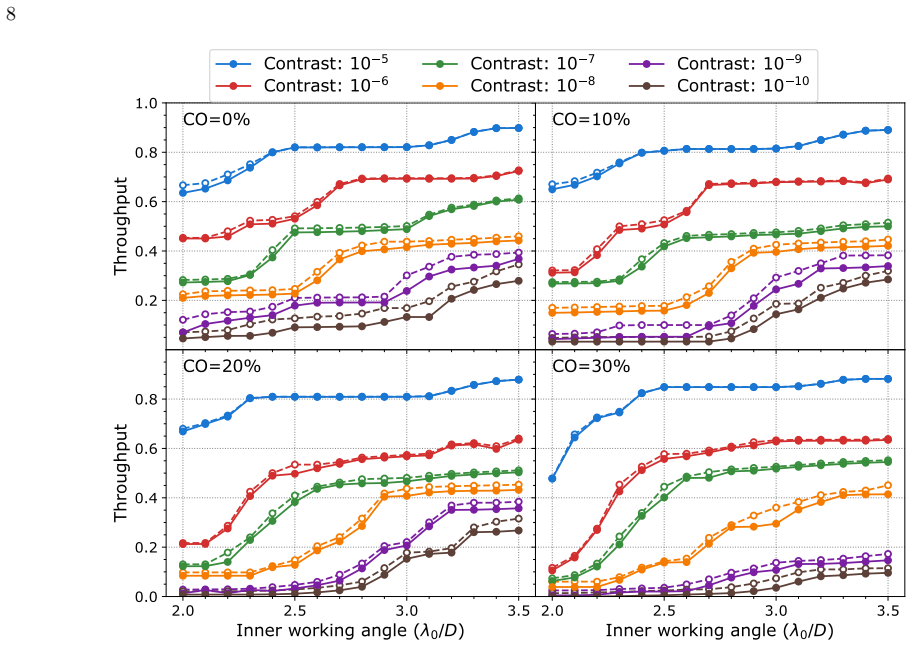
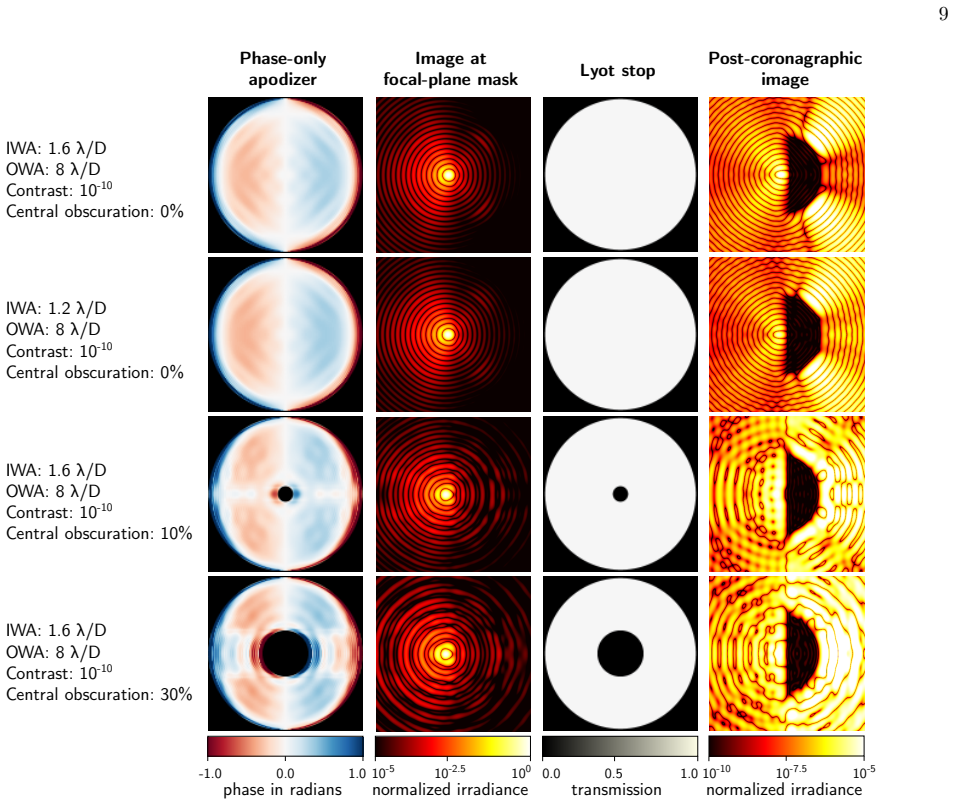
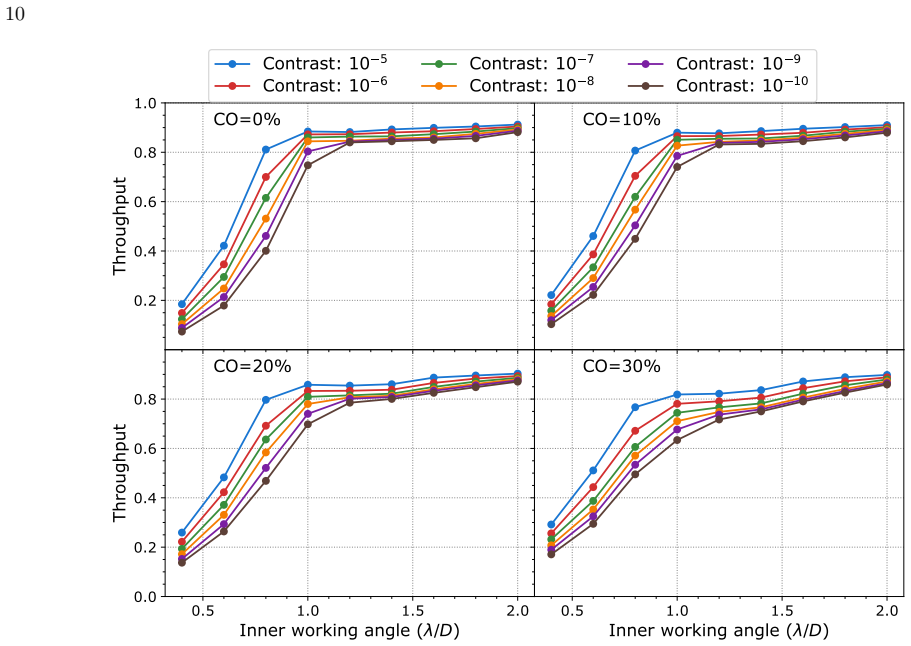
The central discovery is that the PAPLC design problem can be made convex by writing the apodizer as a complex transmission $X(x)+iY(x)$ with the phase-only constraint relaxed to $|X(x)+iY(x)|\le 1$, and that in practice the optimum is still phase-only. The post-coronagraphic electric field is a linear function of that transmission, so the $10^{-c}$ stellar-leakage constraints are convex, and the piston ambiguity is removed by maximizing the real part of the on-axis field. Since the APLC's solution space (real nonnegative apodizer) is a subset of this complex-amplitude space, the PAPLC is guaranteed to match or beat the APLC for the same masks, dark zone, and contrast. The one-sided PAPLC uses an offset knife-edge focal-plane mask; the apodizer creates the one-sided dark zone in the focal plane, and the Lyot stop deepens the contrast by several orders of magnitude, reaching 1.4λ/D at 10⁻¹⁰ contrast and up to about 80% throughput for central obscurations up to 30%. Point-symmetric annular-mask designs are found as a real-valued special case and show only marginal gains over the APLC.
Load-bearing premise
The relaxed optimization problem allows the apodizer amplitude to dip below unity, and the paper's results rely on the assertion—not a proof—that every optimal solution is still phase-only, plus the assumption that the monochromatic one-sided designs hold their 10⁻¹⁰ contrast after the proposed achromatization.
Editorial extensions
If this is right
- Because the PAPLC design space contains the APLC design space, any PAPLC design is guaranteed to match or beat the best APLC for the same pupil, focal-plane mask, Lyot stop, dark zone, and design contrast.
- For one-sided dark zones, the knife-edge PAPLC reaches 1.4λ/D inner working angle at 10⁻¹⁰ contrast with throughput above 75% on pupils with up to 30% central obscuration, a combination not available from the corresponding APLC at these parameters.
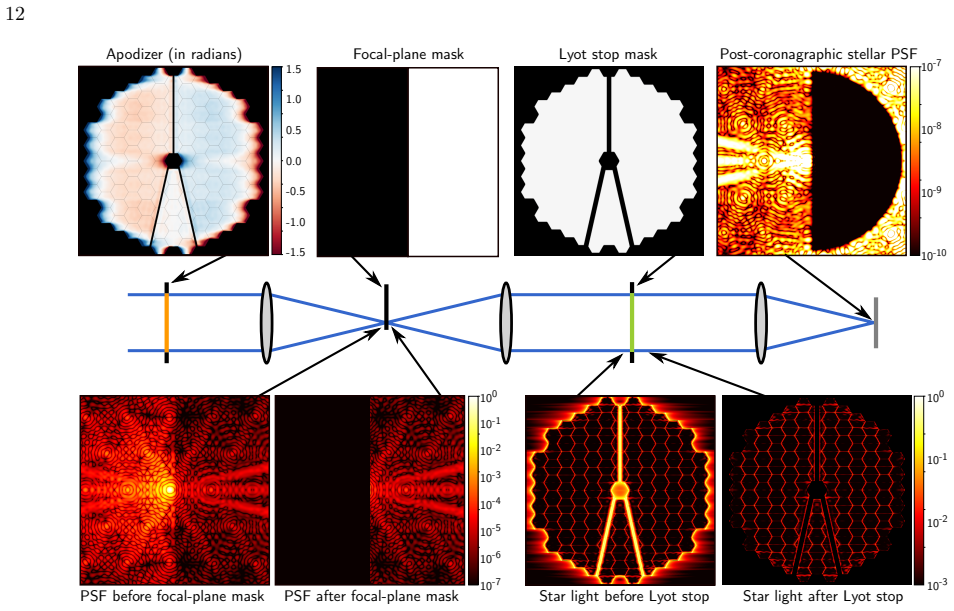
- The LUVOIR-A knife-edge PAPLC design (IWA 2.2λ/D, maximum throughput 78%) roughly triples the maximum throughput of the APLC comparison design on the same aperture, while cutting the inner working angle by 1.5λ/D.
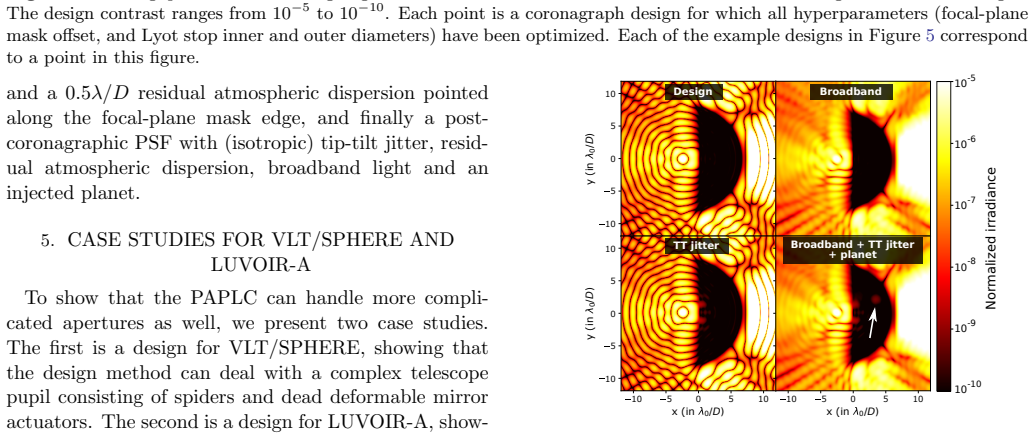
- Alignment of residual atmospheric dispersion along the knife edge makes the coronagraph effectively insensitive to that dispersion, relaxing the atmospheric dispersion corrector requirement to about 1λ/D instead of a few tenths or hundredths of λ/D.
- The design method is not restricted to circular or unobstructed pupils: the VLT/SPHERE and LUVOIR-A case studies show it handles struts, segments, dead deformable-mirror actuators, and non-circular outer edges.
Reading between the lines
- Inference (not in the paper): the one-sided dark zone covers about half the field of view, so survey-mode mapping of a full circumstellar disk would require observing at several roll angles, and the throughput penalty of that mode is not included in the headline >75% figure.
- Inference (not in the paper): the proposed achromatization assumes the wavelength-dependent tilt is implemented exactly; a laboratory test across a 10–20% band could confirm whether the 10⁻¹⁰ contrast floor survives real dispersion, and would be the natural next experiment.
- Inference (not in the paper): because the same convex machinery was used to harden APLCs against low-order aberrations, a similar inclusion of aberration modes should produce robust PAPLC designs; the paper explicitly leaves that to future work.
Signed reviews
Editorial analysis
A structured set of objections, weighed in public.
Referee Report
Summary. This paper introduces a convex optimization framework for designing phase-apodized-pupil Lyot coronagraphs (PAPLCs), in which a phase-only pre-apodizer is paired with a focal-plane mask and a Lyot stop. The method is applied to two configurations: annular focal-plane masks producing point-symmetric dark zones, and knife-edge masks producing one-sided dark zones. Parameter studies with simplified circular obstructed pupils show that point-symmetric PAPLCs perform comparably to APLCs, while one-sided designs achieve smaller inner working angles (down to 1.4 lambda/D) and higher throughput (up to about 75-80%) at design contrasts down to 10^-10, based on monochromatic optimizations. Case studies for VLT/SPHERE and LUVOIR-A demonstrate the approach on segmented, strutted, and non-circular pupils. Section 4.2 argues that the one-sided designs can be made achromatic by centering the knife-edge mask and adding a phase tilt, and Section 5.3 evaluates tip-tilt robustness. The paper also states that the relaxed optimization problem from phase-only to sub-unity complex amplitude in practice returns phase-only solutions, and that PAPLCs always perform as well as or better than APLCs.
Significance. If the headline performance holds under broadband illumination and with physically realizable phase-only apodizers, the knife-edge PAPLC would be an important new coronagraph option for high-contrast imaging on obscured and segmented apertures, offering substantially better throughput and smaller inner working angles than APLCs. The convex optimization methodology is clearly presented, builds on prior work by the same author, and the use of the open-source HCIPy package supports reproducibility. The point-symmetric PAPLC analysis and the VLT/SPHERE and LUVOIR-A case studies are valuable contributions. However, the central claims currently rest on two unverified assumptions: that the relaxed optimization solutions are exactly phase-only, and that the tilt-based achromatization actually delivers the advertised broadband contrast. These gaps make the significance contingent on additional verification.
major comments (4)
- [Section 2.2, Eqs. (10)-(11)] The relaxation from the phase-only constraint X^2+Y^2=1 to the inequality X^2+Y^2<=1 is asserted to produce phase-only solutions in practice, but no evidence is provided: there are no amplitude maps, histograms of |X+iY|, or statistics across the parameter studies. This is load-bearing because the physical coronagraph uses a phase-only apodizer; if any optimized solution has regions with |X+iY|<1, the phase-only projection is not guaranteed to meet the contrast and throughput claims. Moreover, the VLT/SPHERE design in Section 5.1 explicitly blocks light at dead deformable-mirror actuator locations 'at the apodizer,' which is an amplitude operation and directly contradicts the phase-only assertion. The authors should demonstrate that all final designs (including the VLT/SPHERE case) saturate the norm constraint, or they should treat amplitude as part of the physical model and re-derive the affected performance numbers.
- [Section 4.1 and Abstract] The headline values in the abstract - inner working angle as close as 1.4 lambda/D at contrasts of 10^-10 and maximum post-coronagraphic throughput of >75% - come from the parameter study in Section 4.1, which states explicitly that 'All masks were calculated for a single wavelength only: we presume monochromatic light.' The abstract and conclusions present these numbers without the monochromatic qualifier. Section 4.2's achromatization argument is qualitative and does not quantitatively account for the chromatic scaling of the phase plate's non-tilt phase components; no evaluation of Cdesign as defined in Eq. (3) over a finite band is presented for any one-sided design. The authors should either run a broadband end-to-end simulation of the 1.4 lambda/D design over the intended band (e.g., 10% or 20% bandwidth) and report the achieved Cdesign, or clearly state in the abstract that the demonstrated 10^-10 contrast is monochromatic and that broadband achromatization is a proposal that remains to be verified.
- [Section 2.2, paragraph after Eq. (11)] The statement that 'a PAPLC will always perform the same or better than an APLC for a given telescope pupil, dark zone geometry and design contrast' is not justified as a universal claim. The APLC solution space is indeed a subspace of the relaxed complex-amplitude problem, but the actual PAPLC apodizer is constrained to be phase-only. If the relaxed optimum has |X+iY|<1, the phase-only projection may have lower throughput or worse contrast. The empirical comparisons in Sections 3 and 4 are reasonable evidence for the specific cases studied, but the unconditional 'always' wording should be qualified by the tightness of the relaxation, or replaced by a statement about the specific designs presented.
- [Table 1 and Section 5.3] The comparison between PAPLC and APLC throughput in Table 1 is a central demonstration of the PAPLC's advantage, but the APLC designs are described only as a 'preliminary solution' for VLT/SPHERE and 'a part of a coronagraph design study' for LUVOIR-A, courtesy of other groups. These APLC designs may not have been optimized with the same hyperparameter search (focal-plane mask size, Lyot stop geometry) used for the PAPLCs. To make the factor-of-two-to-three throughput comparison fair, the authors should either optimize the APLC baselines with the same procedure described in Section 3, or provide the design parameters and optimization effort for both families so that the reader can judge the comparison.
minor comments (5)
- [Eq. (8)] In Eq. (8), 'X(x) + iY(y)' should presumably read 'X(x) + iY(x)'.
- [Section 2.2] The phrase 'the solutions space for APLCs' contains a typo; it should be 'the solution space for APLCs'.
- [Figure 6] In the rendered figure, the y-axis label 'Throughput' is missing from the CO=20% and CO=30% panels; please ensure all panels have axis labels.
- [Section 4.2] The sentence 'This makes the one-sided PAPLC completely achromatic in theory (barring experimental effects)' is too strong given that the chromaticity of the phase plate's non-tilt phase components is not analyzed. A more cautious wording such as 'approximately achromatic to first order, subject to verification' would better match the evidence presented.
- [Appendix A and Section 2.1] For reproducibility, the authors should report numerical details such as the pupil grid size, the number of optimization variables, and the solver settings (e.g., Gurobi version and optimality tolerances).
Circularity Check
No circularity: the PAPLC performance numbers are outputs of a constrained optimization, not fits or definitions in disguise.
full rationale
The paper's derivation chain is a design optimization, not a prediction from fitted inputs. In Eq. (11), the contrast requirement is imposed as a constraint (|E_coro|^2 < 10^{-c}|E_noncoro|^2) and the throughput and inner working angle are optimized outputs; reporting that the resulting design reaches the design contrast is a statement that the constraint is satisfied, not a prediction of an independently measured quantity. The 'PAPLC always performs at least as well as APLC' argument rests on solution-space inclusion: APLC amplitude masks are feasible for the complex-amplitude relaxed problem, and if the relaxed optimum is phase-only, it is feasible for the PAPLC. This is a valid mathematical argument conditional on the paper's explicit, unproved observation that 'in practice all solutions turn out to be phase only' (Section 2.2). That assertion is an evidence gap, not circularity. Similarly, the monochromatic limitation is admitted directly: 'All masks were calculated for a single wavelength only' (Section 4.1), and the broadband achromatization in Section 4.2 is presented as a theoretical construction rather than a hidden reuse of the result it claims to explain. The self-citation to Por (2017) supplies a convex-optimization method and the analogous APP/SPC comparison, but the central PAPLC derivation and parameter studies are performed in this paper with explicit equations and quoted hyperparameters. The honesty of the paper's own caveats (phase-only not guaranteed, no robustness to Lyot-stop misalignment, monochromatic parameter study) further confirms that the weak points are unverified assumptions rather than definitional circularity. No load-bearing step reduces to its own input, so the appropriate finding is no significant circularity.
Assumptions & free parameters
free parameters (5)
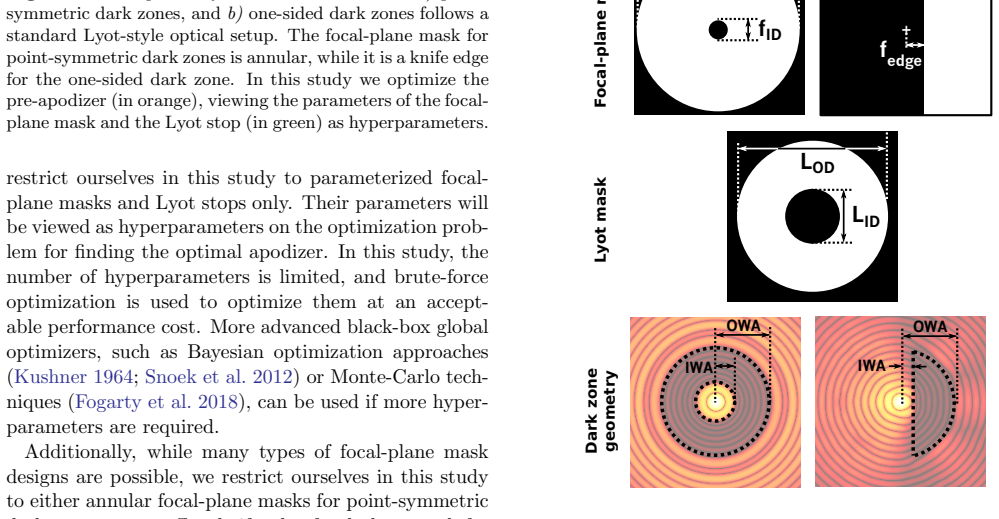
- Focal-plane mask geometry (fID, fOD for annular; fedge for knife edge) =
fID = 2*DZ_min - 5 lambda/D to 2*DZ_min; fOD = 2*DZ_max; fedge = DZ_min to DZ_min - 1.0 lambda/D
- Lyot stop inner and outer diameters (LID, LOD) =
LID = CO to CO + 0.4; LOD = 0.85 to 1 (parameter study); case studies use fixed or thickened pupils
- Dark zone inner radius (DZ_min) and outer radius (DZ_max) =
Point-symmetric DZ_min=2.0-3.5 lambda/D, DZ_max=13.25 lambda/D; one-sided DZ_min=0.4-2.0 lambda/D, DZ_max=8 lambda/D
- Design contrast exponent c (10^-c) =
10^-5 to 10^-10
- Expected Strehl Sexpected =
Not reported; updated iteratively until convergence
assumptions (5)
- standard math Fraunhofer propagation between pupil and focal plane is accurately modeled by Fourier transforms and their inverses.
- domain assumption The telescope pupil can be represented by a scalar complex-amplitude transmission A(x) with negligible polarization, chromatic, and non-scalar effects.
- ad hoc to paper The relaxed complex-amplitude problem |X+iY|<=1 yields solutions with |X+iY|=1 in all cases studied.
- domain assumption The linearized contrast constraints using expected Strehl Sexpected and iterative updating converge to the true contrast constraint.
- domain assumption Achromatization by adding a wavelength-dependent phase tilt renders the one-sided PAPLC completely achromatic in theory.
Cite this review
Pith. "Pith review of Phase-Apodized-Pupil Lyot Coronagraphs for Arbitrary Telescope Pupils." pith.science (2026). https://pith.science/paper/7MH4VRVQ
@misc{pith2026190802585,
  author       = {Pith},
  title        = {Pith review of: Phase-Apodized-Pupil Lyot Coronagraphs for Arbitrary Telescope Pupils},
  year         = {2026},
  howpublished = {\url{https://pith.science/paper/7MH4VRVQ}},
  note         = {Machine review of arXiv:1908.02585}
}
abstract
The phase-apodized-pupil Lyot coronagraph (PAPLC) is a pairing of the apodized-pupil Lyot coronagraph (APLC) and the apodizing phase plate (APP) coronagraph. We describe a numerical optimization method to obtain globally-optimal solutions for the phase apodizers for arbitrary telescope pupils, based on the linear map between complex-amplitude transmission of the apodizer and the electric field in the post-coronagraphic focal plane. PAPLCs with annular focal-plane masks and point-symmetric dark zones perform analogous to their corresponding APLCs. However with a knife-edge focal-plane mask and one-sided dark zones, the PAPLC yields inner working angles as close as $1.4\lambda/D$ at contrasts of $10^{-10}$ and maximum post-coronagraphic throughput of >75% for telescope apertures with central obscurations of up to 30%. We present knife-edge PAPLC designs optimized for the VLT/SPHERE instrument and the LUVOIR-A aperture. These designs show that the knife-edge PAPLC retains its performance, even for realistic telescope pupils with struts, segments and non-circular outer edges.
Figures
Figures from the paper (7 more)


Reference graph
Works this paper leans on
-
[1]
, " * write output.state after.block = add.period write newline
ENTRY address archivePrefix author booktitle chapter doi edition editor eprint howpublished institution journal key month note number organization pages publisher school series title misctitle type volume year version url label extra.label sort.label short.list INTEGERS output.state before.all mid.sentence after.sentence after.block FUNCTION init.state.co...
-
[2]
write newline
" write newline "" before.all 'output.state := FUNCTION format.doi doi empty "" "doi:" doi * if FUNCTION format.url url empty "" new.block "" url * "" * if FUNCTION format.eprint eprint empty "" archivePrefix empty "" archivePrefix ":" * if eprint field.or.null * if FUNCTION format.pid eprint empty format.doi format.eprint if FUNCTION n.dashify 't := "" t...
-
[3]
thebibliography [1] 20pt to REFERENCES 6pt =0pt 10pt plus 3pt =0pt =0pt =1pt plus 1pt =0pt =0pt -12pt =13pt plus 1pt =20pt =13pt plus 1pt \@M =10000 =-1.0em =0pt =0pt 0pt =0pt =1.0em @enumiv\@empty 10000 10000 `\.\@m \@noitemerr \@latex@warning Empty `thebibliography' environment \@ifnextchar \@reference \@latexerr Missing key on reference command Each re...
-
[4]
Beuzit , J.-L., Feldt , M., Dohlen , K., et al. 2008, in , Vol. 7014, Ground-based and Airborne Instrumentation for Astronomy II, 701418
work page 2008
-
[5]
Borucki, W. J., Koch, D. G., Basri, G., et al. 2011, The Astrophysical Journal, 736, 19
work page 2011
-
[6]
Carlotti, A., Vanderbei, R., & Kasdin, N. J. 2011, Opt. Express, 19, 26796. http://www.opticsexpress.org/abstract.cfm?URI=oe-19-27-26796
work page 2011
-
[7]
M., Latham , D
Charbonneau , D., Brown , T. M., Latham , D. W., & Mayor , M. 2000, , 529, L45
2000
-
[8]
Close , L. M., Males , J. R., Kopon , D. A., et al. 2012, in Adaptive Optics Systems III, Vol. 8447, 84470X
work page 2012
Show all 44 references
-
[9]
2006, in SPIE Astronomical Telescopes+ Instrumentation, International Society for Optics and Photonics, 62691N--62691N
Codona, J., Kenworthy, M., Hinz, P., Angel, J., & Woolf, N. 2006, in SPIE Astronomical Telescopes+ Instrumentation, International Society for Optics and Photonics, 62691N--62691N
2006
-
[10]
J., Groff, T
Currie, T., Kasdin, N. J., Groff, T. D., et al. 2018, Publications of the Astronomical Society of the Pacific, 130, 044505
2018
-
[11]
S., Snik, F., Warriner, N
Doelman, D. S., Snik, F., Warriner, N. Z., & Escuti, M. J. 2017, in Techniques and Instrumentation for Detection of Exoplanets VIII, Vol. 10400, International Society for Optics and Photonics, 104000U
2017
-
[12]
C., Rahmer, G., et al
Esc \'a rate, P., Christou, J. C., Rahmer, G., et al. 2018, in Adaptive Optics Systems VI, Vol. 10703, International Society for Optics and Photonics, 107034F
2018
-
[13]
S., et al
Fogarty, K., Mazoyer, J., Laurent, K. S., et al. 2018, in Space Telescopes and Instrumentation 2018: Optical, Infrared, and Millimeter Wave, Vol. 10698, International Society for Optics and Photonics, 106981J
2018
-
[14]
2014, in Adaptive Optics Systems IV, Vol
Fusco, T., Sauvage, J.-F., Petit, C., et al. 2014, in Adaptive Optics Systems IV, Vol. 9148, International Society for Optics and Photonics, 91481U
2014
-
[15]
Gonsalves , R. A. 1982, Optical Engineering, 21, 829
1982
-
[16]
2011, Experimental Astronomy, 30, 59
Guerri, G., Daban, J.-B., Robbe-Dubois, S., et al. 2011, Experimental Astronomy, 30, 59
2011
-
[17]
2016, Gurobi Optimizer Reference Manual, Gurobi Optimization, Inc
Gurobi Optimization, I. 2016, Gurobi Optimizer Reference Manual, Gurobi Optimization, Inc. http://www.gurobi.com
2016
-
[18]
W., Marcy , G
Henry , G. W., Marcy , G. W., Butler , R. P., & Vogt , S. S. 2000, , 529, L41
2000
-
[19]
Hunter, J. D. 2007, Computing In Science & Engineering, 9, 90
2007
-
[20]
2015, , 127, 890
Jovanovic , N., Martinache , F., Guyon , O., et al. 2015, , 127, 890
2015
-
[21]
J., Vanderbei, R
Kasdin, N. J., Vanderbei, R. J., Spergel, D. N., & Littman, M. G. 2003, The Astrophysical Journal, 582, 1147. https://doi.org/10.1086
2003
-
[22]
Kushner, H. J. 1964, Journal of Basic Engineering, 86, 97
1964
-
[23]
A., Graham , J
Macintosh , B. A., Graham , J. R., Palmer , D. W., et al. 2008, in , Vol. 7015, Adaptive Optics Systems, 701518
2008
-
[24]
R., Close, L
Males, J. R., Close, L. M., Morzinski, K. M., et al. 2014, The Astrophysical Journal, 786, 32. http://stacks.iop.org/0004-637X/786/i=1/a=32
2014
-
[25]
1995, , 378, 355
Mayor , M., & Queloz , D. 1995, , 378, 355
1995
-
[26]
2016, in Space Telescopes and Instrumentation 2016: Optical, Infrared, and Millimeter Wave, Vol
Mennesson, B., Gaudi, S., Seager, S., et al. 2016, in Space Telescopes and Instrumentation 2016: Optical, Infrared, and Millimeter Wave, Vol. 9904, 9904 -- 9904 -- 10. https://doi.org/10.1117/12.2240457
2016 doi
-
[27]
2017, Journal of Astronomical Telescopes, Instruments, and Systems, 3, 049002
Miller, K., Guyon, O., & Males, J. 2017, Journal of Astronomical Telescopes, Instruments, and Systems, 3, 049002
2017
-
[28]
2015, The Astrophysical Journal, 799, 225
N'Diaye, M., Pueyo, L., & Soummer, R. 2015, The Astrophysical Journal, 799, 225
2015
-
[29]
2016, , 818, 163
N'Diaye , M., Soummer , R., Pueyo , L., et al. 2016, , 818, 163
2016
-
[30]
P., Snik, F., Kenworthy, M
Otten, G. P., Snik, F., Kenworthy, M. A., et al. 2017, The Astrophysical Journal, 834, 175
2017
-
[31]
2016, Publications of the Astronomical Society of the Pacific, 128, 124404
Pathak, P., Guyon, O., Jovanovic, N., et al. 2016, Publications of the Astronomical Society of the Pacific, 128, 124404
2016
-
[32]
Por, E. H. 2017, in Techniques and Instrumentation for Detection of Exoplanets VIII, Vol. 10400, International Society for Optics and Photonics, 104000V
2017
-
[33]
H., Haffert, S
Por, E. H., Haffert, S. Y., Radhakrishnan, V. M., et al. 2018, in Proc. SPIE , Vol. 10703, Adaptive Optics Systems VI. https://doi.org/10.1117/12.2314407
2018 doi
-
[34]
2017, in UV/Optical/IR Space Telescopes and Instruments: Innovative Technologies and Concepts VIII, Vol
Pueyo, L., Zimmerman, N., Bolcar, M., et al. 2017, in UV/Optical/IR Space Telescopes and Instruments: Innovative Technologies and Concepts VIII, Vol. 10398, 10398 -- 10398 -- 20. https://doi.org/10.1117/12.2274654
2017 doi
-
[35]
E., Zimmerman, N
Riggs, A. E., Zimmerman, N. T., Nemati, B., & Krist, J. 2017, in Techniques and Instrumentation for Detection of Exoplanets VIII, Vol. 10400, International Society for Optics and Photonics, 104000O
2017
-
[36]
2018, in Space Telescopes and Instrumentation 2018: Optical, Infrared, and Millimeter Wave, Vol
Ruane, G., Riggs, A., Mazoyer, J., et al. 2018, in Space Telescopes and Instrumentation 2018: Optical, Infrared, and Millimeter Wave, Vol. 10698, International Society for Optics and Photonics, 106982S
2018
-
[37]
1965, JOSA, 55, 1110
Slepian, D. 1965, JOSA, 55, 1110
1965
-
[38]
2012, in SPIE Astronomical Telescopes+ Instrumentation, International Society for Optics and Photonics, 84500M--84500M
Snik, F., Otten, G., Kenworthy, M., et al. 2012, in SPIE Astronomical Telescopes+ Instrumentation, International Society for Optics and Photonics, 84500M--84500M
2012
-
[39]
Snoek, J., Larochelle, H., & Adams, R. P. 2012, in Advances in neural information processing systems, 2951--2959
2012
-
[40]
2004, The Astrophysical Journal Letters, 618, L161
Soummer, R. 2004, The Astrophysical Journal Letters, 618, L161
2004
-
[41]
2013, arXiv e-prints, arXiv:1305.5422
Spergel , D., Gehrels , N., Breckinridge , J., et al. 2013, arXiv e-prints, arXiv:1305.5422
2013 arXiv
-
[42]
Walt, S. v. d., Colbert, S. C., & Varoquaux, G. 2011, Computing in Science & Engineering, 13, 22
2011
-
[43]
Waterhouse, W. C. 1983, The American Mathematical Monthly, 90, 378
1983
-
[44]
T., Eldorado Riggs , A
Zimmerman , N. T., Eldorado Riggs , A. J., Jeremy Kasdin , N., Carlotti , A., & Vanderbei , R. J. 2016, Journal of Astronomical Telescopes, Instruments, and Systems, 2, 011012
2016
Reviewed August 14, 2026 · model on record in the stance chip above.
Discussion (0). Continue with ORCID to comment.