SECUREVENT: Hybrid AI/ML Security Monitoring for Distributed Event-Based Systems
Pith reviewed 2026-06-28 14:21 UTC · model grok-4.3
The pith
Hybrid security monitoring that adds anomaly detection to static controls is required for distributed event-based systems whose flows, schemas, and timing change too quickly for fixed rules alone.
A machine-rendered reading of the paper's core claim, the machinery that carries it, and where it could break.
Core claim
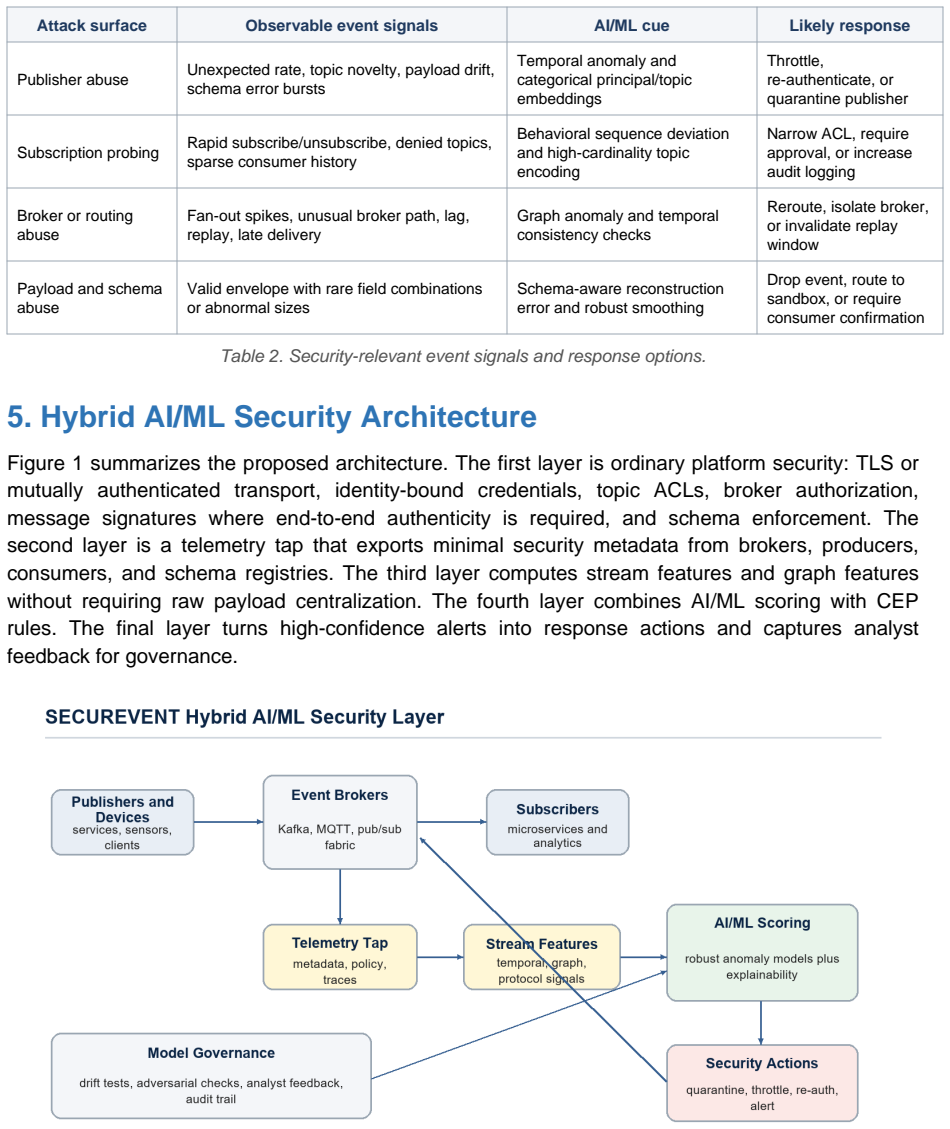
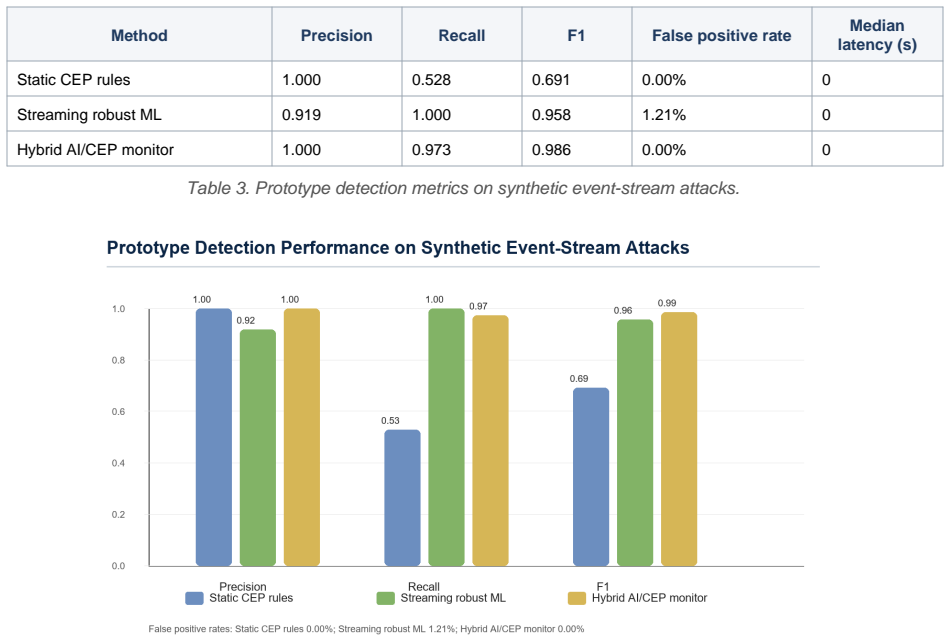
The paper claims that model-based security monitoring is necessary when event flows, identities, schemas, and timing relationships are too dynamic for static controls alone. The SECUREVENT architecture therefore combines authenticated transport, topic-level authorization, and signed events with online anomaly detection, graph-aware behavioral features, complex-event policy rules, federated learning, and adversarial-ML governance. A deterministic prototype study over synthetic event-stream attacks illustrates how the hybrid AI/CEP monitor can improve recall over static rules while retaining a low false-positive rate.
What carries the argument
The SECUREVENT hybrid architecture that integrates cryptographic and authorization mechanisms with AI/ML components for anomaly detection, graph features, and complex-event processing.
If this is right
- Static cryptographic and access controls leave detection gaps when schemas and timing shift rapidly.
- Graph-aware behavioral features enable detection of abuses involving identities and ordering that isolated rules miss.
- Federated learning supports monitoring across distributed components without requiring central collection of raw events.
- Adversarial-ML governance is required to keep the anomaly-detection layer itself from becoming an attack target.
Where Pith is reading between the lines
- The hybrid pattern could extend to other asynchronous substrates such as message queues in cloud microservices.
- Existing complex-event-processing engines already deployed in security operations could serve as a ready integration point.
- A controlled experiment comparing the monitor against static rules on a production IoT telemetry stream would test whether synthetic-attack gains hold in practice.
Load-bearing premise
The synthetic event-stream attacks in the prototype study adequately represent real-world threats, allowing any observed improvement in recall to indicate value in actual distributed event-based deployments.
What would settle it
A measurement on live production event streams from a real distributed system that finds no recall gain or an increase in false positives relative to static rules alone.
Figures
read the original abstract
Distributed event-based systems have become a common substrate for Internet-scale publish/subscribe services, IoT telemetry, cloud-native microservices, and security operations pipelines. Their loose coupling and asynchronous delivery improve scalability, but they also expand the attack surface: publishers, brokers, subscribers, topics, schemas, and temporal ordering can each be abused without a single component observing the whole behavior. This paper proposes SECUREVENT, a hybrid AI/ML security-monitoring architecture for distributed event-based systems. The architecture combines traditional protections such as authenticated transport, topic-level authorization, and signed events with online anomaly detection, graph-aware behavioral features, complex-event policy rules, federated learning, and adversarial-ML governance. A deterministic prototype study over synthetic event-stream attacks illustrates how a hybrid AI/CEP monitor can improve recall over static rules while retaining a low false-positive rate. The central claim is not that machine learning replaces cryptographic and access-control mechanisms, but that model-based security monitoring is necessary when event flows, identities, schemas, and timing relationships are too dynamic for static controls alone.
Editorial analysis
A structured set of objections, weighed in public.
Referee Report
Summary. The paper proposes SECUREVENT, a hybrid AI/ML security-monitoring architecture for distributed event-based systems (publish/subscribe, IoT, microservices). It combines traditional mechanisms (authenticated transport, topic-level authorization, signed events) with online anomaly detection, graph-aware behavioral features, complex-event policy rules, federated learning, and adversarial-ML governance. The central claim is that model-based monitoring is necessary when event flows, identities, schemas, and timing relationships are too dynamic for static controls alone; this is illustrated by a deterministic prototype study over synthetic event-stream attacks that reports improved recall over static rules while retaining a low false-positive rate.
Significance. If the prototype study were shown to instantiate regimes where static controls provably fail due to dynamism, the hybrid architecture could usefully highlight limitations of purely cryptographic and access-control approaches in loosely coupled systems. No machine-checked proofs, reproducible code, or parameter-free derivations are present. The empirical support is currently too underspecified to assess whether the necessity claim holds beyond the chosen synthetic generator.
major comments (1)
- [prototype study description] The description of the deterministic prototype study supplies no information on attack construction, parameter ranges for dynamism (event flows, identities, schemas, timing), validation against real publish/subscribe traces, or the precise static-rule baseline. This is load-bearing for the necessity claim, because without evidence that the synthetic attacks instantiate the dynamic regimes where auth/topic-auth/signatures are insufficient, the reported recall improvement cannot underwrite the general requirement for model-based monitoring.
Simulated Author's Rebuttal
We thank the referee for the constructive feedback. The major comment correctly identifies that the prototype study section requires additional detail to substantiate the necessity claim for model-based monitoring in dynamic regimes. We address this point below and will revise the manuscript accordingly.
read point-by-point responses
-
Referee: [prototype study description] The description of the deterministic prototype study supplies no information on attack construction, parameter ranges for dynamism (event flows, identities, schemas, timing), validation against real publish/subscribe traces, or the precise static-rule baseline. This is load-bearing for the necessity claim, because without evidence that the synthetic attacks instantiate the dynamic regimes where auth/topic-auth/signatures are insufficient, the reported recall improvement cannot underwrite the general requirement for model-based monitoring.
Authors: We agree that the current manuscript provides insufficient detail on the prototype study to fully support the necessity claim. In the revised version we will expand Section 5 (Prototype Study) with: (1) a precise description of how attacks were constructed, including the synthetic generator's mechanisms for injecting dynamism; (2) explicit parameter ranges and distributions for event flow rates, identity churn, schema evolution, and timing jitter; (3) the exact rule set and configuration used for the static-rule baseline; (4) an explicit mapping showing which parameter regimes cause static controls (authenticated transport, topic authorization, signatures) to fail while the hybrid monitor succeeds; and (5) a discussion of the rationale for using synthetic traces together with any attempted validation against public publish/subscribe datasets and the limitations thereof. These additions will make the empirical evidence load-bearing for the architectural argument. revision: yes
Circularity Check
No circularity; high-level architecture proposal with prototype study is self-contained
full rationale
The paper advances a hybrid AI/ML security architecture for event-based systems and supports the necessity claim via a deterministic prototype study on synthetic event-stream attacks. No equations, parameters, derivations, or self-citations appear in the provided text that could reduce any prediction or central claim to its own inputs by construction. The necessity statement remains a qualitative assertion rather than a fitted or self-referential quantity. This matches the default expectation of no significant circularity for an architecture paper lacking mathematical reductions.
Axiom & Free-Parameter Ledger
Reference graph
Works this paper leans on
-
[1]
Security Issues and Requirements for Internet-Scale Publish-Subscribe Systems,
C. Wang, A. Carzaniga, D. Evans, and A. L. Wolf, "Security Issues and Requirements for Internet-Scale Publish-Subscribe Systems," in Proceedings of the 35th Annual Hawaii International Conference on System Sciences (HICSS), 2002, doi: 10.1109/HICSS.2002.994531
-
[2]
A Taxonomy for Security Flaws in Event-Based Systems,
Y. K. Lee and D. Kim, "A Taxonomy for Security Flaws in Event-Based Systems," Applied Sciences, vol. 10, no. 20, article 7338, 2020, doi: 10.3390/app10207338
-
[3]
Confidentiality-Preserving Publish/Subscribe: A Survey,
E. Onica, P. Felber, H. Mercier, and E. Riviere, "Confidentiality-Preserving Publish/Subscribe: A Survey," ACM Computing Surveys, vol. 49, no. 2, article 27, 2016, doi: 10.1145/2940296
-
[4]
MQTT Version 5.0,
OASIS, "MQTT Version 5.0," OASIS Standard, 2019. Available: https://docs.oasis-open.org/mqtt/mqtt/v5.0/mqtt-v5.0.html
2019
-
[5]
Apache Kafka Documentation: Security,
Apache Software Foundation, "Apache Kafka Documentation: Security," 2025. Available: https://kafka.apache.org/documentation/#security
2025
-
[6]
Guide to Intrusion Detection and Prevention Systems (IDPS),
K. Scarfone and P. Mell, "Guide to Intrusion Detection and Prevention Systems (IDPS)," NIST Special Publication 800-94, 2007, doi: 10.6028/NIST.SP.800-94
-
[7]
Machine Learning Based IoT Intrusion Detection System: An MQTT Case Study,
H. Hindy, E. Bayne, M. Bures, R. Atkinson, C. Tachtatzis, and X. Bellekens, "Machine Learning Based IoT Intrusion Detection System: An MQTT Case Study," in Selected Papers from the 12th International Networking Conference, Lecture Notes in Networks and Systems, pp. 73-84, Springer, 2021, doi: 10.1007/978-3-030-64758-2_6
-
[8]
Beholder: A CEP-Based Intrusion Detection and Prevention System for IoT Environments,
M. Lima, R. Lima, F. A. A. Lins, and M. Bonfim, "Beholder: A CEP-Based Intrusion Detection and Prevention System for IoT Environments," Computers & Security, vol. 120, article 102824, 2022, doi: 10.1016/j.cose.2022.102824
-
[9]
StreamLearner: Distributed Incremental Machine Learning on Event Streams,
C. Mayer, R. Mayer, and M. Abdo, "StreamLearner: Distributed Incremental Machine Learning on Event Streams," in Proceedings of the 11th ACM International Conference on Distributed and Event-Based Systems (DEBS), pp. 298-303, 2017, doi: 10.1145/3093742.3095103
-
[10]
SAQL: A Stream-Based Query System for Real-Time Abnormal System Behavior Detection,
P. Gao, X. Xiao, D. Li, Z. Li, K. Jee, Z. Wu, C. H. Kim, S. R. Kulkarni, and P. Mittal, "SAQL: A Stream-Based Query System for Real-Time Abnormal System Behavior Detection," in Proceedings of the 27th USENIX Security Symposium, pp. 639-656, 2018
2018
-
[11]
Efficient Representations for High-Cardinality Categorical Variables in Machine Learning,
Z. Liang, "Efficient Representations for High-Cardinality Categorical Variables in Machine Learning," in 2025 International Conference on Advanced Machine Learning and Data Science (AMLDS), pp. 1-11, IEEE, 2025
2025
-
[12]
Harmonizing Metadata of Language Resources for Enhanced Querying and Accessibility,
Z. Liang, "Harmonizing Metadata of Language Resources for Enhanced Querying and Accessibility," in 2024 5th International Conference on Computers and Artificial Intelligence Technology (CAIT), pp. 642-650, IEEE, 2024
2024
-
[13]
Enhanced Estimation Techniques for Certified Radii in Randomized Smoothing,
Z. Liang, "Enhanced Estimation Techniques for Certified Radii in Randomized Smoothing," in 2025 8th International Conference on Artificial Intelligence and Big Data (ICAIBD), pp. 375-384, IEEE, 2025
2025
-
[14]
Automating Date Format Detection for Data Visualization,
Z. Liang, "Automating Date Format Detection for Data Visualization," in 2025 International Conference on Advanced Machine Learning and Data Science (AMLDS), pp. 756-764, IEEE, 2025
2025
-
[15]
Communication-Efficient Learning of Deep Networks from Decentralized Data,
H. B. McMahan, E. Moore, D. Ramage, S. Hampson, and B. A. y Arcas, "Communication-Efficient Learning of Deep Networks from Decentralized Data," in Proceedings of AISTATS, pp. 1273-1282, 2017
2017
-
[16]
Adversarial Machine Learning: A Taxonomy and Terminology of Attacks and Mitigations,
A. Vassilev, A. Oprea, A. Fordyce, H. Anderson, X. Davies, and M. Hamin, "Adversarial Machine Learning: A Taxonomy and Terminology of Attacks and Mitigations," NIST AI 100-2e2025, 2025, doi: 10.6028/NIST.AI.100-2e2025
-
[17]
M. T. Ribeiro, S. Singh, and C. Guestrin, "Why Should I Trust You?: Explaining the Predictions of Any Classifier," in Proceedings of the 22nd ACM SIGKDD International Conference on Knowledge Discovery and Data Mining, pp. 1135-1144, 2016, doi: 10.1145/2939672.2939778
-
[18]
Kafka: A Distributed Messaging System for Log Processing,
J. Kreps, N. Narkhede, and J. Rao, "Kafka: A Distributed Messaging System for Log Processing," in Proceedings of the 6th International Workshop on Networking Meets Databases (NetDB), 2011
2011
-
[19]
The Dataflow Model: A Practical Approach to Balancing Correctness, Latency, and Cost in Massive-Scale, Unbounded, Out-of-Order Data Processing,
T. Akidau, R. Bradshaw, C. Chambers, S. Chernyak, R. J. Fernandez-Moctezuma, R. Lax, S. McVeety, D. Mills, F. Perry, E. Schmidt, and S. Whittle, "The Dataflow Model: A Practical Approach to Balancing Correctness, Latency, and Cost in Massive-Scale, Unbounded, Out-of-Order Data Processing," Proceedings of the VLDB Endowment, vol. 8, no. 12, pp. 1792-1803, 2015
2015
-
[20]
Time, Clocks, and the Ordering of Events in a Distributed System,
L. Lamport, "Time, Clocks, and the Ordering of Events in a Distributed System," Communications of the ACM, vol. 21, no. 7, pp. 558-565, 1978, doi: 10.1145/359545.359563
-
[21]
Conflict-Free Replicated Data Types,
M. Shapiro, N. Preguica, C. Baquero, and M. Zawirski, "Conflict-Free Replicated Data Types," in Stabilization, Safety, and Security of Distributed Systems, Lecture Notes in Computer Science, vol. 6976, pp. 386-400, Springer, 2011
2011
discussion (0)
Sign in with ORCID, Apple, or X to comment. Anyone can read and Pith papers without signing in.