REVIEW 3 major objections 6 minor 51 references
Improving Progressive Generation with Decomposable Flow Matching
T0 review · 3 major / 6 minor · reviewed 2026-08-15 · deepseek-v4-flash
Pith's one-line read This paper establishes that progressive coarse-to-fine generation can be implemented inside a single Flow Matching model by giving each level of a multiscale representation its own flow timestep, and that this improves image and video…
desk verdict DFM is a simple, well-ablated progressive generation method whose FDD headline overstates the gain; the FID/IS evidence is thinner but consistent, and the paper deserves a serious referee. read the letter →
The pith
A machine-rendered reading of the paper's core claim, the machinery that carries it, and where it could break.
The reading
What carries the argument
The load-bearing object is the per-stage flow timestep vector $(t_1,\dots,t_S)$, which breaks the usual single global timestep into one per level of a multiscale decomposition and thereby turns a Flow Matching model into a coarse-to-fine progressive generator. The decomposition itself is a Laplacian pyramid, in which each level holds the difference between successive downsampled approximations, so levels contain progressively finer detail. Around these two objects the method adds per-scale patchification and timestep-embedding layers inside a DiT-style transformer so one network handles all scales, a masking term that suppresses loss from future fully-noisy scales, and a scale-equivariant autoencoder that maps RGB frequency bands to matching latent frequency bands. These pieces together replace stage-transition machinery with a simple schedule of per-scale timesteps.
What would settle it
Run the ImageNet-1K 512px comparison at fixed training compute with an autoencoder whose latent frequency bands are permuted or otherwise misaligned with RGB frequencies; if DFM's FDD advantage over vanilla Flow Matching collapses or reverses, the mechanism carrying the result is the latent spectral structure rather than the per-stage timestep schedule itself.
Extended reading notes
Core claim
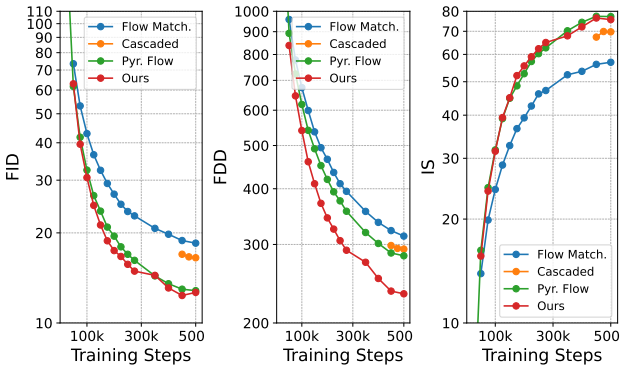
The central claim is that Flow Matching and progressive generation can be fused without special diffusion processes, separate expert models, or ad-hoc samplers. The input is decomposed into $S$ scales $X^s$; each scale receives an independent flow timestep $t_s$, so the forward process is $X^s_{t_s} = t_s X^s_1 + (1-t_s) X^s_0$ per scale, and the model predicts per-scale velocities $v^s$ from the noisy versions of all scales. Training simulates the progressive schedule by sampling a current stage, drawing its timestep from a logit-normal distribution, drawing less-noisy timesteps for previous stages, setting future stages to full noise, and masking those future scales out of the loss. Inference advances the stages one by one with a standard ODE sampler, moving to the next scale once the current one reaches a threshold $\tau$. On ImageNet-1K, Kinetics-700, and a large-model finetuning task, the paper reports that this single-model scheme outperforms vanilla Flow Matching, cascaded diffusion, and Pyramidal Flow at matched training compute.
Load-bearing premise
The large quality gains depend on a compression model whose internal frequency bands line up with the visual frequency bands in RGB; without that spectral alignment the paper's own appendix shows DFM still beats Flow Matching, but the margin shrinks.
Editorial extensions
If this is right
- On ImageNet-1K 512px, DFM reports a 35.2% FDD improvement over the base Flow Matching model and 26.4% over the best-performing prior baseline under equal training compute.
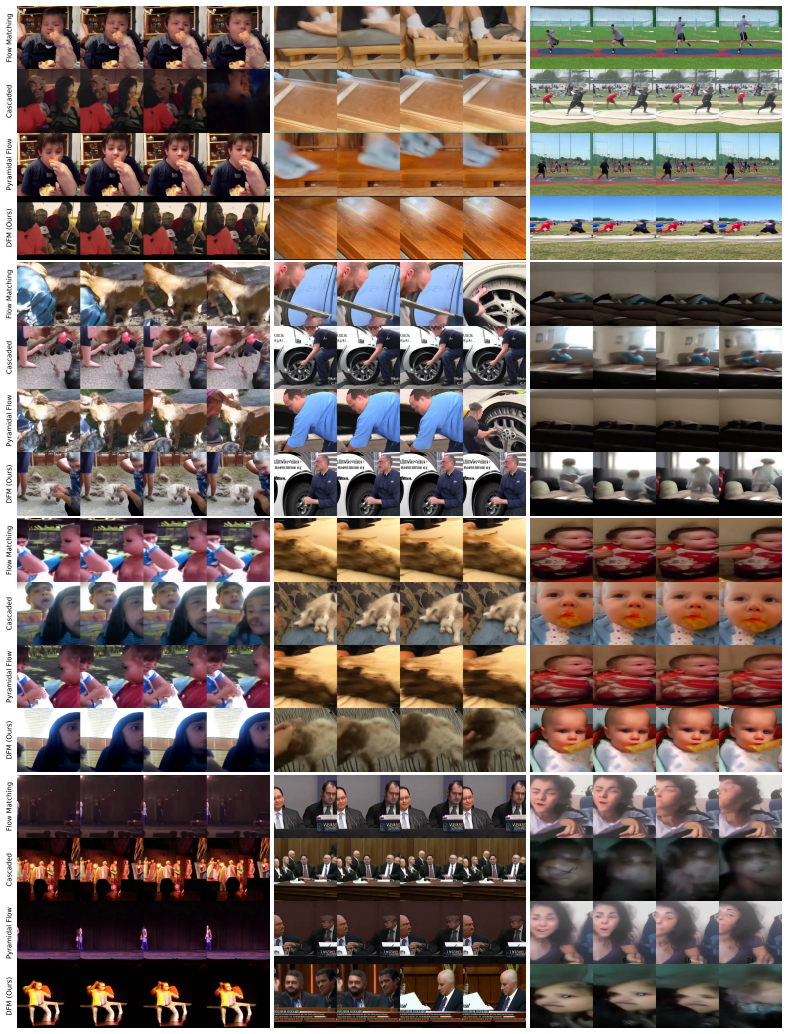
- At 1024px and on Kinetics-700 video, DFM also beats Flow Matching, cascaded models, and Pyramidal Flow on FID, FDD, and related metrics at matched compute.
- Finetuning a large text-to-image model with DFM reaches 28.7% lower FID and 24.3% lower FDD than standard full finetuning after the same number of steps, with higher CLIP similarity.
- Because each scale is generated with its own timestep, intermediate stages can be decoded during inference, giving low-resolution previews without any extra model.
- The decomposition is user-defined, so DWT, DCT, Fourier, or multiscale-autoencoder decompositions are drop-in alternatives to the Laplacian pyramid used in the main results.
Reading between the lines
- If the per-stage timestep schedule is the active ingredient, the same factorization could be applied to non-diffusion generative models, e.g., next-scale autoregressive models, to test whether progressive structure itself or the flow formulation drives the gain.
- The hand-set switch threshold and per-stage step counts suggest a natural extension: learn the sampling schedule along with the model, which might reach the same quality with fewer total steps.
- For video, the same decomposition idea can be applied along time as well as space, which would test whether coarse-to-fine generation improves temporal consistency the way it appears to improve spatial structure.
- A decisive comparison would use a spectrally disentangled tokenizer (e.g., wavelet-based) instead of a scale-equivariant fine-tuned autoencoder, isolating how much of the benefit comes from the latent structure versus the progressive schedule.
Signed reviews
Editorial analysis
A structured set of objections, weighed in public.
Referee Report
Summary. Decomposable Flow Matching (DFM) extends Flow Matching to progressive multi-stage generation. The input latent is decomposed with a Laplacian pyramid into S scales; each scale receives its own flow timestep, and a shared DiT with per-scale patchification, per-scale time embeddings, and masked losses is trained to predict per-scale velocities. At inference, scales are denoised sequentially from coarse to fine according to a threshold schedule with per-stage step counts. Experiments on ImageNet-1K 512/1024 and Kinetics-700 compare DFM with Flow Matching, a cascaded model, and Pyramidal Flow under matched training compute; the paper reports consistent gains, e.g., FDD 200.6 vs 282.9 for Flow Matching on ImageNet 512 at cfg=1.0, and a 35.2% relative FDD improvement over the base architecture is quoted in the abstract. An additional experiment fine-tunes FLUX-dev on an internal dataset and reports faster convergence than standard fine-tuning. The appendix contains extensive ablations over training and sampling hyperparameters, decomposition choices, failed experiments, and limitations.
Significance. The framework is simple, decomposition-agnostic, single-model, and clearly described; these are genuine strengths. The ablation study is unusually thorough, the baseline comparisons are matched in training compute, and the convergence curves show the gain appears throughout training rather than only at the final checkpoint. The candor about failed experiments and limitations is helpful. However, the paper's quantitative claims would be more convincing with repeated seeds, a held-out validation protocol for hyperparameters, and a metric or human study that is sensitive to the high-frequency artifacts the authors acknowledge; the method's main reported gain is on FDD, a DINOv2-based structural metric. The lack of code and the private FLUX dataset also limit independent verification.
major comments (3)
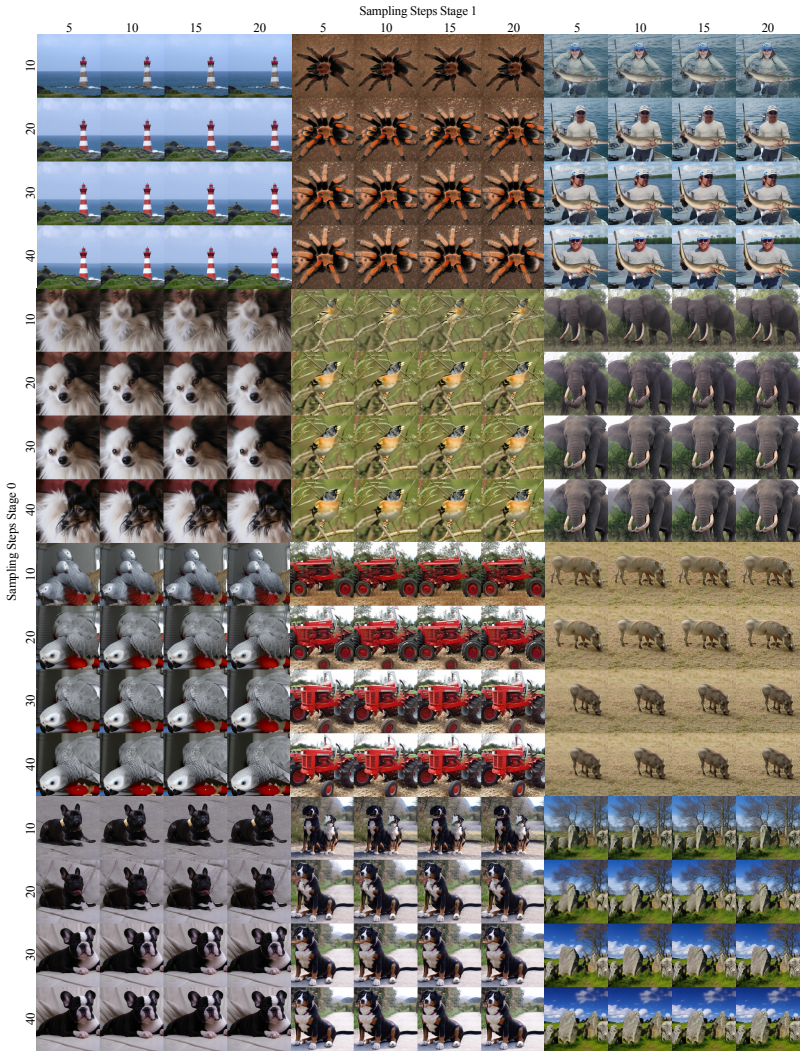
- [§4.2, §4.3, Table 1, Figure 3] The main ImageNet-1K 512px configuration is tuned on the same benchmark used for the headline numbers: p0_t=0.9 and logit-normal location 1.5 are selected from Table 1(a)-(b), and threshold 0.7 with 30/10 per-stage steps is selected from Figure 3 and §4.3. With no validation split and no repeated-seed variance, part of the 35.2% FDD margin in Table 2 may be a selection effect rather than an intrinsic property of DFM. Please evaluate the ablated configurations on a held-out split, or report the sensitivity of the Table 2 comparisons to the selected hyperparameters.
- [§4.4, Table 2] All main results are single runs without error bars. Several margins are small enough to be within typical run-to-run variability, notably Kinetics-700 at cfg=1.0 (FDD 336.7 vs 353.8 for Pyramidal Flow, FVD 260.2 vs 265.6) and ImageNet 512 at cfg=1.5 (FID 4.28 vs 4.57 for Pyramidal Flow). The claim of uniform superiority over all baselines on all metrics therefore needs at least a few seeds for the main comparisons, or bootstrap confidence intervals on the evaluation metrics, to establish that the differences are not noise.
- [§5, Appendix G, Table 2] The abstract's headline '35.2% improvement in FDD' is a Frechet distance on DINOv2 features, which are biased toward global structure, while the paper itself reports 'a decreased presence of high-frequency details' and artifacts in vegetation, fur, and thin structures (§5, App. G, Fig. 7). The FDD gain may therefore partly reflect a shift toward the structural prior encoded by DINOv2 rather than an across-the-board improvement in visual quality. Because FID and IS also improve, I do not see this as invalidating the method, but the 'improves visual quality' claim should be qualified, or supported by a human evaluation or a texture-sensitive metric.
minor comments (6)
- [Eq. (4)] The mask term M_s in Eq. (4) is central to the training loss but is never defined in the main text; please specify which stages are masked and how M_s relates to the architectural input masking described in §3.4.
- [§4.4, Table 2] The sentence 'with the exception of Kinetics-700 FDD' is imprecise: at cfg=1.0 and 1.25 DFM has the best FDD on Kinetics-700; only at cfg=1.5 is DFM slightly behind Cascaded (236.5 vs 235.0).
- [Appendix A.1 / Table 1(c)] The main text says that removing standardization improves performance and that the main experiments exclude standardization, but Appendix A.1 says the model normalizes data across scales with scale-wise pre/post-conditioning; please clarify how the 'standardization' ablated in Table 1(c) differs from the preconditioning described in Appendix A.1.
- [§4.1, evaluation metrics] FDD is cited as 'Frechet Distance computed against DINOv2 features' but no details are given on the DINOv2 variant, layer, pooling, or number of samples used for the covariance estimate; please add these details.
- [Overall] The paper does not release code, and the FLUX experiment in §4.5 is on a private internal dataset; this limits independent verification of the empirical claims, especially given the absence of error bars.
- [Throughout] There are a few typographical errors, including 'add-hoc sampler' in the abstract and 'Addtionally' in Appendix C; please proofread.
Circularity Check
No circular derivation: DFM is an empirical extension of Flow Matching; the only self-citations (autoencoder [38], training schedule [29]) are non-load-bearing, while the admitted high-frequency artifacts and same-benchmark hyperparameter selection raise evaluation-fairness concerns, not circularity.
full rationale
The derivational content of the paper (Sec. 3) is self-contained: Eq. (3) defines per-stage flow timesteps as independent linear interpolations, Eq. (4) is the corresponding multi-scale velocity loss, and Sec. 3.4 describes per-scale patchification and timestep embedders. No equation is defined in terms of the headline FDD/FID numbers, and no fitted constant is renamed as a prediction; the improvements in Table 2 are empirical comparisons run under matched training compute. The paper cites the authors' prior work for the scale-equivariant autoencoder ([38]) and for a cascaded training strategy ([29]), but both are used as engineering components or supporting intuition, equally for baselines and the proposed method; Appendix D additionally shows DFM still outperforms Flow Matching without scale-equivariant fine-tuning, so the self-citations are not load-bearing. The claimed limitations (Sec. 5 and App. G: a decreased presence of high-frequency details and artifacts in vegetation, fur, and thin structures) and the choice of DINOv2-based FDD as the headline metric are substantive threats to the strength of the 'improves visual quality' claim, but they do not make the derivation circular. Likewise, choosing p0_t=0.9, logit-normal location 1.5, threshold 0.7, and 30/10 sampling steps from ablations on ImageNet-1K 512px and then reporting Table 2 on the same benchmark is a model-selection caveat, not an equation-level reduction of the reported gain to its inputs by construction. Overall, the central framework has independent content, and the only circularity-adjacent issue is a minor, non-load-bearing self-citation.
Assumptions & free parameters
free parameters (5)
- First stage sampling probability p0_t =
0.9
- Preceding stage logit-normal location =
1.5
- Sampling threshold tau =
0.7 for 512px, 0.95 for 1024px
- Per-stage sampling steps =
30 steps for stage 1, 10 steps for stage 2
- Stage resolution decomposition =
256->512 for 512px, 256->1024 for 1024px
assumptions (4)
- standard math Laplacian pyramid levels sum to an approximation of the original signal (Eq. 2).
- domain assumption Scale-equivariant finetuning of the autoencoder yields latents whose frequency bands align with RGB frequency bands.
- domain assumption A shared DiT with per-scale patchification and summed token embeddings can represent all stages without destructive interference.
- domain assumption The per-scale flow matching loss with masking (Eq. 4) provides a valid training signal for progressive generation.
Cite this review
Pith. "Pith review of Improving Progressive Generation with Decomposable Flow Matching." pith.science (2026). https://pith.science/paper/7NYTRQJ7
@misc{pith2026250619839,
  author       = {Pith},
  title        = {Pith review of: Improving Progressive Generation with Decomposable Flow Matching},
  year         = {2026},
  howpublished = {\url{https://pith.science/paper/7NYTRQJ7}},
  note         = {Machine review of arXiv:2506.19839}
}
read the original abstract
Generating high-dimensional visual modalities is a computationally intensive task. A common solution is progressive generation, where the outputs are synthesized in a coarse-to-fine spectral autoregressive manner. While diffusion models benefit from the coarse-to-fine nature of denoising, explicit multi-stage architectures are rarely adopted. These architectures have increased the complexity of the overall approach, introducing the need for a custom diffusion formulation, decomposition-dependent stage transitions, add-hoc samplers, or a model cascade. Our contribution, Decomposable Flow Matching (DFM), is a simple and effective framework for the progressive generation of visual media. DFM applies Flow Matching independently at each level of a user-defined multi-scale representation (such as Laplacian pyramid). As shown by our experiments, our approach improves visual quality for both images and videos, featuring superior results compared to prior multistage frameworks. On Imagenet-1k 512px, DFM achieves 35.2% improvements in FDD scores over the base architecture and 26.4% over the best-performing baseline, under the same training compute. When applied to finetuning of large models, such as FLUX, DFM shows faster convergence speed to the training distribution. Crucially, all these advantages are achieved with a single model, architectural simplicity, and minimal modifications to existing training pipelines.
Figures


Figures from the paper (22 more)










Reference graph
Works this paper leans on
-
[1]
Yuval Atzmon, Maciej Bala, Yogesh Balaji, Tiffany Cai, Yin Cui, Jiaojiao Fan, Yunhao Ge, Siddharth Gururani, Jacob Huffman, Ronald Isaac, et al. Edify image: High-quality image generation with pixel space laplacian diffusion models.arXiv preprint arXiv:2411.07126, 2024
arXiv 2024
-
[2]
One transformer fits all distributions in multi-modal diffusion at scale
Fan Bao, Shen Nie, Kaiwen Xue, Chongxuan Li, Shi Pu, Yaole Wang, Gang Yue, Yue Cao, Hang Su, and Jun Zhu. One transformer fits all distributions in multi-modal diffusion at scale. InInternational Conference on Machine Learning, pages 1692–1717. PMLR, 2023
2023
-
[3]
A short note on the kinetics- 700 human action dataset.arXiv preprint arXiv:1907.06987, 2019
Joao Carreira, Eric Noland, Chloe Hillier, and Andrew Zisserman. A short note on the kinetics- 700 human action dataset.arXiv preprint arXiv:1907.06987, 2019
arXiv 1907
-
[4]
Generative pretraining from pixels
Mark Chen, Alec Radford, Rewon Child, Jeff Wu, Heewoo Jun, David Luan, and Ilya Sutskever. Generative pretraining from pixels. InICML. JMLR.org, 2020
work page 2020
-
[5]
Imagenet: A large-scale hierarchical image database
Jia Deng, Wei Dong, Richard Socher, Li-Jia Li, Kai Li, and Li Fei-Fei. Imagenet: A large-scale hierarchical image database. InProceedings of the IEEE Conference on Computer Vision and Pattern Recognition, 2009
work page 2009
-
[6]
Taming transformers for high-resolution image synthesis
Patrick Esser, Robin Rombach, and Bjorn Ommer. Taming transformers for high-resolution image synthesis. InProceedings of the IEEE/CVF conference on computer vision and pattern recognition, pages 12873–12883, 2021
2021
-
[7]
Scaling rectified flow transform- ers for high-resolution image synthesis
Patrick Esser, Sumith Kulal, Andreas Blattmann, Rahim Entezari, Jonas Müller, Harry Saini, Yam Levi, Dominik Lorenz, Axel Sauer, Frederic Boesel, et al. Scaling rectified flow transform- ers for high-resolution image synthesis. InICML, 2024
2024
-
[8]
Spectral image tokenizer.arXiv preprint arXiv:2412.09607, 2024
Carlos Esteves, Mohammed Suhail, and Ameesh Makadia. Spectral image tokenizer.arXiv preprint arXiv:2412.09607, 2024
arXiv 2024
Show all 51 references
-
[9]
f-dm: A multi-stage diffusion model via progressive signal transformation.ICLR (ICLR), 2023
Jiatao Gu, Shuangfei Zhai, Yizhe Zhang, Miguel Angel Bautista, and Josh Susskind. f-dm: A multi-stage diffusion model via progressive signal transformation.ICLR (ICLR), 2023
2023
-
[10]
Matryoshka diffusion models
Jiatao Gu, Shuangfei Zhai, Yizhe Zhang, Joshua M Susskind, and Navdeep Jaitly. Matryoshka diffusion models. InThe Twelfth International Conference on Learning Representations, 2023
2023
-
[11]
Av-link: Temporally-aligned diffusion features for cross-modal audio-video generation.arXiv preprint arXiv:2412.15191, 2024
Moayed Haji-Ali, Willi Menapace, Aliaksandr Siarohin, Ivan Skorokhodov, Alper Canberk, Kwot Sin Lee, Vicente Ordonez, and Sergey Tulyakov. Av-link: Temporally-aligned diffusion features for cross-modal audio-video generation.arXiv preprint arXiv:2412.15191, 2024
2024 arXiv
-
[12]
Classifier-free diffusion guidance.NeurIPS 2021 Workshop on Deep Generative Models and Downstream Applications, 2022
Jonathan Ho and Tim Salimans. Classifier-free diffusion guidance.NeurIPS 2021 Workshop on Deep Generative Models and Downstream Applications, 2022
2021
-
[13]
Cascaded diffusion models for high fidelity image generation.Journal of Machine Learning Research, 23(47):1–33, 2022
Jonathan Ho, Chitwan Saharia, William Chan, David J Fleet, Mohammad Norouzi, and Tim Salimans. Cascaded diffusion models for high fidelity image generation.Journal of Machine Learning Research, 23(47):1–33, 2022
2022
-
[14]
Video diffusion models.Advances in Neural Information Processing Systems, 35:8633–8646, 2022
Jonathan Ho, Tim Salimans, Alexey Gritsenko, William Chan, Mohammad Norouzi, and David J Fleet. Video diffusion models.Advances in Neural Information Processing Systems, 35:8633–8646, 2022
2022
-
[15]
Lora: Low-rank adaptation of large language models.ICLR, 1 (2):3, 2022
Edward J Hu, Yelong Shen, Phillip Wallis, Zeyuan Allen-Zhu, Yuanzhi Li, Shean Wang, Lu Wang, Weizhu Chen, et al. Lora: Low-rank adaptation of large language models.ICLR, 1 (2):3, 2022
2022
-
[16]
Nfig: Autoregressive image generation with next-frequency prediction.arXiv preprint arXiv:2503.07076, 2025
Zhihao Huang, Xi Qiu, Yukuo Ma, Yifu Zhou, Junjie Chen, Hongyuan Zhang, Chi Zhang, and Xuelong Li. Nfig: Autoregressive image generation with next-frequency prediction.arXiv preprint arXiv:2503.07076, 2025
2025
-
[17]
Flexvar: Flexible visual autoregressive modeling without residual prediction.arXiv preprint arXiv:2502.20313, 2025
Siyu Jiao, Gengwei Zhang, Yinlong Qian, Jiancheng Huang, Yao Zhao, Humphrey Shi, Lin Ma, Yunchao Wei, and Zequn Jie. Flexvar: Flexible visual autoregressive modeling without residual prediction.arXiv preprint arXiv:2502.20313, 2025. 11
2025
-
[18]
Pyramidal flow matching for efficient video generative modeling.arXiv preprint arXiv:2410.05954, 2024
Yang Jin, Zhicheng Sun, Ningyuan Li, Kun Xu, Hao Jiang, Nan Zhuang, Quzhe Huang, Yang Song, Yadong Mu, and Zhouchen Lin. Pyramidal flow matching for efficient video generative modeling.arXiv preprint arXiv:2410.05954, 2024
2024
-
[19]
Elucidating the design space of diffusion-based generative models.Advances in neural information processing systems, 35: 26565–26577, 2022
Tero Karras, Miika Aittala, Timo Aila, and Samuli Laine. Elucidating the design space of diffusion-based generative models.Advances in neural information processing systems, 35: 26565–26577, 2022
2022
-
[20]
Analyzing and improving the training dynamics of diffusion models
Tero Karras, Miika Aittala, Jaakko Lehtinen, Janne Hellsten, Timo Aila, and Samuli Laine. Analyzing and improving the training dynamics of diffusion models. InProceedings of the IEEE/CVF Conference on Computer Vision and Pattern Recognition, pages 24174–24184, 2024
2024
-
[21]
Adam: A method for stochastic optimization.arXiv preprint arXiv:1412.6980, 2014
Diederik P Kingma and Jimmy Ba. Adam: A method for stochastic optimization.arXiv preprint arXiv:1412.6980, 2014
2014 arXiv
-
[22]
Eq-vae: Equivariance regularized latent space for improved generative image modeling.arXiv preprint arXiv:2502.09509, 2025
Theodoros Kouzelis, Ioannis Kakogeorgiou, Spyros Gidaris, and Nikos Komodakis. Eq-vae: Equivariance regularized latent space for improved generative image modeling.arXiv preprint arXiv:2502.09509, 2025
2025 arXiv
-
[23]
Flux, 2024
Black Forest Labs. Flux, 2024. URLhttps://bfl.ai/
2024
-
[24]
Autoregressive image generation using residual quantization
Doyup Lee, Chiheon Kim, Saehoon Kim, Minsu Cho, and Wook-Shin Han. Autoregressive image generation using residual quantization. InCVPR, 2022
2022
-
[25]
Hunyuan-dit: A powerful multi-resolution diffusion transformer with fine-grained chinese understanding.arXiv, 2024
Zhimin Li, Jianwei Zhang, Qin Lin, Jiangfeng Xiong, Yanxin Long, Xinchi Deng, Yingfang Zhang, Xingchao Liu, Minbin Huang, Zedong Xiao, Dayou Chen, Jiajun He, Jiahao Li, Wenyue Li, Chen Zhang, Rongwei Quan, Jianxiang Lu, Jiabin Huang, Xiaoyan Yuan, Xiaoxiao Zheng, Yixuan Li, Ji...
2024
-
[26]
Flow matching for generative modeling.arXiv preprint arXiv:2210.02747, 2022
Yaron Lipman, Ricky TQ Chen, Heli Ben-Hamu, Maximilian Nickel, and Matt Le. Flow matching for generative modeling.arXiv preprint arXiv:2210.02747, 2022
2022 arXiv
-
[27]
Flow straight and fast: Learning to generate and transfer data with rectified flow
Xingchao Liu, Chengyue Gong, and Qiang Liu. Flow straight and fast: Learning to generate and transfer data with rectified flow. InICLR, 2023
2023
-
[28]
Step-video-t2v technical report: The practice, challenges, and future of video foundation model.arXiv preprint arXiv:2502.10248, 2025
Guoqing Ma, Haoyang Huang, Kun Yan, Liangyu Chen, Nan Duan, Shengming Yin, Changyi Wan, Ranchen Ming, Xiaoniu Song, Xing Chen, et al. Step-video-t2v technical report: The practice, challenges, and future of video foundation model.arXiv preprint arXiv:2502.10248, 2025
2025 arXiv
-
[29]
Snap video: Scaled spatiotemporal transformers for text-to-video synthesis
Willi Menapace, Aliaksandr Siarohin, Ivan Skorokhodov, Ekaterina Deyneka, Tsai-Shien Chen, Anil Kag, Yuwei Fang, Aleksei Stoliar, Elisa Ricci, Jian Ren, et al. Snap video: Scaled spatiotemporal transformers for text-to-video synthesis. InCVPR, 2024
2024
-
[30]
Dctdiff: Intriguing properties of image generative modeling in the dct space.arXiv preprint arXiv:2412.15032, 2024
Mang Ning, Mingxiao Li, Jianlin Su, Haozhe Jia, Lanmiao Liu, Martin Beneš, Wenshuo Chen, Albert Ali Salah, and Itir Onal Ertugrul. Dctdiff: Intriguing properties of image generative modeling in the dct space.arXiv preprint arXiv:2412.15032, 2024
2024 arXiv
-
[31]
Conditional image generation with pixelcnn decoders
Aäron van den Oord, Nal Kalchbrenner, Oriol Vinyals, Lasse Espeholt, Alex Graves, and Koray Kavukcuoglu. Conditional image generation with pixelcnn decoders. InNIPS, 2016
2016
-
[32]
Maxime Oquab, Timothée Darcet, Théo Moutakanni, Huy V . V o, Marc Szafraniec, Vasil Khalidov, Pierre Fernandez, Daniel HAZIZA, Francisco Massa, Alaaeldin El-Nouby, Mido Assran, Nicolas Ballas, Wojciech Galuba, Russell Howes, Po-Yao Huang, Shang-Wen Li, Ishan Misra, Michael Rab...
2024
-
[33]
Scalable diffusion models with transformers
William Peebles and Saining Xie. Scalable diffusion models with transformers. InICCV, 2023. 12
2023
-
[34]
Learning transferable visual models from natural language supervision
Alec Radford, Jong Wook Kim, Chris Hallacy, Aditya Ramesh, Gabriel Goh, Sandhini Agarwal, Girish Sastry, Amanda Askell, Pamela Mishkin, Jack Clark, et al. Learning transferable visual models from natural language supervision. InICML, 2021
2021
-
[35]
Generating diverse high-fidelity images with vq-vae-2.Advances in neural information processing systems, 32, 2019
Ali Razavi, Aaron Van den Oord, and Oriol Vinyals. Generating diverse high-fidelity images with vq-vae-2.Advances in neural information processing systems, 32, 2019
2019
-
[36]
Generative modelling with inverse heat dissipation
Severi Rissanen, Markus Heinonen, and Arno Solin. Generative modelling with inverse heat dissipation. InThe Eleventh International Conference on Learning Representations, 2023
2023
-
[37]
Photorealistic text-to-image diffusion models with deep language understanding
Chitwan Saharia, William Chan, Saurabh Saxena, Lala Li, Jay Whang, Emily L Denton, Kamyar Ghasemipour, Raphael Gontijo Lopes, Burcu Karagol Ayan, Tim Salimans, et al. Photorealistic text-to-image diffusion models with deep language understanding. InNeurIPS, 2022
2022
-
[38]
Improving the diffusability of autoencoders
Ivan Skorokhodov, Sharath Girish, Benran Hu, Willi Menapace, Yanyu Li, Rameen Abdal, Sergey Tulyakov, and Aliaksandr Siarohin. Improving the diffusability of autoencoders. In ICML, 2025
2025
-
[39]
Exposing flaws of generative model evaluation metrics and their unfair treatment of diffusion models.Advances in Neural Information Processing Systems, 36:3732–3784, 2023
George Stein, Jesse Cresswell, Rasa Hosseinzadeh, Yi Sui, Brendan Ross, Valentin Villecroze, Zhaoyan Liu, Anthony L Caterini, Eric Taylor, and Gabriel Loaiza-Ganem. Exposing flaws of generative model evaluation metrics and their unfair treatment of diffusion models.Advances in...
2023
-
[40]
Roformer: Enhanced transformer with rotary position embedding.Neurocomputing, 2024
Jianlin Su, Murtadha Ahmed, Yu Lu, Shengfeng Pan, Wen Bo, and Yunfeng Liu. Roformer: Enhanced transformer with rotary position embedding.Neurocomputing, 2024
2024
-
[41]
Relay diffusion: Unifying diffusion process across resolutions for image synthesis.arXiv preprint arXiv:2309.03350, 2023
Jiayan Teng, Wendi Zheng, Ming Ding, Wenyi Hong, Jianqiao Wangni, Zhuoyi Yang, and Jie Tang. Relay diffusion: Unifying diffusion process across resolutions for image synthesis.arXiv preprint arXiv:2309.03350, 2023
2023 arXiv
-
[42]
Visual autoregressive modeling: Scalable image generation via next-scale prediction
Keyu Tian, Yi Jiang, Zehuan Yuan, BINGYUE PENG, and Liwei Wang. Visual autoregressive modeling: Scalable image generation via next-scale prediction. InNeurIPS, 2024
2024
-
[43]
Towards accurate generative models of video: A new metric & challenges
Thomas Unterthiner, Sjoerd Van Steenkiste, Karol Kurach, Raphael Marinier, Marcin Michalski, and Sylvain Gelly. Towards accurate generative models of video: A new metric & challenges. arXiv preprint arXiv:1812.01717, 2018
2018 arXiv
-
[44]
One rank at a time: Cascading error dynamics in sequential learning.arXiv preprint arXiv:2505.22602, 2025
Mahtab Alizadeh Vandchali, Anastasios Kyrillidis, et al. One rank at a time: Cascading error dynamics in sequential learning.arXiv preprint arXiv:2505.22602, 2025
2025 arXiv
-
[45]
Attention is all you need
Ashish Vaswani, Noam Shazeer, Niki Parmar, Jakob Uszkoreit, Llion Jones, Aidan N Gomez, Ł ukasz Kaiser, and Illia Polosukhin. Attention is all you need. InNeurIPS, 2017
2017
-
[46]
Wan: Open and advanced large-scale video generative models.arXiv preprint arXiv:2503.20314, 2025
Team Wan, Ang Wang, Baole Ai, Bin Wen, Chaojie Mao, Chen-Wei Xie, Di Chen, Feiwu Yu, Haiming Zhao, Jianxiao Yang, et al. Wan: Open and advanced large-scale video generative models.arXiv preprint arXiv:2503.20314, 2025
2025 arXiv
-
[47]
Tokenformer: Rethinking transformer scaling with tokenized model parameters.arXiv preprint arXiv:2410.23168, 2024
Haiyang Wang, Yue Fan, Muhammad Ferjad Naeem, Yongqin Xian, Jan Eric Lenssen, Liwei Wang, Federico Tombari, and Bernt Schiele. Tokenformer: Rethinking transformer scaling with tokenized model parameters.arXiv preprint arXiv:2410.23168, 2024
-
[48]
Cogvideox: Text-to-video diffusion models with an expert transformer.arXiv preprint arXiv:2408.06072, 2024
Zhuoyi Yang, Jiayan Teng, Wendi Zheng, Ming Ding, Shiyu Huang, Jiazheng Xu, Yuanming Yang, Wenyi Hong, Xiaohan Zhang, Guanyu Feng, et al. Cogvideox: Text-to-video diffusion models with an expert transformer.arXiv preprint arXiv:2408.06072, 2024
2024 arXiv
-
[49]
Vector-quantized image modeling with improved VQGAN
Jiahui Yu, Xin Li, Jing Yu Koh, Han Zhang, Ruoming Pang, James Qin, Alexander Ku, Yuanzhong Xu, Jason Baldridge, and Yonghui Wu. Vector-quantized image modeling with improved VQGAN. InICLR, 2022
2022
-
[50]
Scaling autoregressive models for content-rich text-to-image generation.Transactions on Machine Learning Research, 2022
Jiahui Yu, Yuanzhong Xu, Jing Yu Koh, Thang Luong, Gunjan Baid, Zirui Wang, Vijay Vasudevan, Alexander Ku, Yinfei Yang, Burcu Karagol Ayan, Ben Hutchinson, Wei Han, Zarana Parekh, Xin Li, Han Zhang, Jason Baldridge, and Yonghui Wu. Scaling autoregressive models for content-ric...
2022
-
[192]
Please note that since FLUX-DEVis distilled and post-trained on highly aesthetic images, its distribution differs from that of our internal data
We drop the text conditioning10%of the time to enable classifier-free guidance. Please note that since FLUX-DEVis distilled and post-trained on highly aesthetic images, its distribution differs from that of our internal data. Therefore, a direct comparison with the original FL...
Reviewed August 15, 2026 · model on record in the stance chip above.
Discussion (0). Continue with ORCID to comment.