REVIEW 6 minor 39 references
A finite ZX diagram with one delay generator completely captures infinite translation-invariant stabilizer processes and reduces them to a unique normal form.
Reviewed by Pith at T0; open to challenge. T0 means a machine referee read the full paper against a public rubric. the ladder, T0–T4 →
T0 review · grok-4.5
2026-07-11 22:17 UTC pith:7NZCTD2P
load-bearing objection Solid, self-contained completeness theorem for a natural ZX extension to infinite translation-invariant stabilizer processes; the math checks out.
The Delayed Stabilizer ZX-Calculus
The pith
A machine-rendered reading of the paper's core claim, the machinery that carries it, and where it could break.
Core claim
The delayed stabilizer ZX-calculus is sound, universal and complete for the generating-tableau semantics of shifted affine Lagrangian relations: every diagram rewrites to a unique reduced AP-form whose data are exactly the canonical generating tableau of the infinite stabilizer group it represents.
What carries the argument
The delay generator δ, interpreted either as a one-step shift on sequences of channels or as multiplication by a formal variable; together with generating tableaux of rational functions and the Schur-complementation rewrite that implements generalised local complementation/pivoting.
Load-bearing premise
Composition of generating tableaux only approximates the composition of their infinite expansions; equality of infinite behaviours therefore rests on observational equivalence of finite unrollings rather than strict channel equality.
What would settle it
Exhibit two delayed ZX diagrams that reduce to distinct reduced AP-forms yet induce the same infinite stabilizer group under geometric-series expansion, or a pair of diagrams that are observationally inequivalent but share the same generating tableau.
If this is right
- Any translation-invariant stabilizer process (lattice codes, convolutional codes, infinite graph states) can be drawn as a finite delayed diagram and rewritten to a unique normal form.
- Stabilizer extraction and local-complementation arguments for infinite codes reduce to finite rational-function arithmetic and graph rewrites.
- The same normal-form procedure yields a decision procedure for equality of infinite stabilizer groups of delayed diagrams.
- Catastrophic encoders appear concretely as cases where the geometric-series map is only oplax, giving a diagrammatic test for finite-depth invertibility.
Where Pith is reading between the lines
- The same delay-plus-generating-function pattern should lift to other complete ZX fragments (e.g., Clifford+T) once an appropriate notion of rational phase is supplied.
- Observational equivalence of unrollings may give a practical finite-window test for whether two convolutional codes have identical distance spectra.
- The calculus supplies a candidate syntax for automated compilation of infinite-resource MBQC patterns into finite delayed circuits.
Editorial analysis
A structured set of objections, weighed in public.
Referee Report
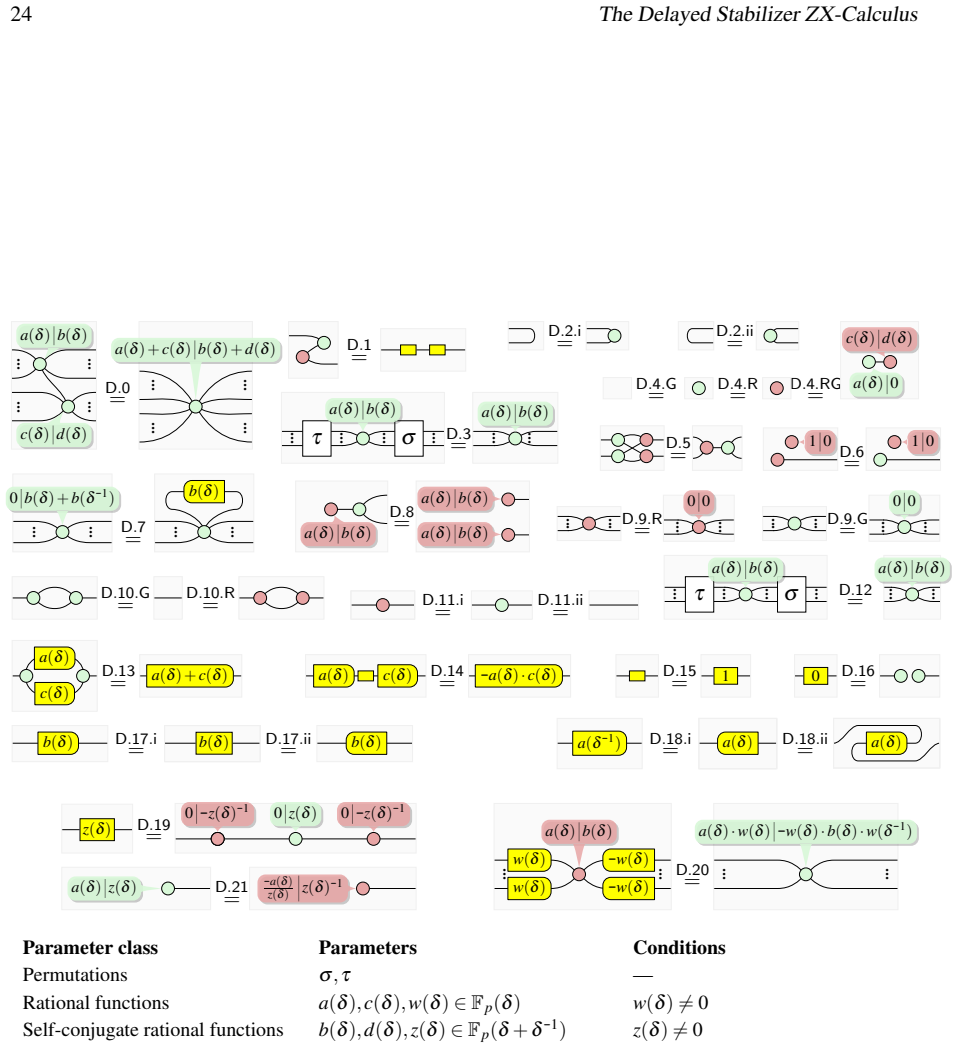
Summary. The paper introduces the delayed stabilizer ZX-calculus (δZX), extending the odd-prime-dimensional stabilizer ZX-calculus by a single delay generator that encodes translation-invariant infinite processes (lattice codes, convolutional codes, infinite graph states). It supplies two semantics: (i) observational equivalence classes of monotone sequences of completely positive maps / infinite stabilizer groups obtained by unrolling, and (ii) generating tableaux—shifted affine Lagrangian relations over the rational function field F_p(δ)—from which the infinite stabilizers are recovered by geometric series. A complete equational theory is given (generalised spiders, Euler decomposition, colour change), and every diagram is reduced via scalable notation and Schur-complementation (generalised local complementation/pivoting) to a unique reduced AP-form that matches the canonical generating tableau. Theorem 9 establishes that the interpretation into sALR_fd is a †-compact-closed equivalence, hence soundness, universality and completeness for the generating-tableau semantics.
Significance. The work fills a genuine gap: ordinary ZX only describes finite truncations, while the literature on topological and convolutional codes is full of infinite, translation-invariant patterns. By giving a finite graphical language with a complete equational theory and a unique normal form, the paper reduces questions about infinite stabilizer processes to finite rewriting and graph theory. The connection to Haah’s polynomial methods, Wilde–Brun generating tableaux, and the authors’ own observational-behaviour framework is cleanly made. Completeness is proved by an explicit normal-form algorithm (graph-like → AP-form → reduced AP-form) backed by detailed inductive lemmas in the appendices; the construction is therefore machine-checkable in principle and immediately usable for reasoning about quantum convolutional codes and lattice foliations. The honest treatment of oplax composition under geometric expansion (catastrophic encoders) is a strength rather than a defect.
minor comments (6)
- The relationship between the two semantics (Γ(Ext(D)) ⊆ StabGrp(D), Proposition 8) is stated correctly but could be flagged more prominently in the introduction and contributions list, so that a reader interested only in infinite channels does not over-read the completeness claim.
- Section 6.1 (Definitions 28–32): the case distinction used to define generalised spiders is well-defined (Lemma 13), yet a short forward pointer to the self-conjugate field F_p(δ+δ^{-1}) (Proposition 9) would help the reader before the axioms are stated.
- Figure 2 and Axiom 5: the generalised Euler decomposition is stated for self-conjugate labels; a one-line remark that the ordinary ZX Euler rule is recovered when the label is constant would improve readability for ZX specialists.
- Example 12 (delayed controlled-X): the infinite propagation of a Pauli-X is illuminating; adding a brief cross-reference to the catastrophic-encoder discussion of Example 8 would tighten the narrative.
- Typographical: occasional missing spaces around δ-powers and a few long displayed equations that break across columns in the arXiv rendering; these are purely cosmetic.
- References: the concurrent work on observational behaviours (Comfort–de Felice 2026) is cited; once published, a stable bibliographic entry would be preferable.
Circularity Check
No significant circularity: completeness is a standard normal-form reduction to an independently defined generating tableau; self-citations supply black-box finite ZX results and the observational framework, not the target equivalence.
specific steps
-
self citation load bearing
[Section 4.1, Proposition 4 and surrounding text; also Theorem 7 / Corollary 2]
"It follows from essentially the same argument as that of Comfort and de Felice [14, Lem. 6.7], that this yields functorial semantics for stateful ZX-diagrams: Proposition 4. … Theorem 7. There is a faithful †-compact closed discard functor Lim: Obs(ALR_fd) o AR_∞ … [14, Cor. 5.6]"
The observational-behaviour semantics and the infinite-stabilizer-group limit are justified by direct appeal to the authors’ concurrent/prior paper [14]. This is load-bearing for the first semantics (Obs and StabGrp) but is not used in the proof of the main completeness result (Theorem 9) for the generating-tableau semantics; hence only a minor, non-central circularity flag.
full rationale
The load-bearing claim (Theorem 9) is that the interpretation of δZX into sALR_fd is a †-CC equivalence. Soundness of the axioms is direct verification against the generating-tableau semantics (Section 6.2). Universality and completeness follow from an explicit rewrite sequence (Lemmas 7, Props. 12–14) that puts every diagram into reduced AP-form, whose data are precisely the unique canonical generating tableau of Proposition 6 (proved by elementary linear algebra over F_p(δ) in Appendix B). The normal form is therefore not defined in terms of the rewrite rules; the rules are shown to reach the independently unique tableau. Composition under geometric-series expansion is only oplax (Theorem 8), but that fact is internal and does not affect completeness for sALR_fd itself. Self-citations ([7] for finite ZX, [14] for Obs and Lim) are used as black boxes for prior fragments; they do not force the new normal-form uniqueness or the delayed axioms. No fitted parameters, no self-definitional loop, and no uniqueness theorem imported solely by author citation appear in the central chain. Score 1 reflects only the minor, non-load-bearing self-citation for the secondary observational semantics.
Axiom & Free-Parameter Ledger
axioms (5)
- domain assumption Odd-prime-dimensional stabilizer ZX-calculus is sound, universal and complete for affine Lagrangian relations (Booth–Carette, Poór et al., Booth–Carette–Comfort).
- domain assumption Observational equivalence of monotone sequences of completely-positive maps (Comfort–de Felice) correctly captures ‘same information content’.
- ad hoc to paper The delay generator satisfies only the sliding equations with spiders (Definition 17).
- ad hoc to paper Shifted symplectic form ϖ_n(f,g) = ω_n(f(δ),g(δ^{-1})) correctly encodes translation-invariant commutation of Pauli sequences.
- standard math Standard linear algebra over the field of rational functions F_p(δ) (Gaussian elimination, Hermitian matrices, Schur complements).
invented entities (3)
-
delay generator δ
no independent evidence
-
generating tableau (shifted affine Lagrangian relation over F_p(δ))
no independent evidence
-
observational behaviours Obs(C) of monotone sequences
no independent evidence
read the original abstract
Many stabilizer quantum error-correcting codes are built from a finite pattern repeated across space or time, such as lattice codes, translation-invariant graph states, and quantum convolutional codes. Ordinary stabilizer ZX-diagrams capture only finite truncations of such systems, obscuring the repeated structure that defines them. We introduce the delayed stabilizer ZX-calculus, a finite graphical language for these infinite, translation-invariant processes. It extends the odd-prime-dimensional stabilizer ZX-calculus with a single new generator, the delay, which feeds data from one time step to the next. We equip the calculus with two semantics. In the first semantics, we interpret the behaviour of a delayed ZX-diagram as an equivalence class of sequences of quantum channels; where two sequences are identified if they have the same information content. We show that the behaviour of a delayed ZX-diagram uniquely determines an infinite stabilizer group. In the second semantics, we interpret the delay as a formal variable, encoding the translation-invariant families of Pauli operators as generating functions. This allows us to represent a delayed ZX-diagram in terms of a tableau of generating functions, from which the infinite stabilizer group can be recovered. Finally, we give a complete axiomatization of the delayed stabilizer ZX-calculus, featuring generalised Euler decomposition and colour change rules. Using generalised forms of local complementation and pivoting, we reduce every diagram to a unique normal form. This establishes soundness, universality, and completeness for the generating tableau semantics.
Figures



Reference graph
Works this paper leans on
-
[1]
093021, doi:10.1088/1367-2630/16/9/093021
Miriam Backens (2014):The ZX-calculus is complete for stabilizer quantum mechanics.New Journal of Physics16(9), p. 093021, doi:10.1088/1367-2630/16/9/093021
-
[2]
Baez & Jason Erbele (2015):Categories in Control.Theory and Applications of Categories30(24), pp
John C. Baez & Jason Erbele (2015):Categories in Control.Theory and Applications of Categories30(24), pp. 836–881. Available athttp://www.tac.mta.ca/tac/volumes/30/24/30-24.pdf
2015
-
[3]
Filippo Bonchi, Paweł Soboci ´nski & Fabio Zanasi (2015):Full Abstraction for Signal Flow Graphs. In: Proceedings of the 42nd Annual ACM SIGPLAN-SIGACT Symposium on Principles of Programming Lan- guages, POPL ’15, ACM, p. 515–526, doi:10.1145/2676726.2676993
-
[4]
2–29, doi:10.1016/j.ic.2016.03.002
Filippo Bonchi, Paweł Soboci ´nski & Fabio Zanasi (2017):The Calculus of Signal Flow Diagrams I: Linear relations on streams.Information and Computation252, p. 2–29, doi:10.1016/j.ic.2016.03.002. Available at https://eprints.soton.ac.uk/396532/
-
[5]
Filippo Bonchi, Paweł Soboci´nski & Fabio Zanasi (2021):A Survey of Compositional Signal Flow Theory, p. 29–56. Springer International Publishing, doi:10.1007/978-3-030-81701-5 2. Available athttps://inria. hal.science/hal-03325995v1/document
-
[6]
Robert I. Booth & Titouan Carette (2022):Complete ZX-Calculi for the Stabilizer Fragment in Odd Prime Dimensions. In Stefan Szeider, Robert Ganian & Alexandra Silva, editors:47th International Symposium on Mathematical Foundations of Computer Science (MFCS 2022),Leibniz International Proceedings in In- formatics (LIPIcs)241, Schloss Dagstuhl – Leibniz-Zen...
-
[7]
Booth, Titouan Carette & Cole Comfort (2024):Graphical Symplectic Algebra
Robert I. Booth, Titouan Carette & Cole Comfort (2024):Graphical Symplectic Algebra. arXiv:2401.07914v3. Accepted to FSCD 2026
Pith/arXiv arXiv 2024
-
[8]
Booth & Cole Comfort:Denotational semantics for stabilizer quantum programs
Robert I. Booth & Cole Comfort:Denotational semantics for stabilizer quantum programs. arXiv:2511.22734v1. Accepted to FSCD 2026
arXiv 2026
-
[9]
Titouan Carette, Emmanuel Jeandel, Simon Perdrix & Renaud Vilmart (2021):Completeness of Graphical Languages for Mixed State Quantum Mechanics.ACM Transactions on Quantum Computing2(4), p. 1–28, doi:10.1145/3464693
-
[10]
Titouan Carette, Marc de Visme & Simon Perdrix (2021):Graphical language with delayed trace: pictur- ing quantum computing with finite memory. In:Proceedings of the 36th Annual ACM/IEEE Symposium on Logic in Computer Science, LICS ’21, Association for Computing Machinery, New York, NY , USA, doi:10.1109/LICS52264.2021.9470553. arXiv:2102.03133
-
[11]
76–82, doi:10.1103/physreva.56.76
Richard Cleve & Daniel Gottesman (1997):Efficient computations of encodings for quantum error correc- tion.Physical Review A56(1), p. 76–82, doi:10.1103/physreva.56.76. arXiv:quant-ph/9607030
-
[12]
043016, doi:10.1088/1367-2630/13/4/043016
Bob Coecke & Ross Duncan (2011):Interacting quantum observables: categorical algebra and diagram- matics.New Journal of Physics13(4), p. 043016, doi:10.1088/1367-2630/13/4/043016
-
[13]
Cambridge University Press, doi:10.1017/9781316219317
Bob Coecke & Aleks Kissinger (2017):Picturing Quantum Processes: A First Course in Quantum Theory and Diagrammatic Reasoning. Cambridge University Press, doi:10.1017/9781316219317
-
[14]
Cole Comfort & Giovanni de Felice (2026):Finite Observations, Infinite Behaviour: Bicategorical Semantics for Stateful Monoidal Processes
2026
-
[15]
In:Electronic Proceedings in Theoretical Computer Science, 372, EPTCS, pp
Cole Comfort & Aleks Kissinger (2022):A Graphical Calculus for Lagrangian Relations. In:Electronic Proceedings in Theoretical Computer Science, 372, EPTCS, pp. 338–351, doi:10.4204/EPTCS.372.24
-
[16]
4452–4505, doi:10.1063/1.1499754
Eric Dennis, Alexei Kitaev, Andrew Landahl & John Preskill (2002):Topological quantum memory.Journal of Mathematical Physics43(9), p. 4452–4505, doi:10.1063/1.1499754. arXiv:quant-ph/0110143
-
[17]
Daniel Gottesman (1997):Stabilizer Codes and Quantum Error Correction. Ph.D. thesis, Caltech. arXiv:quant-ph/9705052
Pith/arXiv arXiv 1997
-
[18]
David Gross (2006):Hudson’s theorem for finite-dimensional quantum systems.Journal of Mathematical Physics47(12), doi:10.1063/1.2393152. arXiv:0602001. C. Comfort and G. de Felice31
-
[19]
351–399, doi:10.1007/s00220-013-1810-2
Jeongwan Haah (2013):Commuting Pauli Hamiltonians as Maps between Free Modules.Communications in Mathematical Physics324(2), p. 351–399, doi:10.1007/s00220-013-1810-2. arXiv:1204.1063
-
[20]
299, doi:10.15446/recolma.v50n2.62214
Jeongwan Haah (2017):Algebraic Methods for Quantum Codes on Lattices.Revista Colombiana de Matem´aticas50(2), p. 299, doi:10.15446/recolma.v50n2.62214
-
[21]
Journal of Mathematical Physics62(9), doi:10.1063/5.0022185
Jeongwan Haah (2021):Clifford quantum cellular automata: Trivial group in 2D and Witt group in 3D. Journal of Mathematical Physics62(9), doi:10.1063/5.0022185. arXiv:1907.02075
-
[22]
G. David Forney Jr & Saikat Guha (2005):Simple Rate-1/3 Convolutional and Tail-Biting Quantum Error- Correcting Codes. In:Proceedings. International Symposium on Information Theory, 2005. ISIT 2005., pp. 1028–1032, doi:10.1109/ISIT.2005.1523495. arXiv:quant-ph/0501099
-
[23]
P. Katis, N. Sabadini & R.F.C. Walters (1997):Bicategories of processes.Journal of Pure and Applied Algebra115(2), p. 141–178, doi:10.1016/s0022-4049(96)00012-6
-
[24]
Aleks Kissinger (2022):Phase-free ZX diagrams are CSS codes (...or how to graphically grok the surface code). arXiv:arXiv:2204.14038
Pith/arXiv arXiv 2022
-
[25]
Preprint
Aleks Kissinger & John van de Wetering (2024):Picturing Quantum Software: An Introduction to the ZX- Calculus and Quantum Compilation. Preprint. Available athttps://zxcalc.github.io/book
2024
-
[26]
Kitaev (2003):Fault-tolerant quantum computation by anyons.Annals of Physics303(1), p
A.Yu. Kitaev (2003):Fault-tolerant quantum computation by anyons.Annals of Physics303(1), p. 2–30, doi:10.1016/s0003-4916(02)00018-0. arXiv:quant-ph/9707021
-
[27]
Werner:Quantum Channels with Memory72(6), p
Dennis Kretschmann & Reinhard F. Werner:Quantum Channels with Memory72(6), p. 062323. doi:10.1103/PhysRevA.72.062323. arXiv:quant-ph/0502106
-
[28]
Neretin (2011):Lectures on Gaussian Integral Operators and Classical Groups.EMS Series of Lectures in Mathematics91, European Mathematical Society
Yurii A. Neretin (2011):Lectures on Gaussian Integral Operators and Classical Groups.EMS Series of Lectures in Mathematics91, European Mathematical Society. Available athttps://www.mat.univie. ac.at/%7Eneretin/lectures/chapter9.ps
2011
-
[29]
Briegel:Universal resources for measurement-based quantum computation97(15), p
Maarten Van den Nest, Akimasa Miyake, Wolfgang D ¨ur & Hans J. Briegel:Universal resources for measurement-based quantum computation97(15), p. 150504. doi:10.1103/PhysRevLett.97.150504. arXiv:quant-ph/0604010
-
[30]
Michael A. Nielsen & Isaac L. Chuang (2012):Quantum Computation and Quantum Information: 10th Anniversary Edition. Cambridge University Press, doi:10.1017/cbo9780511976667
-
[31]
Harold Ollivier & Jean-Pierre Tillich (2003):Description of a Quantum Convolutional Code.Physical Review Letters91(17), doi:10.1103/physrevlett.91.177902. arXiv:0304189
-
[32]
2776–2798, doi:10.1109/tit.2009.2018339
David Poulin, Jean-Pierre Tillich & Harold Ollivier (2009):Quantum Serial Turbo Codes.IEEE Transactions on Information Theory55(6), p. 2776–2798, doi:10.1109/tit.2009.2018339. arXiv:0712.2888
-
[33]
Boldizs ´ar Po ´or, Robert I. Booth, Titouan Carette, John van de Wetering & Lia Yeh (2023):The Qupit Sta- bilizer ZX-travaganza: Simplified Axioms, Normal Forms and Graph-Theoretic Simplification.Electronic Proceedings in Theoretical Computer Science384, p. 220–264, doi:10.4204/eptcs.384.13
-
[34]
Peter Selinger (2004):Towards a semantics for higher-order quantum computation. pp. 127–143. Available athttps://mathstat.dal.ca/ ~selinger/qpl2004/PDFS/09Selinger.pdf
2004
-
[35]
Alan Weinstein (1982):The symplectic “category”, p. 45–51. Springer Berlin Heidelberg, doi:10.1007/bfb0092426
-
[36]
John van de Wetering (2020):ZX-calculus for the working quantum computer scientist. arXiv:arXiv:2012.13966
Pith/arXiv arXiv 2020
-
[37]
Wilde (2008):Quantum coding with entanglement
Mark M. Wilde (2008):Quantum coding with entanglement. Ph.D. thesis, University of Southern California. arXiv:0806.4214
Pith/arXiv arXiv 2008
-
[38]
Entanglement-Assisted Quantum Convolutional Coding
Mark M. Wilde & Todd A. Brun (2010):Entanglement-assisted quantum convolutional coding.Physical Review A81(4), doi:10.1103/physreva.81.042333. arXiv:0712.2223
work page internal anchor Pith review Pith/arXiv arXiv doi:10.1103/physreva.81.042333 2010
-
[39]
Mark M. Wilde, Hari Krovi & Todd A. Brun (2010):Convolutional entanglement distillation. In:2010 IEEE International Symposium on Information Theory, IEEE, p. 2657–2661, doi:10.1109/isit.2010.5513666. arXiv:0708.3699. 32The Delayed Stabilizer ZX-Calculus A Proofs of Section 3 Proposition 2.Proj(CPM)is a discard bicategory with respect to the trace and thep...
discussion (0)
Sign in with ORCID, Apple, or X to comment. Anyone can read and Pith papers without signing in.