REVIEW 3 major objections 5 minor 70 references
Nonparametric Goodness-of-fit Testing under Covariate Shift
T0 review · 3 major / 5 minor · reviewed 2026-08-08 · deepseek-v4-flash
Pith's one-line read The paper proves that bootstrap confidence balls for a target-domain regression function reach nominal coverage under covariate shift.
desk verdict Real and careful theory — the first nonasymptotic L2(Q) coverage guarantees under covariate shift — but 'sharpness' is an overclaim and the coverage theorem only holds for exactly known density ratio and exact target kernel integrals. read the letter →
The pith
A machine-rendered reading of the paper's core claim, the machinery that carries it, and where it could break.
The reading
What carries the argument
The engine is the truncated importance-weighted kernel ridge estimator $\hat f=k_x^\top(K+n\lambda W^{-1})^{-1}y$, with weight $w_n(x)=\min\{\rho(x),\tau_n\}$, paired with a multiplier bootstrap $B=\sqrt n\, k_x^\top(K+n\lambda W^{-1})^{-1}\mathrm{diag}(\hat\varepsilon)z$ whose $L^2(Q)$-norm is evaluated as $(a^\top K_Q a)^{1/2}$ using the fixed matrix $K_Q=(\langle k_{X_i},k_{X_j}\rangle_{L^2(Q)})$. The proof machinery is operator-theoretic: the unitary isometry $L_Q^{1/2}:\mathrm{Ran}(L_Q)\to H$ generated by the square root of the target integral operator lets the source-side RKHS calculus be compared with the target $L^2(Q)$ geometry. Two compatibility conditions carry the argument: the regularized transfer coverage condition $L_Q\preceq C_1^2(L_{P_w}+\lambda I)$ makes the source risk control the target risk, and the non-degenerate covariance condition prevents the Gaussian covariance from degenerating in the target norm, which is what allows anti-concentration. The total error $\Delta=\Delta_G+\Delta_B+\Delta_{\mathrm{bias}}$ enters the coverage bound multiplied by $\sqrt{\tau_n}$, the anti-concentration factor from Lemma 4.1.
What would settle it
Run Algorithm 1 in the oracle setting with known $\rho$, a compact covariate space, a Gaussian RBF kernel, source $N(0,4)$ and target $N(1,1)$ covariates, and $n=1000$, repeating the coverage experiment in Table 2; if the empirical coverage of the 90% ball deviates from 0.90 by more than the theorem's bound, the Gaussian-coupling or bootstrap-coupling step is wrong. A cheaper targeted check is to test Assumption 4.5 numerically by computing the smallest eigenvalue ratio between the two covariance operators it compares; if that ratio is not bounded below by a constant independent of $n$, the anti-concentration step is unavailable and coverage can break.
Extended reading notes
Core claim
On its own terms, the paper's central claim is Theorem 4.1: under Assumptions 4.1–4.5, the coverage error of the bootstrap confidence ball $\mathrm{CS}_\alpha(\hat f)$ is bounded by $|\mathbb{P}(f^*\notin \mathrm{CS}_\alpha(\hat f))-\alpha|\lesssim \eta+\sqrt{\tau_n}\Delta$, with $\Delta=\Delta_G+\Delta_B+\Delta_{\mathrm{bias}}$. The proof splits $\Delta$ into the deterministic bias of the truncated IWKRR estimator, the Gaussian approximation of its stochastic fluctuation in the target $L^2(Q)$ geometry, and the multiplier-bootstrap approximation of that Gaussian, and controls each term through operator comparisons between the target integral operator $L_Q$ and the regularized weighted-source operator $L_{P_w}+\lambda I$. Corollaries 4.2–4.4 turn the general bound into explicit rates, for instance $n^{-(\beta-5)(\beta+10)/(6(\beta+3)(2\beta+5))}\log^3 n$ when the density ratio is bounded and the kernel eigenvalues decay like $k^{-\beta}$ with $\beta>5$. The paper is thus establishing that nonparametric target-domain inference under covariate shift is feasible with asymptotically valid coverage, provided the density ratio is known and two kernel-dependent compatibility conditions hold.
Load-bearing premise
The load-bearing premise is that the target-to-source density ratio $\rho(x)$ is known exactly; Section 7 states that estimating $\rho$ is not covered and its effect on the bootstrap approximation and finite-sample coverage remains unclear and challenging.
Editorial extensions
If this is right
- The inverted test rejects $H_0:\|f_0-f^*\|_{L^2(Q)}=0$ whenever $f_0$ falls outside the bootstrap ball, and Theorem 4.2 shows power tends to 1 for any fixed target-domain separation.
- With bounded density ratio and polynomial spectral decay $\mu_k\asymp k^{-\beta}$, $\beta>5$, the miscoverage rate is $n^{-(\beta-5)(\beta+10)/(6(\beta+3)(2\beta+5))}\log^3 n$; with exponential spectral decay it is $n^{-1/10}(\log n)^{3/2+1/(2\zeta)}$.
- A sub-exponential density-ratio tail is handled by a growing truncation level, while a heavy-tailed ratio with a bounded $\theta$-th moment ($\theta>7$) still yields polylogarithmic coverage error when the kernel eigenvalues decay exponentially.
- The same confidence-ball construction can be used for composite nulls, such as monotonicity of a target regression function, and for two-sample comparisons, as demonstrated in the Survey of Consumer Finances applications.
Reading between the lines
- Editorial inference: if the density ratio is estimated rather than known, the advertised coverage guarantee has no support; Section 7 explicitly leaves this effect unquantified, so a plug-in version is likely to undercover and should be validated by experiment or augmented with a sensitivity analysis.
- Editorial inference: the explicit rates in Corollaries 4.2–4.4 are conservative; the proof uses piecewise optimizer balancing, so a natural testable extension is to compare empirical miscoverage slopes in simulations with the stated exponents to see whether faster decay is possible under the same assumptions.
- Editorial inference: because the bootstrap norm is a cheap quadratic form through the fixed matrix $K_Q$, the method's practical cost is dominated by a single kernel ridge solve; this makes it a plausible building block for routine target-domain uncertainty quantification once reliable density-ratio estimates are available.
Editorial analysis
A structured set of objections, weighed in public.
Referee Report
Summary. The paper proposes a nonparametric goodness-of-fit procedure under covariate shift: from source-labelled data it builds an L2(Q)-norm confidence ball for the regression function using truncated importance-weighted kernel ridge regression plus a multiplier bootstrap. The main result (Theorem 4.1) bounds the miscoverage by η + sqrt(τ_n)(Δ_G+Δ_B+Δ_bias) under four assumptions, and Corollaries 4.2--4.4 translate this into explicit rates under polynomial or exponential kernel eigenvalue decay and bounded, sub-exponential, or bounded-θ-moment density ratios. The proof chain is explicit: Bahadur representation, Gaussian coupling, bootstrap coupling, and anti-concentration are assembled with operator-theoretic tools. An SCF data analysis and simulations are included.
Significance. If the results hold as stated, the paper provides one of the first nonasymptotic, operator-level coverage guarantees for bootstrap confidence balls in the target distribution under covariate shift. The proof is detailed and uses a coherent RKHS/L2(Q) operator calculus, with couplings due to Zaitsev, Monrad--Philipp, and Pinelis--Sakhanenko deployed carefully; the explicit rates are a genuine contribution. However, the guarantees are oracle: Algorithm 1 and all theorems require exact knowledge of the density ratio ρ and exact target L2(Q) inner products. The paper itself concedes in Section 7 that the effect of estimating ρ is not characterized. Consequently, the practical claim of 'valid inference under covariate shift' is not established in the usual setting where only unlabelled target covariates are observed. The abstract's word 'sharpness' is also unsupported by any lower bound.
major comments (3)
- [Corollaries 4.3 and 4.4] The central coverage theorem applies only when the target-to-source density ratio ρ and the target kernel matrix K_Q with entries <k_{X_i},k_{X_j}>_{L2(Q)} are known exactly. Algorithm 1 takes ρ as an input, and the theorem statements contain no term for an estimated density ratio or an estimated target Gram matrix. Section 7 explicitly states that replacing ρ by an estimate leaves the effect on the first-order approximation, bootstrap approximation, and finite-sample coverage 'unclear and challenging'. In the standard covariate-shift setting, where only source and unlabelled target covariates are available, the advertised nominal coverage is therefore not a theorem. This scope gap should be stated prominently in the abstract and introduction, or the paper should extend the analysis to estimated ρ and approximate K_Q (as in the 1200-sample Monte Carlo approximation used in Section 5.1).
- [Abstract and Section 1] Corollaries 4.3 and 4.4 claim coverage rates under the sub-exponential or bounded-θ-moment conditions and spectral decay, but the anti-concentration step in Lemma 4.1 and hence Theorem 4.1 requires Assumption 4.5. The proofs of these corollaries verify Assumption 4.4 through Lemma F.29 or Lemma F.31, but they do not verify the covariance lower bound in Assumption 4.5. As written, the stated rates for the sub-exponential and heavy-tailed cases are not fully established. The authors should either add a perturbation lemma proving Assumption 4.5 under the stated density-ratio conditions, or add Assumption 4.5 explicitly to the hypotheses of Corollaries 4.3 and 4.4.
- [Corollaries 4.3 and 4.4] The abstract claims 'nonasymptotic validity and sharpness' of the confidence sets, but no lower bound is proved anywhere in the paper. Theorem 4.1 and all corollaries give only upper bounds of the form ≲ on the coverage error. The word 'sharpness' should be removed or replaced by a precise statement such as 'explicit nonasymptotic bounds', unless a matching lower bound is added.
minor comments (5)
- [Section 5.1] The symbol ρ is used both for the density ratio function ρ(x) and for the positive lower-bound constant ρ in Assumption 4.5; the two uses are confusing in the same sentence. Consider denoting the lower bound by ρ_min or ρ_0.
- [Section 6] The text says the IWKRR estimator 'uses normalized importance weights and truncated weights w_n(x)=min{ρ(x),τ_n}'. The theoretical development uses unnormalized truncated weights; the use of normalized weights in the experiments should be clarified, and any discrepancy between the implemented and analysed weights should be discussed.
- [Section 1] In Study 1, empirical distances are evaluated with respect to the empirical measure \widehat{Q} on a held-out target set, while the theory is for the exact L2(Q) norm. The confidence intervals in Figure 5 are therefore intervals for the empirical target distance unless additional uniformity or approximation guarantees are provided; this should be stated explicitly.
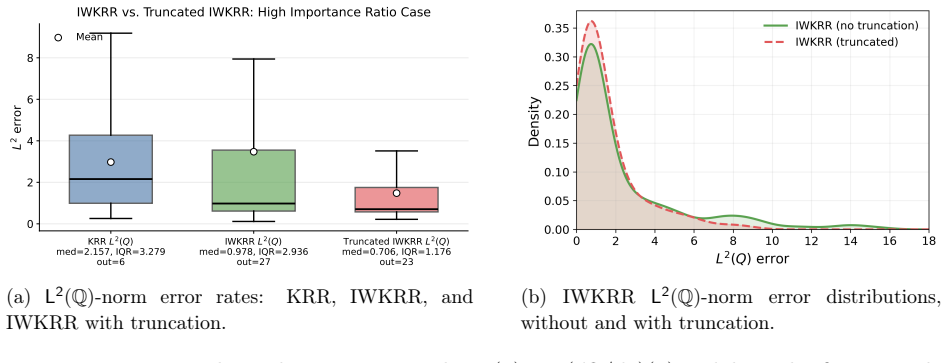
- [Section 6] Minor typographical issues: 'asourcepopulation' in Section 1 should be 'a source population'; Figure 4 repeats the same panel content; and the caption of Figure 1 uses 'out=' without explanation.
- [Section 6] Theorem 4.2 is a simple triangle-inequality argument plus convergence of the estimation error and critical value; it could be stated as a remark to avoid giving it the same weight as the main coverage theorem.
Circularity Check
No circular derivation: coverage theorem is conditional on explicit assumptions; the only self-citation is illustrative and non-load-bearing.
full rationale
The paper's central claim is that bootstrap confidence balls for f* in L2(Q) have miscoverage controlled by eta + sqrt(tau_n)Delta (Theorem 4.1). This is not circular: the error terms Delta_G, Delta_B, Delta_bias are not fitted or defined in terms of the final coverage; they are bounded explicitly in Propositions 4.1-4.5 using Assumptions 4.1-4.5, and those assumptions are stated independently and verified through external analytic inputs (Mercer's theorem, Cordes inequality, Gaussian couplings of Zaitsev and Monrad-Philipp, Bernstein inequalities). The regularized transfer coverage condition (Assumption 4.4) and non-degenerate covariance condition (Assumption 4.5) are genuine hypotheses, not restatements of the coverage conclusion. The only self-citation is to 'Assumption 4 in Xia and Yuan [2021]' as an example of a non-degeneracy condition; it plays no role in the proof and is not used to exclude alternatives, so it is not load-bearing. Section 7's caveat that estimation of rho is not covered is an acknowledged scope limitation: the theorems are explicitly conditional on known rho and exact kernel matrix K_Q, and the paper does not claim a coverage theorem for estimated rho. This is a gap in practical applicability, not a circular step. No fitted input is renamed as a prediction, and no known result is repackaged under new coordinates. The derivation is therefore self-contained against its stated assumptions.
Assumptions & free parameters
free parameters (3)
- lambda_n (regularization parameter) =
n^{-a} in theoretical corollaries; validation-tuned in experiments
- tau_n (truncation level) =
n^{delta} in theoretical corollaries; validation-tuned in experiments
- C0 (truncation constant under bounded density ratio) =
chosen as a sufficiently large fixed constant C0 >= max(rho_bar, tau0)
assumptions (8)
- domain assumption Known density ratio rho(x) = dQ_X/dP_X
- domain assumption Assumption 4.1: uniformly bounded noise |epsilon| <= sigma and E[epsilon^2|X] >= sigma^2
- domain assumption Assumption 4.2: source condition f* = L_{P_{w0}}^s g* for some s in [0,1]
- domain assumption Assumption 4.3: effective dimension condition N_lambda
- domain assumption Assumption 4.4: regularized transfer coverage ||L_Q^{1/2}(L_{P_w}+lambda I)^{-1/2}|| <= C1
- domain assumption Assumption 4.5: non-degenerate covariance and rho(X) >= rho_0 P-almost surely
- domain assumption Compact covariate space and bounded kernel sup_x k(x,x) <= kappa^2
- standard math Mercer's theorem and standard operator inequalities
Cite this review
Pith. "Pith review of Nonparametric Goodness-of-fit Testing under Covariate Shift." pith.science (2026). https://pith.science/paper/7O7BTNET
@misc{pith2026260804860,
  author       = {Pith},
  title        = {Pith review of: Nonparametric Goodness-of-fit Testing under Covariate Shift},
  year         = {2026},
  howpublished = {\url{https://pith.science/paper/7O7BTNET}},
  note         = {Machine review of arXiv:2608.04860}
}
read the original abstract
This paper develops procedures for nonparametric goodness-of-fit testing under covariate shift, where labelled data are drawn from a source population but goodness-of-fit is evaluated for a target population. The distribution mismatch is quantified by either a bounded moment condition or a sub-exponential tail condition on the target-to-source density ratio. Our method combines truncated importance-weighting kernel ridge regression with a multiplier bootstrap to construct confidence sets for the regression function. The truncation stabilizes the importance- weighting kernel ridge regression as well as the bootstrap calibration, making our approach applicable even when the density ratio has heavy tails. We prove nonasymptotic validity and sharpness of the resulting confidence sets under suitable operator compatibility conditions, and establish explicit error rates for coverage probability under specific conditions on the target- to-source density ratio and on the spectral decay of the kernel integral operator. Numerical experiments corroborate our theoretical findings.
Figures


Figures from the paper (21 more)


Reference graph
Works this paper leans on
-
[1]
2017 , author =
On some extensions of Bernstein's inequality for self-adjoint operators , journal =. 2017 , author =
2017
-
[2]
arXiv preprint arXiv:2302.06578 , year=
Kernel ridge regression inference , author=. arXiv preprint arXiv:2302.06578 , year=
-
[3]
2018 , publisher=
High-dimensional probability: An introduction with applications in data science , author=. 2018 , publisher=
2018
-
[4]
The Journal of Machine Learning Research , volume=
A least-squares approach to direct importance estimation , author=. The Journal of Machine Learning Research , volume=. 2009 , publisher=
2009
-
[5]
arXiv preprint arXiv:1206.4650 , year=
Analysis of kernel mean matching under covariate shift , author=. arXiv preprint arXiv:1206.4650 , year=
-
[6]
2013 , publisher=
The bootstrap and Edgeworth expansion , author=. 2013 , publisher=
2013
-
[7]
Journal of the Royal Statistical Society Series B: Statistical Methodology , volume=
Statistical inferences of linear forms for noisy matrix completion , author=. Journal of the Royal Statistical Society Series B: Statistical Methodology , volume=. 2021 , publisher=
2021
-
[8]
1994 , publisher=
An introduction to the bootstrap , author=. 1994 , publisher=
1994
Show all 70 references
-
[9]
The annals of statistics , volume=
Some asymptotic theory for the bootstrap , author=. The annals of statistics , volume=. 1981 , publisher=
1981
-
[10]
1990 , publisher=
Spline models for observational data , author=. 1990 , publisher=
1990
-
[11]
2013 , publisher=
The nature of statistical learning theory , author=. 2013 , publisher=
2013
-
[12]
2002 , publisher=
Learning with kernels: support vector machines, regularization, optimization, and beyond , author=. 2002 , publisher=
2002
-
[13]
Philosophical Transactions of the Royal Society of London
Functions of positive and negative type, and their connection with the theory of integral equations , author=. Philosophical Transactions of the Royal Society of London. Series A , volume=
-
[14]
arXiv preprint arXiv:2303.04020 , year=
When is Importance Weighting Correction Needed for Covariate Shift Adaptation? , author=. arXiv preprint arXiv:2303.04020 , year=
-
[15]
Spectral Theory of Linear Differential Operators and Comparison Algebras , publisher=
Cordes, Heinz Otto , year=. Spectral Theory of Linear Differential Operators and Comparison Algebras , publisher=
-
[16]
Foundations of Computational Mathematics , volume=
Optimal rates for the regularized least-squares algorithm , author=. Foundations of Computational Mathematics , volume=. 2007 , publisher=
2007
-
[17]
Journal of statistical planning and inference , volume=
Improving predictive inference under covariate shift by weighting the log-likelihood function , author=. Journal of statistical planning and inference , volume=. 2000 , publisher=
2000
-
[18]
Machine Learning in Non-Stationary Environments: Introduction to Covariate Shift Adaptation , urldate =
Masashi Sugiyama and Motoaki Kawanabe , publisher =. Machine Learning in Non-Stationary Environments: Introduction to Covariate Shift Adaptation , urldate =
-
[19]
IEEE Transactions on knowledge and data engineering , volume=
A survey on transfer learning , author=. IEEE Transactions on knowledge and data engineering , volume=. 2009 , publisher=
2009
-
[20]
Domain Adaptation for Medical Image Analysis: A Survey , volume=
Guan, Hao and Liu, Mingxia , year=. Domain Adaptation for Medical Image Analysis: A Survey , volume=. IEEE Transactions on Biomedical Engineering , publisher=
-
[21]
Instance Weighting for Domain Adaptation in NLP
Jiang, Jing and Zhai, ChengXiang. Instance Weighting for Domain Adaptation in NLP. Proceedings of the 45th Annual Meeting of the Association of Computational Linguistics. 2007
2007
-
[22]
The Annals of Statistics , volume=
Optimally tackling covariate shift in RKHS-based nonparametric regression , author=. The Annals of Statistics , volume=. 2023 , publisher=
2023
-
[23]
Advances in neural information processing systems , volume=
Learning bounds for importance weighting , author=. Advances in neural information processing systems , volume=
-
[24]
arXiv preprint arXiv:0902.3430 , year=
Domain adaptation: Learning bounds and algorithms , author=. arXiv preprint arXiv:0902.3430 , year=
-
[25]
Conference On Learning Theory , pages=
Marginal singularity, and the benefits of labels in covariate-shift , author=. Conference On Learning Theory , pages=. 2018 , organization=
2018
-
[26]
2025 , eprint=
Label-Efficient Deep Learning in Medical Image Analysis: Challenges and Future Directions , author=. 2025 , eprint=
2025
-
[27]
2024 , author =
A comprehensive survey on deep active learning in medical image analysis , journal =. 2024 , author =
2024
-
[28]
Advances in Neural Information Processing Systems , volume=
Towards a unified analysis of kernel-based methods under covariate shift , author=. Advances in Neural Information Processing Systems , volume=
-
[29]
International Conference on Machine Learning , pages=
A new similarity measure for covariate shift with applications to nonparametric regression , author=. International Conference on Machine Learning , pages=. 2022 , organization=
2022
-
[30]
The Annals of Statistics , volume=
Pseudo-labeling for kernel ridge regression under covariate shift , author=. The Annals of Statistics , volume=. 2026 , publisher=
2026
-
[31]
Bernoulli , volume=
Local convergence rates of the nonparametric least squares estimator with applications to transfer learning , author=. Bernoulli , volume=. 2024 , publisher=
2024
-
[32]
Anti-concentration and honest, adaptive confidence bands , volume=
Chernozhukov, Victor and Chetverikov, Denis and Kato, Kengo , year=. Anti-concentration and honest, adaptive confidence bands , volume=. The Annals of Statistics , publisher=
-
[33]
The Annals of Statistics , number =
Victor Chernozhukov and Denis Chetverikov and Kengo Kato , title =. The Annals of Statistics , number =
-
[34]
Stochastic Processes and their Applications , volume=
Empirical and multiplier bootstraps for suprema of empirical processes of increasing complexity, and related Gaussian couplings , author=. Stochastic Processes and their Applications , volume=. 2016 , publisher=
2016
-
[35]
The Annals of Probability , number =
Victor Chernozhukov and Denis Chetverikov and Kengo Kato , title =. The Annals of Probability , number =
-
[36]
Conference on Learning Theory , pages=
Strong Gaussian approximation for the sum of random vectors , author=. Conference on Learning Theory , pages=. 2022 , organization=
2022
-
[37]
Zaitsev, A. Yu. , title =. Theory of Probability & Its Applications , volume =
-
[38]
The Annals of Statistics , author=
Local and global asymptotic inference in smoothing spline models , volume=. The Annals of Statistics , author=. 2013 , month=
2013
-
[39]
arXiv preprint arXiv:1708.04753 , year=
Frequentist coverage and sup-norm convergence rate in Gaussian process regression , author=. arXiv preprint arXiv:1708.04753 , year=
-
[40]
arXiv preprint arXiv:2501.01610 , year=
Bootstrap Nonparametric Inference under Data Integration , author=. arXiv preprint arXiv:2501.01610 , year=
-
[41]
The Annals of Statistics , volume=
On nonparametric confidence intervals , author=. The Annals of Statistics , volume=. 1997 , publisher=
1997
-
[42]
The Annals of Statistics , number =
Christopher Genovese and Larry Wasserman , title =. The Annals of Statistics , number =
-
[43]
The Annals of Statistics , number =
Gin. The Annals of Statistics , number =
-
[44]
Tony Cai and Mark G
T. Tony Cai and Mark G. Low , title =. The Annals of Statistics , number =
-
[45]
Mathematical Methods of Statistics , volume=
Nonparametric confidence set estimation , author=. Mathematical Methods of Statistics , volume=. 2003 , publisher=
2003
-
[46]
The Annals of Statistics , volume=
Honest confidence regions for nonparametric regression , author=. The Annals of Statistics , volume=. 1989 , publisher=
1989
-
[47]
The Annals of Statistics , volume=
Adaptive hypothesis testing using wavelets , author=. The Annals of Statistics , volume=. 1996 , publisher=
1996
-
[48]
The Annals of Statistics , number =
James Robins and Aad van der Vaart , title =. The Annals of Statistics , number =
-
[49]
Bernoulli , volume=
Large ball probabilities, Gaussian comparison and anti-concentration , author=. Bernoulli , volume=. 2019 , publisher=
2019
-
[50]
2012 , publisher=
Machine learning in non-stationary environments: Introduction to covariate shift adaptation , author=. 2012 , publisher=
2012
-
[51]
international conference on machine learning , pages=
Dropout as a bayesian approximation: Representing model uncertainty in deep learning , author=. international conference on machine learning , pages=. 2016 , organization=
2016
-
[52]
Journal of Machine Learning Research , volume=
Covariate Shift Adaptation by Importance Weighted Cross Validation , author=. Journal of Machine Learning Research , volume=
-
[53]
2016 23rd International Conference on Pattern Recognition (ICPR) , pages=
On Regularization Parameter Estimation under Covariate Shift , author=. 2016 23rd International Conference on Pattern Recognition (ICPR) , pages=. 2016 , doi=. 1608.00250 , archivePrefix=
2016 arXiv
-
[54]
2018 24th International Conference on Pattern Recognition (ICPR) , pages=
Effects of Sampling Skewness of the Importance-Weighted Risk Estimator on Model Selection , author=. 2018 24th International Conference on Pattern Recognition (ICPR) , pages=. 2018 , doi=. 1804.07344 , archivePrefix=
2018 arXiv
-
[55]
2019 IEEE 29th International Workshop on Machine Learning for Signal Processing (MLSP) , pages=
Robust importance-weighted cross-validation under sample selection bias , author=. 2019 IEEE 29th International Workshop on Machine Learning for Signal Processing (MLSP) , pages=. 2019 , organization=
2019
-
[56]
Annals of the Institute of Statistical Mathematics , volume=
Direct Importance Estimation for Covariate Shift Adaptation , author=. Annals of the Institute of Statistical Mathematics , volume=
-
[57]
Advances in Neural Information Processing Systems , volume=
Correcting Sample Selection Bias by Unlabeled Data , author=. Advances in Neural Information Processing Systems , volume=
-
[58]
Algorithmic Learning Theory , series=
Sample Selection Bias Correction Theory , author=. Algorithmic Learning Theory , series=. 2008 , publisher=
2008
-
[59]
Advances in Neural Information Processing Systems , volume=
Conformal Prediction Under Covariate Shift , author=. Advances in Neural Information Processing Systems , volume=
-
[60]
The Annals of Statistics , volume=
Conformal Prediction Beyond Exchangeability , author=. The Annals of Statistics , volume=. 2023 , doi=
2023
-
[61]
arXiv preprint arXiv:2603.05897 , year=
A Minimax Theory of Nonparametric Regression Under Covariate Shift , author=. arXiv preprint arXiv:2603.05897 , year=
- [62]
-
[63]
Probability Theory and Related Fields , volume=
Nearby Variables with Nearby Conditional Laws and a Strong Approximation Theorem for Hilbert Space Valued Martingales , author=. Probability Theory and Related Fields , volume=. 1991 , doi=
1991
-
[64]
Review of Economics and Statistics , volume=
Nonparametric Tests for Treatment Effect Heterogeneity , author=. Review of Economics and Statistics , volume=
-
[65]
Journal of the Royal Statistical Society: Series B (Statistical Methodology) , volume=
Randomization Inference for Treatment Effect Variation , author=. Journal of the Royal Statistical Society: Series B (Statistical Methodology) , volume=
-
[66]
Proceedings of the 58th Annual Meeting of the Association for Computational Linguistics , pages=
Don't Stop Pretraining: Adapt Language Models to Domains and Tasks , author=. Proceedings of the 58th Annual Meeting of the Association for Computational Linguistics , pages=
-
[67]
Nature , volume=
Large Language Models Encode Clinical Knowledge , author=. Nature , volume=. 2023 , doi=
2023
-
[68]
Advances in Neural Information Processing Systems , volume=
LegalBench: A Collaboratively Built Benchmark for Measuring Legal Reasoning in Large Language Models , author=. Advances in Neural Information Processing Systems , volume=. 2023 , doi=
2023
-
[69]
Theory of Probability and Its Applications , volume=
Remarks on Inequalities for Large Deviation Probabilities , author=. Theory of Probability and Its Applications , volume=. 1986 , doi=
1986
-
[70]
2023 , howpublished=
2023
Reviewed August 8, 2026 · model on record in the stance chip above.
Discussion (0). Continue with ORCID to comment.