REVIEW 4 major objections 5 minor 57 references
Umbrella Reinforcement Learning -- computationally efficient tool for hard non-linear problems
T0 review · 4 major / 5 minor · reviewed 2026-08-12 · deepseek-v4-flash
Pith's one-line read Umbrella RL replaces trajectory-based exploration with a continuous agent ensemble and solves hard sparse-reward RL problems.
desk verdict A genuinely novel ensemble-entropy RL idea with an elegant derivation, but the practical updates drop terms the theory needs and the experiments are too thin to support the 'outperforms all SOTA' claim. read the letter →
The pith
A machine-rendered reading of the paper's core claim, the machinery that carries it, and where it could break.
The reading
What carries the argument
The central object is the time-averaged agent density $p(s)=\int_0^\infty \gamma^t p(s,t)\,dt$ together with the modified advantage function $A_u(s,a)=r-\tilde{\alpha}\log(p\cdot\pi)+v\cdot\nabla_s V_u-|\log\gamma|V_u$. The density replaces many discrete trajectories and makes the policy gradient depend on global state coverage, while the log-density term is the entropy force that widens exploration. The algorithm then solves two steady-state equations, a Bellman-type equation $\mathbb{E}_{a\sim\pi}A_u(s,a)=0$ and a continuity-type equation $\nabla_s\cdot(p\langle v\rangle_\pi)-\log\gamma(p-p_0)=0$, with three neural networks for policy, value, and density, using the gradient updates of the paper. This is what carries the argument: the ensemble density and value function are computed as steady states of PDEs rather than accumulated from episodes.
What would settle it
Compute finite-difference solutions of the two steady-state equations, $\mathbb{E}_{a\sim\pi}A_u(s,a)=0$ and $G(p,s)=0$, on a coarse grid covering the Multi-Valley Mountain Car domain and compare them with the neural-network outputs at the end of training; if the residuals are significantly nonzero, the learned value function and density are not the steady-state solutions the policy update assumes.
Extended reading notes
Core claim
Umbrella RL's central claim is that a continuous, effectively infinite ensemble of agents, described by a probability density $p(s,t)$, can be driven toward optimal behavior by maximizing a modified expected return $J_{\mathrm{URL}}(\pi,p)=J(\pi)+\alpha H[p\cdot\pi]$, where $H$ is the discounted joint entropy of the state distribution and policy. The entropy term acts as an automatic exploration-exploitation switch: while no reward has been found it encourages the density to spread over the state space, and once reward states are reached the ordinary return dominates and the ensemble condenses around them. The resulting optimality conditions are a differential advantage equation $\mathbb{E}_{a\sim\pi}A_u(s,a)=0$ and a steady-state density equation $G(p,s)=0$, solved by three neural networks with policy-gradient-style updates. In the two reported environments the method converges to a sensible, near-deterministic policy where trajectory-based baselines produce random or zero-reward behavior.
Load-bearing premise
The neural-network updates are derived from simplified versions of the steady-state equations, and the method assumes that the dropped correction terms, including second-order gradient terms and the divergence term in the density loss, are negligible; if they are not, the learned value function and density are not the ones the theory requires.
Editorial extensions
If this is right
- Sparse-reward tasks with no terminal state become solvable without hand-designed intrinsic rewards, reward shaping, or expert demonstrations.
- Computational cost stays tied to the state distribution rather than to the time discretization, so finer simulation steps do not degrade performance as they do for value iteration.
- The entropy coefficient $\alpha$ sets the exploration-exploitation balance globally, and removing the entropy term makes the algorithm fail on the tested hard problems.
- Because the formulation is continuous-time and general, the same scheme transfers to discrete-time RL and, the authors state, to a model-free version.
Reading between the lines
- A natural extension the authors do not develop is annealing $\alpha$ over training: starting large to force coverage and reducing it later should sharpen the final policy, but the theory presented here gives no guidance on how $\alpha$ should be scheduled.
- The method's reliance on estimating $\log p(s)$ suggests the entropy bonus will become harder to estimate in high-dimensional state spaces, so the curse of dimensionality may reappear for the density network even though the policy computation itself is mesh-free.
- Since $p(s)$ is time-averaged with a discount factor $\gamma$, the method effectively prioritizes states visited earlier in time; tuning $\gamma$ may act as a horizon control for exploration, a connection the paper leaves implicit.
- The comparison with value iteration suggests Umbrella RL could serve as a differentiable replacement for value iteration in continuous state spaces, where grid-based methods are memory-bound; testing on a higher-dimensional control task with a known optimal cost would directly probe that promise.
Editorial analysis
A structured set of objections, weighed in public.
Referee Report
Summary. The paper introduces Umbrella RL, a method that replaces trajectory sampling with a continuous ensemble of agents. The state distribution p(s) and value function V(s) are defined as solutions of coupled steady-state PDEs, Eqs. (14)-(15), derived from a discounted objective J_URL that adds an ensemble-entropy term to the expected return. Three neural networks parameterize the policy, the value function, and the density, and the paper proposes coupled gradient updates, Eqs. (19)-(21). The method is tested on two hard-exploration tasks, Multi-Valley Mountain Car and StandUp, and compared with PPO, RND, iLQR, and value iteration. The authors conclude that Umbrella RL outperforms all available state-of-the-art algorithms on hard RL problems with sparse rewards, state traps, and lack of terminal states.
Significance. The conceptual idea is genuinely interdisciplinary and potentially interesting: instead of simulating trajectories, solve a discounted MDP through a steady-state PDE system for the state density and value function, using NNs as function approximators. If the derivation were rigorous and the empirical evidence robust, this could offer a memory-efficient alternative to value iteration and a principled exploration mechanism for sparse-reward problems. The paper also makes its code available on GitHub. However, the central claim is much stronger than the evidence, and the derivation of the practical NN update rules contains a load-bearing gap that, as it stands, invalidates the claimed convergence to the optimum of J_URL. The contribution is therefore currently unsupported.
major comments (4)
- [Appendix A.5, Eqs. (A.39)-(A.45); main text Eqs. (19)-(20)] The update rules used in all experiments are not gradient steps for the residual losses (A.37) and (A.42). For the value function, Eq. (A.39) drops the term involving ∇_phi[v·∇_s V], i.e. the second-order derivative of V; for the density, Eq. (A.43) drops the entire divergence term ∇_s·(p v) from the residual. The manuscript states these are approximations ('we assume that the second-order gradients may be neglected'; 'we omit the divergence term') but provides no scaling argument or numerical check. If these dropped terms are not negligible, the learned V and p do not solve Eqs. (14)-(15), so the advantage A_u in Eq. (11)-which is used in the policy update (21)-is not the function defined by the theory. The claim that the algorithm converges to the optimum of J_URL is therefore unsupported.
- [Appendix A.8] The 'general approach' does not repair the gap. It defines a natural-gradient-like update P(θ) = (∇_θ y · diag(p) · (∇_θ y)^T)^{-1} ∇_θ y · diag(p) · f and then assumes, without proof, that P(θ) is a gradient of some function Π(θ) (Eq. A.74). Even accepting that assumption, the final update (A.80) uses ∇_θ y · diag(p) · f, whereas the gradient of a squared-residual objective E[||f||^2] would require (∇_θ f)·diag(p)·f. For the value equation, ∇_θ f contains the same second-order terms that were dropped; for the density equation, f itself contains the divergence, so ∇_θ f ≠ ∇_θ y. No identity equates these quantities. Thus the general approach still does not provide a convergence guarantee for the practical algorithm.
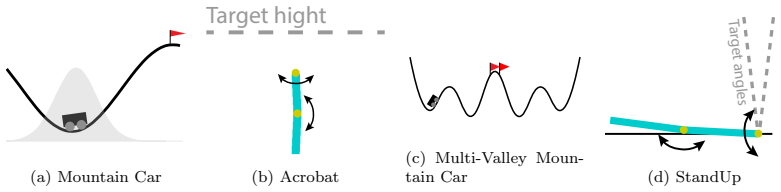
- [Sec. 4.3 and Figs. 2-4] The empirical support for the abstract's global claim is limited. Only two low-dimensional, deterministic toy tasks are considered. The proposed method is tuned per task, with learning rates and weight decays listed in Sec. 4.3, whereas PPO is used with 'default parameters' from Stable Baselines3. No error bars or confidence intervals appear in Figs. 2-4, despite the text stating that results were averaged and variance estimated. The memory comparison (UR approximately 1 GB vs VI approximately 16 GB) is presented as a figure-caption statement without a measurement protocol. These issues preclude the conclusion that Umbrella RL 'outperforms ... all available state-of-the-art algorithms'.
- [Sec. 4.3] The baseline descriptions are incomplete. RND is said to be applied 'for the problems where the observation was a sequence of images', yet the two environments provide low-dimensional state vectors; it is unclear how RND was adapted or whether it received the same information. iLQR is applied with smoothing of discontinuous functions, but the smoothing procedure and the exact treatment of the discrete action set are not specified. Without this detail, the failure of these baselines is not a controlled comparison.
minor comments (5)
- [Sec. 4.1] The domain of position is given as 'x ∈ [−0, 99, 099]', which appears to be a typo for [−0.99, 0.99].
- [Introduction] The sentence 'iLQR [10], MBMF [11], iLQR [10] and MBMF [11]' duplicates the citations; the listing should be cleaned up.
- [Footnote 6] The GitHub URL contains 'SatndUP', which is a typo for 'StandUp'.
- [Eq. (3)] The notation pt is used both for the time-dependent density and for the integration variable; the subscript t in dpt is undefined.
- [Sec. 6] The statement that the approach is 'free from the curse of dimensionality' is at odds with the use of NNs; the paper provides no complexity analysis controlling the network size as the state dimension grows.
Circularity Check
No significant circularity: the derivation chain is self-contained, and the noted approximations are correctness risks rather than circular reductions.
full rationale
The paper defines a single objective J_URL = J(pi) + alpha H[p·pi] and derives the policy gradient and modified advantage Au from that objective by a standard likelihood-ratio argument. The value function and average density are then characterized by the Bellman residual (Eq. 14) and the steady-state continuity equation (Eq. 15), which are not restatements of the objective or of the benchmark results. The neural-network updates in Eqs. (19)-(21) are presented as approximate gradient steps for those residuals; the approximations in Appendix A.5 (dropping second-order gradients and the divergence term) are explicit heuristic assumptions and could invalidate the claim that the learned V and p solve Eqs. (14)-(15), but they do not make the derivation circular: the terms omitted are not fitted targets or renamed outputs of the algorithm. The entropy coefficient alpha is a fixed scalar hyperparameter, not a parameter fitted to reproduce the benchmark curves; the UR-NE ablation is an independent experiment, not a constructional identity. Self-citations are limited to background examples (swarm defensive behavior in Ref. [39]) and to the conceptual umbrella-sampling antecedents (Refs. [44,45]); none of these carries the optimality or superiority claim. The empirical comparison against PPO, RND, iLQR, and VI is made against external algorithms and external implementations, so the central claim is not forced by the paper's own definitions. The load-bearing weaknesses of the paper are mathematical and empirical (unsupported neglect of second-order and divergence terms, small benchmarks), but they are not circularity.
Assumptions & free parameters
free parameters (3)
- Entropy coefficient alpha_tilde =
0.01
- Per-task learning rates and weight decays =
Different values for each of the three networks and for each of the two tasks
- Discount factor gamma =
0.95
assumptions (5)
- domain assumption The environment is a continuous-time Markov decision process with known deterministic dynamics v(s,a) and a stochastic policy pi(a|s).
- ad hoc to paper The coupled steady-state PDEs (14) and (15) characterize the optimum of the entropy-augmented objective.
- ad hoc to paper The dropped second-order gradients and density-divergence terms in the NN update rules are negligible.
- domain assumption A uniform sampling distribution rho over the observation domain provides sufficient coverage for all gradient estimates.
- ad hoc to paper Hand-crafted state representations h(x) can encode the required reflective boundary conditions for each environment.
Cite this review
Pith. "Pith review of Umbrella Reinforcement Learning -- computationally efficient tool for hard non-linear problems." pith.science (2026). https://pith.science/paper/7OA2WI2W
@misc{pith2026241114117,
  author       = {Pith},
  title        = {Pith review of: Umbrella Reinforcement Learning -- computationally efficient tool for hard non-linear problems},
  year         = {2026},
  howpublished = {\url{https://pith.science/paper/7OA2WI2W}},
  note         = {Machine review of arXiv:2411.14117}
}
read the original abstract
We report a novel, computationally efficient approach for solving hard nonlinear problems of reinforcement learning (RL). Here we combine umbrella sampling, from computational physics/chemistry, with optimal control methods. The approach is realized on the basis of neural networks, with the use of policy gradient. It outperforms, by computational efficiency and implementation universality, all available state-of-the-art algorithms, in application to hard RL problems with sparse reward, state traps and lack of terminal states. The proposed approach uses an ensemble of simultaneously acting agents, with a modified reward which includes the ensemble entropy, yielding an optimal exploration-exploitation balance.
Figures


Figures from the paper (1 more)

Reference graph
Works this paper leans on
-
[1]
H. Dong, H. Dong, Z. Ding, S. Zhang, Chang, Deep Reinforcement Learning, Springer, 2020
work page 2020
-
[2]
T. Wang, X. Bao, I. Clavera, J. Hoang, Y. Wen, E. Langlois, S. Zhang, G. Zhang, P. Abbeel, J. Ba, Benchmarking model-based reinforcement learning, arXiv preprint arXiv:1907.02057 (2019)
arXiv 2019
-
[3]
V. Mnih, A. P. Badia, M. Mirza, A. Graves, T. Lillicrap, T. Harley, D. Silver, K. Kavukcuoglu, Asynchronous methods for deep reinforce- ment learning, in: International conference on machine learning, PMLR, 2016, pp. 1928–1937
work page 2016
-
[4]
J. Schulman, F. Wolski, P. Dhariwal, A. Radford, O. Klimov, Proximal policy optimization algorithms, arXiv preprint arXiv:1707.06347 (2017)
arXiv 2017
-
[5]
Y. F. Wu, W. Zhang, P. Xu, Q. Gu, A finite-time analysis of two time- scale actor-critic methods, Advances in Neural Information Processing Systems 33 (2020) 17617–17628
work page 2020
-
[6]
C. J. Watkins, P. Dayan, Q-learning, Machine learning 8 (3) (1992) 279–292
1992
-
[7]
V. Mnih, K. Kavukcuoglu, D. Silver, A. Graves, I. Antonoglou, D. Wier- stra, M. Riedmiller, Playing atari with deep reinforcement learning, arXiv preprint arXiv:1312.5602 (2013)
arXiv 2013
-
[8]
Haarnoja, A
T. Haarnoja, A. Zhou, P. Abbeel, S. Levine, Soft actor-critic: Off-policy maximum entropy deep reinforcement learning with a stochastic ac- tor, in: International conference on machine learning, PMLR, 2018, pp. 1861–1870
2018
Show all 57 references
-
[9]
T. P. Lillicrap, J. J. Hunt, A. Pritzel, N. Heess, T. Erez, Y. Tassa, D. Sil- ver, D. Wierstra, Continuous control with deep reinforcement learning, arXiv preprint arXiv:1509.02971 (2015)
2015 arXiv
-
[10]
W. Li, E. Todorov, Iterative linear quadratic regulator design for nonlin- ear biological movement systems, in: First International Conference on Informatics in Control, Automation and Robotics, Vol. 2, SciTePress, 2004, pp. 222–229
2004
-
[11]
Nagabandi, G
A. Nagabandi, G. Kahn, R. S. Fearing, S. Levine, Neural network dy- namics for model-based deep reinforcement learning with model-free fine-tuning, in: 2018 IEEE International Conference on Robotics and Automation (ICRA), IEEE, 2018, pp. 7559–7566
2018
-
[12]
Burda, H
Y. Burda, H. Edwards, A. Storkey, O. Klimov, Exploration by random network distillation, arXiv preprint arXiv:1810.12894 (2018)
2018 arXiv
-
[13]
Pathak, P
D. Pathak, P. Agrawal, A. A. Efros, T. Darrell, Curiosity-driven ex- ploration by self-supervised prediction, in: International conference on machine learning, PMLR, 2017, pp. 2778–2787
2017
-
[14]
Ecoffet, J
A. Ecoffet, J. Huizinga, J. Lehman, K. O. Stanley, J. Clune, First return, then explore, Nature 590 (7847) (2021) 580–586
2021
-
[15]
Y. Li, Y. Wu, H. Xu, X. Wang, Y. Wu, Solving compositional reinforcement learning problems via task reduction, arXiv preprint arXiv:2103.07607 (2021)
2021 arXiv
-
[16]
R. A. Howard, Dynamic programming and markov processes, MIT Press google schola 2 (1960) 39–47
1960
-
[17]
J. H. Friedman, On bias, variance, 0/1—loss, and the curse-of- dimensionality, Data mining and knowledge discovery 1 (1997) 55–77
1997
-
[18]
Bengio, O
Y. Bengio, O. Delalleau, N. Le Roux, The curse of dimensionality for local kernel machines, Techn. Rep 1258 (12) (2005) 1
2005
-
[19]
M. Bain, C. Sammut, A framework for behavioural cloning., in: Machine Intelligence 15, 1995, pp. 103–129
1995
-
[20]
Arora, P
S. Arora, P. Doshi, A survey of inverse reinforcement learning: Chal- lenges, methods and progress, Artificial Intelligence 297 (2021) 103500
2021
-
[21]
Levine, A
S. Levine, A. Kumar, G. Tucker, J. Fu, Offline reinforcement learning: Tutorial, review, and perspectives on open problems, arXiv preprint arXiv:2005.01643 (2020)
2020 arXiv
-
[22]
C. Chi, Z. Xu, S. Feng, E. Cousineau, Y. Du, B. Burchfiel, R. Tedrake, S. Song, Diffusion policy: Visuomotor policy learning via action diffusion (2024). arXiv:2303.04137. URL https://arxiv.org/abs/2303.04137
2024 arXiv
-
[23]
S. Tao, A. Shukla, T. kai Chan, H. Su, Reverse forward curriculum learning for extreme sample and demonstration efficiency in reinforce- ment learning (2024). arXiv:2405.03379. URL https://arxiv.org/abs/2405.03379
2024 arXiv
-
[24]
Bellemare, S
M. Bellemare, S. Srinivasan, G. Ostrovski, T. Schaul, D. Saxton, R. Munos, Unifying count-based exploration and intrinsic motivation, Advances in neural information processing systems 29 (2016)
2016
-
[25]
Dorigo, M
M. Dorigo, M. Colombetti, Robot shaping: an experiment in behavior engineering, MIT press, 1998
1998
-
[26]
A. Y. Ng, D. Harada, S. Russell, Policy invariance under reward trans- formations: Theory and application to reward shaping, in: Icml, Vol. 99, 1999, pp. 278–287
1999
-
[27]
Jaderberg, V
M. Jaderberg, V. Mnih, W. M. Czarnecki, T. Schaul, J. Z. Leibo, D. Sil- ver, K. Kavukcuoglu, Reinforcement learning with unsupervised auxil- iary tasks, arXiv preprint arXiv:1611.05397 (2016)
2016 arXiv
-
[28]
Laskin, D
M. Laskin, D. Yarats, H. Liu, K. Lee, A. Zhan, K. Lu, C. Cang, L. Pinto, P. Abbeel, Urlb: Unsupervised reinforcement learning benchmark, arXiv preprint arXiv:2110.15191 (2021)
2021 arXiv
-
[29]
Hazan, S
E. Hazan, S. Kakade, K. Singh, A. Van Soest, Provably efficient max- imum entropy exploration, in: International Conference on Machine Learning, PMLR, 2019, pp. 2681–2691
2019
-
[30]
Andrychowicz, F
M. Andrychowicz, F. Wolski, A. Ray, J. Schneider, R. Fong, P. Welin- der, B. McGrew, J. Tobin, O. Pieter Abbeel, W. Zaremba, Hindsight experience replay, Advances in neural information processing systems 30 (2017)
2017
-
[31]
Nachum, S
O. Nachum, S. S. Gu, H. Lee, S. Levine, Data-efficient hierarchical rein- forcement learning, Advances in neural information processing systems 31 (2018)
2018
-
[32]
Lakshminarayanan, A
B. Lakshminarayanan, A. Pritzel, C. Blundell, Simple and scalable pre- dictive uncertainty estimation using deep ensembles, Advances in neural information processing systems 30 (2017)
2017
-
[33]
Dimakopoulou, B
M. Dimakopoulou, B. Van Roy, Coordinated exploration in concurrent reinforcement learning, in: International Conference on Machine Learn- ing, PMLR, 2018, pp. 1271–1279
2018
-
[34]
A. W. Moore, Efficient memory-based learning for robot control, Tech. Rep. UCAM-CL-TR-209, University of Cambridge, Computer Laboratory (Nov. 1990). doi:10.48456/tr-209. URL https://www.cl.cam.ac.uk/techreports/UCAM-CL-TR-209. pdf
1990 doi
-
[35]
R. S. Sutton, Generalization in reinforcement learning: Successful ex- amples using sparse coarse coding, Advances in neural information pro- cessing systems 8 (1995)
1995
-
[36]
Bahamid, A
A. Bahamid, A. M. Ibrahim, A. Ibrahim, I. Z. Zahurin, A. N. Wahid, Intelligent robot-assisted evacuation: A review, Journal of Physics: Con- ference Series 1706 (1) (2020) 012159. doi:10.1088/1742-6596/1706/ 1/012159. URL https://dx.doi.org/10.1088/1742-6596/1706/1/012159
2020 doi
-
[37]
Kuindersma, R
S. Kuindersma, R. Deits, M. Fallon, A. Valenzuela, H. Dai, F. Perme- nter, T. Koolen, P. Marion, R. Tedrake, Optimization-based locomotion planning, estimation, and control design for the atlas humanoid robot, Autonomous robots 40 (2016) 429–455
2016
-
[38]
Haarnoja, S
T. Haarnoja, S. Ha, A. Zhou, J. Tan, G. Tucker, S. Levine, Learning to walk via deep reinforcement learning, arXiv preprint arXiv:1812.11103 (2018)
2018 arXiv
-
[39]
E. E. Nuzhin, M. E. Panov, N. V. Brilliantov, Why animals swirl and how they group, Scientific reports 11 (1) (2021) 1–15
2021
-
[40]
G. M. Torrie, J. P. Valleau, Nonphysical sampling distributions in monte carlo free-energy estimation: Umbrella sampling”, J. Computational Physics 23 (2) (1977) 187–199
1977
-
[41]
Frenkel, B
D. Frenkel, B. Smit, Understanding Molecular Simulation: From Algo- rithms to Applications, Elsevier, London, 1996
1996
-
[42]
J. P. Valleau, Thermodynamic-scaling methods in monte carlo and their application to phase equilibria, Advances in Chemical Physics 105 (2007) 369 – 404. doi:10.1002/9780470141649.ch12
2007 doi
-
[43]
J. P. Valleau, Temperature-and-density-scaling monte carlo: Methodol- ogy and the canonical thermodynamics of lennard-jonesium, Molecular Simulation 31 (2005) 223 – 253. doi:10.1080/08927020500035937
2005 doi
-
[44]
N. V. Brillantov, J. P. Valleau, Effective hamiltonian analysis of fluid criticality and application to the square–well fluid, The Journal of Chem- ical Physics 108 (1998) 1123–1130. doi:10.1063/1.475474
1998 doi
-
[45]
N. V. Brillantov, J. P. Valleau, Thermodynamic scaling monte carlo study of the liquid–gas transition in the square–well fluid, The Journal of Chemical Physics 108 (1998) 1115–1122
1998
-
[46]
Ahmed, N
Z. Ahmed, N. Le Roux, M. Norouzi, D. Schuurmans, Understanding the impact of entropy on policy optimization, in: International conference on machine learning, PMLR, 2019, pp. 151–160
2019
-
[47]
X. Guo, O. Hern´ andez-Lerma, Continuous-time markov decision pro- cesses, in: Continuous-Time Markov Decision Processes, Springer, 2009, pp. 9–18
2009
-
[48]
Agarwal, N
A. Agarwal, N. Jiang, S. M. Kakade, W. Sun, Reinforcement learning: Theory and algorithms, CS Dept., UW Seattle, Seattle, W A, USA, Tech. Rep 32 (2019) 96
2019
-
[49]
R. S. Sutton, A. G. Barto, Reinforcement learning: An introduction, MIT press, 2018
2018
-
[50]
Ekroot, T
L. Ekroot, T. M. Cover, The entropy of markov trajectories, IEEE Transactions on Information Theory 39 (1993) 1418
1993
-
[51]
G. Neu, A. Jonsson, V. G´ omez, A unified view of entropy-regularized markov decision processes, arXiv preprint arXiv:1705.07798 (2017)
2017 arXiv
-
[52]
LeCun, L
Y. LeCun, L. Bottou, G. B. Orr, K.-R. M¨ uller, Efficient backprop, in: Neural networks: Tricks of the trade, Springer, 2002, pp. 9–50
2002
-
[53]
R. S. Sutton, D. McAllester, S. Singh, Y. Mansour, Policy gradient methods for reinforcement learning with function approximation, Ad- vances in neural information processing systems 12 (1999)
1999
-
[54]
Bellman, A markovian decision process, Journal of mathematics and mechanics (1957) 679–684
R. Bellman, A markovian decision process, Journal of mathematics and mechanics (1957) 679–684
1957
-
[55]
K. M. Prasad, R. Bapat, The generalized moore-penrose inverse, Linear Algebra and its Applications 165 (1992) 59–69
1992
-
[56]
Amari, Natural gradient works efficiently in learning, Neural com- putation 10 (2) (1998) 251–276
S.-I. Amari, Natural gradient works efficiently in learning, Neural com- putation 10 (2) (1998) 251–276
1998
-
[57]
∞X i=1 γi−1r(si, ai) s0=s,a0=a # , (A.4) which is termed in RL as
C. C. Pugh, C. Pugh, Real mathematical analysis, Vol. 2011, Springer, 2002. Appendix A. Appendix A.1. Derivation of the evolution equation for p(s, t) The derivation of the equation for p(s, t) is straightforward, as it is es- sentially a continuity equation. Let p(s, t) be th...
2011
Reviewed August 12, 2026 · model on record in the stance chip above.
Discussion (0). Continue with ORCID to comment.