REVIEW 4 major objections 5 minor 51 references
Significant electron-magnon scattering in layered ferromagnet Cr$_2$Te$_3$
T0 review · 4 major / 5 minor · reviewed 2026-08-06 · deepseek-v4-flash
Pith's one-line read This paper reports that electron-magnon scattering, not only Berry curvature or impurity scattering, controls the anomalous Hall effect in Cr2Te3 and explains its sign change near 100 K.
desk verdict Solid experimental evidence for a dynamic AHE term in Cr2Te3, but the magnon attribution is less certain than the authors claim because T-dependent Berry curvature can masquerade as the culprit. read the letter →
The pith
A machine-rendered reading of the paper's core claim, the machinery that carries it, and where it could break.
The reading
What carries the argument
The load-bearing objects are the multivariable scaling relation for the anomalous Hall resistivity, $\Delta\tilde{\rho}_{yx}=a_1\rho^0_{xx}+a_2\rho^T_{xx}+\dots$, which separates static from dynamic disorder contributions, and the spin-orbit-modified $p$-$d$ exchange Hamiltonian $H_{pd}=i\lambda J_{pd}a_0^2\sum_{k,k'}(k\times k')\cdot(\delta S)_{k-k'}c_k^\dagger c_{k'}$. The $a_2$ term isolates the dynamic skew scattering caused by magnons; the Hamiltonian generates both the $T^2$ longitudinal resistivity and the $T^2$ anomalous Hall resistivity from the same electron-magnon collision process. The ratio of the two model resistivities is then used to fix the spin-orbit parameter $\lambda$ against the measured $a_2$.
What would settle it
Measure the anomalous Hall resistivity of Cr$_2$Te$_3$ at magnetic fields strong enough to suppress magnons almost completely (several hundred kOe): if the $a_2$ term is magnon-induced skew scattering, the $T^2$ part of $\Delta\rho_{yx}$ should vanish under full magnon suppression, whereas it should persist if another $T^2$ channel such as electron-electron scattering contributes.
Extended reading notes
Core claim
The central claim is that electron-magnon scattering is a leading source of the anomalous Hall effect in the layered ferromagnet Cr$_2$Te$_3$. Experimentally, the longitudinal resistivity below $T_C$ follows $\rho_{xx}=\rho^0_{xx}+\rho^m_{xx}T^2$, and the anomalous Hall resistivity $\Delta\tilde{\rho}_{yx}$ shows the same quadratic temperature dependence. Using the multivariable scaling of Ref. [39] extended with a dynamic skew term, the paper decomposes $\Delta\tilde{\rho}_{yx}$ into static and dynamic parts and finds the dynamic coefficient $a_2\simeq -0.067$. The temperature-dependent contribution is positively correlated with the electron-magnon scattering coefficient $\rho^m_{xx}$ and is suppressed by magnetic fields that freeze magnons. The authors conclude that magnon-induced skew scattering, arising from a spin-orbit-coupled $p$-$d$ exchange interaction, competes with impurity side-jump and Berry-curvature contributions and drives the sign change near 100 K.
Load-bearing premise
The analysis assumes that all of the observed $T^2$ longitudinal resistivity below $T_C$ comes from electron-magnon scattering and explicitly neglects electron-electron scattering, which also scales as $T^2$; if a substantial part of that term has another origin, the identification of $a_2$ with magnon skew scattering is weakened.
Editorial extensions
If this is right
- The sign change of the anomalous Hall resistivity near 100 K is explained by competition between negative magnon-induced skew scattering and positive impurity side-jump or Berry-curvature terms, so a separate topological Hall mechanism is not required to account for it.
- Below $T_C$, the quadratic temperature dependence of the longitudinal resistivity is dominated by electron-magnon scattering, corroborated by the linear decrease of magnetoresistance with out-of-plane field.
- The dynamic skew-scattering coefficient $a_2\approx -0.067$ is comparable in magnitude to skew-scattering coefficients extracted in other ferromagnetic systems.
- High magnetic fields suppress magnon population and thereby reduce both the magnetoresistance and the temperature-dependent part of the anomalous Hall resistivity.
- The model calculation shows that the same $p$-$d$ exchange interaction with spin-orbit coupling yields $T^2$ scaling for both longitudinal and Hall resistivities, consistent with the experiments.
Reading between the lines
- The paper leaves open whether the same magnon skew-scattering mechanism dominates in other heavy-element layered ferromagnets; a direct test would be to apply the same scaling decomposition to a Te-free ferromagnet with weak spin-orbit coupling and check whether $a_2$ nearly vanishes.
- Since $\lambda$ is fixed by matching the measured $a_2$, the microscopic assignment could be tested independently by first-principles calculation of the spin-orbit matrix element between Te $p$ and Cr $d$ states; agreement with $\lambda J_{pd}\approx 0.084$ eV would not rely on transport data.
- The analysis assigns all of $\rho^T_{xx}$ to magnons; if part of the $T^2$ term is electron-electron scattering, then $a_2$ as extracted would be an upper bound for the magnon skew-scattering coefficient, and a cleaner test would be to compare films where the carrier density is tuned so the electron-electron contribution changes independently of magnon population.
Signed reviews
Editorial analysis
A structured set of objections, weighed in public.
Referee Report
Summary. The paper reports an experimental and theoretical study of the anomalous Hall effect (AHE) in layered ferromagnet Cr2Te3 thin films. The authors measure the longitudinal resistivity and anomalous Hall resistivity as functions of temperature and thickness, decompose the data using a multivariable scaling relation (Eq. 2), and extract a dynamic skew-scattering coefficient a2 ≈ −0.067. They attribute the T^2 longitudinal resistivity to electron-magnon scattering and the negative a2 term to magnon-induced skew scattering, arguing that the sign change of the AHE near 100 K results from competition between this negative term and positive impurity-induced side-jump/Berry-curvature terms. A model calculation based on a spin-orbit-modified p-d exchange interaction reproduces the T^2 scaling and, after adjusting the spin-orbit parameter λ to −0.84, the magnitude of the ratio Δρ_yx/ρ_xx.
Significance. If the central claim is correct, the paper identifies magnon-induced skew scattering as a significant and potentially dominant AHE mechanism in layered ferromagnets with heavy elements, going beyond the usual Berry-curvature and impurity-scattering pictures. The experimental strengths include the systematic thickness dependence, the use of multivariable scaling, the linear magnetoresistance and high-field suppression data that support a magnon-related dynamic contribution, and the first-principles band-structure context. The main limitations are that the model's magnitude agreement is obtained by fitting λ, and that the scaling analysis may be contaminated by a temperature-dependent intrinsic Berry-curvature contribution that the paper itself acknowledges. These issues are addressable and do not invalidate the qualitative conclusion, but they must be resolved before the quantitative assignment of a2 to magnon skew scattering is fully established.
major comments (4)
- [Sec. II C, Eq. (2)] The scaling decomposition assumes the intrinsic Berry-curvature contribution is cρ_xx^2 with a temperature-independent c. The paper states in Sec. II C that the Berry-curvature contribution in Cr2Te3 can vary with temperature due to thermal broadening and that this makes it difficult to extract b2 and c. If σ_xy^int(T) varies with T, then ρ_yx^int(T) = σ_xy^int(T) ρ_xx(T)^2 contains terms that are linear in ρ_T (for example, a T-linear part of σ_xy^int produces a term proportional to ρ0^2 ρ_T). Such a term would be absorbed into the fitted a2 in the slope versus ρ0 analysis of Fig. 4(e). The reported upper bound of about 25% for the quadratic (b2 and c) contributions is estimated from deviations from linearity and therefore only constrains nonlinear-in-ρ_T terms, not a linear-in-ρ_T contamination. Since the DFT calculation in Sec. VI C shows that σ_yx changes sign only 0.06 eV below the Fermi level, finite-temperature smearing can produce a sizeable T-dependent intrinsic term. I request a quantitative estimate of σ_xy^int(T) from the calculated band structure with thermal broadening, and a propagation of that estimate through Eq. (2) to bound the resulting linear-in-ρ_T contribution to a2.
- [Sec. III, Eq. (16) and Table I footnote 4] The model ratio Δρ_cal_yx / ρ_cal_xx is made equal to the extracted a2 = −0.067 by choosing λ = −0.84, as stated in the text and in Table I footnote 4. The magnitude agreement is therefore by construction rather than a predictive test of the model. The model's nontrivial content lies in the T^2 scaling and the negative sign (which requires λ < 0), and the resulting λJpd ≈ 0.084 eV is indeed of the order of the Te atomic spin-orbit coupling. The authors should state this limitation clearly and provide an independent estimate or bound on λ from band-structure or SOC matrix elements if possible; otherwise the model should be presented as an illustrative mechanism rather than a quantitative confirmation.
- [Sec. II B] The decomposition of the longitudinal resistivity uses ρ_T_xx ≡ ρ_xx − ρ0_xx entirely as electron-magnon scattering, with the statement 'we neglect electron-electron scattering' in Sec. II B. Since electron-electron scattering also scales as T^2, a substantial e-e contribution would weaken the correlation between Δρ̃_T_yx and ρ_m_xx in Fig. 4(f) and the assignment of a2 to magnons. The linear magnetoresistance and high-field suppression in Figs. 3 and 5 indicate that magnons contribute to ρ_T_xx, but they do not exclude a coexisting T^2 e-e channel. Please provide an estimate of the possible e-e contribution (for example, from the Kadowaki-Woods ratio or from comparing ρ_m_xx across samples with different residual resistivities) or otherwise justify why the entire T^2 term can be attributed to magnons.
- [Sec. II C, Figs. 4(d) and 4(e)] The key coefficients a1 ≈ −0.034, b1+c ≈ 1.5×10^−4 (µΩ cm)^−1, a2 ≈ −0.067, and b3+2c ≈ 0.7×10^−4 (µΩ cm)^−1 are quoted without uncertainties, goodness-of-fit measures, or the number of independent devices included in each fit. Because the central quantitative claim is that a2 is negative and comparable in magnitude to a1, the fits in Figs. 4(d) and 4(e) should be reported with standard errors (and ideally confidence intervals), and the fitting ranges and weighting schemes should be specified.
minor comments (5)
- [Eq. (1) and Fig. 2(b)] Please specify the temperature range over which Eq. (1) is fitted (the text says 'for T < TC' but does not state the upper bound used in the fit) and the units of T (K).
- [Sec. V B and Fig. 8] The transverse voltage probe configuration is shown schematically but not described in the text; please state whether the V_yx contacts are placed symmetrically with respect to the current path to avoid longitudinal pickup.
- [Fig. 4(b)] The parabolic fitting shown in Fig. 4(b) is for a 10 nm-thick film; please clarify whether the T^2 scaling of Δρ̃_yx is verified for all thicknesses or only for selected samples.
- [Sec. VI D, Eq. (12)] Please state the sign convention connecting Δσ_yx and Δρ_yx in the model calculations and in Fig. 9, since the main text switches between resistivities and conductivities.
- [References [45]] The model is cited to an arXiv preprint from 1998; if a published version exists (e.g., Irkhin and Irkhin, Phys. Rev. B 75, 104412 (2007)), it should be cited instead of or in addition to the arXiv listing.
Circularity Check
The microscopic model's magnitude agreement with a2 is forced by fitting the spin-orbit parameter lambda, so the model-based confirmation of Te-SOC-induced magnon skew scattering is partly circular; the experimental scaling decomposition itself remains independent.
-
fitted input called prediction
[Section VI D (Model calculations), Eq. (16) and Table I footnote 4]
"From the experiments, we obtained a2 = ∆ρyx/ρxx ≃ −0.067. To account for this value, we used the material parameters denoted in Table I and adjusted λ to obtain λ ∼ −0.84."
The model ratio ∆˜ρcal_yx/ρcal_xx in Eq. (16) is linear in the dimensionless spin-orbit parameter λ, and λ is then chosen so that this ratio equals the experimentally extracted a2 = −0.067. The subsequent statement that the p-d exchange model 'can account for' the measured a2 magnitude is therefore not an independent prediction: the agreement is imposed by construction. The inference that λJpd ≈ 0.084 eV is close to the atomic spin-orbit coupling of Te is also a restatement of the fitted λ, not independent evidence for the Te-SOC mechanism. The experimental T^2 scaling, sign competition, and the Eq.
full rationale
The experimental analysis is largely self-contained: Eq. (2) is a scaling decomposition applied to measured Δ˜ρyx vs. ρxx, and a1, a2, b1+c, and b3+2c are extracted from multi-thickness fits rather than imposed by the magnon model. The longitudinal T^2 resistivity is fitted at the outset, but the assignment to electron-magnon scattering is a stated assumption, not a circular derivation; the magnetoresistance and high-field suppression data provide independent phenomenological support for a magnon channel. The paper also candidly notes that a temperature-dependent Berry-curvature contribution could contaminate the decomposition, which is a limitation of the experiment but not a circularity. No load-bearing self-citation chain is present: the model follows Ref. [45] (Irkhin & Irkhin), and the scaling framework follows Hou et al. [39], not the present authors. The one genuine circular element is the model calculation: λ is adjusted to match a2, so the model's numerical agreement with the experiment is by construction rather than a falsifiable prediction. Because the experimental identification of a negative dynamic skew-scattering term does not depend on that fit, the paper is only partially circular: the experimental core stands, but the model-based confirmation of the Te-SOC origin is fitted input presented as support.
Assumptions & free parameters
free parameters (2)
- lambda (spin-orbit coupling parameter) =
-0.84
- Exchange stiffness A_ex =
2.3 x 10^-7 erg cm^-1
assumptions (5)
- domain assumption The quadratic temperature dependence of rho_xx below T_C is attributed to electron-magnon scattering; electron-electron scattering is neglected.
- domain assumption The multivariable scaling form Eq. (2), including a dynamic skew-scattering term a2, describes the AHE, with a2 constant over the 2 to 100 K fit range and b2, c negligible there.
- domain assumption The spin-orbit-modified p-d exchange Hamiltonian Hso in Eq. (11), taken from Ref. [45], applies to Cr2Te3 with the SOC of Te p electrons as the source of lambda.
- domain assumption Free-electron-like dispersion with exchange splitting is used to evaluate the Kubo and force-correlation formulas.
- standard math Kubo formula and the skew-scattering Feynman diagram (Fig. 12) correctly give the anomalous Hall conductivity for this model.
Cite this review
Pith. "Pith review of Significant electron-magnon scattering in layered ferromagnet Cr$_2$Te$_3$." pith.science (2026). https://pith.science/paper/7OBMWP64
@misc{pith2026250711182,
  author       = {Pith},
  title        = {Pith review of: Significant electron-magnon scattering in layered ferromagnet Cr$_2$Te$_3$},
  year         = {2026},
  howpublished = {\url{https://pith.science/paper/7OBMWP64}},
  note         = {Machine review of arXiv:2507.11182}
}
abstract
A layered ferromagnet Cr$_2$Te$_3$ is attracting growing interest because of its unique electronic and magnetic properties. Studies have shown that it exhibits sizable anomalous Hall effect (AHE) that changes sign with temperature. The origin of the AHE and the sign change, however, remains elusive. Here we show experimentally that electron-magnon scattering significantly contributes to the AHE in Cr$_2$Te$_3$ through magnon induced skew scattering, and that the sign change is caused by the competition with the Berry-curvature or impurity-induced side-jump contribution. The electron-magnon skew scattering is expected to arise from the exchange interaction between the itinerant Te $p$-electrons and the localized Cr $d$-electrons modified by the strong spin-orbit coupling on Te. These results suggest that the magnon-induced skew scattering can dominate the AHE in layered ferromagnets with heavy elements.
Figures


Figures from the paper (8 more)




Reference graph
Works this paper leans on
- [1]
-
[2]
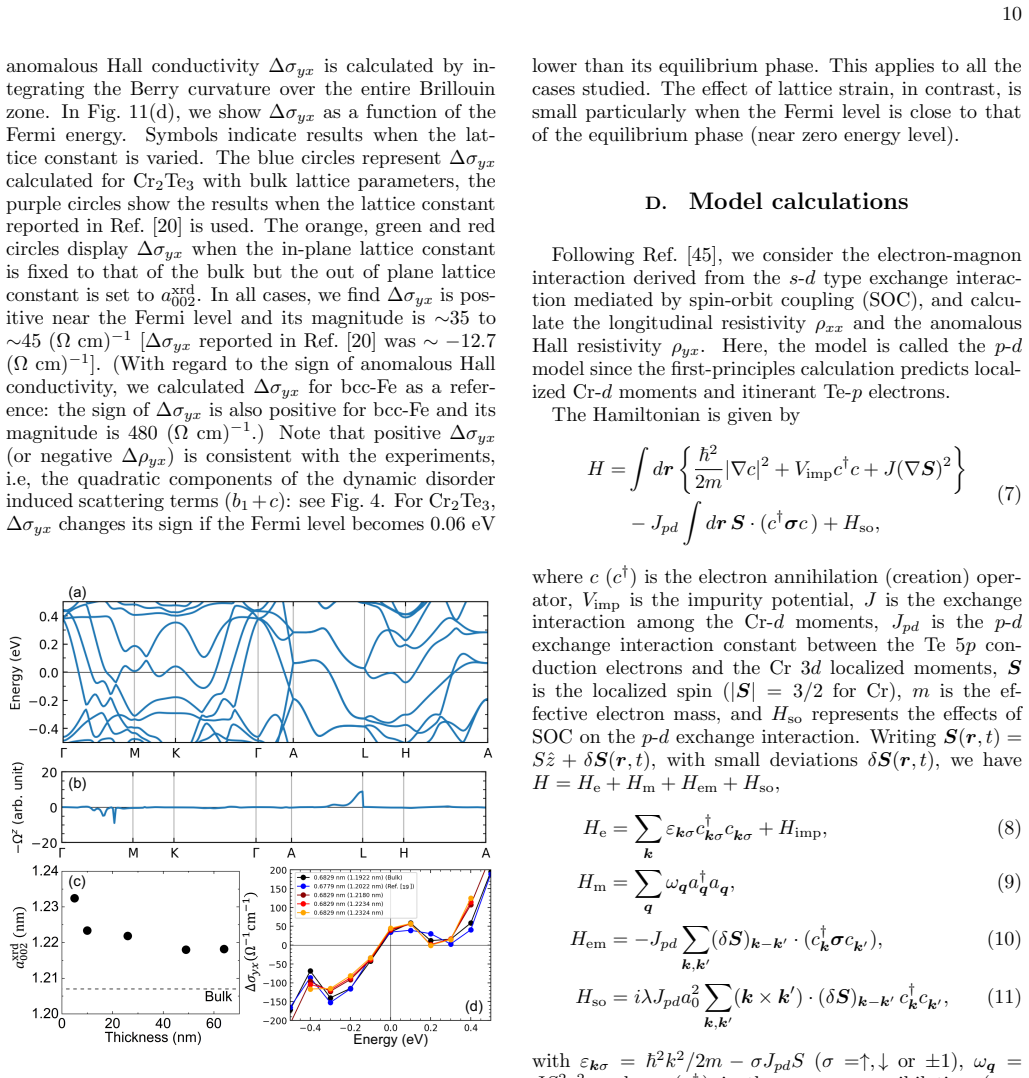
In all cases, we find ∆ σyx is pos- itive near the Fermi level and its magnitude is ∼35 to ∼45 (Ω cm) −1 [∆σyx reported in Ref. [20] was ∼ −12.7 (Ω cm) −1]. (With regard to the sign of anomalous Hall conductivity, we calculated ∆ σyx for bcc-Fe as a refer- ence: the sign of ∆ σyx is also positive for bcc-Fe and its magnitude is 480 (Ω cm) −1.) Note that p...
work page 1922
-
[3]
M. A. McGuire, V. O. Garlea, K. C. Santosh, V. R. Cooper, J. Q. Yan, H. B. Cao, and B. C. Sales, Anti- ferromagnetism in the van der waals layered spin-lozenge semiconductor crte3, Phys. Rev. B 95, 144421 (2017)
work page 2017
-
[4]
Y. Fujisawa, M. Pardo-Almanza, J. Garland, K. Ya- magami, X. Zhu, X. Chen, K. Araki, T. Takeda, M. Kobayashi, Y. Takeda, C. H. Hsu, F. C. Chuang, R. Laskowski, K. H. Khoo, A. Soumyanarayanan, and Y. Okada, Tailoring magnetism in self-intercalated cr1+δte2 epitaxial films, Phys. Rev. Mater. 4, 114001 (2020)
work page 2020
-
[5]
X. Q. Zhang, Q. S. Lu, W. Q. Liu, W. Niu, J. B. Sun, J. Cook, M. Vaninger, P. F. Miceli, D. J. Singh, S. W. Lian, T. R. Chang, X. Q. He, J. Du, L. He, R. Zhang, G. Bian, and Y. B. Xu, Room-temperature intrinsic fer- romagnetism in epitaxial crte2 ultrathin films, Nat. Com- mun. 12, 2492 (2021)
work page 2021
-
[6]
Huang, G
B. Huang, G. Clark, E. Navarro-Moratalla, D. R. Klein, R. Cheng, K. L. Seyler, D. Zhong, E. Schmidgall, M. A. McGuire, D. H. Cobden, W. Yao, D. Xiao, P. Jarillo- Herrero, and X. Xu, Layer-dependent ferromagnetism in a van der waals crystal down to the monolayer limit, Nature 546, 270 (2017)
2017
-
[7]
C. Gong, L. Li, Z. Li, H. Ji, A. Stern, Y. Xia, T. Cao, W. Bao, C. Wang, Y. Wang, Z. Q. Qiu, R. J. Cava, S. G. Louie, J. Xia, and X. Zhang, Discovery of intrinsic fer- romagnetism in two-dimensional van der waals crystals, Nature 546, 265 (2017)
work page 2017
-
[8]
M. Gibertini, M. Koperski, A. F. Morpurgo, and K. S. Novoselov, Magnetic 2d materials and heterostructures, Nat. Nanotechnol. 14, 408 (2019)
work page 2019
Show all 51 references
-
[9]
J. C. Zhong, M. S. Wang, T. Liu, Y. H. Zhao, X. Xu, S. S. Zhou, J. B. Han, L. Gan, and T. Y. Zhai, Strain- sensitive ferromagnetic two-dimensional cr2te3, Nano Re- search 15, 1254 (2022)
2022
-
[10]
H. X. Li, L. J. Wang, J. S. Chen, T. Yu, L. Zhou, Y. Qiu, H. T. He, F. Ye, T. K. Sou, and G. Wang, Molecular beam epitaxy grown cr 2te3 thin films with tunable curie temperatures for spintronic devices, Acs Applied Nano Materials 2, 6809 (2019)
2019
-
[11]
Y. Wen, Z. H. Liu, Y. Zhang, C. X. Xia, B. X. Zhai, X. H. Zhang, G. H. Zhai, C. Shen, P. He, R. Q. Cheng, L. Yin, Y. Y. Yao, M. G. Sendeku, Z. X. Wang, X. B. Ye, C. S. Liu, C. Jiang, C. X. Shan, Y. W. Long, and J. He, Tunable room-temperature ferromagnetism in two- dimensional...
2020
-
[12]
R. Chua, J. Zhou, X. J. Yu, W. Yu, J. Gou, R. Zhu, L. Zhang, M. Z. Liu, M. B. H. Breese, W. Chen, K. P. Loh, Y. P. Feng, M. Yang, Y. L. Huang, and A. T. S. Wee, Room temperature ferromagnetism of monolayer chromium telluride with perpendicular mag- netic anisotropy, Adv. Mater...
2021
-
[13]
A. L. Coughlin, D. Y. Xie, Y. Yao, X. Zhan, Q. Chen, H. Hewa-Walpitage, X. H. Zhang, H. Guo, H. D. Zhou, J. Lou, J. Wang, Y. S. Li, H. A. Fertig, and S. X. Zhang, Near degeneracy of magnetic phases in two-dimensional chromium telluride with enhanced perpendicular mag- netic an...
2020
-
[14]
M. Y. Bian, A. N. Kamenskii, M. J. Han, W. J. Li, S. C. Wei, X. Z. Tian, D. B. Eason, F. Sun, K. K. He, H. L. Hui, F. Yao, R. Sabirianov, J. P. Bird, C. L. Yang, J. W. Miao, J. H. Lin, S. A. Crooker, Y. L. Hou, and H. Zeng, Covalent 2d cr2te3 ferromagnet, Mater. Res. Lett. 9, ...
2021
-
[15]
Liu and C
Y. Liu and C. Petrovic, Anomalous hall effect in the trigo- nal cr5te8 single crystal, Phys. Rev. B 98, 195122 (2018)
2018
-
[16]
Z. Z. Jiang, X. Luo, J. Yan, J. J. Gao, W. Wang, G. C. Zhao, Y. Sun, J. G. Si, W. J. Lu, P. Tong, X. B. Zhu, W. H. Song, and Y. P. Sun, Magnetic anisotropy and anomalous hall effect in monoclinic single crystal cr 5te8, Phys. Rev. B 102, 144433 (2020)
2020
-
[17]
Huang, S
M. Huang, S. S. Wang, Z. H. Wang, P. Liu, J. X. Xiang, C. Feng, X. Q. Wang, Z. M. Zhang, Z. C. Wen, H. J. Xu, G. Q. Yu, Y. L. Lu, W. S. Zhao, S. Y. A. Yang, D. Z. Hou, and B. Xiang, Colossal anomalous hall effect in ferromagnetic van der waals crte 2, Acs Nano 15, 9759 (2021)
2021
-
[18]
Y. Z. Sun, P. F. Yan, J. A. Ning, X. Q. Zhang, Y. F. Zhao, Q. W. Gao, M. Kanagaraj, K. P. Zhang, J. J. Li, X. Y. Lu, Y. Yan, Y. Li, Y. B. Xu, and L. He, Ferromagnetism in two-dimensional crte 2 epitaxial films down to a few atomic layers, Aip Advances 11, 035138 (2021)
2021
-
[19]
Y. X. Ou, W. Yanez, R. Xiao, M. Stanley, S. Ghosh, B. Y. Zheng, W. Jiang, Y. S. Huang, T. Pillsbury, A. Richardella, C. X. Liu, T. Low, V. H. Crespi, K. A. Mkhoyan, and N. Samarth, Zrte2/crte2: an epitaxial van der waals platform for spintronics, Nat. Commun. 13, 2972 (2022)
2022
-
[20]
S. W. Cho, I. H. Lee, Y. W. Lee, S. Kim, Y. G. Khim, S. Y. Park, Y. Jo, J. Choi, S. W. Han, Y. J. Chang, and S. Y. Lee, Investigation of the mechanism of the anoma- lous hall effects in cr 2te3/(bisb)2(tese)3 heterostructure, Nano Convergence 10, 2 (2023)
2023
-
[21]
H. Chi, Y. B. Ou, T. B. Eldred, W. P. Gao, S. Kwon, J. Murray, M. Dreyer, R. E. Butera, A. C. Foucher, H. Ambaye, J. Keum, A. T. Greenberg, Y. H. Liu, M. R. Neupane, G. J. de Coster, O. A. Vail, P. J. Taylor, P. A. Folkes, C. R. Rong, G. Yin, R. K. Lake, F. M. Ross, V. Lauter,...
2023
-
[22]
K. K. He, M. Y. Bian, S. D. Seddon, K. Jagadish, A. Mucchietto, H. Ren, E. Kirstein, R. Asadi, J. Bai, C. Yao, S. Pan, J. X. Yu, P. Milde, C. Huai, H. L. Hui, J. D. Zang, R. Sabirianov, X. M. M. Cheng, G. X. Miao, H. Xing, Y. T. Shao, S. A. Crooker, L. Eng, Y. L. Hou, J. P. Bi...
2024
-
[23]
Fujisawa, M
Y. Fujisawa, M. Pardo-Almanza, C. H. Hsu, A. Mo- hamed, K. Yamagami, A. Krishnadas, G. Q. Chang, F. C. Chuang, K. H. Khoo, J. D. Zang, A. Soumyanarayanan, and Y. Okada, Widely tunable berry curvature in the magnetic semimetal cr 1+δte2, Adv. Mater. 35 (2023)
2023
-
[24]
A. K. Song, J. E. Zhang, Y. Q. Chen, Z. Z. Zhang, X. J. Cheng, R. J. Xu, W. Z. Zhuang, W. X. Sun, Y. Zhang, X. Zhang, Z. Q. Chen, F. Q. Song, Y. Zhang, X. C. Zhai, Y. B. Xu, W. S. Zhao, R. Zhang, and X. F. Wang, Large anomalous hall effect in a noncoplanar magnetic 14 heterost...
2025
-
[25]
Huang, Z
M. Huang, Z. W. Ma, S. Wang, S. Li, M. Li, J. X. Xiang, P. Liu, G. J. Hu, Z. M. Zhang, Z. Sun, Y. L. Lu, Z. G. Sheng, G. Chen, Y. L. Chueh, S. Y. Yang, and B. Xiang, Significant perpendicular magnetic anisotropy in room- temperature layered ferromagnet of cr-intercalated crte2...
2021
-
[26]
Lasek, P
K. Lasek, P. M. Coelho, K. Zberecki, Y. Xin, S. K. Kolekar, J. F. Li, and M. Batzill, Molecular beam epi- taxy of transition metal (ti-, v-, and cr-) tellurides: From monolayer ditellurides to multilayer self-intercalation compounds, Acs Nano 14, 8473 (2020)
2020
-
[27]
Dijkstra, H
J. Dijkstra, H. H. Weitering, C. F. Vanbruggen, C. Haas, and R. A. Degroot, Band-structure calculations, and magnetic and transport properties of ferromagnetic chromium tellurides (crte, cr3te4, cr2te3), J. Phys.: Cond. Matt. 1, 9141 (1989)
1989
-
[28]
C. H. Zhang, C. Liu, J. W. Zhang, Y. Y. Yuan, Y. Wen, Y. Li, D. X. Zheng, Q. Zhang, Z. P. Hou, G. Yin, K. Liu, Y. Peng, and X. X. Zhang, Room-temperature magnetic skyrmions and large topological hall effect in chromium telluride engineered by self-intercalation, Adv. Mater. 35 (2023)
2023
-
[29]
Y. Wang, S. Kajihara, H. Matsuoka, B. K. Saika, K. Yamagami, Y. Takeda, H. Wadati, K. Ishizaka, Y. Iwasa, and M. Nakano, Layer-number-independent two-dimensional ferromagnetism in cr3te4, Nano Lett. 22, 9964 (2022)
2022
-
[30]
J. F. Yang, J. W. Ng, C. Zhu, Y. Wu, J. Y. Shi, R. J. Sun, and B. J. Tang, Chemical vapor deposition of large-area ultrathin cr3te4 nanosheets with robust ferromagnetism, 2d Materials 12, 015002 (2025)
2025
-
[31]
L. D. Tung, V. Kolesnichenko, D. Caruntu, N. H. Chou, C. J. O’Connor, and L. Spinu, Magnetic properties of ultrafine cobalt ferrite particles, J. Appl. Phys. 93, 7486 (2003)
2003
-
[32]
Mannari, Electrical resistance of ferromagnetic metals, Prog
I. Mannari, Electrical resistance of ferromagnetic metals, Prog. Theor. Phys. 22, 335 (1959)
1959
-
[33]
V. Nv, V. P. Dyakina, and V. E. Startsev, Scattering mechanisms of conduction electrons in transition metals at low temperatures, Phys. Status Solidi B 57, 9 (1973)
1973
-
[34]
Raquet, M
B. Raquet, M. Viret, E. Sondergard, O. Cespedes, and R. Mamy, Electron-magnon scattering and magnetic re- sistivity in 3 d ferromagnets, Phys. Rev. B 66, 024433 (2002)
2002
-
[35]
Y. Q. Chen, Y. M. Zhu, R. J. Lin, W. Niu, R. X. Liu, W. Z. Zhuang, X. Zhang, J. H. Liang, W. X. Sun, Z. Q. Chen, Y. S. Hu, F. Q. Song, J. Zhou, D. Wu, B. H. Ge, H. X. Yang, R. Zhang, and X. F. Wang, Observation of colossal topological hall effect in noncoplanar ferromag- net c...
2023
-
[36]
X. Q. Zhang, S. C. Ambhire, Q. S. Lu, W. Niu, J. Cook, J. S. Jiang, D. S. Hong, L. Alahmed, L. He, R. Zhang, Y. B. Xu, S. S. L. Zhang, P. Li, and G. Bian, Giant topological hall effect in van der waals heterostructures of crte2/bi2te3, Acs Nano 15, 15710 (2021)
2021
-
[37]
J. H. Jeon, H. R. Na, H. Kim, S. Lee, S. Song, J. Kim, S. Park, J. Kim, H. Noh, G. Kim, S. K. Jerng, and S. H. Chun, Emergent topological hall effect from exchange coupling in ferromagnetic cr2te3/ noncoplanar antifer- romagnetic cr2se3 bilayers, Acs Nano 16, 8974 (2022)
2022
-
[38]
Nagaosa, J
N. Nagaosa, J. Sinova, S. Onoda, A. H. MacDonald, and N. P. Ong, Anomalous hall effect, Rev. Mod. Phys. 82, 1539 (2010)
2010
-
[39]
Y. Tian, L. Ye, and X. F. Jin, Proper scaling of the anomalous hall effect, Phys. Rev. Lett. 103, 087206 (2009)
2009
-
[40]
D. Z. Hou, G. Su, Y. Tian, X. F. Jin, S. Y. A. Yang, and Q. Niu, Multivariable scaling for the anomalous hall effect, Phys. Rev. Lett. 114, 217203 (2015)
2015
-
[41]
V. L. Grigoryan, J. Xiao, X. H. Wang, and K. Xia, Anomalous hall effect scaling in ferromagnetic thin films, Phys. Rev. B 96, 144426 (2017)
2017
-
[42]
E. V. Vidal, H. Schneider, and G. Jakob, Influence of disorder on anomalous hall effect for heusler compounds, Phys. Rev. B 83, 174410 (2011)
2011
-
[43]
M. S. Gabor, M. Belmeguenai, T. Petrisor, C. Ulhaq- Bouillet, S. Colis, and C. Tiusan, Correlations between structural, electronic transport, and magnetic properties of co2feal0.5si0.5 heusler alloy epitaxial thin films, Phys. Rev. B 92, 054433 (2015)
2015
-
[44]
K. K. Meng, J. Miao, X. G. Xu, J. H. Zhao, and Y. Jiang, Thickness dependence of magnetic anisotropy and intrin- sic anomalous hall effect in epitaxial co 2mnal film, Phys. Lett. A 381, 1202 (2017)
2017
-
[45]
Kikkawa, K
T. Kikkawa, K. Uchida, S. Daimon, Z. Y. Qiu, Y. Shiomi, and E. Saitoh, Critical suppression of spin seebeck effect by magnetic fields, Phys. Rev. B 92, 064413 (2015)
2015
-
[46]
V. Y. Irkhin and Y. P. Irkhin, Electronic structure, cor- relation effects and physical properties of d- and f-metals and their compounds (2021), arXiv:cond-mat/9812072 [cond-mat]
2021 arXiv
-
[47]
T. Doi, K. Nakao, and H. Kamimura, Valence band struc- ture of tellurium .1. k.p perturbation method, J. Phys. Soc. Jpn. 28, 36 (1970)
1970
-
[48]
Furukawa, Y
T. Furukawa, Y. Shimokawa, K. Kobayashi, and T. Itou, Observation of current-induced bulk magnetization in el- emental tellurium, Nat. Commun. 8, 954 (2017)
2017
-
[49]
Sakano, M
M. Sakano, M. Hirayama, T. Takahashi, S. Akebi, M. Nakayama, K. Kuroda, K. Taguchi, T. Yoshikawa, K. Miyamoto, T. Okuda, K. Ono, H. Kumigashira, T. Ideue, Y. Iwasa, N. Mitsuishi, K. Ishizaka, S. Shin, T. Miyake, S. Murakami, T. Sasagawa, and T. Kondo, Radial spin texture in el...
2020
-
[50]
Holstein and H
T. Holstein and H. Primakoff, Field dependence of the intrinsic domain magnetization of a ferromagnet, Phys. Rev. 58, 1098 (1940)
1940
-
[51]
M. D. Kuz’min, K. P. Skokov, L. V. B. Diop, I. A. Radulov, and O. Gutfleisch, Exchange stiffness of ferro- magnets, Eur. Phys. J. Plus 135, 301 (2020)
2020
Reviewed August 6, 2026 · model on record in the stance chip above.
Discussion (0). Continue with ORCID to comment.