REVIEW 5 major objections 5 minor 22 references
Towards Explainable Indoor Localization: Interpreting Neural Network Learning on Wi-Fi Fingerprints Using Logic Gates
T0 review · 5 major / 5 minor · reviewed 2026-08-06 · deepseek-v4-flash
Pith's one-line read LogNet claims a fixed logic-gate architecture can interpret and outperform DNNs on Wi-Fi indoor localization.
desk verdict LogNet is a simple binarized logic-gate classifier that beats a DNN on a new two-year Wi-Fi dataset, but the claim that it interprets DNN behavior is not supported by the experiments. read the letter →
The pith
A machine-rendered reading of the paper's core claim, the machinery that carries it, and where it could break.
The reading
What carries the argument
The load-bearing object is the logic-gate layer built on binarized RSS values. Each fingerprint is normalized, thresholded at $\phi=0.5$ to turn APs into active or inactive bits, and adjacent pairs are fed through one fixed gate ($Z=1-(X+Y)$ for the best-performing NOR variant). The outputs are paired again in each successive hidden layer, halving dimensionality each time, until a compact binary latent vector is formed; only the final softmax layer is trained. Because every bit in that latent vector is the deterministic output of a gate applied to a specific pair of upstream bits, each decision can be traced back to a rule about two access points. The contrasting assumption, that DNNs treat fingerprint noise as uniform Euclidean noise while real temporal noise is per-AP and non-Euclidean, is what the gates exploit.
What would settle it
Sweep the binarization threshold from 0 to 1 on the same two-building dataset and retrain the softmax layer for each value; if LogNet-NOR's mean localization error changes substantially with the threshold, the fixed 0.5 cutoff is load-bearing and the reported robustness is not intrinsic to the logic-gate design.
Extended reading notes
Core claim
The central claim is that a fixed, untrained stack of logic gates can reproduce, and improve on, what DNNs learn for Wi-Fi fingerprint localization, and that the resulting binary latent space is interpretable. LogNet's design assumes that the key information in an RSS fingerprint is which access points are jointly strong or jointly weak, not the exact signal values. Under that view, non-Euclidean temporal noise, which perturbs different APs by different amounts, is filtered out by the discrete gate operations. The paper shows latent-space comparisons where a DNN separates two reference points using continuous-valued bits that are actually noise-susceptible, while LogNet separates the same reference points with stable binary bits that trace back to specific AP-pair rules. The claimed payoff is that the model becomes diagnosable: a failure can be attributed to particular access points, and the same rule-based encoding is what keeps mean localization error low over two years of environmental change.
Load-bearing premise
The load-bearing premise is that the information a DNN uses for Wi-Fi localization can be faithfully captured by fixed pairwise logic rules on binarized signal strengths, so the specific choice of threshold (0.5) and gate (NOR) is what makes both the interpretability and performance claims true.
Editorial extensions
If this is right
- If LogNet's claims hold, Wi-Fi indoor localization can be made auditable: each prediction carries a rule trace showing which access points were decisive.
- The reported parameter counts and latency suggest the approach can run on mobile or embedded devices, where the DNN baselines were substantially larger and slower.
- Because the latent codes are binary and deterministic, model failure under temporal drift can be diagnosed by comparing which bits flip between training and test time, pointing to the access points responsible.
- The method's stability across one to four hidden layers implies that depth can be chosen to trade size against accuracy without retraining the gate stack.
- The reported gains over DNNLOC, SANGRIA, and AUTLOC would make logic-gate networks a competitive baseline for future fingerprint-based indoor localization research.
Reading between the lines
- A natural test the paper does not run is to sweep the binarization threshold and gate choice per layer; if performance is highly sensitive to the 0.5 cutoff, the fixed threshold is doing more work than the logic-gate concept itself.
- The same pairwise binarization scheme transfers in principle to other RF fingerprint modalities such as Bluetooth or UWB; if it transfers, the interpretability mechanism is not specific to Wi-Fi.
- Because each latent bit names an AP-pair rule, LogNet could be inverted to recommend which access points to keep or reposition in a deployment, a use the authors gesture at but do not develop.
- The interpretability claim implicitly asserts that DNNs would have learned those same AP-pair rules; an explicit comparison of LogNet's bit-level attribution against gradient-based attribution on the DNN would test that equivalence.
Editorial analysis
A structured set of objections, weighed in public.
Referee Report
Summary. The paper introduces LogNet, a logic-gate-based architecture for Wi-Fi fingerprint indoor localization. LogNet binarizes RSS values with a fixed threshold, applies pairwise logic gates (e.g., NOR) over adjacent AP pairs across several layers, and trains only a final softmax classifier. The authors claim that LogNet interprets the internal behavior of DNN-based localization models, identifies the most influential APs per reference point, and diagnoses failures under temporal variation, while also improving localization error, model size, and latency relative to prior DNN models. Experiments use a two-building, ten-collection-instance dataset collected over two years, comparing LogNet variants against DNN-DownSample and prior DNN architectures.
Significance. If the central interpretability claim were established, LogNet would be a useful contribution to explainable indoor localization, and the open-sourced dataset [22] is a valuable asset for reproducibility. The paper also demonstrates a lightweight, low-latency alternative that may be attractive for deployment. However, as written, the paper does not show that LogNet explains the decisions of a trained DNN; it presents a standalone deterministic binary encoder whose latent space is never quantitatively connected to DNN weights, activations, or attributions. The performance comparison also contains a selection-on-test-data issue in choosing the NOR gate. These are load-bearing gaps rather than presentation issues, so the manuscript requires substantial revision before its claims can be accepted.
major comments (5)
- [Abstract and Section VI] The central claim that LogNet “interprets the internal behavior of DL models” is not supported by the experiments. LogNet is constructed by binarizing RSS with a fixed threshold and applying deterministic logic gates; its latent space is a function of the input alone, not of the DNN's weights, activations, or gradients. Section V.C compares the two latent spaces side by side, but it never establishes that LogNet's critical bits correspond to the APs that actually drive DNN-DownSample's predictions. A quantitative test, such as verifying that flipping LogNet-identified critical APs changes the DNN's output in the predicted direction, or comparing LogNet's per-RP AP importance against DNN attribution methods, is needed. Without such evidence, the abstract's and conclusions' interpretability claims should be revised to describe LogNet as a transparent alternative model rather than an interpretation of DNN behavior.
- [Section V.B and Figure 4] The selection of the NOR gate is performed on the test data, which biases the reported performance. Section V.B evaluates all six LogNet variants on the CI:0 holdout fingerprint and then selects the best-performing gate (NOR) for subsequent comparisons. This is a form of test-set selection and inflates the reported gains. The gate choice should be made on a validation split or via nested cross-validation, and the paper should report performance for all gates without selecting on test data. Relatedly, the binarization threshold ϕ=0.5 in Section IV is fixed without sensitivity analysis; because the entire architecture and interpretability claims depend on this threshold, the paper should show results across a range of thresholds and justify the chosen value.
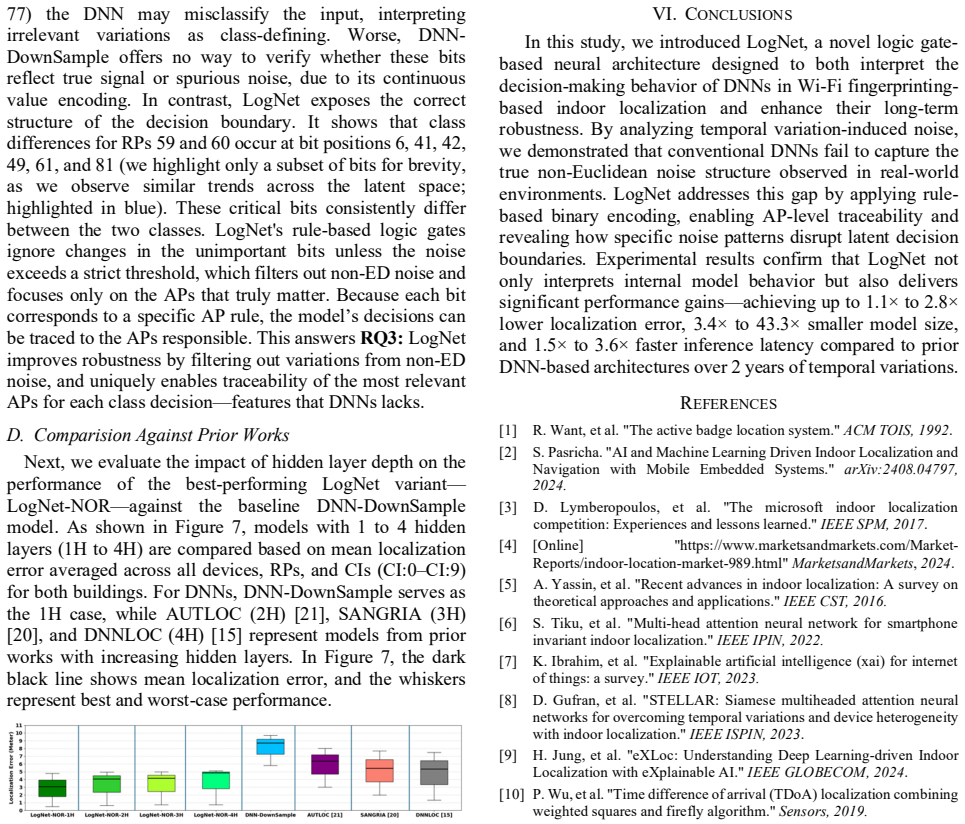
- [Section V.A and Figure 4] The DNN-DownSample baseline appears undertuned, making the reported performance gains less convincing. At CI:0, DNN-DownSample achieves a mean localization error of 5.81 m on a 61-RP building, which is high relative to typical Wi-Fi fingerprinting results, and the paper reports no hyperparameter search, regularization, early stopping, or ensemble averaging for the DNN. Training for 500 epochs at a fixed learning rate of 0.01 may not converge to a competitive baseline. The paper should tune the DNN baselines fairly (including prior architectures compared in Section V.D) and report standard errors, confidence intervals, or significance tests across the six devices and two buildings. Without this, the claimed 1.1x–2.8x improvements are not robustly established.
- [Section V.C] The interpretability analysis in Section V.C is based on manual inspection of two RP pairs (RPs 5/6 and 59/60) and does not provide a validated method for tracing latent bits to AP-level influence. The paper states that DNN-DownSample's varied bits are “not truly discriminative” and that LogNet exposes “the correct structure of the decision boundary,” but no ground-truth or quantitative measure of discriminative APs is given, and no stability analysis across collection instances is provided. The claim that LogNet filters non-Euclidean noise should be tested by measuring bit-flip rates under temporal variation and by showing that the identified critical bits are stable and indeed correspond to APs whose RSS values are informative for the RP pair.
- [Section V.D and Table 2] The comparison against prior DNN-based models (AUTLOC, SANGRIA, DNNLOC) is not controlled: the prior models are reimplemented with different architectures and training settings, and no details are given for how their hyperparameters were selected. The latency measurements in Table 2 are reported without specifying the hardware, framework, or batching conditions, making the 1.5x–3.6x latency claims difficult to verify. A fair head-to-head comparison should use the same dataset, training pipeline, and inference environment, and should report variance across runs.
minor comments (5)
- [Section IV, Algorithm 1] Algorithm 1 trains the softmax layer using backpropagation, so LogNet is not fully rule-based; the final layer is learned. The text should state this clearly to avoid overstating the absence of training.
- [Section III.B] The pairing of APs into adjacent pairs is presented without justification. The paper should discuss whether the ordering of AP indices has any physical or semantic meaning and whether results depend on the pairing scheme.
- [Section V.B] The phrase “all models containing 1 hidden layer” is ambiguous for LogNet because the logic layers are not trained; specifying the exact layer counts and parameter counts would improve reproducibility.
- [Section V.D heading] The heading contains a typo: “Comparision” should be “Comparison.”
- [General] The paper says the data is open-sourced [22], but no link to code for LogNet is provided. Releasing the implementation would strengthen reproducibility.
Circularity Check
LogNet's reported performance superiority is partly in-sample: the NOR gate is selected on the same test data used to report its error, so the 'best-performing variant' claim is a restatement of the selection criterion; the interpretability claim is asserted without a mapping to DNN internals.
-
fitted input called prediction
[Section V.B (gate selection on CI:0) and Section V.D (reporting LogNet-NOR as 'best-performing')]
"We evaluate the performance of six LogNet variants — each using a fixed logic gate (AND, OR, NAND, NOR, XOR, XNOR)— against the baseline DNN-DownSample architecture... In particular, LogNet-NOR achieves the best performance (lowest localization errors) with a mean localization error of 2.75 meters... Next, we evaluate the impact of hidden layer depth on the performance of the best-performing LogNet variant — LogNet-NOR — against the baseline DNN-DownSample model."
The gate type is selected after evaluating all six gates on the same CI:0 holdout fingerprints used to compute the reported error. The paper then carries 'best-performing LogNet-NOR' into Section V.D and the abstract's headline gain claims. Because NOR's selection and its reported error are measured on the same test split, the superiority of NOR over the other variants is a restatement of the selection criterion, not an independent prediction; the headline performance gains are therefore partly forced by the in-sample selection.
full rationale
The paper's core empirical claim — that LogNet, and specifically LogNet-NOR, outperforms DNN baselines — is weakened by a clear selection-on-test-data step: six gate variants are scored on the same CI:0 test set, and the best one is then reported as the model's performance in Section V.D and the abstract. This is a fitted-input-called-prediction pattern, though the underlying error numbers are real measurements, so the paper is only partially circular. The interpretability claim (that LogNet's binary latent space reveals which APs are most influential for the DNN's decisions) is asserted via side-by-side visual comparison rather than demonstrated through any mapping from LogNet bits to DNN weights, activations, or gradients; this is an unsupported leap rather than a definitional circularity, and I do not count it as a separate circular step. The arXiv/self-citations (SANGRIA, STELLAR) are used as baselines or context and are not load-bearing for the main result. No uniqueness theorem is imported. Overall, the central performance prediction reduces in part to its selection criterion, giving a partial circularity score of 5.
Assumptions & free parameters
free parameters (3)
- Binarization threshold phi =
0.5
- Logic gate type =
NOR
- Number of hidden logic layers =
1 to 4
assumptions (3)
- domain assumption RSS values can be normalized to [0,1] and binarized with a fixed threshold without losing discriminative information.
- ad hoc to paper Adjacent pairing of APs is a meaningful spatial or semantic grouping.
- domain assumption Deep neural networks for localization implicitly assume Euclidean noise, which causes their failure under temporal variation.
Cite this review
Pith. "Pith review of Towards Explainable Indoor Localization: Interpreting Neural Network Learning on Wi-Fi Fingerprints Using Logic Gates." pith.science (2026). https://pith.science/paper/7OLI26UH
@misc{pith2026250615559,
  author       = {Pith},
  title        = {Pith review of: Towards Explainable Indoor Localization: Interpreting Neural Network Learning on Wi-Fi Fingerprints Using Logic Gates},
  year         = {2026},
  howpublished = {\url{https://pith.science/paper/7OLI26UH}},
  note         = {Machine review of arXiv:2506.15559}
}
read the original abstract
Indoor localization using deep learning (DL) has demonstrated strong accuracy in mapping Wi-Fi RSS fingerprints to physical locations; however, most existing DL frameworks function as black-box models, offering limited insight into how predictions are made or how models respond to real-world noise over time. This lack of interpretability hampers our ability to understand the impact of temporal variations - caused by environmental dynamics - and to adapt models for long-term reliability. To address this, we introduce LogNet, a novel logic gate-based framework designed to interpret and enhance DL-based indoor localization. LogNet enables transparent reasoning by identifying which access points (APs) are most influential for each reference point (RP) and reveals how environmental noise disrupts DL-driven localization decisions. This interpretability allows us to trace and diagnose model failures and adapt DL systems for more stable long-term deployments. Evaluations across multiple real-world building floorplans and over two years of temporal variation show that LogNet not only interprets the internal behavior of DL models but also improves performance-achieving up to 1.1x to 2.8x lower localization error, 3.4x to 43.3x smaller model size, and 1.5x to 3.6x lower latency compared to prior DL-based models.
Figures


Figures from the paper (3 more)


Reference graph
Works this paper leans on
-
[22]
https://github.com/EPIC-CSU/heterogeneous -rssi- indoor- nav
[Online] "https://github.com/EPIC-CSU/heterogeneous -rssi- indoor- nav" EPIC-CSU, 2023
work page 2023
-
[1]
The active badge location system
R. Want, et al. "The active badge location system." ACM TOIS, 1992
work page 1992
-
[2]
AI and Machine Learning Driven Indoor Localization and Navigation with Mobile Embedded Systems
S. Pasricha. "AI and Machine Learning Driven Indoor Localization and Navigation with Mobile Embedded Systems." arXiv:2408.04797, 2024
arXiv 2024
-
[3]
The microsoft indoor localization competition: Experiences and lessons learned
D. Lymberopoulos, et al . "The microsoft indoor localization competition: Experiences and lessons learned." IEEE SPM, 2017
work page 2017
-
[4]
https://www.marketsandmarkets.com/Market - Reports/indoor-location-market-989.html
[Online] "https://www.marketsandmarkets.com/Market - Reports/indoor-location-market-989.html" MarketsandMarkets, 2024
work page 2024
-
[5]
Recent advances in indoor localization: A survey on theoretical approaches and applications
A. Yassin, et al. "Recent advances in indoor localization: A survey on theoretical approaches and applications." IEEE CST, 2016
work page 2016
-
[6]
Multi -head attention neural network for smartphone invariant indoor localization
S. Tiku, et al . "Multi -head attention neural network for smartphone invariant indoor localization." IEEE IPIN, 2022
work page 2022
-
[7]
Explainable artificial intelligence (xai) for internet of things: a survey
K. Ibrahim, et al. "Explainable artificial intelligence (xai) for internet of things: a survey." IEEE IOT, 2023
work page 2023
Show all 22 references
-
[8]
STELLAR: Siamese multiheaded attention neural networks for overcoming temporal variations and device heterogeneity with indoor localization
D. Gufran, et al . "STELLAR: Siamese multiheaded attention neural networks for overcoming temporal variations and device heterogeneity with indoor localization." IEEE ISPIN, 2023
2023
-
[9]
eXLoc: Understanding Deep Learning -driven Indoor Localization with eXplainable AI
H. Jung, et al . "eXLoc: Understanding Deep Learning -driven Indoor Localization with eXplainable AI." IEEE GLOBECOM, 2024
2024
-
[10]
Time difference of arrival (TDoA) localization combining weighted squares and firefly algorithm
P. Wu, et al. "Time difference of arrival (TDoA) localization combining weighted squares and firefly algorithm." Sensors, 2019
2019
-
[11]
Anguloc: Concurrent angle of arrival estimation for indoor localization with uwb radios
M. Heydariaan, et al. "Anguloc: Concurrent angle of arrival estimation for indoor localization with uwb radios." IEEE DCOSS, 2020
2020
-
[12]
An Adaptive Indoor Localization Approach Using WiFi RSSI Fingerprinting with SLAM -Enabled Robotic Platform and Deep Neural Networks
S. Azghadi, et al. "An Adaptive Indoor Localization Approach Using WiFi RSSI Fingerprinting with SLAM -Enabled Robotic Platform and Deep Neural Networks." IEEE CASCON, 2024
2024
-
[13]
Simple Iterative trilateration -based scheme for indoor localization of IoT devices
B. Stojkoska, et al . "Simple Iterative trilateration -based scheme for indoor localization of IoT devices." ICT Innovations, 2017
2017
-
[14]
RADAR: An in -building RF -based user location and tracking system
P. Bahl, et al . "RADAR: An in -building RF -based user location and tracking system." IEEE INFOCOM, 2000
2000
-
[15]
A DNN -based WiFi-RSSI indoor localization method in IoT
B. Jia, et al. "A DNN -based WiFi-RSSI indoor localization method in IoT." Springer Communications and Networking, 2020
2020
-
[16]
Fingerprinting Indoor Positioning Based on Improved Sequential Deep Learning
D. Mao, et al. "Fingerprinting Indoor Positioning Based on Improved Sequential Deep Learning." MDPI Algorithms 2025
2025
-
[17]
Hybrid wireless fingerprint indoor localization method based on a convolutional neural network
Z. Liu, et al. "Hybrid wireless fingerprint indoor localization method based on a convolutional neural network." MDPI Sensors 2019
2019
-
[18]
Explainable AI: A brief survey on history, research areas, approaches and challenges
F. Xu, et al. "Explainable AI: A brief survey on history, research areas, approaches and challenges." Springer NLPCC, 2019
2019
-
[19]
Explainable indoor localization of BLE devices through RSSI using recursive continuous wavelet transformation and XGBoost classifier
M. Kamal, et al. "Explainable indoor localization of BLE devices through RSSI using recursive continuous wavelet transformation and XGBoost classifier." Future Generation Computer Systems, 2023
2023
-
[20]
SANGRIA: Stacked Autoencoder Neural Networks with Gradient Boosting for Indoor Localization,
D. Gufran, et al, “SANGRIA: Stacked Autoencoder Neural Networks with Gradient Boosting for Indoor Localization,” IEEE ESL, 2023
2023
-
[21]
AutLoc: Deep Autoencoder for Indoor Localization with RSS Fingerprinting,
J. Liu, et al, “AutLoc: Deep Autoencoder for Indoor Localization with RSS Fingerprinting,” IEEE WCSP, 2018
2018
Reviewed August 6, 2026 · model on record in the stance chip above.
Discussion (0). Continue with ORCID to comment.