REVIEW 4 major objections 5 minor 2 cited by
Combining Large Language Models with Static Analyzers for Code Review Generation
T0 review · 4 major / 5 minor · reviewed 2026-08-08 · deepseek-v4-flash
Pith's one-line read Feeding static analyzer results into LLM prompts makes generated code reviews more accurate and more complete.
desk verdict Useful empirical comparison of three ways to bolt static analysis onto LLM code review generation, but the coverage ranking is contaminated by the same LLM that filtered the training data, so only the RAG accuracy result carries real weight. read the letter →
The pith
A machine-rendered reading of the paper's core claim, the machinery that carries it, and where it could break.
The reading
What carries the argument
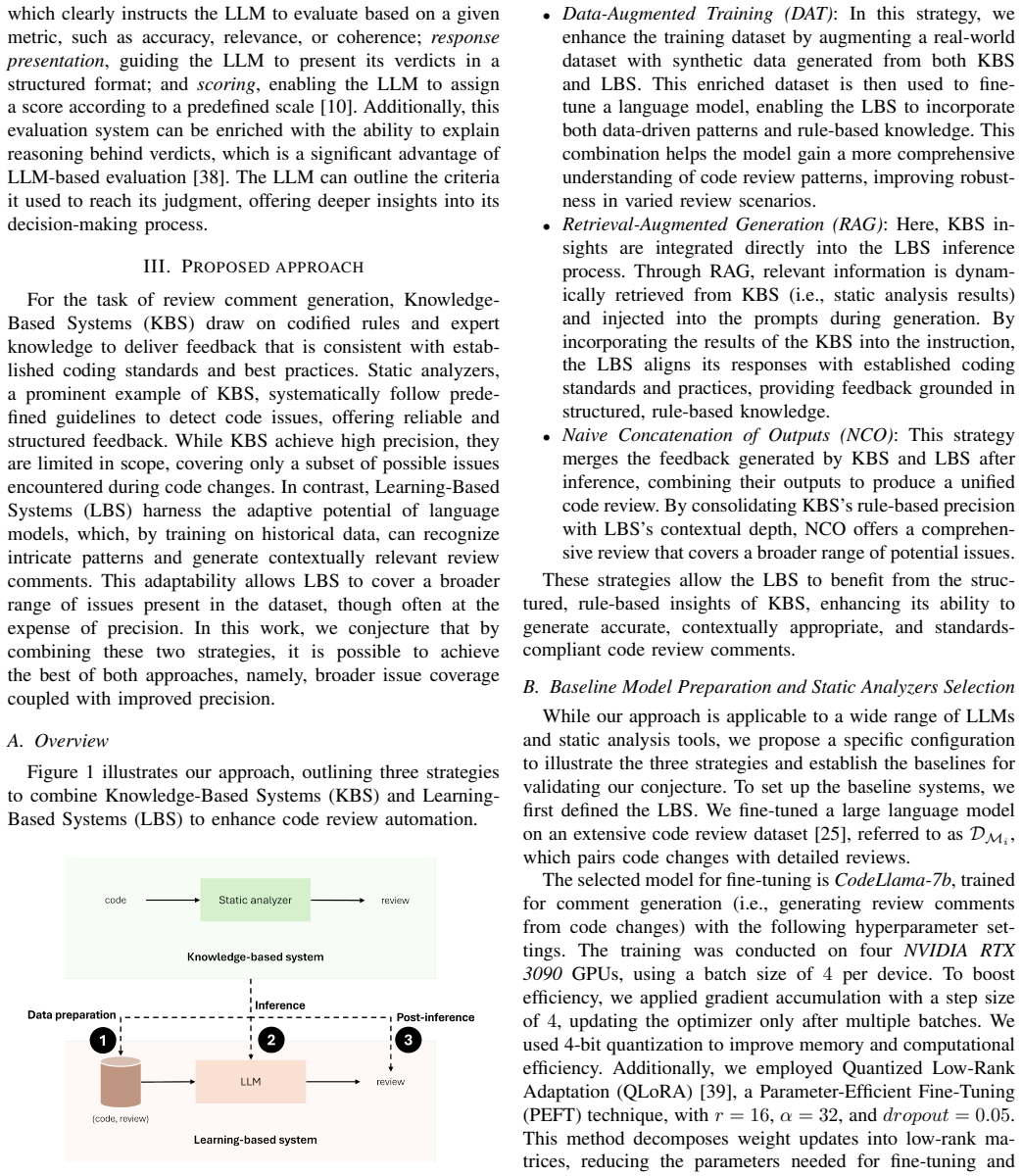
The load-bearing machinery is the choice of where static-analysis knowledge enters the LLM pipeline. Data-Augmented Training (DAT) builds an augmented fine-tuning set in which static-analyzer reports and LLM-generated reviews are rated by a larger LLM, filtered, and balanced, then retrains the model on it. Retrieval-Augmented Generation (RAG) retrieves the static analyzer's findings for the code under review and includes them directly in the prompt, so the model generates with rule-based evidence in context. Naive Concatenation of Outputs (NCO) appends the static analyzer's report to the LLM's comment after generation. The argument rests on RAG, because it is the only strategy that improves accuracy and coverage simultaneously.
What would settle it
Ask human reviewers to independently list every genuine issue in a random sample of the test code changes, then check whether RAG and DAT reviews cover more of those human-listed issues than the judge LLM's own list; if the coverage advantage disappears under human enumeration, the central claim would be refuted.
Extended reading notes
Core claim
The paper's central claim is that knowledge from static analyzers can be fused into an LLM code-review pipeline at three stages, and that the stage matters. Retrieval-augmented generation (RAG), which inserts analyzer findings into the prompt, was the most effective configuration: it raised the accuracy of generated comments relative to the fine-tuned model alone and gave strong issue coverage. Data-augmented training (DAT) achieved the broadest coverage, often ranking first, but with a bimodal pattern in which the model either covered most issues or missed most. Naive concatenation of outputs (NCO) gave only moderate gains because it inherits the LLM's weaknesses. The paper concludes that combining rule-based precision with learning-based adaptability is beneficial, with RAG as the recommended integration point.
Load-bearing premise
The coverage results assume the larger LLM used as a judge has already listed every issue worth finding in each code change, but that model was only validated for classifying reviews as accurate, partially accurate, or not accurate, not for exhaustively enumerating issues.
Editorial extensions
If this is right
- RAG-style prompting can raise the accuracy of LLM-generated code reviews without retraining, as long as static analyzer findings are available at inference time.
- DAT can expand the range of issues a small fine-tuned model detects, but the bimodal ranking pattern warns that coverage gains may come with unstable precision.
- NCO is the cheapest integration but the least reliable, since its quality is capped by the LLM's own review quality.
- The hybrid approach can be applied to any LLM and any source-code static analyzer, not just the specific model and tools used in the experiments.
Reading between the lines
- The coverage comparison uses the larger judge LLM as the reference list of issues, so the reported coverage advantage may partly reflect how closely each approach mimics the judge's own comment style; a human-exhaustive issue enumeration would be a stronger test.
- Combining DAT and RAG is the natural next step: the paper evaluates them separately, but their complementary strengths (DAT for breadth, RAG for accuracy) suggest an additive benefit.
- Because only Java and two style-oriented analyzers were tested, the relative ordering of the three strategies could shift for languages with stronger semantic analyzers or for bug-oriented tools.
- The DAT bimodality implies the augmented dataset's balance between analyzer and LLM reviews is a sensitive hyperparameter; rebalancing toward one source may trade coverage for consistency.
Signed reviews
Editorial analysis
A structured set of objections, weighed in public.
Referee Report
Summary. The paper proposes three hybrid strategies to combine static analyzers (KBS) with a fine-tuned large language model (LBS) for automated code review generation: Data-Augmented Training (DAT), Retrieval-Augmented Generation (RAG), and Naive Concatenation of Outputs (NCO). Using CodeLlama-7b as the LBS and PMD/Checkstyle as the KBS on a Java dataset, the authors evaluate the strategies with a 10% human sample and an LLM-as-a-judge (Llama3-70B) on a filtered set of 1,245 common code differences. The results show that RAG improves accuracy over the standalone LLM (RQ1/RQ3), while DAT and NCO do not; RQ4's coverage ranking places DAT and RAG at the top. The paper concludes that hybrid strategies enhance accuracy and coverage, with RAG being the most effective.
Significance. If the RAG result is robust, the paper offers a practical, low-cost way to improve LLM-generated code reviews by injecting static-analysis context into prompts, and it ships a replication package and dataset. The human-evaluation sanity check (Cohen's kappa 0.72) provides some independent grounding for the accuracy claims. However, the coverage claims—especially for DAT—depend on a self-referential Llama3-70B judge and a potentially leaky data split, and the abstract overstates results that the paper's own figures contradict. The work is relevant to the code-review automation community, but the coverage evidence needs substantial strengthening before the main claims can be accepted.
major comments (4)
- [Section III-C / Section IV-B, RQ4] The coverage evaluation for DAT is circular: Llama3-70B is used both to filter the DAT training data (threshold 8, Figure 4) and as the RQ4 'reference point' judge that ranks DAT reviews first in 49% of cases (Section IV-C4). The RQ2 validation (kappa 0.72) was for three-way accuracy classification on roughly 125 samples, not for exhaustive issue enumeration, so it does not justify the assumption that Llama3-70B 'can identify a comprehensive set of issues.' The authors should validate coverage with an independent ground truth (e.g., human enumeration of issues on a sample) or at minimum report the promised manual inspection details (Section IV-E) with inter-rater agreement.
- [Section III-C / Section IV-B] The augmented dataset Da is built from the original test set Do (the 27,267 Java entries from DMi's test set) and then randomly split into train/validation/test without any stated grouping by code-change identity. Because each code change appears in multiple data points (one per review comment), the same code change may appear in both MF T's training data and the evaluation test set, which would inflate DAT's accuracy and coverage via memorization rather than generalization. The authors must clarify whether the split was grouped by file/code change and, if not, repeat the DAT evaluation with a grouped split.
- [Abstract / Section I / Section IV-C3] The claim that all three hybrid strategies 'enhance the relevance, completeness, and overall quality of review comments' is contradicted by the paper's own results: RQ1 (Figure 8) and RQ3 (Figure 9) show that DAT and NCO do not improve accuracy over Mi, and DAT has the lowest LLM-judged accuracy. The supported accuracy claim is specific to RAG; the abstract and conclusion should be revised to avoid the blanket statement.
- [Section IV-C4] The win-tie-loss coverage analysis uses an arbitrary threshold of at least two rank levels for a win/loss and aggregates percentages without statistical tests or confidence intervals. Additionally, coverage is defined entirely by the judge's ranking, so a 'win' may reflect stylistic alignment with Llama3-70B rather than a genuinely broader set of issues. Reporting pairwise agreement rates, using multiple judges, and inspecting cases where rankings disagree with human judgment would strengthen the claim.
minor comments (5)
- [Section IV-B] The exact number of samples used in RQ1 is not stated; please report the precise count (10% of 1,245) and the human-human agreement before resolving conflicts.
- [Section III-C] Please specify the number of reviews retained before and after the threshold-8 filter and after the random balancing between KBS and LBS, since '78,776 samples' alone does not convey the filtering effect.
- [Section IV-D, Table I] The DAT example includes speculative suggestions (e.g., 'It is possible to remove the final keyword') that may be inaccurate; a representative example would make the qualitative analysis more convincing.
- [Section IV-B] The text uses inconsistent notation ('dif f' vs 'diff', 'structered') and reference [52] appears to misspell 'Tufano'; please proofread.
- [Figures 10 and 11] Please add error bars or confidence intervals, as the raw percentages are based on 1,245 samples and may not support the strength of the claims.
Circularity Check
DAT coverage ranking is circular: Llama3-70B filters DAT's training data and then serves as the RQ4 coverage judge, so DAT's Rank-1 coverage advantage may measure judge alignment.
-
fitted input called prediction
[Sec. III-C (Data Filtering / Fig. 4) and Sec. IV-B (RQ4 setup)]
"We used Llama3-70b, inputting the code and its corresponding reviews. We instructed the model to rate each review on a 10-point scale. A threshold rating of 8 was set, with only reviews surpassing this threshold retained in the final dataset. ... For RQ4, We conducted a comparative evaluation by ranking the generated reviews based on their coverage ... we used the larger LLM, Llama3-70B, as a reference point, assuming it can identify a comprehensive set of issues."
The RQ4 coverage metric is operationalized as agreement with Llama3-70B's ranking of which generated review covers a comprehensive set of issues. DAT's training set Da was constructed by keeping only reviews that Llama3-70B rated >=8 on the same code-review relevance task. Thus MF T is explicitly trained toward comments that Llama3-70B prefers, and the coverage evaluation then uses Llama3-70B as the referee. A DAT review that echoes Llama3-filtered comment styles is rewarded by construction; the reported 49% Rank-1 result for DAT can be explained by judge alignment rather than by an independent measure of issue completeness. The kappa=0.72 validation covers only three-way accuracy classification on ~125 samples, not exhaustive issue enumeration, so it does not break the circularity.
full rationale
The paper's accuracy claims for RAG are supported by an independent human evaluation (RQ1: RAG significantly outperforms Mi) and by LLM evaluation; those are not circular. The circularity burden is concentrated in the RQ4 coverage ranking. DAT's training set was filtered by Llama3-70B (reviews rated >=8 retained), and RQ4 then uses Llama3-70B as the 'reference point' for what counts as comprehensive coverage. Therefore the DAT coverage result (49% Rank 1) is at least partly a measure of agreement with the same model that curated its training data, not an independent measure of issue completeness. The RQ2 kappa=0.72 validation covers only three-way accuracy classification and does not validate exhaustive issue enumeration, so it cannot break this circularity. RAG's coverage is also judged by the same unvalidated reference point, though RAG was not trained on Llama3-filtered data; its accuracy finding retains independent content. The paper's self-citations ([5], [46]) are not load-bearing. Overall: partial circularity in the coverage conclusion for DAT, while the central accuracy conclusion for RAG is independently grounded; score 6.
Assumptions & free parameters
free parameters (4)
- Relevance filtering threshold =
8 on a 10-point scale
- Number of Mi-generated reviews per code change =
4
- KBS/LBS balance in augmented dataset =
50/50 equal distribution
- Win-tie-loss rank difference threshold =
2 rank levels
assumptions (4)
- domain assumption CodeLlama-7b fine-tuned on DMi is a competent representative of learning-based code review generation.
- domain assumption PMD and Checkstyle rule outputs can be treated as knowledge-based review comments comparable to LLM comments.
- domain assumption Llama3-70B judgments are a reliable substitute for human judgments on the full test set.
- ad hoc to paper Merging overlapping code differences into a unified diff preserves the validity of paired KBS and LBS reviews.
Cite this review
Pith. "Pith review of Combining Large Language Models with Static Analyzers for Code Review Generation." pith.science (2026). https://pith.science/paper/7OMB3JIT
@misc{pith2026250206633,
  author       = {Pith},
  title        = {Pith review of: Combining Large Language Models with Static Analyzers for Code Review Generation},
  year         = {2026},
  howpublished = {\url{https://pith.science/paper/7OMB3JIT}},
  note         = {Machine review of arXiv:2502.06633}
}
read the original abstract
Code review is a crucial but often complex, subjective, and time-consuming activity in software development. Over the past decades, significant efforts have been made to automate this process. Early approaches focused on knowledge-based systems (KBS) that apply rule-based mechanisms to detect code issues, providing precise feedback but struggling with complex, context-dependent cases. More recent work has shifted toward fine-tuning pre-trained language models for code review, enabling broader issue coverage but often at the expense of precision. In this paper, we propose a hybrid approach that combines the strengths of KBS and learning-based systems (LBS) to generate high-quality, comprehensive code reviews. Our method integrates knowledge at three distinct stages of the language model pipeline: during data preparation (Data-Augmented Training, DAT), at inference (Retrieval-Augmented Generation, RAG), and after inference (Naive Concatenation of Outputs, NCO). We empirically evaluate our combination strategies against standalone KBS and LBS fine-tuned on a real-world dataset. Our results show that these hybrid strategies enhance the relevance, completeness, and overall quality of review comments, effectively bridging the gap between rule-based tools and deep learning models.
Figures


Figures from the paper (8 more)


Forward citations
Cited by 2 Pith papers
-
SWR-Bench: Assessing LLM Performance in Real-World Code Review Comment Generation
SWR-Bench is a PR-centric code review benchmark with objective LLM scoring; current ACR tools reach at best 19.4% F1, and multi-review aggregation yields relative F1 gains up to 43.7%.
-
CRScore++: Reinforcement Learning with Verifiable Tool and AI Feedback for Code Review
A two-stage SFT+DPO pipeline using linter and code-smell tool outputs plus an LLM judge improves generated code review comments and appears to transfer from Python to Java and JavaScript, though the judge-based evalua...
Reference graph
Works this paper leans on
-
[1]
A review of code reviewer recommendation studies: Challenges and future directions,
H. A. C ¸ etin, E. Do ˘gan, and E. T ¨uz¨un, “A review of code reviewer recommendation studies: Challenges and future directions,” Science of Computer Programming, vol. 208, p. 102652, 2021
work page 2021
-
[2]
A survey on source code review using machine learning,
W. Xiaomeng, Z. Tao, X. Wei, and H. Changyu, “A survey on source code review using machine learning,” in 2018 3rd International Con- ference on Information Systems Engineering (ICISE) . IEEE, 2018, pp. 56–60
work page 2018
-
[3]
Com- mentfinder: a simpler, faster, more accurate code review comments recommendation,
Y . Hong, C. Tantithamthavorn, P. Thongtanunam, and A. Aleti, “Com- mentfinder: a simpler, faster, more accurate code review comments recommendation,” in Proceedings of the 30th ACM joint European software engineering conference and symposium on the foundations of software engineering, 2022, pp. 507–519
2022
-
[4]
Four eyes are better than two: On the impact of code reviews on software quality,
G. Bavota and B. Russo, “Four eyes are better than two: On the impact of code reviews on software quality,” in 2015 IEEE International Conference on Software Maintenance and Evolution (ICSME) . IEEE, 2015, pp. 81–90
2015
-
[5]
Improving the learning of code review successive tasks with cross-task knowledge distillation,
O. Ben Sghaier and H. Sahraoui, “Improving the learning of code review successive tasks with cross-task knowledge distillation,” Proceedings of the ACM on Software Engineering , vol. 1, no. FSE, pp. 1086–1106, 2024
2024
-
[6]
D. Hovemeyer and W. Pugh, “Finding bugs is easy,” Acm sigplan notices, vol. 39, no. 12, pp. 92–106, 2004
work page 2004
-
[7]
Tricorder: Building a program analysis ecosystem,
C. Sadowski, J. Van Gogh, C. Jaspan, E. Soderberg, and C. Winter, “Tricorder: Building a program analysis ecosystem,” in 2015 IEEE/ACM 37th IEEE International Conference on Software Engineering , vol. 1. IEEE, 2015, pp. 598–608
work page 2015
-
[8]
Core: Resolving code quality issues using llms,
N. Wadhwa, J. Pradhan, A. Sonwane, S. P. Sahu, N. Natarajan, A. Kanade, S. Parthasarathy, and S. Rajamani, “Core: Resolving code quality issues using llms,” Proceedings of the ACM on Software Engi- neering, vol. 1, no. FSE, pp. 789–811, 2024
work page 2024
Show all 62 references
-
[9]
Code review automation: strengths and weaknesses of the state of the art,
R. Tufano, O. Dabi ´c, A. Mastropaolo, M. Ciniselli, and G. Bavota, “Code review automation: strengths and weaknesses of the state of the art,” IEEE Transactions on Software Engineering , 2024
2024
-
[10]
Towards contextually aware large language models for software requirements engineering: A retrieval augmented generation framework,
M. S. Ibtasham, “Towards contextually aware large language models for software requirements engineering: A retrieval augmented generation framework,” 2024
2024
-
[11]
Core: Automating review recommendation for code changes,
J. K. Siow, C. Gao, L. Fan, S. Chen, and Y . Liu, “Core: Automating review recommendation for code changes,” in 2020 IEEE 27th Interna- tional Conference on Software Analysis, Evolution and Reengineering (SANER). IEEE, 2020, pp. 284–295
2020
-
[12]
Automating code review,
R. Tufano, “Automating code review,” in 2023 IEEE/ACM 45th Inter- national Conference on Software Engineering: Companion Proceedings (ICSE-Companion). IEEE, 2023, pp. 192–196
2023
-
[13]
A survey on modern code review: Progresses, challenges and opportunities,
Z. Yang, C. Gao, Z. Guo, Z. Li, K. Liu, X. Xia, and Y . Zhou, “A survey on modern code review: Progresses, challenges and opportunities,” arXiv preprint arXiv:2405.18216, 2024
2024
-
[14]
Code generation using machine learning: A systematic review,
E. Dehaerne, B. Dey, S. Halder, S. De Gendt, and W. Meert, “Code generation using machine learning: A systematic review,” Ieee Access , vol. 10, pp. 82 434–82 455, 2022
2022
-
[15]
Evaluating how static analysis tools can reduce code review effort,
D. Singh, V . R. Sekar, K. T. Stolee, and B. Johnson, “Evaluating how static analysis tools can reduce code review effort,” in 2017 IEEE symposium on visual languages and human-centric computing (VL/HCC). IEEE, 2017, pp. 101–105
2017
-
[16]
Evaluating bug finders– test and measurement of static code analyzers,
A. Delaitre, B. Stivalet, E. Fong, and V . Okun, “Evaluating bug finders– test and measurement of static code analyzers,” in 2015 IEEE/ACM 1st International Workshop on Complex Faults and Failures in Large Software Systems (COUFLESS) . IEEE, 2015, pp. 14–20
2015
-
[17]
Using static analysis to find bugs,
N. Ayewah, W. Pugh, D. Hovemeyer, J. D. Morgenthaler, and J. Penix, “Using static analysis to find bugs,” IEEE software, vol. 25, no. 5, pp. 22–29, 2008
2008
-
[18]
On adopting linters to deal with performance concerns in android apps,
S. Habchi, X. Blanc, and R. Rouvoy, “On adopting linters to deal with performance concerns in android apps,” in Proceedings of the 33rd ACM/IEEE International Conference on Automated Software Engineer- ing, 2018, pp. 6–16
2018
-
[19]
FindBugs,
“FindBugs,” https://findbugs.sourceforge.net/, 2005
2005
-
[20]
“PMD,” https://pmd.github.io/, 2000
2000
-
[21]
Checkstyle,
“Checkstyle,” https://checkstyle.org/, 2001
2001
-
[22]
SonarQube,
SonarSource, “SonarQube,” https://www.sonarsource.com/products/ sonarqube/, 2006
2006
-
[23]
Static code analysis tools: A systematic literature review,
D. Stefanovi ´c, D. Nikoli ´c, D. Daki ´c, I. Spasojevi´c, and S. Risti ´c, “Static code analysis tools: A systematic literature review,” in Ann. DAAAM Proc. Int. DAAAM Symp , vol. 31, no. 1, 2020, pp. 565–573
2020
-
[24]
Analyzing the state of static analysis: A large-scale evaluation in open source software,
M. Beller, R. Bholanath, S. McIntosh, and A. Zaidman, “Analyzing the state of static analysis: A large-scale evaluation in open source software,” in 2016 IEEE 23rd International Conference on Software Analysis, Evolution, and Reengineering (SANER) , vol. 1. IEEE, 2016, pp. 470–481
2016
-
[25]
Automating code review activities by large-scale pre-training,
Z. Li, S. Lu, D. Guo, N. Duan, S. Jannu, G. Jenks, D. Majumder, J. Green, A. Svyatkovskiy, S. Fu et al. , “Automating code review activities by large-scale pre-training,” in Proceedings of the 30th ACM Joint European Software Engineering Conference and Symposium on the Foundat...
2022
-
[26]
Using pre-trained models to boost code review automa- tion,
R. Tufano, S. Masiero, A. Mastropaolo, L. Pascarella, D. Poshyvanyk, and G. Bavota, “Using pre-trained models to boost code review automa- tion,” in Proceedings of the 44th international conference on software engineering, 2022, pp. 2291–2302
2022
-
[27]
Reducing human effort and improving quality in peer code reviews using automatic static analysis and reviewer recommenda- tion,
V . Balachandran, “Reducing human effort and improving quality in peer code reviews using automatic static analysis and reviewer recommenda- tion,” in 2013 35th International Conference on Software Engineering (ICSE). IEEE, 2013, pp. 931–940
2013
-
[28]
Auger: automatically generating review comments with pre-training models,
L. Li, L. Yang, H. Jiang, J. Yan, T. Luo, Z. Hua, G. Liang, and C. Zuo, “Auger: automatically generating review comments with pre-training models,” in Proceedings of the 30th ACM Joint European Software Engineering Conference and Symposium on the Foundations of Software Engine...
2022
-
[29]
Llama-reviewer: Advancing code review automation with large language models through parameter- efficient fine-tuning,
J. Lu, L. Yu, X. Li, L. Yang, and C. Zuo, “Llama-reviewer: Advancing code review automation with large language models through parameter- efficient fine-tuning,” in 2023 IEEE 34th International Symposium on Software Reliability Engineering (ISSRE) . IEEE, 2023, pp. 647–658
2023
-
[30]
Codegen: An open large language model for code with multi-turn program synthesis,
E. Nijkamp, B. Pang, H. Hayashi, L. Tu, H. Wang, Y . Zhou, S. Savarese, and C. Xiong, “Codegen: An open large language model for code with multi-turn program synthesis,” arXiv preprint arXiv:2203.13474 , 2022
2022 arXiv
-
[31]
Starcoder: may the source be with you!
R. Li, L. B. Allal, Y . Zi, N. Muennighoff, D. Kocetkov, C. Mou, M. Marone, C. Akiki, J. Li, J. Chim et al., “Starcoder: may the source be with you!” arXiv preprint arXiv:2305.06161 , 2023
2023 arXiv
-
[32]
Code llama: Open foundation models for code,
B. Roziere, J. Gehring, F. Gloeckle, S. Sootla, I. Gat, X. E. Tan, Y . Adi, J. Liu, R. Sauvestre, T. Remez et al. , “Code llama: Open foundation models for code,” arXiv preprint arXiv:2308.12950 , 2023
2023 arXiv
-
[33]
Retrieval-augmented generation for large language models: A survey,
Y . Gao, Y . Xiong, X. Gao, K. Jia, J. Pan, Y . Bi, Y . Dai, J. Sun, M. Wang, and H. Wang, “Retrieval-augmented generation for large language models: A survey,” arXiv preprint arXiv:2312.10997 , 2023
2023 arXiv
-
[34]
Business insights using rag–llms: a review and case study,
M. Arslan, S. Munawar, and C. Cruz, “Business insights using rag–llms: a review and case study,” Journal of Decision Systems , pp. 1–30, 2024
2024
-
[35]
Judgelm: Fine-tuned large language models are scalable judges,
L. Zhu, X. Wang, and X. Wang, “Judgelm: Fine-tuned large language models are scalable judges,” arXiv preprint arXiv:2310.17631 , 2023
2023 arXiv
-
[36]
Judging the judges: A systematic investigation of position bias in pairwise comparative assessments by llms,
L. Shi, W. Ma, and S. V osoughi, “Judging the judges: A systematic investigation of position bias in pairwise comparative assessments by llms,” arXiv preprint arXiv:2406.07791 , 2024
2024
-
[37]
Judging the judges: Evaluating alignment and vulnerabili- ties in llms-as-judges,
A. S. Thakur, K. Choudhary, V . S. Ramayapally, S. Vaidyanathan, and D. Hupkes, “Judging the judges: Evaluating alignment and vulnerabili- ties in llms-as-judges,” arXiv preprint arXiv:2406.12624 , 2024
2024 arXiv
-
[38]
Judging llm-as-a-judge with mt-bench and chatbot arena,
L. Zheng, W.-L. Chiang, Y . Sheng, S. Zhuang, Z. Wu, Y . Zhuang, Z. Lin, Z. Li, D. Li, E. Xing et al. , “Judging llm-as-a-judge with mt-bench and chatbot arena,” Advances in Neural Information Processing Systems, vol. 36, pp. 46 595–46 623, 2023
2023
-
[39]
Lora: Low-rank adaptation of large language models,
E. J. Hu, Y . Shen, P. Wallis, Z. Allen-Zhu, Y . Li, S. Wang, L. Wang, and W. Chen, “Lora: Low-rank adaptation of large language models,” arXiv preprint arXiv:2106.09685 , 2021
2021 arXiv
-
[40]
A critical comparison on six static analysis tools: Detection, agreement, and precision,
V . Lenarduzzi, F. Pecorelli, N. Saarimaki, S. Lujan, and F. Palomba, “A critical comparison on six static analysis tools: Detection, agreement, and precision,” Journal of Systems and Software , vol. 198, p. 111575, 2023
2023
-
[41]
Comparing bug finding tools for java open source software,
E. H. Oskouei and O. Kalıpsız, “Comparing bug finding tools for java open source software,” 2018
2018
-
[42]
Why don’t software developers use static analysis tools to find bugs?
B. Johnson, Y . Song, E. Murphy-Hill, and R. Bowdidge, “Why don’t software developers use static analysis tools to find bugs?” in 2013 35th International Conference on Software Engineering (ICSE). IEEE, 2013, pp. 672–681
2013
-
[43]
The effectiveness of supervised machine learning algorithms in predicting software refac- toring,
M. Aniche, E. Maziero, R. Durelli, and V . H. Durelli, “The effectiveness of supervised machine learning algorithms in predicting software refac- toring,” IEEE Transactions on Software Engineering , vol. 48, no. 4, pp. 1432–1450, 2020
2020
-
[44]
Judging llm-as-a-judge with mt-bench and chatbot arena,
L. Zheng, W.-L. Chiang, Y . Sheng, S. Zhuang, Z. Wu, Y . Zhuang, Z. Lin, Z. Li, D. Li, E. Xing et al. , “Judging llm-as-a-judge with mt-bench and chatbot arena,” Advances in Neural Information Processing Systems, vol. 36, 2024
2024
-
[45]
An empirical study of llm-as-a-judge for llm evaluation: Fine-tuned judge models are task- specific classifiers,
H. Huang, Y . Qu, J. Liu, M. Yang, and T. Zhao, “An empirical study of llm-as-a-judge for llm evaluation: Fine-tuned judge models are task- specific classifiers,” arXiv preprint arXiv:2403.02839 , 2024
2024 arXiv
-
[46]
Codeultrafeedback: An llm-as-a-judge dataset for aligning large language models to coding preferences,
M. Weyssow, A. Kamanda, and H. Sahraoui, “Codeultrafeedback: An llm-as-a-judge dataset for aligning large language models to coding preferences,” arXiv preprint arXiv:2403.09032 , 2024
2024 arXiv
-
[47]
Active retrieval augmented generation,
Z. Jiang, F. F. Xu, L. Gao, Z. Sun, Q. Liu, J. Dwivedi-Yu, Y . Yang, J. Callan, and G. Neubig, “Active retrieval augmented generation,” arXiv preprint arXiv:2305.06983, 2023
2023 arXiv
-
[48]
Replication package,
“Replication package,” https://github.com/ImenJaoua/ Hybrid-Code-Review
-
[49]
Datasets and results,
Anonymous, “Datasets and results,” 2024. [Online]. Available: https://zenodo.org/records/14061110
2024
-
[50]
Interrater reliability: the kappa statistic,
M. L. McHugh, “Interrater reliability: the kappa statistic,” Biochemia medica, vol. 22, no. 3, pp. 276–282, 2012
2012
-
[51]
Intelligent code reviews using deep learning,
A. Gupta and N. Sundaresan, “Intelligent code reviews using deep learning,” in Proceedings of the 24th ACM SIGKDD International Conference on Knowledge Discovery and Data Mining (KDD’18) Deep Learning Day, 2018
2018
-
[52]
Towards automating code review activities,
R. Tufan, L. Pascarella, M. Tufanoy, D. Poshyvanykz, and G. Bavota, “Towards automating code review activities,” in 2021 IEEE/ACM 43rd International Conference on Software Engineering (ICSE) , 2021, pp. 163–174
2021
-
[53]
Repairagent: An autonomous, llm-based agent for program repair,
I. Bouzenia, P. Devanbu, and M. Pradel, “Repairagent: An autonomous, llm-based agent for program repair,” arXiv preprint arXiv:2403.17134 , 2024
2024 arXiv
-
[54]
Pyty: Repairing static type errors in python,
Y . W. Chow, L. Di Grazia, and M. Pradel, “Pyty: Repairing static type errors in python,” in Proceedings of the IEEE/ACM 46th International Conference on Software Engineering , 2024, pp. 1–13
2024
-
[55]
Learning deep semantics for test completion,
P. Nie, R. Banerjee, J. J. Li, R. J. Mooney, and M. Gligoric, “Learning deep semantics for test completion,” in 2023 IEEE/ACM 45th Interna- tional Conference on Software Engineering (ICSE) . IEEE, 2023, pp. 2111–2123
2023
-
[56]
No more manual tests? evaluating and improving chatgpt for unit test generation,
Z. Yuan, Y . Lou, M. Liu, S. Ding, K. Wang, Y . Chen, and X. Peng, “No more manual tests? evaluating and improving chatgpt for unit test generation,” arXiv preprint arXiv:2305.04207 , 2023
2023 arXiv
-
[57]
Adaptive test generation using a large language model,
M. Sch ¨afer, S. Nadi, A. Eghbali, and F. Tip, “Adaptive test generation using a large language model,” 2023, cite arxiv:2302.06527. [Online]. Available: http://arxiv.org/abs/2302.06527
2023 arXiv
-
[58]
Skipanalyzer: A tool for static code analysis with large language models,
M. M. Mohajer, R. Aleithan, N. S. Harzevili, M. Wei, A. B. Belle, H. V . Pham, and S. Wang, “Skipanalyzer: A tool for static code analysis with large language models,” arXiv preprint arXiv:2310.18532 , 2023
2023 arXiv
-
[59]
Gptscan: Detecting logic vulnerabilities in smart contracts by combining gpt with program analysis,
Y . Sun, D. Wu, Y . Xue, H. Liu, H. Wang, Z. Xu, X. Xie, and Y . Liu, “Gptscan: Detecting logic vulnerabilities in smart contracts by combining gpt with program analysis,” in Proceedings of the IEEE/ACM 46th International Conference on Software Engineering, 2024, pp. 1–13
2024
-
[60]
D2a: A dataset built for ai-based vulnerability detection methods using differential analysis,
Y . Zheng, S. Pujar, B. Lewis, L. Buratti, E. Epstein, B. Yang, J. Laredo, A. Morari, and Z. Su, “D2a: A dataset built for ai-based vulnerability detection methods using differential analysis,” in 2021 IEEE/ACM 43rd International Conference on Software Engineering: Software En...
2021
-
[61]
Reposvul: A repository-level high-quality vulnerability dataset,
X. Wang, R. Hu, C. Gao, X.-C. Wen, Y . Chen, and Q. Liao, “Reposvul: A repository-level high-quality vulnerability dataset,” in Proceedings of the 2024 IEEE/ACM 46th International Conference on Software Engineering: Companion Proceedings , 2024, pp. 472–483
2024
-
[62]
Stall+: Boosting llm-based repository-level code completion with static analysis,
J. Liu, Y . Chen, M. Liu, X. Peng, and Y . Lou, “Stall+: Boosting llm-based repository-level code completion with static analysis,” arXiv preprint arXiv:2406.10018, 2024
2024 arXiv
Reviewed August 8, 2026 · model on record in the stance chip above.
Discussion (0). Continue with ORCID to comment.