Black hole equations of state and response functions
Pith reviewed 2026-06-27 02:35 UTC · model grok-4.3
The pith
Black hole stability depends on which thermodynamic variables are held fixed under perturbations.
A machine-rendered reading of the paper's core claim, the machinery that carries it, and where it could break.
Core claim
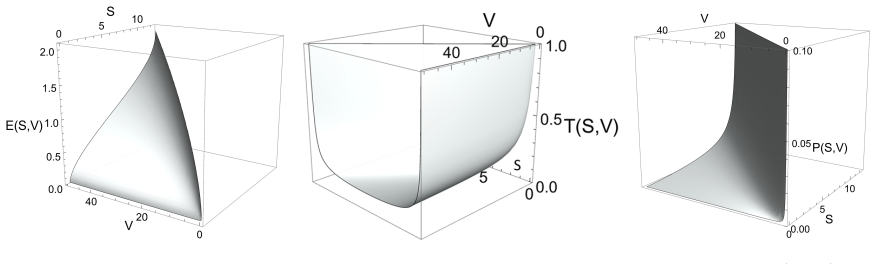
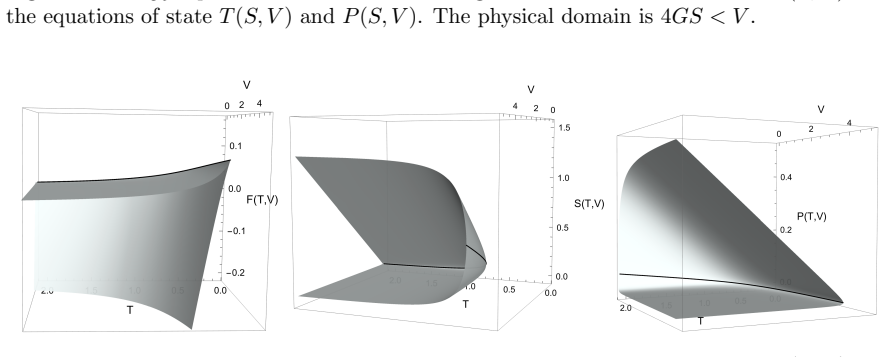
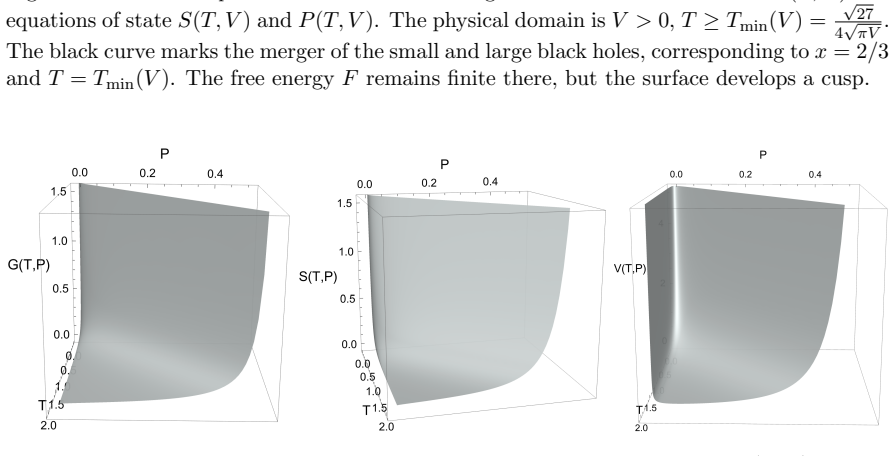
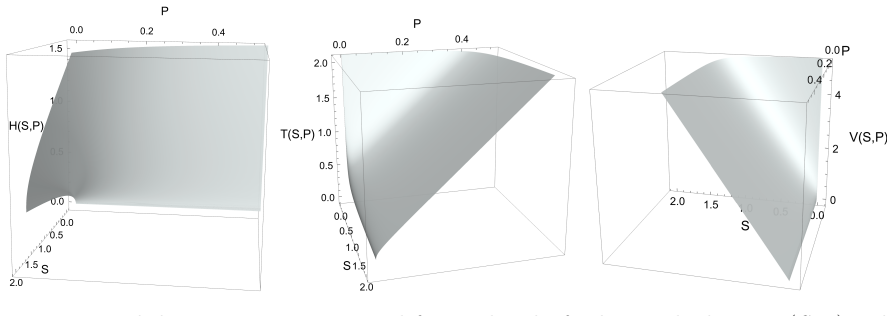
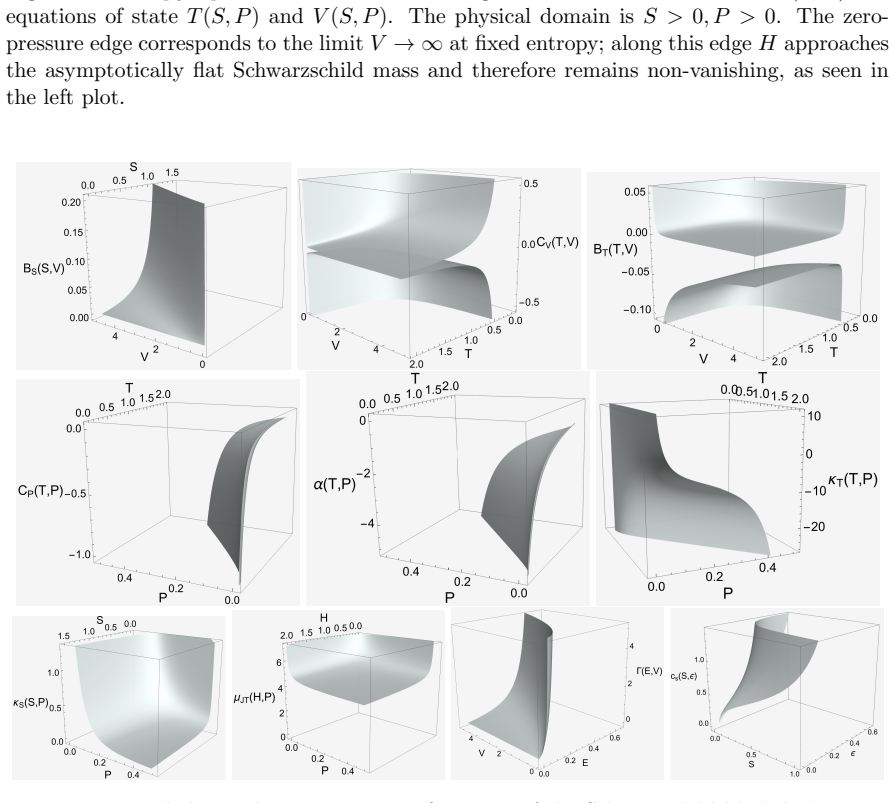
For the quasi-local Schwarzschild black hole, stability depends on the thermodynamic representation, or equivalently on which variables are held fixed under equilibrium perturbations. The large black hole branch is thermally stable at fixed volume but mechanically unstable under isothermal compression, while the system is mechanically stable under adiabatic compression everywhere. At fixed pressure, the black hole is thermally unstable throughout the physical state space. The thermal expansion coefficient is negative everywhere and isenthalpic expansion always cools the black hole.
What carries the argument
Thermodynamic representations, each consisting of a potential and one independent variable chosen from each conjugate pair, from which equations of state and response functions are obtained as first and second derivatives.
If this is right
- The large black hole branch remains thermally stable when volume is held fixed.
- The same branch is mechanically unstable under isothermal compression.
- Mechanical stability holds under adiabatic compression for every black hole state.
- Thermal instability occurs at fixed pressure in the entire physical state space.
- Isenthalpic expansion cools the black hole because the expansion coefficient is negative.
Where Pith is reading between the lines
- The same representation-based analysis could be applied to other quasi-local black hole solutions to test whether their stability also varies with the choice of fixed variables.
- The reported negative thermal expansion coefficient may translate into a corresponding property of the dual holographic fluid.
- Specifying the thermodynamic representation removes apparent contradictions between different statements about black hole stability.
Load-bearing premise
The cavity area and its conjugate surface pressure can be interpreted as the thermodynamic volume and pressure of a holographically dual system.
What would settle it
A direct computation of the thermal expansion coefficient for the cavity-enclosed Schwarzschild black hole that yields a positive value would contradict the reported negative coefficient.
Figures
read the original abstract
We systematically develop a framework for equilibrium thermodynamics in terms of thermodynamic representations, which are choices of thermodynamic potential and independent variables, one from each conjugate pair. In each representation, equations of state arise from first derivatives of the potential and response functions from its second derivatives. We apply this framework to ideal gases and to Schwarzschild black holes in a spherical cavity in various representations, interpreting the cavity area and its conjugate surface pressure as the thermodynamic volume and pressure of a holographically dual system. For this quasi-local Schwarzschild black hole, stability depends on the thermodynamic representation, or equivalently on which variables are held fixed under equilibrium perturbations. The large black hole branch is thermally stable at fixed volume but mechanically unstable under isothermal compression, while the system is mechanically stable under adiabatic compression everywhere. At fixed pressure, the black hole is thermally unstable throughout the physical state space. We also find that the thermal expansion coefficient is negative everywhere and show that isenthalpic expansion always cools the black hole. More broadly, the framework provides a systematic route to deriving equations of state and response functions for a wide class of black hole systems using quasi-local gravitational thermodynamics.
Editorial analysis
A structured set of objections, weighed in public.
Referee Report
Summary. The manuscript develops a general framework for thermodynamic representations, where each representation consists of a thermodynamic potential and a choice of independent variables from each conjugate pair. Equations of state are obtained from first derivatives of the potential, and response functions from second derivatives. This framework is applied to ideal gases as a consistency check and to quasi-local Schwarzschild black holes in a spherical cavity, where the cavity area and its conjugate surface pressure are interpreted as the thermodynamic volume and pressure of a holographically dual system. The central results concern representation-dependent stability and response functions for the black hole, including thermal stability of the large branch at fixed volume but mechanical instability under isothermal compression, mechanical stability under adiabatic compression, thermal instability at fixed pressure, negative thermal expansion coefficient, and cooling under isenthalpic expansion.
Significance. If the identification of cavity area with thermodynamic volume is justified, the paper offers a systematic approach to computing equations of state and response functions for black holes using quasi-local thermodynamics. The finding that stability depends on the thermodynamic representation provides new insight into black hole thermodynamics and could have implications for holographic duals. The framework itself is general and could be applied to other systems.
major comments (1)
- [Application to Schwarzschild black holes] The substitution of the cavity area for the thermodynamic volume V (and conjugate pressure for P) in the holographic dual interpretation is presented without an explicit derivation of the first law in the form dE = T dS - P dV or verification that Maxwell relations hold under this identification. Since the stability conclusions (e.g., thermal stability at fixed volume but not at fixed pressure) and response functions rely on this substitution being thermodynamically consistent, this justification is load-bearing and should be provided.
minor comments (1)
- The abstract clearly summarizes the results but could benefit from specifying the exact representations considered for the black hole.
Simulated Author's Rebuttal
We thank the referee for their careful reading of the manuscript and for highlighting the need for explicit thermodynamic consistency in the application to Schwarzschild black holes. We address the major comment below and will revise the manuscript accordingly.
read point-by-point responses
-
Referee: The substitution of the cavity area for the thermodynamic volume V (and conjugate pressure for P) in the holographic dual interpretation is presented without an explicit derivation of the first law in the form dE = T dS - P dV or verification that Maxwell relations hold under this identification. Since the stability conclusions (e.g., thermal stability at fixed volume but not at fixed pressure) and response functions rely on this substitution being thermodynamically consistent, this justification is load-bearing and should be provided.
Authors: We agree that an explicit derivation of the first law and verification of the Maxwell relations under the cavity-area identification would strengthen the presentation and address the load-bearing nature of this step. In the revised manuscript we will add a dedicated subsection deriving dE = T dS − P dV from the quasi-local energy expression for the Schwarzschild solution in a spherical cavity, following the standard boundary-term construction. We will then compute the relevant Maxwell relations explicitly for the chosen representations and confirm that they are satisfied. This material will be inserted in Section 3 prior to the stability analysis, ensuring the response functions and stability conclusions rest on a fully documented thermodynamic foundation. revision: yes
Circularity Check
No significant circularity; framework derivations are self-contained
full rationale
The paper first defines thermodynamic representations as choices of potential and one variable from each conjugate pair, then derives equations of state from first derivatives and response functions from second derivatives using standard thermodynamic identities. These steps are applied to ideal gases (recovering known results) and to the quasi-local Schwarzschild black hole by substituting the cavity area for volume under the stated holographic interpretation. No load-bearing claim reduces by construction to a fitted parameter renamed as prediction, a self-citation chain, or an ansatz smuggled via prior work; the stability conclusions follow directly from the representation choice and Maxwell relations without circular reduction. The interpretation of area as volume is an explicit modeling assumption rather than a definitional equivalence.
Axiom & Free-Parameter Ledger
axioms (2)
- domain assumption Equilibrium thermodynamics applies to Schwarzschild black holes in a spherical cavity using quasi-local quantities.
- domain assumption Cavity area and surface pressure correspond to thermodynamic volume and pressure of a holographically dual system.
Reference graph
Works this paper leans on
-
[1]
L. D. Landau and E. M. Lifshitz,Statistical Physics, Part 1, vol. 5 ofCourse of Theoretical Physics. Butterworth-Heinemann, Oxford, 1980, 10.1016/c2009-0-24487-4
-
[2]
Schroeder,An Introduction to Thermal Physics
D. Schroeder,An Introduction to Thermal Physics. Addison Wesley, 2000
2000
-
[3]
Blundell and K
S. Blundell and K. Blundell,Concepts in Thermal Physics. OUP Oxford, 2010
2010
-
[4]
H. B. Callen,Thermodynamics and an Introduction to Thermostatistics. John Wiley & Sons, New York, 2 ed., 1985
1985
-
[5]
R. M. Wald,The thermodynamics of black holes,Living Rev. Rel.4(2001) 6, [gr-qc/9912119]
Pith/arXiv arXiv 2001
-
[6]
B. P. Dolan,Where Is the PdV in the First Law of Black Hole Thermodynamics? INTECH, 2012.1209.1272. 10.5772/52455
-
[7]
S. W. Hawking,Particle creation by black holes,Communications in Mathematical Physics43(1975) 199–220
1975
-
[8]
J. D. Bekenstein,Black holes and entropy,Phys. Rev. D7(1973) 2333–2346
1973
-
[9]
T. Padmanabhan,Classical and quantum thermodynamics of horizons in spherically symmetric space-times,Class. Quant. Grav.19(2002) 5387–5408, [gr-qc/0204019]
Pith/arXiv arXiv 2002
-
[10]
D. Hansen, D. Kubiznak and R. B. Mann,Criticality and Surface Tension in Rotating Horizon Thermodynamics,Class. Quant. Grav.33(2016) 165005, [1604.06312]
Pith/arXiv arXiv 2016
-
[11]
D. Hansen, D. Kubiznak and R. Mann,Horizon Thermodynamics from Einstein’s Equation of State,Phys. Lett. B771(2017) 277–280, [1610.03079]
Pith/arXiv arXiv 2017
-
[12]
D. Kastor, S. Ray and J. Traschen,Enthalpy and the Mechanics of AdS Black Holes, Class. Quant. Grav.26(2009) 195011, [0904.2765]
Pith/arXiv arXiv 2009
-
[13]
B. P. Dolan,The cosmological constant and the black hole equation of state,Class. Quant. Grav.28(2011) 125020, [1008.5023]
Pith/arXiv arXiv 2011
-
[14]
M. Cvetic, G. W. Gibbons, D. Kubiznak and C. N. Pope,Black Hole Enthalpy and an Entropy Inequality for the Thermodynamic Volume,Phys. Rev. D84(2011) 024037, [1012.2888]
Pith/arXiv arXiv 2011
-
[15]
B. P. Dolan,Pressure and volume in the first law of black hole thermodynamics,Class. Quant. Grav.28(2011) 235017, [1106.6260]
Pith/arXiv arXiv 2011
-
[16]
D. Kubiznak and R. B. Mann,Black hole chemistry,Can. J. Phys.93(2015) 999–1002, [1404.2126]
arXiv 2015
-
[17]
D. Kubiznak, R. B. Mann and M. Teo,Black hole chemistry: thermodynamics with Lambda,Class. Quant. Grav.34(2017) 063001, [1608.06147]. 33
Pith/arXiv arXiv 2017
-
[18]
R. B. Mann,Black hole chemistry: The first 15 years,Int. J. Mod. Phys. D34(2025) 2542001, [2508.01830]
arXiv 2025
-
[19]
R. Mancilla,Generalized Euler equation from effective action: implications for the smarr formula in AdS black holes,JHEP11(2025) 089, [2410.06605]
arXiv 2025
-
[20]
D. Kubiznak and R. B. Mann,P-V criticality of charged AdS black holes,JHEP07 (2012) 033, [1205.0559]
Pith/arXiv arXiv 2012
-
[21]
J. W. York Jr.,Black-hole thermodynamics and the euclidean einstein action,Physical Review D33(1986) 2092–2099
1986
-
[22]
B. F. Whiting and J. W. York, Jr.,Action Principle and Partition Function for the Gravitational Field in Black Hole Topologies,Phys. Rev. Lett.61(1988) 1336
1988
-
[23]
E. A. Martinez and J. W. York, Jr.,Additivity of the entropies of black holes and matter in equilibrium,Phys. Rev. D40(1989) 2124–2127
1989
-
[24]
J. D. Brown, G. L. Comer, E. A. Martinez, J. Melmed, B. F. Whiting and J. W. York, Jr.,Thermodynamic Ensembles and Gravitation,Class. Quant. Grav.7(1990) 1433–1444
1990
-
[25]
H. W. Braden, J. D. Brown, B. F. Whiting and J. W. York, Jr.,Charged black hole in a grand canonical ensemble,Phys. Rev. D42(1990) 3376–3385
1990
-
[26]
J. D. Brown, E. A. Martinez and J. W. York, Jr.,Complex Kerr-Newman geometry and black hole thermodynamics,Phys. Rev. Lett.66(1991) 2281–2284
1991
-
[27]
J. D. Brown and J. York, James W.,Quasilocal energy and conserved charges derived from the gravitational action,Phys. Rev. D47(1993) 1407–1419, [gr-qc/9209012]
Pith/arXiv arXiv 1993
-
[28]
J. D. Brown and J. W. York, Jr.,The Microcanonical functional integral. 1. The Gravitational field,Phys. Rev. D47(1993) 1420–1431, [gr-qc/9209014]
Pith/arXiv arXiv 1993
-
[29]
S. G. A. Borsboom and M. R. Visser,Holographic pressure and volume for black holes, Class. Quant. Grav.43(2026) 095018, [2602.05130]
Pith/arXiv arXiv 2026
-
[30]
B. Banihashemi, E. Shaghoulian and S. Shashi,Flat space gravity at finite cutoff,Class. Quant. Grav.42(2025) 035010, [2409.07643]
arXiv 2025
-
[31]
G. L. Comer,Ensemble dependence of the stability of thermal black holes,Class. Quant. Grav.9(1992) 947–962
1992
-
[32]
P. T. Landsberg,Thermodynamics and Statistical Mechanics. Oxford University Press, Oxford, 1978
1978
-
[33]
Weinhold,Metric geometry of equilibrium thermodynamics,J
F. Weinhold,Metric geometry of equilibrium thermodynamics,J. Chem. Phys.63 (1975) 2479
1975
-
[34]
Ruppeiner,Thermodynamics: A Riemannian geometric model,Phys
G. Ruppeiner,Thermodynamics: A Riemannian geometric model,Phys. Rev. A20 (1979) 1608. 34
1979
-
[35]
Ruppeiner,Riemannian geometry in thermodynamic fluctuation theory,Rev
G. Ruppeiner,Riemannian geometry in thermodynamic fluctuation theory,Rev. Mod. Phys.67(1995) 605–659
1995
-
[36]
¨O. ¨Okc¨ u and E. Aydıner,Joule–Thomson expansion of the charged AdS black holes, Eur. Phys. J. C77(2017) 24, [1611.06327]
Pith/arXiv arXiv 2017
-
[37]
B. P. Dolan,Compressibility of rotating black holes,Phys. Rev. D84(2011) 127503, [1109.0198]
Pith/arXiv arXiv 2011
-
[38]
L. McGough, M. Mezei and H. Verlinde,Moving the CFT into the bulk withT T,JHEP 04(2018) 010, [1611.03470]
Pith/arXiv arXiv 2018
-
[39]
E. A. Martinez,Quasilocal energy for a Kerr black hole,Phys. Rev. D50(1994) 4920–4928, [gr-qc/9405033]
Pith/arXiv arXiv 1994
-
[40]
M. H. Dehghani and R. B. Mann,Quasilocal thermodynamics of Kerr and Kerr - anti-de Sitter space-times and the AdS / CFT correspondence,Phys. Rev. D64(2001) 044003, [hep-th/0102001]
Pith/arXiv arXiv 2001
-
[41]
J. D. E. Creighton and R. B. Mann,Quasilocal thermodynamics of dilaton gravity coupled to gauge fields,Phys. Rev. D52(1995) 4569–4587, [gr-qc/9505007]
Pith/arXiv arXiv 1995
-
[42]
D. Astefanesei, R. Ballesteros, P. Cabrera, G. Casanova and R. Rojas,Existence of thermodynamically stable asymptotically flat black holes,Phys. Rev. D110(2024) 024045, [2404.15566]
arXiv 2024
-
[43]
R. Andr´ e and J. P. S. Lemos,Thermodynamics of five-dimensional Schwarzschild black holes in the canonical ensemble,Phys. Rev. D102(2020) 024006, [2006.10050]
arXiv 2020
-
[44]
R. Andr´ e and J. P. S. Lemos,Thermodynamics ofd-dimensional Schwarzschild black holes in the canonical ensemble,Phys. Rev. D103(2021) 064069, [2101.11010]
arXiv 2021
-
[45]
G. Neri and S. Liberati,Covariant phase space analysis of Lanczos-Lovelock gravity with boundaries,JHEP06(2024) 136, [2404.16981]
arXiv 2024
-
[46]
S. Carlip and S. Vaidya,Phase transitions and critical behavior for charged black holes, Class. Quantum Grav.20(2003) 3827–3838, [gr-qc/0306054]
Pith/arXiv arXiv 2003
-
[47]
F. Simovic and R. B. Mann,Critical Phenomena of Charged de Sitter Black Holes in Cavities,Class. Quant. Grav.36(2019) 014002, [1807.11875]
Pith/arXiv arXiv 2019
-
[48]
D. Astefanesei and E. Radu,Quasilocal formalism and black ring thermodynamics, Phys. Rev. D73(2006) 044014, [hep-th/0509144]
Pith/arXiv arXiv 2006
-
[49]
A. P. Lundgren,Charged black hole in a canonical ensemble,Phys. Rev. D77(2008) 044014, [gr-qc/0612119]
Pith/arXiv arXiv 2008
-
[50]
T. V. Fernandes and J. P. S. Lemos,Grand canonical ensemble of a d-dimensional Reissner-Nordstr¨ om black hole in a cavity,Phys. Rev. D108(2023) 084053, [2309.12388]. 35
arXiv 2023
-
[51]
T. V. Fernandes and J. P. S. Lemos,Canonical ensemble of a d-dimensional Reissner-Nordstr¨ om black hole in a cavity,Phys. Rev. D111(2025) 104027, [2504.15339]
arXiv 2025
-
[52]
Hermann,Geometry, Physics, and Systems
R. Hermann,Geometry, Physics, and Systems. Lecture notes in pure and applied mathematics. M. Dekker, 1973
1973
-
[53]
Mrugala,Geometrical formulation of equilibrium phenomenological thermodynamics, Reports on Mathematical Physics14(1978) 419–427
R. Mrugala,Geometrical formulation of equilibrium phenomenological thermodynamics, Reports on Mathematical Physics14(1978) 419–427
1978
-
[54]
H. W. Haslach,Geometric structure of the non-equilibrium thermodynamics of homogeneous systems,Reports on Mathematical Physics39(Apr., 1997) 147–162
1997
-
[55]
Bravetti,Contact geometry and thermodynamics,Int
A. Bravetti,Contact geometry and thermodynamics,Int. J. Geom. Meth. Mod. Phys. 16(2018) 1940003. 36
2018
discussion (0)
Sign in with ORCID, Apple, or X to comment. Anyone can read and Pith papers without signing in.