REVIEW 3 major objections 5 minor 51 references
Surrogate-assisted multi-objective design of complex multibody systems
T0 review · 3 major / 5 minor · reviewed 2026-08-11 · deepseek-v4-flash
Pith's one-line read Coupling NSGA-II with repeatedly retrained neural surrogates finds near-optimal suspension designs with orders-of-magnitude fewer simulations.
desk verdict A plausible surrogate-assisted multi-objective framework on a real suspension problem, but the near-optimality claim rests on a self-referential stopping criterion and no reference front. read the letter →
The pith
A machine-rendered reading of the paper's core claim, the machinery that carries it, and where it could break.
The reading
What carries the argument
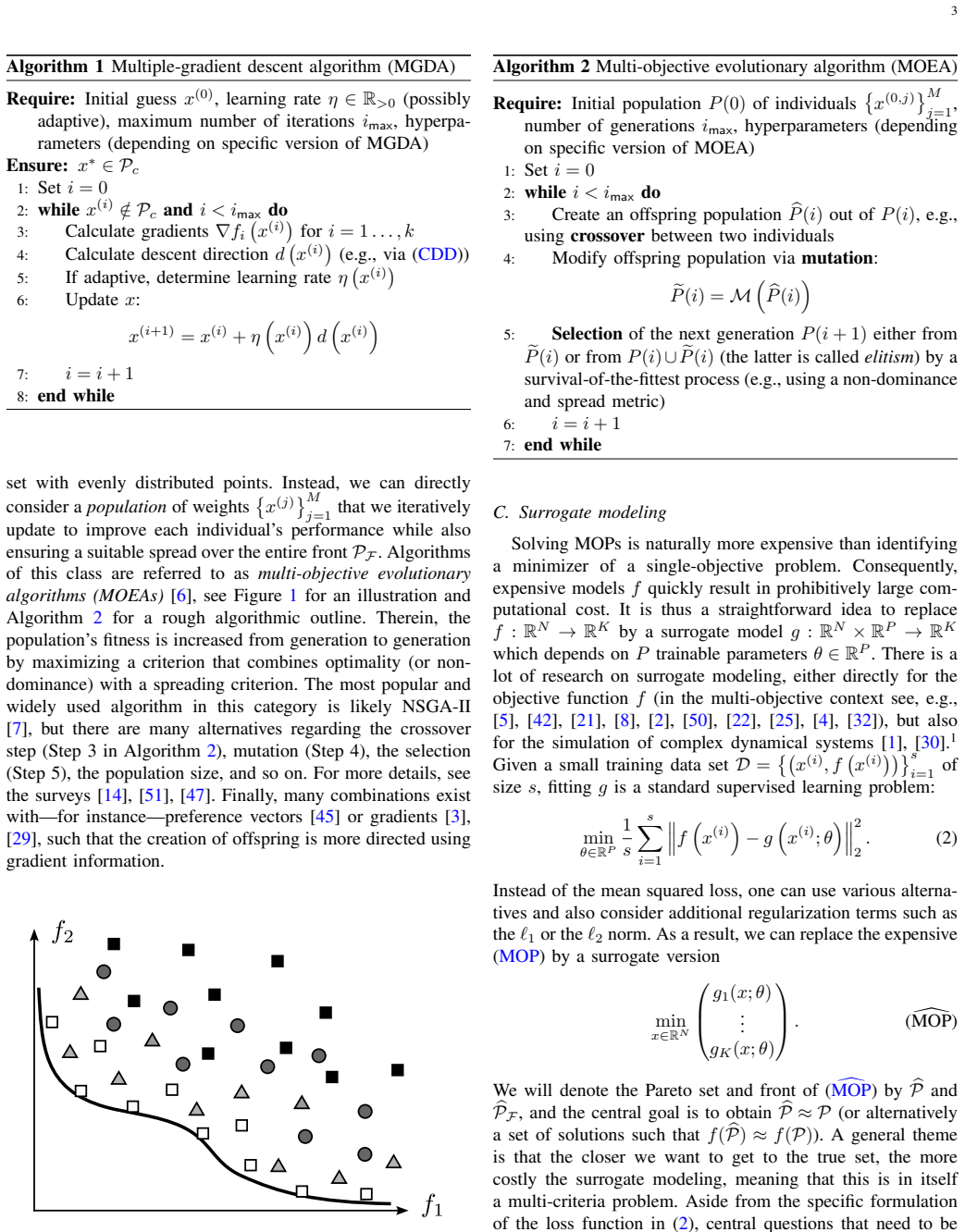
The load-bearing mechanism is Algorithm 3, an iterative loop that alternates between building a surrogate of the expensive objective $f : \mathbb{R}^{24} \to \mathbb{R}^2$ and solving the surrogate problem $(\widehat{\mathrm{MOP}})$ with NSGA-II. New expensive samples are placed by k-means clustering the current surrogate Pareto front, so each batch of simulations targets the region the surrogate believes is optimal. Convergence is judged by the Hausdorff distance $d_H(\widehat{\mathrm{PF}}^{(j-1)}, \widehat{\mathrm{PF}}^{(j)})$, the largest distance from any point of one set to the nearest point in the other set, between fronts of successive iterations; when that distance drops below $h_{\min}$, the loop stops. A final non-dominance test on all true samples yields the reported Pareto set, turning a roughly thirty-second-per-evaluation model into a few-seconds-per-iteration optimization.
What would settle it
Evaluate the final surrogate Pareto front on the true suspension model and compare it with a reference Pareto front obtained by a very expensive high-generation NSGA-II run directly on the true model; if the true-evaluated surrogate front is dominated by the reference front, or if their Hausdorff distance is much larger than the threshold $h_{\min}=2$ used to stop the loop, then the convergence criterion has not certified near-optimality.
Extended reading notes
Core claim
The authors' central discovery is that a back-and-forth procedure—surrogate training, optimization on the surrogate, Pareto-informed resampling, retraining—solves the expensive multibody design problem efficiently and near-optimally. The recommended configuration is NSGA-II as the multi-objective solver with a fully connected neural network as the surrogate, using twenty new expensive samples per iteration chosen by k-means clustering of the previous surrogate Pareto front. The algorithm stops when the Hausdorff distance between successive surrogate Pareto fronts falls below a threshold; on this problem that took eleven iterations with a per-iteration sample size of twenty, and the resulting front is judged to be of high quality. The authors also report that radial-basis-function surrogates stop earlier but produce a worse front, and that larger sample sizes reduce iterations while increasing wall-clock time.
Load-bearing premise
The procedure assumes that a small Hausdorff distance between two consecutive surrogate Pareto fronts means the front has converged to the true Pareto front; if the surrogate stays confidently wrong in the same region, the fronts can stabilize far from the true optimum, and the paper's RBF experiment shows that stopping early on this criterion does not by itself certify quality.
Editorial extensions
If this is right
- For this rear-suspension problem, NSGA-II combined with an ANN surrogate and Pareto-informed sampling replaces an infeasible optimization (about 30 seconds per evaluation) with a loop that converges in roughly ten to eleven iterations of twenty evaluations, a speedup of several orders of magnitude.
- RBF surrogates converge in fewer iterations but to a visibly worse front, which the paper attributes to RBF sensitivity to unevenly distributed samples, making surrogate choice a decisive factor.
- The stopping rule trades accuracy for cost: a smaller Hausdorff threshold improves the front but needs many more expensive iterations.
- Larger per-iteration sample sizes cut the number of iterations but raise total computation time, so sample size must be balanced against the simulation budget.
- The final Pareto front reported is the result of a non-dominance test on the true expensive samples, so the delivered set is grounded in real evaluations rather than surrogate predictions alone.
Reading between the lines
- If the same loop were run with a fixed total budget but an adaptive per-iteration sample size, earlier iterations could explore coarsely and later iterations refine; the paper names adaptive sample sizes as future work, so this is an extension rather than a claim.
- The convergence proxy is only as good as the surrogate's consistency: two successive surrogate fronts can be close to each other yet both be far from the true Pareto front, so a practical deployment should validate the final front with true evaluations.
- Because the method treats the simulator as a black box, the same loop should transfer to other expensive simulation-based multi-objective design problems, such as structural or energy-system design, though the paper only demonstrates it on one suspension model.
- A direct test of the claimed speedup would compare total wall-clock time against a standard NSGA-II run on the true model with the same budget and report the Hausdorff distance between the two fronts.
Editorial analysis
A structured set of objections, weighed in public.
Referee Report
Summary. The manuscript proposes a surrogate-assisted framework for expensive multi-objective optimization of multibody systems. Algorithm 3 alternates between training a surrogate (ANN or RBF), solving the surrogate MOP with NSGA-II (or MGDA), and using k-means clustering on the current surrogate Pareto set to select additional expensive samples. Convergence is declared when the Hausdorff distance between successive surrogate Pareto fronts falls below hmin. The method is demonstrated on a 24-parameter rear-suspension model with two objectives. The authors report that ANN surrogates with NSGA-II outperform RBFs and MGDA, requiring 11 iterations to converge, and conclude that the framework yields a speedup of several orders and convergence to high-quality solutions.
Significance. The algorithmic template is sensible and the paper addresses an important problem: how to allocate a limited budget of expensive simulations when approximating a Pareto front. The pseudocode and the MBS test case are concrete, and the paper explicitly compares two surrogate classes and two optimizer families. Strengths include a cheap convergence criterion, a clear description of the sampling strategy, and a nontrivial engineering test problem. However, the current evidence is almost entirely internal: all claims are relative to surrogate-based fronts generated by the same pipeline. There is no reference Pareto front, no direct-optimization baseline, no repeated runs, and no accounting of total wall-clock time. Thus the headline claims of near-optimality and several-orders speedup are not yet supported. The methodology is a plausible and useful contribution, but the experimental validation needs substantial strengthening.
major comments (3)
- [Algorithm 3, lines 9-12] The stopping criterion h = d_H(bPF^(j-1), bPF^(j)) < hmin is a self-comparison of two surrogate-generated fronts; it certifies consistency between successive approximations of the same surrogate problem, not closeness to the true Pareto front. A systematically biased surrogate can stabilize far from the true PF. The paper itself provides an internal counterexample in Section V-B: with the RBF surrogate, Algorithm 3 stops after 6 iterations with a front the authors judge worse than the ANN front, yet the same hmin = 2 criterion is used for the ANN result. The conclusion 'convergence to high-quality solutions' therefore is not directly supported. The revision should evaluate the final surrogate front on the true simulator and compare it against a reference Pareto front or a direct NSGA-II run on the expensive model with a comparable budget.
- [Section V] There is no reference Pareto front and no non-surrogate baseline in the experiments. All reported comparisons are among variants of Algorithm 3, so the claim that ANN+NSGA-II is 'the best way to find near-optimal solutions' cannot be assessed without a ground-truth front. Please add a high-budget direct optimization baseline (for example, NSGA-II applied directly to the expensive model with a predefined evaluation budget, or a set of independently converged single- or multi-objective optima) and report the resulting front together with the surrogate fronts.
- [Section V-C and Conclusion] The claim of 'a significant speedup of several orders' is not quantified. No total wall-clock time for Algorithm 3 is reported against a direct-optimization baseline; statements such as 'approximately 30 seconds for a single function evaluation' and 'a few seconds for solving the surrogate MOP' do not by themselves establish the speedup, because training, retraining, clustering, and NSGA-II iterations consume time as well. In addition, NSGA-II is stochastic, yet no repeated runs or variance measures are reported for any experiment. The revision should report total wall-clock budgets, numbers of true evaluations, and statistics over multiple independent runs.
minor comments (5)
- [Section II-C] The sentence 'We will experiment with various values for m' appears to refer to the sample size s or the batch size; please correct the variable and make the statement consistent with Algorithm 3.
- [Section V] There are several typos and grammatical errors: 'Guassian' should be 'Gaussian', 'imporoves' should be 'improves', and the sentence ending 'and a better approximated Pareto front' in Section V-C is incomplete.
- [Figure 10] The caption is inconsistent with the text: the caption says (c) and (d) illustrate computation times, while the text says (c) shows the number of iterations versus sample size; please harmonize the caption, axis labels, and the referenced quantities.
- [Figure 8] The sub-figures are small and the axes are not always labeled; adding consistent axis labels and legends would help the reader verify the claimed convergence behavior visually.
- [Section IV] The statement 'we found hmin = 2 to be a good value' would be more informative with a short description of the range of thresholds tested and the effect of the threshold on the RBF and ANN results.
Circularity Check
Algorithm 3's stopping rule certifies surrogate-front self-consistency, not near-optimality; the conclusion 'convergence to high-quality solutions' reads quality off that self-referential criterion.
-
self definitional
[Algorithm 3, lines 9–12; Section V-A; Section VI (Conclusion)]
"Convergence: Compute Hausdorff distance (cf. (3)) h = dH ( bP (j−1) F , bP (j) F ); if h < hmin then STOP ... Since we use the surrogate-based Pareto fronts bP (j−1) F and bP (j) F for X and Y in Algorithm 3—which are finite sets of dimension M—the sup and inf operators can be replaced by max and min, respectively. ... A significant speedup of several orders was observed while indicating convergence to high-quality solutions."
The only convergence test in Algorithm 3 compares two successive surrogate-generated Pareto fronts. A small Hausdorff distance h therefore means the surrogate's own front stopped moving; it does not measure distance to the true Pareto front PF. The conclusion nevertheless treats this internal stability as 'convergence to high-quality solutions.' Line 15's non-dominance test on the real samples D only guarantees that the returned points are nondominated among the evaluated samples, not that they are near PF. Hence the near-optimality claim is, by construction, an assertion about the surrogate's self-consistency rather than a validated property of the true problem.
full rationale
Most of the paper is a self-contained empirical comparison: ANN vs RBF surrogates, NSGA-II vs MGDA, and different sample sizes, all evaluated on the same suspension problem with true simulations. Those comparisons are not circular; they rest on actual expensive evaluations and internal performance measures. There is no load-bearing self-citation chain or imported uniqueness theorem: references to the authors' prior work (e.g., [2], [17]) are background or methodological context, not the justification for the central claim. The one genuinely self-referential step is the convergence criterion in Algorithm 3. The Hausdorff distance is taken between two consecutive surrogate Pareto fronts, so the stopping signal is a measure of the surrogate's consistency with itself. When the paper concludes that a 'significant speedup' and 'convergence to high-quality solutions' were observed, the quality component is inferred from this internal stability. Since no reference Pareto front, direct-optimization baseline, or repeated-run benchmark is reported, the near-optimality claim reduces to the algorithm's own stopping definition. This is partial circularity: the engineering comparison (which surrogate/optimizer is faster or better under this protocol) has independent content, but the advertised guarantee of near-optimality does not. Score 6 reflects that the central quality claim is forced by the self-referential stopping rule, while other parts of the paper retain independent empirical content.
Assumptions & free parameters
free parameters (4)
- Hausdorff threshold hmin =
2
- RBF kernel width sigma =
0.5
- ANN architecture =
2 hidden layers, 64 neurons each
- NSGA-II population size and generations =
M=100, imax=200
assumptions (5)
- domain assumption The Neweul-M2 suspension model faithfully represents the physical rear suspension system.
- domain assumption The objective functions f1 and f2 are deterministic and noise-free.
- ad hoc to paper k-means clustering on the surrogate Pareto front in objective space yields design-space samples that improve the surrogate where it matters.
- ad hoc to paper Small Hausdorff distance between successive surrogate fronts implies proximity to the true Pareto front.
- domain assumption The 7 Hz sinusoidal excitation is a representative maneuver for suspension design objectives.
Cite this review
Pith. "Pith review of Surrogate-assisted multi-objective design of complex multibody systems." pith.science (2026). https://pith.science/paper/7QLMIW5P
@misc{pith2026241214854,
  author       = {Pith},
  title        = {Pith review of: Surrogate-assisted multi-objective design of complex multibody systems},
  year         = {2026},
  howpublished = {\url{https://pith.science/paper/7QLMIW5P}},
  note         = {Machine review of arXiv:2412.14854}
}
read the original abstract
The optimization of large-scale multibody systems is a numerically challenging task, in particular when considering multiple conflicting criteria at the same time. In this situation, we need to approximate the Pareto set of optimal compromises, which is significantly more expensive than finding a single optimum in single-objective optimization. To prevent large costs, the usage of surrogate models, constructed from a small but informative number of expensive model evaluations, is a very popular and widely studied approach. The central challenge then is to ensure a high quality (that is, near-optimality) of the solutions that were obtained using the surrogate model, which can be hard to guarantee with a single pre-computed surrogate. We present a back-and-forth approach between surrogate modeling and multi-objective optimization to improve the quality of the obtained solutions. Using the example of an expensive-to-evaluate multibody system, we compare different strategies regarding multi-objective optimization, sampling and also surrogate modeling, to identify the most promising approach in terms of computational efficiency and solution quality.
Figures


Figures from the paper (6 more)


Reference graph
Works this paper leans on
-
[1]
A survey of projection-based model reduction methods for parametric dynamical systems,
P. Benner, S. Gugercin, and K. Willcox, “A survey of projection-based model reduction methods for parametric dynamical systems,” SIAM Review, vol. 57, no. 4, pp. 483–531, 2015
2015
-
[2]
M. Berkemeier and S. Peitz, “Derivative-free multiobjective trust region descent method using radial basis function surrogate models,” Mathe- matical and Computational Applications , vol. 26, no. 2, 2021
work page 2021
-
[3]
On gradients and hybrid evolutionary algorithms for real-valued multiobjective optimization,
P. A. N. Bosman, “On gradients and hybrid evolutionary algorithms for real-valued multiobjective optimization,” IEEE Transactions on Evolutionary Computation, vol. 16, no. 1, pp. 51–69, 2012
work page 2012
-
[4]
Enhancing multi-objective optimisation through ma- chine learning-supported multiphysics simulation,
D. Botache, J. Decke, W. Ripken, A. Dornipati, F. G ¨otz-Hahn, M. Ayeb, and B. Sick, “Enhancing multi-objective optimisation through ma- chine learning-supported multiphysics simulation,” in Machine Learning and Knowledge Discovery in Databases. Applied Data Science Track , A. Bifet, T. Krilavi ˇcius, I. Miliou, and S. Nowaczyk, Eds. Cham: Springer Nature...
work page 2024
-
[5]
T. Chugh, K. Sindhya, J. Hakanen, and K. Miettinen, “Handling com- putationally expensive multiobjective optimization problems with evolu- tionary algorithms-a survey,”Reports of the Department of Mathematical Information Technology, Series B, Scientific Computing no. B, vol. 4, no. 2015, p. 1957, 2015
work page 2015
-
[6]
C. A. Coello Coello, G. B. Lamont, and D. A. Van Veldhuizen, Evolutionary Algorithms for Solving Multi-Objective Problems , 2nd ed. Springer, 2007
work page 2007
-
[7]
A fast and elitist multiobjective genetic algorithm: NSGA-II,
K. Deb, A. Pratap, S. Agarwal, and T. Meyarivan, “A fast and elitist multiobjective genetic algorithm: NSGA-II,” IEEE Transactions on Evolutionary Computation, vol. 6, no. 2, p. 182–197, 2002
work page 2002
-
[8]
Surrogate modeling approaches for multiobjective optimization: Methods, taxonomy, and results,
K. Deb, P. C. Roy, and R. Hussein, “Surrogate modeling approaches for multiobjective optimization: Methods, taxonomy, and results,” Mathe- matical and Computational Applications , vol. 26, no. 1, 2021
work page 2021
Show all 51 references
-
[9]
Multiple-gradient descent algorithm (MGDA) for mul- tiobjective optimization,
J.-A. D ´esid´eri, “Multiple-gradient descent algorithm (MGDA) for mul- tiobjective optimization,” Comptes Rendus. Math ´ematique, vol. 350, no. 5–6, p. 313–318, Mar. 2012
2012
-
[10]
Ehrgott, Multicriteria optimization, 2nd ed
M. Ehrgott, Multicriteria optimization, 2nd ed. Springer, 2005
2005
-
[11]
Newton’s method for multiobjective optimization,
J. Fliege, L. M. Gra ˜na Drummond, and B. F. Svaiter, “Newton’s method for multiobjective optimization,” SIAM Journal on Optimization, vol. 20, no. 2, pp. 602–626, 2009
2009
-
[12]
Steepest descent methods for multicriteria optimization,
J. Fliege and B. F. Svaiter, “Steepest descent methods for multicriteria optimization,” Mathematical Methods of Operations Research , vol. 51, no. 3, pp. 479–494, 2000
2000
-
[13]
A method for constrained multiobjective optimization based on sqp techniques,
J. Fliege and A. I. F. Vaz, “A method for constrained multiobjective optimization based on sqp techniques,” SIAM Journal on Optimization , vol. 26, no. 4, pp. 2091–2119, 2016
2016
-
[14]
An overview of evolutionary algorithms in multiobjective optimization,
C. M. Fonseca and P. J. Fleming, “An overview of evolutionary algorithms in multiobjective optimization,” Evolutionary Computation , vol. 3, no. 1, pp. 1–16, 1995. 9 (a) (b) (c) (d) Figure 10: (a) and (b) illustrate the final Pareto front bPF after convergence and the last com...
1995
-
[15]
An Efficient Descent Method for Locally Lip- schitz Multiobjective Optimization Problems,
B. Gebken and S. Peitz, “An Efficient Descent Method for Locally Lip- schitz Multiobjective Optimization Problems,” Journal of Optimization Theory and Applications , vol. 188, pp. 696–723, 2021
2021
-
[16]
A Descent Method for Equality and Inequality Constrained Multiobjective Optimization Problems,
B. Gebken, S. Peitz, and M. Dellnitz, “A Descent Method for Equality and Inequality Constrained Multiobjective Optimization Problems,” in Numerical and Evolutionary Optimization – NEO 2017 , L. Trujillo, O. Sch ¨utze, Y . Maldonado, and P. Valle, Eds. Springer, Cham, 2019, pp. 29–61
2017
-
[17]
On the hierarchical structure of Pareto critical sets,
——, “On the hierarchical structure of Pareto critical sets,” Journal of Global Optimization, vol. 73, no. 4, pp. 891–913, 2019
2019
- [18]
-
[19]
Heißing and M
B. Heißing and M. Ersoy, Chassis Handbook: Fundamentals, Driving Dynamics, Components, Mechatronics, Perspectives , ser. SpringerLink B¨ucher. Wiesbaden: Vieweg+Teubner, 2011
2011
-
[20]
Hillermeier, Nonlinear Multiobjective Optimization: A Generalized Homotopy Approach
C. Hillermeier, Nonlinear Multiobjective Optimization: A Generalized Homotopy Approach. Birkh ¨auser, 2001
2001
-
[21]
A generative Kriging surrogate model for constrained and unconstrained multi-objective optimization,
R. Hussein and K. Deb, “A generative Kriging surrogate model for constrained and unconstrained multi-objective optimization,” inProceed- ings of the Genetic and Evolutionary Computation Conference 2016 , ser. GECCO ’16. New York, NY , USA: Association for Computing Machinery, ...
2016
-
[22]
Multi-objective GFlowNets,
M. Jain, S. C. Raparthy, A. Hern ´andez-Garc´ıa, J. Rector-Brooks, Y . Bengio, S. Miret, and E. Bengio, “Multi-objective GFlowNets,” in Proceedings of the 40th International Conference on Machine Learning , ser. Proceedings of Machine Learning Research, A. Krause, E. Brunskill...
2023
-
[23]
Adam: A method for stochastic optimization,
D. P. Kingma and J. Ba, “Adam: A method for stochastic optimization,” arXiv preprint arXiv:1412.6980v9 , 2017
2017 arXiv
-
[24]
From Neweul to Neweul-M2: Symbolical equations of motion for multibody system analysis and synthesis,
T. Kurz, P. Eberhard, C. Henninger, and W. Schiehlen, “From Neweul to Neweul-M2: Symbolical equations of motion for multibody system analysis and synthesis,” Multibody System Dynamics, vol. 24, no. 1, pp. 25–41, Jan. 2010
2010
-
[25]
Large language model for multi-objective evolutionary optimization,
F. Liu, X. Lin, Z. Wang, S. Yao, X. Tong, M. Yuan, and Q. Zhang, “Large language model for multi-objective evolutionary optimization,” arXiv:2310.12541, 2023
2023 arXiv
-
[26]
Interactive bundle-based method for non- differentiable multiobjeective optimization: NIMBUS,
K. Miettinen and M. M ¨akel¨a, “Interactive bundle-based method for non- differentiable multiobjeective optimization: NIMBUS,” Optimization, vol. 34, no. 3, pp. 231–246, 1995
1995
-
[27]
Miettinen, Nonlinear Multiobjective Optimization
K. Miettinen, Nonlinear Multiobjective Optimization . Springer US, 1998
1998
-
[28]
Kraftfahrzeug, unebenheits- einpunktanregung,
M. Mitschke and H. Wallentowitz, “Kraftfahrzeug, unebenheits- einpunktanregung,” in Dynamik Der Kraftfahrzeuge. Springer Fachme- dien Wiesbaden, 2014, pp. 369–441
2014
-
[29]
Multi- objective ADAM optimizer (MAdam),
F. Nikbakhtsarvestani, M. Ebrahimi, and S. Rahnamayan, “Multi- objective ADAM optimizer (MAdam),” in 2023 IEEE International Conference on Systems, Man, and Cybernetics (SMC) , 2023, pp. 3860– 3867
2023
-
[30]
A Survey of Recent Trends in Multiobjective Optimal Control – Surrogate Models, Feedback Control and Objective Reduction,
S. Peitz and M. Dellnitz, “A Survey of Recent Trends in Multiobjective Optimal Control – Surrogate Models, Feedback Control and Objective Reduction,” Mathematical and Computational Applications , vol. 23, no. 2, 2018
2018
-
[31]
Gradient-based multiobjective optimization with uncertainties,
——, “Gradient-based multiobjective optimization with uncertainties,” in NEO 2016, Y . Maldonado, L. Trujillo, O. Sch ¨utze, A. Riccardi, and M. Vasile, Eds. Springer, 2018, vol. 731, pp. 159–182
2016
-
[32]
Multi-objective deep learning: Taxonomy and survey of the state of the art,
S. Peitz and S. S. Hotegni, “Multi-objective deep learning: Taxonomy and survey of the state of the art,” arXiv:2412.01566, 2024
2024 arXiv
-
[33]
Quasi-newton’s method for multiobjective optimization,
Z. Povalej, “Quasi-newton’s method for multiobjective optimization,” Journal of Computational and Applied Mathematics , vol. 255, pp. 765– 777, 2014
2014
-
[34]
A comprehensive review of machine learning in multi-objective optimization,
Q. Qu, Z. Ma, A. Clausen, and B. N. Jorgensen, “A comprehensive review of machine learning in multi-objective optimization,” in 2021 IEEE 4th International Conference on Big Data and Artificial Intelli- gence (BDAI). IEEE, Jul. 2021, p. 7–14
2021
-
[35]
Stochastic method for the solution of unconstrained vector optimization problems,
S. Sch ¨affler, R. Schultz, and K. Weinzierl, “Stochastic method for the solution of unconstrained vector optimization problems,” Journal of Optimization Theory and Applications, vol. 114, no. 1, p. 209–222, 2002
2002
-
[36]
Multibody system dynamics: Roots and perspectives,
W. Schiehlen, “Multibody system dynamics: Roots and perspectives,” Multibody System Dynamics , vol. 1, no. 2, p. 149–188, 1997
1997
-
[37]
Research trends in multibody system dynamics,
——, “Research trends in multibody system dynamics,” Multibody System Dynamics, vol. 18, no. 1, p. 3–13, 2007
2007
-
[38]
Tire wear reduction based on an extended multibody rear axle model,
J. Sch ¨utte and W. Sextro, “Tire wear reduction based on an extended multibody rear axle model,” Vehicles, vol. 3, no. 2, pp. 233–256, may 2021
2021
-
[39]
Using the averaged hausdorff distance as a performance measure in evolutionary multiobjective optimization,
O. Sch ¨utze, X. Esquivel, A. Lara, and C. A. C. Coello, “Using the averaged hausdorff distance as a performance measure in evolutionary multiobjective optimization,” IEEE Transactions on Evolutionary Com- putation, vol. 16, no. 4, pp. 504–522, 2012
2012
-
[40]
Multi-task learning as multi-objective opti- mization,
O. Sener and V . Koltun, “Multi-task learning as multi-objective opti- mization,” Advances in neural information processing systems , vol. 31, 2018
2018
-
[41]
Fast Multiobjective Gradient Methods with Nesterov Acceleration via Inertial Gradient-like Systems,
K. Sonntag and S. Peitz, “Fast Multiobjective Gradient Methods with Nesterov Acceleration via Inertial Gradient-like Systems,” Journal of Optimization Theory and Applications , vol. 201, pp. 539–582, 2024
2024
-
[42]
A survey on handling computationally expensive multiobjective optimization problems using surrogates: non-nature inspired methods,
M. Tabatabaei, J. Hakanen, M. Hartikainen, K. Miettinen, and K. Sind- hya, “A survey on handling computationally expensive multiobjective optimization problems using surrogates: non-nature inspired methods,” Structural and Multidisciplinary Optimization , vol. 52, no. 1, p. 1–...
2015
-
[43]
Proximal gradient methods for multiobjective optimization and their applications,
H. Tanabe, E. H. Fukuda, and N. Yamashita, “Proximal gradient methods for multiobjective optimization and their applications,” Computational Optimization and Applications , vol. 72, no. 2, p. 339–361, 2018
2018
-
[44]
An accelerated proximal gradient method for multiobjective optimization,
——, “An accelerated proximal gradient method for multiobjective optimization,” Computational Optimization and Applications , vol. 86, no. 2, p. 421–455, 2023
2023
-
[45]
A preference- based evolutionary algorithm for multi-objective optimization,
L. Thiele, K. Miettinen, P. J. Korhonen, and J. Molina, “A preference- based evolutionary algorithm for multi-objective optimization,” Evolu- tionary Computation, vol. 17, no. 3, pp. 411–436, 2009
2009
-
[46]
M. N. Thombre, H. A. Preisig, and M. B. Addis, Developing Surrogate Models via Computer Based Experiments . Elsevier, 2015, p. 641–646
2015
-
[47]
Evolutionary large-scale multi-objective optimization: A survey,
Y . Tian, L. Si, X. Zhang, R. Cheng, C. He, K. C. Tan, and Y . Jin, “Evolutionary large-scale multi-objective optimization: A survey,” ACM Comput. Surv., vol. 54, no. 8, Oct. 2021
2021
-
[48]
Woernle, Multibody Systems: An Introduction to the Kinematics and Dynamics of Systems of Rigid Bodies
C. Woernle, Multibody Systems: An Introduction to the Kinematics and Dynamics of Systems of Rigid Bodies . Springer Berlin Heidelberg
-
[49]
Day- dreamer: World models for physical robot learning,
P. Wu, A. Escontrela, D. Hafner, P. Abbeel, and K. Goldberg, “Day- dreamer: World models for physical robot learning,” in Proceedings of The 6th Conference on Robot Learning , ser. Proceedings of Machine Learning Research, K. Liu, D. Kulic, and J. Ichnowski, Eds., vol. 205. PM...
2023
-
[50]
A convolutional neural network-based surrogate model for multi-objective optimization evolu- tionary algorithm based on decomposition,
T. Zhang, F. Li, X. Zhao, W. Qi, and T. Liu, “A convolutional neural network-based surrogate model for multi-objective optimization evolu- tionary algorithm based on decomposition,” Swarm and Evolutionary Computation, vol. 72, p. 101081, Jul. 2022
2022
-
[51]
Multiobjective evolutionary algorithms: A survey of the state of the art,
A. Zhou, B.-Y . Qu, H. Li, S.-Z. Zhao, P. N. Suganthan, and Q. Zhang, “Multiobjective evolutionary algorithms: A survey of the state of the art,” Swarm and Evolutionary Computation , vol. 1, no. 1, pp. 32–49, 2011
2011
Reviewed August 11, 2026 · model on record in the stance chip above.
Discussion (0). Continue with ORCID to comment.