REVIEW 3 major objections 5 minor 52 references
Learning Autonomous Surgical Irrigation and Suction with the da Vinci Research Kit Using Reinforcement Learning
T0 review · 3 major / 5 minor · reviewed 2026-08-12 · deepseek-v4-flash
Pith's one-line read Two vision-based reinforcement-learning agents trained in a fluid simulator transfer to a physical da Vinci Research Kit and autonomously perform surgical irrigation and suction, leaving contaminant residuals close to those of a human…
desk verdict Credible first demonstration of autonomous irrigation-suction with raw RGB on a dVRK, but the residual-mass numbers are undercut by an unresolved handling of force-terminated trials. read the letter →
The pith
A machine-rendered reading of the paper's core claim, the machinery that carries it, and where it could break.
The reading
What carries the argument
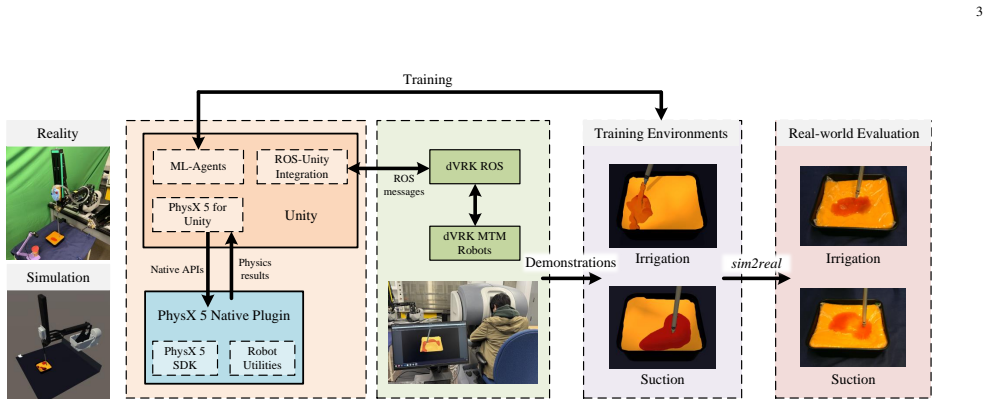
The load-bearing machinery is CRESSim-ML, the paper's simulated surgical-robot learning platform, plus a trained policy pair. The simulation side uses position-based fluid dynamics (PBF) particles with a screen-space rendering pass and a color-diffusion scheme that updates each particle's color as a distance- and speed-weighted average of nearby particles, so irrigated liquid visibly mixes with the contaminant. The control side exploits the fact that the patient-side manipulator with the suction/irrigator tool is a kinematically constrained 5-DoF robot: the policy outputs incremental joint-space targets, avoiding the need for Cartesian inverse kinematics, and observes current joint positions plus a tissue-contact indicator. The transfer side combines domain randomization over colors, lighting, camera pose, tissue shape, and fluid physics with a two-lesson curriculum for irrigation and imitation learning (behavior cloning and a GAIL-style auxiliary reward) that helps the suction agent but not the irrigation one. Together these components let a raw-RGB policy trained in simulation produce the reported physical-world results.
What would settle it
Re-run the suction-only and combined irrigation-suction trials on the physical robot, this time including the nine force-terminated trials in the average as their measured or worst-case residuals; if the mean suctionable residue then rises well above the 2.24-2.64 gram band, the transfer claim is only true for a selected subset of trials. A complementary check is to vary the camera pose, light angle, or contaminant color beyond the trained randomization range and measure the residual after autonomous irrigation and manual suction.
Extended reading notes
Core claim
Stated on the paper's own terms: two agents, one for irrigation and one for suction, map an $84 \times 84$ RGB frame plus stacked joint positions to incremental 5-DoF joint-space commands at 10 Hz, and after sim-to-real transfer they complete the physical irrigation-suction procedure in most trials. The irrigation agent learns to aim the suction/irrigator at dark contaminant and toggle irrigation only while the tool is close to it, using a curriculum that first teaches approach-and-activate behavior before adding the full dilution reward. The suction agent learns to move toward liquid regions and remove them under a cone-shaped suction force field, with rewards for particles removed and for approaching the nearest liquid. Real-world measurements put irrigation-plus-manual-suction residuals at about 2.1-2.2 grams versus 1.90 grams for human irrigation, suction-only residuals at 2.64 and 2.24 grams for roughly 22-gram and 31-gram starting pools, and combined autonomous trials at 2.42 grams of suctionable liquid left behind out of an initial ~5 grams, with 4.40 grams total remaining because the suction policy leaves some irrigated liquid. An ANOVA finds no statistically significant difference among the three suction-performance groups, and the paper reports no significant correlation between irrigation quality and suction outcome.
Load-bearing premise
The reported real-world averages come from completed trials only; the performance figures assume that the nine trials halted by the hard-coded force limit would not have added substantially larger residuals had they been allowed to finish.
Editorial extensions
If this is right
- A template for automating fluid-handling surgical subtasks becomes available: simulate with PBF and color diffusion, randomize appearance and physics, and train a raw-RGB joint-space policy.
- The suction agent can be deployed independently, for example in blood-suction tasks, because it was trained on diverse liquid configurations and does not require the irrigation agent.
- In the authors' statistical test, the fully autonomous two-step sequence performs no worse than suction alone, meaning an upstream autonomous irrigation step does not measurably harm downstream suction.
- The measured irrigation gap to human operation is about 0.2-0.3 grams, which the paper presents as showing agent performance close to that of a human.
Reading between the lines
- The paper leaves implicit that a high-level supervisor could decide when to switch from irrigation to suction and when to repeat the cycle; the 2.42 grams of leftover suctionable liquid suggests a second pass would reduce the residual further.
- The nine force-limit terminations imply that contact-rich suction needs an explicit recovery behavior, such as lifting the end-effector off the tissue before repositioning, which the current policy lacks.
- The color-diffusion and screen-space fluid rendering could be reused for vision-based training in other mixed-fluid surgical contexts, such as bleeding with cauterization smoke, where visual mixing matters more than exact fluid mechanics.
- Adding depth or stereo observations would likely shrink the reported sim-to-real gap, but the paper's exclusion of depth is a reasonable design choice because real-world depth is noisy; this trade-off is testable.
Editorial analysis
A structured set of objections, weighed in public.
Referee Report
Summary. This manuscript proposes CRESSim-ML, a Unity/PhysX-based learning platform for the da Vinci Research Kit, and uses it to train two vision-based RL agents—one for irrigating a contaminant and one for suctioning liquid—using domain randomization, curriculum learning, and imitation learning. The agents are transferred to a physical dVRK with an EndoWrist Suction/Irrigator and evaluated in irrigation-only (10 trials), suction-only (20 trials), and combined irrigation-suction (10 trials) settings. The headline quantitative claims are that after autonomous irrigation plus manual suction, 2.11 g (abstract: 2.21 g) of contaminant remains versus 1.90 g for manual irrigation, that the suction agent leaves 2.64 and 2.24 g residuals for roughly 20 g and 30 g initial fluid loads, and that combined autonomous irrigation-suction leaves 4.40 g total weight with 2.42 g of suctionable residual. The authors position this as the first automated two-step irrigation-suction policy using raw RGB observations.
Significance. If the empirical results survive scrutiny, this is a useful advance: it extends sim-to-real RL to fluid manipulation in surgery, demonstrates a two-step irrigation-suction pipeline with raw RGB input, and provides a reusable simulation platform. The authors deserve credit for conducting physical experiments with external weight measurements rather than only simulated metrics, for reporting training curves and reward design, and for documenting suboptimal outcomes. The main novelty is the simulation and application contribution; the RL machinery (PPO plus DR/CL/IL) is standard. The quantitative strength of the paper is currently limited by small per-condition sample sizes, the unresolved treatment of force-terminated trials, and an internal inconsistency in the headline irrigation number.
major comments (3)
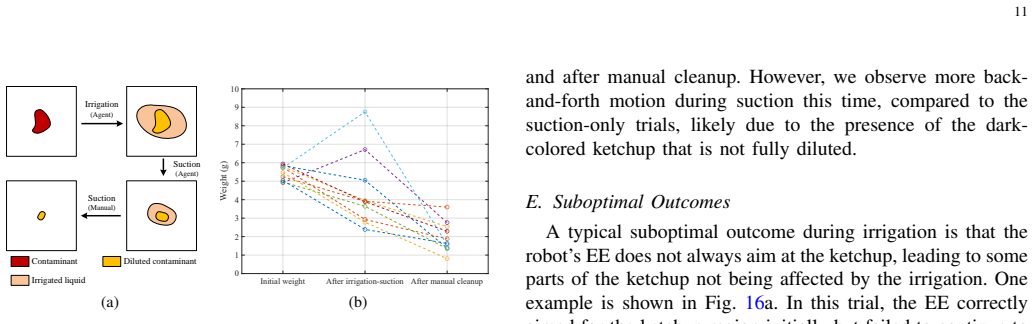
- [Section VII.C; Sections VI.C and VI.D] Section VII.C states that 9 of the 30 suction trials (20 suction-only plus 10 combined) were terminated by a hardcoded EE force limit, but Sections VI.C and VI.D report residual means (2.64 +/- 1.87 g, 2.24 +/- 2.24 g, and 2.42 +/- 2.04 g) without stating whether terminated trials were included, excluded, or assigned a terminal weight. Force termination occurs when the EE contacts tissue or liquid, which is exactly the situation in which pooled fluid must be suctioned, so excluding those trials conditions the reported averages on success and likely biases them downward. If the trials were included, the measurement at termination is not defined. This ambiguity is load-bearing for the sim-to-real transfer claim; the authors should report all per-trial outcomes, state the inclusion rule, and provide the mean over all 30 trials under a clearly defined terminal measurement.
- [Abstract vs. Section VI.B] The abstract reports that autonomous irrigation leaves 2.21 g after manual suction, while Section VI.B reports 2.11 +/- 0.80 g for the same quantity; one of these values is incorrect, and the inconsistency affects a headline result. In addition, the claim that the agent's performance is 'close to that of a human' (1.90 +/- 0.49 g) is based on overlapping uncertainties with no significance test or confidence interval. With n=10, the difference of 0.21 g is not interpretable as equivalence; report an appropriate statistical comparison or soften the claim to a qualitative observation.
- [Sections V.A and VI.B] The irrigation-only evaluation measures performance by the contaminant weight remaining after the agent's irrigation followed by a manual suction that is assumed to be optimal. This is an indirect proxy for 'dilution', and the assumption of optimal manual suction is neither validated nor described (number of passes, suction duration, stopping rule). Since the trained irrigation reward is based on simulated particle states, no real-world measurement directly confirms that the agent is diluting the contaminant rather than merely moving fluid around. The proxy is reasonable as a first-order metric, but it should be explicitly framed as a proxy and the manual-suction protocol should be specified so that the irrigation claim is reproducible.
minor comments (5)
- [Figure 11b] Figure 11b would be much more informative if force-terminated trials were marked with a distinct symbol, since the current plot is used to support the residual means and the treatment of terminated trials is under discussion.
- [Section VI.D] The Pearson and Spearman correlations are computed on n=10 trials; the absence of significant correlation is weak evidence and should be reported as such rather than as support for independence of irrigation and suction performance.
- [Section VI.D and Section IX] There are typos in the manuscript: 'ANOV A' should be 'ANOVA' in Section VI.D, and the acknowledgment heading is printed as 'A CKOWLEDGMENTS'.
- [Equation (2)] Equation (2) and the adjacent text describe color diffusion with weights that include a velocity factor c||v_j||, but the notation does not make clear whether the weights are normalized over both i and j or only j; clarifying this would make the update well-defined and reproducible.
- [Section VII.A] The statement that no quantitative analysis of sim-to-real transfer was performed is an important limitation; it should be reflected more prominently in the conclusion and not only in the discussion.
Circularity Check
No significant circularity: the central sim-to-real claims are validated by external real-world weight measurements, not by the training rewards or self-cited components.
full rationale
The paper's derivation chain is not circular. Two vision-based RL agents are trained in a simulator with hand-crafted rewards, domain randomization, curriculum learning, and imitation learning; the headline results are grams of residual liquid measured on a scale in the real world after autonomous or manual suction. These outcome metrics are external to the training objective and are not constructed from the reward features (Table I) or from the simulator state. The suction environment borrows its cone-force suction model and reward structure from the authors' prior work [19], and the CRESSim-ML platform builds on CRESSim [22]; these are self-citations, but they are building blocks used to construct the training environment, not conclusions that the present paper tries to derive from them. The real-world trials are an independent, externally falsifiable check of the sim-to-real transfer claim, so the citations do not bear the weight of the empirical conclusion. The paper's own Section VII.C discloses a potential confound: 9 suction trials were terminated by a hardcoded force limit, and the reported means do not state whether those trials are included. That is a statistical-reporting weakness, not a circularity: it does not make the reported residual mass identical to any input or fitted quantity. The irrigation evaluation uses manual suction after autonomous irrigation as a proxy for irrigation effectiveness; this is an explicit measurement assumption, not a self-referential derivation. No equation in the paper defines a prediction in terms of the data it is meant to predict.
Assumptions & free parameters
free parameters (6)
- Reward function weights for irrigation and suction (Table I) =
e.g., 10 for distance-to-blood change, 5 for task completion, 0.2/0.03 for particle removal rewards
- Color diffusion kernel parameters sigma and velocity factor c =
Not quantified in the paper
- Threshold for determining whether dense blood particles are affected by irrigation =
Not stated
- Domain randomization ranges for object colors, camera pose, lighting, and physics properties =
Not stated numerically
- Curriculum lesson transition proportions for irrigation =
Not stated numerically
- Hardcoded force limit threshold for real-world trials =
Not stated
assumptions (7)
- domain assumption PhysX 5 position-based fluids provide a sufficiently faithful model of irrigation and suction fluid behavior for sim-to-real transfer.
- domain assumption Screen-space fluid rendering with surface-only color extraction produces images close enough to real camera images for a vision policy to transfer.
- domain assumption A manual suction performed after autonomous irrigation removes all suctionable fluid, so the remaining weight isolates irrigation performance.
- domain assumption Tomato ketchup, playdough, and dyed water adequately emulate clotted blood, tissue, and diluted blood for validating the agents.
- domain assumption The rigid-body tissue approximation does not critically break the learned policy in the real world.
- domain assumption The cone-shaped suction force field from [19] is an adequate model of real suction for policy transfer.
- ad hoc to paper Trials terminated by the hardcoded force limit can be ignored or excluded without biasing the reported averages.
Cite this review
Pith. "Pith review of Learning Autonomous Surgical Irrigation and Suction with the da Vinci Research Kit Using Reinforcement Learning." pith.science (2026). https://pith.science/paper/7QZYFJOD
@misc{pith2026241114622,
  author       = {Pith},
  title        = {Pith review of: Learning Autonomous Surgical Irrigation and Suction with the da Vinci Research Kit Using Reinforcement Learning},
  year         = {2026},
  howpublished = {\url{https://pith.science/paper/7QZYFJOD}},
  note         = {Machine review of arXiv:2411.14622}
}
read the original abstract
The irrigation-suction process is a common procedure to rinse and clean up the surgical field in minimally invasive surgery (MIS). In this process, surgeons first irrigate liquid, typically saline, into the surgical scene for rinsing and diluting the contaminant, and then suction the liquid out of the surgical field. While recent advances have shown promising results in the application of reinforcement learning (RL) for automating surgical subtasks, fewer studies have explored the automation of fluid-related tasks. In this work, we explore the automation of both steps in the irrigation-suction procedure and train two vision-based RL agents to complete irrigation and suction autonomously. To achieve this, a platform is developed for creating simulated surgical robot learning environments and for training agents, and two simulated learning environments are built for irrigation and suction with visually plausible fluid rendering capabilities. With techniques such as domain randomization (DR) and carefully designed reward functions, two agents are trained in the simulator and transferred to the real world. Individual evaluations of both agents show satisfactory real-world results. With an initial amount of around 5 grams of contaminants, the irrigation agent ultimately achieved an average of 2.21 grams remaining after a manual suction. As a comparison, fully manual operation by a human results in 1.90 grams remaining. The suction agent achieved 2.64 and 2.24 grams of liquid remaining across two trial groups with more than 20 and 30 grams of initial liquid in the container. Fully autonomous irrigation-suction trials reduce the contaminant in the container from around 5 grams to an average of 2.42 grams, although yielding a higher total weight remaining (4.40) due to residual liquid not suctioned. Further information about the project is available at https://tbs-ualberta.github.io/CRESSim/.
Figures


Figures from the paper (12 more)




Reference graph
Works this paper leans on
-
[1]
Manipulating soft tissues by deep reinforcement learning for au- tonomous robotic surgery,
N. D. Nguyen, T. Nguyen, S. Nahavandi, A. Bhatti, and G. Guest, “Manipulating soft tissues by deep reinforcement learning for au- tonomous robotic surgery,” in 2019 IEEE International Systems Con- ference (SysCon). IEEE, 2019, pp. 1–7
2019
-
[2]
A new tensioning method using deep reinforcement learning for surgical pattern cutting,
T. Nguyen, N. D. Nguyen, F. Bello, and S. Nahavandi, “A new tensioning method using deep reinforcement learning for surgical pattern cutting,” in 2019 IEEE international conference on industrial technology (ICIT) . IEEE, 2019, pp. 1339–1344
work page 2019
-
[3]
Deep reinforcement learning in continuous action space for autonomous robotic surgery,
A. A. Shahkoo and A. A. Abin, “Deep reinforcement learning in continuous action space for autonomous robotic surgery,” International Journal of Computer Assisted Radiology and Surgery , vol. 18, no. 3, pp. 423–431, 2023
work page 2023
-
[4]
Soft tissue simulation environment to learn manipulation tasks in autonomous robotic surgery,
E. Tagliabue, A. Pore, D. Dall’Alba, E. Magnabosco, M. Piccinelli, and P. Fiorini, “Soft tissue simulation environment to learn manipulation tasks in autonomous robotic surgery,” in 2020 IEEE/RSJ International Conference on Intelligent Robots and Systems (IROS) . IEEE, 2020, pp. 3261–3266
work page 2020
-
[5]
P. M. Scheikl et al. , “Sim-to-real transfer for visual reinforcement learning of deformable object manipulation for robot-assisted surgery,” IEEE Robotics and Automation Letters, vol. 8, no. 2, pp. 560–567, 2022
work page 2022
-
[6]
A. A. Shahkoo and A. A. Abin, “Autonomous tissue manipulation via surgical robot using deep reinforcement learning and evolutionary algorithm,” IEEE Transactions on Medical Robotics and Bionics , vol. 5, no. 1, pp. 30–41, 2023
work page 2023
-
[7]
Y . Ou and M. Tavakoli, “Sim-to-real surgical robot learning and au- tonomous planning for internal tissue points manipulation using rein- forcement learning,” IEEE Robotics and Automation Letters , vol. 8, no. 5, pp. 2502–2509, 2023
work page 2023
-
[8]
V . M. Varier, D. K. Rajamani, N. Goldfarb, F. Tavakkolmoghaddam, A. Munawar, and G. S. Fischer, “Collaborative suturing: A reinforcement learning approach to automate hand-off task in suturing for surgical robots,” in 2020 29th IEEE international conference on robot and human interactive communication (RO-MAN) . IEEE, 2020, pp. 1380–1386
work page 2020
Show all 52 references
-
[9]
Bimanual regrasping for suture needles using reinforcement learning for rapid motion planning,
Z.-Y . Chiu, F. Richter, E. K. Funk, R. K. Orosco, and M. C. Yip, “Bimanual regrasping for suture needles using reinforcement learning for rapid motion planning,” in 2021 IEEE International Conference on Robotics and Automation (ICRA) . IEEE, 2021, pp. 7737–7743
2021
-
[10]
Learning needle pick-and-place without expert demonstrations,
R. Bendikas, V . Modugno, D. Kanoulas, F. Vasconcelos, and D. Stoy- anov, “Learning needle pick-and-place without expert demonstrations,” IEEE Robotics and Automation Letters , 2023
2023
-
[11]
Augmented dexterity: How robots can enhance human surgical skills,
K. Goldberg and G. Guthart, “Augmented dexterity: How robots can enhance human surgical skills,” Science Robotics , vol. 9, no. 95, p. eadr5247, 2024
2024
-
[12]
Learning nonprehensile dynamic manipulation: Sim2real vision-based policy with a surgical robot,
R. Gondokaryono, M. Haiderbhai, S. A. Suryadevara, and L. A. Kahrs, “Learning nonprehensile dynamic manipulation: Sim2real vision-based policy with a surgical robot,” IEEE Robotics and Automation Letters , 2023
2023
-
[13]
Sim2real rope cutting with a surgical robot using vision-based reinforcement learning,
M. Haiderbhai, R. Gondokaryono, A. Wu, and L. A. Kahrs, “Sim2real rope cutting with a surgical robot using vision-based reinforcement learning,” IEEE Transactions on Automation Science and Engineering , 2024
2024
-
[14]
J. W. Milsom, B. B ¨ohm, and K. Nakajima, Eds., Laparoscopic Colorec- tal Surgery. New York: Springer, 2006
2006
-
[15]
Saline irrigation versus gauze wiping and suction only for peritoneal decontamination during laparoscopic repair for perforated peptic ulcer disease,
L.-C. Tsao et al., “Saline irrigation versus gauze wiping and suction only for peritoneal decontamination during laparoscopic repair for perforated peptic ulcer disease,” Scientific reports, vol. 13, no. 1, p. 1170, 2023
2023
-
[16]
Verticalized-tip trajec- tory tracking of a 3d-printable soft continuum robot: Enabling surgical blood suction automation,
J. Lai, K. Huang, B. Lu, Q. Zhao, and H. K. Chu, “Verticalized-tip trajec- tory tracking of a 3d-printable soft continuum robot: Enabling surgical blood suction automation,” IEEE/ASME Transactions on Mechatronics , vol. 27, no. 3, pp. 1545–1556, 2021
2021
-
[17]
Autonomous robotic suction to clear the surgical field for hemostasis using image-based blood flow detection,
F. Richter et al., “Autonomous robotic suction to clear the surgical field for hemostasis using image-based blood flow detection,” IEEE Robotics and Automation Letters , vol. 6, no. 2, pp. 1383–1390, 2021
2021
-
[18]
Model-predictive con- trol of blood suction for surgical hemostasis using differentiable fluid simulations,
J. Huang, F. Liu, F. Richter, and M. C. Yip, “Model-predictive con- trol of blood suction for surgical hemostasis using differentiable fluid simulations,” in 2021 IEEE International Conference on Robotics and Automation (ICRA). IEEE, 2021, pp. 12 380–12 386
2021
-
[19]
Autonomous blood suction for robot-assisted surgery: A sim-to-real reinforcement learning approach,
Y . Ou, A. Soleymani, X. Li, and M. Tavakoli, “Autonomous blood suction for robot-assisted surgery: A sim-to-real reinforcement learning approach,” IEEE Robotics and Automation Letters , 2024
2024
-
[20]
From decision to action in surgical autonomy: Multi-modal large language models for robot-assisted blood suction,
S. Zargarzadeh, M. Mirzaei, Y . Ou, and M. Tavakoli, “From decision to action in surgical autonomy: Multi-modal large language models for robot-assisted blood suction,” IEEE Robotics and Automation Letters , 2025
2025
-
[21]
An open-source research kit for the da vinci® surgical system,
P. Kazanzides, Z. Chen, A. Deguet, G. S. Fischer, R. H. Taylor, and S. P. DiMaio, “An open-source research kit for the da vinci® surgical system,” in 2014 IEEE international conference on robotics and automation (ICRA). IEEE, 2014, pp. 6434–6439
2014
-
[22]
A realistic surgical simulator for non-rigid and contact-rich manipulation in surgeries with the da vinci research kit,
Y . Ou, S. Zargarzadeh, P. Sedighi, and M. Tavakoli, “A realistic surgical simulator for non-rigid and contact-rich manipulation in surgeries with the da vinci research kit,” in 2024 21st International Conference on Ubiquitous Robots (UR) , 2024, pp. 64–70
2024
-
[23]
Automating vascular shunt insertion with the dvrk surgical robot,
K. Dharmarajan et al. , “Automating vascular shunt insertion with the dvrk surgical robot,” in 2023 IEEE International Conference on Robotics and Automation (ICRA) . IEEE, 2023, pp. 6781–6788
2023
-
[24]
3d perception based imitation learning under limited demonstration for laparoscope control in robotic surgery,
B. Li et al. , “3d perception based imitation learning under limited demonstration for laparoscope control in robotic surgery,” in 2022 International Conference on Robotics and Automation (ICRA) . IEEE, 2022, pp. 7664–7670
2022
-
[25]
Learning laparoscope actions via video features for proactive robotic field-of-view control,
B. Li, B. Lu, Z. Wang, F. Zhong, Q. Dou, and Y .-H. Liu, “Learning laparoscope actions via video features for proactive robotic field-of-view control,” IEEE Robotics and Automation Letters, vol. 7, no. 3, pp. 6653– 6660, 2022. 15
2022
-
[26]
Savanet: Surgical action-driven visual attention network for autonomous endoscope control,
H. Gao et al., “Savanet: Surgical action-driven visual attention network for autonomous endoscope control,” IEEE Transactions on Automation Science and Engineering , vol. 20, no. 4, pp. 2655–2667, 2022
2022
-
[27]
Open-sourced reinforce- ment learning environments for surgical robotics,
F. Richter, R. K. Orosco, and M. C. Yip, “Open-sourced reinforce- ment learning environments for surgical robotics,” arXiv preprint arXiv:1903.02090, 2019
1903 arXiv
-
[28]
Ambf-rl: A real-time simulation based reinforcement learning toolkit for medical robotics,
V . M. Varier, D. K. Rajamani, F. Tavakkolmoghaddam, A. Munawar, and G. S. Fischer, “Ambf-rl: A real-time simulation based reinforcement learning toolkit for medical robotics,” in 2022 International Symposium on Medical Robotics (ISMR) . IEEE, 2022, pp. 1–8
2022
-
[29]
Surrol: An open- source reinforcement learning centered and dvrk compatible platform for surgical robot learning,
J. Xu, B. Li, B. Lu, Y .-H. Liu, Q. Dou, and P.-A. Heng, “Surrol: An open- source reinforcement learning centered and dvrk compatible platform for surgical robot learning,” in 2021 IEEE/RSJ International Conference on Intelligent Robots and Systems (IROS) . IEEE, 2021, pp. 1821–1828
2021
-
[30]
Human-in-the- loop embodied intelligence with interactive simulation environment for surgical robot learning,
Y . Long, W. Wei, T. Huang, Y . Wang, and Q. Dou, “Human-in-the- loop embodied intelligence with interactive simulation environment for surgical robot learning,” IEEE Robotics and Automation Letters (RAL) , 2023
2023
-
[31]
Lapgym-an open source framework for rein- forcement learning in robot-assisted laparoscopic surgery,
P. M. Scheikl et al. , “Lapgym-an open source framework for rein- forcement learning in robot-assisted laparoscopic surgery,” Journal of Machine Learning Research , vol. 24, no. 368, pp. 1–42, 2023
2023
-
[32]
Surgical gym: A high- performance gpu-based platform for reinforcement learning with surgi- cal robots,
S. Schmidgall, A. Krieger, and J. Eshraghian, “Surgical gym: A high- performance gpu-based platform for reinforcement learning with surgi- cal robots,” in 2024 IEEE International Conference on Robotics and Automation (ICRA). IEEE, 2024, pp. 13 354–13 361
2024
-
[33]
Orbit-surgical: An open-simulation framework for learning surgical augmented dexterity,
Q. Yu et al., “Orbit-surgical: An open-simulation framework for learning surgical augmented dexterity,” in 2024 IEEE International Conference on Robotics and Automation (ICRA) . IEEE, 2024, pp. 15 509–15 516
2024
-
[34]
Fluid directed rigid body control using deep reinforcement learning,
P. Ma, Y . Tian, Z. Pan, B. Ren, and D. Manocha, “Fluid directed rigid body control using deep reinforcement learning,” ACM Transactions on Graphics (TOG), vol. 37, no. 4, pp. 1–11, 2018
2018
-
[35]
Pournet: Robust robotic pouring through curriculum and curiosity- based reinforcement learning,
E. Babaians, T. Sharma, M. Karimi, S. Sharifzadeh, and E. Steinbach, “Pournet: Robust robotic pouring through curriculum and curiosity- based reinforcement learning,” in 2022 IEEE/RSJ International Con- ference on Intelligent Robots and Systems (IROS) . IEEE, 2022, pp. 9332–9339
2022
-
[36]
Fluidlab: A differentiable environment for benchmarking complex fluid manipulation,
Z. Xian et al., “Fluidlab: A differentiable environment for benchmarking complex fluid manipulation,” in The Eleventh International Conference on Learning Representations , 2022
2022
-
[37]
Physics-based fluid simulation in computer graphics: Survey, research trends, and challenges,
X. Wang et al. , “Physics-based fluid simulation in computer graphics: Survey, research trends, and challenges,” Computational Visual Media , vol. 10, no. 5, pp. 803–858, 2024
2024
-
[38]
Fast and robust tracking of fluid surfaces,
M. M ¨uller, “Fast and robust tracking of fluid surfaces,” in Proceedings of the 2009 ACM SIGGRAPH/Eurographics Symposium on Computer Animation, 2009, pp. 237–245
2009
-
[39]
Interactive screen-space surface rendering of dynamic particle clouds,
H. Cords and O. G. Staadt, “Interactive screen-space surface rendering of dynamic particle clouds,” Journal of Graphics, GPU, and Game Tools , vol. 14, no. 3, pp. 1–19, 2009
2009
-
[40]
Screen space fluid rendering with curvature flow,
W. J. van der Laan, S. Green, and M. Sainz, “Screen space fluid rendering with curvature flow,” in Proceedings of the 2009 symposium on Interactive 3D graphics and games , 2009, pp. 91–98
2009
-
[41]
Anisotropic screen space rendering for particle-based fluid simulation,
Y . Xu et al., “Anisotropic screen space rendering for particle-based fluid simulation,” Computers & Graphics , vol. 110, pp. 118–124, 2023
2023
-
[42]
Position based fluids,
M. Macklin and M. M ¨uller, “Position based fluids,” ACM Transactions on Graphics (TOG) , vol. 32, no. 4, pp. 1–12, 2013
2013
-
[43]
Real-time screen space rendering method for particle- based multiphase fluid simulation,
Y . Zhang et al., “Real-time screen space rendering method for particle- based multiphase fluid simulation,” Simulation Modelling Practice and Theory, vol. 136, p. 103008, 2024
2024
-
[44]
A narrow-range filter for screen-space fluid rendering,
N. Truong and C. Yuksel, “A narrow-range filter for screen-space fluid rendering,” Proceedings of the ACM on Computer Graphics and Interactive Techniques, vol. 1, no. 1, pp. 1–15, 2018
2018
-
[45]
Unity: A general platform for intelligent agents,
A. Juliani et al., “Unity: A general platform for intelligent agents,” arXiv preprint arXiv:1809.02627, 2018
2018 arXiv
-
[46]
Domain randomization for transferring deep neural networks from simulation to the real world,
J. Tobin, R. Fong, A. Ray, J. Schneider, W. Zaremba, and P. Abbeel, “Domain randomization for transferring deep neural networks from simulation to the real world,” in 2017 IEEE/RSJ international conference on intelligent robots and systems (IROS) . IEEE, 2017, pp. 23–30
2017
-
[47]
Curriculum learning for reinforcement learning domains: A framework and survey,
S. Narvekar, B. Peng, M. Leonetti, J. Sinapov, M. E. Taylor, and P. Stone, “Curriculum learning for reinforcement learning domains: A framework and survey,” Journal of Machine Learning Research , vol. 21, no. 181, pp. 1–50, 2020
2020
-
[48]
Learning from demonstrations for autonomous soft-tissue retraction,
A. Pore, E. Tagliabue, M. Piccinelli, D. Dall’Alba, A. Casals, and P. Fiorini, “Learning from demonstrations for autonomous soft-tissue retraction,” in 2021 International Symposium on Medical Robotics (ISMR). IEEE, 2021, pp. 1–7
2021
-
[49]
Cressim-mpm: A material point method library for surgical soft body simulation with cutting and suturing,
Y . Ou and M. Tavakoli, “Cressim-mpm: A material point method library for surgical soft body simulation with cutting and suturing,” arXiv preprint arXiv:2502.18437, 2025
2025 arXiv
-
[50]
Diffusion policy: Visuomotor policy learning via action diffusion,
C. Chi et al., “Diffusion policy: Visuomotor policy learning via action diffusion,” in Proceedings of Robotics: Science and Systems (RSS), 2023
2023
-
[51]
Learning fine- grained bimanual manipulation with low-cost hardware,
T. Z. Zhao, V . Kumar, S. Levine, and C. Finn, “Learning fine- grained bimanual manipulation with low-cost hardware,” arXiv preprint arXiv:2304.13705, 2023
2023 arXiv
-
[52]
Surgical robot transformer (srt): Imitation learning for surgical tasks,
J. W. Kim et al. , “Surgical robot transformer (srt): Imitation learning for surgical tasks,” in CoRL 2024 Workshop on Whole-body Control and Bimanual Manipulation: Applications in Humanoids and Beyond , 2024. Yafei Ou received his B.Sc. degree in Mechanical Design, Manufactur...
2024
Reviewed August 12, 2026 · model on record in the stance chip above.
Discussion (0). Continue with ORCID to comment.