REVIEW 3 major objections 4 minor 53 references
Do Large Language Models Excel in Complex Logical Reasoning with Formal Language?
T0 review · 3 major / 4 minor · reviewed 2026-08-07 · deepseek-v4-flash
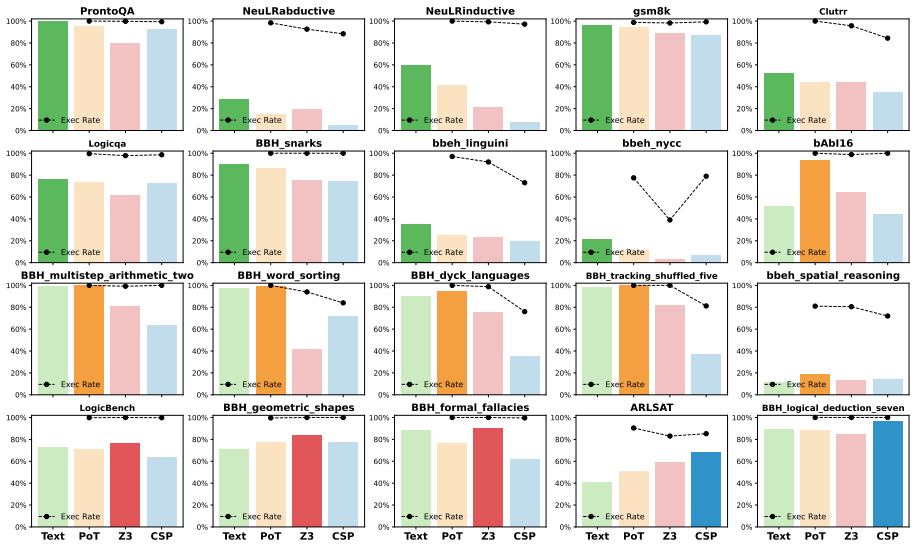
Pith's one-line read Most current LLMs reason less accurately when asked to answer in formal code than in plain text, and only a 'thinking' model keeps high performance across Python, Z3, and CSP formats.
desk verdict A broad, reusable evaluation map of 31 models across 66 tasks and four trajectory formats, but the headline numbers rest on an unvalidated LLM judge and would need that fixed before I'd trust the ranking. read the letter →
The pith
A machine-rendered reading of the paper's core claim, the machinery that carries it, and where it could break.
The reading
What carries the argument
The central mechanism is the trajectory format, formalized as LLM(Q) = <s1, s2, ..., sn> --Exec--> A: the model emits a sequence of steps in one of four languages (free text, executable Python, Z3 solver code, or python-constraint CSP code), an external engine executes the trajectory to produce answer A, and an LLM judge compares A with a reference answer. The evaluation manipulates this mechanism along three axes—model family (Instruct versus Thinking, 7B to 72B), reasoning-type taxonomy (deductive, inductive, abductive, mixed-form), and trajectory format—using zero-shot prompts with a three-step self-refinement pass for formal languages. The same trajectory machinery drives the training intervention: rejected fine-tuning samples GPT-4o trajectories, keeps only those that execute and match the reference answer, and mixes them with general-domain data to fine-tune a 7B base model.
What would settle it
Take a random sample of model completions in Z3 and CSP formats, have human logicians score them against ground truth, and compare those scores with Qwen-2.5-72B-Instruct's rubric judgments; if agreement on formal trajectories is near chance, the paper's central findings would collapse. A simpler check is to count how often the judge marks a completion wrong when the executed output is semantically correct but not string-identical to the reference.
Extended reading notes
Core claim
The central claim is that current mainstream LLMs are more adept at natural-language reasoning than at formal-language reasoning: across a 66-task suite, most models' accuracy declines as trajectories move from Text to Python (PoT) to Z3 to CSP, and the drop is steepest on difficult tasks such as the bbeh series. Thinking models significantly outperform Instruct models, especially when formal language is employed, but the advantage does not hold at small parameter scale, where a distilled 7B thinking model performs worse on CSP than comparable Instruct models. The only evaluated model that stays ahead in all tasks and all four trajectory formats is QwQ-32B. A generalization analysis finds that PoT data transfers best to other formats, that Z3 and CSP transfer well across reasoning types, and that CSP is hard to generalize from but easy to generalize to; the authors attribute formal-language failures to a lack of pertinent training knowledge. Finally, a rejected fine-tuning method using GPT-4o-sampled, execution-verified trajectories improves Qwen2.5-7B's average accuracy from 34.0% to 42.0% and its execution rate from 65.3% to 76.0%.
Load-bearing premise
Every headline accuracy number is produced by one automatic judge, Qwen-2.5-72B-Instruct, comparing each model's completion against a reference answer; if that judge systematically marks correct but differently expressed answers as wrong, especially for formal trajectories, the formal-language deficit and the training gains would not be supported.
Editorial extensions
If this is right
- If the central claim is correct, prompting current Instruct models to solve logic problems by writing Python, Z3, or CSP code will not reliably improve accuracy and will often lower it, especially on hard inductive and mixed-form tasks.
- Thinking models are the category most able to exploit formal language, but this only holds at sufficient parameter scale; small distilled thinking models lose their advantage in CSP and Z3.
- Formalization does not cure inductive reasoning: every evaluated model shows limited inductive capability in all four trajectory formats.
- Program-of-thought data is the best cross-format training signal, transferring positively to Text, Z3, and CSP, while CSP data transfers negatively to PoT and Z3.
- Rejected fine-tuning with filtered formal trajectories is a cheap way to improve small models, raising a 7B model's average accuracy by 8 points and its execution rate by about 11 points.
Reading between the lines
- Because the paper uses zero-shot prompts only, a natural extension is to test whether few-shot formalization or chain-of-thought-then-code pipelines reverse the formal-language deficit; the current result suggests the deficit is in the model's formal knowledge, not the prompt format.
- The CSP asymmetry—hard to transfer from, easy to transfer to—suggests CSP is a distinct representational skill that is readily teachable once basic reasoning exists; a testable extension is to measure whether small amounts of CSP data improve downstream formal-language performance more than equal amounts of PoT data.
- The excluded formal systems (Lean, Prolog, Coq, SMT-LIB) may behave differently from Python, Z3, and CSP because they require proof construction rather than answer search; the paper's transfer findings do not automatically extend to them.
Editorial analysis
A structured set of objections, weighed in public.
Referee Report
Summary. The manuscript presents FormalEval, a three-axis evaluation of LLMs on 66 logical reasoning tasks using Text, PoT, Z3, and CSP trajectory formats. Part I evaluates 10 models spanning Instruct and Thinking series and claims that Thinking models significantly outperform Instruct models, especially under formal language, that all models are weak in inductive reasoning, and that Text generally outperforms formal languages except for QwQ-32B. Part II studies transfer across reasoning types and trajectory formats, concluding that PoT transfers well while CSP transfers poorly. Part III applies rejection-sampling fine-tuning (RFT) to Qwen2.5-7B with formal-relative training data, reporting average accuracy gains of about +8 points and a +17-point CSP gain. The paper includes per-task result tables, case studies, and a public code/data link.
Significance. If the measurement methodology is sound, the paper provides a useful large-scale evaluation resource and several falsifiable findings about formal-language reasoning, and its RFT recipe is a practical contribution for small models. The paper ships detailed per-task tables and a public repository, which is commendable. However, the central claims rest on a single unvalidated LLM judge, so the ordinal comparisons and the RFT gains are not yet established. The contribution is primarily empirical, and its value depends entirely on measurement validity.
major comments (3)
- [Appendix D.1 (Figure 14); Tables 4-6] Every accuracy number in the paper, including the headline Thinking-vs-Instruct gap and the Part III RFT gains, is produced by asking Qwen-2.5-72B-Instruct to compare a model completion with a reference answer using the rubric in Figure 14. The paper reports no human agreement, no judge calibration on known-correct or known-wrong outputs, and no error analysis on formal trajectories. This matters especially for formal formats because execution rates are far below 100% on many tasks: for example, Table 6 shows Qwen2.5-7B gsm8k PoT Exec Rate 21.3 and bbeh_temporal_sequence PoT Exec Rate 0.0, and Table 5 shows GPT-4o bbeh_zebra_puzzles Z3 Exec Rate 49.0. On such items the judge is not grading an executed result; it is grading unexecuted code plus whatever textual explanation the model emitted. If the judge systematically rewards verbose reasoning traces or penalizes terse code, the abstract's first finding and the reported +17.0 CSP gain would be artifacts. This concern must be addressed by reporting judge agreement against human labels or deterministic answer matching, separately per format and per model family, and by re-checking whether the ordinal claims survive that validation.
- [Section 3.1; Abstract] The claim that Thinking models 'significantly outperform' Instruct models is a categorical statistical statement, but the paper reports only point estimates with no confidence intervals, significance tests, or effect-size measures. For instance, Tables 4 and 5 allow per-format averages to be compared, but there is no uncertainty quantification around any of the averages or per-task differences, and the phrase 'significantly' is used without a defined test. Given that the comparisons are made on fixed benchmark subsets and the judge itself is stochastic, the authors should report bootstrap confidence intervals or paired significance tests across the 66 tasks (or justify deterministic evaluation). Without this, the headline finding is not quantitatively supported as stated.
- [Section 4.1; Table 3] The Introduction states that training data for the generalization experiments has 'the same scale size' to make a fair comparison, but Table 3 shows that the fine-grained training groups range from 1042 samples (Inductive_CSP) to 1820 samples (Abductive_Text), a difference of about 75%, and the coarse-grained groups range from 6346 to 7448 samples. These size differences can confound the cross-format and cross-reasoning-type transfer comparisons in Figures 4 and 5. The authors should either match training set sizes exactly or control for data quantity through ablations before claiming that one format transfers better than another.
minor comments (4)
- [Section 3.1] There is a typo in the phrase 'Deducitve-BBH_web'; it should be 'Deductive-BBH_web'.
- [Section 2.2 / Appendix D.1] Part I mentions a three-step self-refinement process for formal-language trajectories, but the prompts in Figures 11-13 do not describe this refinement, and Appendix D.1 does not specify how refinement is implemented or how many attempts are made. Please clarify the self-refinement protocol for reproducibility.
- [Table 2] The MATH row shows '5000 *7500' across the Eval and Train columns, which is ambiguous; please clarify the meaning of the asterisk and how the subset was sampled to balance the dataset.
- [Section 5.1] The phrase 'we collect the portions of current evaluation datasets that overlap with training data' is ambiguous and could be read as suggesting that evaluation benchmarks were used in training; please specify the official train/test splits used, and describe how data leakage was avoided for all 66 tasks.
Circularity Check
No circularity found: headline findings are empirical measurements on external benchmarks and do not reduce to fitted inputs, self-citations, or definitions.
full rationale
I walked the paper's claimed derivation chain. The central claims are empirical evaluations: trajectory formats are defined by execution semantics (Section 2.2), and the headline findings in Section 3.1 ('Thinking models significantly outperform Instruct models, especially when formal language is employed') are summaries of accuracy measurements across 31 models and 66 task subsets against external benchmark references. No parameter is fitted to produce a headline result, and no equation equates a prediction to its input by construction. The generalization analysis in Part II trains on the training splits of the collected datasets and evaluates on separate evaluation splits; gains are reported as deltas over a baseline, so the measured transfer effects are not forced by data overlap. Part III's RFT experiment filters teacher samples by executability and reference correctness, then evaluates on evaluation tasks; the reported improvements are external measurements rather than renamed fit values. Citations to prior work (e.g., Xu et al. 2025, Pan et al. 2023) are to independent groups and are not load-bearing self-citations. The main methodological concern is that all accuracy numbers come from a single unvalidated LLM judge, Qwen-2.5-72B-Instruct (Appendix D.1, Figure 14). That is a measurement-validity and soundness concern, not a circularity concern, because the judge is not a parameter fitted to the paper's conclusions and the claims do not reduce to the judge's own outputs. The Limitations section openly discusses coverage and model-currency limitations but does not reveal any circular step. Therefore the appropriate circularity score is 0.
Assumptions & free parameters
free parameters (4)
- Self-refinement steps for formal-language trajectories =
3
- Per-dataset training sample cap for RFT =
3000
- SFT training epochs =
3
- Maximum generation length =
16384
assumptions (4)
- domain assumption The 66 tasks are correctly partitioned into deductive, inductive, abductive, and mixed-form reasoning categories.
- domain assumption Qwen-2.5-72B-Instruct's judge prompt (Appendix D.1) produces correct correctness labels for every format and task.
- standard math Python 3.12, the Z3 solver, and python-constraint faithfully execute the generated trajectories and produce the intended answer.
- ad hoc to paper The taxonomy in Section 2.1 (premise to conclusion for deduction, etc.) is a valid operationalization of logical reasoning types for NLP benchmarks.
Cite this review
Pith. "Pith review of Do Large Language Models Excel in Complex Logical Reasoning with Formal Language?." pith.science (2026). https://pith.science/paper/7R3OKJUT
@misc{pith2026250516998,
  author       = {Pith},
  title        = {Pith review of: Do Large Language Models Excel in Complex Logical Reasoning with Formal Language?},
  year         = {2026},
  howpublished = {\url{https://pith.science/paper/7R3OKJUT}},
  note         = {Machine review of arXiv:2505.16998}
}
read the original abstract
Large Language Models (LLMs) have been shown to achieve breakthrough performance on complex logical reasoning tasks. Nevertheless, most existing research focuses on employing formal language to guide LLMs to derive reliable reasoning paths, while systematic evaluations of these capabilities are still limited. In this paper, we aim to conduct a comprehensive evaluation of LLMs across various logical reasoning problems utilizing formal languages. From the perspective of three dimensions, i.e., spectrum of LLMs, taxonomy of tasks, and format of trajectories, our key findings are: 1) Thinking models significantly outperform Instruct models, especially when formal language is employed; 2) All LLMs exhibit limitations in inductive reasoning capability, irrespective of whether they use a formal language; 3) Data with PoT format achieves the best generalization performance across other languages. Additionally, we also curate the formal-relative training data to further enhance the small language models, and the experimental results indicate that a simple rejected fine-tuning method can better enable LLMs to generalize across formal languages and achieve the best overall performance. Our codes and reports are available at https://github.com/jiangjin1999/FormalEval.
Figures


Figures from the paper (10 more)


Reference graph
Works this paper leans on
-
[1]
Josh Achiam, Steven Adler, Sandhini Agarwal, Lama Ahmad, Ilge Akkaya, Florencia Leoni Aleman, Diogo Almeida, Janko Altenschmidt, Sam Altman, Shyamal Anadkat, and 1 others. 2023. Gpt-4 technical report. arXiv preprint arXiv:2303.08774
arXiv 2023
-
[2]
Jinze Bai, Shuai Bai, Yunfei Chu, Zeyu Cui, Kai Dang, Xiaodong Deng, Yang Fan, Wenbin Ge, Yu Han, Fei Huang, and 1 others. 2023. Qwen technical report. arXiv preprint arXiv:2309.16609
arXiv 2023
-
[3]
Rama Krishna Sai Bhagavatula, Ronan Le Bras, Chaitanya Malaviya, Yejin Choi, and Noah A Smith. 2020. Abductionrules: Training transformers to explain unexpected inputs. In Proceedings of the 58th Annual Meeting of the Association for Computational Linguistics, pages 4246--4258
work page 2020
-
[4]
Xiao Bi, Deli Chen, Guanting Chen, Shanhuang Chen, Damai Dai, Chengqi Deng, Honghui Ding, Kai Dong, Qiushi Du, Zhe Fu, and 1 others. 2024. Deepseek llm: Scaling open-source language models with longtermism. arXiv preprint arXiv:2401.02954
arXiv 2024
-
[5]
Nikolaj Bj rner, Anh-Dung Phan, and Lars Fleckenstein. 2015. z-an optimizing smt solver. In Tools and Algorithms for the Construction and Analysis of Systems: 21st International Conference, TACAS 2015, Held as Part of the European Joint Conferences on Theory and Practice of Software, ETAPS 2015, London, UK, April 11-18, 2015, Proceedings 21, pages 194--19...
work page 2015
-
[6]
Andrei Bulatov, Peter Jeavons, and Andrei Krokhin. 2005. Classifying the complexity of constraints using finite algebras. SIAM journal on computing, 34(3):720--742
work page 2005
-
[7]
Benjamin Callewaert, Simon Vandevelde, and Joost Vennekens. 2025. Verus-lm: a versatile framework for combining llms with symbolic reasoning. arXiv preprint arXiv:2501.14540
arXiv 2025
-
[8]
Karl Cobbe, Vineet Kosaraju, Mohammad Bavarian, Mark Chen, Heewoo Jun, Lukasz Kaiser, Matthias Plappert, Jerry Tworek, Jacob Hilton, Reiichiro Nakano, and 1 others. 2021. Training verifiers to solve math word problems. In null
work page 2021
Show all 53 references
-
[9]
Denise D Cummins, Todd Lubart, Olaf Alksnis, and Robert Rist. 1991. Conditional reasoning and causation. Memory & cognition, 19:274--282
1991
-
[10]
Peter A Flach and Antonis C Kakas. 2000. Abduction and Induction: Essays on their relation and integration, volume 18. Springer Science & Business Media
2000
-
[11]
Robert Friedman. 2023. Large language models and logical reasoning. Encyclopedia, 3(2):687--697
2023
-
[12]
Luyu Gao, Aman Madaan, Shuyan Zhou, Uri Alon, Pengfei Liu, Yiming Yang, Jamie Callan, and Graham Neubig. 2023. Pal: Program-aided language models. In International Conference on Machine Learning, pages 10764--10799. PMLR
2023
-
[13]
Vinod Goel. 2007. Anatomy of deductive reasoning. Trends in cognitive sciences, 11(10):435--441
2007
-
[14]
Aaron Grattafiori, Abhimanyu Dubey, Abhinav Jauhri, Abhinav Pandey, Abhishek Kadian, Ahmad Al-Dahle, Aiesha Letman, Akhil Mathur, Alan Schelten, Alex Vaughan, and 1 others. 2024. The llama 3 herd of models. arXiv e-prints, pages arXiv--2407
2024
-
[15]
Daya Guo, Dejian Yang, Haowei Zhang, Junxiao Song, Ruoyu Zhang, Runxin Xu, Qihao Zhu, Shirong Ma, Peiyi Wang, Xiao Bi, and 1 others. 2025. Deepseek-r1: Incentivizing reasoning capability in llms via reinforcement learning. arXiv preprint arXiv:2501.12948
2025 arXiv
-
[16]
Simeng Han, Hailey Schoelkopf, Yilun Zhao, Zhenting Qi, Martin Riddell, Wenfei Zhou, James Coady, David Peng, Yujie Qiao, Luke Benson, and 1 others. 2024. Folio: Natural language reasoning with first-order logic. In Proceedings of the 2024 Conference on Empirical Methods in Na...
2024
-
[17]
Joy He-Yueya, Gabriel Poesia, Rose Wang, and Noah Goodman. 2023. Solving math word problems by combining language models with symbolic solvers. In The 3rd Workshop on Mathematical Reasoning and AI at NeurIPS'23
2023
-
[18]
Dan Hendrycks, Collin Burns, Saurav Kadavath, Akul Arora, Steven Basart, Eric Tang, Dawn Song, and Jacob Steinhardt. 2021. Measuring mathematical problem solving with the math dataset. Sort, 2(4):0--6
2021
-
[19]
Philip N Johnson-Laird. 1999. Deductive reasoning. Annual review of psychology, 50(1):109--135
1999
-
[20]
Mehran Kazemi, Bahare Fatemi, Hritik Bansal, John Palowitch, Chrysovalantis Anastasiou, Sanket Vaibhav Mehta, Lalit K Jain, Virginia Aglietti, Disha Jindal, Peter Chen, and 1 others. 2025. Big-bench extra hard. arXiv preprint arXiv:2502.19187
2025 arXiv
-
[21]
Mehran Kazemi, Quan Yuan, Deepti Bhatia, Najoung Kim, Xin Xu, Vaiva Imbrasaite, and Deepak Ramachandran. 2023. Boardgameqa: A dataset for natural language reasoning with contradictory information. Advances in Neural Information Processing Systems, 36:39052--39074
2023
-
[22]
Gonzalez, Hao Zhang, and Ion Stoica
Woosuk Kwon, Zhuohan Li, Siyuan Zhuang, Ying Sheng, Lianmin Zheng, Cody Hao Yu, Joseph E. Gonzalez, Hao Zhang, and Ion Stoica. 2023. Efficient memory management for large language model serving with pagedattention. In Proceedings of the ACM SIGOPS 29th Symposium on Operating S...
2023
-
[23]
Fangyu Lei, Qian Liu, Yiming Huang, Shizhu He, Jun Zhao, and Kang Liu. 2024. S3eval: A synthetic, scalable, systematic evaluation suite for large language model. In Proceedings of the 2024 Conference of the North American Chapter of the Association for Computational Linguistic...
2024
-
[24]
Jian Liu, Leyang Cui, Hanmeng Liu, Dandan Huang, Yile Wang, and Yue Zhang. 2021. Logiqa: a challenge dataset for machine reading comprehension with logical reasoning. In Proceedings of the Twenty-Ninth International Conference on International Joint Conferences on Artificial I...
2021
-
[25]
Qiyuan Liu, Ming Yan, Yiyang Liu, Pan Lu, Siwei Wang, and Songfang Huang. 2020. Logiqa: A challenge dataset for machine reading comprehension with logical reasoning. In Proceedings of the 2020 Conference on Empirical Methods in Natural Language Processing (EMNLP), pages 1866--1877
2020
-
[26]
Qing Lyu, Shreya Havaldar, Adam Stein, Li Zhang, Delip Rao, Eric Wong, Marianna Apidianaki, and Chris Callison-Burch. 2023. Faithful chain-of-thought reasoning. In The 13th International Joint Conference on Natural Language Processing and the 3rd Conference of the Asia-Pacific...
2023
-
[27]
Theo X Olausson, Alex Gu, Benjamin Lipkin, Cedegao E Zhang, Armando Solar-Lezama, Joshua B Tenenbaum, and Roger Levy. 2023. Linc: A neurosymbolic approach for logical reasoning by combining language models with first-order logic provers. In Proceedings of the 2023 Conference o...
2023
-
[28]
Liangming Pan, Alon Albalak, Xinyi Wang, and William Yang Wang. 2023. Logic-lm: Empowering large language models with symbolic solvers for faithful logical reasoning. In Findings of the Association for Computational Linguistics: EMNLP 2023, pages 3806--3824
2023
-
[29]
Gaurav Parmar, Shikhar Murari, and Mohit Bansal. 2023. Logicbench: A challenging benchmark for logical reasoning with large language models. In Findings of the Association for Computational Linguistics: EMNLP 2023, pages 148--168
2023
-
[30]
S RANISE. 2003. The smt-lib format: An initial proposal. 1st PDPAR, 2003
2003
-
[31]
Abulhair Saparov and He He. 2023. Language models are greedy reasoners: A systematic formal analysis of chain-of-thought. In The Eleventh International Conference on Learning Representations
2023
-
[32]
Koustuv Sinha, Shagun Sodhani, Jin Dong, Joelle Pineau, and William L Hamilton. 2019. Clutrr: A diagnostic benchmark for inductive reasoning from text. In Proceedings of the 2019 Conference on Empirical Methods in Natural Language Processing and the 9th International Joint Con...
2019
-
[33]
Mirac Suzgun, Nathan Scales, Nathanael Scharli, Sebastian Gehrmann, Yi Tay, Hyung Won Chung, Michael Petrov, Vincent Y Zhao, Ryan Murphy, Adam Roberts, and 1 others. 2022. Challenging big-bench tasks and whether chain-of-thought can solve them. arXiv preprint arXiv:2210.09261
2022 arXiv
-
[34]
Fumiya Uchiyama, Takeshi Kojima, Andrew Gambardella, Qi Cao, Yusuke Iwasawa, and Yutaka Matsuo. 2023. Which programming language and what features at pre-training stage affect downstream logical inference performance? Findings of the Association for Computational Linguistics: ...
2023
-
[35]
Marco Valentino, Mokanarangan Thayaparan, and Andr \'e Freitas. 2022. Case-based abductive natural language inference. In Proceedings of the 29th International Conference on Computational Linguistics, pages 1556--1568
2022
-
[36]
Xinyi Wang, Liangming Pan, and William Yang Wang. 2024. Logic-lm++: Multi-step refinement for symbolic formulations. In The Twelfth International Conference on Learning Representations
2024
-
[37]
Jason Wei, Xuezhi Wang, Dale Schuurmans, Maarten Bosma, Fei Xia, Ed Chi, Quoc V Le, Denny Zhou, and 1 others. 2022. Chain-of-thought prompting elicits reasoning in large language models. Advances in neural information processing systems, 35:24824--24837
2022
-
[38]
Jason Weston, Antoine Bordes, Sumit Chopra, Tomas Mikolov, and Alexander Rush. 2015. Towards ai-complete question answering: A set of prerequisite toy tasks. In null
2015
-
[39]
Jason Weston, Antoine Bordes, Sumit Chopra, Alexander M Rush, Bart Van Merri \"e nboer, Armand Joulin, and Tomas Mikolov. 2016. Towards ai-complete question answering: A set of prerequisite toy tasks. In 4th International Conference on Learning Representations, ICLR 2016
2016
-
[40]
Yuan Xia, Akanksha Atrey, Fadoua Khmaissia, and Kedar S Namjoshi. 2025. Can large language models learn formal logic? a data-driven training and evaluation framework. arXiv preprint arXiv:2504.20213
2025 arXiv
-
[41]
Siheng Xiong, Yuan Yang, Ali Payani, Ehsan Shareghi, and Faramarz Fekri. 2024. Strategies for improving nl-to-fol translation with llms: Data generation, incremental fine-tuning, and verification. arXiv preprint arXiv:2409.16461
2024 arXiv
-
[42]
Fangzhi Xu, Qika Lin, Jiawei Han, Tianzhe Zhao, Jun Liu, and Erik Cambria. 2025. Are large language models really good logical reasoners? a comprehensive evaluation and beyond. IEEE Transactions on Knowledge & Data Engineering, pages 1--15
2025
-
[43]
Yuan Yang, Siheng Xiong, Ali Payani, Ehsan Shareghi, and Faramarz Fekri. 2023 a . Harnessing the power of large language models for natural language to first-order logic translation. arXiv preprint arXiv:2305.15541
2023 arXiv
-
[44]
Zonglin Yang, Xinya Du, Rui Mao, Jinjie Ni, and Erik Cambria. 2023 b . Logical reasoning over natural language as knowledge representation: A survey. In The 61st Annual Meeting Of The Association For Computational Linguistics
2023
-
[45]
Xi Ye, Qiaochu Chen, Isil Dillig, and Greg Durrett. 2023. Satlm: Satisfiability-aided language models using declarative prompting. In Proceedings of NeurIPS
2023
-
[46]
Nathan Young, Qiming Bao, Joshua Bensemann, and Michael J Witbrock. 2022. Abductionrules: Training transformers to explain unexpected inputs. In Findings of the Association for Computational Linguistics: ACL 2022, pages 218--227
2022
-
[47]
Fei Yu, Hongbo Zhang, Prayag Tiwari, and Benyou Wang. 2024. Natural language reasoning, a survey. ACM Computing Surveys, 56(12):1--39
2024
-
[48]
Jing Zhang, Bo Chen, Lingxi Zhang, Xirui Ke, and Haipeng Ding. 2021. Neural, symbolic and neural-symbolic reasoning on knowledge graphs. AI Open, 2:14--35
2021
-
[49]
Yixin Zhao, Adina Williams, Emily Dinan, Mohit Bansal, Mark Yatskar, and Yejin Choi. 2021. Adversarial nli: A new benchmark for natural language understanding. In null
2021
-
[50]
Victor Zhong, Chandra Bhagavatula, Ronan Le Bras, Yejin Choi, and Noah A Smith. 2022. Analytical reasoning of text: Unifying machine reading and logical reasoning. In Findings of the Association for Computational Linguistics: NAACL 2022, pages 2307--2323
2022
-
[51]
Wanjun Zhong, Siyuan Wang, Duyu Tang, Zenan Xu, Daya Guo, Jiahai Wang, Jian Yin, Ming Zhou, and Nan Duan. 2021. Ar-lsat: Investigating analytical reasoning of text. arXiv e-prints, pages arXiv--2104
2021
-
[52]
online" 'onlinestring :=
ENTRY address archivePrefix author booktitle chapter edition editor eid eprint eprinttype howpublished institution journal key month note number organization pages publisher school series title type volume year doi pubmed url lastchecked label extra.label sort.label short.list...
-
[53]
write newline
" write newline "" before.all 'output.state := FUNCTION n.dashify 't := "" t empty not t #1 #1 substring "-" = t #1 #2 substring "--" = not "--" * t #2 global.max substring 't := t #1 #1 substring "-" = "-" * t #2 global.max substring 't := while if t #1 #1 substring * t #2 gl...
Reviewed August 7, 2026 · model on record in the stance chip above.
Discussion (0). Continue with ORCID to comment.