REVIEW 3 major objections 180 references
SHIFT: Survival Prediction from Incomplete and Heterogeneous Genomic Data
T0 review · 3 major / 0 minor · reviewed 2026-07-11 · grok-4.5
Pith's one-line read A single transformer can predict cancer survival from incomplete gene panels without filling in missing values.
desk verdict Solid applied methods paper on a real multi-center genomics problem; gains under severe panel mismatch are real but rest on small external n and modest C-index edges without formal uncertainty. read the letter →
The pith
A machine-rendered reading of the paper's core claim, the machinery that carries it, and where it could break.
The reading
What carries the argument
SHIFT: each genomic feature is embedded as its own token; a binary availability mask excludes missing tokens from self-attention so the class token aggregates only observed genes; variable-rate masking (VRM) randomly hides up to a fraction f of features each training sample to build robustness to heterogeneous panels.
What would settle it
Train SHIFT with random VRM, then evaluate on an external cohort whose missing genes form a fixed institutional panel that was never seen during training; if concordance falls below the best mean-imputed baseline on that panel, the transfer claim fails.
Extended reading notes
Core claim
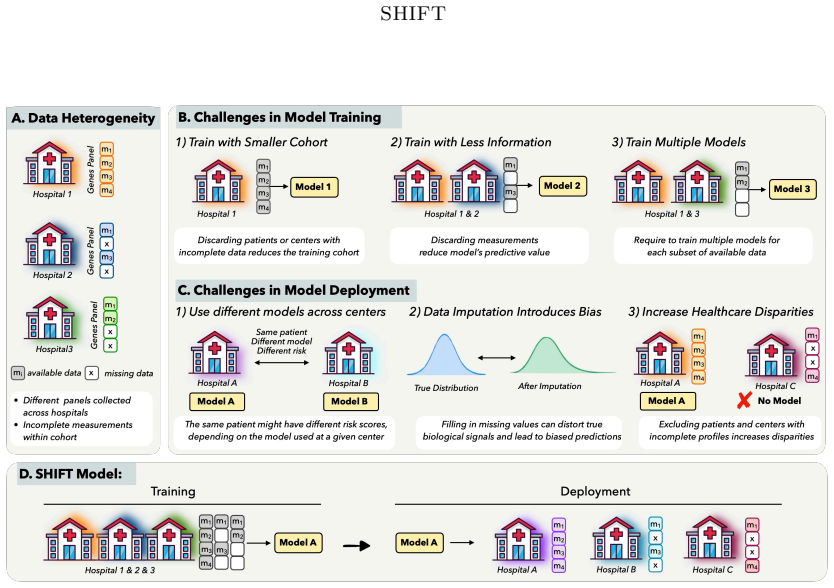
SHIFT shows that a missingness-aware transformer, trained with variable-rate feature masking, can predict survival directly from incomplete genomic inputs without test-time imputation, remain competitive when all features are present, and match or outperform imputation-based baselines under severe cross-cohort panel mismatch, while allowing incomplete cohorts to contribute useful signal during model development.
Load-bearing premise
The paper assumes that randomly hiding different numbers of genes during training is a good enough stand-in for the fixed, institution-specific blocks of genes that real sequencing panels leave out.
Editorial analysis
A structured set of objections, weighed in public.
Referee Report
Summary. The paper proposes SHIFT, a transformer-based discrete-time survival model for incomplete genomic inputs. Each genomic feature is embedded by a dedicated SNN block, a binary availability mask is used as a key-padding mask so that self-attention aggregates only observed features into a [CLS] token, and predictions are made without test-time imputation. Training uses variable-rate feature masking (VRM) that randomly drops up to a fraction f of features per sample. Experiments cover GBM (36 shared features; TCGA development, CPTAC and German external) and LUSC (197 features in TCGA/CPTAC vs 22 in a private US cohort, i.e., 88.8% structural absence). Baselines include CoxPH, RSF, XGBoost-Cox, DeepSurv, DeepHit, and SNN, with KNN/mean imputation where needed. Reported results claim that SHIFT-VRM is competitive on fully aligned panels, matches or beats imputed baselines under severe panel mismatch (US Ens-All 0.570 without imputation), and that adding the incomplete US cohort during training improves CPTAC Ens-All from 0.602 to 0.629.
Significance. If the claims hold under stronger statistical scrutiny, the work is practically significant for multi-center precision oncology: structural panel mismatch is a real deployment barrier, and a single missingness-aware model that avoids test-time imputation and can retain incomplete cohorts is a useful alternative to shared-feature restriction or site-specific models. Strengths include a coherent architecture (feature-wise tokens + attention mask + discrete-time NLL), a clear experimental ladder (complete-data control, severe-mismatch inference, shared-feature control, multi-site training, and f-ablation), and external validation on two cancers. The contribution is more applied and systems-level than foundational: masked attention for incomplete tabular inputs is known, and VRM is a free design choice; the value lies in the survival setting, the severe structural-missingness evaluation, and the inclusive multi-center training result.
major comments (3)
- Tables 3–5 are load-bearing for the central claims (parity under 175/197 missing features; incomplete cohorts improve external performance), but all decisive numbers are single-point Ens-All/Top-3 C-indices on small external sets (US n=102, CPTAC n=101) without confidence intervals, multi-seed variance, or paired significance tests. Differences of ~0.02–0.03 (e.g., CPTAC Ens-All 0.602→0.629; US match to CoxPH+mean at 0.570) may be within fold/seed noise. The Discussion acknowledges limited statistical testing and modest external sizes; these claims need bootstrap CIs and/or paired tests (or multi-seed ensembles) before superiority or “incomplete cohorts help” can be treated as secured.
- Sec. 3.3 defines VRM as ki ~ Uniform{0,…,⌊f·d⌋} with random feature indices; the Discussion notes that real panel mismatch is often fixed and site-structured rather than random. The transfer claim—that robustness under random absence generalizes to institutional block missingness—is therefore an untested assumption for the LUSC US setting. A load-bearing control would train with structured/block masks that mimic panel subsets (or leave-one-panel-out style masks) and re-evaluate US/CPTAC; without that, the reported external gains may overstate robustness to real deployment missingness.
- Table 4’s shared 22-feature control shows SHIFT w/o VRM is not superior on the reduced panel (Ens-All 0.494 vs SNN 0.528), while SHIFT-VRM’s advantage is reported only when trained on all 197 features and applied natively. This is a useful design point, but the manuscript should more carefully separate architecture benefit from “train on richer panels + mask at deploy” benefit, and report the same uncertainty quantification on the 22-feature baselines so the full-feature advantage is not overstated relative to the standard lowest-common-denominator practice.
Circularity Check
No circularity: empirical ML evaluation of architecture and training choices on held-out external C-index, not a derivation that reduces to its inputs by construction.
full rationale
SHIFT is an empirical methods paper. Its load-bearing claims are comparative C-index results on external cohorts (Tables 1–5), obtained by training a masked-attention transformer with optional variable-rate feature masking and evaluating without test-time imputation. The discrete-time NLL objective (Eqs. 1–4), feature-token SNN embeddings, key-padding mask, and VRM schedule (ki ~ Uniform{0,…,⌊f·d⌋}) are free design choices; none of them define the reported C-index or force the ranking versus CoxPH/RSF/SNN/imputation baselines. Self-citations (e.g., Chen et al. multimodal survival work, Lipkova et al. on multi-center missingness) supply background and baseline implementations but do not supply uniqueness theorems or identities that make the external results true by construction. There is no fitted parameter renamed as a prediction of a closely related quantity, no self-definitional loop, and no ansatz smuggled in that collapses the claim. The paper is therefore self-contained against external benchmarks; circularity score is 0.
Assumptions & free parameters
free parameters (5)
- masking fraction f =
0.5 (default)
- censored-term weight β =
0.6
- number of discrete survival intervals K =
4
- token/hidden dimension D and heads H =
D=128, H=4, layers=2
- training hyperparameters (lr, batch, patience) =
lr=5e-4, batch=16, patience=15
assumptions (4)
- domain assumption Discrete-time survival with quartile-binned hazards and the three-term NLL of Zadeh & Schmid is an adequate objective for ranking risk via sum of survival probabilities.
- domain assumption Structural missingness can be handled by key-padding masks so zero-filled missing tokens do not contribute to attention aggregation.
- ad hoc to paper Random variable-rate feature masking during training improves robustness to heterogeneous real-world panel missingness.
- ad hoc to paper Feature-specific SNN embeddings without positional encodings are sufficient because genomic features have no natural order and identity is carried by per-feature parameters.
invented entities (2)
-
SHIFT architecture
-
Variable-rate feature masking (VRM)
Cite this review
Pith. "Pith review of SHIFT: Survival Prediction from Incomplete and Heterogeneous Genomic Data." pith.science (2026). https://pith.science/paper/7R7GDDIR
@misc{pith2026260707725,
  author       = {Pith},
  title        = {Pith review of: SHIFT: Survival Prediction from Incomplete and Heterogeneous Genomic Data},
  year         = {2026},
  howpublished = {\url{https://pith.science/paper/7R7GDDIR}},
  note         = {Machine review of arXiv:2607.07725}
}
read the original abstract
Genomic prediction models often fail to transfer across institutions because sequencing panels differ across sites, creating structural feature missingness at deployment. Existing approaches to this challenge typically restrict analysis to genes shared across cohorts, exclude patients with incomplete profiles, or rely on test-time imputation, all of which can reduce robustness and limit the use of multi-center data. We propose Survival prediction Handling Incomplete Features using Transformer (SHIFT), a missingness-aware survival model that directly predicts from incomplete genomic inputs without test-time imputation. SHIFT represents each genomic feature separately and uses masked self-attention, along with a feature-availability mask, so that predictions are based only on observed inputs. Further, we introduce variable-rate feature masking during training to improve robustness to heterogeneous missingness patterns. We evaluate the approach on glioblastoma and lung squamous cell carcinoma with external validation across multiple cohorts, including a challenging setting with severe cross-cohort panel mismatch. Across these settings, SHIFT shows strong generalization and compares favorably with standard survival baselines and imputation-based approaches, while using a single model across differing feature sets. We also find that incorporating patients from incomplete cohorts during development can improve performance on external data, suggesting that partially observed cohorts need not be excluded from model building. These results support missingness-aware modeling as a practical strategy for multi-center survival prediction in precision oncology.
Figures

Reference graph
Works this paper leans on
-
[1]
Scientific reports , volume=
Predicting clinical outcomes from large scale cancer genomic profiles with deep survival models , author=. Scientific reports , volume=. 2017 , publisher=
2017
-
[2]
Clinical cancer research , volume=
Deep learning--based multi-omics integration robustly predicts survival in liver cancer , author=. Clinical cancer research , volume=. 2018 , publisher=
2018
-
[3]
Biology , volume=
Deep learning techniques with genomic data in cancer prognosis: a comprehensive review of the 2021--2023 literature , author=. Biology , volume=. 2023 , publisher=
2021
-
[4]
Artificial Intelligence Review , volume=
Deep learning for survival analysis: a review , author=. Artificial Intelligence Review , volume=. 2024 , publisher=
2024
-
[5]
Biometrics , volume=
Unlocking the power of multi-institutional data: Integrating and harmonizing genomic data across institutions , author=. Biometrics , volume=. 2024 , publisher=
2024
-
[6]
Frontiers in artificial intelligence , volume=
Missing data in multi-omics integration: Recent advances through artificial intelligence , author=. Frontiers in artificial intelligence , volume=. 2023 , publisher=
2023
-
[7]
Archives of Pathology and Laboratory Medicine , volume=
Validation of OncoPanel: a targeted next-generation sequencing assay for the detection of somatic variants in cancer , author=. Archives of Pathology and Laboratory Medicine , volume=. 2017 , publisher=
2017
-
[8]
Cancer cell , volume=
Artificial intelligence for multimodal data integration in oncology , author=. Cancer cell , volume=. 2022 , publisher=
2022
Show all 180 references
-
[9]
Journal of clinical epidemiology , volume=
A gentle introduction to imputation of missing values , author=. Journal of clinical epidemiology , volume=. 2006 , publisher=
2006
-
[10]
Journal of Computer and Communications , volume=
Missing Data Imputation: A Comprehensive , author=. Journal of Computer and Communications , volume=
-
[11]
Nature biomedical engineering , volume=
Algorithmic fairness in artificial intelligence for medicine and healthcare , author=. Nature biomedical engineering , volume=. 2023 , publisher=
2023
-
[12]
Journal of the Royal Statistical Society: Series B (Methodological) , volume=
Regression models and life-tables , author=. Journal of the Royal Statistical Society: Series B (Methodological) , volume=. 1972 , publisher=
1972
-
[13]
Kogalur and Eugene H
Hemant Ishwaran and Udaya B. Kogalur and Eugene H. Blackstone and Michael S. Lauer , title =. The Annals of Applied Statistics , number =. 2008 , doi =
2008
-
[14]
BMC medical research methodology , volume=
DeepSurv: personalized treatment recommender system using a Cox proportional hazards deep neural network , author=. BMC medical research methodology , volume=. 2018 , publisher=
2018
-
[15]
Proceedings of the AAAI conference on artificial intelligence , volume=
Deephit: A deep learning approach to survival analysis with competing risks , author=. Proceedings of the AAAI conference on artificial intelligence , volume=
-
[16]
Proceedings of the 31st international conference on neural information processing systems , pages=
Self-normalizing neural networks , author=. Proceedings of the 31st international conference on neural information processing systems , pages=
-
[17]
Proceedings of the IEEE/CVF international conference on computer vision , pages=
Multimodal co-attention transformer for survival prediction in gigapixel whole slide images , author=. Proceedings of the IEEE/CVF international conference on computer vision , pages=
-
[18]
Cancer Cell , volume=
Pan-cancer integrative histology-genomic analysis via multimodal deep learning , author=. Cancer Cell , volume=. 2022 , publisher=
2022
-
[19]
Proceedings of the IEEE/CVF Conference on Computer Vision and Pattern Recognition , pages=
Modeling dense multimodal interactions between biological pathways and histology for survival prediction , author=. Proceedings of the IEEE/CVF Conference on Computer Vision and Pattern Recognition , pages=
-
[20]
BMC medical informatics and decision making , volume=
Nearest neighbor imputation algorithms: a critical evaluation , author=. BMC medical informatics and decision making , volume=. 2016 , publisher=
2016
-
[21]
2019 5th International Conference on Science in Information Technology (ICSITech) , pages=
K-nearest neighbor (k-NN) based missing data imputation , author=. 2019 5th International Conference on Science in Information Technology (ICSITech) , pages=. 2019 , organization=
2019
-
[22]
BioData mining , volume=
Evaluation of different approaches for missing data imputation on features associated to genomic data , author=. BioData mining , volume=. 2021 , publisher=
2021
-
[23]
American journal of epidemiology , volume=
Multiple imputation for missing data via sequential regression trees , author=. American journal of epidemiology , volume=. 2010 , publisher=
2010
-
[24]
Nature Biomedical Engineering , volume=
Synthetic data in machine learning for medicine and healthcare , author=. Nature Biomedical Engineering , volume=. 2021 , publisher=
2021
-
[25]
Medical image analysis , volume=
Generative adversarial network in medical imaging: A review , author=. Medical image analysis , volume=. 2019 , publisher=
2019
-
[26]
2017 IEEE international conference on data mining (ICDM) , pages=
Generating synthetic time series to augment sparse datasets , author=. 2017 IEEE international conference on data mining (ICDM) , pages=. 2017 , organization=
2017
-
[27]
Medical Image Computing and Computer Assisted Intervention--MICCAI 2018: 21st International Conference, Granada, Spain, September 16-20, 2018, Proceedings, Part I , pages=
Distribution matching losses can hallucinate features in medical image translation , author=. Medical Image Computing and Computer Assisted Intervention--MICCAI 2018: 21st International Conference, Granada, Spain, September 16-20, 2018, Proceedings, Part I , pages=. 2018 , org...
2018
-
[28]
Expert Systems with Applications , volume=
Deep learning versus conventional methods for missing data imputation: A review and comparative study , author=. Expert Systems with Applications , volume=. 2023 , publisher=
2023
-
[29]
Briefings in bioinformatics , volume=
A comprehensive review of cancer survival prediction using multi-omics integration and clinical variables , author=. Briefings in bioinformatics , volume=. 2025 , publisher=
2025
-
[30]
Briefings in functional genomics , volume=
A comprehensive review of machine learning techniques for multi-omics data integration: challenges and applications in precision oncology , author=. Briefings in functional genomics , volume=. 2024 , publisher=
2024
-
[31]
EBioMedicine , volume=
Personalising cancer medicine with prognostic markers , author=. EBioMedicine , volume=. 2021 , publisher=
2021
-
[32]
Neil Jethani and Mukund Sudarshan and Ian Connick Covert and Su-In Lee and Rajesh Ranganath , booktitle=. Fast. 2022 , url=
2022
-
[33]
Nature Medicine , pages=
AI-based differential diagnosis of dementia etiologies on multimodal data , author=. Nature Medicine , pages=. 2024 , publisher=
2024
-
[34]
BMC medical research methodology , volume=
Survival prediction models: an introduction to discrete-time modeling , author=. BMC medical research methodology , volume=. 2022 , publisher=
2022
-
[35]
Experimental & molecular medicine , volume=
Tumor microenvironment and radioresistance , author=. Experimental & molecular medicine , volume=. 2021 , publisher=
2021
-
[36]
2002 , publisher=
Breaking down barriers , author=. 2002 , publisher=
2002
-
[37]
Computational and structural biotechnology journal , volume=
Machine learning applications in cancer prognosis and prediction , author=. Computational and structural biotechnology journal , volume=. 2015 , publisher=
2015
-
[38]
Cancer informatics , volume=
Applications of machine learning in cancer prediction and prognosis , author=. Cancer informatics , volume=. 2006 , publisher=
2006
-
[39]
Nature , volume=
International evaluation of an AI system for breast cancer screening , author=. Nature , volume=. 2020 , publisher=
2020
-
[40]
Nature biomedical engineering , volume=
Data-efficient and weakly supervised computational pathology on whole-slide images , author=. Nature biomedical engineering , volume=. 2021 , publisher=
2021
-
[41]
nature , volume=
Dermatologist-level classification of skin cancer with deep neural networks , author=. nature , volume=. 2017 , publisher=
2017
-
[42]
Nature medicine , volume=
Clinical-grade computational pathology using weakly supervised deep learning on whole slide images , author=. Nature medicine , volume=. 2019 , publisher=
2019
-
[43]
Nature medicine , volume=
Deep learning-enabled assessment of cardiac allograft rejection from endomyocardial biopsies , author=. Nature medicine , volume=. 2022 , publisher=
2022
-
[44]
Nature , volume=
AI-based pathology predicts origins for cancers of unknown primary , author=. Nature , volume=. 2021 , publisher=
2021
-
[46]
Knowledge-Based Systems , volume=
Multiscale-attention masked autoencoder for missing data imputation of wind turbines , author=. Knowledge-Based Systems , volume=. 2024 , publisher=
2024
-
[48]
Neural computing and applications , volume=
An improved self-attention for long-sequence time-series data forecasting with missing values , author=. Neural computing and applications , volume=. 2024 , publisher=
2024
-
[49]
AI Open , volume=
Not Another Imputation Method: A Transformer-based Model for Missing Values in Tabular Datasets , author=. AI Open , volume=. 2026 , doi=
2026
-
[50]
, author=
Missing Value Imputation for Radar-Derived Time-Series Tracks of Aerial Targets Based on Improved Self-Attention-Based Network. , author=. Computers, Materials & Continua , volume=
-
[51]
arXiv preprint arXiv:2601.10386 , year=
Handling Missing Modalities in Multimodal Survival Prediction for Non-Small Cell Lung Cancer , author=. arXiv preprint arXiv:2601.10386 , year=
-
[52]
Briefings in Bioinformatics , volume=
Multimodal deep learning approaches for precision oncology: a comprehensive review , author=. Briefings in Bioinformatics , volume=. 2025 , publisher=
2025
-
[53]
Journal of clinical epidemiology , volume=
Handling missing data in clinical research , author=. Journal of clinical epidemiology , volume=. 2022 , publisher=
2022
-
[55]
International Journal of Innovative Technology and Interdisciplinary Sciences , volume=
A review of missing data handling techniques for machine learning , author=. International Journal of Innovative Technology and Interdisciplinary Sciences , volume=
-
[56]
Nature genetics , volume=
The Cancer Genome Atlas Pan-Cancer analysis project , author=. Nature genetics , volume=. 2013 , publisher=
2013
-
[57]
Information Fusion , volume=
EmbraceNet: A robust deep learning architecture for multimodal classification , author=. Information Fusion , volume=. 2019 , publisher=
2019
-
[58]
Scientific reports , volume=
Multi-channel 3D deep feature learning for survival time prediction of brain tumor patients using multi-modal neuroimages , author=. Scientific reports , volume=. 2019 , publisher=
2019
-
[59]
IEEE transactions on medical imaging , volume=
Personalized radiotherapy design for glioblastoma: integrating mathematical tumor models, multimodal scans, and Bayesian inference , author=. IEEE transactions on medical imaging , volume=. 2019 , publisher=
2019
-
[60]
EBioMedicine , volume=
Prediction of lung malignancy progression and survival with machine learning based on pre-treatment FDG-PET/CT , author=. EBioMedicine , volume=. 2022 , publisher=
2022
-
[61]
Nature Communications , volume=
Machine learning of genomic features in organotropic metastases stratifies progression risk of primary tumors , author=. Nature Communications , volume=. 2021 , publisher=
2021
-
[62]
Nature genetics , volume=
The cancer genome atlas pan-cancer analysis project , author=. Nature genetics , volume=. 2013 , publisher=
2013
-
[63]
American journal of translational research , volume=
A multi-omics-based serial deep learning approach to predict clinical outcomes of single-agent anti-PD-1/PD-L1 immunotherapy in advanced stage non-small-cell lung cancer , author=. American journal of translational research , volume=. 2021 , publisher=
2021
-
[64]
Nature Communications , volume=
Predicting response to enzalutamide and abiraterone in metastatic prostate cancer using whole-omics machine learning , author=. Nature Communications , volume=. 2023 , publisher=
2023
-
[65]
Nature Machine Intelligence , volume=
Integration of multiomics data with graph convolutional networks to identify new cancer genes and their associated molecular mechanisms , author=. Nature Machine Intelligence , volume=. 2021 , publisher=
2021
-
[66]
Proceedings of the IEEE/CVF Conference on Computer Vision and Pattern Recognition , pages=
Multi stain graph fusion for multimodal integration in pathology , author=. Proceedings of the IEEE/CVF Conference on Computer Vision and Pattern Recognition , pages=
-
[67]
Nature Medicine , pages=
Multistain deep learning for prediction of prognosis and therapy response in colorectal cancer , author=. Nature Medicine , pages=. 2023 , publisher=
2023
-
[68]
Scientific reports , volume=
Early prediction of neoadjuvant chemotherapy response for advanced breast cancer using PET/MRI image deep learning , author=. Scientific reports , volume=. 2020 , publisher=
2020
-
[69]
Journal of Biomedical Informatics , volume=
Attention-based multimodal fusion with contrast for robust clinical prediction in the face of missing modalities , author=. Journal of Biomedical Informatics , volume=. 2023 , publisher=
2023
-
[70]
Medical Imaging 2018: Digital Pathology , volume=
RaPtomics: integrating radiomic and pathomic features for predicting recurrence in early stage lung cancer , author=. Medical Imaging 2018: Digital Pathology , volume=. 2018 , organization=
2018
-
[71]
The Lancet Digital Health , volume=
Development and validation of a radiopathomics model to predict pathological complete response to neoadjuvant chemoradiotherapy in locally advanced rectal cancer: a multicentre observational study , author=. The Lancet Digital Health , volume=. 2022 , publisher=
2022
-
[72]
Nature , volume=
Multi-omic machine learning predictor of breast cancer therapy response , author=. Nature , volume=. 2022 , publisher=
2022
-
[73]
Nature cancer , volume=
Pan-cancer computational histopathology reveals mutations, tumor composition and prognosis , author=. Nature cancer , volume=. 2020 , publisher=
2020
-
[74]
Nature cancer , volume=
Pan-cancer image-based detection of clinically actionable genetic alterations , author=. Nature cancer , volume=. 2020 , publisher=
2020
-
[75]
Nature Reviews Gastroenterology & Hepatology , volume=
Development of AI-based pathology biomarkers in gastrointestinal and liver cancer , author=. Nature Reviews Gastroenterology & Hepatology , volume=. 2020 , publisher=
2020
-
[76]
Nature medicine , volume=
Classification and mutation prediction from non--small cell lung cancer histopathology images using deep learning , author=. Nature medicine , volume=. 2018 , publisher=
2018
-
[77]
Neuro-oncology , volume=
The 2021 WHO classification of tumors of the central nervous system: a summary , author=. Neuro-oncology , volume=. 2021 , publisher=
2021
-
[78]
The Lancet Oncology , volume=
Automated deep-learning system for Gleason grading of prostate cancer using biopsies: a diagnostic study , author=. The Lancet Oncology , volume=. 2020 , publisher=
2020
-
[79]
Frontiers in Immunology , volume=
Immunotherapy for EGFR-mutant advanced non-small-cell lung cancer: Current status, possible mechanisms and application prospects , author=. Frontiers in Immunology , volume=. 2022 , publisher=
2022
-
[80]
Nature medicine , volume=
Deep learning in histopathology: the path to the clinic , author=. Nature medicine , volume=. 2021 , publisher=
2021
-
[81]
Computers in Biology and Medicine , pages=
Predicting lung cancer survival based on clinical data using machine learning: A review , author=. Computers in Biology and Medicine , pages=. 2023 , publisher=
2023
-
[82]
2009 IEEE conference on computer vision and pattern recognition , pages=
ImageNet: A large-scale hierarchical image database , author=. 2009 IEEE conference on computer vision and pattern recognition , pages=. 2009 , organization=
2009
-
[83]
Nature Reviews Cancer , volume=
Harnessing multimodal data integration to advance precision oncology , author=. Nature Reviews Cancer , volume=. 2022 , publisher=
2022
-
[84]
European Respiratory Journal , volume=
Predicting EGFR mutation status in lung adenocarcinoma on computed tomography image using deep learning , author=. European Respiratory Journal , volume=. 2019 , publisher=
2019
-
[85]
Griswold, J. S. and Lightle, T. L. and Lovelady, J. G. , title =. IEEE Communications Magazine , year = 1990, volume = 28, number = 6, pages =
1990
-
[86]
acher, J. and V
Ebersp"acher, J. and V"ogel, H.-J. , title =
-
[87]
Arnaud, B. St. , title =
-
[88]
2023 IEEE International Conference on Bioinformatics and Biomedicine (BIBM) , pages=
Multi-modal Learning with Missing Modality in Predicting Axillary Lymph Node Metastasis , author=. 2023 IEEE International Conference on Bioinformatics and Biomedicine (BIBM) , pages=. 2023 , organization=
2023
-
[89]
Frontiers in oncology , volume=
Predicting axillary lymph node metastasis in early breast cancer using deep learning on primary tumor biopsy slides , author=. Frontiers in oncology , volume=. 2021 , publisher=
2021
-
[90]
IEEE transactions on pattern analysis and machine intelligence , volume=
Bias in cross-entropy-based training of deep survival networks , author=. IEEE transactions on pattern analysis and machine intelligence , volume=. 2020 , publisher=
2020
-
[91]
International conference on machine learning , pages=
Attention-based deep multiple instance learning , author=. International conference on machine learning , pages=. 2018 , organization=
2018
-
[92]
Nature Reviews Bioengineering , volume=
Artificial intelligence for digital and computational pathology , author=. Nature Reviews Bioengineering , volume=. 2023 , publisher=
2023
-
[93]
npj Digital Medicine , volume=
Multimodal machine learning in precision health: A scoping review , author=. npj Digital Medicine , volume=. 2022 , publisher=
2022
-
[94]
Nature Medicine , volume=
Multimodal biomedical AI , author=. Nature Medicine , volume=. 2022 , publisher=
2022
-
[95]
Journal of proteome research , volume=
The CPTAC data portal: a resource for cancer proteomics research , author=. Journal of proteome research , volume=. 2015 , publisher=
2015
-
[96]
Contemporary oncology , volume=
The Cancer Genome Atlas (TCGA): an immeasurable source of knowledge , author=. Contemporary oncology , volume=. 2015 , publisher=
2015
-
[97]
ESMO open , volume=
Methylation subgroup and molecular heterogeneity is a hallmark of glioblastoma: implications for biopsy targeting, classification and therapy , author=. ESMO open , volume=. 2022 , publisher=
2022
-
[98]
Acta neuropathologica , volume=
The 2016 World Health Organization classification of tumors of the central nervous system: a summary , author=. Acta neuropathologica , volume=. 2016 , publisher=
2016
-
[99]
Contemporary Oncology/Wsp
Review The Cancer Genome Atlas (TCGA): an immeasurable source of knowledge , author=. Contemporary Oncology/Wsp. 2015 , publisher=
2015
-
[100]
Frontiers in medicine , volume=
Deep learning for whole slide image analysis: an overview , author=. Frontiers in medicine , volume=. 2019 , publisher=
2019
-
[101]
PLoS computational biology , volume=
Cox-nnet: an artificial neural network method for prognosis prediction of high-throughput omics data , author=. PLoS computational biology , volume=. 2018 , publisher=
2018
-
[102]
ACM Computing Surveys (CSUR) , volume=
Machine learning for survival analysis: A survey , author=. ACM Computing Surveys (CSUR) , volume=. 2019 , publisher=
2019
-
[103]
Nature Machine Intelligence , volume=
Predicting tumour mutational burden from histopathological images using multiscale deep learning , author=. Nature Machine Intelligence , volume=. 2020 , publisher=
2020
-
[104]
NPJ Precision Oncology , volume=
Self-supervised attention-based deep learning for pan-cancer mutation prediction from histopathology , author=. NPJ Precision Oncology , volume=. 2023 , publisher=
2023
-
[105]
Scientific reports , volume=
Predicting EGFR mutational status from pathology images using a real-world dataset , author=. Scientific reports , volume=. 2023 , publisher=
2023
-
[106]
Nature biomedical engineering , volume=
Multiple-instance learning of somatic mutations for the classification of tumour type and the prediction of microsatellite status , author=. Nature biomedical engineering , volume=. 2024 , publisher=
2024
-
[107]
Scientific Reports , volume=
Long-term cancer survival prediction using multimodal deep learning , author=. Scientific Reports , volume=. 2021 , publisher=
2021
-
[108]
IEEE Transactions on Biomedical Engineering , volume=
Dynamic-deephit: A deep learning approach for dynamic survival analysis with competing risks based on longitudinal data , author=. IEEE Transactions on Biomedical Engineering , volume=. 2019 , publisher=
2019
-
[109]
Nature communications , volume=
Deep learning-based transformation of H&E stained tissues into special stains , author=. Nature communications , volume=. 2021 , publisher=
2021
-
[110]
Proceedings of the IEEE international conference on computer vision , pages=
Unpaired image-to-image translation using cycle-consistent adversarial networks , author=. Proceedings of the IEEE international conference on computer vision , pages=
-
[111]
Journal of Biomedical Informatics , volume=
Integration of incomplete multi-omics data using knowledge distillation and supervised variational autoencoders for disease progression prediction , author=. Journal of Biomedical Informatics , volume=. 2023 , publisher=
2023
-
[112]
Proceedings of the AAAI Conference on Artificial Intelligence , volume=
Smil: Multimodal learning with severely missing modality , author=. Proceedings of the AAAI Conference on Artificial Intelligence , volume=
-
[113]
The Twelfth International Conference on Learning Representations , year=
Multimodal patient representation learning with missing modalities and labels , author=. The Twelfth International Conference on Learning Representations , year=
-
[114]
Proceedings of the IEEE/CVF Conference on Computer Vision and Pattern Recognition , pages=
Multi-modal learning with missing modality via shared-specific feature modelling , author=. Proceedings of the IEEE/CVF Conference on Computer Vision and Pattern Recognition , pages=
-
[115]
Proceedings of the 28th ACM SIGKDD Conference on Knowledge Discovery and Data Mining , pages=
M3care: Learning with missing modalities in multimodal healthcare data , author=. Proceedings of the 28th ACM SIGKDD Conference on Knowledge Discovery and Data Mining , pages=
-
[116]
Proceedings of the IEEE/CVF Conference on Computer Vision and Pattern Recognition , pages=
Multimodal representation learning by alternating unimodal adaptation , author=. Proceedings of the IEEE/CVF Conference on Computer Vision and Pattern Recognition , pages=
-
[117]
Proceedings of the 26th ACM SIGKDD International Conference on Knowledge Discovery & Data Mining , pages=
Multimodal learning with incomplete modalities by knowledge distillation , author=. Proceedings of the 26th ACM SIGKDD International Conference on Knowledge Discovery & Data Mining , pages=
-
[118]
Proceedings of the National Academy of Sciences , volume=
Predicting cancer outcomes from histology and genomics using convolutional networks , author=. Proceedings of the National Academy of Sciences , volume=. 2018 , publisher=
2018
-
[119]
2022 IEEE International Conference on Bioinformatics and Biomedicine (BIBM) , pages=
Survival prediction for gastric cancer via multimodal learning of whole slide images and gene expression , author=. 2022 IEEE International Conference on Bioinformatics and Biomedicine (BIBM) , pages=. 2022 , organization=
2022
-
[120]
bioRxiv , pages=
Graph attention-based fusion of pathology images and gene expression for prediction of cancer survival , author=. bioRxiv , pages=. 2023 , publisher=
2023
-
[121]
IEEE Transactions on Medical Imaging , volume=
Pathomic fusion: an integrated framework for fusing histopathology and genomic features for cancer diagnosis and prognosis , author=. IEEE Transactions on Medical Imaging , volume=. 2020 , publisher=
2020
-
[122]
Proceedings of the IEEE/CVF International Conference on Computer Vision , pages=
Multimodal optimal transport-based co-attention transformer with global structure consistency for survival prediction , author=. Proceedings of the IEEE/CVF International Conference on Computer Vision , pages=
-
[123]
arXiv preprint arXiv:2405.07702 , year=
FORESEE: Multimodal and Multi-view Representation Learning for Robust Prediction of Cancer Survival , author=. arXiv preprint arXiv:2405.07702 , year=
-
[124]
Medical Image Computing and Computer Assisted Intervention--MICCAI 2019: 22nd International Conference, Shenzhen, China, October 13--17, 2019, Proceedings, Part III 22 , pages=
Robust multimodal brain tumor segmentation via feature disentanglement and gated fusion , author=. Medical Image Computing and Computer Assisted Intervention--MICCAI 2019: 22nd International Conference, Shenzhen, China, October 13--17, 2019, Proceedings, Part III 22 , pages=. ...
2019
-
[125]
IEEE transactions on medical imaging , volume=
Unpaired multi-modal segmentation via knowledge distillation , author=. IEEE transactions on medical imaging , volume=. 2020 , publisher=
2020
-
[126]
Proceedings of the 28th international conference on machine learning (ICML-11) , pages=
Multimodal deep learning , author=. Proceedings of the 28th international conference on machine learning (ICML-11) , pages=
-
[127]
IEEE transactions on pattern analysis and machine intelligence , volume=
Multimodal machine learning: A survey and taxonomy , author=. IEEE transactions on pattern analysis and machine intelligence , volume=. 2018 , publisher=
2018
-
[128]
Proceedings of the AAAI conference on artificial intelligence , volume=
Efficient large-scale multi-modal classification , author=. Proceedings of the AAAI conference on artificial intelligence , volume=
-
[129]
Proceedings of the IEEE/CVF conference on computer vision and pattern recognition , pages=
Deep modular co-attention networks for visual question answering , author=. Proceedings of the IEEE/CVF conference on computer vision and pattern recognition , pages=
-
[130]
Neurocomputing , volume=
A multimodal fusion approach for image captioning , author=. Neurocomputing , volume=. 2019 , publisher=
2019
-
[131]
Proceedings of the European conference on computer vision (ECCV) , pages=
Multimodal unsupervised image-to-image translation , author=. Proceedings of the European conference on computer vision (ECCV) , pages=
-
[132]
Proceedings of the AAAI Conference on Artificial Intelligence , volume=
M3AE: multimodal representation learning for brain tumor segmentation with missing modalities , author=. Proceedings of the AAAI Conference on Artificial Intelligence , volume=
-
[133]
Proceedings of the IEEE/CVF conference on computer vision and pattern recognition , pages=
Multimodal token fusion for vision transformers , author=. Proceedings of the IEEE/CVF conference on computer vision and pattern recognition , pages=
-
[134]
NeuroImage , volume=
Daft: A universal module to interweave tabular data and 3d images in cnns , author=. NeuroImage , volume=. 2022 , publisher=
2022
-
[135]
Proceedings of the IEEE/CVF International Conference on Computer Vision (ICCV) Workshops , month =
Huang, Weichen , title =. Proceedings of the IEEE/CVF International Conference on Computer Vision (ICCV) Workshops , month =. 2023 , pages =
2023
-
[136]
International journal of computer assisted radiology and surgery , volume=
Improving detection of prostate cancer foci via information fusion of MRI and temporal enhanced ultrasound , author=. International journal of computer assisted radiology and surgery , volume=. 2020 , publisher=
2020
-
[137]
Statistics in medicine , volume=
Multivariable prognostic models: issues in developing models, evaluating assumptions and adequacy, and measuring and reducing errors , author=. Statistics in medicine , volume=. 1996 , publisher=
1996
-
[138]
Radiology , volume=
The national lung screening trial: overview and study design , author=. Radiology , volume=. 2011 , publisher=
2011
-
[139]
Nature cancer , volume=
Artificial intelligence in histopathology: enhancing cancer research and clinical oncology , author=. Nature cancer , volume=. 2022 , publisher=
2022
-
[140]
Nature Reviews Cancer , pages=
A guide to artificial intelligence for cancer researchers , author=. Nature Reviews Cancer , pages=. 2024 , publisher=
2024
-
[141]
2016 , eprint=
Neural Machine Translation by Jointly Learning to Align and Translate , author=. 2016 , eprint=
2016
-
[142]
Advances in neural information processing systems , volume=
Attention is all you need , author=. Advances in neural information processing systems , volume=
-
[143]
Missing data imputation: A comprehensive
Majed Alwateer, El-Sayed Atlam, Mahmoud Mohammed Abd El-Raouf, Osama A Ghoneim, and Ibrahim Gad. Missing data imputation: A comprehensive. Journal of Computer and Communications, 12: 0 53--75, 2024
2024
-
[144]
Nearest neighbor imputation algorithms: a critical evaluation
Lorenzo Beretta and Alessandro Santaniello. Nearest neighbor imputation algorithms: a critical evaluation. BMC medical informatics and decision making, 16: 0 197--208, 2016
2016
-
[145]
Multiple imputation for missing data via sequential regression trees
Lane F Burgette and Jerome P Reiter. Multiple imputation for missing data via sequential regression trees. American journal of epidemiology, 172 0 (9): 0 1070--1076, 2010
2010
-
[146]
Not another imputation method: A transformer-based model for missing values in tabular datasets
Camillo Maria Caruso, Paolo Soda, and Valerio Guarrasi. Not another imputation method: A transformer-based model for missing values in tabular datasets. AI Open, 7: 0 96--122, 2026. doi:10.1016/j.aiopen.2026.01.002
2026 doi
-
[147]
Deep learning--based multi-omics integration robustly predicts survival in liver cancer
Kumardeep Chaudhary, Olivier B Poirion, Liangqun Lu, and Lana X Garmire. Deep learning--based multi-omics integration robustly predicts survival in liver cancer. Clinical cancer research, 24 0 (6): 0 1248--1259, 2018
2018
-
[148]
Pathomic fusion: an integrated framework for fusing histopathology and genomic features for cancer diagnosis and prognosis
Richard J Chen, Ming Y Lu, Jingwen Wang, Drew FK Williamson, Scott J Rodig, Neal I Lindeman, and Faisal Mahmood. Pathomic fusion: an integrated framework for fusing histopathology and genomic features for cancer diagnosis and prognosis. IEEE Transactions on Medical Imaging, 41...
2020
-
[149]
Synthetic data in machine learning for medicine and healthcare
Richard J Chen, Ming Y Lu, Tiffany Y Chen, Drew FK Williamson, and Faisal Mahmood. Synthetic data in machine learning for medicine and healthcare. Nature Biomedical Engineering, 5 0 (6): 0 493--497, 2021 a
2021
-
[150]
Multimodal co-attention transformer for survival prediction in gigapixel whole slide images
Richard J Chen, Ming Y Lu, Wei-Hung Weng, Tiffany Y Chen, Drew FK Williamson, Trevor Manz, Maha Shady, and Faisal Mahmood. Multimodal co-attention transformer for survival prediction in gigapixel whole slide images. In Proceedings of the IEEE/CVF international conference on co...
2021
-
[151]
Pan-cancer integrative histology-genomic analysis via multimodal deep learning
Richard J Chen, Ming Y Lu, Drew FK Williamson, Tiffany Y Chen, Jana Lipkova, Zahra Noor, Muhammad Shaban, Maha Shady, Mane Williams, Bumjin Joo, et al. Pan-cancer integrative histology-genomic analysis via multimodal deep learning. Cancer Cell, 40 0 (8): 0 865--878, 2022
2022
-
[152]
Algorithmic fairness in artificial intelligence for medicine and healthcare
Richard J Chen, Judy J Wang, Drew FK Williamson, Tiffany Y Chen, Jana Lipkova, Ming Y Lu, Sharifa Sahai, and Faisal Mahmood. Algorithmic fairness in artificial intelligence for medicine and healthcare. Nature biomedical engineering, 7 0 (6): 0 719--742, 2023
2023
-
[153]
Xgboost: A scalable tree boosting system
Tianqi Chen and Carlos Guestrin. Xgboost: A scalable tree boosting system. In Proceedings of the 22nd ACM SIGKDD International Conference on Knowledge Discovery and Data Mining, KDD '16, page 785–794, New York, NY, USA, 2016. Association for Computing Machinery. ISBN 978145034...
2016 doi
-
[154]
Unlocking the power of multi-institutional data: Integrating and harmonizing genomic data across institutions
Yuan Chen, Ronglai Shen, Xiwen Feng, and Katherine Panageas. Unlocking the power of multi-institutional data: Integrating and harmonizing genomic data across institutions. Biometrics, 80 0 (4): 0 ujae146, 2024
2024
-
[155]
Distribution matching losses can hallucinate features in medical image translation
Joseph Paul Cohen, Margaux Luck, and Sina Honari. Distribution matching losses can hallucinate features in medical image translation. In Medical Image Computing and Computer Assisted Intervention--MICCAI 2018: 21st International Conference, Granada, Spain, September 16-20, 201...
2018
-
[156]
Regression models and life-tables
David R Cox. Regression models and life-tables. Journal of the Royal Statistical Society: Series B (Methodological), 34 0 (2): 0 187--202, 1972
1972
-
[157]
A gentle introduction to imputation of missing values
A Rogier T Donders, Geert JMG Van Der Heijden, Theo Stijnen, and Karel GM Moons. A gentle introduction to imputation of missing values. Journal of clinical epidemiology, 59 0 (10): 0 1087--1091, 2006
2006
-
[158]
The cptac data portal: a resource for cancer proteomics research
Nathan J Edwards, Mauricio Oberti, Ratna R Thangudu, Shuang Cai, Peter B McGarvey, Shine Jacob, Subha Madhavan, and Karen A Ketchum. The cptac data portal: a resource for cancer proteomics research. Journal of proteome research, 14 0 (6): 0 2707--2713, 2015
2015
-
[159]
Multiscale-attention masked autoencoder for missing data imputation of wind turbines
Yuwei Fan, Chenlong Feng, Rui Wu, Chao Liu, and Dongxiang Jiang. Multiscale-attention masked autoencoder for missing data imputation of wind turbines. Knowledge-Based Systems, 299: 0 112114, 2024
2024
-
[160]
Missing data in multi-omics integration: Recent advances through artificial intelligence
Javier E Flores, Daniel M Claborne, Zachary D Weller, Bobbie-Jo M Webb-Robertson, Katrina M Waters, and Lisa M Bramer. Missing data in multi-omics integration: Recent advances through artificial intelligence. Frontiers in artificial intelligence, 6: 0 1098308, 2023
2023
-
[161]
Generating synthetic time series to augment sparse datasets
Germain Forestier, Fran c ois Petitjean, Hoang Anh Dau, Geoffrey I Webb, and Eamonn Keogh. Generating synthetic time series to augment sparse datasets. In 2017 IEEE international conference on data mining (ICDM), pages 865--870. IEEE, 2017
2017
-
[162]
Validation of oncopanel: a targeted next-generation sequencing assay for the detection of somatic variants in cancer
Elizabeth P Garcia, Alissa Minkovsky, Yonghui Jia, Matthew D Ducar, Priyanka Shivdasani, Xin Gong, Azra H Ligon, Lynette M Sholl, Frank C Kuo, Laura E MacConaill, et al. Validation of oncopanel: a targeted next-generation sequencing assay for the detection of somatic variants ...
2017
-
[163]
Handling missing data in clinical research
Martijn W Heymans and Jos WR Twisk. Handling missing data in clinical research. Journal of clinical epidemiology, 151: 0 185--188, 2022
2022
-
[164]
Kogalur, Eugene H
Hemant Ishwaran, Udaya B. Kogalur, Eugene H. Blackstone, and Michael S. Lauer. Random survival forests . The Annals of Applied Statistics, 2 0 (3): 0 841 -- 860, 2008. doi:10.1214/08-AOAS169
2008 doi
-
[165]
Modeling dense multimodal interactions between biological pathways and histology for survival prediction
Guillaume Jaume, Anurag Vaidya, Richard J Chen, Drew FK Williamson, Paul Pu Liang, and Faisal Mahmood. Modeling dense multimodal interactions between biological pathways and histology for survival prediction. In Proceedings of the IEEE/CVF Conference on Computer Vision and Pat...
2024
-
[166]
A review of missing data handling techniques for machine learning
Luke Oluwaseye Joel, Wesley Doorsamy, and Babu Sena Paul. A review of missing data handling techniques for machine learning. International Journal of Innovative Technology and Interdisciplinary Sciences, 5 0 (3): 0 971--1005, 2022
2022
-
[167]
Deepsurv: personalized treatment recommender system using a cox proportional hazards deep neural network
Jared L Katzman, Uri Shaham, Alexander Cloninger, Jonathan Bates, Tingting Jiang, and Yuval Kluger. Deepsurv: personalized treatment recommender system using a cox proportional hazards deep neural network. BMC medical research methodology, 18: 0 1--12, 2018
2018
-
[168]
Self-normalizing neural networks
G \"u nter Klambauer, Thomas Unterthiner, Andreas Mayr, and Sepp Hochreiter. Self-normalizing neural networks. In Proceedings of the 31st international conference on neural information processing systems, pages 972--981, 2017
2017
-
[169]
Deephit: A deep learning approach to survival analysis with competing risks
Changhee Lee, William Zame, Jinsung Yoon, and Mihaela Van Der Schaar. Deephit: A deep learning approach to survival analysis with competing risks. In Proceedings of the AAAI conference on artificial intelligence, volume 32, 2018
2018
-
[170]
Deep learning techniques with genomic data in cancer prognosis: a comprehensive review of the 2021--2023 literature
Minhyeok Lee. Deep learning techniques with genomic data in cancer prognosis: a comprehensive review of the 2021--2023 literature. Biology, 12 0 (7): 0 893, 2023
2021
-
[171]
Artificial intelligence for multimodal data integration in oncology
Jana Lipkova, Richard J Chen, Bowen Chen, Ming Y Lu, Matteo Barbieri, Daniel Shao, Anurag J Vaidya, Chengkuan Chen, Luoting Zhuang, Drew FK Williamson, et al. Artificial intelligence for multimodal data integration in oncology. Cancer cell, 40 0 (10): 0 1095--1110, 2022
2022
-
[172]
Masking the gaps: An imputation-free approach to time series modeling with missing data
Abhilash Neog, Arka Daw, Sepideh Fatemi Khorasgani, and Anuj Karpatne. Masking the gaps: An imputation-free approach to time series modeling with missing data. arXiv preprint arXiv:2502.15785, 2025
2025
-
[173]
Evaluation of different approaches for missing data imputation on features associated to genomic data
Ben Omega Petrazzini, Hugo Naya, Fernando Lopez-Bello, Gustavo Vazquez, and Luc \' a Spangenberg. Evaluation of different approaches for missing data imputation on features associated to genomic data. BioData mining, 14: 0 1--13, 2021
2021
-
[174]
K-nearest neighbor (k-nn) based missing data imputation
Utomo Pujianto, Aji Prasetya Wibawa, Muhammad Iqbal Akbar, et al. K-nearest neighbor (k-nn) based missing data imputation. In 2019 5th International Conference on Science in Information Technology (ICSITech), pages 83--88. IEEE, 2019
2019
-
[175]
Review the cancer genome atlas (tcga): an immeasurable source of knowledge
Katarzyna Tomczak, Patrycja Czerwi \'n ska, and Maciej Wiznerowicz. Review the cancer genome atlas (tcga): an immeasurable source of knowledge. Contemporary Oncology/Wsp \'o czesna Onkologia , 2015 0 (1): 0 68--77, 2015
2015
-
[176]
Long-term cancer survival prediction using multimodal deep learning
Lu \' s A Vale-Silva and Karl Rohr. Long-term cancer survival prediction using multimodal deep learning. Scientific Reports, 11 0 (1): 0 13505, 2021
2021
-
[177]
Attention is all you need
Ashish Vaswani, Noam Shazeer, Niki Parmar, Jakob Uszkoreit, Llion Jones, Aidan N Gomez, ukasz Kaiser, and Illia Polosukhin. Attention is all you need. Advances in neural information processing systems, 30, 2017
2017
-
[178]
Deep learning for survival analysis: a review
Simon Wiegrebe, Philipp Kopper, Raphael Sonabend, Bernd Bischl, and Andreas Bender. Deep learning for survival analysis: a review. Artificial Intelligence Review, 57 0 (3): 0 65, 2024
2024
-
[179]
Generative adversarial network in medical imaging: A review
Xin Yi, Ekta Walia, and Paul Babyn. Generative adversarial network in medical imaging: A review. Medical image analysis, 58: 0 101552, 2019
2019
-
[180]
Predicting clinical outcomes from large scale cancer genomic profiles with deep survival models
Safoora Yousefi, Fatemeh Amrollahi, Mohamed Amgad, Chengliang Dong, Joshua E Lewis, Congzheng Song, David A Gutman, Sameer H Halani, Jose Enrique Velazquez Vega, Daniel J Brat, et al. Predicting clinical outcomes from large scale cancer genomic profiles with deep survival mode...
2017
-
[181]
Bias in cross-entropy-based training of deep survival networks
Shekoufeh Gorgi Zadeh and Matthias Schmid. Bias in cross-entropy-based training of deep survival networks. IEEE transactions on pattern analysis and machine intelligence, 43 0 (9): 0 3126--3137, 2020
2020
-
[182]
An improved self-attention for long-sequence time-series data forecasting with missing values
Zhi-cheng Zhang, Yong Wang, Jian-jian Peng, and Jun-ting Duan. An improved self-attention for long-sequence time-series data forecasting with missing values. Neural computing and applications, 36 0 (8): 0 3921--3940, 2024
2024
-
[183]
Review for handling missing data with special missing mechanism
Youran Zhou, Sunil Aryal, and Mohamed Reda Bouadjenek. Review for handling missing data with special missing mechanism. arXiv preprint arXiv:2404.04905, 2024
2024 arXiv
Reviewed July 11, 2026 · model on record in the stance chip above.
Discussion (0). Continue with ORCID to comment.