REVIEW 3 major objections 4 minor 1 cited by
Better Regret Rates in Bilateral Trade via Sublinear Budget Violation
T0 review · 3 major / 4 minor · reviewed 2026-08-06 · deepseek-v4-flash
Pith's one-line read A regret-violation trade-off for repeated bilateral trade is proposed, but the lower bound theorem is flawed as written.
desk verdict The upper bound is a real contribution, but the matching lower bound is vacuous as stated: substituting the paper's own parameters into Theorem 5.18 gives a negative lower bound, so the claimed full characterization does not hold. read the letter →
The pith
A machine-rendered reading of the paper's core claim, the machinery that carries it, and where it could break.
The reading
The paper also claims a matching lower bound, constructed with two copies of an apple-tasting gadget. However, the lower bound theorem as printed is problematic. The theorem states RT ≥ min{ (1/2048) N ϵ^2 - 3gT^β, (3/32) ϵT - 3gT^β }, but the proof's second case actually yields a term proportional to N/ϵ^2, not Nϵ^2. Substituting the paper's own parameters (g = T^{1-4β/3}/24, N = T^{1-β}/200) gives a negative lower bound for the endpoints β=3/4 and β=6/7, meaning the claimed Ω(T^{1-β/3}) does not follow. This appears to be a fixable typo rather than a conceptual impossibility, but until corrected, the full characterization is not supported.
Extended reading notes
Core claim
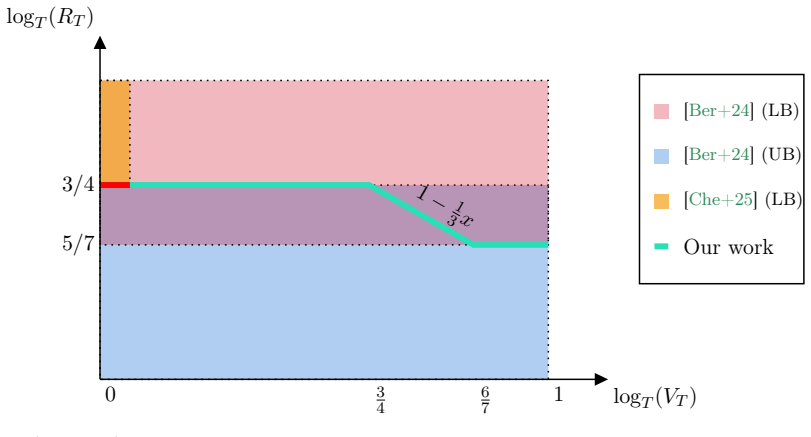
The paper's central claim is Theorem 1.1 and Theorem 1.2: for any β in [3/4, 6/7], there is an algorithm with VT ≤ O~(T^β) and RT ≤ O~(T^{1-β/3}) against adversarial valuations, and any algorithm with VT ≤ T^β must suffer RT ≥ Ω(T^{1-β/3}) even under stochastic valuations with two-bit feedback. If correct, this fully characterizes the regret-violation trade-off and shows the prior bounds of Bernasconi et al. are tight.
Load-bearing premise
The lower bound construction in Section 5 assumes that playing in the exploration region N_k is the only way to distinguish the k-th perturbed instance from the base instance, and that the KL divergence of the feedback distributions is at most O(ϵ^2/γ6) (Lemma 5.16). The proof then relies on this to relate exploration counts to regret across instances. If this KL bound is too loose, or if the revenue of points outside the exploration/exploitation grid can effectively compensate violations (Lemmas 5.7-5.9 fail), the claimed Ω(T^{1-β/3}) lower bound cannot hold.
Signed reviews
Editorial analysis
A structured set of objections, weighed in public.
Referee Report
Summary. The paper studies repeated bilateral trade when the learner is allowed to violate the global budget-balance constraint by at most T^β over T rounds. For β in [3/4, 6/7], it proposes a stochastic-setting algorithm (Section 3) and an adversarial-setting algorithm (Section 4) achieving regret O~(T^{1−β/3}) with violation O~(T^β), and claims a matching lower bound Ω(T^{1−β/3}) in Section 5. If correct, this would fully characterize the regret–violation trade-off and would close the gaps left by Bernasconi et al. [Ber+24] and Chen et al. [Che+25].
Significance. The upper-bound part of the paper is technically substantive: the adaptive-grid construction, the unbiased GFT estimator for non-SBB mechanisms, and the sleeping-experts dynamic regret bound are interesting and appear internally coherent. The claimed lower bound, however, is the load-bearing component that would turn the paper into a full characterization. As discussed below, Theorem 5.18, on which Theorem 1.2 rests, is vacuous under the paper's own parameter choices. Since the advertised main contribution is the matching lower bound and the resulting full characterization, the paper's central claim is not established by the given proof.
major comments (3)
- [§5.6, Theorem 5.18] The stated lower bound is vacuous under the parameters defined in §5.1. With N = (1/200)T^{1−β}, g = (1/24)T^{1−4β/3}, and ε = g/(12(N+1)) ≈ (25/36)T^{−β/3}, the second argument of the min in Theorem 5.18 equals (3/32)εT − 3gT^β = ((25/384) − (1/8))T^{1−β/3} = −(23/384)T^{1−β/3} < 0 for every β ∈ [3/4, 6/7]. The first argument, (1/2048)N/ε² − 3gT^β, is also negative because (1/2048)N/ε² ≈ 0.0005·T^{1−β/3}, which is smaller than 0.125·T^{1−β/3}. A lower bound of the form RT ≥ (negative quantity) is true for all algorithms and cannot imply the claimed Ω(T^{1−β/3}). This invalidates Theorem 1.2, the matching lower bound advertised in the abstract and introduction.
- [§5.6, proof of Theorem 5.18] The proof's second case derives R0_T ≥ (1/32)·γ6·(N−1)·(1/(4ε))² − 3gT^β, which with γ6 ≥ 1/16 evaluates to at least (N−1)/(8192ε²) − 3gT^β. This does not match the displayed first argument of the min in the theorem statement, (1/2048)N/ε² − 3gT^β; the factor-four discrepancy cannot be absorbed by γ6, whose lower bound is 1/16. The proof therefore does not establish the expression stated in the theorem, and the case analysis does not justify the final min.
- [§1.1, Theorem 1.2; §5.6] Even if the constants in Theorem 5.18 were corrected, the present parameterization cannot yield a positive lower bound: the largest candidate positive term is (3/32)εT ≈ 0.065·T^{1−β/3}, while the subtracted term 3gT^β equals (1/8)T^{1−β/3} ≈ 0.125·T^{1−β/3}. The subtraction is nearly twice the largest positive term, so the bound is negative uniformly over the stated range. Rescuing the lower bound would require a different choice of g, ε, or N, but such a change would ripple through Lemmas 5.13–5.17, so this is not a local typo in the theorem statement.
minor comments (4)
- [§4.3.2, Algorithm 5] Algorithm 5, line 2, writes α ← T^{1/3} (or a similar superscript without β), while the proof of Theorem 4.15 and the surrounding text use α = T^{β/3}. Please make the definition consistent.
- [§3.3.1, Lemma 3.6] In the proof of Lemma 3.6, the procedure is said to be called with L = ⌈(αK2^{i−1})⌉, but the displayed running time uses the squared denominator ⌈(αK2^{i−1})^{-2}⌉. This is presumably a typesetting error, but it makes the proof hard to follow.
- [§3.4, Theorem 3.11] The proof says 'Substituting for γ ∈ [3/4, 6/7]', but the trade-off parameter is β throughout the paper; γ is undefined in this statement. Please replace γ with β.
- [§5.5, Lemma 5.16] The name 'Pilsken inequality' should be 'Pinsker inequality'.
Circularity Check
No significant circularity found; the derivation chain is self-contained, and the lower-bound issue flagged by the skeptic is a correctness concern rather than a circular reduction.
full rationale
The upper-bound algorithm is derived from an explicit regret decomposition in which all quantities (K, α, T0, N, grid size, estimation error) are substituted into concentration and grid-approximation inequalities. The final rate O~(T^{1-β/3}) is obtained by balancing independent terms (e.g., T0K, T0/(αK), αT, T/sqrt(T0) in the stochastic case; KN, N^2/(Kα), αT/N, T/sqrt(N) in the adversarial case) and using the stated β-range inequalities 5β/3−1 ≤ 1−β/3 and 2β−1 ≤ 1−β/3. No fitted parameter is renamed as a prediction, and no target result is used as an input to its own proof. The lower bound is also derived from a self-contained hard-instance construction: explicit distributions µ_k, a partition into exploration/exploitation regions, GFT-revenue comparisons (Lemmas 5.7–5.9), a KL-divergence relation (Lemma 5.16) that is standard and externally cited ([CB+23]), and a final averaging over instances. Although the paper cites [Ber+24] with an overlapping author, the cited results are used as prior algorithmic constructions and standard techniques, not as a substitute for the proof of the paper's own trade-off; the central claim does not reduce to a self-citation chain. The skeptic's observation that Theorem 5.18 appears numerically vacuous under the paper's own parameter choices (since 3gT^β dominates both arguments of the min) is a potential correctness flaw in the lower bound, but it is not circularity: it does not consist in re-deriving the target result from an equivalent input, but rather in the stated lower bound not following from the given calculations. Per the review rules, that concern belongs under correctness risk and does not raise the circularity score.
Assumptions & free parameters
free parameters (5)
- ℓ =
1/8
- g =
T^{1-4β/3}/24
- N_lb =
T^{1-β}/200
- γ1 =
g/(4(N_lb+1))
- γ5 =
1/2
assumptions (5)
- domain assumption Valuations are bounded in [0,1]; the benchmark is the best fixed price in hindsight.
- domain assumption Fixed-price mechanisms characterize the benchmark (Hagerty-Rogerson).
- domain assumption The adversary is oblivious; valuations can be adversarial but are chosen before play.
- standard math Hoeffding and Azuma-Hoeffding concentration inequalities.
- standard math KL decomposition of feedback distributions (Lemma 15.1 in Cesa-Bianchi et al. 2023).
Cite this review
Pith. "Pith review of Better Regret Rates in Bilateral Trade via Sublinear Budget Violation." pith.science (2026). https://pith.science/paper/7RBUEM3A
@misc{pith2026250711419,
  author       = {Pith},
  title        = {Pith review of: Better Regret Rates in Bilateral Trade via Sublinear Budget Violation},
  year         = {2026},
  howpublished = {\url{https://pith.science/paper/7RBUEM3A}},
  note         = {Machine review of arXiv:2507.11419}
}
abstract
Bilateral trade is a central problem in algorithmic economics, and recent work has explored how to design trading mechanisms using no-regret learning algorithms. However, no-regret learning is impossible when budget balance has to be enforced at each time step. Bernasconi et al. [Ber+24] show how this impossibility can be circumvented by relaxing the budget balance constraint to hold only globally over all time steps. In particular, they design an algorithm achieving regret of the order of $\tilde O(T^{3/4})$ and provide a lower bound of $\Omega(T^{5/7})$. In this work, we interpolate between these two extremes by studying how the optimal regret rate varies with the allowed violation of the global budget balance constraint. Specifically, we design an algorithm that, by violating the constraint by at most $T^{\beta}$ for any given $\beta \in [\frac{3}{4}, \frac{6}{7}]$, attains regret $\tilde O(T^{1 - \beta/3})$. We complement this result with a matching lower bound, thus fully characterizing the trade-off between regret and budget violation. Our results show that both the $\tilde O(T^{3/4})$ upper bound in the global budget balance case and the $\Omega(T^{5/7})$ lower bound under unconstrained budget balance violation obtained by Bernasconi et al. [Ber+24] are tight.
Figures


Figures from the paper (2 more)


Forward citations
Cited by 1 Pith paper
-
Breaking the $T^{3/4}$ Barrier for Regret Minimization With Bi-Dimensional CDFs
A new three-phase algorithm achieves O~(T^{7/10}) regret for two-dimensional Lipschitz CDF-dependent rewards, improving on the previous O~(T^{3/4}).
Reference graph
Works this paper leans on
- [1]
-
[2]
, N} µ0(w5) = γ5 ≥ 0, and finally we have that µ0(ωi
= µ0(wN −i 4 ) = γ1 1 − 2i 3(N ) ≥ γ1 1 3 ≥ 0 ∀i ∈ {0, . . . , N} µ0(w5) = γ5 ≥ 0, and finally we have that µ0(ωi
-
[6]
, N} Then we prove the statement for a perturbed instancesµk, k ∈ {1,
= 1 4 1 − X j∈{1,2,3,4} X i∈{0,...,N } µ0(wi j) − γ5 = 1 4 (1 − 4(N + 1)γ1 − γ5) = 1 4 (1 − g − γ5) ≥ 1 16 ∀i ∈ {0, . . . , N} Then we prove the statement for a perturbed instancesµk, k ∈ {1, . . . , N− 1}. In this case, we can observe that the probabilitiesγ5 and γ6 do not change, and all other probabilities are guaranteed to be greater or equal t...
Reviewed August 6, 2026 · model on record in the stance chip above.
Discussion (0). Continue with ORCID to comment.