REVIEW 4 major objections 5 minor 23 references
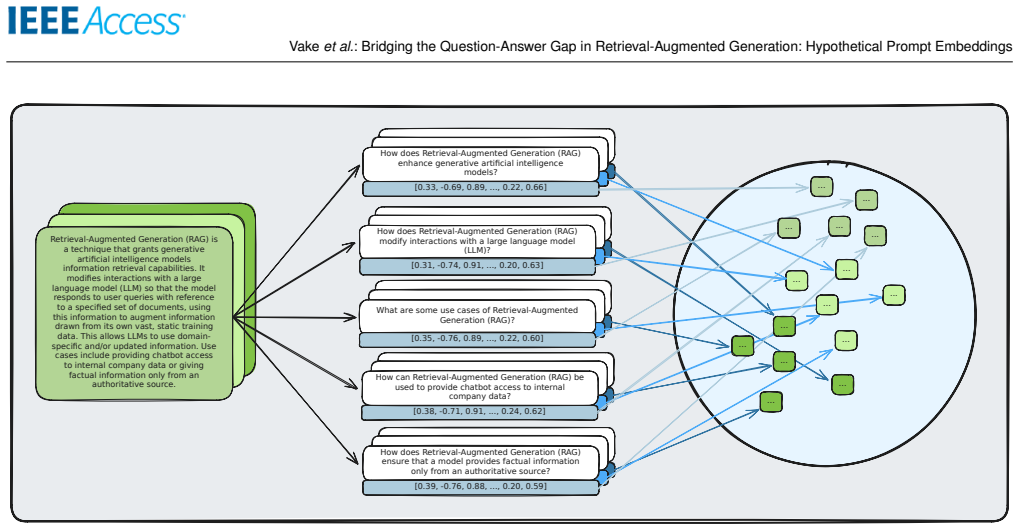
HyPE eliminates the query-document style gap by precomputing hypothetical question embeddings at indexing time, turning retrieval into question-to-question matching with no added query latency.
Reviewed by Pith at T0; open to challenge. T0 means a machine referee read the full paper against a public rubric. the ladder, T0–T4 →
T0 review · deepseek-v4-flash
2026-08-03 07:39 UTC pith:7RC7JZE3
load-bearing objection HyPE is a plausible inversion of HyDE, but the paper never isolates the multi-vector-per-chunk effect from question–question matching, and the reported statistics are not credible as stated. the 4 major comments →
Bridging the Question-Answer Gap in Retrieval-Augmented Generation: Hypothetical Prompt Embeddings
The pith
A machine-rendered reading of the paper's core claim, the machinery that carries it, and where it could break.
Core claim
HyPE's central claim is that the retrieval bottleneck in RAG is the question-to-document style gap, and that this gap can be eliminated offline by re-representing each chunk as a set of hypothetical user questions. For each chunk the method asks an LLM to produce k questions that the chunk would answer, embeds each question with the dense retriever, and indexes the (embedding, chunk) pairs. Retrieval then embeds only the real user query and does an ANN search over question embeddings, retrieving the chunks behind the nearest question vectors. The authors argue this works because embedding models cluster texts by style, so an interrogative query lands closer to hypothetical questions about th
What carries the argument
Hypothetical Prompt Embeddings (HyPE)—precomputed question vectors associated with each chunk. The mechanism inverts HyDE: instead of generating a synthetic answer at query time, an LLM generates multiple hypothetical questions per chunk during indexing; each question is embedded with the same dense retriever that will later embed user queries, and the (question-vector, chunk) pairs form the index. Retrieval becomes nearest-neighbor search in question space, so a user's interrogative query matches against interrogative prompts, not against expository text.
Load-bearing premise
The method assumes the dense embedder clusters interrogative sentences closer to other interrogative sentences than to declarative text; the paper cites prior literature for this rather than validating it with its chosen embedder, and where that assumption weakens (as on MS MARCO), HyPE offers no advantage.
What would settle it
Run HyPE and naive RAG on a corpus whose queries are written in declarative style, or with an embedder trained on question-answer pairs that eliminate the style distinction; if the precision/recall gap disappears, the style-clustering premise fails. A cheaper check: for the chosen embedder, measure the distribution of cosine similarity between real queries and hypothetical questions versus real queries and their gold chunks; overlap of the two distributions would predict exactly the datasets where HyPE wins.
If this is right
- RAG systems can get HyDE-style style-bridging with zero additional query-time latency, since all LLM calls happen once per chunk offline.
- Retrieval quality improves most where queries and documents differ most in style and length; gains shrink on short lexical-overlap corpora like MS MARCO.
- The retrieved-context improvements carry through to generation: higher faithfulness, higher context utilization, and lower hallucination rate.
- HyPE is orthogonal to re-ranking, query decomposition, multi-vector retrieval, and other accessories—it can replace passage vectors without changing the orchestration.
- The index grows by a factor of k (questions per chunk) in the number of vectors, with a one-time index build cost proportional to corpus size.
Where Pith is reading between the lines
- Since HyPE weights all generated questions equally, an obvious extension is prompt scoring or selection; pruning low-quality questions could reduce index bloat and noise amplification, which the paper's higher noise-sensitivity-in-relevant-context score already hints at.
- The method's reliance on style-based clustering is embedder-dependent; one could test whether training or fine-tuning the embedder with question-style pairs amplifies the gap further, or whether the effect is robust across multilingual embedders.
- Question-question matching is a general principle: it could be applied to any dense retrieval setting where user intents are naturally phrased as questions (FAQ retrieval, e-commerce support), not just RAG pipelines.
- The observed parity on MS MARCO sets a scope condition: HyPE's benefit is largest when the naive baseline fails due to style divergence; knowing when to switch it on could be data-driven rather than a mode to always run.
Editorial analysis
A structured set of objections, weighed in public.
Referee Report
Summary. The paper introduces HyPE (Hypothetical Prompt Embeddings), a retrieval-augmented generation (RAG) approach that precomputes multiple hypothetical question embeddings for each corpus chunk at indexing time. At retrieval, user queries are embedded and matched against these question embeddings, effectively turning retrieval into a question–question matching task and avoiding the query-time LLM calls of HyDE. The authors evaluate HyPE against a Naive RAG baseline and HyDE across six datasets using RAGChecker metrics (context precision, claim recall, generator faithfulness, etc.). They report substantial average gains (about 20 percentage points in precision and 16 in recall) and large gains on datasets with longer documents, while noting that MS MARCO shows only marginal differences. Statistical significance is assessed with Wilcoxon signed-rank tests over the six datasets.
Significance. If the reported gains hold, HyPE is an attractive method: it eliminates query-time LLM generation, is index-time only, and appears to improve retrieval on several benchmarks. The paper includes a reproducible pipeline (open-source generator, fixed embedder, RAGChecker evaluation) and reports raw per-dataset numbers, which is commendable. The central idea—shifting hypothetical content generation from query time to indexing time—is simple, plausible, and could be broadly applicable. However, the current evidence does not isolate the proposed question–question mechanism from the trivial effect of storing multiple vectors per chunk, and the statistical analysis over only six datasets is too weak to support the strong claims of reliability.
major comments (4)
- [Section III, Algorithm 1; Table 3] The paper never reports the number of hypothetical questions generated per chunk, despite this being a key free parameter (called 'prompts-per-chunk k' in Algorithm 1). HyPE stores k vectors per chunk, while Naive RAG stores one. The reported improvements could therefore arise simply from having more vectors per chunk, i.e., semantic coverage, rather than from question–question style alignment. The paper acknowledges this confound in its own discussion ('generating multiple hypothetical queries per chunk broadens the semantic reach') but provides no ablation varying k, no comparison against a multi-vector baseline that uses non-interrogative expansions (e.g., k statement-style paraphrases or k Doc2Query-like questions appended and embedded), and no analysis of MS MARCO's k=1 underperformance. Without such controls, the central claim that 'question–question matching beats question–documen
- [Section V, Table 5] The Wilcoxon signed-rank analysis is performed on only six paired datasets. With n=6, the attainable p-values are coarse, and after Holm–Bonferroni adjustment many reported adjusted p-values are 0.063–0.094, which is above the conventional 0.05 threshold. The text calls these results 'statistically reliable,' but this is an overstatement. The minimum attainable exact level makes any strong significance claim impossible with this sample size. Please either weaken the statistical language, report exact raw p-values alongside adjusted ones, or supplement with a query-level or chunk-level analysis that has higher statistical power. The effect sizes (Cliff's |δ|) are indeed large and should be emphasized, but significance claims should be calibrated accordingly.
- [Section III, paragraph after Algorithm 2] The proposed mechanism relies on the premise that embedding models place interrogative texts closer together than a query and its answer chunk, citing Reimers [17] for 'style-based clustering.' This premise is not validated for the chosen embedder (bge-m3). A simple diagnostic would strengthen the paper: compute average cosine similarities between (real query, generated hypothetical question) pairs vs. (real query, chunk) pairs, or train a classifier to see whether question-style vectors separate from statement-style vectors in the chosen embedding space. The MS MARCO results, where HyPE underperforms Naive at retrieval depth k=1, suggest the premise may not hold uniformly. Without such a check, the mechanism remains an untested assumption.
- [Section IV.A, Table 2, and Section V] Experimental reproducibility is hampered by incomplete reporting. The number of generated questions per chunk is critical but not stated, and the paper does not specify which LLM was used for question generation (the generator LLM, Mistral-NeMo, is mentioned only for the generation pipeline, not for question generation), nor the decoding parameters (temperature, top-p, max tokens, number of questions). For the two manually chunked datasets, maximum chunk length and overlap are given, but not for datasets that already come pre-segmented. The paper should provide a complete configuration table, including the total number of vectors indexed per dataset (which affects retrieval cost) and the exact prompt used (Figure 3 is shown but not the prompt that requests a specific number of questions).
minor comments (5)
- [Abstract and Section III] The abstract states 'embedding the chunk in place of the prompt,' but the methodology embeds the hypothetical prompt, not the chunk. The wording is confusing; please align it with the actual procedure.
- [Algorithm 1 and Table 3] The symbol k is overloaded: it denotes 'prompts-per-chunk' in Algorithm 1 and retrieval depth (number of retrieved chunks) in Table 3 and Figure 4. This is likely to confuse readers; use a different symbol (e.g., m) for one of the two.
- [Table 2 and Table 3] The dataset name is inconsistently written as 'RAG-dataset-12000' in Table 2 and 'RAG-12000' in Table 3. Please standardize.
- [Section V, Table 4] Table 4 reports mean ± sd computed across the six datasets, not across repeated runs. Calling this 'mean ± sd' without clarification is misleading because the sd reflects dataset heterogeneity, not experimental uncertainty. Please clarify in the caption.
- [Section V, Figure 7 and Table 5] The text reports 'Noise sensitivity (relevant)' as a metric where higher is worse, yet Table 4 and Figure 7 list it with a down arrow. That is consistent. However, in the Wilcoxon table the row 'Noise sens. (relevant)' is bolded for HyPE vs. both baselines, which might be misinterpreted as a beneficial result because the paper does not explicitly restate the direction. Add a sentence clarifying that higher values in this metric are detrimental.
Circularity Check
No significant circularity: HyPE is an empirical retrieval method evaluated on held-out external benchmarks; its improvements are not forced by construction.
full rationale
HyPE's derivation chain is not circular. The method precomputes LLM-generated hypothetical questions per chunk at indexing time and stores their dense embeddings as vector–chunk pairs; at query time it embeds the real user query and performs standard ANN search. The reported gains are measured against held-out queries on six external datasets using RAGChecker, with no parameter fitted to the test data and no result that is equivalent to an input by definition. The central premise about style-based clustering is an empirical assumption cited from external work (Reimers 2019, [17]) and is not derived from the paper's own outputs; it could be wrong, but that is a correctness/validity concern, not circularity. The paper also explicitly discloses limitations: it does not score or filter generated questions and treats all prompts equally, and its own MS MARCO results at k=1 show HyPE below Naive RAG. The skeptic's concern that gains may stem from multiple vectors per chunk rather than question-question alignment is a plausible missing-control-baseline critique, but it does not make the claim circular: no component of the method is defined in terms of the target result, and no self-citation chain is load-bearing. Therefore the appropriate circularity score is 0.
Axiom & Free-Parameter Ledger
free parameters (3)
- number of hypothetical questions per chunk (k/m)
- LLM decoding temperature and generation parameters
- maximum chunk length / overlap for manually chunked datasets =
500 tokens / 50 tokens
axioms (3)
- domain assumption Embedding models exhibit style-based clustering such that interrogative sentences are closer to each other than to declarative passages (Section III, citing Reimers 2019).
- domain assumption RAGChecker's context precision, claim recall, faithfulness, and related metrics are valid and unbiased measures of retrieval and generation quality (Section IV).
- domain assumption The gold QA pairs in the six datasets are representative of real user query styles (Section IV-A).
read the original abstract
Retrieval-Augmented Generation (RAG) systems synergize retrieval mechanisms with generative language models to enhance the accuracy and relevance of responses. However, bridging the style gap between user queries and relevant information in document text remains a persistent challenge in retrieval-augmented systems, often addressed by runtime solutions (e.g., Hypothetical Document Embeddings (HyDE)) that attempt to improve alignment but introduce extra computational overhead at query time. To address these challenges, we propose Hypothetical Prompt Embeddings (HyPE), a framework that shifts the generation of hypothetical content from query time to the indexing phase. By precomputing multiple hypothetical prompts for each data chunk and embedding the chunk in place of the prompt, HyPE transforms retrieval into a question-question matching task, bypassing the need for runtime synthetic answer generation. This approach does not introduce latency but also strengthens the alignment between queries and relevant context. Our experimental results on six common datasets show that HyPE can improve retrieval context precision by up to 42 percentage points and claim recall by up to 45 percentage points, compared to standard approaches, while remaining compatible with re-ranking, multi-vector retrieval, query decomposition, and other RAG advancements
Figures


Reference graph
Works this paper leans on
-
[1]
Retrieval-augmented generation for knowledge-intensive nlp tasks,
P. Lewis, E. Perez, A. Piktus, F. Petroni, V . Karpukhin, N. Goyal, H. Küt- tler, M. Lewis, W.-t. Yih, T. Rocktäschel et al., “Retrieval-augmented generation for knowledge-intensive nlp tasks,” Advances in Neural Infor- mation Processing Systems, vol. 33, pp. 9459–9474, 2020
2020
-
[2]
Financial report chunking for effective retrieval augmented generation,
A. J. Yepes, Y . You, J. Milczek, S. Laverde, and R. Li, “Financial report chunking for effective retrieval augmented generation,” arXiv preprint arXiv:2402.05131, 2024
Pith/arXiv arXiv 2024
-
[3]
Searchd-advanced retrieval with text generation using large language models and cross encoding re-ranking,
P. Mishra, A. Mahakali, and P. S. Venkataraman, “Searchd-advanced retrieval with text generation using large language models and cross encoding re-ranking,” in 2024 IEEE 20th International Conference on Automation Science and Engineering (CASE). IEEE, 2024, pp. 975– 980
2024
-
[4]
Qa- gnn: Reasoning with language models and knowledge graphs for question answering,
M. Yasunaga, H. Ren, A. Bosselut, P. Liang, and J. Leskovec, “Qa- gnn: Reasoning with language models and knowledge graphs for question answering,” arXiv preprint arXiv:2104.06378, 2021
Pith/arXiv arXiv 2021
-
[5]
Precise zero-shot dense retrieval without relevance labels,
L. Gao, X. Ma, J. Lin, and J. Callan, “Precise zero-shot dense retrieval without relevance labels,” arXiv preprint arXiv:2212.10496, 2022
Pith/arXiv arXiv 2022
-
[6]
Few-shot learning with retrieval augmented language models,
G. Izacard, P. Lewis, M. Lomeli, L. Hosseini, F. Petroni, T. Schick, J. Dwivedi-Yu, A. Joulin, S. Riedel, and E. Grave, “Few-shot learning with retrieval augmented language models,” arXiv preprint arXiv:2208.03299, vol. 1, no. 2, p. 4, 2022
Pith/arXiv arXiv 2022
-
[7]
The vocabulary problem in human-system communication,
G. W. Furnas, T. K. Landauer, L. M. Gomez, and S. T. Dumais, “The vocabulary problem in human-system communication,” Communications of the ACM, vol. 30, no. 11, pp. 964–971, 1987
1987
-
[8]
Document expansion by query prediction,
R. Nogueira, W. Yang, J. Lin, and K. Cho, “Document expansion by query prediction,” arXiv preprint arXiv:1904.08375, 2019
Pith/arXiv arXiv 1904
-
[9]
Approximate nearest neighbor negative contrastive learning for dense text retrieval,
L. Xiong, C. Wu, I. Yamada, Z. Du, X. Lu, J. Yang, and J. Lin, “Approximate nearest neighbor negative contrastive learning for dense text retrieval,” in International Conference on Learning Representations (ICLR), 2021
2021
-
[10]
From doc2query to doctttttquery,
R. Nogueira, J. Lin, and A. Epistemic, “From doc2query to doctttttquery,” Online preprint, vol. 6, no. 2, 2019
2019
-
[11]
The probabilistic relevance framework: Bm25 and beyond,
S. Robertson, H. Zaragoza et al., “The probabilistic relevance framework: Bm25 and beyond,” Foundations and Trends® in Information Retrieval, vol. 3, no. 4, pp. 333–389, 2009
2009
-
[12]
Doc2query–: when less is more,
M. Gospodinov, S. MacAvaney, and C. Macdonald, “Doc2query–: when less is more,” in European Conference on Information Retrieval. Springer, 2023, pp. 414–422
2023
-
[13]
Zero-shot neu- ral passage retrieval via domain-targeted synthetic question generation,
J. Ma, I. Korotkov, Y . Yang, K. Hall, and R. McDonald, “Zero-shot neu- ral passage retrieval via domain-targeted synthetic question generation,” arXiv preprint arXiv:2004.14503, 2020
Pith/arXiv arXiv 2004
-
[14]
Ar- agog: A large-scale evaluation of retrieval-enhanced generation methods,
P. Eibich, N. Zhou, N. Rajani, D. Khashabi, D. Roth, and E. Durmus, “Ar- agog: A large-scale evaluation of retrieval-enhanced generation methods,” arXiv preprint arXiv:2404.01037, 2024
Pith/arXiv arXiv 2024
-
[15]
R. Gupta et al., “A comprehensive survey of retrieval-augmented gener- ation: Evolution, current landscape and future directions,” arXiv preprint arXiv:2410.12837, 2024
Pith/arXiv arXiv 2024
-
[16]
A survey on knowledge-oriented retrieval-augmented generation,
S. Cheng, B. Y . Lin, and X. Ren, “A survey on knowledge-oriented retrieval-augmented generation,” arXiv preprint arXiv:2503.10677, 2025
Pith/arXiv arXiv 2025
-
[17]
Sentence-bert: Sentence embeddings using siamese bert- networks,
N. Reimers, “Sentence-bert: Sentence embeddings using siamese bert- networks,” arXiv preprint arXiv:1908.10084, 2019
Pith/arXiv arXiv 1908
-
[18]
Dense passage retrieval for open-domain question answering,
V . Karpukhin, B. O˘guz, S. Min, P. Lewis, L. Wu, S. Edunov, D. Chen, and W.-t. Yih, “Dense passage retrieval for open-domain question answering,” arXiv preprint arXiv:2004.04906, 2020
Pith/arXiv arXiv 2004
-
[20]
Ragchecker: A fine-grained framework for diagnosing retrieval-augmented generation,
D. Ru, L. Qiu, X. Hu, T. Zhang, P. Shi, S. Chang, J. Cheng, C. Wang, S. Sun, H. Li, Z. Zhang, B. Wang, J. Jiang, T. He, Z. Wang, P. Liu, Y . Zhang, and Z. Zhang, “Ragchecker: A fine-grained framework for diagnosing retrieval-augmented generation,” 2024. [Online]. Available: https://arxiv.org/abs/2408.08067
Pith/arXiv arXiv 2024
-
[21]
Ms marco: A human-generated machine reading comprehension dataset,
T. Nguyen, M. Rosenberg, X. Song, J. Gao, S. Tiwary, R. Majumder, and L. Deng, “Ms marco: A human-generated machine reading comprehension dataset,” 2016
2016
-
[22]
Multihop-rag: Benchmarking retrieval-augmented generation for multi-hop queries,
Y . Tang and Y . Yang, “Multihop-rag: Benchmarking retrieval-augmented generation for multi-hop queries,” 2024
2024
-
[23]
Ragbench: Explainable bench- mark for retrieval-augmented generation systems,
R. Friel, M. Belyi, and A. Sanyal, “Ragbench: Explainable bench- mark for retrieval-augmented generation systems,” arXiv preprint arXiv:2407.11005, 2024
Pith/arXiv arXiv 2024
-
[24]
Bge m3- embedding: Multi-lingual, multi-functionality, multi-granularity text em- beddings through self-knowledge distillation,
J. Chen, S. Xiao, P. Zhang, K. Luo, D. Lian, and Z. Liu, “Bge m3- embedding: Multi-lingual, multi-functionality, multi-granularity text em- beddings through self-knowledge distillation,” 2024. DOMEN VAKE(M.S.) received the B.S. and M.S. degrees in Computer Science from University of Primorska, Slovenia. He is currently pursuing the Ph.D. degree in Compute...
2024
discussion (0)
Sign in with ORCID, Apple, or X to comment. Anyone can read and Pith papers without signing in.