REVIEW 4 major objections 5 minor 125 references
MusiChat turns music generation into a conversational, iterative edit of an existing song rather than a one-shot regeneration.
Reviewed by Pith at T0; open to challenge. T0 means a machine referee read the full paper against a public rubric. the ladder, T0–T4 →
T0 review · deepseek-v4-flash
2026-07-31 23:21 UTC pith:7RD5J47J
load-bearing objection MusiChat makes a real architectural bet on structure-preserving conversational editing, but the paper never directly verifies its central invariant for LLM-driven edits. the 4 major comments →
MusiChat: Vibe Composing for Music Creation
The pith
A machine-rendered reading of the paper's core claim, the machinery that carries it, and where it could break.
Core claim
The central discovery claim is that an LLM conversing with a user can orchestrate deterministic symbolic music operations to edit a song in place. The song's identity is carried by a lyric-aligned skeleton—the melody, rhythm, phrase structure, and lyric-to-note alignment—while style-specific details (harmony, articulation, dynamics, expressiveness) are layered on by interchangeable realizers that promise to preserve that skeleton. Because edits apply to the current composition rather than spawning new generations, multi-turn conversations can accumulate changes without error. The authors report that this makes melody preservation two to three times better than a regenerate-from-scratch basel
What carries the argument
The load-bearing object is the 'melodic scaffold,' or lyric-aligned musical skeleton: a deterministic representation of melody, rhythm, phrase structure, and lyric alignment derived from lyrics. On top of it sit three pluggable surface realizers—deterministic, LLM-refined, and LLM-replaced—which are asserted to modify only surface attributes while preserving the scaffold and note onsets. This separation is what converts a prompt-and-regenerate generator into an edit-in-place composer.
Load-bearing premise
The central promise rests on the invariant, stated in Section 2.3, that all three realizers preserve the melodic scaffold and note onsets; the paper's objective tests cover only deterministic edits, while its Limitations section concedes that the purely algorithmic melody engine may under-fit certain genres, so scaffold drift under LLM-driven edits remains unmeasured.
What would settle it
Run a fixed song through multiple conversational turns of LLM-refine or LLM-replace style edits and compare, for every turn, the sequence of note onsets and the pitch-class contour against the pre-edit scaffold; if any turn alters an onset position or changes the melodic contour outside the requested surface attribute, the preservation contract is false. A simple automated script can compute this from the MusicXML/MIDI before and after.
If this is right
- A user can request an in-place change to title, key, tempo, pitch, chord harmony, or style and keep the rest of the song recognizably the same.
- Multi-turn editing should not accumulate errors: the reported preservation contract holds 100% at every dialogue depth in the conversational evaluation.
- Because style is a surface layer, the same underlying song can be re-styled across genres without recomposing the melody.
- Non-musicians can perform precise musical edits through natural language, without a DAW or notation expertise.
- Deterministic routing of unambiguous requests lowers cost and latency; LLM reasoning is reserved for open-ended creative requests.
Where Pith is reading between the lines
- If the scaffold-preservation invariant extends to LLM-driven realizers (not yet measured), the LLM effectively becomes an orchestrator and stylist rather than a composer, which could shift how music-generation models are trained and evaluated.
- The same hierarchy could be applied to polyphonic and multi-instrument composition: replace the single melodic scaffold with a multi-track scaffold and keep the surface-realizer contract, enabling instrument-level edits.
- One testable extension is measuring scaffold drift under repeated LLM-refine turns; the paper's own Limitations section notes the purely algorithmic melody generator may be less flexible for some genres, so the invariant may be harder to hold when the scaffold itself needs adjustment.
Editorial analysis
A structured set of objections, weighed in public.
Referee Report
Summary. MusiChat is a conversational "vibe composing" system for symbolic music generation. It uses a hierarchical engine that first builds a lyric-aligned melodic skeleton and then applies one of three surface realizers — deterministic, LLM-refined, and LLM-replace — which are claimed to preserve the scaffold and note onsets while changing surface attributes. A hybrid intent router with regular-expression detectors and an LLM classifier maps user requests to operations; persistent composition state is kept across turns. The paper reports 95.31% accuracy on single-turn and 100% on multi-turn deterministic feature edits, a 35-participant human study with no significant MOS differences among realizers, 2:1 and 3:1 like-to-dislike ratios for naturalness and quality, and a conversational evaluation showing higher melodic/lyric preservation than a regenerate-from-scratch baseline.
Significance. If the scaffold-preservation invariant holds for all three realizers, this would be a meaningful advance over prompt-and-regenerate systems: users could refine style, rhythm, or pitch without unrelated parts of the piece changing. The deterministic engine is transparent and reproducible, the multi-turn edit tests are useful, and the conversational evaluation includes a baseline comparison. The problem is that the main invariant is only directly tested for deterministic edits; the LLM-driven realizers that are central to "vibe composing" are evaluated only through a small conversational study whose fidelity scores (restyle 0.65) are far from the perfect preservation asserted. The contribution is therefore promising but not yet supported by the evidence presented.
major comments (4)
- [§2.3 and §3.3 (Fig. 6B, 6C)] The central claim that "all realizers preserve the melodic scaffold and note onsets" is asserted in §2.3 but not directly measured for the two LLM-based realizers. The objective feature-editing test (Table 1) covers only deterministic edits; the conversational evaluation is the only place LLM-driven operations appear, and it reports restyle melody fidelity of 0.65 (Fig. 6B) and contour/rhythm preservation of 0.81/0.80 (Fig. 6C) — not 1.0. Because "melody fidelity (contour+rhythm)" is a coarse aggregate with no per-turn confidence intervals, it cannot confirm the scaffold/onset invariant. A direct comparison of scaffold and note-onset preservation under LLM-refined and LLM-replace, or a clear qualification of the invariant, is needed before the headline contribution is established.
- [Table 1 and §3.1] The 95.31% single-turn and 100% multi-turn accuracies are presented as the headline quantitative evidence, but all sixty-four single-turn and all thirty-six multi-turn edits are deterministic parameter/symbolic changes (title, key signature, tempo, pitch). These do not exercise the LLM-based realizers or open-ended style/refinement requests. Moreover, the two single-turn loss categories both involve pitch (Pitch 6/8; KS+Tempo+Pitch 7/8), so the system's reliability on the most musical of the tested attributes is weaker than the aggregate suggests. The headline accuracy should be reported as accuracy on deterministic edits, not as a general measure of interactive music editing.
- [§3.2.2, Fig. 3] The human study found no statistically significant difference among the three realizers: all pairwise bootstrap 95% CIs for MOS differences straddle zero, and the deterministic realizer has the highest point estimate. This does not support the implication that the LLM-refined and LLM-replace realizers add perceived musical value. It is not fatal by itself, but the discussion should state that the realizers are perceptually equivalent in this study and should not claim an advantage for LLM-based realization without further evidence.
- [§3.3, Fig. 6D] The claim that "no error accumulation" holds "100% at every dialogue depth" is based on 15 conversational turns, of which only a few involve LLM-driven operations (restyle n=5, key n=4, tempo n=4, title n=2). The "contract preserved" rate conflates deterministic and LLM operations; with such small per-type samples, the 100% preservation rate cannot be taken as validation of the invariant under open-ended conversational refinement. Reporting Wilson CIs (as in Fig. 6A) for each cell would show the uncertainty.
minor comments (5)
- [§2.3] Typo: "skelton" should be "skeleton."
- [§3.3, Fig. 6 caption] The Wilcoxon p=6.1e-05 and r=1.00 in the Fig. 6 caption are not explained in the text; please specify the test procedure and effect-size definition.
- [§3.1 and Table 1] Multi-turn category labels such as "KS+Pitch,Tempo" are ambiguous; define the turn structure explicitly (which edits occur in which turn).
- [§3.3] "More detailed evaluation for objective, music-theory-based metrics have been conducted in (Liao et al., 2025)" is a self-reference; include the relevant metrics or clearly state that the present paper relies on that separate report.
- [Ethics Statement] The sentence "does not contain any copyright concerns since it is purely algorithmic" is not self-evident; algorithmic origin does not by itself settle copyright questions. Rephrase.
Circularity Check
No significant circularity; preservation claims are design/empirical and self-citations are not load-bearing.
full rationale
MusiChat's central claim—in-turn refinement that preserves musical structure and user intent—rests on an explicit engine design (Section 2.3: realizers start from a fresh copy of a stable skeleton and modify only surface attributes), not on a fitted parameter or on a prediction derived from its own inputs. The objective feature-editing results (Table 1) are implementation acceptance tests for deterministic edits (title, key, tempo, pitch), not circular predictions; the reported 0.65 restyle melody fidelity in Figure 6B shows the fidelity metric is not forced to 1.0 and therefore has independent empirical content. The human MOS study (35 participants, ratings split by musical experience and realizer) is an independent perceptual anchor, and the regenerate-from-scratch baseline in Figure 6 provides an external comparison. The self-citations (Liao et al., 2022–2025) describe the algorithmic engine and point to more detailed music-theory metrics; they are not used as a uniqueness theorem or as the sole justification for the preservation claim, since the paper includes its own measurements and baseline comparisons. The main weakness—the scaffold/onset-preservation invariant is asserted for LLM-refined and LLM-replace realizers but not directly measured for those realizers—is a missing-evidence and correctness-risk issue, not a circularity. The Limitations section itself acknowledges dependence on LLM interpretation and algorithmic flexibility constraints, further indicating that the authors do not present the system as a self-validating tautology.
Axiom & Free-Parameter Ledger
free parameters (2)
- Genre style parameter sets (8 genres) =
Unspecified
- Pitch traversal parameters (buffer size, stepwise bias, smoothing coefficients) =
Unspecified
axioms (5)
- domain assumption Linguistic stress patterns determine time signature, phrase segmentation, and rhythm allocation.
- domain assumption A buffer-constrained, predominantly stepwise pitch traversal yields musically acceptable melodies.
- domain assumption Changing surface attributes while preserving scaffold/note onsets preserves musical identity.
- ad hoc to paper Regular expressions plus LLM intent routing correctly map natural-language utterances to structured operations.
- domain assumption LLM-generated lyrics from text or image are an adequate semantic foundation for the subsequent musical scaffold.
read the original abstract
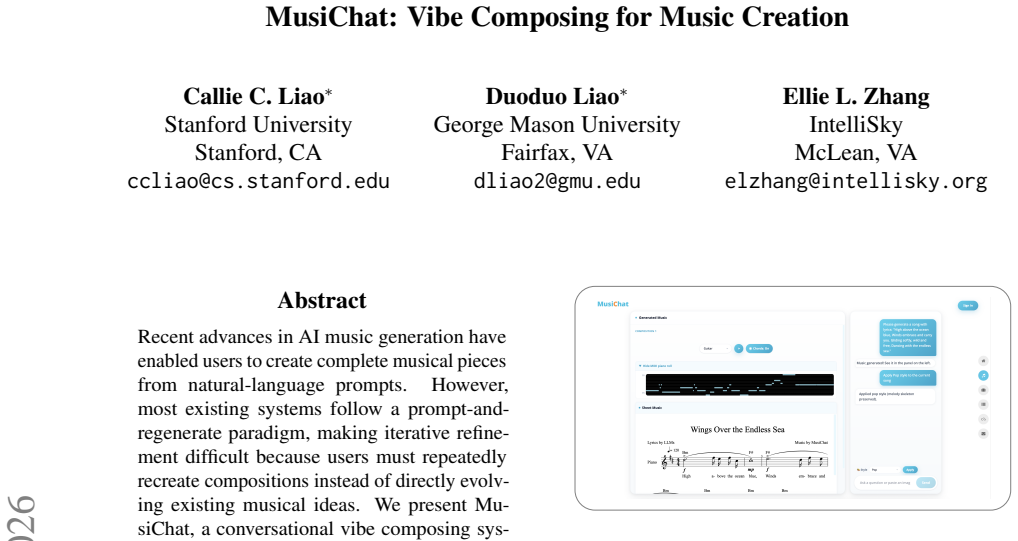
Recent advances in AI music generation have enabled users to create complete musical pieces from natural-language prompts. However, most existing systems follow a prompt-and-regenerate paradigm, making iterative refinement difficult because users must repeatedly recreate compositions instead of directly evolving existing musical ideas. We present MusiChat, a conversational vibe composing system that enables collaborative human-AI music creation through natural-language interaction and iterative refinement. At the core of MusiChat is a hierarchical controllable music generation framework that separates lyric-aligned musical structure generation from expressive surface realization, allowing flexible stylistic transformations and structure-preserving edits. The system integrates a large language model with a hybrid symbolic music engine through a memory-augmented architecture that maintains the active composition state and user history across interactions. A hybrid intent-routing mechanism further enables efficient interpretation of both precise musical edits and open-ended creative requests. Rather than regenerating compositions from scratch, MusiChat incrementally transforms an evolving musical artifact while preserving relevant musical structure and user intent. We evaluate MusiChat through objective analysis and human studies, achieving 95.31% and 100% accuracy for single- and multi-turn interactions, respectively, and obtaining like-to-dislike ratios of 2:1 for melody naturalness and 3:1 for musical quality. Our results demonstrate that MusiChat supports coherent multi-turn music authoring and interactive human-AI co-creation through a conversational interface.
Figures


Reference graph
Works this paper leans on
-
[1]
Yi, Zihao and Ouyang, Jiarui and Xu, Zhe and Liu, Yuwen and Liao, Tianhao and Luo, Haohao and Shen, Ying , title =. ACM Comput. Surv. , month = dec, articleno =. 2025 , issue_date =. doi:10.1145/3771090 , abstract =
doi:10.1145/3771090 2025
-
[2]
2025 , eprint=
LLMs Get Lost In Multi-Turn Conversation , author=. 2025 , eprint=
2025
-
[3]
Flamingo: a Visual Language Model for Few-Shot Learning , url =
Alayrac, Jean-Baptiste and Donahue, Jeff and Luc, Pauline and Miech, Antoine and Barr, Iain and Hasson, Yana and Lenc, Karel and Mensch, Arthur and Millican, Katherine and Reynolds, Malcolm and Ring, Roman and Rutherford, Eliza and Cabi, Serkan and Han, Tengda and Gong, Zhitao and Samangooei, Sina and Monteiro, Marianne and Menick, Jacob L and Borgeaud, S...
-
[4]
Chain-of-Thought Prompting Elicits Reasoning in Large Language Models , url =
Wei, Jason and Wang, Xuezhi and Schuurmans, Dale and Bosma, Maarten and ichter, brian and Xia, Fei and Chi, Ed and Le, Quoc V and Zhou, Denny , booktitle =. Chain-of-Thought Prompting Elicits Reasoning in Large Language Models , url =
-
[5]
Visual Instruction Tuning , url =
Liu, Haotian and Li, Chunyuan and Wu, Qingyang and Lee, Yong Jae , booktitle =. Visual Instruction Tuning , url =
-
[6]
2024 , eprint=
MeloTrans: A Text to Symbolic Music Generation Model Following Human Composition Habit , author=. 2024 , eprint=
2024
-
[7]
Yu, Jiaxing and Wu, Xinda and Xu, Yunfei and Zhang, Tieyao and Wu, Songruoyao and Ma, Le and Zhang, Kejun , title =. 2025 , isbn =. doi:10.1609/aaai.v39i24.34766 , booktitle =
-
[8]
2023 , eprint=
MelodyGLM: Multi-task Pre-training for Symbolic Melody Generation , author=. 2023 , eprint=
2023
-
[9]
Simple and Controllable Music Generation , url =
Copet, Jade and Kreuk, Felix and Gat, Itai and Remez, Tal and Kant, David and Synnaeve, Gabriel and Adi, Yossi and Defossez, Alexandre , booktitle =. Simple and Controllable Music Generation , url =
-
[10]
2024 , eprint=
Multimodal Chain-of-Thought Reasoning in Language Models , author=. 2024 , eprint=
2024
-
[11]
Electronics , VOLUME =
Zhao, Yujia and Yang, Mingzhi and Lin, Yujia and Zhang, Xiaohong and Shi, Feifei and Wang, Zongjie and Ding, Jianguo and Ning, Huansheng , TITLE =. Electronics , VOLUME =. 2025 , NUMBER =
2025
-
[12]
2020 , eprint=
Jukebox: A Generative Model for Music , author=. 2020 , eprint=
2020
-
[13]
2018 , eprint=
Music Transformer , author=. 2018 , eprint=
2018
-
[14]
1983 , publisher=
A Generative Theory of Tonal Music , author=. 1983 , publisher=
1983
-
[15]
Generative Processes in Music: The Psychology of Performance, Improvisation, and Composition , pages=
Cognitive Constraints on Compositional Systems , author=. Generative Processes in Music: The Psychology of Performance, Improvisation, and Composition , pages=. 2001 , publisher=
2001
-
[16]
Shansong Liu and Atin Sakkeer Hussain and Qilong Wu and Chenshuo Sun and Ying Shan , year=. M ^. 2311.11255 , archivePrefix=
-
[17]
2025 , eprint=
Evaluating Multimodal Large Language Models on Core Music Perception Tasks , author=. 2025 , eprint=
2025
-
[18]
2024 , eprint=
Can LLMs "Reason" in Music? An Evaluation of LLMs' Capability of Music Understanding and Generation , author=. 2024 , eprint=
2024
-
[19]
S ong C omposer: A Large Language Model for Lyric and Melody Generation in Song Composition
Ding, Shuangrui and Liu, Zihan and Dong, Xiaoyi and Zhang, Pan and Qian, Rui and Huang, Junhao and He, Conghui and Lin, Dahua and Wang, Jiaqi. S ong C omposer: A Large Language Model for Lyric and Melody Generation in Song Composition. Proceedings of the 63rd Annual Meeting of the Association for Computational Linguistics (Volume 1: Long Papers). 2025. do...
-
[20]
Language Models are Few-Shot Learners , url =
Brown, Tom and Mann, Benjamin and Ryder, Nick and Subbiah, Melanie and Kaplan, Jared D and Dhariwal, Prafulla and Neelakantan, Arvind and Shyam, Pranav and Sastry, Girish and Askell, Amanda and Agarwal, Sandhini and Herbert-Voss, Ariel and Krueger, Gretchen and Henighan, Tom and Child, Rewon and Ramesh, Aditya and Ziegler, Daniel and Wu, Jeffrey and Winte...
-
[21]
Song, Jiahao and Wang, Yu-Zhao , title =. 2025 , isbn =. doi:10.1145/3746027.3755482 , booktitle =
arXiv 2025
-
[22]
2023 , eprint=
MusicLM: Generating Music From Text , author=. 2023 , eprint=
2023
-
[23]
2023 , eprint=
MuseCoco: Generating Symbolic Music from Text , author=. 2023 , eprint=
2023
-
[24]
Proceedings of the 63rd Annual Meeting of the Association for Computational Linguistics (Volume 1: Long Papers) , year =
SongComposer: A Large Language Model for Lyric and Melody Generation in Song Composition , author =. Proceedings of the 63rd Annual Meeting of the Association for Computational Linguistics (Volume 1: Long Papers) , year =
-
[25]
Advances in Neural Information Processing Systems , volume =
Language Models are Few‑Shot Learners , author =. Advances in Neural Information Processing Systems , volume =. 2020 , publisher =
2020
-
[26]
arXiv preprint arXiv:2005.00341 , year=
Jukebox: A Generative Model for Music , author=. arXiv preprint arXiv:2005.00341 , year=
Pith/arXiv arXiv 2005
-
[28]
International Conference on Machine Learning (ICML) , year=
A Hierarchical Latent Vector Model for Learning Long-Term Structure in Music , author=. International Conference on Machine Learning (ICML) , year=
-
[29]
ACM Computing Surveys , year=
Deep Learning Techniques for Music Generation – A Survey , author=. ACM Computing Surveys , year=
-
[30]
International Conference on Computational Creativity (ICCC) , year=
Interactive Music Generation with Human-in-the-Loop AI , author=. International Conference on Computational Creativity (ICCC) , year=
-
[31]
ACM Multimedia , year=
Interactive Conversational Agents for Collaborative Music Creation , author=. ACM Multimedia , year=
-
[32]
ICLR , year=
Pop Music Transformer: Beat-based Modeling and Generation of Expressive Pop Piano Compositions , author=. ICLR , year=
-
[33]
Proceedings of the 63rd Annual Meeting of the Association for Computational Linguistics (Volume 1: Long Papers) , pages =
SongComposer: A Large Language Model for Lyric and Melody Generation in Song Composition , author =. Proceedings of the 63rd Annual Meeting of the Association for Computational Linguistics (Volume 1: Long Papers) , pages =. 2025 , address =
2025
-
[34]
Proceedings of the 61st Annual Meeting of the Association for Computational Linguistics (Volume 1: Long Papers) , pages =
Unsupervised Melody-to-Lyrics Generation , author =. Proceedings of the 61st Annual Meeting of the Association for Computational Linguistics (Volume 1: Long Papers) , pages =. 2023 , address =
2023
-
[35]
International Conference on Learning Representations (ICLR) , year =
ReAct: Synergizing Reasoning and Acting in Language Models , author =. International Conference on Learning Representations (ICLR) , year =
-
[36]
Proceedings of the 61st Annual Meeting of the Association for Computational Linguistics (Volume 1: Long Papers) , pages =
UniLG: A Unified Structure-aware Framework for Lyrics Generation , author =. Proceedings of the 61st Annual Meeting of the Association for Computational Linguistics (Volume 1: Long Papers) , pages =. 2023 , address =
2023
-
[37]
Findings of the Association for Computational Linguistics: EMNLP 2023 , pages =
Translate the Beauty in Songs: Jointly Learning to Align Melody and Translate Lyrics , author =. Findings of the Association for Computational Linguistics: EMNLP 2023 , pages =. 2023 , address =
2023
-
[38]
arXiv preprint arXiv:2412.09428 , year=
Multimodal Music Generation with Explicit Bridges and Retrieval Augmentation , author=. arXiv preprint arXiv:2412.09428 , year=
-
[39]
Electronics , volume=
AI-Enabled Text-to-Music Generation: A Comprehensive Review of Methods, Frameworks, and Future Directions , author=. Electronics , volume=. 2025 , doi=
2025
-
[40]
Proceedings of the 22nd International Society for Music Information Retrieval Conference , year=
Symbolic Music Generation with Diffusion Models , author=. Proceedings of the 22nd International Society for Music Information Retrieval Conference , year=
-
[41]
arXiv preprint arXiv:2412.13786 , year=
SongEditor: Adapting Zero-Shot Song Generation Language Model as a Multi-Task Editor , author=. arXiv preprint arXiv:2412.13786 , year=
-
[42]
Proceedings of the 41st International Conference on Machine Learning , series =
Symbolic Music Generation with Non-Differentiable Rule Guided Diffusion , author =. Proceedings of the 41st International Conference on Machine Learning , series =. 2024 , url =
2024
-
[43]
Composer Style-Specific Symbolic Music Generation using Vector Quantized Discrete Diffusion Models , year=
Zhang, Jincheng and Fazekas, György and Saitis, Charalampos , booktitle=. Composer Style-Specific Symbolic Music Generation using Vector Quantized Discrete Diffusion Models , year=
-
[44]
arXiv preprint arXiv:2505.03314 , year=
Mamba-Diffusion Model with Learnable Wavelet for Controllable Symbolic Music Generation , author=. arXiv preprint arXiv:2505.03314 , year=
-
[45]
arXiv preprint arXiv:2501.08809 , year=
XMusic: Towards a Generalized and Controllable Symbolic Music Generation Framework , author=. arXiv preprint arXiv:2501.08809 , year=
-
[46]
Findings of the Association for Computational Linguistics: ACL 2024 , pages =
ChatMusician: Understanding and Generating Music Intrinsically with LLM , author =. Findings of the Association for Computational Linguistics: ACL 2024 , pages =. 2024 , publisher =
2024
-
[47]
2023 , url =
MuseCoco: Generating Symbolic Music from Text , author =. 2023 , url =
2023
-
[48]
2023 , url =
MusicLM: Generating Music from Text , author =. 2023 , url =
2023
-
[49]
2024 , eprint =
MuPT: A Generative Symbolic Music Pretrained Transformer , author =. 2024 , eprint =
2024
-
[50]
Aho and Jeffrey D
Alfred V. Aho and Jeffrey D. Ullman , title =. 1972
1972
-
[51]
Publications Manual , year = "1983", publisher =
1983
-
[52]
Ashok K. Chandra and Dexter C. Kozen and Larry J. Stockmeyer , year = "1981", title =. doi:10.1145/322234.322243
arXiv 1981
-
[53]
Scalable training of
Andrew, Galen and Gao, Jianfeng , booktitle=. Scalable training of
-
[54]
Dan Gusfield , title =. 1997
1997
-
[55]
Tetreault , title =
Mohammad Sadegh Rasooli and Joel R. Tetreault , title =. Computing Research Repository , volume =. 2015 , url =
2015
-
[56]
A Framework for Learning Predictive Structures from Multiple Tasks and Unlabeled Data , Volume =
Ando, Rie Kubota and Zhang, Tong , Issn =. A Framework for Learning Predictive Structures from Multiple Tasks and Unlabeled Data , Volume =. Journal of Machine Learning Research , Month = dec, Numpages =
-
[57]
2025 , eprint=
MusicAIR: A Multimodal AI Music Generation Framework Powered by an Algorithm-Driven Core , author=. 2025 , eprint=
2025
-
[58]
39th Conference on Neural Information Processing Systems (NeurIPS 2025) Workshop: The First Workshop on Generative and Protective AI for Content Creation
IMAiGen: Image-to-Music Generation via Semantic Decomposition , author =. 39th Conference on Neural Information Processing Systems (NeurIPS 2025) Workshop: The First Workshop on Generative and Protective AI for Content Creation. , year =
2025
-
[59]
and Liao, Callie C
Zhang, Ellie L. and Liao, Callie C. and Liao, Duoduo , booktitle=. 2025 , volume=
2025
-
[60]
Open Music Theory , year =
Mark Gotham and Kyle Gullings and Chelsey Hamm and Bryn Hughes and Brian Jarvis and Megan Lavengood and John Peterson , publisher =. Open Music Theory , year =
-
[61]
XMusic: Towards a Generalized and Controllable Symbolic Music Generation Framework , year=
Tian, Sida and Zhang, Can and Yuan, Wei and Tan, Wei and Zhu, Wenjie , journal=. XMusic: Towards a Generalized and Controllable Symbolic Music Generation Framework , year=
-
[62]
What's Key for Key? The Krumhansl-Schmuckler Key-Finding Algorithm Reconsidered , urldate =
David Temperley , journal =. What's Key for Key? The Krumhansl-Schmuckler Key-Finding Algorithm Reconsidered , urldate =
-
[63]
C. L. Krumhansl and E. J. Kessler , journal =. Tracing the dynamic changes in perceived tonal organization in a spatial representation of musical keys , urldate =
-
[64]
2024 , url =
MusicXML , title =. 2024 , url =
2024
-
[65]
Journal of Children's Music , volume=
Birds are Flying , author=. Journal of Children's Music , volume=
-
[66]
MELFuSION: Synthesizing Music from Image and Language Cues Using Diffusion Models , year=
Chowdhury, Sanjoy and Nag, Sayan and Joseph, K J and Srinivasan, Balaji Vasan and Manocha, Dinesh , booktitle=. MELFuSION: Synthesizing Music from Image and Language Cues Using Diffusion Models , year=
-
[67]
and Liao, Duoduo and Zhang, Ellie L
Liao, Callie C. and Liao, Duoduo and Zhang, Ellie L. , booktitle =. 2024 , volume =. doi:10.1109/BigData62323.2024.10825973 , url =
arXiv 2024
-
[68]
2023 , eprint=
Re-creation of Creations: A New Paradigm for Lyric-to-Melody Generation , author=. 2023 , eprint=
2023
-
[69]
Lam, Max W. Y. and Tian, Qiao and Li, Tang and Yin, Zongyu and Feng, Siyuan and Tu, Ming and Ji, Yuliang and Xia, Rui and Ma, Mingbo and Song, Xuchen and Chen, Jitong and Yuping, Wang and Wang, Yuxuan , booktitle =. Efficient Neural Music Generation , volume =
-
[70]
Shangda Wu and Dingyao Yu and Xu Tan and Maosong Sun , booktitle=. C. 2023 , ADDRESS =
2023
-
[71]
arXiv preprint arXiv:2302.03917 , year=
Noise2music: Text-conditioned music generation with diffusion models , author=. arXiv preprint arXiv:2302.03917 , year=
-
[72]
arXiv preprint arXiv:2301.11325 , year=
Musiclm: Generating music from text , author=. arXiv preprint arXiv:2301.11325 , year=
-
[73]
Zhonghao Sheng and others , booktitle=. Song. 2020 , ADDRESS =
2020
-
[74]
Chen Zhang and others , journal=. Re. 2022 , ADDRESS =
2022
-
[75]
T ele M elody: Lyric-to-Melody Generation with a Template-Based Two-Stage Method
Ju, Zeqian and others. T ele M elody: Lyric-to-Melody Generation with a Template-Based Two-Stage Method. Proc. of the 2022 Conf. on Empirical Methods in Natural Language Processing. 2022. doi:10.18653/v1/2022.emnlp-main.364
-
[76]
Callie C. Liao and Duoduo Liao and Jesse Guessford
Multimodal Lyrics-Rhythm Matching , author="Callie C. Liao and Duoduo Liao and Jesse Guessford", booktitle="Proc. of the 2022 IEEE Int. Conf. on Big Data (BigData)", year="2022", pages=. doi:10.1109/BigData55660.2022.10021009
arXiv 2022
-
[78]
Peiling Lu and others , journal=. Muse
-
[79]
Liang, Hongru and Lei, Wenqiang and Chan, Paul Yaozhu and Yang, Zhenglu and Sun, Maosong and Chua, Tat-Seng , title =. 2020 , address =. doi:10.1145/3394171.3414032 , booktitle =
arXiv 2020
-
[80]
NLPCC , year=
Neural Melody Composition from Lyrics , author=. NLPCC , year=
-
[81]
IEEE Int
MusicLDM: Enhancing Novelty in Text-to-Music Generation Using Beat-Synchronous Mixup Strategies , author=. IEEE Int. Conf. on Acoustics, Speech, and Signal Processing (ICASSP) , year=
-
[82]
ArXiv Preprint ArXiv:2303.08774 , year=
Gpt-4 technical report , author=. ArXiv Preprint ArXiv:2303.08774 , year=
discussion (0)
Sign in with ORCID, Apple, or X to comment. Anyone can read and Pith papers without signing in.