REVIEW 5 major objections 6 minor 1 cited by
Socially-Aware Autonomous Driving: Inferring Yielding Intentions for Safer Interactions
T0 review · 5 major / 6 minor · reviewed 2026-08-16 · deepseek-v4-flash
Pith's one-line read Adding a Bayesian-inferred yielding probability to a DQN's state reduces autonomous-vehicle lane-change collisions to 7.52 percent and raises successful completion to 92.02 percent.
desk verdict A clear integration of SVO, Bayesian inference, and DQN for lane changes, but the empirical case for 'social awareness' is weakened by circular labeling, no held-out validation, and a single-seed simulation. read the letter →
The pith
A machine-rendered reading of the paper's core claim, the machinery that carries it, and where it could break.
The reading
What carries the argument
The carrying object is the SVO-BN yielding-intention estimator, a DAG-structured Bayesian network with a top layer of ego and target vehicle state vectors, a middle layer of four continuous variables (SVO angle, relative acceleration, relative velocity, relative distance) each modeled as a Gaussian conditioned on intention, and a bottom layer with a binary latent variable for yielding versus passing. Inference uses Bayes' rule after discretizing the continuous variables into bins via the Gaussian percent-point function, yielding the posterior $P(I=1|E)$ that is appended to the DQN observation. The SVO angle itself is $\varphi_i(t)=\arctan(\Delta U_j(t)/\Delta U_i(t))$, the arctangent of the ratio of the conflicting vehicle's longitudinal displacement change to the ego vehicle's.
What would settle it
On the paper's own 36 labeled conflict cases, check whether the yielding posterior $P(I=1|E)$ rises above 0.5 before the conflicting vehicle's speed drops in the yielding cases; if the posterior only moves after the outcome is already visible, the Bayesian network is classifying outcomes rather than anticipating intention, and the DQN improvement would need a different explanation.
Extended reading notes
Core claim
The central claim is that a deep Q-network whose state includes a Bayesian-inferred probability that the adjacent-lane vehicle will yield learns safer and more efficient lane changes than standard DRL baselines. The paper reports DQN-YI reduces collision rate to 7.52 percent, raises successful lane changes to 92.02 percent, and achieves average reward 10.63 while maintaining average speed 26.20 m/s. The intended mechanism is that the SVO-BN module converts otherwise ambiguous kinematics into an explicit belief about the target driver's intention, and that belief changes when the AV commits to the maneuver.
Load-bearing premise
The load-bearing premise is that the SVO angle, computed as the arctangent of the ratio of two vehicles' longitudinal displacement changes, actually captures the conflicting driver's social preference, and that the yielding and passing labels derived from who completes the lane change first transfer to the simulated drivers; if either link fails, the Bayesian network is just re-encoding kinematics and the DQN gains may not come from social awareness.
Editorial extensions
If this is right
- If the central claim is right, an AV that conditions on an inferred yielding probability can roughly halve its collision rate in lane-change conflicts relative to value-based DRL baselines trained under identical conditions.
- The success-rate jump to 92.02 percent implies the intention feature helps the AV commit to lane changes it can complete rather than shying away from all conflicts.
- Average speed staying at 26.20 m/s while the collision rate falls shows the safety improvement does not come from conservative slowdowns.
- The two qualitative cases show the learned policy waits when the inferred passing probability is 100 percent and merges when the yielding probability rises, a concrete behavioral rule the network exhibits.
Reading between the lines
- The arctangent SVO formula is invariant under equal scaling of the two displacement changes, so it may encode relative kinematics rather than social preference; a natural extension would test speed-normalized or acceleration-weighted variants of the angle.
- Because intention labels come from who completes the lane change first, the Bayesian network is supervised by conflict outcome; validating the posterior against human-annotated yielding judgments or gaze and head cues would separate intention inference from outcome prediction.
- Since the yielding probability is simply appended to the state vector, the same SVO-BN module could be plugged into other DRL algorithms or other interaction tasks such as merging and intersection crossing without changing the learning rule.
Signed reviews
Editorial analysis
A structured set of objections, weighed in public.
Referee Report
Summary. The paper addresses the problem of inferring whether a conflicting vehicle in an adjacent lane will yield or pass during an autonomous lane change. It proposes a Social Value Orientation (SVO) feature computed from relative longitudinal displacements, a Bayesian Network over SVO, relative acceleration, relative velocity, and relative distance that outputs a yielding probability, and a DQN whose state is augmented with this probability (DQN-YI). The BN is fitted to 36 manually labeled conflict cases from NGSIM US-101 (16 yielding, 20 passing), and DQN-YI is trained and tested in highway-env with IDM/MOBIL surrounding vehicles. The reported results in Table II show a lower collision rate and higher success rate than A2C, DQN, Double DQN, Dueling DQN, and D3QN.
Significance. The contribution is potentially relevant: explicit probabilistic intention estimates are a plausible way to improve DRL-based lane-change safety, and combining an SVO ring measure with a Bayesian Network is a reasonably novel way to operationalize social preference. The paper uses a naturalistic dataset (NGSIM) rather than only synthetic data and compares against several standard DRL baselines. The qualitative case studies in Figures 13 and 14 help illustrate the intended behavior. However, the significance of the central claim is conditional on resolving three issues: the SVO-based labeling partly constructs the very correlation the BN exploits; the simulation evidence is a single table without error bars or multiple seeds and is run in the training scenario; and the NGSIM-trained BN is applied to IDM/MOBIL agents without any validation of transfer. Until these are addressed, the paper does not establish that the gains come from social awareness rather than from feeding extra kinematic features into the DQN.
major comments (5)
- [Section V-C and Eq. (11)] The labeling procedure in Section V-C uses 'comprehensive SVO ring scores' as one of the criteria for assigning yielding/passing labels, while SVO is also an input feature to the BN in Eq. (11). This makes the reported relationship between SVO and yielding behavior partly an artifact of the labeling process: the BN is trained to predict labels that were partly derived from the same SVO values it consumes. I ask the authors to relabel using only the behavioral criterion (which vehicle completes the lane change first), or to train on SVO-free labels and treat the SVO correlation as an independent validation.
- [Section VII-B and Table II] The quantitative claim rests on a single evaluation run: Table II reports one number per metric with no standard deviation, no number of random seeds, and no statistical test, and Section VII-B states explicitly that the test scenario is identical to the training scenario. This does not support the conclusion that DQN-YI 'significantly improves' safety and efficiency. Please report mean and variance over at least 5-10 seeds, run significance tests, and evaluate on held-out or perturbed traffic configurations (for example, different traffic densities or different IDM parameters) so that the improvement generalizes beyond the training scenario.
- [Section VI-B and Eqs. (2)-(3)] The BN is trained on NGSIM US-101 trajectories but deployed on highway-env vehicles controlled by IDM/MOBIL, which have no latent yielding/passing intention variable; their 'yielding' is emergent from car-following and lane-change rules. Because the SVO feature in Eqs. (2)-(3) is a deterministic nonlinear function of relative longitudinal displacement, the BN posterior may be no more than a re-encoding of the kinematic features RA, RV, and RD. To support the claim of social awareness, the authors should compare DQN-YI against a DQN whose state includes raw SVO/RA/RV/RD values directly, and, if possible, validate the BN posterior against ground-truth simulator intentions.
- [Section IV-B and V-C] The intention estimator itself is never evaluated on held-out data, and its construction parameters are not reported. The BN is trained on only 36 conflict cases (976 yielding frames and 1220 passing frames), with no train/test split, no accuracy or AUC, and no values for k, p1, p2, or the prior P(I) used in Eqs. (6), (7), and (11). Please report the estimator's classification performance on a held-out subset and provide the parameter values; without these, the central contribution cannot be reproduced or assessed.
- [Section IV-D, Eq. (19)] The MDP state definition in Eq. (19) lists only positions and velocities, yet the proposed DQN-YI is described as using the inferred yielding probability as part of the state representation (Figure 3 and the introduction). The formal state space should include the BN posterior P(I=1|E) and specify exactly how it is concatenated with the kinematic matrix; otherwise the method as defined does not match the implementation.
minor comments (6)
- [Section IV-A] The restriction of the SVO angle to [0, 90] degrees is introduced without explaining how negative or out-of-range values of arctan(Delta U_j / Delta U_i) are handled; please clarify the mapping.
- [Eq. (21)] The reward function multiplies the on-road reward r_or^t with the other reward terms, so any off-road state yields exactly zero total reward rather than a negative penalty; please confirm whether this is intended and define the reward dimensions clearly.
- [Section II-B] The phrase 'their’ goals' contains a typo and should read 'their goals'.
- [Section IV-B] The sentence 'both variable nodes are connected by a directed edge E indicate' is grammatically incomplete; please revise.
- [Figure 11] The text refers to the 'left side' of Figure 11 for yielding cases, but the panels are not labeled; adding explicit panel labels would improve clarity.
- [Section IV-A, reference [31]] The arithmetic-mean utility formula in Eq. (3) is credited to reference [31], a mixed-motive reinforcement-learning paper; please verify that this citation is appropriate and, if so, explain the connection.
Circularity Check
The paper's intention labels are partly generated from the SVO signal that is also the BN's evidence, so the inferred yielding probability is partially a self-defined re-encoding of the same kinematics.
-
self definitional
[Section V-C (Dataset labeling), Eq. (11) in Section IV-B-3]
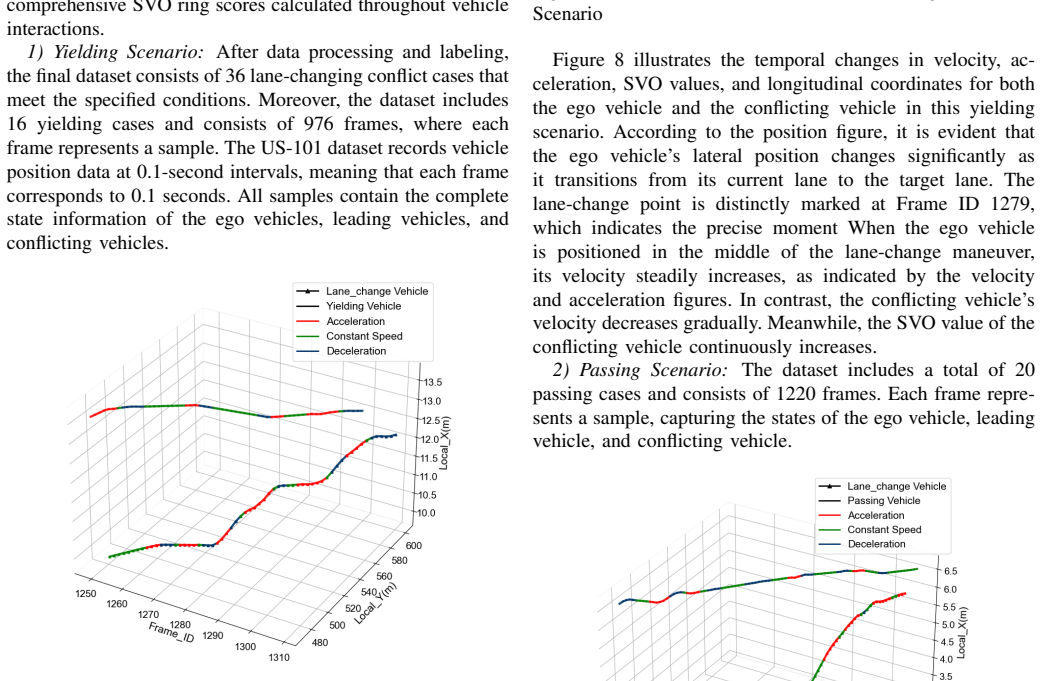
"the naturalistic US-101 dataset needs to be labeled with passing and yielding intentions of the conflicting vehicles based on two criteria. First, labeling depends on whether the conflicting vehicles yield to ego vehicles, which is determined by whether the ego vehicles complete lane changes first or the conflicting vehicles pass first. Secondly, intentions labeling is based on the comprehensive SVO ring scores calculated throughout vehicle interactions."
The BN's evidence vector includes SVO as an input feature: Eq. (11) factors P(E,I) with P(svo=svo1|I), and Section IV-B-2 lists SVO among the continuous variables derived from AV/TV dynamics. Section V-C then assigns the training target I using 'comprehensive SVO ring scores' as one of the two labeling criteria. Because the same SVO-derived signal is both a predictor and part of the label definition, the learned P(SVO|I) and posterior P(I|E) are partly constructed: any classifier using SVO will appear to find a strong SVO-yielding relationship even if SVO carries no independent social information. The resulting 'yielding probability' is in part a renaming of the kinematic ratio used to create the labels.
-
other
[Section IV-A, Eq. (2)]
"φi(t) = arctan(∆Uj(t)/∆Ui(t)) (2) ... ∆Ui(t) and ∆Uj(t) represent the changes in longitudinal position of the TV and its neighboring vehicles between two consecutive time points, respectively."
The variable called Social Value Orientation is defined as a deterministic arctan function of longitudinal displacement changes. Since this same variable is both an evidence node in the BN (Eq. 11) and a criterion for assigning intention labels (Section V-C), the 'social preference' explanation of yielding behavior is a relabeling of relative kinematics. The posterior P(I|E) is therefore a classifier over a nonlinear projection of the same positions and velocities that determine who passes first, not an independently measured social trait.
full rationale
The main advertised contribution is a social intention estimator whose output is added to the DQN state, and the paper supports the estimator by showing that SVO distributions differ between yielding and passing cases (Figure 11). That evidence is weakened by the labeling rule: Section V-C explicitly uses 'comprehensive SVO ring scores' to label intentions, while Section IV-B-3 uses SVO as evidence in the Bayesian network. Thus the correlation between SVO and intention is at least partly a definitional artifact rather than an independent empirical discovery. The simulation improvements in Table II are not by themselves circular: DQN-YI is compared against DRL baselines with identical hyperparameters, and the added BN posterior could in principle improve performance by supplying any informative kinematic summary. However, the paper's central interpretation of that improvement as evidence of 'social awareness' depends on the contaminated label construction. The kinematic reduction of SVO (Eq. 2) compounds the issue: the 'social preference' angle is a deterministic function of longitudinal displacement changes, so the BN's inferred intention is a nonlinear projection of relative motion relabeled through SVO-based targets. I do not find self-citation chains or uniqueness arguments; the circularity is concentrated in the self-definitional labeling loop. Score 6 reflects partial circularity: one key 'prediction' (the inferred yielding probability and its SVO correlation) reduces by construction, while the DQN-YI performance comparison retains independent empirical content.
Assumptions & free parameters
free parameters (6)
- Bayesian Network interval count k =
not reported
- PPF truncation percentiles p1 and p2 =
not reported
- Gaussian likelihood parameters for each feature and intention =
not reported
- Prior P(I) =
implied by label frequencies, 16 of 36 yielding
- Reward weights and velocity normalization bounds =
all omega = 1, vmin = 20 m/s, vmax = 30 m/s
- DQN hyperparameters =
gamma=0.9, replay=2000, batch=32, lr=0.001, epsilon=0.1, target update=1000
assumptions (6)
- domain assumption SVO utility model U = cos(phi) U_ego + sin(phi) U_other (Eq. 1) describes driver social preference.
- ad hoc to paper The SVO angle can be restricted to the range [0, 90] degrees.
- ad hoc to paper Each continuous feature is Gaussian given intention (Eq. 5).
- ad hoc to paper Features are conditionally independent given intention (Eq. 11).
- domain assumption Conflict outcome, specifically who completes the maneuver first, reveals the conflicting vehicle's yielding or passing intention.
- ad hoc to paper A BN trained on NGSIM US-101 trajectories transfers to highway-env vehicles with IDM and MOBIL behavior.
Cite this review
Pith. "Pith review of Socially-Aware Autonomous Driving: Inferring Yielding Intentions for Safer Interactions." pith.science (2026). https://pith.science/paper/7RWM5J5C
@misc{pith2026250420004,
  author       = {Pith},
  title        = {Pith review of: Socially-Aware Autonomous Driving: Inferring Yielding Intentions for Safer Interactions},
  year         = {2026},
  howpublished = {\url{https://pith.science/paper/7RWM5J5C}},
  note         = {Machine review of arXiv:2504.20004}
}
read the original abstract
Since the emergence of autonomous driving technology, it has advanced rapidly over the past decade. It is becoming increasingly likely that autonomous vehicles (AVs) would soon coexist with human-driven vehicles (HVs) on the roads. Currently, safety and reliable decision-making remain significant challenges, particularly when AVs are navigating lane changes and interacting with surrounding HVs. Therefore, precise estimation of the intentions of surrounding HVs can assist AVs in making more reliable and safe lane change decision-making. This involves not only understanding their current behaviors but also predicting their future motions without any direct communication. However, distinguishing between the passing and yielding intentions of surrounding HVs still remains ambiguous. To address the challenge, we propose a social intention estimation algorithm rooted in Directed Acyclic Graph (DAG), coupled with a decision-making framework employing Deep Reinforcement Learning (DRL) algorithms. To evaluate the method's performance, the proposed framework can be tested and applied in a lane-changing scenario within a simulated environment. Furthermore, the experiment results demonstrate how our approach enhances the ability of AVs to navigate lane changes safely and efficiently on roads.
Figures


Figures from the paper (10 more)




Forward citations
Cited by 1 Pith paper
-
An Intention-driven Lane Change Framework Considering Heterogeneous Dynamic Cooperation in Mixed-traffic Environment
An intention-driven lane change framework with a learned cooperation score improves lane change classification accuracy on NGSIM over rule-based and learning baselines.
Reference graph
Works this paper leans on
-
[1]
How do autonomous vehicles decide? Sensors (Basel, Switzerland) , 23, 2022
Sumbal Malik, Manzoor Ahmed Khan, Hesham El-Sayed, Muham- mad Jalal Khan, and Obaid Ullah. How do autonomous vehicles decide? Sensors (Basel, Switzerland) , 23, 2022
work page 2022
-
[2]
Constantin Hubmann, Marvin Becker, Daniel Althoff, David Lenz, and Christoph Stiller. Decision making for autonomous driving considering interaction and uncertain prediction of surrounding vehicles. 2017 IEEE Intelligent Vehicles Symposium (IV) , pages 1671–1678, 2017
work page 2017
-
[3]
Mingyang Cui, Jinxin Liu, Hao Zheng, Qing Xu, Jiangqiang Wang, Lu Geng, and Takaaki Sekiguchi. Passing-yielding intention estima- tion during lane change conflict: A semantic-based bayesian inference method. IET Intelligent Transport Systems , 2023
work page 2023
-
[4]
Driver lane change intention recognition in the connected environment
Yingshi Guo, Hongjia Zhang, Chang Wang, Qinyu Sun, and Wanmin Li. Driver lane change intention recognition in the connected environment. Physica A: Statistical Mechanics and its Applications , 2021
work page 2021
-
[5]
Driver intention recog- nition based on continuous hidden markov model
Lisheng Jin, Haijing Hou, and Yuying Jiang. Driver intention recog- nition based on continuous hidden markov model. Proceedings 2011 International Conference on Transportation, Mechanical, and Electrical Engineering (TMEE), pages 739–742, 2011
work page 2011
-
[6]
Lane changing intention recognition based on speech recognition models
Keqiang Li, Xiao Wang, Youchun Xu, and Jianqiang Wang. Lane changing intention recognition based on speech recognition models. Transportation Research Part C-emerging Technologies , 69:497–514, 2016
work page 2016
-
[7]
Social value orientation modulates the processing of outcome evaluation involving others
Xinmu Hu, Zhenhua Xu, and Xiaoqin Mai. Social value orientation modulates the processing of outcome evaluation involving others. Social Cognitive and Affective Neuroscience , 12:1730 – 1739, 2017
work page 2017
-
[8]
Kochenderfer, David Isele, and Kikuo Fujimura
Xiaobai Ma, Jiachen Li, Mykel J. Kochenderfer, David Isele, and Kikuo Fujimura. Reinforcement learning for autonomous driving with latent state inference and spatial-temporal relationships. 2021 IEEE International Conference on Robotics and Automation (ICRA) , pages 6064–6071, 2020
work page 2021
Show all 40 references
-
[9]
Deep reinforcement learning on autonomous driving policy with aux- iliary critic network
Yuanqing Wu, Siqin Liao, Xiang Liu, Zhihang Li, and Renquan Lu. Deep reinforcement learning on autonomous driving policy with aux- iliary critic network. IEEE Transactions on Neural Networks and Learning Systems, 34:3680–3690, 2021
2021
-
[10]
Decision-making tech- nology for autonomous vehicles: Learning-based methods, applications and future outlook
Qi Liu, Xueyuan Li, Shihua Yuan, and Zirui Li. Decision-making tech- nology for autonomous vehicles: Learning-based methods, applications and future outlook. 2021 IEEE International Intelligent Transportation Systems Conference (ITSC) , pages 30–37, 2021
2021
-
[11]
Automated speed and lane change decision making using deep reinforcement learning
Carl-Johan Hoel, Krister Wolff, and Leo Laine. Automated speed and lane change decision making using deep reinforcement learning. 2018 21st International Conference on Intelligent Transportation Systems (ITSC), pages 2148–2155, 2018
2018
-
[12]
Lane change decision-making through deep reinforcement learning
Mukesh Ghimire, Malobika Roy Choudhury, and Guna Sekhar Sai Har- sha Lagudu. Lane change decision-making through deep reinforcement learning. ArXiv, abs/2112.14705, 2021
2021 arXiv
-
[13]
Lane change decision-making through deep reinforcement learning with driver’s in- puts
Yanbin Wu, Zhishuai Yin, Jia Yu, and Ming Zhang. Lane change decision-making through deep reinforcement learning with driver’s in- puts. 2022 IEEE 7th International Conference on Intelligent Transporta- tion Engineering (ICITE) , pages 314–319, 2022
2022
-
[14]
Intent-aware autonomous driving: A case study on highway merging scenarios
Nishtha Mahajan and Qi Zhang. Intent-aware autonomous driving: A case study on highway merging scenarios. ArXiv, abs/2309.13206, 2023
2023 arXiv
-
[15]
Albert Demba and Dietmar P. F. Möller. Vehicle-to-vehicle commu- nication technology. 2018 IEEE International Conference on Elec- tro/Information Technology (EIT), pages 0459–0464, 2018
2018
-
[16]
Butakov and Petros A
Vadim A. Butakov and Petros A. Ioannou. Personalized driver assistance for signalized intersections using v2i communication. IEEE Transactions on Intelligent Transportation Systems , 17:1910–1919, 2016
1910
-
[17]
Dolan, and Bakhtiar Litkouhi
Chiyu Dong, John M. Dolan, and Bakhtiar Litkouhi. Intention estimation for ramp merging control in autonomous driving. 2017 IEEE Intelligent Vehicles Symposium (IV), pages 1584–1589, 2017
2017
-
[18]
Dolan, and Bakhtiar Litkouhi
Chiyu Dong, John M. Dolan, and Bakhtiar Litkouhi. Interactive ramp merging planning in autonomous driving: Multi-merging leading pgm (mml-pgm). 2017 IEEE 20th International Conference on Intelligent Transportation Systems (ITSC) , pages 1–6, 2017
2017
-
[19]
Dolan, and Bakhtiar Litkouhi
Chiyu Dong, John M. Dolan, and Bakhtiar Litkouhi. Smooth behavioral estimation for ramp merging control in autonomous driving. 2018 IEEE Intelligent Vehicles Symposium (IV) , pages 1692–1697, 2018
2018
-
[20]
Intention-aware autonomous driving decision-making in an uncontrolled intersection
Weilong Song, Guang ming Xiong, and Huiyan Chen. Intention-aware autonomous driving decision-making in an uncontrolled intersection. Mathematical Problems in Engineering , 2016:1–15, 2016
2016
-
[21]
Novel decision-making strategy for connected and autonomous vehicles in highway on-ramp merging
Zine el abidine Kherroubi, Samir Aknine, and Rebiha Bacha. Novel decision-making strategy for connected and autonomous vehicles in highway on-ramp merging. IEEE Transactions on Intelligent Trans- portation Systems, 23:12490–12502, 2022
2022
-
[22]
Dolan, and Bakhtiar Litkouhi
Junqing Wei, John M. Dolan, and Bakhtiar Litkouhi. Autonomous vehicle social behavior for highway entrance ramp management. 2013 IEEE Intelligent Vehicles Symposium (IV) , pages 201–207, 2013
2013
-
[23]
Social behavior for autonomous vehicles
Wilko Schwarting, Alyssa Pierson, Javier Alonso-Mora, Sertac Kara- man, and Daniela Rus. Social behavior for autonomous vehicles. Proceedings of the National Academy of Sciences of the United States of America, 116:24972 – 24978, 2019
2019
-
[24]
R. O. Murphy, Kurt Alexander Ackermann, and Michel J. J. Handgraaf. Measuring social value orientation. SSRN Electronic Journal , 2011
2011
-
[25]
Otten, W
VU Research, Portal, van Lange, P.A.M. Otten, W. de Bruin, E.N.M. Joireman, Paul A.M. Van Lange, Willemien Otten, Ellen N. M. De Bruin, Jeff Joireman, Hal Kelley, C. Rusbult, Ben R. Slugoski, and A M Van Lange. Development of prosocial, individualistic, and competitive orienta...
1997
-
[26]
Wim B. G. Liebrand and Charles G. McClintock. The ring measure of social values: A computerized procedure for assessing individual differ- ences in information processing and social value orientation. European Journal of Personality, 2:217 – 230, 1988
1988
-
[27]
Comprehensive safety evaluation of highly automated vehicles at the roundabout scenario
Xinpeng Wang, Songan Zhang, and Huei Peng. Comprehensive safety evaluation of highly automated vehicles at the roundabout scenario. IEEE Transactions on Intelligent Transportation Systems , 23:20873– 20888, 2021
2021
-
[28]
Malikopoulos
Viet-Anh Le and Andreas A. Malikopoulos. A cooperative optimal control framework for connected and automated vehicles in mixed traffic using social value orientation. 2022 IEEE 61st Conference on Decision and Control (CDC) , pages 6272–6277, 2022
2022
-
[29]
Luca Crosato, Hubert P. H. Shum, Edmond S. L. Ho, and Chongfeng Wei. Interaction-aware decision-making for automated vehicles using social value orientation. IEEE Transactions on Intelligent Vehicles , 8:1339–1349, 2022
2022
-
[30]
Human-like decision-making at unsignalized intersection using social value orientation
Yan Tong, Licheng Wen, Pinlong Cai, Daocheng Fu, Song Mao, and Yikang Li. Human-like decision-making at unsignalized intersection using social value orientation. ArXiv, abs/2306.17456, 2023
2023 arXiv
-
[31]
McKee, Ian M
Kevin R. McKee, Ian M. Gemp, Brian McWilliams, Edgar A. Duéñez- Guzmán, Edward Hughes, and Joel Z. Leibo. Social diversity and social preferences in mixed-motive reinforcement learning. In Adaptive Agents and Multi-Agent Systems , 2020
2020
-
[32]
Colyar, John A
Alexiadis, James D. Colyar, John A. Halkias, Rob C Hranac, and Gene McHale. The next generation simulation program. Ite Journal-institute of Transportation Engineers, 74, 2004
2004
-
[33]
To- ward driving scene understanding: A dataset for learning driver behavior and causal reasoning
Vasili Ramanishka, Yi-Ting Chen, Teruhisa Misu, and Kate Saenko. To- ward driving scene understanding: A dataset for learning driver behavior and causal reasoning. 2018 IEEE/CVF Conference on Computer Vision and Pattern Recognition, pages 7699–7707, 2018
2018
-
[34]
Argoverse: 3d tracking and forecasting with rich maps
Ming-Fang Chang, John Lambert, Patsorn Sangkloy, Jagjeet Singh, Sławomir B ˛ ak, Andrew Hartnett, De Wang, Peter Carr, Simon Lucey, Deva Ramanan, and James Hays. Argoverse: 3d tracking and forecasting with rich maps. 2019 IEEE/CVF Conference on Computer Vision and Pattern Reco...
2019
-
[35]
The highd dataset: A drone dataset of naturalistic vehicle trajectories on german highways for validation of highly automated driving sys- tems
Robert Krajewski, Julian Bock, Laurent Kloeker, and Lutz Eckstein. The highd dataset: A drone dataset of naturalistic vehicle trajectories on german highways for validation of highly automated driving sys- tems. 2018 21st International Conference on Intelligent Transportation ...
2018
-
[36]
Interaction dataset: An international, adversarial and cooperative motion dataset in interactive driving scenarios with semantic maps
Wei Zhan, Liting Sun, Di Wang, Haojie Shi, Aubrey Clausse, Maximil- ian Naumann, Julius Kümmerle, Hendrik Königshof, Christoph Stiller, Arnaud de La Fortelle, and Masayoshi Tomizuka. Interaction dataset: An international, adversarial and cooperative motion dataset in interacti...
1910 arXiv
-
[37]
agrum/pyagrum: a toolbox to build models and algorithms for prob- abilistic graphical models in python
Gaspard Ducamp, Christophe Gonzales, and Pierre-Henri Wuillemin. agrum/pyagrum: a toolbox to build models and algorithms for prob- abilistic graphical models in python. In International Conference on Probabilistic Graphical Models . PMLR, 2020
2020
-
[38]
An environment for autonomous driving decision- making
Edouard Leurent. An environment for autonomous driving decision- making. https://github.com/eleurent/highway-env, 2018
2018
-
[39]
Congested traffic states in empirical observations and microscopic simulations
Martin Treiber, Ansgar Hennecke, and Dirk Helbing. Congested traffic states in empirical observations and microscopic simulations. Physical review. E, Statistical physics, plasmas, fluids, and related interdisci- plinary topics, 62 2 Pt A:1805–24, 2000
2000
-
[40]
Mobil : General lane-changing model for car-following models
Arne Kesting. Mobil : General lane-changing model for car-following models. 2007
2007
Reviewed August 16, 2026 · model on record in the stance chip above.
Discussion (0). Continue with ORCID to comment.