Vine Codes: Low-Overhead Quantum LDPC Codes on a Planar Square Grid
Pith reviewed 2026-06-26 16:49 UTC · model grok-4.3
The pith
Vine codes are planar qLDPC codes that cut data and measure qubits by up to 28% versus surface codes at circuit distance 7 while using only nearest-neighbor gates.
A machine-rendered reading of the paper's core claim, the machinery that carries it, and where it could break.
Core claim
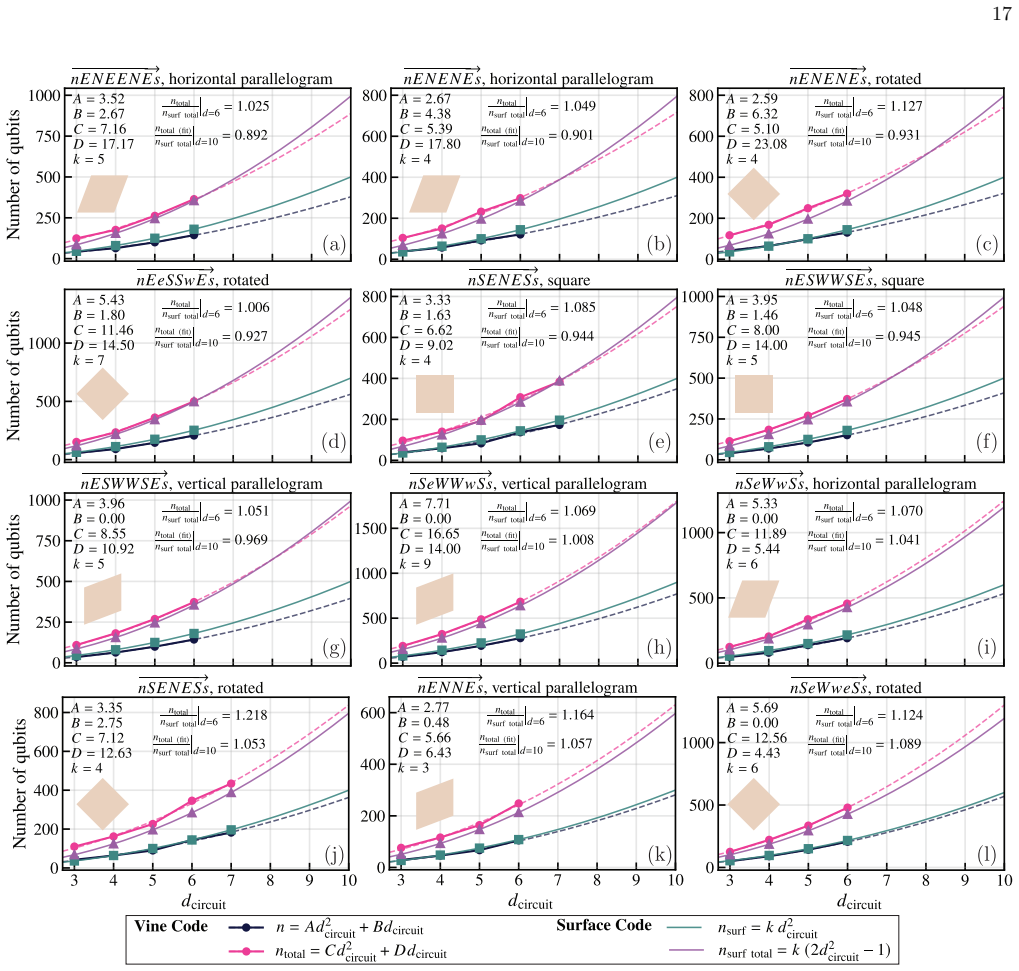
Vine codes are qLDPC codes on a planar square grid with open boundaries constructed using routing qubits and nearest-neighbor iSWAP and CZ gates. The authors identify candidate codes such as [[121,4,6]], [[221,6,7]], and [[234,9,6]] whose circuit distances yield up to a 28% reduction in data and measure qubits relative to the surface code at distance 7. Even after including routing qubits the total qubit count remains lower, for example by roughly 18% at distance 10. Circuit-level simulations show superior performance to the surface code at a noise rate of 10^{-3}. Flip-vine codes are defined to support single-qubit transversal Clifford gates, and generalized open boundaries are constructed
What carries the argument
Vine codes, qLDPC codes on a planar square grid with open boundaries realized through routing qubits and nearest-neighbor two-qubit gates.
If this is right
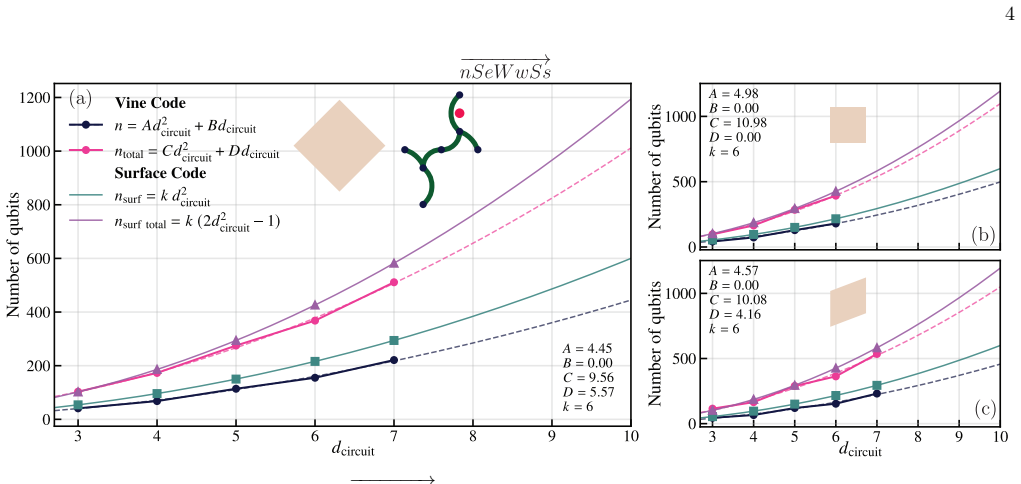
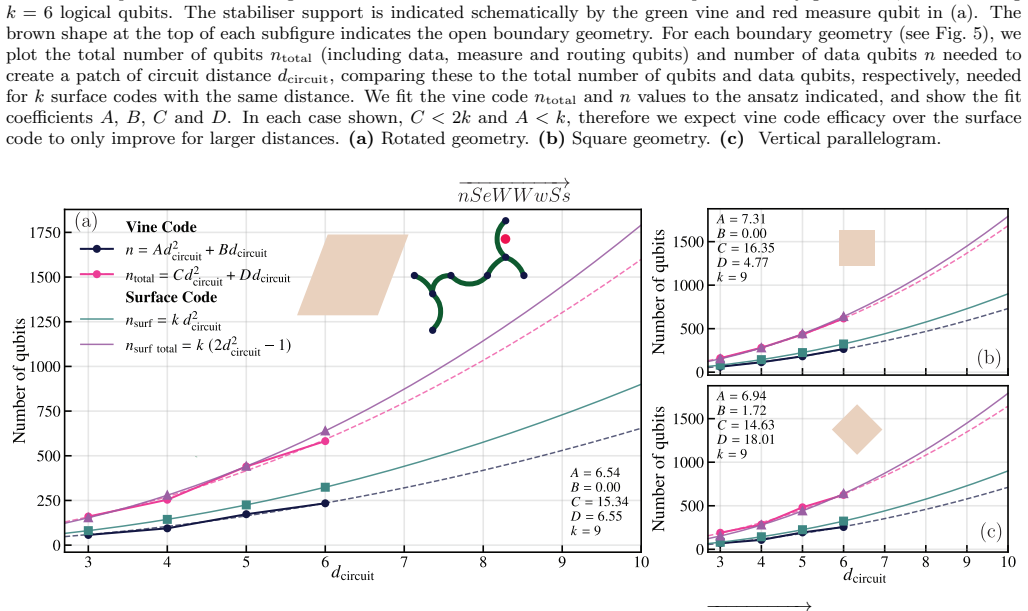
- Data and measure qubits are reduced by up to 28% relative to the surface code at circuit distance 7.
- Total qubit count including routing qubits drops by approximately 18% at circuit distance 10.
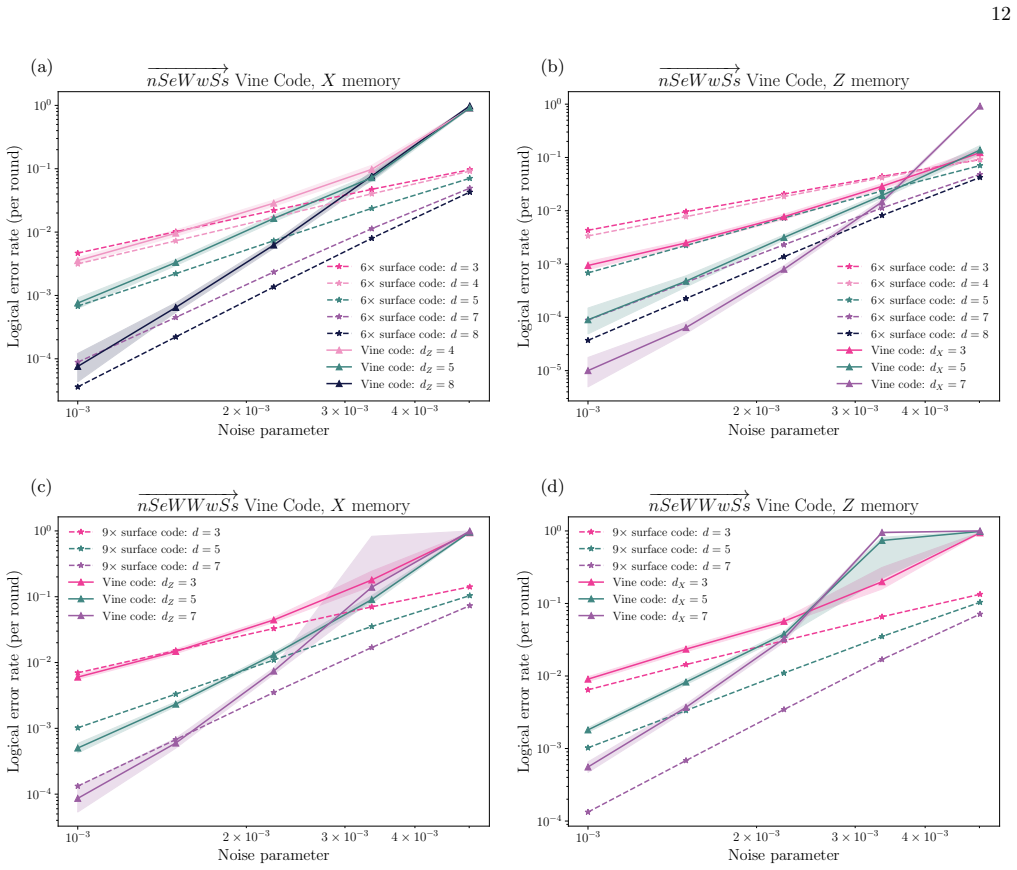
- At a noise rate of 10^{-3}, vine codes achieve lower logical error rates than the surface code in circuit-level simulations while using fewer qubits.
- Flip-vine codes admit single-qubit transversal Clifford gates useful for fault-tolerant logic.
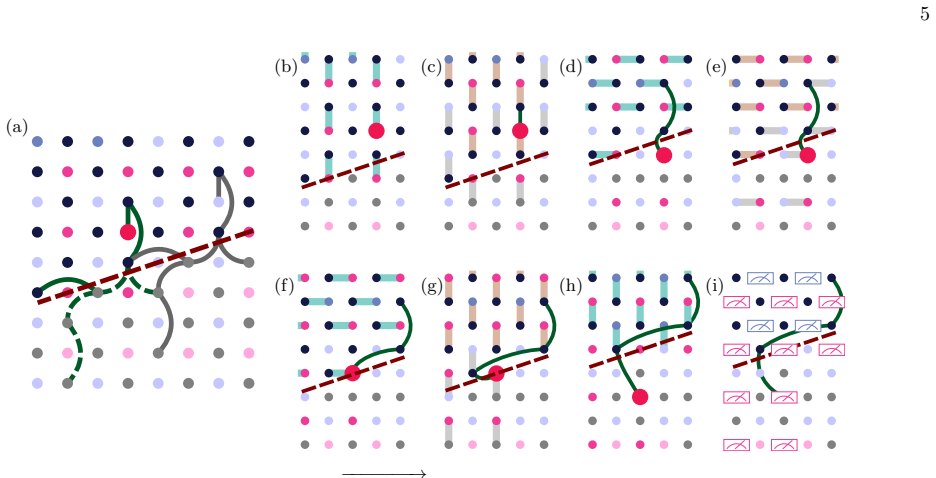
- An exhaustive enumeration of all unique vine codes up to stabilizer weight 9 is supplied, together with constructions for generalized open boundaries.
Where Pith is reading between the lines
- Overhead reductions are stated to increase at higher distances, which would compound resource savings for larger-scale error-corrected computation.
- The planar nearest-neighbor requirement aligns directly with existing superconducting qubit layouts that lack long-range couplers.
- Transversal Clifford support in flip-vine codes may lower the cost of magic-state cultivation within the same grid architecture.
- The supplied catalog up to weight 9 supplies a concrete starting point for further code searches or hardware mapping studies.
Load-bearing premise
The numeric searches have found codes whose circuit distances and logical error rates under the stated noise model are accurately represented by the reported figures.
What would settle it
Circuit-level simulation at distance 7 under the same depolarizing noise model at 10^{-3} that shows a vine code requires more total qubits or produces a higher logical error rate than the surface code.
Figures
read the original abstract
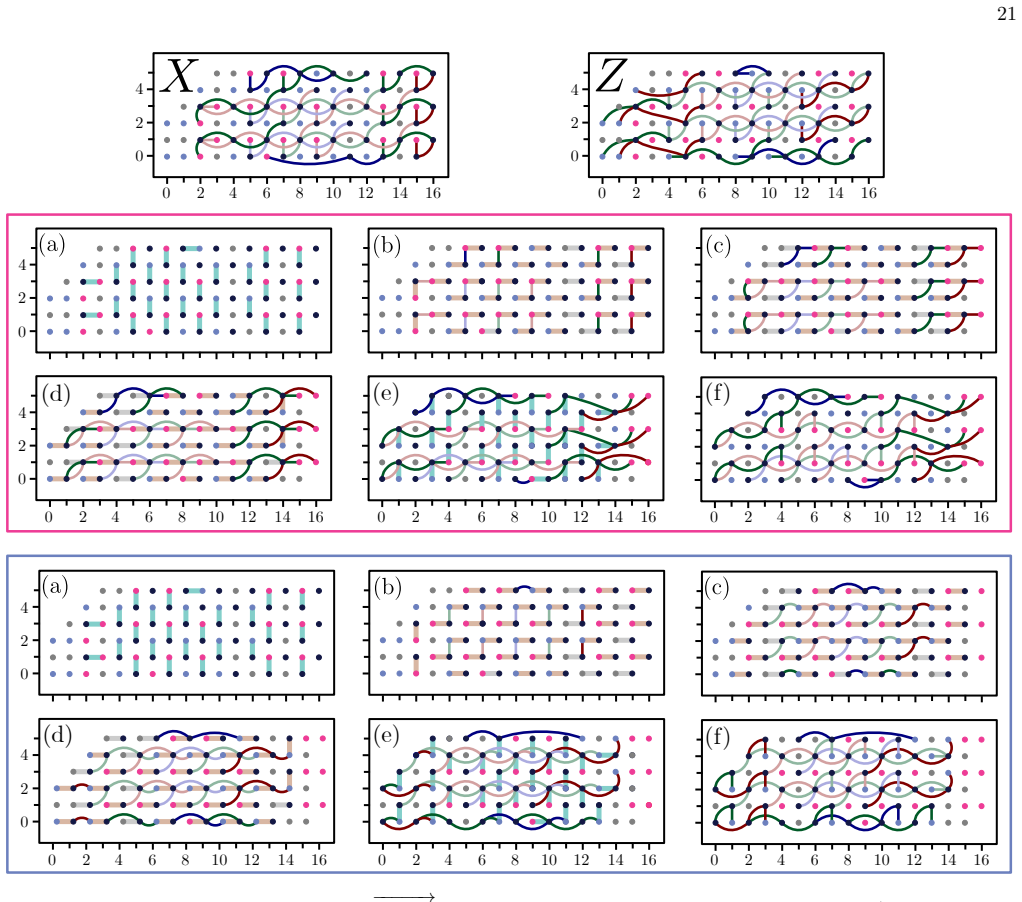
The surface code is a promising route towards large-scale quantum computing, requiring only nearest-neighbour gates amenable to superconducting hardware. However, surface codes incur large qubit overheads. Novel quantum low-density parity check (qLDPC) codes promise to reduce overheads but require long-range connections that are difficult to achieve on superconducting platforms. Here, we introduce "Vine Codes" - qLDPC codes that are implementable on a planar square grid through nearest-neighbour, two-qubit gates native to superconducting platforms (iSWAP and CZ). Our approach generalises "Directional Codes" recently introduced by Geh\'er et. al. (2025) which are constrained to a torus. In contrast, vine codes have open boundary conditions constructed with the aid of routing qubits. We perform extensive numeric searches and find promising candidate vine codes, e.g. [[121,4,6]], [[221,6,7]], and [[234,9,6]] codes. We verify the circuit distances and show that data and measure qubits required can be reduced by up to ~28% relative to the surface code at a circuit distance of 7. Even including routing qubits, vine codes require fewer total qubits than the surface code (e.g. ~18% reduction at circuit distance 10) and benefits are expected to increase at higher distances. We perform circuit-level noise simulations to demonstrate that under a realistic noise model and at a near-term noise rate of $10^{-3}$, vine codes can perform better than the surface code while using fewer qubits. We give an exhaustive list of all unique vine codes up to stabiliser-weight 9. We additionally introduce "Flip-Vine Codes" which possess single-qubit transversal Clifford gates useful for fault-tolerant logic and magic state cultivation. We furthermore construct examples of generalised open boundaries for vine codes that go beyond the familiar X/Z boundaries of the surface and tile codes.
Editorial analysis
A structured set of objections, weighed in public.
Referee Report
Summary. The manuscript introduces Vine Codes, a family of qLDPC codes implementable on a planar square grid using only nearest-neighbor iSWAP and CZ gates. The codes generalize Directional Codes to open boundaries via routing qubits. Numeric searches yield candidates such as [[121,4,6]], [[221,6,7]], and [[234,9,6]]. The authors claim these achieve up to ~28% reduction in data+measure qubits relative to the surface code at circuit distance 7 (and ~18% total-qubit reduction at distance 10), verify the circuit distances, and show via circuit-level simulations that vine codes can outperform the surface code at p=10^{-3}. They also provide an exhaustive list of vine codes up to stabilizer weight 9 and introduce Flip-Vine Codes possessing transversal Clifford gates.
Significance. If the reported qubit reductions and logical-error-rate advantages are reproducible, the work would offer a concrete route to lower-overhead qLDPC codes on superconducting hardware without long-range connections. The explicit planar constructions, the exhaustive enumeration up to weight 9, and the introduction of codes with single-qubit transversal gates are clear strengths that could be built upon.
major comments (2)
- [Abstract / numeric-search description] Abstract and the numeric-search paragraph: the central overhead claims (~28% data+measure reduction at circuit distance 7 for [[221,6,7]] and ~18% total-qubit reduction at distance 10) rest on numeric searches whose selection criteria, distance-verification procedure (decoder-based or exhaustive, including routing and measurement errors), and noise-model parameters are not described. Without these details the reported advantage over the surface code cannot be independently assessed.
- [Circuit-level noise simulations paragraph] Circuit-level noise simulations paragraph: the statement that vine codes 'can perform better than the surface code' at p=10^{-3} is load-bearing for the practical-advantage claim, yet the precise noise model (gate error rates for iSWAP/CZ, measurement error rates, routing-qubit error handling, and decoder) is not specified, preventing verification that the simulated logical error rates are not artifacts of the search or decoder choice.
minor comments (2)
- [Results on qubit overhead] The distinction between 'data and measure qubits' and 'total qubits including routing qubits' should be made explicit with a table or equation that lists both quantities for each reported code and the corresponding surface-code baseline.
- [Introduction] The reference to Gehér et al. (2025) Directional Codes should include a brief contrast of boundary conditions and routing-qubit usage to clarify the generalization.
Simulated Author's Rebuttal
We thank the referee for their thorough review and for recognizing the potential significance of Vine codes for planar qLDPC implementations. We agree that the two major comments identify genuine gaps in the description of our methods. Below we respond point-by-point and commit to a major revision that supplies the requested details.
read point-by-point responses
-
Referee: [Abstract / numeric-search description] Abstract and the numeric-search paragraph: the central overhead claims (~28% data+measure reduction at circuit distance 7 for [[221,6,7]] and ~18% total-qubit reduction at distance 10) rest on numeric searches whose selection criteria, distance-verification procedure (decoder-based or exhaustive, including routing and measurement errors), and noise-model parameters are not described. Without these details the reported advantage over the surface code cannot be independently assessed.
Authors: We agree that the numeric-search methodology and verification protocol were described too briefly. In the revised manuscript we will add a dedicated subsection that specifies: (i) the exact selection criteria and objective function used in the exhaustive and heuristic searches, (ii) the distance-verification procedure (decoder-based Monte-Carlo sampling that explicitly includes routing-qubit errors and measurement errors, cross-checked against exhaustive enumeration for small instances), and (iii) the precise noise-model parameters employed when computing the reported overhead reductions. These additions will enable independent reproduction of the ~28 % and ~18 % figures. revision: yes
-
Referee: [Circuit-level noise simulations paragraph] Circuit-level noise simulations paragraph: the statement that vine codes 'can perform better than the surface code' at p=10^{-3} is load-bearing for the practical-advantage claim, yet the precise noise model (gate error rates for iSWAP/CZ, measurement error rates, routing-qubit error handling, and decoder) is not specified, preventing verification that the simulated logical error rates are not artifacts of the search or decoder choice.
Authors: We concur that the circuit-level simulation details must be stated explicitly. The revised manuscript will include a new paragraph (or expanded methods section) that lists: the per-gate error rates assigned to iSWAP and CZ, the measurement-error probability, the model for routing-qubit errors, the decoder algorithm and its hyperparameters, and the precise depolarizing or circuit-level noise model used at p = 10^{-3}. We will also state how many shots were run and how logical-error rates were extracted, thereby removing any ambiguity about possible artifacts. revision: yes
Circularity Check
No circularity: explicit constructions, external citation, and independent benchmarks
full rationale
Vine codes are defined by generalizing directional codes (cited to Gehér et al. 2025, external authors) to open boundaries with routing qubits. Candidates such as [[121,4,6]] are located by numeric search, circuit distances are verified directly, and qubit-count/performance claims are obtained by explicit comparison to the independently defined surface code plus circuit-level simulations at p=10^{-3}. No equation, parameter fit, or self-citation chain reduces any reported advantage to a quantity defined inside the paper; the surface-code baseline and noise model are external. This is the normal non-circular case for a construction-plus-benchmark paper.
Axiom & Free-Parameter Ledger
axioms (2)
- domain assumption The numeric search procedure locates all or the best vine codes up to the stated stabilizer weight and correctly computes their circuit distances.
- domain assumption The chosen circuit-level noise model at 10^{-3} is representative of near-term superconducting hardware.
invented entities (1)
-
routing qubits
no independent evidence
Forward citations
Cited by 1 Pith paper
-
Bunny Codes: Broadening Superconducting Quantum Error Correction Capability through Advanced Control Engineering
Bunny codes are qLDPC codes found via exhaustive search that achieve ~3x higher code rate than toric codes (periodic) and ~2x over rotated surface codes (open) when using CNOT+CXSWAP on nearest-neighbor connectivity, ...
Reference graph
Works this paper leans on
-
[1]
Commutativity:Stabilisers of opposite type must have even overlapping support
-
[2]
interleaved
Independent measurement:Measure qubits must not be entangled or “interleaved” at the measure- ment step. This requires that, forX- andZ-stabilisers with common data support, the subset of data qubits en- tangled with theX-measure qubit before theZ-measure qubit must be of even size, and vice versa. Let us define the set of data qubitsD= {q1, q2, . . . , q...
-
[3]
In this case, all their codewords are a fixed weight and do not in- crease with the system size
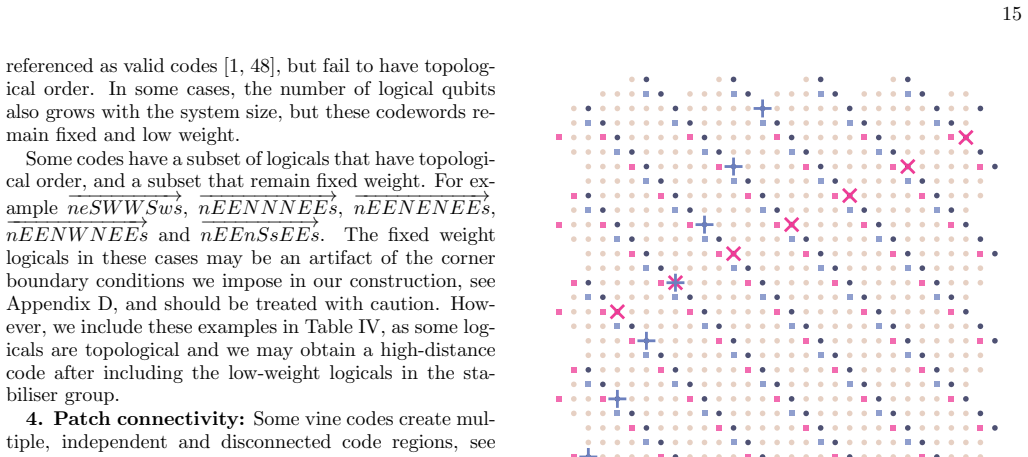
T opological order condition:Some sequences that satisfy conditions1and2above do not pro- duce topologically ordered codes. In this case, all their codewords are a fixed weight and do not in- crease with the system size. For example, − − − − − − − − →N EN N EN,− − − − − − − − − − →N EN N N EN, − − − − − − − − − − − →N EEN N EEN, − − − − − − − − − − − − − ...
-
[4]
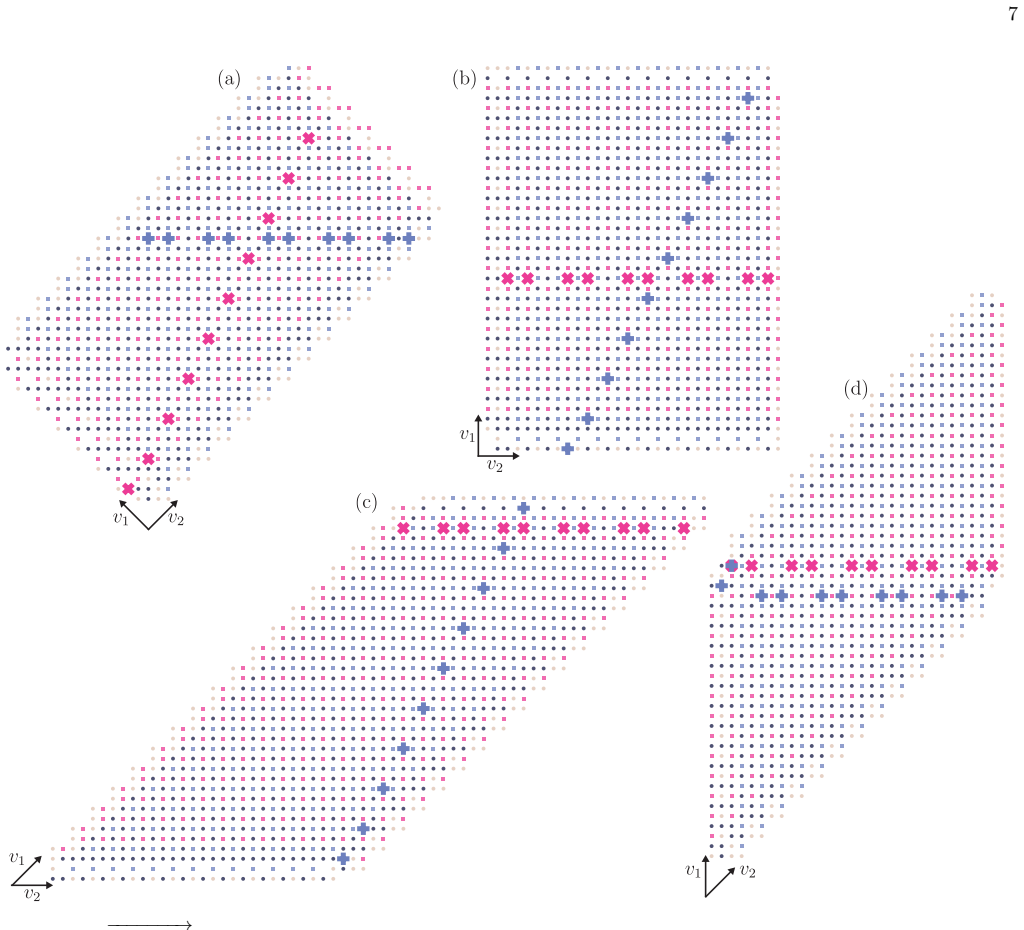
Patch connectivity:Some vine codes create mul- tiple, independent and disconnected code regions, see Fig. 8. In our exhaustive search, we build vine codes us- ing a square patch with boundariesv 1 = 30, andv 2 = 30, which initially contains 450 data qubits. During the boundary formation, where stabilisers are truncated and removed, data qubits that are no...
-
[5]
detectors
Begin and end with CX gate:We remove se- quences that begin or end with a CXSWAP gate, i.e. the instructionN,E,SorW. This is because there exists an equivalent vine sequence that begins and ends with a CX gate that has identical data qubit support and en- tangling order. Consider replacing the CXSWAP that begins a sequence with the CX gate in the opposite...
-
[6]
G. P. Geh´ er, D. Byfield, and A. Ruban, Direc- tional codes: a new family of quantum LDPC codes on hexagonal- and square-grid connectivity hardware (2025), arXiv:2507.19430 [quant-ph]
arXiv 2025
-
[7]
Kitaev, Fault-tolerant quantum computation by anyons, Annals of Physics303, 2–30 (2003)
A. Kitaev, Fault-tolerant quantum computation by anyons, Annals of Physics303, 2–30 (2003)
2003
-
[8]
Dennis, A
E. Dennis, A. Kitaev, A. Landahl, and J. Preskill, Topological quantum memory, Journal of Mathemati- cal Physics43, 4452–4505 (2002)
2002
-
[9]
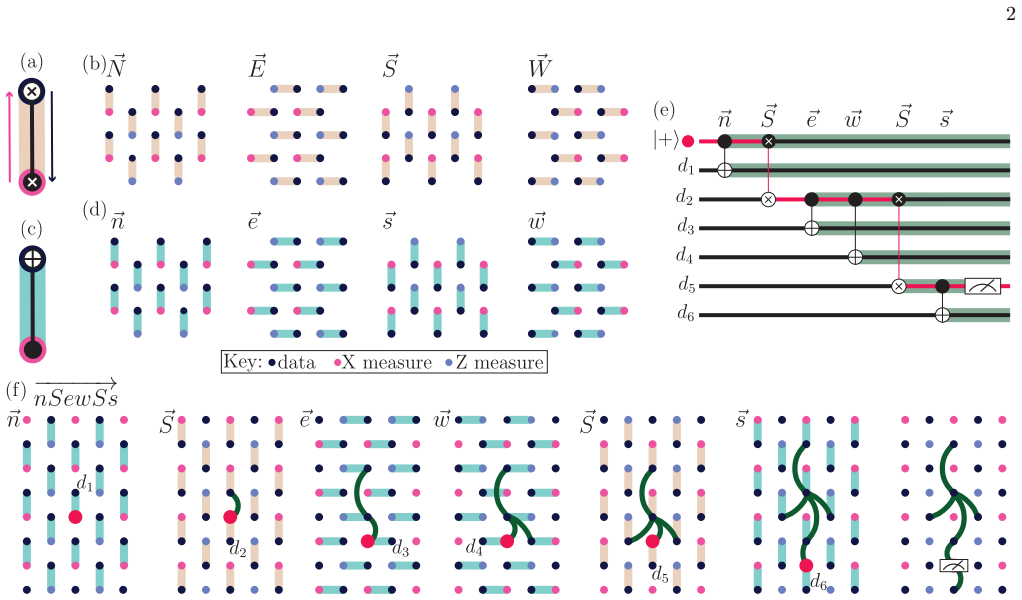
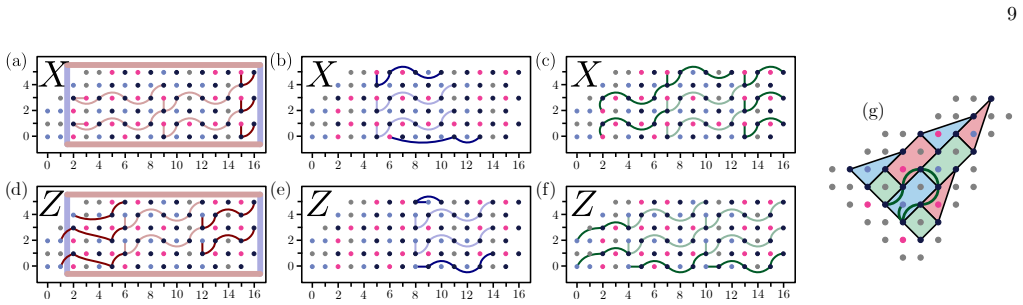
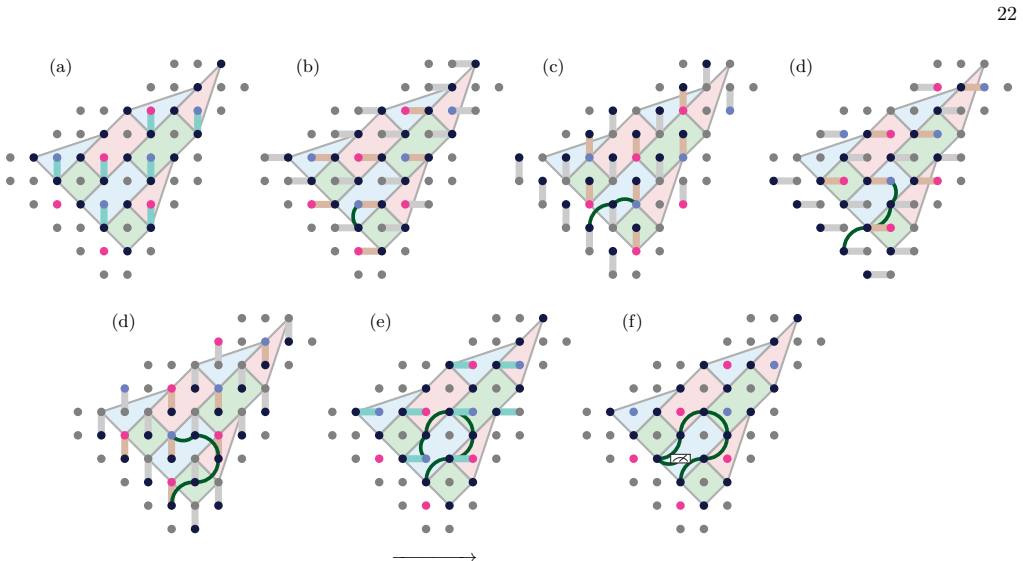
S. B. Bravyi and A. Y. Kitaev, Quantum codes on a 22 (a) (b) (c) (d) (d) (e) (f) FIG. 14. Syndrome measurement circuit for the − − − − − − − →sEN W Swflip-vine code on a triangular patch. OneZstabiliser is traced out through the steps of the circuit (a)-(e). The same measure qubit will measure anXstabiliser with the same support in the next QEC round. The...
Pith/arXiv arXiv 1998
-
[10]
A. G. Fowler, M. Mariantoni, J. M. Martinis, and A. N. Cleland, Surface codes: Towards practical large- scale quantum computation, Physical Review A86, 10.1103/physreva.86.032324 (2012)
-
[11]
E. T. Campbell, B. M. Terhal, and C. Vuillot, Roads towards fault-tolerant universal quantum computation, Nature549, 172–179 (2017)
2017
-
[12]
Higgott and C
O. Higgott and C. Gidney, Sparse Blossom: correcting a million errors per core second with minimum-weight matching, Quantum9, 1600 (2025)
2025
-
[13]
Delfosse and N
N. Delfosse and N. H. Nickerson, Almost-linear time de- coding algorithm for topological codes, Quantum5, 595 (2021)
2021
- [14]
-
[15]
S. Bravyi, M. Suchara, and A. Vargo, Efficient al- gorithms for maximum likelihood decoding in the surface code, Physical Review A90, 10.1103/phys- reva.90.032326 (2014)
-
[16]
Raussendorf and J
R. Raussendorf and J. Harrington, Fault-tolerant quan- tum computation with high threshold in two dimen- sions, Physical Review Letters98, 190504 (2007)
2007
-
[17]
Horsman, A
D. Horsman, A. G. Fowler, S. Devitt, and R. V. Me- ter, Surface code quantum computing by lattice surgery, New Journal of Physics14, 123011 (2012)
2012
-
[18]
Bombin and M
H. Bombin and M. A. Martin-Delgado, Quantum mea- surements and gates by code deformation, Journal of Physics A: Mathematical and Theoretical42, 095302 (2009)
2009
-
[19]
B. J. Brown, K. Laubscher, M. S. Kesselring, and J. R. Wootton, Poking holes and cutting corners to achieve Clifford gates with the surface code, Physical Review X 7, 10.1103/physrevx.7.021029 (2017)
-
[20]
B. J. Brown, A fault-tolerant non-Clifford gate for the surface code in two dimensions, Science Advances6, 10.1126/sciadv.aay4929 (2020)
-
[21]
S. Bravyi and A. Kitaev, Universal quantum computa- tion with ideal clifford gates and noisy ancillas, Physical Review A71, 10.1103/physreva.71.022316 (2005)
-
[22]
Litinski, Magic state distillation: Not as costly as you think, Quantum3, 205 (2019)
D. Litinski, Magic state distillation: Not as costly as you think, Quantum3, 205 (2019)
2019
-
[23]
Litinski, A game of surface codes: Large-scale quan- tum computing with lattice surgery, Quantum3, 128 (2019)
D. Litinski, A game of surface codes: Large-scale quan- tum computing with lattice surgery, Quantum3, 128 (2019)
2019
-
[24]
Quantum criticality under decoherence or weak mea- surement,
C. Chamberland and E. T. Campbell, Universal quan- tum computing with twist-free and temporally encoded lattice surgery, PRX Quantum3, 10.1103/prxquan- tum.3.010331 (2022)
-
[25]
G. P. Geh´ er, O. Crawford, and E. T. Campbell, Tangling schedules eases hardware connectivity requirements for quantum error correction, PRX Quantum5, 010348 (2024)
2024
-
[26]
G. H. Low, W. J. Huggins, D. W. Berry, T. Khattar, A. F. White, N. C. Rubin, and R. Babbush, A denser planar surface code (2026), arXiv:2605.30455 [quant- ph]
Pith/arXiv arXiv 2026
-
[27]
Google Quantum AIet al., Suppressing quantum er- rors by scaling a surface code logical qubit, Nature614, 676–681 (2023)
2023
-
[28]
R. S. Gupta, N. Sundaresan, T. Alexander, C. J. Wood, S. T. Merkel, M. B. Healy, M. Hillenbrand, T. Jochym- O’Connor, J. R. Wootton, T. J. Yoder, A. W. Cross, M. Takita, and B. J. Brown, Encoding a magic state with beyond break-even fidelity, Nature625, 259–263 (2024). 23
2024
-
[29]
Google Quantum AIet al., Quantum error correction below the surface code threshold, Nature638, 920–926 (2024)
2024
-
[30]
Google Quantum AIet al., Demonstrating dynamic sur- face codes (2025), arXiv:2412.14360 [quant-ph]
arXiv 2025
-
[31]
E. Rosenfeldet al., Magic state cultivation on a superconducting quantum processor (2025), arXiv:2512.13908 [quant-ph]
arXiv 2025
-
[32]
Harper, C
R. Harper, C. Lain´ e, E. T. Hockings, C. McLauch- lan, G. M. Nixon, B. J. Brown, and S. D. Bartlett, Characterising the failure mechanisms of error-corrected quantum logic gates, Nature Communications17, 5039 (2026)
2026
-
[33]
S.-H. Lee, X. C. Kolesnikow, J. Zen, E. T. Hockings, C. K. McLauchlan, G. M. Nixon, T. R. Scruby, S. D. Bartlett, R. Harper, and B. J. Brown, Scalable quan- tum error correction tailored for a heavy-hex qubit array (2026), arXiv:2604.14296 [quant-ph]
Pith/arXiv arXiv 2026
-
[34]
Y. Wang, F. Shen, H. Xie, A. Zhang, Y. Gao, C. Zhang, X. Zhu, F. Jin, Y. Zou, N. Wang, Z. Cui, Z. Bao, Z. Zhu, J. Zhong, G. Liu, J.-N. Yang, Y. Han, Y. He, J. Shen, H. Wang, J. Huang, X. Zhang, S. Zhou, H. Dong, J. Deng, Y. Wu, Z. Song, H. Li, Z. Wang, C. Song, Q. Guo, P. Zhang, H. Wang, and Y. Li, A supercon- ducting surface-code processor with lattice-s...
Pith/arXiv arXiv 2026
-
[35]
K. Wang, Z. Lu, C. Zhang, G. Liu, J. Chen, Y. Wang, Y. Wu, S. Xu, X. Zhu, F. Jin, Y. Gao, Z. Tan, Z. Cui, N. Wang, Y. Zou, A. Zhang, T. Li, F. Shen, J. Zhong, Z. Bao, Z. Zhu, Y. Han, Y. He, J. Shen, H. Wang, J.- N. Yang, Z. Song, J. Deng, H. Dong, Z.-Z. Sun, W. Li, Q. Ye, S. Jiang, Y. Ma, P.-X. Shen, P. Zhang, H. Li, Q. Guo, Z. Wang, C. Song, H. Wang, and...
2026
-
[36]
Bravyi, A
S. Bravyi, A. W. Cross, J. M. Gambetta, D. Maslov, P. Rall, and T. J. Yoder, High-threshold and low- overhead fault-tolerant quantum memory, Nature627, 778–782 (2024)
2024
-
[37]
P. Webster, L. Berent, O. Chandra, E. T. Hockings, N. Baspin, F. Thomsen, S. C. Smith, and L. Z. Cohen, The pinnacle architecture: Reducing the cost of break- ing RSA-2048 to 100 000 physical qubits using quantum LDPC codes (2026), arXiv:2602.11457 [quant-ph]
Pith/arXiv arXiv 2048
-
[38]
T. J. Yoder, E. Schoute, P. Rall, E. Pritchett, J. M. Gambetta, A. W. Cross, M. Carroll, and M. E. Beverland, Tour de gross: A modular quan- tum computer based on bivariate bicycle codes (2025), arXiv:2506.03094 [quant-ph]
Pith/arXiv arXiv 2025
-
[39]
S. Xu, K. Liu, P. Rall, Z. He, and Y. Ding, Dis- tilling magic states in the bicycle architecture (2026), arXiv:2602.20546 [quant-ph]
Pith/arXiv arXiv 2026
-
[40]
M. Cain, Q. Xu, R. King, L. R. B. Picard, H. Levine, M. Endres, J. Preskill, H.-Y. Huang, and D. Blu- vstein, Shor’s algorithm is possible with as few as 10,000 reconfigurable atomic qubits (2026), arXiv:2603.28627 [quant-ph]
Pith/arXiv arXiv 2026
-
[41]
S. J. S. Tan, Y. Hong, T.-C. Lin, M. J. Gullans, and M.-H. Hsieh, Single-shot universality in quantum LDPC codes via code-switching (2025), arXiv:2510.08552 [quant-ph]
arXiv 2025
-
[42]
V. Menon, J. P. Bonilla Ataides, R. Mehta, A. Gu, D. B. Tan, and M. D. Lukin, Magic tricycles: Efficient magic-state generation with finite block-length quantum LDPC codes, Physical Review X16, 10.1103/ghhp-cytl (2026)
- [43]
-
[44]
A. J. Malcolm, A. N. Glaudell, P. Fuentes, D. Chan- dra, A. Schotte, C. DeLisle, R. Haenel, A. Ebrahimi, J. Roffe, A. O. Quintavalle, S. J. Beale, N. R. Lee-Hone, and S. Simmons, Computing efficiently in QLDPC codes (2025), arXiv:2502.07150 [quant-ph]
arXiv 2025
-
[45]
T. R. Scruby, T. Hillmann, and J. Roffe, High-threshold, low-overhead and single-shot decodable fault-tolerant quantum memory, PRX Quantum7, 10.1103/67xf-zdjb (2026)
-
[46]
V. Steffan, S. H. Choe, N. P. Breuckmann, F. R. F. Pereira, and J. N. Eberhardt, Tile codes: High-efficiency quantum codes on a lattice with boundary (2025), arXiv:2504.09171 [quant-ph]
arXiv 2025
- [47]
-
[48]
R. K. Radebold, S. D. Bartlett, and A. C. Doherty, Explicit instances of quantum tanner codes (2025), arXiv:2508.05095 [quant-ph]
arXiv 2025
-
[50]
M. A. Tremblay, N. Delfosse, and M. E. Bever- land, Constant-overhead quantum error correction with thin planar connectivity, Physical Review Letters129, 050504 (2022)
2022
-
[51]
Pecorari, S
L. Pecorari, S. Jandura, G. K. Brennen, and G. Pupillo, High-rate quantum LDPC codes for long- range-connected neutral atom registers, Nature Com- munications16, 1111 (2025)
2025
-
[52]
Lin and L
H.-K. Lin and L. P. Pryadko, Quantum two-block group algebra codes, Phys. Rev. A109, 022407 (2024)
2024
-
[53]
Rowshan, Structural analysis of directional qLDPC codes (2026), arXiv:2602.19057 [quant-ph]
M. Rowshan, Structural analysis of directional qLDPC codes (2026), arXiv:2602.19057 [quant-ph]
arXiv 2026
-
[54]
McEwen, D
M. McEwen, D. Bacon, and C. Gidney, Relaxing hard- ware requirements for surface code circuits using time- dynamics, Quantum7, 1172 (2023)
2023
-
[55]
S. A. Caldwellet al., Parametrically activated entan- gling gates using transmon qubits, Phys. Rev. Appl.10, 034050 (2018)
2018
-
[56]
Y. Sung, L. Ding, J. Braum¨ uller, A. Veps¨ al¨ ainen, B. Kannan, M. Kjaergaard, A. Greene, G. O. Samach, C. McNally, D. Kim, A. Melville, B. M. Niedzielski, M. E. Schwartz, J. L. Yoder, T. P. Orlando, S. Gus- tavsson, and W. D. Oliver, Realization of high-fidelity CZ andZZ-free iSWAP gates with a tunable coupler, Phys. Rev. X11, 021058 (2021)
2021
-
[57]
M. Roth, M. Ganzhorn, N. Moll, S. Filipp, G. Salis, and S. Schmidt, Analysis of a parametrically driven exchange-type gate and a two-photon excitation gate between superconducting qubits, Phys. Rev. A96, 062323 (2017)
2017
-
[58]
Kriˇ zan, J
C. Kriˇ zan, J. Bizn´ arov´ a, L. Chen, E. Hogedal, A. Os- man, C. W. Warren, S. Kosen, H.-X. Li, T. Abad, A. Aggarwal, M. Caputo, J. Fern´ andez-Pend´ as, A. Gaikwad, L. Gr¨ onberg, A. Nylander, R. Reham- mar, M. Rommel, O. I. Yuzephovich, A. Frisk Kockum, J. Govenius, G. Tancredi, and J. Bylander, Quantum SWAP gate realized with CZ and iSWAP gates in a ...
2025
-
[59]
J. N. Eberhardt, F. R. F. Pereira, and V. Steffan, Prun- ing qLDPC codes: Towards bivariate bicycle codes with open boundary conditions (2024), arXiv:2412.04181 [quant-ph]
arXiv 2024
-
[60]
A. Kubica and M. E. Beverland, Universal transversal gates with color codes: A simplified approach, Physical Review A91, 10.1103/physreva.91.032330 (2015)
-
[61]
C. Gidney, N. Shutty, and C. Jones, Magic state cultiva- tion: growing T states as cheap as CNOT gates (2024), arXiv:2409.17595 [quant-ph]
Pith/arXiv arXiv 2024
-
[62]
J. Claes, Cultivating T states on the surface code with only two-qubit gates (2025), arXiv:2509.05232 [quant- ph]
arXiv 2025
- [63]
-
[64]
K. Sahay, P.-K. Tsai, K. Chang, Q. Su, T. B. Smith, S. Singh, and S. Puri, Fold-transversal surface code cul- tivation (2026), arXiv:2509.05212 [quant-ph]
arXiv 2026
-
[65]
IBM Quantum,https://quantum.cloud.ibm.com/ computers(2026)
2026
-
[66]
Bombin and M
H. Bombin and M. A. Martin-Delgado, Topological quantum distillation, Phys. Rev. Lett.97, 180501 (2006)
2006
-
[67]
M. S. Kesselring, J. C. Magdalena de la Fuente, F. Thomsen, J. Eisert, S. D. Bartlett, and B. J. Brown, Anyon condensation and the color code, PRX Quantum 5, 10.1103/prxquantum.5.010342 (2024)
-
[68]
M. S. Kesselring, F. Pastawski, J. Eisert, and B. J. Brown, The boundaries and twist defects of the color code and their applications to topological quantum com- putation, Quantum2, 101 (2018)
2018
-
[69]
Z. Liang, K. Liu, H. Song, and Y.-A. Chen, Generalized toric codes on twisted tori for quantum error correction, PRX Quantum6, 10.1103/rmy6-9n89 (2025)
-
[70]
C. Chamberland, G. Zhu, T. J. Yoder, J. B. Hertzberg, and A. W. Cross, Topological and subsystem codes on low-degree graphs with flag qubits, Physical Review X 10, 10.1103/physrevx.10.011022 (2020)
-
[71]
Bombin, G
H. Bombin, G. Duclos-Cianci, and D. Poulin, Universal topological phase of two-dimensional stabilizer codes, New Journal of Physics14, 073048 (2012)
2012
-
[72]
Kapustin and N
A. Kapustin and N. Saulina, Topological boundary con- ditions in Abelian Chern–Simons theory, Nucl. Phys. B 845, 393–435 (2011)
2011
-
[73]
Levin, Protected edge modes without symmetry, Phys
M. Levin, Protected edge modes without symmetry, Phys. Rev. X3, 021009 (2013)
2013
-
[74]
Barkeshli, C.-M
M. Barkeshli, C.-M. Jian, and X.-L. Qi, Classification of topological defects in Abelian topological states, Phys. Rev. B88, 241103 (2013)
2013
-
[75]
Yoshida, Gapped boundaries, group cohomology and fault-tolerant logical gates, Ann
B. Yoshida, Gapped boundaries, group cohomology and fault-tolerant logical gates, Ann. Phys.377, 387–413 (2017)
2017
-
[76]
L. P. Pryadko and W. Zeng, dist-m4ri: distance of a classical or quantum CSS code,https://github.com/ QEC-pages/dist-m4ri(2024)
2024
-
[77]
Vine codes: Low-overhead quan- tum LDPC codes on a planar square grid
G. Nixon, C. K. McLauchlan, and C. Van Rest, Stim circuits and data for “Vine codes: Low-overhead quan- tum LDPC codes on a planar square grid” manuscript, 10.5281/zenodo.20746752 (2026)
- [78]
-
[79]
Roffe, LDPC: Python tools for low density parity check codes,https://pypi.org/project/ldpc/(2022)
J. Roffe, LDPC: Python tools for low density parity check codes,https://pypi.org/project/ldpc/(2022)
2022
-
[80]
F. Battistel, B. Varbanov, and B. Terhal, Hardware- efficient leakage-reduction scheme for quantum error correction with superconducting transmon qubits, PRX Quantum2, 10.1103/prxquantum.2.030314 (2021)
-
[81]
J. P. Bonilla Ataides, D. K. Tuckett, S. D. Bartlett, S. T. Flammia, and B. J. Brown, The xzzx surface code, Na- ture Communications12, 10.1038/s41467-021-22274-1 (2021)
discussion (0)
Sign in with ORCID, Apple, or X to comment. Anyone can read and Pith papers without signing in.