REVIEW 3 major objections 5 minor 27 references
SP3O: Reinforcement Learning from Segment Preferences without Reward Modeling
T0 review · 3 major / 5 minor · reviewed 2026-08-15 · deepseek-v4-flash
Pith's one-line read The paper proves that policy gradients in a stochastic MDP can be recovered, up to a constant, from pairwise preferences between short trajectory segments, and builds SP3O, a reward-model-free and critic-free algorithm on that identity.
desk verdict SP3O is a genuinely new first-order, reward-model-free PbRL method from segment preferences, but the central theorem is proven only at pi_ref = pi_theta and the simulated oracle is too well-informed; both gaps are fixable. read the letter →
The pith
A machine-rendered reading of the paper's core claim, the machinery that carries it, and where it could break.
The reading
What carries the argument
The load-bearing object is the segment MDP $M_1$: a discounted finite-horizon MDP of length $L$ whose per-step reward is the original reward for the first $L-1$ steps and $r'_L(s,a) = Q^{\pi_{\text{ref}}}_M(s,a)$ at the terminal step, with initial distribution the discounted occupancy measure of the reference policy, $d'_0(s) = (1-\gamma^L)\sum_{k\ge 0} \gamma^{kL} \Pr[s_{kL+1}=s \mid \pi_{\text{ref}}]$. Lemmas 2 and 3 establish that under $\pi_{\text{ref}}$ the Q-function and discounted state occupancy match those of the original MDP; Theorem 1 then converts the policy gradient of $J_M$ into a scaled gradient of a value difference $J_{M_1}(\pi_\theta) - J_{M_1}(\pi_1)$. This is what lets segment comparisons, passed through the inverse-logistic estimator $D$ and a clipped importance-weighted PPO-style loss, act as a first-order policy gradient signal in a general stochastic MDP.
What would settle it
Run SP3O in a stochastic MDP with a known true reward, but replace the preference oracle with one that follows the standard partial-return model, where preferences depend only on the reward sum inside the segment and ignore the quality of the final state. If the policy-gradient estimate is biased and learning degrades in an environment where final-state quality matters, such as goal reaching, that would confirm the method's validity depends on the Eq-4 oracle model rather than on segment feedback alone.
Extended reading notes
Core claim
The paper's core discovery is an identity (Theorem 1): when the reference policy used to collect segments is the current policy, the gradient of the expected return in the original infinite-horizon discounted MDP is a scaled gradient of a value difference in a constructed finite-horizon segment MDP, $\nabla_\theta J_M(\pi_\theta) = \frac{1}{1-\gamma^L} \nabla_\theta (J_{M_1}(\pi_\theta) - J_{M_1}(\pi_1))$ for any policy $\pi_1$. The segment MDP grants rewards $r(s,a)$ at its first $L-1$ steps and ends with a terminal reward equal to $Q^{\pi_{\text{ref}}}_M(s_L,a_L)$, the reference policy's Q-function at the segment's final state-action pair; its initial state distribution is the discounted occupancy of the reference policy. The proof shows that the Q-function and discounted occupancy of the reference policy coincide in the two MDPs (Lemmas 2 and 3), so the policy gradient theorem applies. This identity lets SP3O estimate the gradient from segment preference feedback: preferences are assumed to follow a logistic model on segment return plus the noisy terminal Q-value, the inverse logistic function yields an estimate $D$ of the return difference, and a PPO-style clipped, off-policy importance-weighted loss converts $D$ into a policy update. The same machinery yields a segment-length tradeoff: too short a segment inherits the oracle's bounded terminal-Q noise, too long a segment inflates variance for a fixed feedback budget.
Load-bearing premise
The whole construction assumes that when people compare two short segments, they judge them by the rewards collected inside the segment plus how good the final situation is under the current policy, and that this judgment is only mildly noisy; if real preferences work differently, the estimated reward differences and the gradients built from them are biased.
Editorial extensions
If this is right
- Segment-level preference feedback is sufficient for first-order policy optimization in stochastic MDPs; the preference query budget no longer needs to scale with trajectory length.
- The gradient estimator is unbiased when the reference policy is the current policy and the oracle follows the paper's Eq-4 preference model, with PPO-style clipping providing stability in off-policy updates.
- There is a provable tradeoff in segment length: the optimal $L$ balances oracle terminal-Q noise $\gamma^{L-1}\nu$ against variance $\frac{1}{1-\gamma}\sqrt{L\log(2/\delta)/N}$, and experiments show the best $L$ grows with the oracle budget $N$.
- Because $\pi_1$ in Theorem 1 is arbitrary, the update can compare the current policy against a slightly older policy or any similar reference, which the loss function exploits by using $\pi_{\theta_{t-1}}$ as the comparison policy.
- Longer horizons help rather than hurt SP3O, since segments extract more preference signal per evaluation; the control and LLM experiments show this advantage growing with the horizon.
Reading between the lines
- A natural testable extension would replace the terminal Q-term with a learned or estimated value bootstrap when the Q-function of the reference policy is unknown; the theory suggests the estimator remains valid to the extent that bootstrap tracks $Q^{\pi_{\text{ref}}}_M(s_L,a_L)$.
- The segment-MDP identity suggests a bridge to off-policy evaluation: any algorithm that can estimate $J_{M_1}$ differences from segment data inherits a first-order estimate of the original policy gradient, so segment-level reward-model-free critic architectures could be built on the same construction.
- If real human preferences follow the partial-return model rather than the Eq-4 model, SP3O's $D$ is biased; an informative comparison would measure preference models on human data, for instance whether final-state quality dominates choice in goal-reaching tasks as the paper argues.
- The horizon-dependent expertise factor used in the control experiments (0.1 for SP3O versus $10/H$ for baselines) is a practical calibration choice; an ablation varying it could separate algorithmic advantage from oracle-calibration effects.
Signed reviews
Editorial analysis
A structured set of objections, weighed in public.
Referee Report
Summary. The paper proposes SP3O, a reward-model-free and critic-free policy-gradient method for stochastic MDPs that learns from pairwise preferences over short trajectory segments. The authors introduce a segment MDP whose terminal reward is the Q-function of a reference policy, and prove (Theorem 1) that when the reference policy equals the current policy, the policy gradient of the original MDP objective equals a scaled gradient of the segment-MDP value difference. They also provide a Hoeffding-style error bound (Proposition 1) to motivate a segment-length tradeoff. The algorithm is evaluated against Online DPO, P3O, and ZPG in MuJoCo control tasks and an LLM finetuning task, reporting improved performance especially in long-horizon settings.
Significance. If the theoretical claims held for the algorithm as implemented, this would be a meaningful contribution: it would give the first gradient-based, first-order PbRL method for general stochastic MDPs with segment feedback that avoids both reward models and critics. The segment-MDP construction with a terminal Q-reward is an elegant idea that directly addresses the known limitation of partial-return preference models. The paper is clearly written, provides full proofs in the appendix, and its experiments are extensive (including a large-seed ablation study). The main weakness is a substantial gap between the theorem's assumptions and the implemented algorithm, which is partially acknowledged in the appendix but not resolved or bounded.
major comments (3)
- [Section 3 (Algorithm 1), Section 4.1 (Theorem 1), Appendix C.1.2, C.2.1]
- [Section 4.2 (Proposition 1) and Eq. (6)]
- [Section 5.2 and Appendix C.2.1]
minor comments (5)
- [Section 4.2 and Appendix D.5]
- [Lemma 1 (Section 3)]
- [Theorem 1 (Section 4.1)]
- [Section 3 and Lemma 1]
- [Section 5.2]
Circularity Check
No material circularity: Theorem 1 is a genuine policy-gradient identity for an auxiliary segment MDP; implementation mismatches are correctness gaps, not circular reductions.
full rationale
The paper's central theoretical claim, Theorem 1, is a real derivation rather than a restatement of an input. The auxiliary segment MDP M1 is deliberately defined so that its terminal reward equals Q^{pi_ref}_M and its initial distribution equals the discounted occupancy of pi_ref, which makes Lemmas 2 and 3 true by construction. But the theorem does not stop there: it applies the policy gradient theorem to M1 and combines those definitional identities to prove the nontrivial scaling relation between gradients, so the conclusion is not merely the definition of M1. The preference signal D in Eq. 5 is a fixed inverse-logistic transform of binary preference labels, not a fitted parameter, and Proposition 1 is a Hoeffding bound on a sample average; no target performance number is used to fit anything. The only same-author citations (Zhang and Ying 2025a,b) appear as descriptions of alternative zeroth-order methods and are not load-bearing in the proofs. The paper does state limitations that create a theory/practice gap: Appendix C.1.2 replaces discounted state sampling with uniform sampling, and Appendix C.2.1 keeps the base model as reference despite sampling from the current policy, so the condition pi_ref = pi_theta of Theorem 1 is violated in parts of the implementation. Those are correctness and robustness concerns, not circularity, because the paper does not hide the deviation and the theoretical statement remains a well-defined mathematical identity under its stated assumptions. Overall, no step reduces by construction to its own inputs.
Assumptions & free parameters
free parameters (3)
- Segment length L =
5, 20, 50 in main experiments; ablated 5-40
- Effective horizon constant C0 in H = C0/(1-gamma) =
unspecified
- Expertise factor in simulated oracle =
0.1 for SP3O, 10/H for baselines, 0.01 for SP3O in Swimmer
assumptions (6)
- domain assumption Human preference oracle follows the logistic segment model in Eq 4, with terminal Q estimate of the reference policy and bounded noise.
- ad hoc to paper The reference policy equals the current policy, pi_ref = pi_theta, for Theorem 1.
- domain assumption Support inclusion: the supports of pi_theta_t and pi_theta_{t-1} are contained in the support of pi_ref.
- ad hoc to paper Segments are sampled from the discounted occupancy distribution d_0^1 of pi_ref.
- standard math Infinite-horizon discounted MDP with rewards bounded in [0,1] and bounded value functions.
- standard math Hoeffding's inequality applies to independent segment samples in Proposition 1.
Cite this review
Pith. "Pith review of SP3O: Reinforcement Learning from Segment Preferences without Reward Modeling." pith.science (2026). https://pith.science/paper/7TGMMVSJ
@misc{pith2026260802951,
  author       = {Pith},
  title        = {Pith review of: SP3O: Reinforcement Learning from Segment Preferences without Reward Modeling},
  year         = {2026},
  howpublished = {\url{https://pith.science/paper/7TGMMVSJ}},
  note         = {Machine review of arXiv:2608.02951}
}
read the original abstract
Preference-based reinforcement learning (PbRL) for general stochastic MDPs often requires training a reward model. Existing reward-model-free methods are either restricted to bandits or deterministic MDPs, such as DPO or P3O, or use zeroth-order, gradient-free optimization, which in general exhibits a slower convergence rate than gradient-based algorithms. Furthermore, existing reward-model-free preference-based RL algorithms almost exclusively use trajectory-level feedback, which can require significant effort from a human evaluator when trajectories are long. On the other hand, segments are much shorter, so they are easier to compare and evaluate. In this paper, we introduce a novel reward-model-free, critic-free, and gradient-based PbRL algorithm compatible with segment preferences named Segment Pairwise Proximal Policy Optimization (SP3O). SP3O utilizes segment-level preference feedback to construct an accurate policy value difference estimator via off-policy importance sampling, and then uses the estimator to compute the policy gradient via a PPO-type loss function. We provide a theoretical basis for the algorithm and analyze the tradeoff in choosing the segment length. We also evaluate it experimentally against other PbRL/RLHF algorithms in robotic control and LLM finetuning settings to show its improved performance, especially in long-horizon tasks.
Figures


Figures from the paper (5 more)



Reference graph
Works this paper leans on
-
[4]
Yuntao Bai, Andy Jones, Kamal Ndousse, Amanda Askell, Anna Chen, Nova DasSarma, Dawn Drain, Stanislav Fort, Deep Ganguli, Tom Henighan, et al. Training a helpful and harmless assistant with reinforcement learning from human feedback.arXiv preprint arXiv:2204.05862,
-
[8]
Joey Hejna, Rafael Rafailov, Harshit Sikchi, Chelsea Finn, Scott Niekum, W Bradley Knox, and Dorsa Sadigh. Contrastive preference learning: learning from human feedback without rl.arXiv preprint arXiv:2310.13639,
-
[9]
Stephen Casper, Xander Davies, Claudia Shi, Thomas Krendl Gilbert, Jérémy Scheurer, Javier Rando, Rachel Freedman, Tomasz Korbak, David Lindner, Pedro Freire, et al. Open problems and fundamental limitations of reinforcement learning from human feedback.arXiv preprint arXiv:2307.15217,
-
[15]
13 Samuel Gehman, Suchin Gururangan, Maarten Sap, Yejin Choi, and Noah A Smith. Realtoxicityprompts: Evaluating neural toxic degeneration in language models.arXiv preprint arXiv:2009.11462,
arXiv 2009
-
[17]
Reinforcement Learning with Segment Feedback
Yihan Du, Anna Winnicki, Gal Dalal, Shie Mannor, and R Srikant. Reinforcement learning with segment feedback. arXiv preprint arXiv:2502.01876,
-
[18]
Adam: A method for stochastic optimization.arXiv preprint arXiv:1412.6980,
Diederik P Kingma and Jimmy Ba. Adam: A method for stochastic optimization.arXiv preprint arXiv:1412.6980,
-
[20]
Decoupled weight decay regularization.arXiv preprint arXiv:1711.05101,
Ilya Loshchilov and Frank Hutter. Decoupled weight decay regularization.arXiv preprint arXiv:1711.05101,
-
[21]
Approximating kl divergence, 2020.URL http://joschu
John Schulman. Approximating kl divergence, 2020.URL http://joschu. net/blog/kl-approx. html, 14,
work page 2020
Show all 27 references
-
[22]
15 A.2 Comparison of Preference Models
14 Appendix Table of Contents A Related Work 15 A.1 Preference-Based RL. . . . . . . . . . . . . . . . . . . . . . . . . . . . . . . . . . . . . . . . . 15 A.2 Comparison of Preference Models. . . . . . . . . . . . . . . . . . . . . . . . . . . . . . . . . . 15 A.3 Use of Traj...
2011
-
[23]
This makes them inapplicable to many modern RL problems
are based on restrictive assumptions, including discrete state/action spaces, a fully parametric policy, or a known transition kernel. This makes them inapplicable to many modern RL problems. A.2 Comparison of Preference Models. For two segmentsσ1 andσ2 with lengthL, most exis...
2017
-
[24]
Specifically, even if the partial returns of two segments are the same, 15 humans could still prefer one trajectory segment based on the value of the last state and action
as not accurately representing how real human preferences are generated. Specifically, even if the partial returns of two segments are the same, 15 humans could still prefer one trajectory segment based on the value of the last state and action. For example, in goal-reaching t...
2022
-
[26]
During training, policies were Gaussian with a parameter controlling the log standard deviation for each dimension in the action space
optimizer was used for all policy networks. During training, policies were Gaussian with a parameter controlling the log standard deviation for each dimension in the action space. However, during the evaluation, all policies were based on their deterministic version without th...
2022
-
[27]
The global gradient norm is clipped to1.0
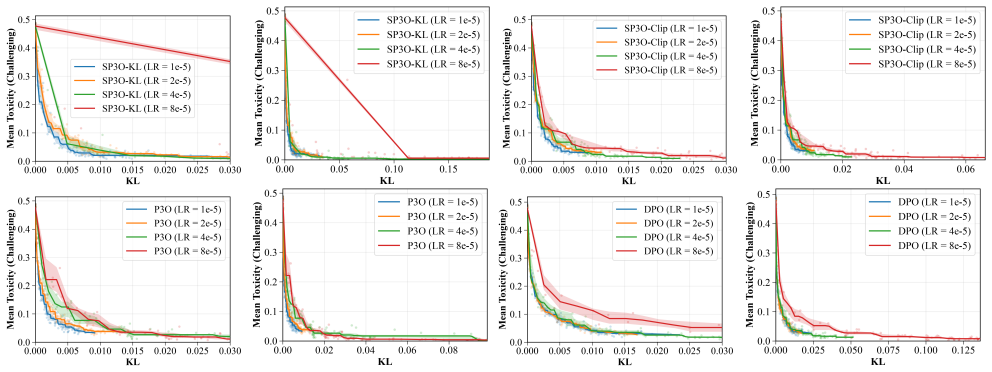
optimizer was used for all algorithms withβ1“0.9 ,β2“0.999 , andϵ“10 ´8. The global gradient norm is clipped to1.0. Shown in Figure 7 are the toxicity versus KL curves of each algorithm with different learning rates. For the regularization parameters in these experiments we us...
2020
-
[1000]
We observe that in Ant-v5 usingπθt´1 as the second policy out performs setting the second policy toπθref
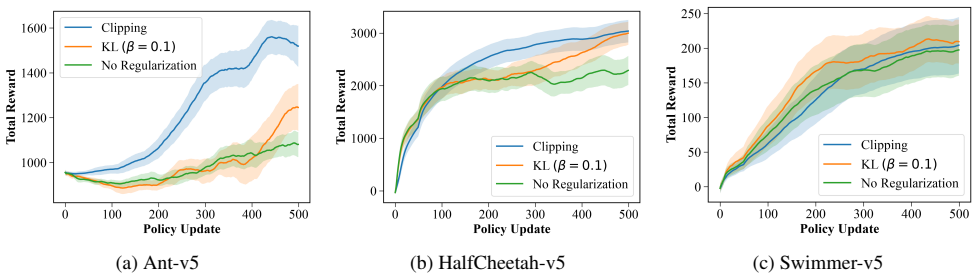
The curves are smoothing with a sliding window of 50 updates. We observe that in Ant-v5 usingπθt´1 as the second policy out performs setting the second policy toπθref . In the other environments, the two variants perform comparably. (a) Ant-v5 (b) HalfCheetah-v5 (c) Swimmer-v5...
2019
-
[1952]
12 Qining Zhang and Lei Ying
ISSN 00063444, 14643510. 12 Qining Zhang and Lei Ying. Zeroth-order policy gradient for reinforcement learning from human feedback without reward inference. InThe Thirteenth International Conference on Learning Representations, 2025a. W Bradley Knox, Stephane Hatgis-Kessell, S...
-
[2012]
Step-dpo: Step-wise preference optimization for long-chain reasoning of llms.arXiv preprint arXiv:2406.18629,
Xin Lai, Zhuotao Tian, Yukang Chen, Senqiao Yang, Xiangru Peng, and Jiaya Jia. Step-dpo: Step-wise preference optimization for long-chain reasoning of llms.arXiv preprint arXiv:2406.18629,
-
[2013]
Proximal policy optimization algorithms.arXiv preprint arXiv:1707.06347,
John Schulman, Filip Wolski, Prafulla Dhariwal, Alec Radford, and Oleg Klimov. Proximal policy optimization algorithms.arXiv preprint arXiv:1707.06347,
-
[2014]
Making reinforcement learning work on swimmer.arXiv preprint arXiv:2208.07587,
Maël Franceschetti, Coline Lacoux, Ryan Ohouens, Antonin Raffin, and Olivier Sigaud. Making reinforcement learning work on swimmer.arXiv preprint arXiv:2208.07587,
-
[2017]
Pebble: Feedback-efficient interactive reinforcement learning via relabeling experience and unsupervised pre-training.arXiv preprint arXiv:2106.05091,
Kimin Lee, Laura Smith, and Pieter Abbeel. Pebble: Feedback-efficient interactive reinforcement learning via relabeling experience and unsupervised pre-training.arXiv preprint arXiv:2106.05091,
-
[2018]
Aligning text-to-image models using human feedback.arXiv preprint arXiv:2302.12192, 2023b
Kimin Lee, Hao Liu, Moonkyung Ryu, Olivia Watkins, Yuqing Du, Craig Boutilier, Pieter Abbeel, Mohammad Ghavamzadeh, and Shixiang Shane Gu. Aligning text-to-image models using human feedback.arXiv preprint arXiv:2302.12192, 2023b. Ralph Allan Bradley and Milton E. Terry. Rank a...
-
[2019]
Playing atari with deep reinforcement learning.arXiv preprint arXiv:1312.5602,
V olodymyr Mnih, Koray Kavukcuoglu, David Silver, Alex Graves, Ioannis Antonoglou, Daan Wierstra, and Martin Riedmiller. Playing atari with deep reinforcement learning.arXiv preprint arXiv:1312.5602,
-
[2020]
Preference transformer: Modeling human preferences using transformers for rl.arXiv preprint arXiv:2303.00957,
Changyeon Kim, Jongjin Park, Jinwoo Shin, Honglak Lee, Pieter Abbeel, and Kimin Lee. Preference transformer: Modeling human preferences using transformers for rl.arXiv preprint arXiv:2303.00957,
-
[2021]
Gymnasium: A standard interface for reinforcement learning environments.arXiv preprint arXiv:2407.17032,
Mark Towers, Ariel Kwiatkowski, Jordan Terry, John U Balis, Gianluca De Cola, Tristan Deleu, Manuel Goulão, Andreas Kallinteris, Markus Krimmel, Arjun KG, et al. Gymnasium: A standard interface for reinforcement learning environments.arXiv preprint arXiv:2407.17032,
-
[2022]
Rlaif vs
Harrison Lee, Samrat Phatale, Hassan Mansoor, Thomas Mesnard, Johan Ferret, Kellie Lu, Colton Bishop, Ethan Hall, Victor Carbune, Abhinav Rastogi, et al. Rlaif vs. rlhf: Scaling reinforcement learning from human feedback with ai feedback.arXiv preprint arXiv:2309.00267, 2023a....
-
[2023]
Deepseekmath: Pushing the limits of mathematical reasoning in open language models
Zhihong Shao, Peiyi Wang, Qihao Zhu, Runxin Xu, Junxiao Song, Xiao Bi, Haowei Zhang, Mingchuan Zhang, YK Li, Yang Wu, et al. Deepseekmath: Pushing the limits of mathematical reasoning in open language models. arXiv preprint arXiv:2402.03300,
-
[2024]
Provable reinforcement learning from human feedback with an unknown link function
Qining Zhang and Lei Ying. Provable reinforcement learning from human feedback with an unknown link function. arXiv preprint arXiv:2506.03066, 2025b. Róbert Busa-Fekete, Balázs Szörényi, Paul Weng, Weiwei Cheng, and Eyke Hüllermeier. Preference-based reinforcement learning: ev...
-
[2026]
Shangmin Guo, Biao Zhang, Tianlin Liu, Tianqi Liu, Misha Khalman, Felipe Llinares, Alexandre Rame, Thomas Mesnard, Yao Zhao, Bilal Piot, et al
URLhttps://openreview.net/forum?id=9osvTOYbT4. Shangmin Guo, Biao Zhang, Tianlin Liu, Tianqi Liu, Misha Khalman, Felipe Llinares, Alexandre Rame, Thomas Mesnard, Yao Zhao, Bilal Piot, et al. Direct language model alignment from online ai feedback.arXiv preprint arXiv:2402.04792,
Reviewed August 15, 2026 · model on record in the stance chip above.
Discussion (0). Continue with ORCID to comment.