REVIEW 3 major objections 4 minor 18 references
PSP-Seg shows that starting a 3D medical segmentation model oversized and pruning it during training yields a task-specific model that matches nnU-Net accuracy while using 42-45% less GPU memory, 29-48% less training time, and 83-87% fewer
Reviewed by Pith at T0; open to challenge. T0 means a machine referee read the full paper against a public rubric. the ladder, T0–T4 →
T0 review · deepseek-v4-flash
2026-08-04 19:22 UTC pith:7TOAX5T2
load-bearing objection Progressive pruning during training is a fresh idea for 3D segmentation, but the 'on par with nnU-Net' claim rests on a weak statistical test and inconsistent GPU reporting. the 3 major comments →
Unified Start, Personalized End: Progressive Pruning for Efficient 3D Medical Image Segmentation
The pith
A machine-rendered reading of the paper's core claim, the machinery that carries it, and where it could break.
Core claim
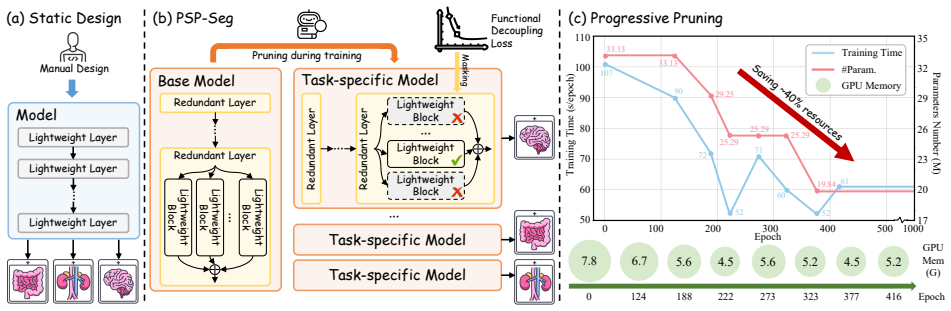
The paper's claim: a redundant U-Net-like model, pruned progressively during training, yields a compact model whose segmentation performance is on par with nnU-Net while consuming far fewer resources. Two functional decoupling losses drive the pruning: a Target Representation loss aligns encoder features on full and ground-truth-masked images; a Region Localization loss supervises channel-averaged decoder feature maps with binarized labels. When these losses converge, block-wise pruning enumerates candidate masks within each parallel redundant module, selects the subset with the smallest Frobenius-norm change in output, and can restore masked blocks if the overall loss worsens. Final archite
What carries the argument
Parallel Redundant Module (PRM): each PRM contains several parallel bottleneck convolution blocks with different kernel sizes (1x1x1, 1x3x3, etc.) whose outputs are weighted and summed, providing redundant capacity. The Functional Decoupling Loss has two terms: TR loss encourages the shared encoder to produce similar features for the full image and a GT-masked foreground-only image; RL loss computes BCE between channel-averaged decoder feature maps and binarized labels. Block-wise pruning enumerates all p-block subsets per PRM, computes output discrepancy via Frobenius norm, masks the least-important subset, and later either permanently prunes or restores them depending on loss improvement.
Load-bearing premise
The reported efficiency gains assume that time and GPU-memory measurements are comparable across the two GPUs used, yet SwinUNETR-V2 and U-Mamba ran on an NVIDIA 3090 while all other models ran on a 2080 Ti (Appendix F.1); if the GPU model changes the readings, the advantage over those two baselines is unsupported.
What would settle it
Run PSP-Seg-S and nnU-Net on the same GPU (identical patch 128x128x128, batch 2, same iterations), measure peak GPU memory and per-epoch time; if the 42-45% memory and 29-48% time reductions do not reproduce, the central efficiency claim is falsified. Also, if random block pruning produces the same final Dice as FD-loss-guided pruning on LiTS, the claim that functional decoupling guides the pruning is falsified.
If this is right
- On five datasets, PSP-Seg-S matches nnU-Net's Dice/NSD within statistical noise (p>0.05) while using 42-45% less GPU memory and 83-87% fewer parameters.
- The pruned architecture is task-specific: different datasets retain different efficient blocks, with small-kernel blocks at the shallow encoder/deep decoder and larger kernels in the middle.
- A compact model obtained by pruning outperforms the same architecture re-trained from scratch, with and without pre-training, across model sizes.
- Resource savings grow during training: the model's GPU memory, per-epoch time, and parameter count all decrease progressively, reaching about 40% resource reduction at convergence.
- Setting the initial prune step to 2 and calibration set to 100 images yields the best efficiency-performance balance on LiTS.
Where Pith is reading between the lines
- The method can be read as a data-dependent architecture search: the final structure is a byproduct of the training data and the FD-loss signals, so extending PRM to attention- or Mamba-style blocks could yield efficient architectures outside pure convolutions.
- Because the pruned model beats a re-trained compact model, the pruning trajectory itself appears to act as knowledge transfer; testing whether the same holds with random pruning would isolate whether the FD-loss guidance is essential.
- A practical extension would replace the fixed 100-sample calibration set with a class-balanced or online sampler; the paper's two-point ablation (50 vs 100) suggests sensitivity to calibration-set composition on rare tumor classes.
- The 'redundant base fills available GPU memory' rule means the achievable final accuracy is bounded by the largest model that fits the GPU; on larger hardware, starting from a bigger redundant base may scale performance further.
Editorial analysis
A structured set of objections, weighed in public.
Referee Report
Summary. The paper proposes PSP-Seg, a progressive pruning framework for 3D medical image segmentation. It starts from a deliberately redundant U-shaped model built from Parallel Redundant Modules (PRMs), each containing several parallel efficient convolution blocks. Training combines the segmentation loss with two 'functional decoupling' losses (TR and RL), and a mask-then-prune process periodically removes the least output-perturbing blocks, with restoration if the loss degrades. Three variants (S, B, L) are evaluated on LiTS, KiTS, BraTS21, Hepatic Vessel, and Colon against seven advanced and six efficient segmentation baselines, all implemented within the nnU-Net V2 framework. The central claim is that PSP-Seg-S achieves performance on par with nnU-Net while reducing GPU memory by 42–45%, training time by 29–48%, and parameters by 83–87% across all five datasets.
Significance. If substantiated, the paper addresses a real limitation of static efficient-architecture design: the same fixed model is unlikely to be optimal for diverse tasks. The progressive, task-adaptive pruning idea is timely, and the use of practical metrics (GPU memory, wall-clock time, parameter count) is appropriate. The manuscript's concrete strengths include a complete algorithmic description (Algorithm 1), ablations of each component, per-task pruning visualizations (Fig. 4 and Fig. 6), and a public code link. The claimed resource savings are substantial. However, the performance-parity claim currently rests on a statistically weakened comparison, and some resource measurements are hardware-confounded, so the central conclusion needs additional evidence before the paper can be accepted.
major comments (3)
- [Appendix F.1, §4.1] The abstract's claim that PSP-Seg-S is 'on par with nnU-Net' is not tested by the reported analysis. The table footnote states that the Wilcoxon signed-rank test compares PSP-Seg results with 'the best result for each metric', not with nnU-Net. Numerically, PSP-Seg-S is below nnU-Net on 4 of 5 datasets (LiTS DSC 79.2 vs 80.2 and NSD 76.5 vs 79.3; KiTS DSC 88.7 vs 90.8 and NSD 85.5 vs 88.9; BraTS21 DSC 84.3 vs 85.0 and NSD 89.9 vs 90.5; Hepatic Vessel NSD 71.7 vs 72.9), with only Colon higher (DSC 41.3 vs 37.9). No p-values versus nnU-Net are reported. If the unit is one dataset (n=5), a two-sided Wilcoxon test cannot reach p<0.05 (minimum p=0.0625), making every asterisk uninformative. If the unit is per-case, comparing against 'the best result for each metric' introduces selection bias. A direct per-case paired test against nnU-Net is needed, and the equivalence claim must be framed acc
- [§3.3, Appendix B] Resource comparisons are not fully controlled. Appendix F.1 admits that SwinUNETR-V2 and U-Mamba were benchmarked on an NVIDIA 3090, while all other models (including PSP-Seg and nnU-Net) used an NVIDIA 2080 Ti. Because GPU memory and per-epoch time are hardware-dependent, the efficiency advantages over those two baselines reported in Tables 1–2 are confounded. Additionally, PSP-Seg's 1000-epoch pre-training on TotalSegmentator (§4.1) is excluded from the reported training time. The abstract's 'training time by 29–48%' should state whether it refers only to target-task fine-tuning and whether pre-training is counted as part of the method's total resource budget.
- [§3.3, Appendix B] The pruning trigger is described inconsistently. The main text says 'convergence is declared if no lower loss is observed over the past 10 epochs. If the current loss improves upon the historical best, block-wise pruning is triggered' — if no improvement has occurred for 10 epochs, the current loss cannot be an improvement over the historical best. Appendix B clarifies that the improvement check is actually a restoration test (current loss vs historical best + 0.01), but the two checks are conflated in the main text. Please rewrite §3.3 to separate convergence detection from the over-pruning/restoration check, and specify whether pruning decisions are based on training loss or calibration-set validation. This is necessary to reproduce Algorithm 1 and to understand the pruning dynamics.
minor comments (4)
- Typo: 'heir high computational and memory demands' should be 'their high computational and memory demands'.
- The column heading 'A VG' appears to mean 'Average'; please spell it out for readability.
- The statistical marking is ambiguous: the footnote says results with p>0.05 are marked with *, but no p-values or sample sizes are reported. State whether the Wilcoxon test is per-dataset or per-case, and report the actual p-values for the key comparisons.
- 'DPSeg' appears as a label in the figure caption; this looks like a typo for 'PSP-Seg'.
Circularity Check
No significant circularity: PSP-Seg is an empirical pruning-method paper whose performance claims are tested on held-out data; the cited self-overlapping works are not load-bearing justifications.
full rationale
The paper is an empirical methods paper, not a derivation chain in which an output quantity is defined in terms of the claimed prediction. The pruning criterion (Eq. 6) selects the minimal-perturbation block subset using a calibration set sampled from the training data, and segmentation performance is evaluated on an 80:20 held-out test split, so the reported DSC/NSD values are not forced by the pruning fit. The FD loss weights (α=β=0.1) and pruning hyperparameters (p, calibration-set size) are hand-set rather than fitted values renamed as predictions. No uniqueness theorem or load-bearing self-citation chain is invoked: works co-authored by Y. Xia (CoTr, UniMiSS+, DoDNet) appear as baselines or as the source of the data-split protocol, not as justification for PSP-Seg's central mechanism. The abstract's 'on par with nnU-Net' claim is statistically under-supported because the Wilcoxon test in Tables 1/2 compares PSP-Seg to 'the best result for each metric' rather than to nnU-Net specifically, and Appendix F.1 notes that SwinUNETR-V2 and U-Mamba were benchmarked on a different GPU; these are correctness and comparability concerns, not circularity. No specific reduction of a result to its own inputs can be exhibited, so the circularity score is 0.
Axiom & Free-Parameter Ledger
free parameters (6)
- alpha (FD loss weight for TR loss) =
0.1
- beta (FD loss weight for RL loss) =
0.1
- Pruning threshold for over-pruning detection =
0.01
- Convergence window =
10 epochs
- Initial pruning step p =
2 for PSP-Seg-L, 1 for PSP-Seg-S and PSP-Seg-B
- Calibration set size =
100
axioms (5)
- domain assumption Frobenius norm discrepancy on a calibration set approximates a block's importance for segmentation performance.
- domain assumption Pre-training on TotalSegmentator transfers to the five target datasets.
- domain assumption FD loss convergence indicates a good moment to prune.
- domain assumption Resource metrics are comparable across different GPU hardware.
- domain assumption The 80:20 random split yields representative test sets.
Cite this review
Pith. "Pith review of Unified Start, Personalized End: Progressive Pruning for Efficient 3D Medical Image Segmentation." pith.science (2026). https://pith.science/paper/7TOAX5T2
@misc{pith2026250909267,
  author       = {Pith},
  title        = {Pith review of: Unified Start, Personalized End: Progressive Pruning for Efficient 3D Medical Image Segmentation},
  year         = {2026},
  howpublished = {\url{https://pith.science/paper/7TOAX5T2}},
  note         = {Machine review of arXiv:2509.09267}
}
read the original abstract
3D medical image segmentation often faces heavy resource and time consumption, limiting its scalability and rapid deployment in clinical environments. Existing efficient segmentation models are typically static and manually designed prior to training, which restricts their adaptability across diverse tasks and makes it difficult to balance performance with resource efficiency. In this paper, we propose PSP-Seg, a progressive pruning framework that enables dynamic and efficient 3D segmentation. PSP-Seg begins with a redundant model and iteratively prunes redundant modules through a combination of block-wise pruning and a functional decoupling loss. We evaluate PSP-Seg on five public datasets, benchmarking it against seven state-of-the-art models and six efficient segmentation models. Results demonstrate that the lightweight variant, PSP-Seg-S, achieves performance on par with nnU-Net while reducing GPU memory usage by 42-45%, training time by 29-48%, and parameter number by 83-87% across all datasets. These findings underscore PSP-Seg's potential as a cost-effective yet high-performing alternative for widespread clinical application.
Figures




Reference graph
Works this paper leans on
-
[1]
This selective masking facilitates efficient model compression while preserving performance
For each prunable PRM module in the model, the algorithm systematically evaluates different combina- tions of branch masks and selects the subset that minimally affects the model output. This selective masking facilitates efficient model compression while preserving performance. F Experiments Results F.1 Detailed Results of Segmentation Performance We fur...
2080
-
[3]
arXiv preprint arXiv:2102.04306
Transunet: Transform- ers make strong encoders for medical image segmentation. arXiv preprint arXiv:2102.04306. Chen, T.; Huang, S.; Xie, Y .; Jiao, B.; Jiang, D.; Zhou, H.; Li, J.; and Wei, F
-
[5]
Hatamizadeh, A.; Nath, V .; Tang, Y .; Yang, D.; Roth, H
A data-scalable transformer for medical im- age segmentation: architecture, model efficiency, and bench- mark.arXiv preprint arXiv:2203.00131. Hatamizadeh, A.; Nath, V .; Tang, Y .; Yang, D.; Roth, H. R.; and Xu, D
-
[7]
arXiv preprint arXiv:2106.14568
Deep ensembling with no overhead for either train- ing or testing: The all-round blessings of dynamic sparsity. arXiv preprint arXiv:2106.14568. Lu, X.; Liu, Q.; Xu, Y .; Zhou, A.; Huang, S.; Zhang, B.; Yan, J.; and Li, H
-
[9]
arXiv preprint arXiv:2401.04722
U-mamba: Enhancing long-range dependency for biomedical image segmentation. arXiv preprint arXiv:2401.04722. Ma, N.; Zhang, X.; Zheng, H.-T.; and Sun, J
-
[10]
Pang, Y .; Liang, J.; Huang, T.; Chen, H.; Li, Y .; Li, D.; Huang, L.; and Wang, Q
Shortgpt: Layers in large language models are more redundant than you expect.arXiv preprint arXiv:2403.03853. Pang, Y .; Liang, J.; Huang, T.; Chen, H.; Li, Y .; Li, D.; Huang, L.; and Wang, Q
-
[12]
Sun, M.; Liu, Z.; Bair, A.; and Kolter, J
Lhu-net: A light hybrid u-net for cost- efficient, high-performance volumetric medical image seg- mentation.arXiv preprint arXiv:2404.05102. Sun, M.; Liu, Z.; Bair, A.; and Kolter, J. Z
-
[13]
arXiv preprint arXiv:2306.11695
A simple and effective pruning approach for large language models. arXiv preprint arXiv:2306.11695. Ulyanov, D.; Vedaldi, A.; and Lempitsky, V
-
[15]
Cotr: Effi- ciently bridging cnn and transformer for 3d medical image segmentation. InMedical Image Computing and Computer Assisted Intervention–MICCAI 2021: 24th International Conference, Strasbourg, France, September 27–October 1, 2021, Proceedings, Part III 24, 171–180. Springer. Xie, Y .; Zhang, J.; Xia, Y .; and Wu, Q
2021
-
[16]
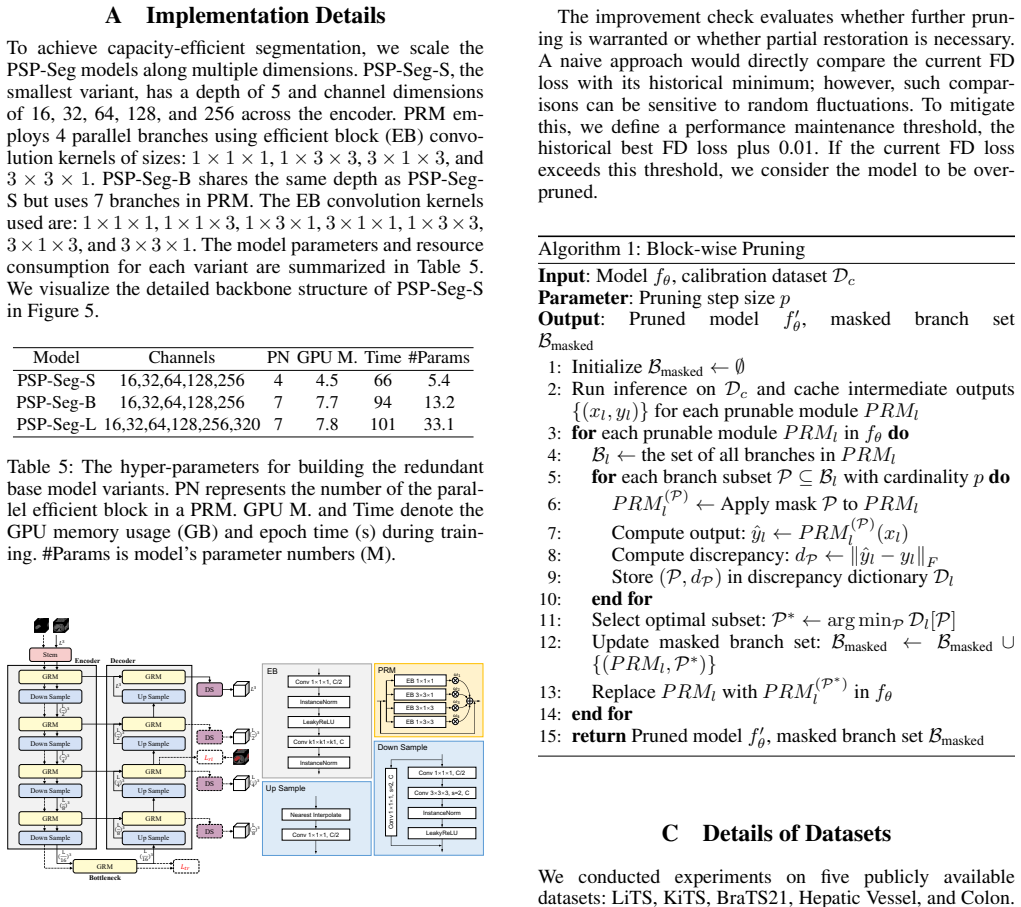
nnformer: Interleaved transformer for volumetric segmentation.arXiv preprint arXiv:2109.03201. A Implementation Details To achieve capacity-efficient segmentation, we scale the PSP-Seg models along multiple dimensions. PSP-Seg-S, the smallest variant, has a depth of 5 and channel dimensions of 16, 32, 64, 128, and 256 across the encoder. PRM em- ploys 4 p...
-
[17]
Model Channels PN GPU M. Time #Params PSP-Seg-S 16,32,64,128,256 4 4.5 66 5.4 PSP-Seg-B 16,32,64,128,256 7 7.7 94 13.2 PSP-Seg-L 16,32,64,128,256,320 7 7.8 101 33.1 Table 5: The hyper-parameters for building the redundant base model variants. PN represents the number of the paral- lel efficient block in a PRM. GPU M. and Time denote the GPU memory usage (...
2022
-
[2015]
InMedical image computing and computer-assisted intervention–MICCAI 2015: 18th international conference, Munich, Germany, October 5-9, 2015, proceedings, part III 18, 234–241
U-net: Convolutional networks for biomedical image segmenta- tion. InMedical image computing and computer-assisted intervention–MICCAI 2015: 18th international conference, Munich, Germany, October 5-9, 2015, proceedings, part III 18, 234–241. Springer. Roy, S.; Koehler, G.; Ulrich, C.; Baumgartner, M.; Petersen, J.; Isensee, F.; Jaeger, P. F.; and Maier-H...
2015
-
[2016]
arXiv preprint arXiv:1607.08022
Instance normalization: The missing ingredient for fast stylization. arXiv preprint arXiv:1607.08022. Wasserthal, J.; Breit, H.-C.; Meyer, M. T.; Pradella, M.; Hinck, D.; Sauter, A. W.; Heye, T.; Boll, D. T.; Cyriac, J.; Yang, S.; Bach, M.; and Segeroth, M
-
[2019]
InMedical Image Computing and Com- puter Assisted Intervention–MICCAI 2019: 22nd Interna- tional Conference, Shenzhen, China, October 13–17, 2019, Proceedings, Part III 22, 184–192
3D dilated multi-fiber network for real-time brain tumor seg- mentation in MRI. InMedical Image Computing and Com- puter Assisted Intervention–MICCAI 2019: 22nd Interna- tional Conference, Shenzhen, China, October 13–17, 2019, Proceedings, Part III 22, 184–192. Springer. Chen, J.; Lu, Y .; Yu, Q.; Luo, X.; Adeli, E.; Wang, Y .; Lu, L.; Yuille, A. L.; and Zhou, Y
2019
-
[2021]
The rsna-asnr-miccai brats 2021 benchmark on brain tumor segmentation and radiogenomic classification.arXiv preprint arXiv:2107.02314. Bilic, P.; Christ, P.; Li, H. B.; V orontsov, E.; Ben-Cohen, A.; Kaissis, G.; Szeskin, A.; Jacobs, C.; Mamani, G. E. H.; Chartrand, G.; et al
Pith/arXiv arXiv 2021
-
[2022]
Cheng, H.; Zhang, M.; and Shi, J
Task-specific expert pruning for sparse mixture-of-experts.arXiv preprint arXiv:2206.00277. Cheng, H.; Zhang, M.; and Shi, J. Q
-
[2023]
Stu-net: Scal- able and transferable medical image segmentation models empowered by large-scale supervised pre-training.arXiv preprint arXiv:2304.06716. Isensee, F.; Jaeger, P. F.; Kohl, S. A.; Petersen, J.; and Maier- Hein, K. H
-
[2024]
Not all experts are equal: Efficient expert pruning and skipping for mixture-of-experts large language models.arXiv preprint arXiv:2402.14800. Ma, J.; Li, F.; and Wang, B
discussion (0)
Sign in with ORCID, Apple, or X to comment. Anyone can read and Pith papers without signing in.