REVIEW 3 major objections 5 minor 1 cited by
AutoPentest: Enhancing Vulnerability Management With Autonomous LLM Agents
T0 review · 3 major / 5 minor · reviewed 2026-08-15 · deepseek-v4-flash
Pith's one-line read A multi-agent GPT-4o system can autonomously execute black-box penetration testing steps, completing 15–26% of subtasks on three Hack The Box machines released after the model's training cutoff.
desk verdict Honest incremental contribution with open-source code and better evaluation hygiene than most prior work, but the contamination defense is weaker than the paper suggests and the evaluation is too small to carry much weight. read the letter →
The pith
A machine-rendered reading of the paper's core claim, the machinery that carries it, and where it could break.
The reading
What carries the argument
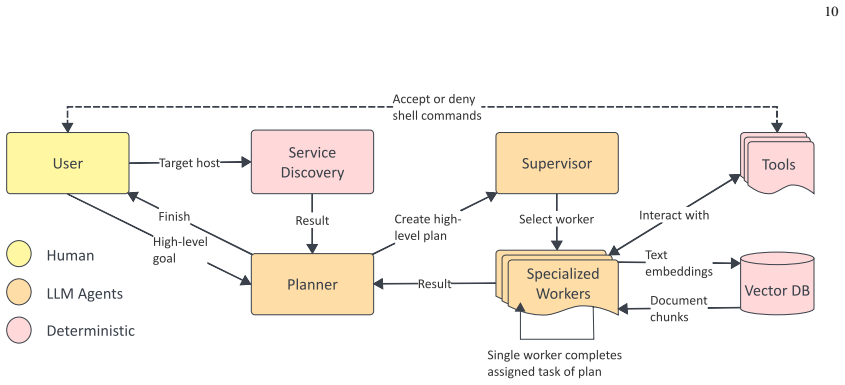
The load-bearing mechanism is a hierarchical multi-agent loop: a Planner agent produces a step-by-step plan, a Supervisor delegates the next step to a Specialised Worker, and the worker executes it with a fixed toolset, after which the Planner re-plans based on the worker's observations. The plan-and-solve idea comes from Wang et al., the multi-agent division of labour from the AutoGen concept, and the worker's context is enriched by retrieval-augmented generation (RAG) over a vector database of pentest documentation, so each step is informed by relevant OWASP, CWE, HackTricks, and PortSwigger material. Deterministic service discovery with nmap feeds NVD CVE lookups into the Planner's initial context, and temperature is set to 0 as recommended by related work on AutoAttacker. This machinery lets the system chain many small autonomous decisions into a longer attack path while keeping the LLM's context bounded.
What would settle it
Prompt a no-tools GPT-4o instance with each machine name and ask how to get user and root access; if it can reliably reproduce the exact attack paths (the Joomla configuration disclosure on Devvortex, the ActiveMQ CVE on Broker, the vm2 escape on Codify) without any tool output, the post-cutoff novelty claim is falsified. Alternatively, run AutoPentest on a set of fresh easy Linux HTB machines that have no public writeups at all; a collapse in completion rates would indicate the reported 15–26% was largely memorisation.
Extended reading notes
Core claim
On the paper's own terms, the discovery is that a GPT-4o agent framework can autonomously run a black-box penetration test from an initial IP address through enumeration, vulnerability analysis, and attempted exploitation, and that it finishes a non-trivial minority of the attack chain. AutoPentest uses a Planner agent to build and repeatedly revise a high-level plan, a Supervisor that delegates each step, and Specialised Workers organised around OWASP Top 10 categories plus privilege escalation, all augmented with retrieval-augmented generation from a vector database and tools for shell commands, Python execution, headless browsing, web search, and NVD lookups. The paper's experiments on Devvortex, Broker, and Codify measure subtask completion rates of 15.38%, 20%, and 25.93% for AutoPentest, versus 15.38%, 20%, and 22.22% for a human manually executing ChatGPT-4o's suggested commands. The author interprets the results as showing that these systems are already good at enumeration and vulnerability identification but still struggle with reliable exploitation, and that the approach is viable enough that stronger future models and implementation work could make it a practical part of vulnerability management.
Load-bearing premise
The result depends on the assumption that the three Hack The Box machines, released in November 2023, are not effectively represented in GPT-4o's October 2023 training data; if the model has memorised public walkthroughs of these machines, the measured subtask completions reflect recall rather than novel reasoning.
Editorial extensions
If this is right
- If the results hold, autonomous LLM agents can already serve as a first-pass reconnaissance and vulnerability triage layer, flagging target services and known CVEs before a human tester takes over.
- Because the biggest failures were in exploitation and long-horizon execution, fixing agent memory, shell-state tracking, and interactive tool use should yield larger gains than prompt tweaks.
- The cost data imply that per-token API usage, while more expensive than a flat subscription in small experiments, scales past ChatGPT's per-hour message cap, making continuous or scheduled scans feasible.
- Future evaluations should follow the same post-training-cutoff rule and add automated monitoring of web searches, since public solutions online would otherwise contaminate results.
Reading between the lines
- The cleanest test of the novelty claim would be to run AutoPentest against machines released after the cutoff that have never been publicly solved; the current design relies on the absence of writeups rather than proving their absence.
- Comparing $96.20 in API costs against $20 in subscription cost understates the API route's advantage for repeated, unattended scans, since the subscription's hourly message cap is the binding constraint.
- The task-repetition and assumed-shell-context failures suggest that state tracking, not model intelligence, is the next bottleneck; checkpointing and explicit shell-state summaries, both mentioned in the paper, are testable fixes.
Signed reviews
Editorial analysis
A structured set of objections, weighed in public.
Referee Report
Summary. AutoPentest is a multi-agent penetration-testing system built on GPT-4o and LangChain. The paper reviews prior LLM-based pentesting work, identifies common evaluation issues, and presents a hierarchical agent architecture (planner, supervisor, and specialised workers) augmented with RAG and external tools. It evaluates AutoPentest on three Hack The Box machines released in November 2023, after the GPT-4o training cutoff, by decomposing official walkthroughs into subtasks (26, 10, and 27 subtasks for Devvortex, Broker, and Codify, respectively). The study compares best-run subtask completion rates of AutoPentest with a manually operated ChatGPT-4o baseline and reports token costs. The headline results are 15.4%, 20.0%, and 25.9% subtask completion for AutoPentest versus 15.4%, 20.0%, and 22.2% for ChatGPT-4o on the three machines, with a total AutoPentest API cost of $96.20.
Significance. The paper's related-work review is useful, particularly its emphasis on training-data leakage and on methodological omissions in prior studies. The implementation is open source, the prompts are listed in full in the appendix, and the cost accounting is transparent; these are genuine strengths for reproducibility. However, the empirical basis is narrow (three easy Linux machines, best-of-run scoring, no repeated-run statistics), and the claimed advantage over the baseline rests on a one-subtask difference on a single machine. The post-cutoff release date is an imperfect guarantee against leakage, and the search-log safeguard is not independently verifiable. If revised to address these issues, the paper would be a credible early empirical datapoint for autonomous LLM-based penetration testing; in its current form the accuracy and comparative claims are only partially supported.
major comments (3)
- [Section V and Section VI-B (Table III)] The central comparison is based on the best run within a two-hour window on only three machines, with no repeated-run statistics. Section V states that an approach was restarted when no subtask had been completed for 20 minutes and that two to four runs were typical, but Section VI-B reports only the highest-scoring run. With this protocol, a one-subtask difference on Codify (25.93% vs. 22.22%) is within run-to-run noise, so the claim that AutoPentest 'slightly outperforms' ChatGPT-4o is not statistically supported. Please report all runs, per-run counts, and per-subtask completion, and base the comparison on a statistic that reflects the small sample.
- [Section V, Section VII-B, Appendix C-A] The post-cutoff release date does not by itself rule out leakage of the route to completion. The three machines are solved via CVEs that were public before the October 2023 cutoff (Joomla CVE-2023-23752, Apache ActiveMQ CVE-2023-46604, vm2 CVE-2023-29199), and the subtask benchmark is derived from official write-ups. Moreover, Specialised Workers have live Tavily search and RAG access to public offensive-security documents (Sections IV-C and IV-D), so machine-specific walkthroughs could in principle be retrieved during a run. The manual check of search behaviour is a reasonable first step, but no raw query logs are published, so the safeguard is not independently verifiable. I request a direct probe, such as an ablation with web search and RAG disabled, or a test in which the model receives only generic CVE descriptions, and that the external-validity claims be calibrated to the strength of that evidence.
- [Section VI-B and RQ2 (Section I-A)] RQ2 asks how accurately the system identifies and exploits vulnerabilities, but Table III only reports aggregate completed-subtask counts, with no separate identification metric and no per-subtask breakdown. As a result, the statement in Section VI-B that enumeration and identification 'is working well' is not directly supported by the tabulated data. A subtask-level table showing which steps were completed by each approach in each run would separate identification failures from exploitation failures and make the evaluation interpretable.
minor comments (5)
- [Abstract and Table III] The abstract states completion rates of '15-25 %', but Table III reports 25.93% for AutoPentest on Codify. The abstract should say 15-26% or be reconciled with Table III.
- [Table III] The table uses the label 'ChatGPT-4.0' while the text and other tables use 'ChatGPT-4o'. The labels should be made consistent throughout.
- [Table IV] The machine name is spelled 'Devortex' in the table, whereas the text and Table II use 'Devvortex'. Please correct the spelling.
- [Section VI-C] The cost comparison contrasts $96.20 in metered API usage with a $20 ChatGPT Plus subscription. These are different purchasing and usage models; the comparison should state explicitly that the subscription is rate-limited and that API costs scale with usage, aspects the text only partially acknowledges.
- [Section VII-B] The paper states that all online searches were manually checked and that no leakage behaviour was found, but no search-query history or agent logs are published. Releasing the raw logs or a query summary alongside the repository would substantially strengthen the verification of this claim.
Circularity Check
No circularity: the evaluation is an external benchmark measurement with no fitted parameters, no self-citation chain, and no prediction that reduces to its inputs.
full rationale
AutoPentest makes no formal derivation or prediction that reduces to its own inputs. The central measurement is the fraction of subtasks completed on three HTB machines, where the subtasks are defined in appendix C-A from official solution write-ups and are therefore external to the system being evaluated. No parameter is fitted to the evaluation data and then re-reported as a prediction; the only configuration choice of this kind, temperature 0, is taken from cited related work and applied uniformly to the AutoPentest condition. The cost figures are direct token-billing arithmetic from Azure pricing, not a modeled claim. The paper's selection of machines released after the GPT-4o training cutoff is an external-validity argument, and the reviewer's memorization concern is a legitimate threat to that validity, which the paper itself acknowledges with the wording that release after the cutoff 'minimises the chance of public solutions being used in the training data.' That limitation is not circularity, because the benchmark content and scoring rubric come from public write-ups rather than from the model's own outputs, and the claimed result is an empirical measurement rather than an analytic consequence of how the system was built. There are no load-bearing self-citations, no imported uniqueness theorems, and no ansatz smuggled in through prior work. Accordingly, no circular step is identified, and the appropriate score is 0.
Assumptions & free parameters
assumptions (5)
- domain assumption The HTB machines released in November 2023 postdate GPT-4o's training data cutoff and are therefore not memorized.
- domain assumption Manual inspection of all web searches performed by the agents is sufficient to rule out retrieval of public solutions.
- domain assumption Subtask lists derived from official HTB walkthroughs are a valid measure of progress for comparing approaches.
- domain assumption Human reviewers rejected commands only for safety, never because they knew the expected solution path.
- domain assumption The three easy Linux HTB machines are representative of penetration testing targets for the purpose of scaling conclusions.
Cite this review
Pith. "Pith review of AutoPentest: Enhancing Vulnerability Management With Autonomous LLM Agents." pith.science (2026). https://pith.science/paper/7UBHE4GY
@misc{pith2026250510321,
  author       = {Pith},
  title        = {Pith review of: AutoPentest: Enhancing Vulnerability Management With Autonomous LLM Agents},
  year         = {2026},
  howpublished = {\url{https://pith.science/paper/7UBHE4GY}},
  note         = {Machine review of arXiv:2505.10321}
}
abstract
A recent area of increasing research is the use of Large Language Models (LLMs) in penetration testing, which promises to reduce costs and thus allow for higher frequency. We conduct a review of related work, identifying best practices and common evaluation issues. We then present AutoPentest, an application for performing black-box penetration tests with a high degree of autonomy. AutoPentest is based on the LLM GPT-4o from OpenAI and the LLM agent framework LangChain. It can perform complex multi-step tasks, augmented by external tools and knowledge bases. We conduct a study on three capture-the-flag style Hack The Box (HTB) machines, comparing our implementation AutoPentest with the baseline approach of manually using the ChatGPT-4o user interface. Both approaches are able to complete 15-25 % of the subtasks on the HTB machines, with AutoPentest slightly outperforming ChatGPT. We measure a total cost of \$96.20 US when using AutoPentest across all experiments, while a one-month subscription to ChatGPT Plus costs \$20. The results show that further implementation efforts and the use of more powerful LLMs released in the future are likely to make this a viable part of vulnerability management.
Figures
Forward citations
Cited by 1 Pith paper
-
A Survey of LLM-Driven Penetration Testing: Taxonomy, Co-Evolution, and Open Challenges
LLM pentest agents co-evolved through four bottleneck-driven phases into RLVR systems, while CTF platforms became dual evaluation/training infrastructure and three linked reliability gaps remain.
Reference graph
Works this paper leans on
-
[1]
Teams of LLM Agents can Exploit Zero- Day Vulnerabilities,
R. Fang, R. Bindu, A. Gupta, Q. Zhan, and D. Kang, “Teams of LLM Agents can Exploit Zero- Day Vulnerabilities,” Jun. 2024, arXiv:2406.01637 [cs]. [Online]. Available: http://arxiv.org/abs/2406.01637
arXiv 2024
-
[2]
AutoAttacker: A Large Language Model Guided System to Implement Automatic Cyber-attacks,
J. Xu, J. W. Stokes, G. McDonald, X. Bai, D. Marshall, S. Wang, A. Swaminathan, and Z. Li, “AutoAttacker: A Large Language Model Guided System to Implement Automatic Cyber-attacks,” Mar. 2024, arXiv:2403.01038 [cs]. [Online]. Available: http://arxiv.org/abs/2403.01038
arXiv 2024
-
[3]
LLMs as Hackers: Autonomous Linux Privilege Escalation Attacks,
A. Happe, A. Kaplan, and J. Cito, “LLMs as Hackers: Autonomous Linux Privilege Escalation Attacks,” Mar. 2024, arXiv:2310.11409 [cs]. [Online]. Available: http: //arxiv.org/abs/2310.11409
arXiv 2024
-
[4]
S. Moskal, S. Laney, E. Hemberg, and U.-M. O’Reilly, “LLMs Killed the Script Kiddie: How Agents Supported by Large Language Models Change the Landscape of Network Threat Testing,” Oct. 2023, arXiv:2310.06936 [cs]. [Online]. Available: http://arxiv.org/abs/2310.06936
arXiv 2023
-
[5]
BreachSeek: A Multi-Agent Automated Penetration Tester,
I. Alshehri, A. Alshehri, A. Almalki, M. Bamardouf, and A. Akbar, “BreachSeek: A Multi-Agent Automated Penetration Tester,” Aug. 2024, arXiv:2409.03789 [cs]. [Online]. Available: http://arxiv.org/abs/2409.03789
arXiv 2024
-
[6]
HackSynth: LLM Agent and Evaluation Framework for Autonomous Penetration Testing,
L. Muzsai, D. Imolai, and A. Luk ´acs, “HackSynth: LLM Agent and Evaluation Framework for Autonomous Penetration Testing,” Dec. 2024, arXiv:2412.01778 [cs]. [Online]. Available: http://arxiv.org/abs/2412.01778
arXiv 2024
-
[7]
An Empirical Evaluation of LLMs for Solving Offensive Security Challenges,
M. Shao, B. Chen, S. Jancheska, B. Dolan-Gavitt, S. Garg, R. Karri, and M. Shafique, “An Empirical Evaluation of LLMs for Solving Offensive Security Challenges,” Feb. 2024, arXiv:2402.11814 [cs]. [Online]. Available: http://arxiv.org/abs/2402.11814
arXiv 2024
-
[8]
PentestAgent: Incorporating LLM Agents to Automated Penetration Testing,
X. Shen, L. Wang, Z. Li, Y . Chen, W. Zhao, D. Sun, J. Wang, and W. Ruan, “PentestAgent: Incorporating LLM Agents to Automated Penetration Testing,” Nov. 2024, arXiv:2411.05185 [cs]. [Online]. Available: http: //arxiv.org/abs/2411.05185
arXiv 2024
Show all 23 references
-
[9]
Interactive Tools Substantially Assist LM Agents in Finding Security Vulnerabilities,
T. Abramovich, M. Udeshi, M. Shao, K. Lieret, H. Xi, K. Milner, S. Jancheska, J. Yang, C. E. Jimenez, F. Khorrami, P. Krishnamurthy, B. Dolan- Gavitt, M. Shafique, K. Narasimhan, R. Karri, and O. Press, “Interactive Tools Substantially Assist LM Agents in Finding Security Vuln...
2025 arXiv
-
[10]
CAI: An Open, Bug Bounty-Ready Cybersecurity AI,
V . Mayoral-Vilches, L. J. Navarrete-Lozano, M. Sanz- G´omez, L. S. Espejo, M. Crespo- ´Alvarez, F. Oca-Gonzalez, F. Balassone, A. Glera-Pic ´on, U. Ayucar-Carbajo, J. A. Ruiz-Alcalde, S. Rass, M. Pinzger, and E. Gil-Uriarte, “CAI: An Open, Bug Bounty-Ready Cybersecurity AI,” ...
2025 arXiv
-
[11]
PTHelper: An open source tool to support the Penetration Testing process,
J. C. de Gracia and A. S ´anchez-Maci´an, “PTHelper: An open source tool to support the Penetration Testing process,” Jun. 2024, arXiv:2406.08242 [cs]. [Online]. Available: http://arxiv.org/abs/2406.08242
2024 arXiv
-
[12]
Generative AI for pentesting: the good, the bad, the ugly,
E. Hilario, S. Azam, J. Sundaram, K. Imran Mohammed, and B. Shanmugam, “Generative AI for pentesting: the good, the bad, the ugly,”International Journal of Information Security, Mar. 2024. [Online]. Available: https://doi.org/10.1007/s10207-024-00835-x
2024 doi
-
[13]
PentestGPT: An LLM-empowered Automatic Penetration Testing Tool,
G. Deng, Y . Liu, V . Mayoral-Vilches, P. Liu, Y . Li, Y . Xu, T. Zhang, Y . Liu, M. Pinzger, and S. Rass, “PentestGPT: An LLM-empowered Automatic Penetration Testing Tool,” Aug. 2023, arXiv:2308.06782 [cs]. [Online]. Available: http://arxiv.org/abs/2308.06782
2023 arXiv
-
[14]
CIPHER: Cybersecurity Intelligent Penetration-Testing Helper for Ethical Researcher,
D. Pratama, N. Suryanto, A. A. Adiputra, T.-T.-H. Le, A. Y . Kadiptya, M. Iqbal, and H. Kim, “CIPHER: Cybersecurity Intelligent Penetration-Testing Helper for Ethical Researcher,”Sensors, vol. 24, no. 21, p. 6878, Jan. 2024, number: 21 Publisher: Multidisciplinary Digital Publ...
2024
-
[15]
Understanding Hackers’ Work: An Empirical Study of Offensive Security Practitioners,
A. Happe and J. Cito, “Understanding Hackers’ Work: An Empirical Study of Offensive Security Practitioners,” inProceedings of the 31st ACM Joint European Software Engineering Conference and Symposium on the F oundations of Software Engineering, Nov. 2023, pp. 1669–1680, arXiv:...
2023 arXiv
-
[16]
A study on penetration testing process and tools,
H. M. Z. A. Shebli and B. D. Beheshti, “A study on penetration testing process and tools,” in2018 IEEE Long Island Systems, Applications and Technology Conference (LISAT), May 2018, pp. 1–7. [Online]. Available: https://ieeexplore.ieee.org/abstract/document/8378035
2018
-
[17]
Large Language Models: A Survey,
S. Minaee, T. Mikolov, N. Nikzad, M. Chenaghlu, R. Socher, X. Amatriain, and J. Gao, “Large Language Models: A Survey,” Feb. 2024, arXiv:2402.06196 [cs]. [Online]. Available: http://arxiv.org/abs/2402.06196
2024 arXiv
-
[18]
Can LLMs Hack Enterprise Networks? Autonomous Assumed Breach Penetration-Testing Active Directory Networks,
A. Happe and J. Cito, “Can LLMs Hack Enterprise Networks? Autonomous Assumed Breach Penetration-Testing Active Directory Networks,” Feb. 2025, arXiv:2502.04227 [cs]. [Online]. Available: http://arxiv.org/abs/2502.04227
2025 arXiv
-
[19]
Plan-and-Solve Prompting: Improving Zero- Shot Chain-of-Thought Reasoning by Large Language Models,
L. Wang, W. Xu, Y . Lan, Z. Hu, Y . Lan, R. K.-W. Lee, and E.-P. Lim, “Plan-and-Solve Prompting: Improving Zero- Shot Chain-of-Thought Reasoning by Large Language Models,” May 2023, arXiv:2305.04091 [cs]. [Online]. Available: http://arxiv.org/abs/2305.04091
2023 arXiv
-
[20]
AutoGen: Enabling Next-Gen LLM Applications via Multi-Agent Conversation,
Q. Wu, G. Bansal, J. Zhang, Y . Wu, B. Li, E. Zhu, L. Jiang, X. Zhang, S. Zhang, J. Liu, A. H. Awadallah, R. W. White, D. Burger, and C. Wang, “AutoGen: Enabling Next-Gen LLM Applications via Multi-Agent Conversation,” Oct. 2023, arXiv:2308.08155 [cs]. [Online]. Available: htt...
2023 arXiv
-
[21]
Retrieval-Augmented Generation for Knowledge-Intensive NLP Tasks,
P. Lewis, E. Perez, A. Piktus, F. Petroni, V . Karpukhin, N. Goyal, H. K ¨uttler, M. Lewis, W.-t. Yih, T. Rockt¨aschel, S. Riedel, and D. Kiela, “Retrieval-Augmented Generation for Knowledge-Intensive NLP Tasks,” inAdvances in Neural Information Processing Systems, vol. 33. Cu...
2020
-
[22]
The Convergence of AI and Cybersecurity: An Examination of ChatGPT’s Role in Penetration Testing and its Ethical and Legal Implications,
M. P. Heim, N. Starckjohann, and M. Torgersen, “The Convergence of AI and Cybersecurity: An Examination of ChatGPT’s Role in Penetration Testing and its Ethical and Legal Implications,” Bachelor thesis, NTNU, 2023, accepted: 2023-07-05T17:25:05Z. [Online]. Available: https://n...
2023
-
[23]
ChainReactor: Automated Privilege Escalation Chain Discovery via{AI}Planning,
G. D. Pasquale, I. Grishchenko, R. Iesari, G. Pizarro, L. Cavallaro, C. Kruegel, and G. Vigna, “ChainReactor: Automated Privilege Escalation Chain Discovery via{AI}Planning,” 2024, pp. 5913–5929. [Online]. Available: https://www.usenix.org/conference/ usenixsecurity24/presenta...
2024
Reviewed August 15, 2026 · model on record in the stance chip above.
Discussion (0). Continue with ORCID to comment.