Sensing the Inflationary Production of Scalars
Pith reviewed 2026-06-26 23:30 UTC · model grok-4.3
The pith
Massless minimally coupled scalars during de Sitter inflation enhance the real part of gravitational mode functions far more than conformally coupled fields, interpretable as a shift in the Hubble parameter.
A machine-rendered reading of the paper's core claim, the machinery that carries it, and where it could break.
Core claim
During de Sitter inflation the one-loop graviton self-energy arising from matter loops is inserted into the linearized Einstein equations. Exact corrections to the gravitational mode functions are then obtained via a Green's function solution subject to the usual initial-state ambiguity. Conformally coupled fields produce only logarithmic enhancements to the decay of the imaginary part after horizon crossing. Massless minimally coupled scalars produce a far stronger enhancement of the rate at which the real part approaches a constant, which can be interpreted as a shift of the inflationary Hubble parameter.
What carries the argument
Graviton self-energy from matter loops, inserted into the linearized Einstein equations and solved with a Green's function to obtain one-loop corrections to gravitational mode functions.
If this is right
- The distinction between conformally coupled and minimally coupled scalars is visible in the real versus imaginary parts of the corrected mode functions.
- The milder logarithmic corrections from conformally coupled matter can be resummed using a variant of the renormalization group.
- The stronger effect from minimally coupled scalars admits an interpretation as an effective shift of the Hubble parameter during inflation.
- These one-loop corrections arise specifically from the inflationary particle production experienced by massless minimally coupled scalars.
Where Pith is reading between the lines
- If the Hubble shift interpretation holds, the effective expansion rate during inflation receives a quantum correction whose size is set by the scalar abundance.
- Similar enhancements might appear in other tensor observables such as the tensor power spectrum or the tensor-to-scalar ratio.
- The initial-state ambiguity could change the precise numerical size of the correction while leaving the qualitative difference between the two classes of matter fields intact.
- Precision measurements of primordial gravitational waves at future observatories could in principle constrain the strength of this scalar-induced effect.
Load-bearing premise
The graviton self-energy computed from matter loops can be inserted into the linearized Einstein equations to obtain quantum-corrected mode functions, despite the usual ambiguity in the choice of initial state for the Green's function.
What would settle it
A direct computation or observation showing that the enhancement of the real part for minimally coupled scalars is absent or no stronger than the logarithmic effect for conformally coupled fields would falsify the central claim.
Figures
read the original abstract
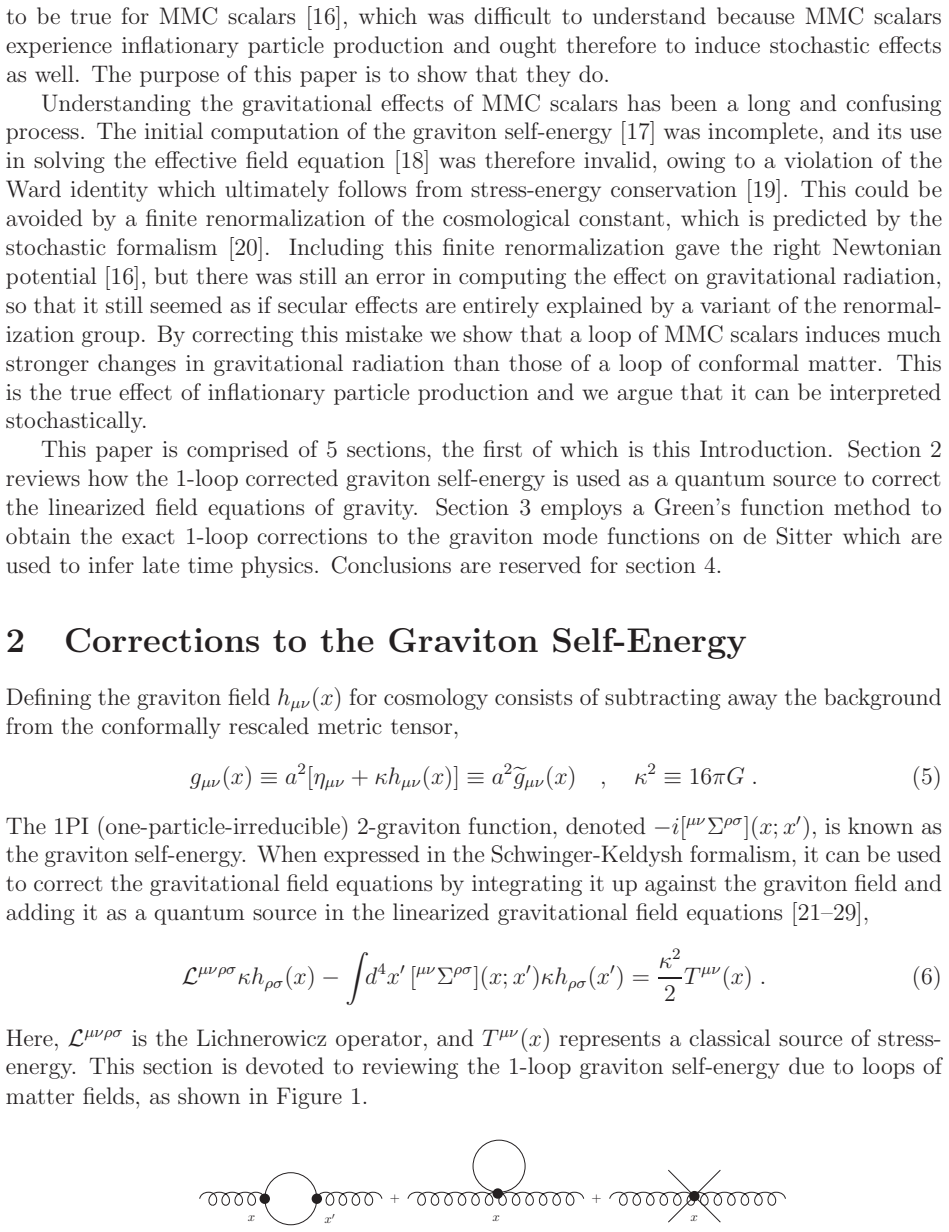
We review the mechanism by which loops of matter fields contribute to the graviton self-energy during de Sitter inflation. The self-energy is used to quantum-correct the linearized Einstein equations. A Green's function method is employed to obtain exact 1-loop corrections to the plane wave mode functions of gravitational radiation, subject to the usual ambiguity in the initial state. Conformally coupled matter, which does not experience inflationary particle production, makes only a logarithmic enhancement of the rate at which the imaginary part of the mode function goes to zero after horizon crossing. These corrections can be understood, and even summed up, using a variant of the renormalization group. However, massless, minimally coupled scalars, which experience massive inflationary particle production, induce a much stronger enhancement of the rate at which the real part of the mode function approaches a constant. One interpretation of this effect is as a shift of the inflationary Hubble parameter.
Editorial analysis
A structured set of objections, weighed in public.
Referee Report
Summary. The paper reviews the mechanism by which loops of matter fields contribute to the graviton self-energy during de Sitter inflation. This self-energy is inserted into the linearized Einstein equations, and a Green's function method is used to compute exact 1-loop corrections to the plane-wave mode functions of gravitational radiation (subject to the usual ambiguity in the initial state for the Green's function). Conformally coupled matter produces only a logarithmic enhancement to the decay of the imaginary part of the mode function after horizon crossing, which can be resummed via a renormalization-group variant. Massless minimally coupled scalars, by contrast, produce a much stronger enhancement to the rate at which the real part approaches a constant, which the authors interpret as a possible shift in the inflationary Hubble parameter.
Significance. If the central claim holds, the work would establish a concrete, potentially observable distinction between the back-reaction of conformally coupled versus minimally coupled scalars on tensor modes, arising from inflationary particle production. This could provide a new probe of quantum effects in inflation and a concrete realization of how matter loops renormalize the effective Hubble scale.
major comments (1)
- [Green's function method] The discussion of the Green's function method (and the associated initial-state ambiguity): the claimed parametrically stronger enhancement for massless minimally coupled scalars, and its interpretation as a Hubble shift, is obtained by solving the corrected wave equation with a Green's function whose initial state is left ambiguous. The manuscript notes the ambiguity but does not demonstrate that the reported enhancement is independent of this choice or that it survives a consistent renormalization-group resummation in the same manner as the conformal case.
Simulated Author's Rebuttal
We thank the referee for their careful reading of the manuscript and for highlighting the importance of the initial-state ambiguity in the Green's function approach. We address this concern directly below and indicate the revisions that will be incorporated.
read point-by-point responses
-
Referee: [Green's function method] The discussion of the Green's function method (and the associated initial-state ambiguity): the claimed parametrically stronger enhancement for massless minimally coupled scalars, and its interpretation as a Hubble shift, is obtained by solving the corrected wave equation with a Green's function whose initial state is left ambiguous. The manuscript notes the ambiguity but does not demonstrate that the reported enhancement is independent of this choice or that it survives a consistent renormalization-group resummation in the same manner as the conformal case.
Authors: We acknowledge that the manuscript notes the initial-state ambiguity but does not provide an explicit demonstration of independence for the minimally coupled case. The parametrically stronger enhancement arises from the infrared-divergent self-energy sourced by the produced scalars; this drives a secular term in the particular solution of the wave equation. Homogeneous solutions (which encode the initial-state choice) decay after horizon crossing and therefore cannot affect the leading late-time correction. We will revise the manuscript to include an explicit calculation with a general initial state (two arbitrary constants) and show that these constants enter only subleading, decaying contributions. For the renormalization-group aspect, the conformal case produces logarithmic corrections that admit standard RG resummation, whereas the minimal-coupling case generates a stronger, non-logarithmic shift that we interpret as a renormalization of the Hubble parameter; a direct analogue of the conformal RG procedure does not apply, but we will add a discussion clarifying this distinction and why the Hubble-shift interpretation is nevertheless robust. These changes amount to a partial revision. revision: partial
Circularity Check
No circularity: derivation uses standard Green's functions and loop self-energy without feeding target result back into inputs
full rationale
The paper computes 1-loop graviton self-energy from matter loops, inserts it into linearized Einstein equations, and solves for mode function corrections via Green's function. The distinction between conformally coupled (logarithmic effect on imaginary part) and minimally coupled scalars (stronger effect on real part) follows from the presence or absence of inflationary particle production in the loop calculation. Renormalization-group resummation is applied to the conformal case as a variant of standard techniques. No equation or step reduces the claimed enhancement to a fitted parameter, self-definition, or self-citation chain; the initial-state ambiguity is explicitly noted as usual rather than resolved by assuming the target result. The central claim therefore remains independent of its own output.
Axiom & Free-Parameter Ledger
axioms (1)
- domain assumption Quantum field theory in curved spacetime applies to de Sitter inflation and permits computation of graviton self-energy from matter loops
Reference graph
Works this paper leans on
-
[1]
Planck 2018 results. VI. Cosmological parameters
N. Aghanim et al. [Planck], Astron. Astrophys. 641, A6 (2020) [erratum: Astron. As- trophys. 652, C4 (2021)] doi:10.1051/0004-6361/201833910 [arXiv:1807.06209 [astro- ph.CO]]
work page internal anchor Pith review Pith/arXiv arXiv doi:10.1051/0004-6361/201833910 2020
-
[2]
The Atacama Cosmology Telescope: DR6 Power Spectra, Likelihoods and $\Lambda$CDM Parameters
T. Louis et al. [Atacama Cosmology Telescope], JCAP 11, 062 (2025) doi:10.1088/1475- 7516/2025/11/062 [arXiv:2503.14452 [astro-ph.CO]]. 8
work page internal anchor Pith review Pith/arXiv arXiv doi:10.1088/1475- 2025
-
[3]
Schr¨odinger, Physica 6, 899-912 (1939), doi:10.1016/S0031-8914(39)90091-1
E. Schr¨odinger, Physica 6, 899-912 (1939), doi:10.1016/S0031-8914(39)90091-1
-
[4]
E. Lifshitz, J. Phys. (USSR) 10, no.2, 116 (1946) doi:10.1007/s10714-016-2165-8
-
[5]
L. P. Grishchuk, Sov. Phys. JETP 40, no.3, 409-415 (1975)
1975
-
[6]
A. A. Starobinsky, JETP Lett. 30, 682-685 (1979)
1979
-
[7]
V. F. Mukhanov and G. V. Chibisov, JETP Lett. 33, 532-535 (1981)
1981
-
[8]
V. K. Onemli and R. P. Woodard, Class. Quant. Grav. 19, 4607 (2002) doi:10.1088/0264-9381/19/17/311 [arXiv:gr-qc/0204065 [gr-qc]]
work page internal anchor Pith review Pith/arXiv arXiv doi:10.1088/0264-9381/19/17/311 2002
-
[9]
A. A. Starobinsky, Lect. Notes Phys. 246, 107-126 (1986) doi:10.1007/3-540-16452-9 6
-
[10]
N. C. Tsamis and R. P. Woodard, Nucl. Phys. B 724, 295-328 (2005) doi:10.1016/j.nuclphysb.2005.06.031 [arXiv:gr-qc/0505115 [gr-qc]]
work page internal anchor Pith review Pith/arXiv arXiv doi:10.1016/j.nuclphysb.2005.06.031 2005
-
[11]
A. A. Starobinsky and J. Yokoyama, Phys. Rev. D 50, 6357-6368 (1994) doi:10.1103/PhysRevD.50.6357 [arXiv:astro-ph/9407016 [astro-ph ]]
work page internal anchor Pith review Pith/arXiv arXiv doi:10.1103/physrevd.50.6357 1994
-
[12]
R. P. Woodard, Int. J. Mod. Phys. D 34, no.10, 2542002 (2025) doi:10.1142/S0218271825420027 [arXiv:2501.05077 [gr-qc]]
-
[13]
A. J. Foraci and R. P. Woodard, Phys. Rev. D 111, no.6, 063531 (2025) doi:10.1103/PhysRevD.111.063531 [arXiv:2412.11022 [gr-qc]]
-
[14]
A. F. Radkowski, Annals Phys. 56, no.2, 319-354 (1970) doi:10.1016/0003- 4916(70)90021-7
-
[15]
A. J. Foraci and R. P. Woodard, Phys. Lett. B 868, 139649 (2025) doi:10.1016/j.physletb.2025.139649 [arXiv:2501.01972 [gr-qc]]
-
[16]
S. P. Miao, N. C. Tsamis and R. P. Woodard, JHEP 07, 099 (2024) doi:10.1007/JHEP07(2024)099 [arXiv:2405.00116 [gr-qc]]
-
[17]
Scalar Contribution to the Graviton Self-Energy during Inflation
S. Park and R. P. Woodard, Phys. Rev. D 83, 084049 (2011) doi:10.1103/PhysRevD.83.084049 [arXiv:1101.5804 [gr-qc]]
work page internal anchor Pith review Pith/arXiv arXiv doi:10.1103/physrevd.83.084049 2011
-
[18]
S. Park, T. Prokopec and R. P. Woodard, JHEP 01, 074 (2016) doi:10.1007/JHEP01(2016)074 [arXiv:1510.03352 [gr-qc]]
work page internal anchor Pith review Pith/arXiv arXiv doi:10.1007/jhep01(2016)074 2016
-
[19]
N. C. Tsamis, R. P. Woodard and B. Yesilyurt, Phys. Lett. B 849, 138472 (2024) doi:10.1016/j.physletb.2024.138472 [arXiv:2312.15913 [gr-qc]]
-
[20]
S. P. Miao, N. C. Tsamis and R. P. Woodard, Class. Quant. Grav. 41, no.21, 215007 (2024) doi:10.1088/1361-6382/ad7dc8 [arXiv:2405.01024 [gr-qc]]
-
[21]
J. S. Schwinger, J. Math. Phys. 2, 407–432 (1961) doi:10.1063/1.1703727
-
[22]
K. T. Mahanthappa, Phys. Rev. 126, 329–340 (1962) doi:10.1103/PhysRev.126.329 9
-
[23]
P. M. Bakshi and K. T. Mahanthappa, J. Math. Phys. 4, 1–11 (1963) doi:10.1063/1.1703883
-
[24]
P. M. Bakshi and K. T. Mahanthappa, J. Math. Phys. 4, 12–16 (1963) doi:10.1063/1.1703879
-
[25]
L. V. Keldysh, Sov. Phys. JETP 20, 1018–1026 (1965)
1965
-
[26]
K. C. Chou, Z. B. Su, B. L. Hao and L. Yu, Phys. Rept. 118, 1–131 (1985) doi:10.1016/0370-1573(85)90136-X
-
[27]
R. D. Jordan, Phys. Rev. D 33, 444–454 (1986) doi:10.1103/PhysRevD.33.444
-
[28]
E. Calzetta and B. L. Hu, Phys. Rev. D 35, 495 (1987) doi:10.1103/PhysRevD.35.495
-
[29]
L. H. Ford and R. P. Woodard, Class. Quant. Grav. 22, 1637–1647 (2005) doi:10.1088/0264-9381/22/9/011
-
[30]
N. N. Bogoliubov and O. S. Parasiuk, Acta Math. 97, 227-266 (1957) doi:10.1007/BF02392399
-
[31]
K. Hepp, Commun. Math. Phys. 2, 301-326 (1966) doi:10.1007/BF01773358
-
[32]
W. Zimmermann, Commun. Math. Phys. 11, 1-8 (1968) doi:10.1007/BF01654298
-
[33]
W. Zimmermann, Commun. Math. Phys. 15, 208-234 (1969) doi:10.1007/BF01645676
-
[34]
M. J. Duff and J. T. Liu, Phys. Rev. Lett. 85, 2052-2055 (2000) doi:10.1088/0264- 9381/18/16/310 [arXiv:hep-th/0003237 [hep-th]]
work page internal anchor Pith review Pith/arXiv arXiv doi:10.1088/0264- 2052
-
[35]
S. P. Miao, N. C. Tsamis, R. P. Woodard and B. Yesilyurt, Class. Q uant. Grav. 42, no.10, 105001 (2025) doi:10.1088/1361-6382/adcfe9 [arXiv:2407.0 7864 [gr-qc]]
-
[36]
Quantum Contributions to Cosmological Correlations II: Can These Corrections Become Large?
S. Weinberg, Phys. Rev. D 74, 023508 (2006) doi:10.1103/PhysRevD.74.023508 [arXiv:hep-th/0605244 [hep-th]]
work page internal anchor Pith review Pith/arXiv arXiv doi:10.1103/physrevd.74.023508 2006
-
[37]
E. O. Kahya, V. K. Onemli and R. P. Woodard, Phys. Rev. D 81, 023508 (2010) doi:10.1103/PhysRevD.81.023508 [arXiv:0904.4811 [gr-qc]]
work page internal anchor Pith review Pith/arXiv arXiv doi:10.1103/physrevd.81.023508 2010
-
[38]
N. C. Tsamis and R. P. Woodard, Phys. Rev. D 54, 2621-2639 (1996) doi:10.1103/PhysRevD.54.2621 [arXiv:hep-ph/9602317 [hep-ph]]
work page internal anchor Pith review Pith/arXiv arXiv doi:10.1103/physrevd.54.2621 1996
-
[39]
L. Tan, N. C. Tsamis and R. P. Woodard, Phil. Trans. Roy. Soc. L ond. A 380, 0187 (2021) doi:10.1098/rsta.2021.0187 [arXiv:2107.13905 [gr-qc]]. 10
discussion (0)
Sign in with ORCID, Apple, or X to comment. Anyone can read and Pith papers without signing in.