REVIEW 2 major objections 5 minor 51 references
A plug-in optimizer balances flatness and low loss so that learnable prompts keep both seen-class accuracy and unseen-class generalization.
Reviewed by Pith at T0; open to challenge. T0 means a machine referee read the full paper against a public rubric. the ladder, T0–T4 →
T0 review · grok-4.5
2026-07-11 02:58 UTC pith:7X4ZMEQE
load-bearing objection Solid plug-in SAM optimizer for VLM prompts with real HM gains across five methods; the dual-constraint story is a clean increment, but the EMA that underpins the geometry is never checked. the 2 major comments →
SAMPLe: SAM-based Optimizer for Prompt Learning in VLMs
The pith
A machine-rendered reading of the paper's core claim, the machinery that carries it, and where it could break.
Core claim
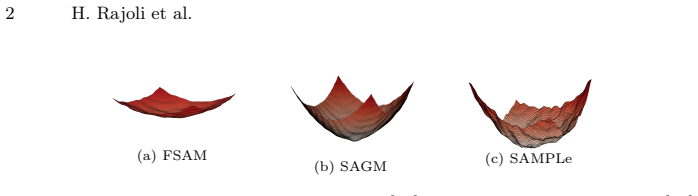
SAMPLe improves generalization of prompt learning by solving, at every step, a dual-objective loss that jointly minimizes empirical risk and enforces orthogonality of the perturbed gradient to the full-batch direction; the resulting flatter, still-low-loss minima transfer better to unseen classes and domains than ordinary SAM, F-SAM or SAGM.
What carries the argument
The dual-objective update of Eq. 10–14: SAM-style ascent to a nearby point, followed by a correction that subtracts the projection onto the full-batch gradient so the final step is forced toward the batch-specific (orthogonal) direction while remaining aligned with the current mini-batch gradient.
Load-bearing premise
The method assumes that a cheap exponential moving average of mini-batch gradients is a faithful enough stand-in for the true full-batch gradient that the orthogonality constraint actually steers the optimizer into flatter regions rather than merely adding noise.
What would settle it
Replace the EMA full-gradient estimate with the true full-batch gradient (or measure its cosine error on the prompt parameters) and check whether the reported gains in harmonic mean and domain-shift accuracy disappear or reverse.
Editorial analysis
A structured set of objections, weighed in public.
Referee Report
Summary. The paper proposes SAMPLe, a plug-in sharpness-aware optimizer for prompt learning in VLMs. It addresses the performance–generalization trade-off of learnable prompts by a dual-objective loss (Eq. 10) that simultaneously minimizes empirical risk and a perturbed loss while enforcing (i) alignment of the perturbed gradient with the mini-batch gradient (exploitation) and (ii) orthogonality of that gradient to an EMA approximation of the full-batch gradient (exploration). The method is integrated into CoOp, CoCoOp, MaPLe, CoPrompt and TCP and evaluated on base-to-new, cross-dataset and cross-domain protocols over 11 datasets. A convergence rate of O(log T / √T) is proved under standard bounded-gradient and K-Lipschitz assumptions (Thm. 1 / Appendix 8.1). Empirically, SAMPLe raises harmonic-mean accuracy relative to SAM, F-SAM and SAGM for every backbone (Table 1) and improves transfer averages (Tables 2–3).
Significance. If the dual-constraint geometry is the operative mechanism, SAMPLe supplies a clean, model-agnostic optimizer that consistently improves five distinct prompt learners without architectural changes. The breadth of the experimental suite (five methods × eleven datasets × three protocols), the term-wise ablation (Appendix Table 6), the sensitivity plots for ρ and λ (Fig. 3), and the standard-rate convergence proof are genuine strengths that make the work useful to the prompt-learning community even if the precise geometric story requires further verification.
major comments (2)
- [Sec. 3.1, 4.2 (Eqs. 9, 13–14)] Sec. 3.1 and 4.2 (Eqs. 9, 13–14): the entire dual-objective argument treats the EMA mt as a faithful proxy for the true full-batch gradient ∇F L. No cosine-similarity, norm-error or other fidelity metric between mt and the exact full-batch gradient on the prompt parameters is reported, nor is an exact-full-batch ablation provided. Because the prompt space is tiny, modest EMA lag can turn the claimed orthogonal-exploration term into unstructured noise; the observed HM gains over F-SAM/SAGM could therefore arise from a different effect of the α-term. A short diagnostic (or exact-full-batch control) is needed to substantiate the mechanistic claim.
- [Table 1, Fig. 3] Table 1 and Fig. 3: while average HM improvements are consistent, several individual base/new cells show non-monotonic or mixed behaviour (e.g., CoOp+SAMPLe base accuracy drops on StanfordCars relative to CoOp+FSAM; MaPLe+SAMPLe is essentially tied with MaPLe+SAGM on Food101). The paper asserts that SAMPLe “does not sacrifice one [base/new] in favour of the other,” yet the per-dataset tables contain counter-examples. A brief discussion of when the dual constraints fail to preserve base accuracy would strengthen the central claim.
minor comments (5)
- [Fig. 1] Fig. 1 caption and surrounding text claim that SAMPLe reaches both flatter minima and lower empirical risk; the visualisation is qualitative only. A quantitative sharpness measure (e.g., largest Hessian eigenvalue or average loss in a ρ-ball) would make the landscape claim more rigorous.
- [Algorithm 1] Algorithm 1 line 10 writes θ t ← heta t − ηt abla L( heta t;D) after computing the dual objective; it is unclear whether the gradient of the full dual loss or only the ERM term is used for the parameter update. Clarifying the exact gradient that is back-propagated would aid reproducibility.
- [Sec. 3.1–4.2] Notation for the full-batch gradient alternates between abla F L, mt and abla LF; a single consistent symbol would improve readability.
- [Table 3] Table 3 contains a typographical error (“71,03” instead of “71.03”) for CoCoOp+SAMPLe on ImageNet.
- [Appendix 8.6] The staged-training protocol used for MaPLe and CoPrompt (Appendix 8.6) is described only briefly; stating whether the same schedule is applied to the SAM/F-SAM/SAGM baselines would remove a possible confound.
Circularity Check
No circularity: dual-objective is an explicit design choice verified by algebra, not a prediction forced by its own inputs or self-citation.
full rationale
The paper proposes an optimizer (Eq. 10) whose form is deliberately chosen to encode two gradient constraints (ERM alignment of the perturbed gradient plus orthogonality to the full-batch direction). The subsequent Taylor expansion (Eqs. 11–14) and the cancellation that isolates the batch-specific component are pure algebraic consequences of that definition; they do not claim to derive an independent physical or statistical quantity. Convergence (Theorem 1) follows standard first-order arguments under Lipschitz and bounded-gradient assumptions that do not embed the reported accuracy numbers. Empirical gains (Tables 1–3) are measured on held-out base/new splits and external ImageNet variants never used to set ρ, α or λ. Self-citations are limited to ordinary SAM literature and do not supply a uniqueness theorem or load-bearing premise. The EMA approximation mt is an unvalidated modeling assumption, but that is a correctness risk, not circularity. Nothing reduces by construction to a fitted performance metric.
Axiom & Free-Parameter Ledger
free parameters (3)
- perturbation radius ρ =
0.05–0.10
- alignment coefficient α =
0.0015
- EMA decay λ =
0.15
axioms (4)
- standard math Loss gradient is bounded: ∥∇L(θt;D)∥ ≤ ∇Lmax for all t
- standard math Stochastic gradient is K-Lipschitz
- domain assumption EMA mt of mini-batch gradients is a faithful proxy for the true full-batch gradient ∇F L
- domain assumption First-order Taylor expansion adequately approximates the inner max of SAM
invented entities (1)
-
SAMPLe dual-objective loss (Eq. 10)
no independent evidence
read the original abstract
Pre-trained Vision-Language Models (VLMs) like CLIP have proven highly effective as foundation models for various downstream applications. However, prompt learning in VLMs encounters a performance-generalization dilemma: while prompts can be tuned to achieve high accuracy on seen distributions, this tuning process often undermines their generalizability to unseen data. The limited set of learnable prompts, which contextualize and condition the input to steer it toward the task within the pretrained VLM, tends to overfit the training data, leading to a trade-off between task-specific performance and preserving generalization. To address this dilemma, we introduce SAMPLe (Sharpness-Aware Minimization Prompt Learning), a plug-in sharpness-aware optimizer that enhances prompt generalizability by accounting for loss landscape sharpness. Unlike conventional methods, SAMPLe balances exploration and exploitation by satisfying objective function constraints at each step, dynamically adapting to the current optimization state based on the local curvature and gradient properties. This approach reduces overfitting on seen distributions and improves adaptability to unseen data, preserving the generalization potential of pre-trained VLM models. We integrate SAMPLe into multiple prompt learning frameworks, including CoOp, CoCoOp, MaPLe, TCP, and Co-Prompt, demonstrating its effectiveness across diverse methods. Experiments show that SAMPLe elevates prompt learning frameworks and consistently outperforms existing optimizers across diverse settings, establishing itself as a robust, model-agnostic solution for prompt learning.
Figures


Reference graph
Works this paper leans on
-
[1]
Sharpness-Aware Minimization Improves Language Model Generalization
Bahri, D., Mobahi, H., Tay, Y.: Sharpness-aware minimization improves language model generalization. arXiv preprint arXiv:2110.08529 (2021)
work page internal anchor Pith review Pith/arXiv arXiv 2021
-
[2]
Bossard, L., Guillaumin, M., Van Gool, L.: Food-101–mining discriminative com- ponents with random forests. In: Computer vision–ECCV 2014: 13th European conference, zurich, Switzerland, September 6-12, 2014, proceedings, part VI 13. pp. 446–461. Springer (2014)
work page 2014
-
[3]
In: International conference on machine learning
Chen, T., Kornblith, S., Norouzi, M., Hinton, G.: A simple framework for contrastive learning of visual representations. In: International conference on machine learning. pp. 1597–1607. PMLR (2020)
work page 2020
-
[4]
Chen, X., Hsieh, C.J., Gong, B.: When vision transformers outperform resnets without pre-training or strong data augmentations. ICLR (2022)
work page 2022
-
[5]
In: Proceedings of the IEEE/CVF Conference on Computer Vision and Pattern Recognition
Cimpoi, M., Maji, S., Kokkinos, I., Mohamed, S., Vedaldi, A.: Describing textures in the wild. In: Proceedings of the IEEE/CVF Conference on Computer Vision and Pattern Recognition. pp. 3606–3613 (2014)
work page 2014
-
[6]
In: Proceedings of the IEEE/CVF Conference on Computer Vision and Pattern Recognition
Deng, J., Dong, W., Socher, R., Li, L.J., Li, K., Fei-Fei, L.: Imagenet: A large-scale hierarchical image database. In: Proceedings of the IEEE/CVF Conference on Computer Vision and Pattern Recognition. pp. 248–255. Ieee (2009)
work page 2009
-
[7]
LPT: Less-overfitting Prompt Tuning for Vision-Language Model
Ding, C., Gao, X., Dong, S., He, Y., Wang, Q., Kot, A., Gong, Y.: Lobg: less overfitting for better generalization in vision-language model. arXiv preprint arXiv:2410.10247 (2024)
work page internal anchor Pith review Pith/arXiv arXiv 2024
-
[8]
Dziugaite, G.K., Roy, D.M.: Computing nonvacuous generalization bounds for deep (stochastic) neural networks with many more parameters than training data. arXiv preprint arXiv:1703.11008 (2017)
work page internal anchor Pith review Pith/arXiv arXiv 2017
-
[9]
In: 2004 Conference on Computer Vision and Pattern Recognition Workshop
Fei-Fei, L., Fergus, R., Perona, P.: Learning generative visual models from few training examples: An incremental bayesian approach tested on 101 object categories. In: 2004 Conference on Computer Vision and Pattern Recognition Workshop. pp. 178–178 (2004).https://doi.org/10.1109/CVPR.2004.383
-
[10]
Sharpness-Aware Minimization for Efficiently Improving Generalization
Foret, P., Kleiner, A., Mobahi, H., Neyshabur, B.: Sharpness-aware minimization for efficiently improving generalization. arXiv preprint arXiv:2010.01412 (2020)
work page internal anchor Pith review Pith/arXiv arXiv 2010
-
[11]
In: International Conference on Learning Representations (2021)
Foret, P., Kleiner, A., Mobahi, H., Neyshabur, B.: Sharpness-aware minimization for efficiently improving generalization. In: International Conference on Learning Representations (2021)
work page 2021
-
[12]
Helber, P., Bischke, B., Dengel, A., Borth, D.: Eurosat: A novel dataset and deep learning benchmark for land use and land cover classification. IEEE Journal of Selected Topics in Applied Earth Observations and Remote Sensing12(7), 2217– 2226 (2019)
work page 2019
-
[13]
In: Proceedings of the IEEE/CVF international conference on computer vision
Hendrycks, D., Basart, S., Mu, N., Kadavath, S., Wang, F., Dorundo, E., Desai, R., Zhu, T., Parajuli, S., Guo, M., et al.: The many faces of robustness: A critical analysis of out-of-distribution generalization. In: Proceedings of the IEEE/CVF international conference on computer vision. pp. 8340–8349 (2021)
work page 2021
-
[14]
In: Proceedings of the IEEE/CVF Conference on Computer Vision and Pattern Recognition
Hendrycks, D., Zhao, K., Basart, S., Steinhardt, J., Song, D.: Natural adversarial examples. In: Proceedings of the IEEE/CVF Conference on Computer Vision and Pattern Recognition. pp. 15262–15271 (2021)
work page 2021
-
[15]
In: ICLR (2025),https://openreview.net/forum?id=vf5aUZT0Fz
Iacob, A., Sani, L., Kurmanji, M., Shen, W.F., Qiu, X., Cai, D., Gao, Y., Lane, N.D.: DEPT: Decoupled embeddings for pre-training language models. In: ICLR (2025),https://openreview.net/forum?id=vf5aUZT0Fz
work page 2025
-
[16]
Ishida, T., Yamane, I., Sakai, T., Niu, G., Sugiyama, M.: Do we need zero training loss after achieving zero training error? ICML’20, JMLR.org (2020) SAMPLe: SAM-based Optimizer for Prompt Learning in VLMs 17
work page 2020
-
[17]
In: Annual Conference of the European Association for Computer Graphics, Eurographics (2022)
Jetly, V., Ibayashi, H.: Splash in a flash: Sharpness-aware minimization for efficient liquid splash simulation. In: Annual Conference of the European Association for Computer Graphics, Eurographics (2022)
work page 2022
-
[18]
In: International conference on machine learning
Jia, C., Yang, Y., Xia, Y., Chen, Y.T., Parekh, Z., Pham, H., Le, Q., Sung, Y.H., Li, Z., Duerig, T.: Scaling up visual and vision-language representation learning with noisy text supervision. In: International conference on machine learning. pp. 4904–4916. PMLR (2021)
work page 2021
-
[19]
On Large-Batch Training for Deep Learning: Generalization Gap and Sharp Minima
Keskar, N.S., Mudigere, D., Nocedal, J., Smelyanskiy, M., Tang, P.T.P.: On large- batch training for deep learning: Generalization gap and sharp minima. arXiv preprint arXiv:1609.04836 (2016)
work page internal anchor Pith review Pith/arXiv arXiv 2016
-
[20]
In: Proceedings of the IEEE/CVF Conference on Computer Vision and Pattern Recognition
Khattak, M.U., Rasheed, H., Maaz, M., Khan, S., Khan, F.S.: Maple: Multi-modal prompt learning. In: Proceedings of the IEEE/CVF Conference on Computer Vision and Pattern Recognition. pp. 19113–19122 (2023)
work page 2023
-
[21]
In: Proceedings of the IEEE/CVF International Conference on Computer Vision
Khattak, M.U., Wasim, S.T., Naseer, M., Khan, S., Yang, M.H., Khan, F.S.: Self-regulating prompts: Foundational model adaptation without forgetting. In: Proceedings of the IEEE/CVF International Conference on Computer Vision. pp. 15190–15200 (2023)
work page 2023
-
[22]
In: International Conference on Machine Learning
Kim, M., Li, D., Hu, S.X., Hospedales, T.: Fisher sam: Information geometry and sharpness aware minimisation. In: International Conference on Machine Learning. pp. 11148–11161. PMLR (2022)
work page 2022
-
[23]
In: Proceedings of the IEEE/CVF Conference on Computer Vision and Pattern Recognition Workshops
Krause, J., Stark, M., Deng, J., Fei-Fei, L.: 3d object representations for fine-grained categorization. In: Proceedings of the IEEE/CVF Conference on Computer Vision and Pattern Recognition Workshops. pp. 554–561 (2013)
work page 2013
-
[24]
In: International Conference on Machine Learning
Kwon, J., Kim, J., Park, H., Choi, I.K.: Asam: Adaptive sharpness-aware min- imization for scale-invariant learning of deep neural networks. In: International Conference on Machine Learning. pp. 5905–5914. PMLR (2021)
work page 2021
-
[25]
In: Proceedings of the IEEE/CVF Conference on Computer Vision and Pattern Recognition
Li, T., Zhou, P., He, Z., Cheng, X., Huang, X.: Friendly sharpness-aware mini- mization. In: Proceedings of the IEEE/CVF Conference on Computer Vision and Pattern Recognition. pp. 5631–5640 (2024)
work page 2024
-
[26]
IEEE Transactions on Multimedia pp
Liu, L., Wang, N., Zhou, D., Liu, D., Yang, X., Gao, X., Liu, T.: Generalizable prompt learning via gradient constrained sharpness-aware minimization. IEEE Transactions on Multimedia pp. 1–14 (2024).https://doi.org/10.1109/TMM. 2024.3521702
work page doi:10.1109/tmm 2024
-
[27]
IEEE Transactions on Machine Learning in Communications and Networking4, 98–114 (2025)
Lotfi, F., Rajoli, H., Afghah, F.: Task-specific sharpness-aware o-ran resource man- agement using multi-agent reinforcement learning. IEEE Transactions on Machine Learning in Communications and Networking4, 98–114 (2025)
work page 2025
-
[28]
In: Proceedings of the IEEE/CVF Conference on Computer Vision and Pattern Recog- nition
Lu, Y., Liu, J., Zhang, Y., Liu, Y., Tian, X.: Prompt distribution learning. In: Proceedings of the IEEE/CVF Conference on Computer Vision and Pattern Recog- nition. pp. 5206–5215 (2022)
work page 2022
-
[29]
Fine-Grained Visual Classification of Aircraft
Maji, S., Rahtu, E., Kannala, J., Blaschko, M., Vedaldi, A.: Fine-grained visual classification of aircraft. arXiv preprint arXiv:1306.5151 (2013)
work page internal anchor Pith review Pith/arXiv arXiv 2013
-
[30]
In: 2008 Sixth Indian conference on computer vision, graphics & image processing
Nilsback, M.E., Zisserman, A.: Automated flower classification over a large number of classes. In: 2008 Sixth Indian conference on computer vision, graphics & image processing. pp. 722–729. IEEE (2008)
work page 2008
-
[31]
Sensitivity and Generalization in Neural Networks: an Empirical Study
Novak, R., Bahri, Y., Abolafia, D.A., Pennington, J., Sohl-Dickstein, J.: Sensi- tivity and generalization in neural networks: an empirical study. arXiv preprint arXiv:1802.08760 (2018)
work page internal anchor Pith review Pith/arXiv arXiv 2018
-
[32]
In: Proceed- ings of the IEEE/CVF Conference on Computer Vision and Pattern Recognition
Parkhi, O.M., Vedaldi, A., Zisserman, A., Jawahar, C.: Cats and dogs. In: Proceed- ings of the IEEE/CVF Conference on Computer Vision and Pattern Recognition. pp. 3498–3505. IEEE (2012) 18 H. Rajoli et al
work page 2012
-
[33]
In: International conference on machine learning
Radford, A., Kim, J.W., Hallacy, C., Ramesh, A., Goh, G., Agarwal, S., Sastry, G., Askell, A., Mishkin, P., Clark, J., et al.: Learning transferable visual models from natural language supervision. In: International conference on machine learning. pp. 8748–8763. PMLR (2021)
work page 2021
-
[34]
Advances in Neural Information Processing Systems38, 168772–168794 (2026)
Rajoli Nowdeh, H., Ji, J., Ma, X., Afghah, F.: Modality-aware sam: Sharpness- aware-minimization driven gradient modulation for harmonized multimodal learning. Advances in Neural Information Processing Systems38, 168772–168794 (2026)
work page 2026
-
[35]
Recht, B., Roelofs, R., Schmidt, L., Shankar, V.: Do imagenet classifiers generalize to imagenet? In: International Conference on Machine Learning. pp. 5389–5400. PMLR (2019)
work page 2019
-
[36]
UCF101: A Dataset of 101 Human Actions Classes From Videos in The Wild
Soomro, K.: Ucf101: A dataset of 101 human actions classes from videos in the wild. arXiv preprint arXiv:1212.0402 (2012)
work page internal anchor Pith review Pith/arXiv arXiv 2012
-
[37]
Advances in Neural Information Processing Systems32(2019)
Wang, H., Ge, S., Lipton, Z., Xing, E.P.: Learning robust global representations by penalizing local predictive power. Advances in Neural Information Processing Systems32(2019)
work page 2019
-
[38]
In: Proceedings of the IEEE/CVF Conference on Computer Vision and Pattern Recognition
Wang, P., Zhang, Z., Lei, Z., Zhang, L.: Sharpness-aware gradient matching for domain generalization. In: Proceedings of the IEEE/CVF Conference on Computer Vision and Pattern Recognition. pp. 3769–3778 (2023)
work page 2023
-
[39]
In: Proceedings of the IEEE/CVF Conference on Computer Vision and Pattern Recognition
Xiao, J., Hays, J., Ehinger, K.A., Oliva, A., Torralba, A.: Sun database: Large-scale scene recognition from abbey to zoo. In: Proceedings of the IEEE/CVF Conference on Computer Vision and Pattern Recognition. pp. 3485–3492. IEEE (2010)
work page 2010
-
[40]
In: Proceedings of the IEEE/CVF Conference on Computer Vision and Pattern Recognition
Yao, H., Zhang, R., Xu, C.: Visual-language prompt tuning with knowledge-guided context optimization. In: Proceedings of the IEEE/CVF Conference on Computer Vision and Pattern Recognition. pp. 6757–6767 (2023)
work page 2023
-
[41]
In: Proceedings of the IEEE/CVF Conference on Computer Vision and Pattern Recognition
Yao, H., Zhang, R., Xu, C.: Tcp: Textual-based class-aware prompt tuning for visual-language model. In: Proceedings of the IEEE/CVF Conference on Computer Vision and Pattern Recognition. pp. 23438–23448 (2024)
work page 2024
-
[42]
FILIP: Fine-grained Interactive Language-Image Pre-Training
Yao, L., Huang, R., Hou, L., Lu, G., Niu, M., Xu, H., Liang, X., Li, Z., Jiang, X., Xu, C.: Filip: Fine-grained interactive language-image pre-training. arXiv preprint arXiv:2111.07783 (2021)
work page internal anchor Pith review Pith/arXiv arXiv 2021
-
[43]
Medical image analysis 12(5), 603–615 (2008)
Yeo, B.T., Sabuncu, M.R., Desikan, R., Fischl, B., Golland, P.: Effects of registration regularization and atlas sharpness on segmentation accuracy. Medical image analysis 12(5), 603–615 (2008)
work page 2008
-
[44]
In: Proceedings of the IEEE/CVF Conference on Computer Vision and Pattern Recognition
Zhai, X., Wang, X., Mustafa, B., Steiner, A., Keysers, D., Kolesnikov, A., Beyer, L.: Lit: Zero-shot transfer with locked-image text tuning. In: Proceedings of the IEEE/CVF Conference on Computer Vision and Pattern Recognition. pp. 18123– 18133 (2022)
work page 2022
-
[45]
IEEE Transactions on Pattern Analysis and Machine Intelligence (2024)
Zhang, J., Huang, J., Jin, S., Lu, S.: Vision-language models for vision tasks: A survey. IEEE Transactions on Pattern Analysis and Machine Intelligence (2024)
work page 2024
-
[46]
In: Proceedings of the IEEE/CVF Conference on Computer Vision and Pattern Recognition
Zhang, X., Xu, R., Yu, H., Zou, H., Cui, P.: Gradient norm aware minimization seeks first-order flatness and improves generalization. In: Proceedings of the IEEE/CVF Conference on Computer Vision and Pattern Recognition. pp. 20247–20257 (2023)
work page 2023
-
[47]
In: 2022 IEEE/CVF Conference on Computer Vision and Pat- tern Recognition (CVPR)
Zhou, K., Yang, J., Loy, C.C., Liu, Z.: Conditional prompt learning for vision- language models. In: 2022 IEEE/CVF Conference on Computer Vision and Pat- tern Recognition (CVPR). pp. 16795–16804 (2022).https://doi.org/10.1109/ CVPR52688.2022.01631
-
[48]
International Journal of Computer Vision130(9), 2337–2348 (2022)
Zhou, K., Yang, J., Loy, C.C., Liu, Z.: Learning to prompt for vision-language models. International Journal of Computer Vision130(9), 2337–2348 (2022)
work page 2022
-
[49]
Zhou, Z., Dong, S., Ding, C., Gao, X., He, Y., Gong, Y.: Diversity covariance-aware prompt learning for vision-language models. Pattern Recognition p. 112806 (2025) SAMPLe: SAM-based Optimizer for Prompt Learning in VLMs 19
work page 2025
-
[50]
In: Proceedings of the IEEE/CVF International Conference on Computer Vision
Zhu, B., Niu, Y., Han, Y., Wu, Y., Zhang, H.: Prompt-aligned gradient for prompt tuning. In: Proceedings of the IEEE/CVF International Conference on Computer Vision. pp. 15659–15669 (2023)
work page 2023
-
[51]
Zhuang, J., Gong, B., Yuan, L., Cui, Y., Adam, H., Dvornek, N., Tatikonda, S., Duncan, J., Liu, T.: Surrogate gap minimization improves sharpness-aware training. ICLR (2021) SAMPLe: SAM-based Optimizer for Prompt Learning in VLMs 1 8 Appendix In this supplementary material, we begin with the proof of Theorem1, followed by a comprehensive comparison of var...
work page 2021
discussion (0)
Sign in with ORCID, Apple, or X to comment. Anyone can read and Pith papers without signing in.