REVIEW 3 major objections 4 minor 17 references
The Curious Language Model: Strategic Test-Time Information Acquisition
T0 review · 3 major / 4 minor · reviewed 2026-08-07 · deepseek-v4-flash
Pith's one-line read CuriosiTree is a zero-shot, test-time policy that scores each candidate information-gathering action by simulated expected information gain minus a cost penalty, chooses the best by greedy tree search, and — in a clinical diagnosis…
desk verdict CuriosiTree is a genuinely new cost-aware test-time information-acquisition framework, but the reported quantitative evidence is too thin and the same-model simulator loop leaves the headline efficiency claim conditional. read the letter →
The pith
A machine-rendered reading of the paper's core claim, the machinery that carries it, and where it could break.
The reading
What carries the argument
The load-bearing object is the selection rule $\widehat{\mathrm{EIG}}(a) - \lambda c(a)$ (Equation 5), computed as a Monte Carlo estimate over a prompted environment simulator $\hat{E}$ with prior locking: for each candidate action and each of the top-$k$ candidate diagnoses, the simulator is asked to produce the outcome a patient or test would give if that diagnosis were true, and a logical-consistency mask $A \in \{0,1\}^k$ records which candidates survive the simulated evidence. The surrogate $\widehat{\mathrm{EIG}} = -\log\bigl((1/k)\sum_l A_l\bigr)$ then measures how many hypotheses an action would eliminate, standing in for the analytically intractable entropy reduction of Equation 4. This machinery converts 'which query is worth its price?' into a handful of parallel LLM calls, and the greedy loop — predict when the top class exceeds threshold $\tau$, otherwise buy the highest-scoring affordable action, until budget $B$ runs out — is what carries the conclusion that cost-aware exploration beats implicit self-evaluation.
What would settle it
Run the same ten-diagnosis protocol with a deliberately degraded simulator: for example, a $\hat{E}$ that answers 'I don't know' to a fixed fraction of patient questions, or a different model family with weaker medical knowledge, while the real environment $E$ keeps its current oracle behavior. If CuriosiTree's success rate and cost advantage over Random Action Selection do not shrink monotonically as $\hat{E}$ diverges from $E$, the claim that simulator-based expected information gain is what drives the gains would be undercut.
Extended reading notes
Core claim
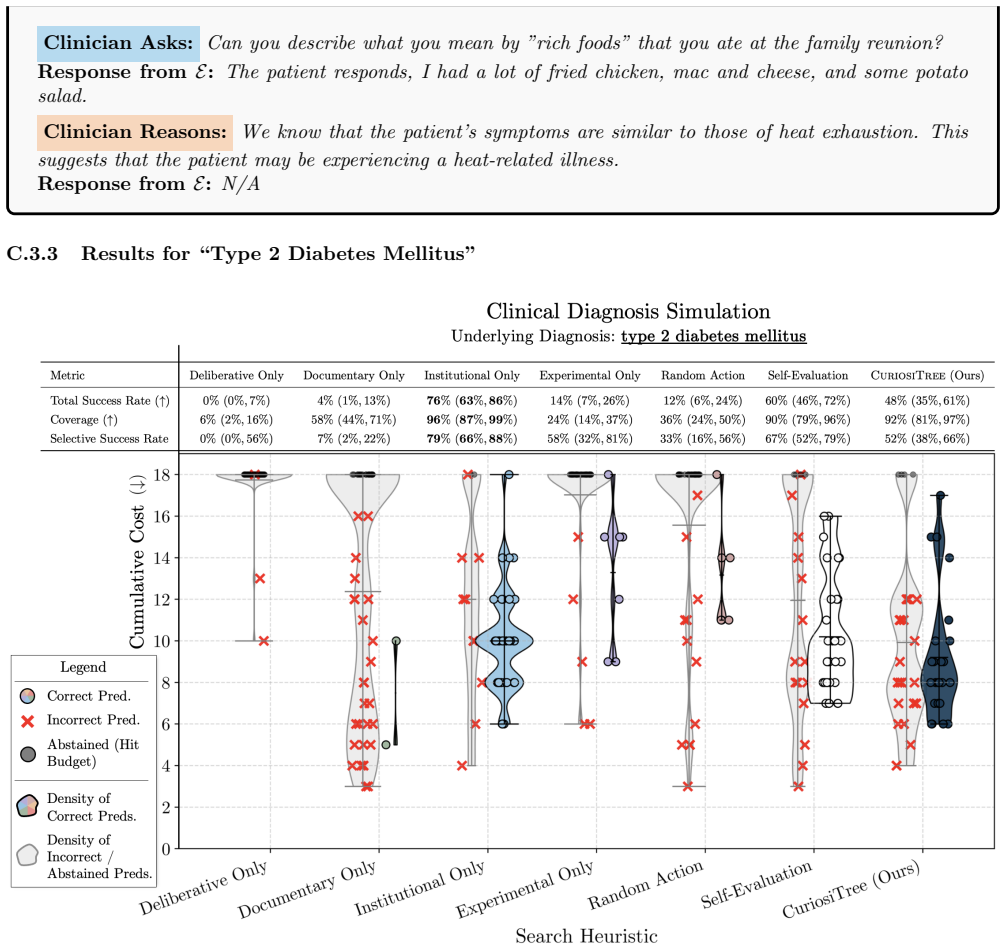
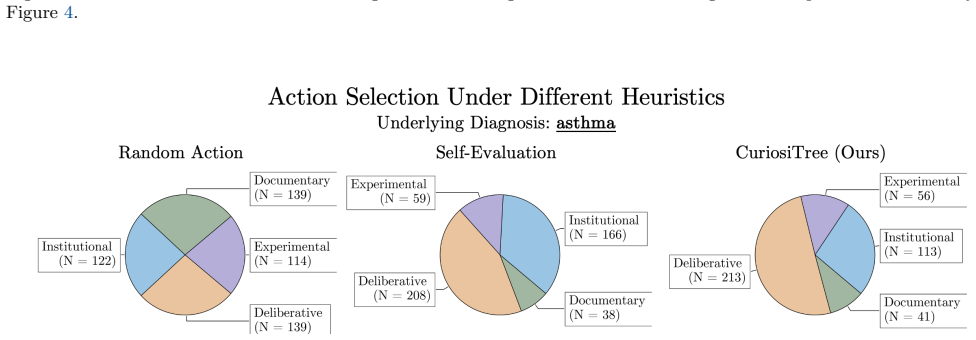
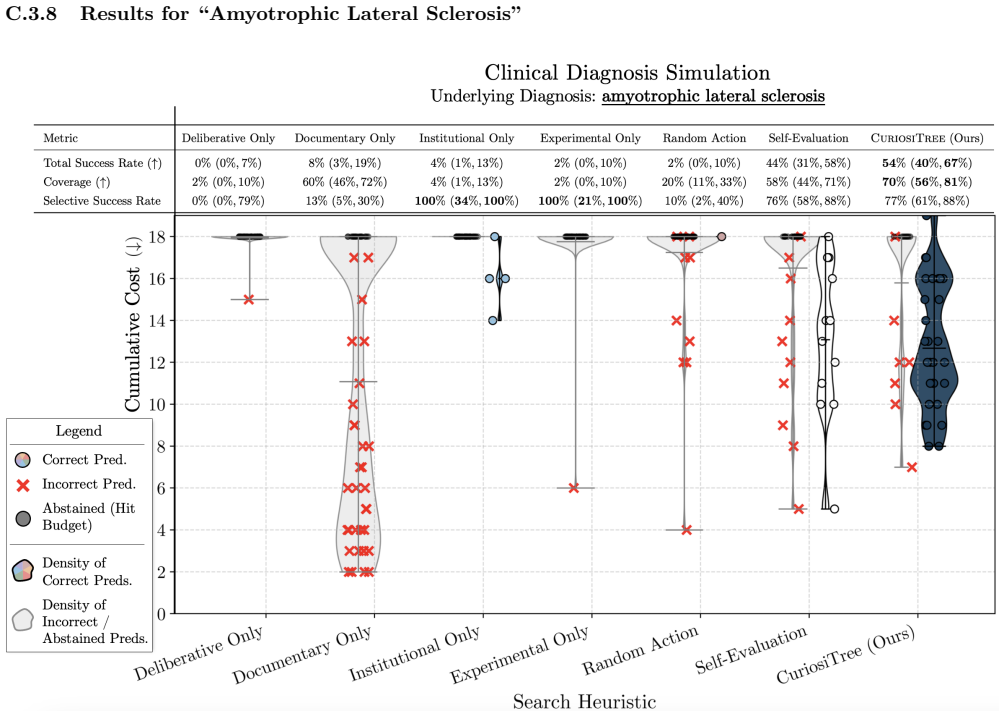
On its own terms, the paper establishes that a greedy tree-search policy driven by a cost-penalized expected information gain is a better zero-shot guide for LLM information acquisition than the alternatives it tests. At each step the policy samples $k'$ candidate actions from four classes — deliberative reasoning, Wikipedia retrieval, patient questions, and laboratory test requisitions — simulates each under an approximate environment model $\hat{E}$ implemented by prompting, and selects the action maximizing $\widehat{\mathrm{EIG}}(\tilde a_t \mid X^{(i)}_{d_t}) - \lambda c(\tilde a_t)$ (Equation 5). Because true entropies are unavailable from the model's top-$k$ scored lists, the paper operates on a surrogate: it asks the model which candidate diagnoses remain logically consistent with each simulated outcome and sets $\widehat{\mathrm{EIG}} = -\log\bigl((1/k)\sum A\bigr)$, the log of the surviving fraction, with 'prior locking' conditioning each simulation on one of the top-$k$ labels. The empirical claim is that in the lupus testbed and the other diagnoses in the supplement, this heuristic yields higher total and selective success rates with lower cumulative cost than Random Action Selection, Self-Evaluation, and each unimodal policy, while the method's action-class mix shows it discovering that institutional (patient) knowledge is the most efficient channel.
Load-bearing premise
The policy's rankings are only as good as the prompted environment simulator that imagines what each question, test, or search would return; if that simulator shares the acting model's blind spots, the information-gain scores can be confident but wrong, and the paper does not show how the advantage decays as the simulator drifts further from the real environment.
Editorial extensions
If this is right
- Closed, API-served LLMs can run the whole policy — sampling, simulation, scoring, prediction — through prompts and constrained decoding alone, with no access to weights or gradients.
- With a confidence threshold $\tau$ and budget $B$, the system abstains rather than guesses when information is too expensive, so deployment can guarantee a minimum predicted-probability bar.
- The action-class analysis implies that no single information channel is enough: intrinsic reasoning and document retrieval alone never produced a correct diagnosis in the main testbed, whereas the mixed policy diagnosed successfully.
- Reasoning steps in 84% of the examined trials left the leading diagnosis unchanged while often tightening the distribution, so intrinsic deliberation functions as a confidence sharpener inside the acquisition loop.
- The framework is stated for any sequential classification setting with heterogeneous, priced information sources, not only medicine; the cost-ordering and budget machinery carry over directly.
Reading between the lines
- Because the surrogate rewards eliminating top-$k$ candidates, it implicitly assumes the true diagnosis is already on the list; a testable extension is to seed the candidate list with a deliberately wrong or deliberately absent ground truth and measure how quickly questions or tests reintroduce it.
- Clinician, simulator, and environment are all the same underlying Llama-3.1-70B model with different prompts, so shared inductive biases could make simulated outcomes look more informative than a truly independent source would; using a second, independently trained model for $\hat{E}$ would quantify this.
- The cost scheme (reasoning and retrieval at 1, patient question at 2, lab test at 3) and the fixed tradeoff $\lambda = 0.1$ are choices, not measurements; sweeping $\lambda$ per diagnosis or measuring against real test prices would test whether the advantage survives accurate costs.
- The method's heavy reliance on institutional knowledge suggests its edge over baselines may depend on how descriptive the patient simulator is; a terse patient simulator is a direct stress test of that dependence.
Editorial analysis
A structured set of objections, weighed in public.
Referee Report
Summary. The paper proposes CuriosiTree, a zero-shot test-time policy for selective information acquisition by large language models. Given a predictive distribution from an LLM, CuriosiTree scores candidate actions by a Monte Carlo estimate of expected information gain under a learned environment simulator minus a cost penalty (Equation 5), and iteratively selects actions until a confidence threshold is met or a budget is exhausted. The method is validated in a simulated clinical diagnosis setting with four action types (reasoning, retrieval, patient questions, laboratory tests) against unimodal and multimodal baselines. The authors report higher total success rate and coverage at lower cumulative cost for the diagnosis 'lupus' in the main text, with additional diagnoses in the supplement.
Significance. If the central claim holds, the paper makes a useful contribution: it offers a decision-theoretic framework for integrating heterogeneous information sources at test time without fine-tuning, and it demonstrates that a heuristic tree-search policy can outperform random and self-evaluative baselines. Strengths include a clear formalization (Equations 4-5), a transparent implementation with structured decoding and prior locking, a public code repository, and extensive supplementary prompts and qualitative transcripts. The Information Ecosystem taxonomy, while not strictly necessary for the method, provides a useful conceptual backdrop. However, the empirical support is currently conditional on several untested assumptions about the simulator and on statistical reporting that is not yet sufficient to support the strength of the claims.
major comments (3)
- [Sections 3.3, 3.4, and 4.1] The central quantitative claim is conditional on an unvalidated alignment between the environment simulator bE and the actual environment E. Equation 5 scores actions entirely by simulation under bE, while in the experiments E is implemented by the same Llama-3.1-70B-Instruct model family, prompted differently. Because the clinician, the consistency checker, and E are all instances of the same model, the surrogate dEIG may reflect the model's own semantic priors rather than true environmental information. The paper states that bE is prompted differently to emulate an imperfect simulator, but it does not report any agreement statistic between bE's simulated outcomes and E's actual outcomes, nor does it vary the simulator family or deliberately corrupt bE. I request a mismatched-simulator experiment (e.g., using a different model family for bE than for E, or adding noise to simulated outcomes) and a quantitative comparison of simulated versus actual outcomes; without such evidence, the reported advantage over baselines could be an artifact of self-consistency.
- [Section 4.3 and Figure 4] The headline result is based on 50 trials for a single diagnosis ('lupus'), with no confidence intervals or significance tests. The text says CuriosiTree 'enjoys a significantly higher Total Success Rate and Coverage' and 'visually achieves higher success', but no error bars or p-values are provided; a 50-trial difference could be within sampling error. The additional diagnoses are relegated to the supplement, also without error bounds. Please report per-diagnosis and aggregate statistics with confidence intervals and, where appropriate, a sign test or bootstrapped comparison against baselines, so that the reader can assess the robustness of the superiority claim.
- [Section 3.4 and Algorithm 1] The surrogate dEIG is computed by asking the same LLM to return a boolean consistency mask over the current top-k predictions. Since this mask is itself a semantic judgment by the same model, it is not an independent measure of information gain. The paper acknowledges the bias when the true label is not in the top-k, but it does not assess how often this occurs or how sensitive the behavior is to k. Please report the frequency with which the ground-truth label falls outside the top-k during trajectories, and analyze how the surrogate's performance varies with k; this is a load-bearing component of the method, and its failure mode should be empirically characterized.
minor comments (4)
- [Section 5 (Intrinsic Knowledge)] In the paragraph 'Intrinsic Knowledge May Serve to Sharpen the Predictive Distribution', the phrase 'without altering the its most likely prediction' should read 'without altering its most likely prediction.'
- [Section 4.3] The text 'The multimodal baselines, in constrast, contrast the' contains a typo: 'in constrast' should be 'in contrast.'
- [References] In the reference list, the Shannon entry gives the journal name as 'The Bell system technical journal'; it should be capitalized as 'The Bell System Technical Journal.'
- [Section 1.2] The second contribution bullet states that CuriosiTree 'acquires a greater quantity of relevant information at lower cumulative cost than other methods'; given the statistical reporting issue in Major Comment 2, this claim should be softened or supported by the requested error analysis.
Circularity Check
No significant circularity: CuriosiTree's decision-theoretic derivation is self-contained; the shared LLM between E and bE is a validity concern, not a definitional circularity.
full rationale
We walked the paper's derivation chain from Equation 4 through Algorithm 1 and the experimental protocol. The action utility is a standard Monte Carlo estimate of expected information gain, and the surrogate dEIG (Algorithm 1, lines 15-17) is explicitly framed as an approximation rather than as a fitted quantity. No parameter is fitted to the evaluation data and then reported as a prediction: lambda and tau are fixed constants, and the action-selection rule is a heuristic rather than a learned or calibrated model. The environment E and the simulator bE are distinct prompt instantiations over the same base LLM, and the paper's reported success rates are measured in E, not in bE. This raises an external-validity concern about whether the simulator faithfully captures real clinical response dynamics, but it is not a circular reduction: E is not defined in terms of bE, and dEIG is not equal to the E outcome by construction. There are no load-bearing self-citations, no imported uniqueness theorems, and no renamed known result masquerading as a prediction. We therefore find no specific circular step that can be exhibited under the analysis rules.
Assumptions & free parameters
free parameters (5)
- lambda (cost-utility tradeoff) =
0.1
- action costs c(a) =
reasoning=1, RAG=1, question=2, lab test=3
- k (top-k prediction count) and k' (action candidates) =
k not stated in main text; k' = 5 per action class, 20 total
- tau (confidence threshold) =
not stated in main text
- B (acquisition budget) =
not stated in main text
assumptions (3)
- domain assumption The LLM's top-k predictive distribution can be normalized to approximate the true posterior over diagnoses.
- domain assumption Logical consistency of candidates with simulated action outcomes is a valid proxy for expected information gain.
- domain assumption The LLM-based environment simulators, patient simulator, and oracle produce reliable and sufficiently realistic responses.
invented entities (1)
-
Information Ecosystem taxonomy partitions (direct, deliberative, documentary, institutional, experimental)
Cite this review
Pith. "Pith review of The Curious Language Model: Strategic Test-Time Information Acquisition." pith.science (2026). https://pith.science/paper/7XLGQ7JI
@misc{pith2026250609173,
  author       = {Pith},
  title        = {Pith review of: The Curious Language Model: Strategic Test-Time Information Acquisition},
  year         = {2026},
  howpublished = {\url{https://pith.science/paper/7XLGQ7JI}},
  note         = {Machine review of arXiv:2506.09173}
}
read the original abstract
Decision-makers often possess insufficient information to render a confident decision. In these cases, the decision-maker can often undertake actions to acquire the necessary information about the problem at hand, e.g., by consulting knowledgeable authorities or by conducting experiments. Importantly, different levers of information acquisition come with different costs, posing the challenge of selecting the actions that are both informative and cost-effective. In this work, we propose CuriosiTree, a heuristic-based, test-time policy for zero-shot information acquisition in large language models (LLMs). CuriosiTree employs a greedy tree search to estimate the expected information gain of each action and strategically chooses actions based on a balance of anticipated information gain and associated cost. Empirical validation in a clinical diagnosis simulation shows that CuriosiTree enables cost-effective integration of heterogenous sources of information, and outperforms baseline action selection strategies in selecting action sequences that enable accurate diagnosis.
Figures


Figures from the paper (20 more)








Reference graph
Works this paper leans on
-
[1]
Star-gate: Teaching language models to ask clarifying questions.arXiv preprint arXiv:2403.19154,
Chinmaya Andukuri, Jan-Philipp Fr¨ anken, Tobias Gerstenberg, and Noah D Goodman. Star-gate: Teaching language models to ask clarifying questions.arXiv preprint arXiv:2403.19154,
-
[4]
Reasoning with language model is planning with world model.arXiv preprint arXiv:2305.14992,
Shibo Hao, Yi Gu, Haodi Ma, Joshua Jiahua Hong, Zhen Wang, Daisy Zhe Wang, and Zhiting Hu. Reasoning with language model is planning with world model.arXiv preprint arXiv:2305.14992,
-
[5]
Yue Huang, Jiawen Shi, Yuan Li, Chenrui Fan, Siyuan Wu, Qihui Zhang, Yixin Liu, Pan Zhou, Yao Wan, Neil Zhen- qiang Gong, et al. Metatool benchmark for large language models: Deciding whether to use tools and which to use.arXiv preprint arXiv:2310.03128,
-
[6]
Zongliang Ji, Anna Goldenberg, and Rahul G Krishnan. Measurement scheduling for icu patients with offline reinforcement learning.arXiv preprint arXiv:2402.07344,
-
[7]
Which Questions Improve Learning the Most? Utility Estimation of Questions with LM-based Simulations
Dong-Ho Lee, Hyundong Cho, Jonathan May, and Jay Pujara. What is a good question? utility estimation with llm-based simulations.arXiv preprint arXiv:2502.17383,
-
[9]
Shuyue Stella Li, Jimin Mun, Faeze Brahman, Jonathan S Ilgen, Yulia Tsvetkov, and Maarten Sap. Aligning llms to ask good questions a case study in clinical reasoning.arXiv preprint arXiv:2502.14860, 2025b. Chris Lu, Cong Lu, Robert Tjarko Lange, Jakob Foerster, Jeff Clune, and David Ha. The ai scientist: Towards fully automated open-ended scientific disco...
-
[10]
Davide Mazzaccara, Alberto Testoni, and Raffaella Bernardi. Learning to ask informative questions: Enhancing llms with preference optimization and expected information gain.arXiv preprint arXiv:2406.17453,
-
[11]
Yusuf Roohani, Andrew Lee, Qian Huang, Jian Vora, Zachary Steinhart, Kexin Huang, Alexander Marson, Percy Liang, and Jure Leskovec. Biodiscoveryagent: An ai agent for designing genetic perturbation experiments.arXiv preprint arXiv:2405.17631,
Show all 17 references
-
[13]
Llms in the imaginarium: tool learning through simulated trial and error.arXiv preprint arXiv:2403.04746, 2024a
Boshi Wang, Hao Fang, Jason Eisner, Benjamin Van Durme, and Yu Su. Llms in the imaginarium: tool learning through simulated trial and error.arXiv preprint arXiv:2403.04746, 2024a. Wenxuan Wang, Juluan Shi, Chaozheng Wang, Cheryl Lee, Youliang Yuan, Jen-tse Huang, and Michael R...
-
[15]
Modeling future conversation turns to teach llms to ask clarifying questions.arXiv preprint arXiv:2410.13788,
Michael JQ Zhang, W Bradley Knox, and Eunsol Choi. Modeling future conversation turns to teach llms to ask clarifying questions.arXiv preprint arXiv:2410.13788,
-
[16]
Asthma” with CuriosiT ree Description:A sequence of actions and responses attempting to diagnose “asthma
Attempted Diagnosis of “Asthma” with CuriosiT ree Description:A sequence of actions and responses attempting to diagnose “asthma” usingCuriosiTree. Clinician Asks:What seems to be the main reason you’re visiting the clinic today? Response fromE:The patient responds, I’ve been ...
2024
-
[17]
Cystic Fibrosis
Unsuccessfully Diagnosing “Cystic Fibrosis” with CuriosiT ree Description:A sequence of actions and responses attempting to diagnose “cystic fibrosis” usingCu- riosiTree. 34 Clinician Asks:What brings you to the clinic today? Response fromE:The patient responds, I’ve been havi...
2024
-
[1924]
From selection to generation: A survey of llm-based active learning
Yu Xia, Subhojyoti Mukherjee, Zhouhang Xie, Junda Wu, Xintong Li, Ryan Aponte, Hanjia Lyu, Joe Barrow, Hongjie Chen, Franck Dernoncourt, et al. From selection to generation: A survey of llm-based active learning. arXiv preprint arXiv:2502.11767,
-
[1948]
Climategpt: Towards ai synthesizing interdisciplinary research on climate change.arXiv preprint arXiv:2401.09646,
David Thulke, Yingbo Gao, Petrus Pelser, Rein Brune, Rricha Jalota, Floris Fok, Michael Ramos, Ian van Wyk, Abdallah Nasir, Hayden Goldstein, et al. Climategpt: Towards ai synthesizing interdisciplinary research on climate change.arXiv preprint arXiv:2401.09646,
-
[2020]
Questbench: Can llms ask the right question to acquire information in reasoning tasks?arXiv preprint arXiv:2503.22674, 2025a
Belinda Z Li, Been Kim, and Zi Wang. Questbench: Can llms ask the right question to acquire information in reasoning tasks?arXiv preprint arXiv:2503.22674, 2025a. 10 Ruochen Li, Teerth Patel, Qingyun Wang, and Xinya Du. Mlr-copilot: Autonomous machine learning research based o...
-
[2023]
The llama 3 herd of models.arXiv preprint arXiv:2407.21783,
Aaron Grattafiori, Abhimanyu Dubey, Abhinav Jauhri, Abhinav Pandey, Abhishek Kadian, Ahmad Al-Dahle, Aiesha Letman, Akhil Mathur, Alan Schelten, Alex Vaughan, et al. The llama 3 herd of models.arXiv preprint arXiv:2407.21783,
-
[2024]
Tora: A tool-integrated reasoning agent for mathematical problem solving.arXiv preprint arXiv:2309.17452,
Zhibin Gou, Zhihong Shao, Yeyun Gong, Yelong Shen, Yujiu Yang, Minlie Huang, Nan Duan, and Weizhu Chen. Tora: A tool-integrated reasoning agent for mathematical problem solving.arXiv preprint arXiv:2309.17452,
Reviewed August 7, 2026 · model on record in the stance chip above.
Discussion (0). Sign in to comment.