Quantum critical properties of non-Hermitian XY models with magnetic field
Pith reviewed 2026-06-27 21:58 UTC · model grok-4.3
The pith
Quantum critical properties of non-Hermitian XY spin chains depend on both the formalism and the chosen ground-state analog.
A machine-rendered reading of the paper's core claim, the machinery that carries it, and where it could break.
Core claim
Using exact solutions for the non-Hermitian XY models, the energy, magnetization, and asymptotic behavior of static correlation functions are computed in both the standard and biorthogonal formalisms for two different states. The critical properties, including the phase diagram, are found to depend on the formalism and the state. Arguments are provided in favor of standard quantum mechanics, with the state choice depending on hypothetical experimental preparation.
What carries the argument
Exact solutions of the non-Hermitian XY spin chains with magnetic field, used to evaluate expectation values in standard versus biorthogonal quantum mechanics for two candidate ground states.
If this is right
- The phase diagram shifts when the formalism is switched from standard to biorthogonal quantum mechanics.
- Long-distance correlations exhibit different decay rates depending on which candidate state is used.
- Standard quantum mechanics produces critical behavior that reduces to the Hermitian limit in a consistent way.
- The appropriate state for calculations is determined by the experimental preparation of the system.
Where Pith is reading between the lines
- Theoretical work on non-Hermitian criticality should state the assumed experimental context to make definite predictions.
- The same dependence on formalism and state may appear in other non-Hermitian lattice models.
- Direct comparison with laboratory measurements on driven or lossy spin chains could decide which formalism applies.
Load-bearing premise
The two states considered are appropriate analogs of a Hermitian ground state and the exact solutions fully capture the long-distance asymptotic behavior of the correlation functions.
What would settle it
Prepare one of the non-Hermitian XY chains experimentally, measure its magnetization or long-distance correlations, and check whether the data match the standard or biorthogonal predictions.
Figures


read the original abstract
The characterization of the quantum critical properties of genuine non-Hermitian many-body systems remains ambiguous as neither the state considered nor the definition of expectation values is unique. In this work, we investigate the quantum critical properties of two models of non-Hermitian XY spin chains with magnetic field. Using exact solutions, we systematically investigate the parameter dependence of the energy, the magnetization as well as the long-distance asymptotic behavior of static correlation functions. We compute expectation values within the standard formalism of quantum mechanics as well as within biorthogonal quantum mechanics and take two different states which one might reasonably consider to be the analog of the ground state of a Hermitian model. The critical properties, including such fundamental characteristics as the phase diagram, depend on both the formalism used as well as the state considered. We provide arguments in favor of the use of standard quantum mechanics. Which state to be taken in computations, depends on the (hypothetical) experimental preparation of the system.
Editorial analysis
A structured set of objections, weighed in public.
Referee Report
Summary. The manuscript investigates the quantum critical properties of two non-Hermitian XY spin chain models with magnetic field. Using exact solutions, the authors compute the energy, magnetization, and long-distance asymptotics of static correlation functions. They compare results obtained within the standard quantum mechanics formalism and biorthogonal quantum mechanics, considering two different states as potential analogs of the Hermitian ground state. The central finding is that the critical properties, including the phase diagram, depend on both the chosen formalism and the state. The authors provide arguments favoring the standard formalism and note that the appropriate state depends on the experimental preparation of the system.
Significance. If the results hold, this paper highlights a fundamental ambiguity in defining quantum criticality for non-Hermitian systems, showing through concrete examples that different formalisms and state choices can lead to qualitatively different phase diagrams and critical behaviors. The use of exact solutions on solvable models is a notable strength, enabling precise comparisons without numerical approximations or fitting parameters. This contributes to clarifying how to approach non-Hermitian many-body physics, particularly in light of potential experimental realizations, and supports the preference for standard quantum mechanics based on the presented arguments.
minor comments (2)
- The abstract states that correlation functions and magnetization are computed from exact solutions, but the manuscript should include a brief explicit example (e.g., in the section deriving the long-distance asymptotics) showing how the decay exponents or amplitudes are extracted for at least one parameter point in each formalism to increase transparency.
- Notation for the two candidate ground states (standard vs. biorthogonal) should be introduced with a short table or explicit definitions early in the methods section to avoid any ambiguity when results from the two formalisms are contrasted.
Simulated Author's Rebuttal
We thank the referee for their positive summary of our manuscript and for recommending minor revision. No specific major comments were listed in the report, so there are no individual points requiring point-by-point rebuttal or changes.
Circularity Check
No significant circularity
full rationale
The paper's central claims rest on explicit exact solutions of the XY models, with direct computation of energies, magnetizations, and correlation functions under two formalisms and two candidate ground states. These quantities are obtained from the model's spectrum and eigenvectors without parameter fitting or renormalization that would force the outputs to match inputs. No self-citation chains, uniqueness theorems, or ansatzes are invoked to justify the phase diagrams or critical properties; the dependence on formalism and state is demonstrated by explicit comparison rather than by construction. The modeling choices are flagged as assumptions conditioned on experimental preparation, not derived results.
Axiom & Free-Parameter Ledger
Reference graph
Works this paper leans on
-
[1]
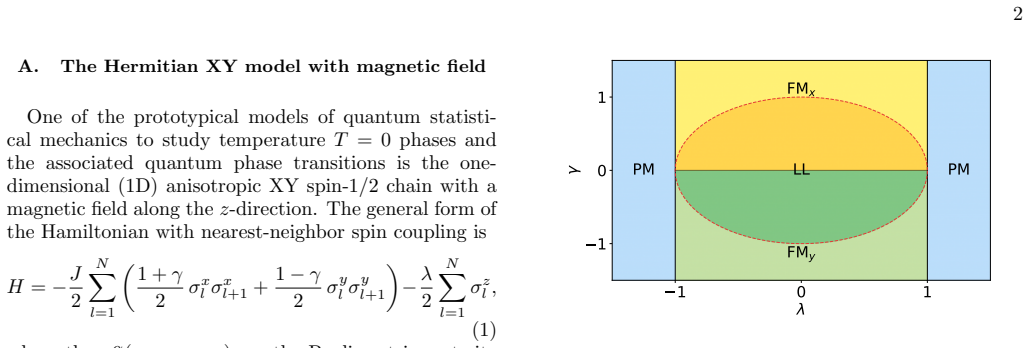
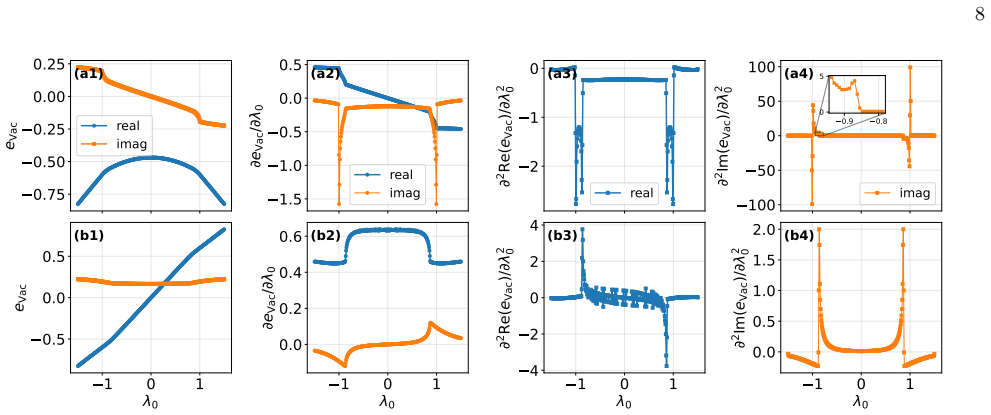
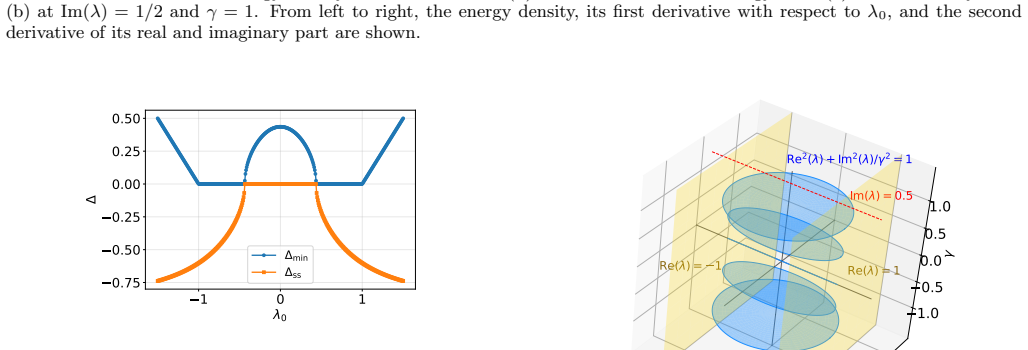
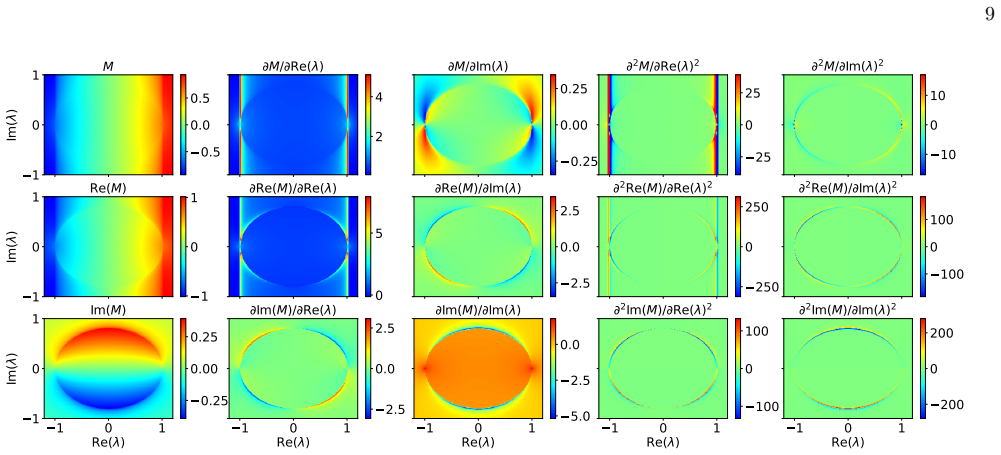
For−1< γ <1 this circle is squeezed to an ellipse 8 0.75 0.50 0.25 0.00 0.25 eVac (a1) real imag 1.5 1.0 0.5 0.0 0.5 eVac/ 0 (a2) real imag 2 1 0 2Re(eVac)/ 2 0 (a3) real 100 50 0 50 100 2Im(eVac)/ 2 0 (a4) 0.9 0.8 0 5 imag 1 0 1 0 0.5 0.0 0.5 eVac (b1) 1 0 1 0 0.0 0.2 0.4 0.6eVac/ 0 (b2) 1 0 1 0 4 2 0 2 4 2Re(eVac)/ 2 0 (b3) 1 0 1 0 0.0 0.5 1.0 1.5 2.0 2...
-
[2]
In this we also compare the behavior obtained from the RR and LR expectation value
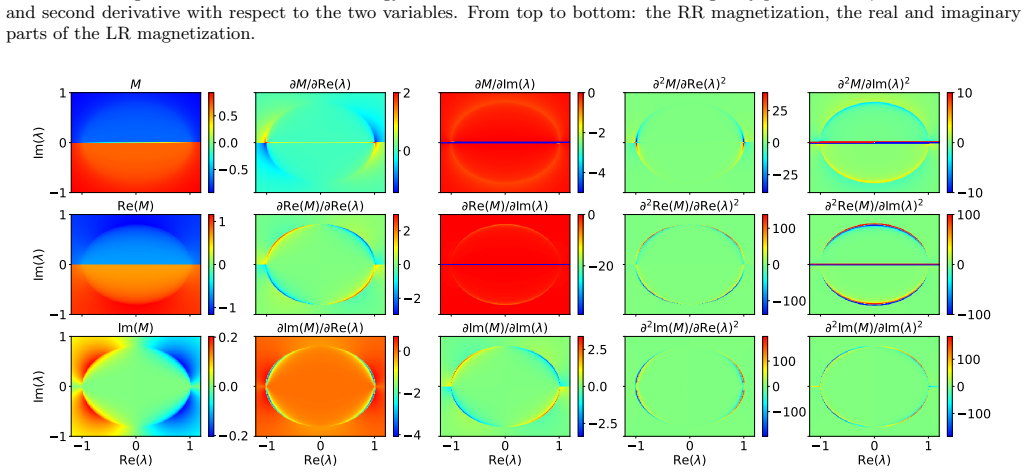
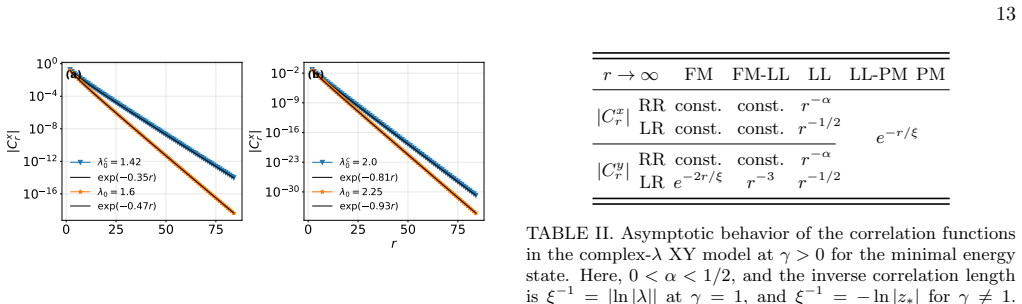
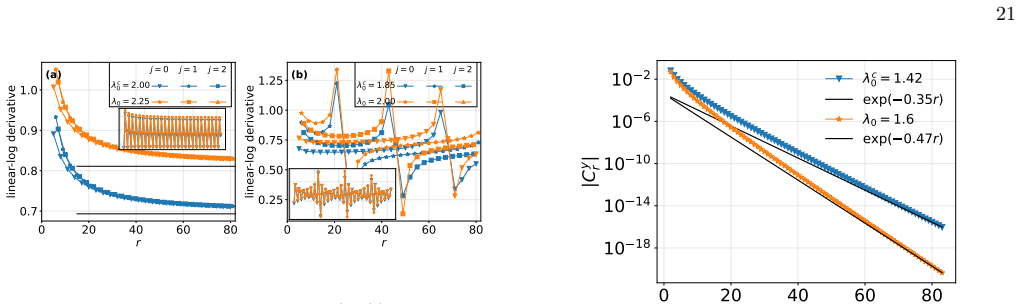
RR versus LR To provide an overview of our results, we summarize the asymptotic behavior of the correlation functions in Table II. In this we also compare the behavior obtained from the RR and LR expectation value. As already emphasized when investigating open quan- tum systems employing the formalism of standard quan- tum mechanics and thus use RR expect...
-
[3]
As shown above in this we only find a LL and a PM phase
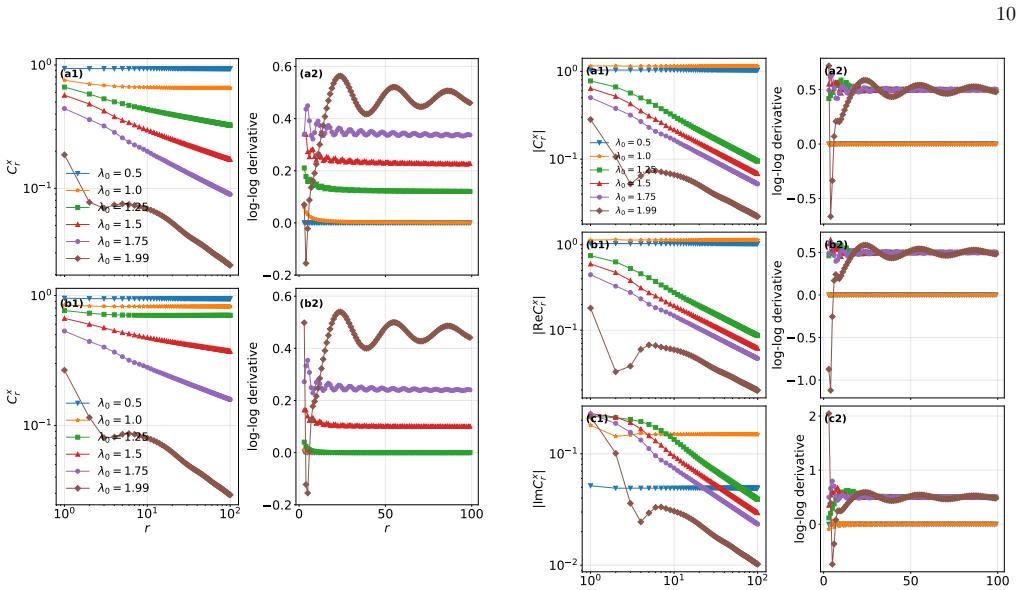
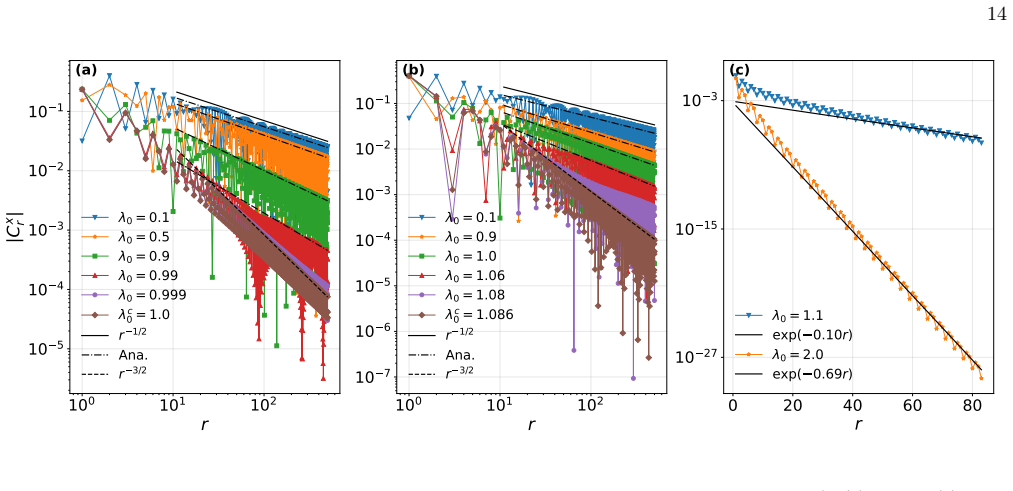
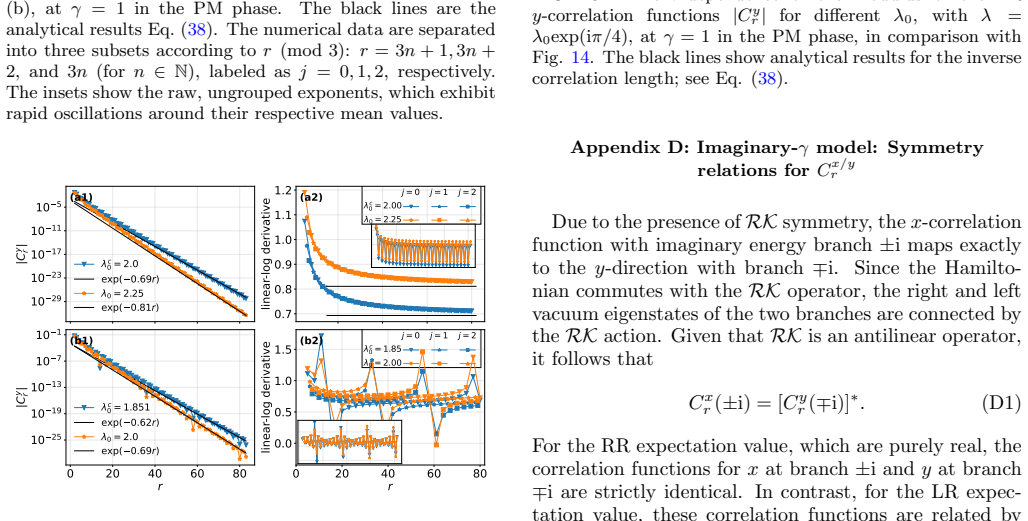
Correlation functions in the steady state As a last step in our study of the complex-λmodel we briefly discuss results forC x r in the steady state. As shown above in this we only find a LL and a PM phase. Figure 15 shows ther-dependence of the RRx- correlation function for different parameter sets. Panel (a) and (b) show data in the LL phase and at the L...
-
[4]
Note the log- log scale of panels (a1), (b) and (c)
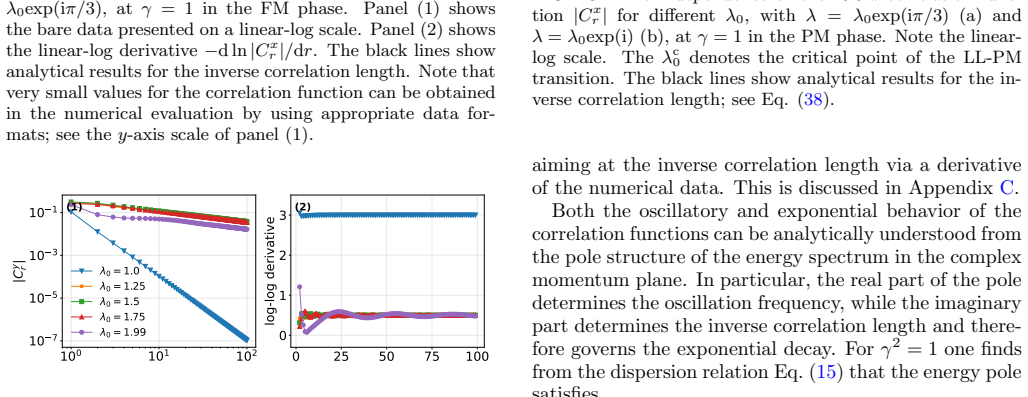
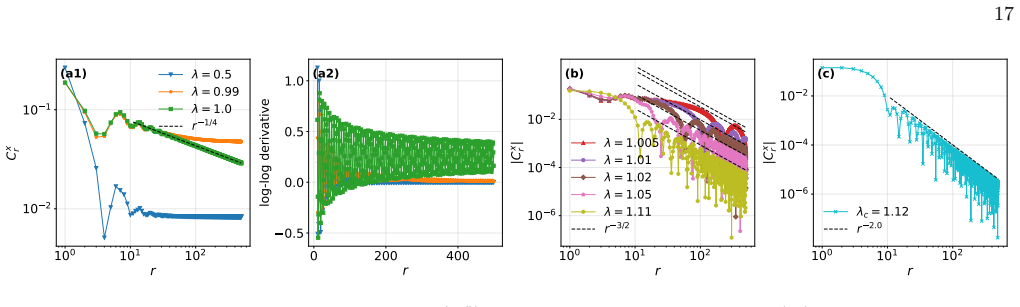
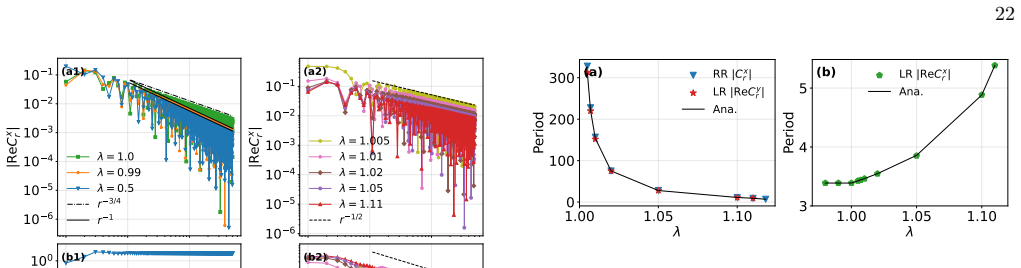
TheRK-broken phase and the transition lines Figure 19 shows ther-dependence of thex-direction correlation function using the RR expectation value for γ= 0.5 and−λ c ≤λ≤λ c = p 1 +γ 2, i.e., in the RK-broken phase and at the transition. Note the log- log scale of panels (a1), (b) and (c). For−1< λ <1 the correlation function approaches a constant at larger...
-
[5]
Figure 21 shows ther-dependence of|C x r |com- puted taking the RR as well as the LR expectation value on a linear-log scale forλ > λ c
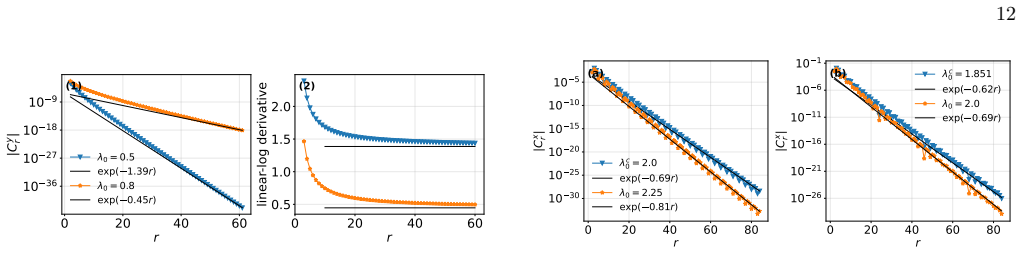
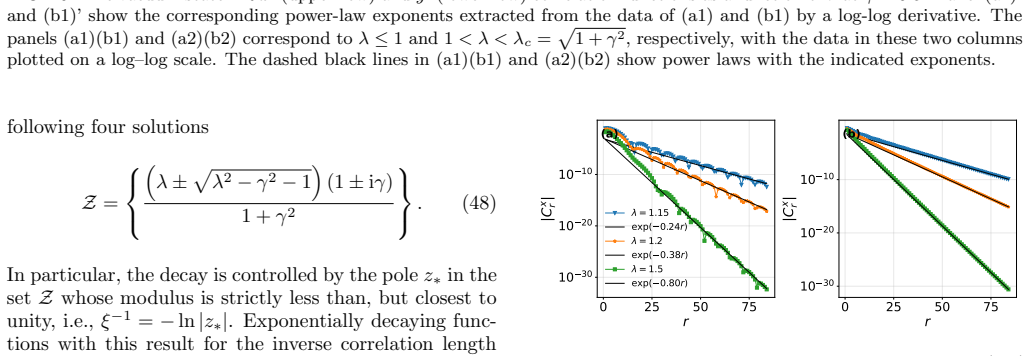
TheRK-symmetric phase In theRK-symmetric phase, the real energy spectrum is gapped, and the RR and LR correlation functionsC x r andC y r exhibit exponential decay; the system is in a PM phase. Figure 21 shows ther-dependence of|C x r |com- puted taking the RR as well as the LR expectation value on a linear-log scale forλ > λ c. For both types of expec- t...
-
[6]
minimal energy state
RR versus LR As for the Hermitian XY model with magnetic field and the complex-λmodel we summarize our findings for the asymptoticr-dependence of the correlation functions in Table III. This also allows for a direct comparison of the results for the RR and the LR correlation functions. We observe that the LR results are again closer to the ones of the Her...
-
[7]
RR and LR exponents in the LL phase For the LR expectation value, the behavior of correla- tion functions is determined by the scalar Toeplitz matrix in Eq
Complex-λmodel a. RR and LR exponents in the LL phase For the LR expectation value, the behavior of correla- tion functions is determined by the scalar Toeplitz matrix in Eq. (33) with elements ˜Mr =⟨B 0Ar+1⟩. To apply the FH theorem, we rewrite ˜Mr =ϕ −r in the form of a stan- dard Fourier transformation (B2) ϕr =− 1 2π Z 2π 0 λ−cosk+ i sinkp (λ−cosk) 2 ...
-
[8]
(33) varies across three distinct regimes:|λ|<1, |λ|= 1, and 1<|λ|< λ c
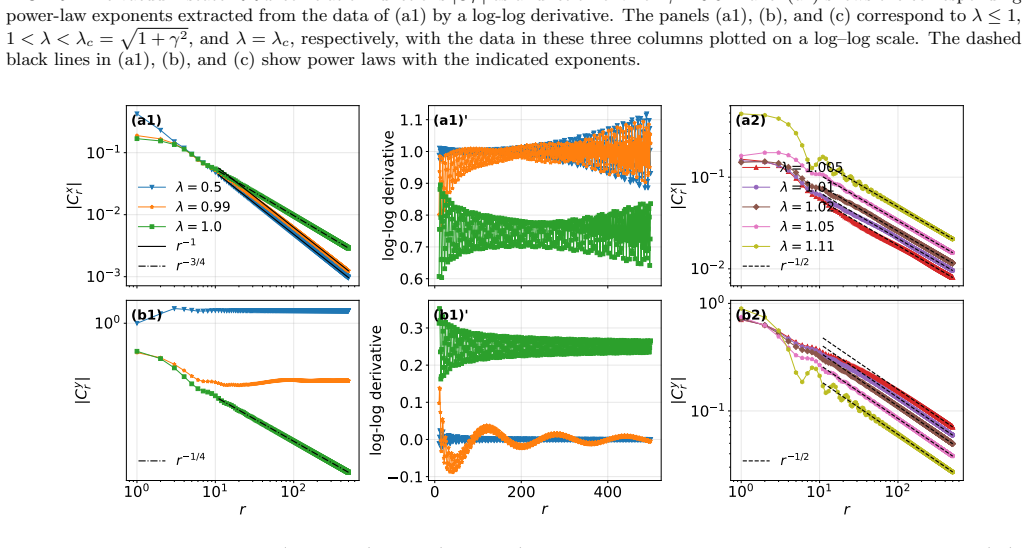
Imaginary-γmodel For the LR expectation value in theRK-broken phase, the singular behavior of the generating function in Eq. (33) varies across three distinct regimes:|λ|<1, |λ|= 1, and 1<|λ|< λ c. The singular structures are summarized in Table IV. By applying Eq. (B3), the cor- responding FH exponents (α, β) for each singularity are obtained, as detaile...
-
[9]
Sachdev, Quantum Phase Transitions (Cambridge University Press, 2nd ed
S. Sachdev, Quantum Phase Transitions (Cambridge University Press, 2nd ed. 2011)
2011
-
[10]
Y. Ashida, Z. Gong, and M. Ueda, Non- Hermitian physics, Adv. Phys.69, 249 (2020), doi: 10.1080/00018732.2021.1876991
-
[12]
C. M. Bender, P. E. Dorey, C. Dunning, A. Fring, D. W. Hook, H. F. Jones, S. Kuzhel, G. L´ evai, and R. Tateo, PTSymmetry (World Scientific, 2019)
2019
-
[13]
V. Meden, L. Grunwald, and D. M. Kennes, PT-symmetric, non-Hermitian quantum many-body physics—a methodological perspective, Rep. Prog. Phys. 86, 124501 (2023), doi:10.1088/1361-6633/ad05f3
-
[14]
D. C. Brody, Biorthogonal quantum mechanics, J. Phys. A: Math. Theor.47, 035305 (2014), doi:10.1088/1751- 8113/47/3/035305
-
[15]
Auerbach, Interacting Electrons and Quantum Mag- netism (Springer, 2016)
A. Auerbach, Interacting Electrons and Quantum Mag- netism (Springer, 2016)
2016
-
[16]
E. Lieb, T. Schultz, and D. Mattis, Two soluble models of an antiferromagnetic chain, Ann. Phys.16, 407 (1961), doi:10.1016/0003-4916(61)90115-4
-
[17]
E. Barouch, B. M. McCoy, and M. Dresden, Statistical Mechanics of the XY Model. I, Phys. Rev. A2, 1075 (1970), doi:10.1103/PhysRevA.2.1075
-
[18]
E. Barouch and B. M. McCoy, Statistical Mechanics of the XY Model. II. Spin-Correlation Functions, Phys. Rev. A3, 786 (1971), doi:10.1103/PhysRevA.3.786. 23
-
[19]
E. Barouch and B. M. McCoy, Statistical Mechanics of the XY Model. III, Phys. Rev. A3, 2137 (1971), doi: 10.1103/PhysRevA.3.2137
-
[20]
B. M. McCoy, E. Barouch, and D. B. Abraham, Statis- tical Mechanics of the XY Model. IV. Time-Dependent Spin-Correlation Functions, Phys. Rev. A4, 2331 (1971), doi:10.1103/PhysRevA.4.2331
-
[21]
Franchini, An introduction to integrable techniques for one-dimensional quantum systems, (Cham: Springer International Publishing, 2017)
F. Franchini, An introduction to integrable techniques for one-dimensional quantum systems, (Cham: Springer International Publishing, 2017)
2017
-
[22]
H. P. Breuer and F. Petruccione, The theory of open quantum systems, (Oxford University Press, 2002)
2002
-
[23]
A. J. Daley, Quantum trajectories and open many- body quantum systems, Adv. Phys.63, 77 (2014), doi: 10.1080/00018732.2014.933502
-
[24]
J. R. Taylor, Scattering Theory: The Quantum Theory of Nonrelativistic Collisions, (Dover Publications 2006)
2006
-
[25]
P.-X. Shen, Z. Lu, J. L. Lado, and M. Trif, Non- Hermitian Fermi-Dirac Distribution in Persistent Cur- rent Transport, Phys. Rev. Lett.133, 086301 (2024), doi:10.1103/PhysRevLett.133.086301
-
[26]
C. Joshi, F. Nissen, and J. Keeling, Quantum cor- relations in the one-dimensional driven dissipative XY model, Phys. Rev. A88, 063835 (2013), doi: 10.1103/PhysRevA.88.063835
-
[27]
M. Foss-Feig, K. R. A. Hazzard, J. J. Bollinger, A. M. Rey, and C. W. Clark, Dynamical quantum correlations of Ising models on an arbitrary lattice and their resilience to decoherence, New J. Phys.15, 113008 (2013), doi: 10.1088/1367-2630/15/11/113008
-
[28]
T. Prosen and I. Piˇ zorn, Quantum Phase Transition in a Far-from-Equilibrium Steady State of an XY Spin Chain, Phys. Rev. Lett.101, 105701 (2008), doi: 10.1103/PhysRevLett.101.105701
-
[29]
Liang, Image classification based on RESNET
M. ˇZnidariˇ c, Exact solution for a diffusive nonequi- librium steady state of an open quantum chain, J. Stat. Mech.2010, L05002 (2010), doi:10.1088/1742- 5468/2010/05/L05002
-
[30]
C. Monthus, Dissipative random quantum spin chain with boundary-driving and bulk-dephasing: magneti- zation and current statistics in the non-equilibrium- steady-state, J. Stat. Mech.2017, 043302 (2017), doi: 10.1088/1742-5468/aa64f4
-
[31]
M. F. Maghrebi and A. V. Gorshkov, Nonequi- librium many-body steady states via Keldysh for- malism, Phys. Rev. B93, 014307 (2016), doi: 10.1103/PhysRevB.93.014307
-
[32]
X. Zhu, Y. Zhang, S. Pang, C. Qiao, Q. Liu, and S. Wu, Quantum measurements with preselection and postselection, Phys. Rev. A84, 052111 (2011), doi: 10.1103/PhysRevA.84.052111
-
[33]
Y.-G. Liu, L. Xu, and Z. Li, Quantum phase transition in a non-Hermitian XY spin chain with global complex transverse field, J. Phys.: Condens. Matter33, 295401 (2021), doi:10.1088/1361-648X/ac00dd
-
[34]
F. Wang, G. Liang, Z. Zhao, L.-Y. Luo, D.-J. Zhang, and B.-M. Xu, Survival of Hermitian Criticality in the Non- Hermitian Framework, Phys. Rev. B113, 165149 (2026), doi:10.1103/y34y-32dt
-
[35]
T. E. Lee and C.-K. Chan, Heralded Magnetism in Non- Hermitian Atomic Systems, Phys. Rev. X4, 041001 (2014), doi:10.1103/PhysRevX.4.041001
-
[36]
J. Pi and R. L¨ u, Phase diagram and quantum criticality of a non-Hermitian XY model with a complex transverse field, J. Phys.: Condens. Matter33, 345601 (2021), doi: 10.1088/1361-648X/ac06ef
-
[37]
D. C. Liu and M. T. Batchelor, Characterizing phase transitions and criticality in non-Hermitian extensions of the XY model, Phys. Rev. B112, 014422 (2025), doi: 10.1103/b55l-7tbc
-
[38]
X. Turkeshi and M. Schir´ o, Entanglement and correlation spreading in non-Hermitian spin chains, Phys. Rev. B107, L020403 (2023), doi: 10.1103/PhysRevB.107.L020403
-
[39]
C. Miao, Y. Li, J. Wang, P. Zhang, Q. Li, L. Hu, Y. Xu, and X. Kong, Crossover behavior at an exceptional point for quantum entanglement and correlation in a non- Hermitian XY spin system, Phys. Rev. B110, 014403 (2024), doi:10.1103/PhysRevB.110.014403
-
[40]
X. Z. Zhang and Z. Song, Non-Hermitian anisotropic XYmodel with intrinsic rotation-time-reversal sym- metry, Phys. Rev. A87, 012114 (2013), doi: 10.1103/PhysRevA.87.012114
-
[41]
X. Z. Zhang and Z. Song, Geometric phase and phase diagram for a non-Hermitian quantumXY model, Phys. Rev. A88, 042108 (2013), doi: 10.1103/PhysRevA.88.042108
-
[42]
L.-F. Zhang and W. C. Yu, Probing phase transitions in non-Hermitian systems with quantum entanglement, Phys. Rev. B112, 144308 (2025), doi:10.1103/26jz-zmsv
-
[43]
Y. Wu, W. Liu, J. Geng, X. Song, X. Ye, C.-K. Duan, X. Rong, J. Du, Observation of parity-time symmetry breaking in a single-spin system, Science364, 878 (2019), doi:10.1126/science.aaw8205
-
[44]
R.-D. Huang, W.-L. Li, and Z. Li, Tunable chiral spi- ral phases in a non-Hermitian Ising-Gamma spin chain, Phys. Rev. A113, 012203 (2026), doi:10.1103/fqnf-trdw
-
[45]
T. K. Konar, L. G. C. Lakkaraju, and A. Sen (De), Quan- tum battery with non-Hermitian charging, Phys. Rev. A 109, 042207 (2024), doi:10.1103/PhysRevA.109.042207
-
[46]
K. D. Agarwal, T. K. Konar, L. G. C. Lakkaraju, and A. Sen (De), Recognizing critical lines via entanglement in non-Hermitian systems, Phys. Rev. A113, 022201 (2026), doi:10.1103/b5sd-fn57
-
[47]
These Lindblad operators also introduce overall imagi- nary constant shifts,−i Im(λ)/2 and−iγ/2, correspond- ing to a global decay rate (i.e., a shift on the zero-energy point) that does not affect physical observables after proper normalization
-
[48]
Y.-H. Yan, R. Wang, and K.-L. Zhang, Dynam- ical spin-nematic order in a transverse field Ising chain with non-Hermitian Gamma interaction, doi: 10.48550/arXiv.2604.17700
work page internal anchor Pith review Pith/arXiv arXiv doi:10.48550/arxiv.2604.17700
-
[49]
K. Das Agarwal, T. K. Konar, L. G. C. Lakkaraju, and A. Sen De, Critical quantum metrology using non-Hermitian spin model withRT-symmetry, doi: 10.48550/arXiv.2503.24331
-
[50]
P. Zhang, Q. Li, C. Miao, Y. Xu, S. Yan, and X. Kong, Effects of the Dzyaloshinsky-Moriya interaction on entanglement and chiral criticality in a non-Hermitian XY system, Phys. Rev. B113, 134433 (2026), doi: 10.1103/8ycw-8lmk
-
[51]
K. Das Agarwal, T. K. Konar, L. G. C. Lakkaraju, and A. Sen(De), Detecting exceptional points through dynam- ics in non-Hermitian systems, Phys. Rev. A110, 012226 (2024), doi:10.1103/PhysRevA.110.012226
-
[52]
L. G. C. Lakkaraju, and A. Sen(De), Detection of an un- broken phase of a non-Hermitian system via a Hermitian 24 factorization surface, Phys. Rev. A104, 052222 (2021), doi:10.1103/PhysRevA.104.052222
-
[53]
Y. Zhou, W. Xia, L. Li, and W. Li, Diagnosing quantum many-body chaos in non-Hermitian quantum spin chain via Krylov complexity, Phys. Rev. Research7, 033281 (2025), doi:10.1103/fw62-j2n9
-
[54]
However, it is rather close to biorthog- onal quantum mechanics and we do not further dwell on this; for more see [5]
A third approach, calledPT-symmetric quantum me- chanics, exists [4]. However, it is rather close to biorthog- onal quantum mechanics and we do not further dwell on this; for more see [5]
-
[55]
T. Ehrhardt and B. Silbermann, A status report on the asymptotic behavior of Toeplitz determinants with Fisher-Hartwig singularities, Oper. Theory Adv. Appl. 124, 217 (2001), doi:10.1007/978-3-0348-8323-8˙11
-
[56]
T. Ehrhardt, Toeplitz Determinants with One Fisher–Hartwig Singularity, Journal of Functional Analysis148, 229 (2001), doi:10.1006/jfan.1996.3074
-
[57]
P. Deift, A. Its, and I. Krasovsky, Asymptotics of Toeplitz, Hankel, and Toeplitz+Hankel determinants with Fisher-Hartwig singularities, Annals of Mathemat- ics174, 1243 (2011), doi:10.4007/annals.2011.174.2.12
-
[58]
B.-Q. Jin and V. E. Korepin, Quantum Spin Chain, Toeplitz Determinants and the Fisher—Hartwig Conjec- ture, Journal of statistical physics116, 79 (2004), doi: 10.1023/B:JOSS.0000037230.37166.42
-
[59]
F. Ares, J. G. Esteve, F. Falceto and A. R. de Queiroz, Entanglement in fermionic chains with finite-range cou- pling and broken symmetries, Phys. Rev. A92, 042334 (2015), doi:10.1103/PhysRevA.92.042334
-
[60]
F. Ares, J. G. Esteve, F. Falceto and A. R. de Queiroz, Entanglement entropy in the long-range Ki- taev chain, Phys. Rev. A97, 062301 (2018), doi: 10.1103/PhysRevA.97.062301
-
[61]
E. Basor, T. Ehrhardt, and J. A. Virtanen, Asymptotics of block Toeplitz determinants with piecewise continuous symbols, Communications on Pure and Applied Mathe- matics78, 120 (2025), doi:10.1002/cpa.22223
-
[62]
This is misleading as the latter would also transform the spin- 1/2 operatorsσ α l → −σ α l
Note that in several papers [31–33, 44] the antilinear op- eratorKis referred to as the time-reversal operator. This is misleading as the latter would also transform the spin- 1/2 operatorsσ α l → −σ α l
discussion (0)
Sign in with ORCID, Apple, or X to comment. Anyone can read and Pith papers without signing in.