REVIEW 3 major objections 5 minor 63 references
Breaking Structural Isolation: Scalable Graph Clustering via Community-Aware Sampling and Structural Entropy
T0 review · 3 major / 5 minor · reviewed 2026-07-11 · grok-4.5
Pith's one-line read SCISE breaks structural isolation in mini-batch graph clustering by expanding each batch with community context from constrained structural entropy, then learning contrastive embeddings on the denser structural subgraph.
desk verdict Solid scalable clustering pipeline that beats strong baselines on million-node graphs; the engineering is careful and the empirical package is thorough, even if the pieces are mostly known. read the letter →
The pith
A machine-rendered reading of the paper's core claim, the machinery that carries it, and where it could break.
The reading
What carries the argument
Structural Entropy Community Constraint (SECC): a greedy merge that repeatedly unites communities only while the number of communities exceeds a target N_comm, allowing temporary entropy increases when necessary so that the final partition contains exactly N_comm cohesive groups rather than thousands of micro-communities.
What would settle it
Replace the SECC partition with completely random community labels (or with a deliberately over-fragmented partition) and re-run the full pipeline on Ogbn-products or Reddit; if accuracy collapses to the level of the strongest non-community baseline, the claim that the constrained prior is doing essential work is falsified.
Extended reading notes
Core claim
The central claim is that the combination of a cardinality-constrained structural-entropy community prior, community-aware batch expansion, and intra-batch structural-affinity contrastive learning is sufficient to restore the global community signal that ordinary mini-batch training destroys, and that this restoration yields state-of-the-art unsupervised clustering accuracy and scalability on graphs up to millions of nodes.
Load-bearing premise
That one fixed community partition computed once by SECC, using a user-chosen target number of communities, is a good enough structural scaffold for every subsequent mini-batch expansion.
Editorial analysis
A structured set of objections, weighed in public.
Referee Report
Summary. The paper proposes SCISE, a scalable unsupervised graph clustering framework that addresses structural isolation in mini-batch GCL training. It combines three components: SECC (Algorithm 1), a constrained structural-entropy agglomeration that forces merges until a user-specified community count N_comm; CSampE, which expands each mini-batch with same-community nodes (full expansion for small communities, random-walk backbone for large ones); and StructCL, a multi-positive InfoNCE loss on a random-walk affinity matrix A* inside the expanded batch. After GCN encoding, K-means produces the final partitions. Experiments on six benchmarks (Photo through Ogbn-products) against ten baselines report best or second-best scores on 21 of 24 metrics (Table 2), with ablations (Table 3), hyper-parameter sweeps, noise/sparsity stress tests, runtime/memory tables, and t-SNE visualizations.
Significance. If the empirical claims hold, SCISE supplies a practical recipe for unsupervised clustering on million-node graphs that remain memory-feasible where several strong baselines OOM. The combination of a one-shot structural-entropy prior with community-aware batch expansion is a concrete engineering contribution that demonstrably restores long-range topology (Table 11) and yields large gains on large graphs (e.g., +17% F1 on Ogbn-arxiv). The paper ships extensive controls (ablations of every module and joint removals, noise ratios up to 100%, edge deletion up to 80%, runtime/memory breakdowns) and public code, which strengthens reproducibility and makes the work immediately usable for large-scale graph mining.
major comments (3)
- Table 9 (100% random noise row) shows that completely random community labels leave SCISE competitive with or better than MAGI on several datasets. Combined with the modest drops when SECC is removed alone (Table 3, w/o SECC), this undercuts the claim that the quality of the SECC prior is load-bearing. The manuscript should either (a) quantify how much of the Table 2 gains survive under random or noisy priors on all six datasets, or (b) reframe SECC as a convenient but non-essential initializer whose main role is to supply a cheap community index for CSampE.
- Section 4.1 / Algorithm 1: the forced-merge rule (when no ΔH < 0 pairs remain, still merge until |C| = N_comm) is an ad-hoc axiom. The paper never proves or even bounds that the resulting partitions remain near-minimal entropy or that they preserve the hierarchical semantics structural entropy is supposed to capture. A short theoretical or empirical characterization of the entropy gap introduced by forced merges (beyond the heatmaps in Fig. 8) is needed to justify the operator as more than a constrained agglomerative heuristic.
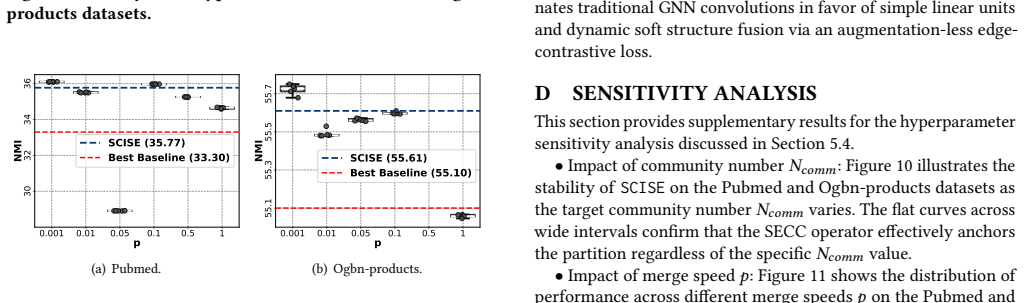
- N_comm is a free hyper-parameter that must be chosen by the user (Table 13 lists values from 300 to 59 000). Although Fig. 5 and the appendix show flat sensitivity curves, the abstract and introduction still present SECC as automatically producing cohesive partitions. The paper should state clearly that N_comm is an ordinary hyper-parameter (or supply a default selection rule, e.g., the unconstrained SE minimum) so that the method is not oversold as parameter-free community discovery.
minor comments (5)
- Eq. (2) for ΔH is lengthy and contains nested volume/cut terms; a short derivation or reference to the exact structural-entropy difference formula would help readers verify correctness.
- Figure 1 caption and the surrounding text use both “structural isolation” and “structural barriers”; consistent terminology would improve clarity.
- Table 2 reports “Improv.(%)” only against the best baseline per metric; adding the absolute scores of the second-best method in the same row would make the margin transparent.
- Section 4.5 claims overall epoch complexity O(N·(w_l w_t + f d)); the constant factor introduced by |V*_batch| expansion is left implicit. A short remark on observed expansion ratios (already in Table 11) would make the bound more concrete.
- A few typographical issues: “studys of multi-relational” (p. 3), “structure-aware” vs. “Structural” capitalization inconsistency, and missing spaces around some equation references.
Circularity Check
No significant circularity: empirical SOTA claims rest on external ground-truth metrics and ablations; structural-entropy definitions and self-citations supply background operators, not the reported scores.
full rationale
SCISE is an engineering/ML systems paper whose central claims are quantitative outperformance (Table 2: best/second-best on 21/24 NMI/ARI/ACC/F1 metrics vs. ten baselines, including memory-feasible runs on Reddit/Ogbn-products where several competitors OOM) plus supporting ablations (Table 3), noise/sparsity robustness (Tables 9-10), and sensitivity (Figs. 4-7). The training objective (StructCL multi-positive InfoNCE on random-walk affinities inside CSampE-expanded batches) and the SECC preprocessing (constrained greedy merge of structural entropy, Algorithm 1) never receive ground-truth labels; final partitions are produced by ordinary K-means on the learned embeddings and scored against external labels. N_comm is an ordinary hyper-parameter (set far larger than true K; shown stable across wide ranges and even under 100% random community noise). Self-citations (Li & Pan structural entropy definition, prior SE applications by overlapping authors) appear only as background definitions or related-work baselines that the paper itself outperforms; none is a uniqueness theorem that forces the numerical results, nor is any fitted quantity renamed a prediction. The derivation chain therefore does not reduce by construction to its inputs.
Assumptions & free parameters
free parameters (5)
- N_comm (target community count)
- p (merge speed / parallel merge ratio)
- θ (community-size expansion threshold)
- w_t, w_l (random-walk count and length)
- batch size B, learning rate, temperature τ
assumptions (4)
- domain assumption Structural entropy of a graph is well-defined by the encoding-tree formula of Li & Pan (2016) and is a meaningful objective for community discovery.
- ad hoc to paper Forcing merges even when ΔH ≥ 0 until exactly N_comm communities remain still yields useful cohesive partitions.
- domain assumption Random-walk visit counts inside a mini-batch are a sufficient proxy for higher-order structural affinity for contrastive learning.
- domain assumption K-means on the final GCN embeddings recovers the ground-truth semantic clusters.
invented entities (3)
-
SECC operator (Structural Entropy Community Constraint)
-
CSampE (Community-Aware Sampling Expansion)
-
StructCL (Structural Contrastive Learning)
Cite this review
Pith. "Pith review of Breaking Structural Isolation: Scalable Graph Clustering via Community-Aware Sampling and Structural Entropy." pith.science (2026). https://pith.science/paper/A33HTGV3
@misc{pith2026260705469,
  author       = {Pith},
  title        = {Pith review of: Breaking Structural Isolation: Scalable Graph Clustering via Community-Aware Sampling and Structural Entropy},
  year         = {2026},
  howpublished = {\url{https://pith.science/paper/A33HTGV3}},
  note         = {Machine review of arXiv:2607.05469}
}
read the original abstract
Unsupervised graph clustering is a fundamental technique for uncovering underlying semantic patterns in large-scale networks. Although Graph Contrastive Learning has demonstrated promising performance, existing methods often suffer from the "structural isolation" issue during mini-batch training, making it challenging to capture cohesive community structures that characterize the global topological distribution. To address these challenges, we propose SCISE, a Scalable unsupervised graph Clustering framework that preserves structural Integrity by synergizing community-aware sampling with constrained Structural Entropy. Specifically, we first introduce the Structural Entropy Community Constraint operator (SECC), which optimizes structural information within a constrained solution space to mitigate community fragmentation and enhance partition cohesion. Second, to prevent global information loss during batch training, we design a Community-Aware Sampling Expansion (CSampE) mechanism that incorporates the community context of target nodes into sampling batches, effectively breaking structural barriers and preserving topological integrity. Finally, we devise a Structural Contrastive Learning (StructCL) module that refines edge weights based on intra-batch structural similarity, guiding the encoder to learn representations in a higher-order structural space. Extensive experiments on six mainstream benchmark datasets demonstrate that SCISE significantly outperforms state-of-the-art algorithms, with ablation studies and robustness analyses further validating its effectiveness and reliability for real-world large-scale graphs.
Figures


Figures from the paper (11 more)




Reference graph
Works this paper leans on
-
[1]
Amit Aflalo, Shai Bagon, Tamar Kashti, and Yonina Eldar. 2023. Deepcut: Unsu- pervised segmentation using graph neural networks clustering. InProceedings of the IEEE/CVF International Conference on Computer Vision. 32–41
2023
-
[2]
Leman Akoglu, Hanghang Tong, and Danai Koutra. 2015. Graph based anomaly detection and description: a survey.Data mining and knowledge discovery29, 3 (2015), 626–688
2015
-
[3]
Deyu Bo, Xiao Wang, Chuan Shi, Meiqi Zhu, Emiao Lu, and Peng Cui. 2020. Structural deep clustering network. InProceedings of the web conference 2020. 1400–1410
2020
-
[4]
Yuwei Cao, Hao Peng, Angsheng Li, Chenyu You, Zhifeng Hao, and Philip S Yu
-
[5]
InProceedings of the Conference on Uncertainty in Artificial Intelligence
Multi-Relational Structural Entropy. InProceedings of the Conference on Uncertainty in Artificial Intelligence. 1–15
-
[6]
Yuwei Cao, Hao Peng, Zhengtao Yu, and Philip S Yu. 2024. Hierarchical and Incremental Structural Entropy Minimization for Unsupervised Social Event Detection. InProceedings of the AAAI conference on artificial intelligence. 1–13
2024
-
[7]
Jianfei Chen, Jun Zhu, and Le Song. 2018. Stochastic Training of Graph Con- volutional Networks with Variance Reduction. InInternational Conference on Machine Learning. PMLR, 942–950
2018
-
[8]
Mulin Chen, Bocheng Wang, and Xuelong Li. 2024. Deep contrastive graph learning with clustering-oriented guidance. InProceedings of the AAAI Conference on Artificial Intelligence, Vol. 38. 11364–11372
2024
Show all 63 references
-
[9]
Wei-Lin Chiang, Xuanqing Liu, Si Si, Yang Li, Samy Bengio, and Cho-Jui Hsieh
-
[10]
InProceedings of the 25th ACM SIGKDD international conference on knowledge discovery & data mining
Cluster-gcn: An efficient algorithm for training deep and large graph convolutional networks. InProceedings of the 25th ACM SIGKDD international conference on knowledge discovery & data mining. 257–266
-
[11]
Fnu Devvrit, Aditya Sinha, Inderjit Dhillon, and Prateek Jain. 2022. S3GC: Scalable Self-Supervised Graph Clustering. InAdvances in Neural Information Processing Systems, Vol. 35. Curran Associates, Inc., 3248–3261
2022
-
[12]
Santo Fortunato. 2010. Community detection in graphs.Physics reports486, 3-5 (2010), 75–174
2010
-
[13]
Hongyang Gao, Zhengyang Wang, and Shuiwang Ji. 2018. Large-scale learn- able graph convolutional networks. InProceedings of the 24th ACM SIGKDD international conference on knowledge discovery & data mining. 1416–1424
2018
-
[14]
Will Hamilton, Zhitao Ying, and Jure Leskovec. 2017. Inductive representation learning on large graphs.Advances in neural information processing systems30 (2017)
2017
-
[15]
Weihua Hu, Matthias Fey, Marinka Zitnik, Yuxiao Dong, Hongyu Ren, Bowen Liu, Michele Catasta, and Jure Leskovec. 2020. Open graph benchmark: Datasets for machine learning on graphs.Advances in neural information processing systems 33 (2020), 22118–22133
2020
-
[16]
Li Huang, Jingyun Zhang, Weikang Gong, Guangjie Zeng, Hao Peng, and Dong- sheng Chen. 2026. SECTOR: structural entropy-based learning of spatiotemporal organisation in spatial transcriptomics.Bioinformatics42, 6 (2026), btag367
2026
-
[17]
Xiang Huang, Hao Peng, Li Sun, Hui Lin, Chunyang Liu, Jiang Cao, and Philip S Yu. 2025. Structural entropy guided probabilistic coding. InProceedings of the AAAI Conference on Artificial Intelligence, Vol. 39. 17467–17475
2025
-
[18]
Kipf and Max Welling
Thomas N. Kipf and Max Welling. 2017. Semi-Supervised Classification with Graph Convolutional Networks. In5th International Conference on Learning Representations, ICLR 2017, Toulon, France, April 24-26, 2017, Conference Track Proceedings. OpenReview.net. https://openreview.ne...
2017
-
[19]
Gayan K Kulatilleke, Marius Portmann, and Shekhar S Chandra. 2025. SCGC: Self-supervised contrastive graph clustering.Neurocomputing611 (2025), 128629
2025
-
[20]
Angsheng Li and Yicheng Pan. 2016. Structural information and dynamical complexity of networks.IEEE TIT62, 6 (2016), 3290–3339
2016
-
[21]
Mengyao Li, Zhibang Yang, Xu Zhou, Yixiang Fang, Kenli Li, and Keqin Li
-
[22]
Surveys57, 7 (2025), 1–36
Clustering on attributed graphs: From single-view to multi-view.Comput. Surveys57, 7 (2025), 1–36
2025
-
[23]
Yunfei Liu, Jintang Li, Yuehe Chen, Ruofan Wu, Ericbk Wang, Jing Zhou, Sheng Tian, Shuheng Shen, Xing Fu, Changhua Meng, et al . 2024. Revisiting modu- larity maximization for graph clustering: A contrastive learning perspective. In Proceedings of the 30th ACM SIGKDD Conferenc...
2024
-
[24]
Yue Liu, Ke Liang, Jun Xia, Xihong Yang, Sihang Zhou, Meng Liu, Xinwang Liu, and Stan Z Li. 2023. Reinforcement graph clustering with unknown cluster number. InProceedings of the 31st ACM international conference on multimedia. 3528–3537
2023
-
[25]
Yue Liu, Ke Liang, Jun Xia, Sihang Zhou, Xihong Yang, Xinwang Liu, and Stan Z Li. 2023. Dink-net: Neural clustering on large graphs. InInternational conference on machine learning. PMLR, 21794–21812
2023
-
[26]
Yiwei Liu, Jiamou Liu, Zijian Zhang, Liehuang Zhu, and Angsheng Li. 2019. REM: From structural entropy to community structure deception.Proceedings of the Advances in Neural Information Processing Systems32 (2019), 1–11
2019
-
[27]
Yue Liu, Jun Xia, Sihang Zhou, Xihong Yang, Ke Liang, Chenchen Fan, Yan Zhuang, Stan Z Li, Xinwang Liu, and Kunlun He. 2022. A survey of deep graph clustering: Taxonomy, challenge, application, and open resource.arXiv preprint arXiv:2211.12875(2022)
2022 arXiv
-
[28]
Yixin Liu, Yu Zheng, Daokun Zhang, Hongxu Chen, Hao Peng, and Shirui Pan
-
[29]
InProceedings of the ACM Web Conference 2022
Towards unsupervised deep graph structure learning. InProceedings of the ACM Web Conference 2022. 1392–1403
2022
-
[30]
Hao Peng, Jingyun Zhang, Xiang Huang, Zhifeng Hao, Angsheng Li, Zhengtao Yu, and Philip S Yu. 2024. Unsupervised Social Bot Detection via Structural Information Theory.ACM Transactions on Information Systems42, 6 (2024), 42
2024
-
[31]
Ladislav Rampášek, Michael Galkin, Vijay Prakash Dwivedi, Anh Tuan Luu, Guy Wolf, and Dominique Beaini. 2022. Recipe for a general, powerful, scalable graph transformer.Advances in Neural Information Processing Systems35 (2022), 14501–14515
2022
-
[32]
Yazhou Ren, Jingyu Pu, Zhimeng Yang, Jie Xu, Guofeng Li, Xiaorong Pu, Philip S Yu, and Lifang He. 2024. Deep clustering: A comprehensive survey.IEEE trans- actions on neural networks and learning systems36, 4 (2024), 5858–5878
2024
-
[33]
Prithviraj Sen, Galileo Namata, Mustafa Bilgic, Lise Getoor, Brian Galligher, and Tina Eliassi-Rad. 2008. Collective classification in network data.AI magazine29, 3 (2008), 93–93
2008
-
[34]
Oleksandr Shchur, Maximilian Mumme, Aleksandar Bojchevski, and Stephan Günnemann. 2018. Pitfalls of graph neural network evaluation.arXiv preprint arXiv:1811.05868(2018)
2018 arXiv
-
[35]
Xiao Shen, Dewang Sun, Shirui Pan, Xi Zhou, and Laurence T Yang. 2023. Neigh- bor contrastive learning on learnable graph augmentation. InProceedings of the AAAI conference on artificial intelligence, Vol. 37. 9782–9791
2023
-
[36]
Zhihao Shi, Jie Wang, Fanghua Lu, Hanzhu Chen, Defu Lian, Zheng Wang, Jieping Ye, and Feng Wu. 2024. Label deconvolution for node representation learning on large-scale attributed graphs against learning bias.IEEE Transactions on Pattern Analysis and Machine Intelligence46, 12...
2024
-
[37]
Hamed Shirzad, Ameya Velingker, Balaji Venkatachalam, Danica J Sutherland, and Ali Kemal Sinop. 2023. Exphormer: Sparse transformers for graphs. In International Conference on Machine Learning. PMLR, 31613–31632
2023
-
[38]
Li Sun, Zhenhao Huang, Hao Peng, Yujie Wang, Chunyang Liu, and Philip S Yu. 2024. LSEnet: Lorentz Structural Entropy Neural Network for Deep Graph Clustering. InInternational Conference on Machine Learning. PMLR, 47078–47104
2024
-
[39]
Anton Tsitsulin, John Palowitch, Bryan Perozzi, and Emmanuel Müller. 2023. Graph clustering with graph neural networks.Journal of Machine Learning Research24, 127 (2023), 1–21
2023
-
[40]
Petar Veličković, William Fedus, William L Hamilton, Pietro Liò, Yoshua Bengio, and R Devon Hjelm. 2018. Deep graph infomax. InInternational Conference on Learning Representations
2018
-
[41]
Yifei Wang, Yupan Wang, Zeyu Zhang, Song Yang, Kaiqi Zhao, and Jiamou Liu
-
[42]
InProceedings of the AAAI Conference on Artificial Intelligence
User: Unsupervised structural entropy-based robust graph neural network. InProceedings of the AAAI Conference on Artificial Intelligence. 10235–10243
-
[43]
Felix Wu, Amauri Souza, Tianyi Zhang, Christopher Fifty, Tao Yu, and Kilian Weinberger. 2019. Simplifying graph convolutional networks. InInternational conference on machine learning. Pmlr, 6861–6871
2019
-
[44]
Junran Wu, Xueyuan Chen, Bowen Shi, Shangzhe Li, and Ke Xu. 2023. SEGA: Structural Entropy Guided Anchor View for Graph Contrastive Learning. In Proceedings of the ICML. PMLR, 1–20
2023
-
[45]
Junran Wu, Xueyuan Chen, Ke Xu, and Shangzhe Li. 2022. Structural entropy guided graph hierarchical pooling. InProceedings of the International Conference on Machine Learning. PMLR, 24017–24030
2022
-
[46]
Qitian Wu, Wentao Zhao, Chenxiao Yang, Hengrui Zhang, Fan Nie, Haitian Jiang, Yatao Bian, and Junchi Yan. 2023. Sgformer: Simplifying and empowering transformers for large-graph representations.Advances in neural information processing systems36 (2023), 64753–64773
2023
-
[47]
Zonghan Wu, Shirui Pan, Fengwen Chen, Guodong Long, Chengqi Zhang, and Philip S Yu. 2020. A comprehensive survey on graph neural networks.IEEE transactions on neural networks and learning systems32, 1 (2020), 4–24
2020
-
[48]
Junyuan Xie, Ross Girshick, and Ali Farhadi. 2016. Unsupervised deep embedding for clustering analysis. InInternational conference on machine learning. PMLR, 478–487
2016
-
[49]
Minhui Xie, Hao Peng, Pu Li, Guangjie Zeng, Shuhai Wang, Jia Wu, Peng Li, and Philip S Yu. 2025. Hierarchical superpixel segmentation via structural information theory. InProceedings of the 2025 SIAM International Conference on Data Mining (SDM). SIAM, 242–251
2025
-
[50]
Xihong Yang, Yue Liu, Sihang Zhou, Siwei Wang, Wenxuan Tu, Qun Zheng, Xinwang Liu, Liming Fang, and En Zhu. 2023. Cluster-guided contrastive graph clustering network. InProceedings of the AAAI conference on artificial intelligence, Vol. 37. 10834–10842
2023
-
[51]
Xihong Yang, Cheng Tan, Yue Liu, Ke Liang, Siwei Wang, Sihang Zhou, Jun Xia, Stan Z Li, Xinwang Liu, and En Zhu. 2023. Convert: Contrastive graph clustering with reliable augmentation. InProceedings of the 31st ACM international conference on multimedia. 319–327
2023
-
[52]
Zhenyu Yang, Ge Zhang, Jia Wu, Jian Yang, Quan Z Sheng, Hao Peng, Angsheng Li, Shan Xue, and Jianlin Su. 2023. Minimum entropy principle guided graph neural networks. InProceedings of the Sixteenth ACM International Conference on Web Search and Data Mining. 114–122
2023
-
[53]
Rex Ying, Ruining He, Kaifeng Chen, Pong Eksombatchai, William L Hamilton, and Jure Leskovec. 2018. Graph convolutional neural networks for web-scale 13 recommender systems. InProceedings of the 24th ACM SIGKDD international conference on knowledge discovery & data mining. 974–983
2018
-
[54]
Guangjie Zeng, Hao Peng, Angsheng Li, Li Sun, Chunyang Liu, Shengze Li, Yicheng Pan, and Philip S Yu. 2026. Hyperbolic continuous structural entropy for hierarchical clustering. InProceedings of the AAAI Conference on Artificial Intelligence, Vol. 40. 28094–28102
2026
-
[55]
Hanqing Zeng, Hongkuan Zhou, Ajitesh Srivastava, Rajgopal Kannan, and Viktor Prasanna. 2019. GraphSAINT: Graph Sampling Based Inductive Learning Method. InInternational Conference on Learning Representations
2019
-
[56]
Xianghua Zeng, Hao Peng, and Angsheng Li. 2025. Proactive Bot Detection Based on Structural Information Principles.IEEE Transactions on Pattern Analysis and Machine Intelligence(2025)
2025
-
[57]
Xianghua Zeng, Hao Peng, Angsheng Li, Chunyang Liu, Lifang He, and Philip S. Yu. 2023. Hierarchical State Abstraction based on Structural Information Princi- ples. InProceedings of the Thirty-Second International Joint Conference on Artificial Intelligence, IJCAI-23, Edith Elk...
2023
-
[58]
Xianghua Zeng, Hao Peng, Yicheng Pan, Angsheng Li, and Guanlin Wu. 2026. Structural Information-based Hierarchical Diffusion for Offline Reinforcement Learning.Advances in Neural Information Processing Systems38 (2026), 109539– 109567
2026
-
[59]
Jingyun Zhang, Hao Peng, Li Sun, Guanlin Wu, Chunyang Liu, and Zhengtao Yu
-
[60]
InProceedings of the 31st ACM SIGKDD Conference on Knowledge Discovery and Data Mining V
Unsupervised graph clustering with deep structural entropy. InProceedings of the 31st ACM SIGKDD Conference on Knowledge Discovery and Data Mining V
-
[61]
Jingyun Zhang, Hao Peng, Mingdai Yang, and Philip S Yu. 2025. Enhanced Pre-training for Recommendation via Hypergraph Structural Entropy.ACM Transactions on Information Systems44, 2 (2025), 1–48
2025
-
[62]
Yanqiao Zhu, Yichen Xu, Feng Yu, Qiang Liu, Shu Wu, and Liang Wang. 2021. Graph contrastive learning with adaptive augmentation. InProceedings of the web conference 2021. 2069–2080
2021
-
[63]
Dongcheng Zou, Hao Peng, and Chunyang Liu. 2024. A structural information guided hierarchical reconstruction for graph anomaly detection. InProceed- ings of the 33rd ACM International Conference on Information and Knowledge Management. 4318–4323. 14 7 APPENDIX A NOTATIONS The ...
2024
Reviewed July 11, 2026 · model on record in the stance chip above.
Discussion (0). Sign in to comment.