REVIEW 4 major objections 4 minor 1 cited by
Quantum Mpemba Effect in Dissipative Spin Chains at Criticality
T0 review · 4 major / 4 minor · reviewed 2026-08-05 · deepseek-v4-flash
Pith's one-line read Critical points in dissipative spin chains produce a strong quantum Mpemba effect: the zero-temperature state relaxes faster than all thermal states, and in the thermodynamic limit only criticality supports it.
desk verdict The numerical observation—sQME right at the critical points—is new and plausible, but the paper never specifies that its initial states are restricted to the m=0 sector; taken literally, the T=0 ferromagnetic ground state is a dark state and the central claim collapses. read the letter →
The pith
A machine-rendered reading of the paper's core claim, the machinery that carries it, and where it could break.
The reading
What carries the argument
The load-bearing object is the Liouvillian superoperator L of the Lindblad master equation and its spectral decomposition. The relevant mechanism is overlap: because the late-time relaxation rate of a state is set by the slowest eigenmode it overlaps, an initial state whose overlap with slow modes vanishes relaxes anomalously fast. The dephasing dissipators L_j = S^z_j + I/2 conserve total magnetization, which lets the authors isolate the m = 0 invariant subspace; within that subspace the critical-point ground state has zero weight on slow modes, while every finite-temperature state has nonzero weight there. This overlap contrast, rather than a global change in the Liouvillian gap, is what c
What would settle it
Compute D(t) under dephasing for the global ferromagnetic ground state |↑↑⋯↑⟩ rather than the m = 0 sector ground state, with L = 8 and Δ = 1, and compare against the T/J = 1 thermal state in the same subspace; if the polarized state's trajectory does not cross the thermal trajectory, the strong QME is an artifact of the sector restriction.
Extended reading notes
Core claim
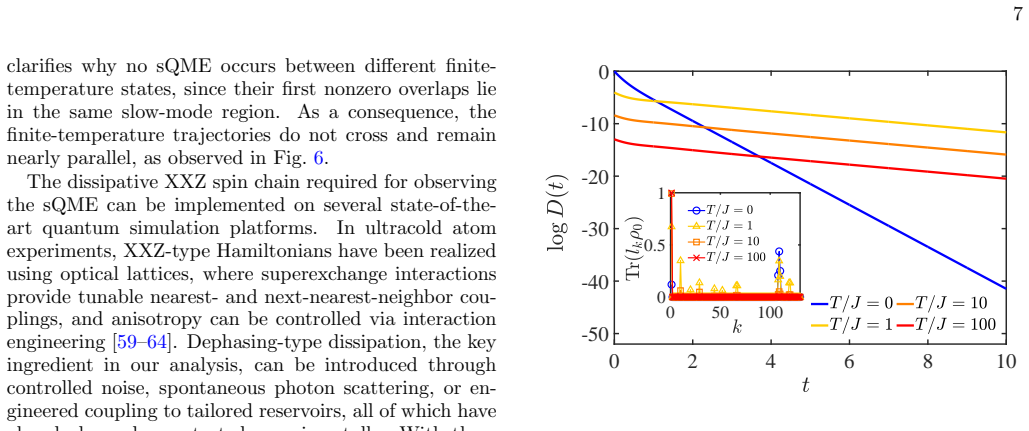
On the paper's own terms, the central discovery is a structural fact about the Liouvillian superoperator at criticality. For an XXZ chain with dephasing dissipators L_j = S^z_j + I/2, total magnetization is conserved and the dynamics can be restricted to a fixed-m sector; taking m = 0, one can compare the heating of a zero-temperature initial state (the lowest-energy state of that sector) with thermal states at T > 0. At the ferromagnetic critical point Δ = 1 the zero-temperature trajectory crosses the trajectories of all finite-temperature states, marking a strong QME, and the same holds at the antiferromagnetic critical point Δ = −1 by an energy-sign symmetry. In the frustrated J1–J2 chain
Load-bearing premise
The argument depends on measuring relaxation from states prepared in the m = 0 magnetization sector, where the 'ground state' is the lowest-energy state of that sector rather than the chain's global ground state; with a different initial-state family the crossing that defines the strong Mpemba effect may disappear.
Editorial extensions
If this is right
- In the XXZ chain, the strong QME occurs at Δ = 1 and Δ = −1, where the zero-temperature state's trajectory crosses every finite-temperature trajectory; away from these points it degrades to a weak QME and then disappears.
- In the frustrated J1–J2 XXZ model, the same strong QME appears for J2/J1 > −0.25 at Δ = 1 and collapses abruptly at the critical ratio −0.25, another quantum phase transition.
- The effect is tied to overlaps with slow Liouvillian modes: thermal states have nonzero weight on slow modes, while the critical-point ground state has vanishing overlap, so its relaxation is not bottlenecked by the slowest decay channels.
- Increasing system size or initial temperature shrinks the parameter window in which the QME is observed, so in the thermodynamic limit the strong QME can persist only exactly at the critical point.
- The required XXZ-type Hamiltonian and dephasing dissipation are realizable in ultracold atoms, trapped ions, and superconducting qubits, making the crossover signature experimentally observable with current techniques.
Reading between the lines
- A direct unstated test is to lift the sector restriction: start from the global fully polarized ground state of the ferromagnetic XXZ chain under the same dephasing, and the claimed vanishing slow-mode overlap—and with it the strong QME—should disappear; that would confirm the m = 0 sector is doing the work.
- The overlap mechanism suggests a broader design principle: any initial state engineered to be orthogonal to the slow Liouvillian modes, not necessarily a critical ground state, should relax anomalously fast; criticality is one route, but structured or symmetry-protected initial states could emulate it.
- If the finite-size scaling shown in the paper extends, the width of the QME window could serve as a quantitative finite-size probe of the critical regime, and relaxation-time crossings could locate unknown critical points in frustrated chains without ground-state spectroscopy.
Editorial analysis
A structured set of objections, weighed in public.
Referee Report
Summary. The paper studies the quantum Mpemba effect (QME) in dissipative spin chains described by a Lindblad master equation with dephasing noise. For the XXZ chain and the J1-J2 XXZ chain, the authors numerically compute the relaxation of the L2 distance D(t) from the maximally mixed steady state for initial thermal states at different temperatures. They report a strong QME (sQME) precisely at the quantum critical points Delta=1, Delta=-1, and J2/J1=-0.25, where the zero-temperature initial state relaxes faster than all finite-temperature states despite being farther from equilibrium. The mechanism is attributed to the vanishing overlap of the zero-temperature state with the slow-decaying Liouvillian modes, in contrast to finite-temperature states. The paper also argues that in the thermodynamic limit the sQME survives only exactly at the critical point.
Significance. If the central claim holds, the paper identifies quantum criticality as a sharp enhancer of anomalous relaxation, which is of interest for both nonequilibrium quantum dynamics and quantum simulation platforms. The numerical work is substantial: exact diagonalization is performed for system sizes up to L=14, the Liouvillian spectral decomposition is used without fitting parameters, and the overlap analysis in Sec. IV provides a concrete, falsifiable mechanism. However, the significance is currently compromised by an ambiguity in the definition of the initial states and by an unsupported finite-size extrapolation. These issues are load-bearing for the main claim and need to be resolved before the paper can be accepted.
major comments (4)
- [Sec. III.A, Eq. (7)] The initial states are not consistently defined. Eq. (7) defines rho_T as a global Gibbs state over all eigenstates of H, but the text then restricts the dynamics to the invariant subspace with fixed m=<S^z>, and all figure captions state S^z_tot=0. These definitions are incompatible for the dephasing dissipator in Eq. (6): the fully polarized states |up...up> and |down...down> are dark states of the dissipator, and at Delta=1 the global ground state of the ferromagnetic XXZ model lies in the fully polarized sector. A literal T=0 initial state from Eq. (7) is therefore stationary or nearly stationary, and D(t) in Eq. (8) does not decay to zero. The curves in Figs. 2 and 6 can only be obtained by taking the lowest-energy state within the m=0 sector and by projecting finite-temperature states onto the same sector. The paper never states this. Please define the sector-restricted initial sta
- [Sec. II, Eq. (3)] The dissipation strength gamma_j is introduced in Eq. (3) but never specified in the numerical sections or figure captions. If gamma_j is uniform, it only rescales time and does not affect the crossing analysis, but the paper should state this explicitly. If gamma_j varies with site or boundary, it could materially change the Liouvillian spectrum and the overlap selection. Please specify the value or convention used for all simulations.
- [Sec. III.A, Fig. 3] The claim that 'in the thermodynamic limit, the sQME can persist only exactly at the quantum critical point' is an extrapolation from L=6,8,10,12,14 in Fig. 3 and L=8 in Fig. 5(a). The figures show that the parameter window for QME shrinks with system size, but no finite-size scaling analysis, collapse, or extrapolation is provided. Please provide a quantitative scaling analysis (e.g., the width of the QME window as a function of 1/L) or soften the conclusion to a conjecture supported by the finite-size trend.
- [Sec. IV, Fig. 6] The overlap analysis is a key explanatory step, but the overlap magnitude plotted in the inset is not defined. Please specify whether it is |Tr(l_n rho_0)|, normalized by ||rho_0|| or by some other convention, and explain how the eigenmode index is ordered. This is needed to verify the claim that the zero-temperature state has vanishing overlap with the slow modes.
minor comments (4)
- [Abstract and text] There are several typos and wording issues, e.g., 'thermal eauilibrium' in the abstract, 'HSE' after Eq. (1), and 'J2-J1 XXZ' in the conclusion where 'J1-J2' is intended.
- [Fig. 2 caption] The caption states that the red line is T/J=1, but panels (b-e) appear to show multiple finite-temperature curves. Please clarify the color/line convention for all curves.
- [References] References [12] and [15] appear to be the same work (Shapira et al., Phys. Rev. Lett. 133, 010403 (2024)). Please consolidate or distinguish them.
- [Eq. (9)] In Eq. (9) the notation l_max and r_max is introduced without explaining that they are the left and right eigenvectors of the Liouvillian associated with lambda_max. A brief definition would improve readability.
Circularity Check
No significant circularity: the central sQME claim is an exact Liouvillian spectral computation, not a fitted or self-referential result. The only self-citation (ref. [24]) is background and non-load-bearing. A separate rigor issue about the m=0 projection of the initial states is noted as a correctness risk, not a circular step.
full rationale
The paper's central derivation is a direct numerical solution of the Lindblad master equation (2) with dephasing operators (6), followed by a spectral decomposition (4) and an overlap analysis (Figs. 5-6). No parameter is fitted to the crossing data; the sQME is identified by exact trajectory crossings, and the overlap explanation is an independent post-hoc diagnostic. The claim that the zero-temperature state has vanishing overlap with the slow Liouvillian modes is computed from the exact eigenvectors and is not assumed in the definition of the initial states. Therefore the central result does not reduce to its inputs by construction. The only self-citation is ref. [24], by four of the five present authors, used in the introductory list of prior QME studies in disordered systems; it is not load-bearing and does not support any of the paper's derivations. A genuine rigor concern is that the initial states defined by Eq. (7) are global thermal states and the global ground state, whereas the dynamics is restricted to the m=0 invariant subspace and the figures set total S_z=0. Under the dephasing Liouvillian (6), the fully polarized global ground state at Delta=1 is stationary, so the plotted zero-temperature decay cannot correspond to Eq. (7) as written; an m=0 projection/conditioning is implicitly used but never defined. This makes the physical interpretation of the initial-state family ambiguous, but it is a definitional-consistency/correctness issue rather than a circularity: the reported crossing is still a genuine property of the (unstated) sector-conditioned initial states and the exact Liouvillian, not a quantity that is equal to an input by construction. Hence the circularity score remains low.
Assumptions & free parameters
free parameters (1)
- gamma_j (dissipation strength)
assumptions (3)
- standard math Born-Markov approximation and Lindblad master equation
- domain assumption The steady state of the dephasing dynamics is the maximally mixed state (infinite temperature) in each conserved magnetization sector.
- ad hoc to paper The m=0 invariant subspace is sufficient to characterize the QME, and initial states can be restricted to this sector.
Cite this review
Pith. "Pith review of Quantum Mpemba Effect in Dissipative Spin Chains at Criticality." pith.science (2026). https://pith.science/paper/A37U75AW
@misc{pith2026250818906,
  author       = {Pith},
  title        = {Pith review of: Quantum Mpemba Effect in Dissipative Spin Chains at Criticality},
  year         = {2026},
  howpublished = {\url{https://pith.science/paper/A37U75AW}},
  note         = {Machine review of arXiv:2508.18906}
}
read the original abstract
The Quantum Mpemba Effect (QME) is the quantum counterpart of the classical Mpemba effect--a counterintuitive phenomenon in which a system initially at a higher temperature relax to thermal eauilibrium faster than one at a lower temperature. In this work, we investigate the QME in one-dimensional quantum spin chains coupled to a Markovian environment. By analyzing the full relaxation dynamics governed by the Lindblad master equation, we reveal the emergence of a strong quantum Mpemba effect at quantum critical points. Our findings reveal that criticality enhances the non-monotonic dependence of relaxation times on the initial temperature, leading to anomalously accelerated equilibration. This phenomenon is directly linked to the structure of the Liouvillian spectrum at criticality and the associated overlaps with the initial states. These findings demonstrate that quantum phase transitions could provide a natural setting for realizing and enhancing non-equilibrium phenomena in open quantum systems.
Figures


Figures from the paper (3 more)


Forward citations
Cited by 1 Pith paper
-
Strong Quantum Mpemba Effect from Exact Slow-Mode Selection in Constrained Rydberg Chains
Translation-invariant states with Tr(Hρ0)=0 remove the exact H slow mode of the dephased Liouvillian and thus relax asymptotically faster than thermal states, yielding a strong quantum Mpemba effect in constrained Ryd...
Reference graph
Works this paper leans on
-
[1]
E. B. Mpemba and D. G. Osborne, Cool? Phys. Educ. 4, 172 (1969)
1969
-
[2]
Jeng, The Mpemba effect: When can hot water freeze faster than cold?, Am
M. Jeng, The Mpemba effect: When can hot water freeze faster than cold?, Am. J. Phys.74, 514 (2006)
2006
-
[3]
Klich, O
I. Klich, O. Raz, O. Hirschberg, and M. Vucelja, Mpemba index and anomalous relaxation, Phys. Rev. X9, 021060 (2019)
2019
-
[4]
Y.-H. Ahn, H. Kang, D.-Y. Koh, and H. Lee, Experimen- tal verifications of Mpemba-like behaviors of clathrate hydrates, Korean J. Chem. Eng.33, 1903 (2016)
work page 1903
-
[5]
P. Chaddah, S. Dash, K. Kumar, and A. Banerjee, Over- taking while approaching equilibrium, arXiv:1011.3598
-
[6]
Kumar and J
A. Kumar and J. Bechhoefer, Exponentially faster cool- ing in a colloidal system, Nature (London)584, 64 (2020)
2020
-
[7]
C. Hu, J. Li, S. Huang, H. Li, C. Luo, J. Chen, S. Jiang, and L. An, Conformation directed Mpemba effect on polylactide crystallization, Cryst. Growth Des.18, 5757 (2018)
work page 2018
-
[8]
J. Liu, J. Li, B. Liu, I. W. Hamley, and S. Jiang, Mpemba effect in crystallization of polybutene-1, Soft Matter19, 3337 (2023)
work page 2023
Show all 66 references
-
[9]
Chorazewski, M
M. Chorazewski, M. Wasiak, A. V. Sychev, V. I. Ko- rotkovskii, and E. B. Postnikov, The curious case of 1-ethylpyridinium triflate: Ionic liquid exhibiting the Mpemba effect, J. Solution Chem.53, 80 (2024)
2024
-
[10]
Lasanta, F
A. Lasanta, F. Vega Reyes, A. Prados, and A. Santos, When the hotter cools more quickly: Mpemba effect in granular fluids, Phys. Rev. Lett.119, 148001 (2017)
2017
-
[11]
Lu and O
Z. Lu and O. Raz, Nonequilibrium thermodynamics of the Markovian Mpemba effect and its inverse, Proc. Natl. Acad. Sci. U.S.A.114, 5083 (2017)
2017
-
[12]
S. A. Shapira,Y. Shapira, J. Markov, G. Teza, N. Ak- erman, O. Raz, and R. Ozeri, Inverse Mpemba Effect Demonstrated on a Single Trapped Ion Qubit, Phys. Rev. Lett.133, 010403 (2024)
2024
-
[13]
Kumar, R
A. Kumar, R. Ch´ etrite, and J. Bechhoefer, Anomalous heating in a colloidal system, Proc. Natl. Acad. Sci. U.S.A.119, e2118484119 (2022)
2022
-
[14]
L. Kh. Joshi, J. Franke, A. Rath, F. Ares, S. Murciano, F. Kranzl, R. Blatt, P. Zoller, B. Vermersch, P. Calabrese, C. F. Roos, and M. K. Joshi, Observing the quantum Mpemba effect in quantum simulations, Phys. Rev. Lett. 133, 010402 (2024)
2024
-
[15]
S. A. Shapira, Y. Shapira, J. Markov, G. Teza, N. Aker- man, O. Raz, and R. Ozeri, The Mpemba effect demon- strated on a single trapped ion qubit, Phys. Rev. Lett. 133, 010403 (2024)
2024
-
[16]
Zhang, G
J. Zhang, G. Xia, C.-W. Wu, T. Chen, Q. Zhang, Y. Xie, W.-B. Su, W. Wu, C.-W. Qiu, P.-X. Chen, W. Li, H. Jing, and Y.-L. Zhou, Observation of quantum strong Mpemba effect, Nat. Commun.16, 301 (2025)
2025
-
[17]
F. Ares, P. Calabrese, and S. Murciano, The quantum Mpemba effects, Nat. Rev. Phys.7, 451 (2025)
2025
-
[18]
Murciano, F
S. Murciano, F. Ares, I. Klich, and P. Calabrese, Entan- glement asymmetry and quantum Mpemba effect in the XY spin chain, J. Stat. Mech. (2024) 013103
2024
-
[19]
Chalas, F
K. Chalas, F. Ares, C. Rylands, and P. Calabrese, Multi- ple crossing during dynamical symmetry restoration and implications for the quantum Mpemba effect, J. Stat. Mech. (2024) 103101
2024
-
[20]
Rylands, K
C. Rylands, K. Klobas, F. Ares, P. Calabrese, S. Mur- ciano, and B. Bertini, Microscopic origin of the quantum Mpemba effect in integrable systems, Phys. Rev. Lett. 133, 010401 (2024)
2024
-
[21]
Lastres, S
M. Lastres, S. Murciano, F. Ares, P. Calabrese, Entan- glement asymmetry in the critical XXZ spin chain, J. Stat. Mech. (2025) 013107
2025
-
[22]
Liu, H.-K
S. Liu, H.-K. Zhang, S. Yin, S.-X. Zhang, and H. Yao, Quantum Mpemba effects in many-body localization sys- tems, arXiv:2408.07750
-
[23]
J. W. Dong, H. F. Mu, M. Qin, and H. T. Cui, Quantum Mpemba effect of localization in the dissipative mosaic model, Phys. Rev. A111, 022215 (2025)
2025
-
[25]
Liu, H.-K
S. Liu, H.-K. Zhang, S. Yin, and S.-X. Zhang, Symmetry Restoration and Quantum Mpemba Effect in Symmetric Random Circuits, Phys. Rev. Lett.133140405 (2024)
2024
-
[26]
F. Ares, S. Murciano, P. Calabrese, L. Piroli, Entangle- ment asymmetry dynamics in random quantum circuits, arXiv:2501.12459
-
[27]
Turkeshi, P
X. Turkeshi, P. Calabrese, and A. De Luca, Quantum Mpemba Effect in Random Circuits Phys. Rev. Lett. 135, 040403 (2025)
2025
-
[28]
Fossati, C
M. Fossati, C. Rylands, and P. Calabrese, Entanglement asymmetry in CFT with boundary symmetry breaking, arXiv:2411.10244
-
[29]
35, 17 (2025)
Hui Yu, Shuo Liu, and Shi-Xin Zhang, Quantum Mpemba effects from symmetry perspectives, AAPPS Bull. 35, 17 (2025)
2025
-
[30]
Chang, S
W.-X. Chang, S. Yin, S.-X. Zhang, and Z.-X. Li, Imaginary-time Mpemba effect in quantum many-body system, arXiv:2409.06547. 9
-
[31]
Longhi, Photonic Mpemba effect, Opt
S. Longhi, Photonic Mpemba effect, Opt. Lett. 49, 5188 (2024)
2024
-
[32]
Longhi, Mpemba effect and super-accelerated ther- malization in the damped quantum harmonic oscillator, Quantum 9, 1677 (2025)
S. Longhi, Mpemba effect and super-accelerated ther- malization in the damped quantum harmonic oscillator, Quantum 9, 1677 (2025)
2025
-
[33]
Longhi, Quantum Mpemba effect from initial system- reservoir entanglement, APL Quantum2, 026133 (2025)
S. Longhi, Quantum Mpemba effect from initial system- reservoir entanglement, APL Quantum2, 026133 (2025)
2025
-
[34]
Longhi, Quantum Mpemba Effect from Non-Normal Dynamics, Entropy2025, 27, 581
S. Longhi, Quantum Mpemba Effect from Non-Normal Dynamics, Entropy2025, 27, 581
-
[35]
X. Wang, J. Su, and J. Wang, Mpemba meets quantum chaos: Anomalous relaxation and Mpemba crossings in dissipative Sachdev-Ye-Kitaev models, arXiv:2410.06669
-
[36]
Wang and J
X. Wang and J. Wang, Mpemba effects in nonequilibrium open quantum systems, Phys. Rev. Research6, 033330 (2024)
2024
-
[37]
A. K. Chatterjee, S. Takada, and H. Hayakawa, Multiple quantum Mpemba effect: Exceptional points and oscilla- tions, Phys. Rev. A110, 022213 (2024)
2024
-
[38]
Moroder, O
M. Moroder, O. Culhane, K. Zawadzki, and J. Goold, Thermodynamics of the quantum Mpemba effect, Phys. Rev. Lett. 133, 140404 (2024)
2024
-
[39]
Westhoff, S
P. Westhoff, S. Paeckel, M. Moroder, Fast and direct preparation of a genuine lattice BEC via the quantum Mpemba effect, arXiv:2504.05549
-
[40]
T. V. Vu and H. Hayakawa, Thermomajorization Mpemba Effect, Phys. Rev. Lett.134, 107101 (2025)
2025
-
[41]
Summer, M
A. Summer, M. Moroder, L. P. Bettmann, X. Turkeshi, I. Marvian, J. Goold, A resource theoretical unifi- cation of Mpemba effects: classical and quantum, arXiv:2507.16976
-
[42]
Barontini, R
G. Barontini, R. Labouvie, F. Stubenrauch, A. Vogler, V. Guarrera, and H. Ott, Controlling the Dynamics of an Open Many-Body Quantum System with Localized Dissipation, Phys. Rev. Lett.110, 035302 (2013)
2013
-
[43]
B. Yan, S. A. Moses, B. Gadway, J. P. Covey, K. R. Hazzard, A. M. Rey, D. S. Jin, and J. Ye, Observation of dipolar spin-exchange interactions with lattice-confined polar molecules, Nature (London)501, 521 (2013)
2013
-
[44]
Y. S. Patil, S. Chakram, and M. Vengalattore, Measurement-Induced Localization of an Ultracold Lat- tice Gas, Phys. Rev. Lett.115, 140402 (2015)
2015
-
[45]
Labouvie, B
R. Labouvie, B. Santra, S. Heun, and H. Ott, Bistability in a Driven-Dissipative Superfluid, Phys. Rev. Lett.116, 235302 (2016)
2016
-
[46]
Tomita, S
T. Tomita, S. Nakajima, I. Danshita, Y. Takasu, and Y. Takahashi, Observation of the Mott insulator to su- perfluid crossover of a driven-dissipative Bose-Hubbard system, Sci. Adv.3, e1701513 (2017)
2017
-
[47]
H. P. L¨ uschen, P. Bordia, S. S. Hodgman, M. Schreiber, S. Sarkar, A. J. Daley, M. H. Fischer, E. Altman, I. Bloch, and U. Schneider, Signatures of Many-Body Localization in a Controlled Open Quantum System, Phys. Rev. X7, 011034 (2017)
2017
-
[48]
Sponselee, L
K. Sponselee, L. Freystatzky, B. Abeln, M. Diem, B. Hundt, A. Kochanke, T. Ponath, B. Santra, L. Mathey, K. Sengstock, and C. Becker, Dynamics of ultracold quantum gases in the dissipative Fermi-Hubbard model, Quantum Sci. Technol.4, 014002 (2018)
2018
-
[49]
Tomita, S
T. Tomita, S. Nakajima, Y. Takasu, and Y. Takahashi, Dissipative Bose-Hubbard system with intrinsic two- body loss, Phys. Rev. A99, 031601(R) (2019)
2019
-
[50]
Takasu, T
Y. Takasu, T. Yagami, Y. Ashida, R. Hamazaki, Y. Kuno, and Y. Takahashi, PT-symmetric non-Hermitian quantum many-body system using ultracold atoms in an optical lattice with controlled dissipation, Prog. Theor. Exp. Phys.2020, 12A110 (2020)
2020
-
[51]
Bouganne, M
R. Bouganne, M. B. Aguilera, A. Ghermaoui, and F. Gerbier, Anomalous decay of coherence in a dissipative many-body system, Nat. Phys.16, 21 (2020)
2020
-
[52]
Y. Zhao, Y. Tian, J. Ye, Y. Wu, Z. Zhao, Z. Chi, T. Tian, H. Yao, J. Hu, Y. Chen, and W. Chen, Observation of universal dissipative dynamics in strongly correlated quantum gas, arXiv:2309.10257 (2023)
2023
-
[53]
G. M. Moy, J. J. Hope, and C. M. Savage, Born and Markov approximations for atom lasers, Phys. Rev. A 59, 667 (1999)
1999
-
[54]
Breuer and F
H.-P. Breuer and F. Petruccione,The Theory of Open Quantum Systems, (Oxford University Press, Oxford, 2002)
2002
-
[55]
Lindblad, On the generators of quantum dynamical semigroups, Commun
G. Lindblad, On the generators of quantum dynamical semigroups, Commun. Math. Phys.119, 48 (1976)
1976
-
[56]
Gorini, A
V. Gorini, A. Kossakowski, and E. C. Sudarsahan, Com- pletely positive dynamical semigroups of N-level systems, J. Math. Phys.17, 821 (1976)
1976
-
[57]
Nomura and K
K. Nomura and K. Okamoto, Critical properties of S= 1/2 antiferromagnetic XXZ chain with next-nearest- neighbour interactions, J. Phys. A: Math. Gen.27, 5773 (1994)
1994
-
[58]
M. Sato, S. Furukawa, S. Onoda, and A. Furusaki, Com- peting phases in spin-1/2J 1–J2 chain with easy-plane anisotropy, Mod. Phys. Lett. B25, 901 (2011)
2011
-
[59]
B. Yan, S. A. Moses, B. Gadway, J. P. Covey, K. R. Hazzard, A. M. Rey, D. S. Jin, and J. Ye, Observation of dipolar spin-exchange interactions with lattice-confined polar molecules, Nature501, 521 (2013)
2013
-
[60]
S. Hild, T. Fukuhara, P. Schauß, J. Zeiher, M. Knap, E. Demler, I. Bloch, and C. Gross, Far-from-Equilibrium Spin Transport in Heisenberg Quantum Magnets, Phys. Rev. Lett.113, 147205 (2014)
2014
-
[61]
Murmann, F
S. Murmann, F. Deuretzbacher, G. Z¨ urn, J. Bjerlin, S. M. Reimann, L. Santos, T. Lompe, and S. Jochim, Antiferro- magnetic Heisenberg Spin Chain of a Few Cold Atoms in a One-Dimensional Trap, Phys. Rev. Lett.115, 215301 (2015)
2015
-
[62]
Jepsen, R
N. Jepsen, R. J. Fletcher, A. P. M. Place, M. P. Zaletel, and W. S. Bakr, Spin Transport in a Tunable Heisenberg Model Realized with Ultracold Atoms, Nature588, 403 (2020)
2020
-
[63]
P. N. Jepsen, W. W. Ho, J. Amato-Grill, I. Dimitrova, E. Demler, and W. Ketterle, Transverse Spin Dynamics in the Anisotropic Heisenberg Model Realized with Ul- tracold Atoms Phys. Rev. X11, 041054 (2021)
2021
-
[64]
Scheie, N
A. Scheie, N. E. Sherman, M. Dupont, S. E. Nagler, M. B. Stone, G. E. Granroth, J. E. Moore, and D. A. Ten- nant, Detection of Kardar-Parisi-Zhang hydrodynamics in a quantum Heisenberg spin-1/2 chain, Nat. Phys.17, 726 (2021)
2021
-
[65]
Sch¨ afer, T
F. Sch¨ afer, T. Fukuhara, S. Sugawa, Y. Takasu, and Y. Takahashi, Tools for quantum simulation with ultracold atoms in optical lattices, Nat. Rev. Phys.2, 411 (2020)
2020
-
[66]
M¨ uller, S
M. M¨ uller, S. Diehl, G. Pupillo, and P. Zoller, Engineered Open Systems and Quantum Simulations with Atoms and Ions, Adv. At. Mol. Opt. Phys.61, 1-80 (2012)
2012
-
[67]
P. M. Harrington, E. J. Mueller, and K. W. Murch, Engi- neered dissipation for quantum information science, Nat. Rev. Phys.4, 660 (2022)
2022
Reviewed August 5, 2026 · model on record in the stance chip above.
Discussion (0). Sign in to comment.