REVIEW 4 major objections 6 minor 62 references
Observation of Uniform Supercurrent Flow in Polycrystalline K-doped Ba122 by Combined Magneto-optical Imaging and Finite-element Modeling
T0 review · 4 major / 6 minor · reviewed 2026-08-07 · deepseek-v4-flash
Pith's one-line read Magneto-optical images and finite-element simulations agree that supercurrent flows uniformly in a polycrystalline iron-based superconductor.
desk verdict Clear MO evidence for uniform supercurrent flow in polycrystalline K-doped Ba122, with an FEM consistency check that is less quantitative than the authors claim. read the letter →
The pith
A machine-rendered reading of the paper's core claim, the machinery that carries it, and where it could break.
The reading
What carries the argument
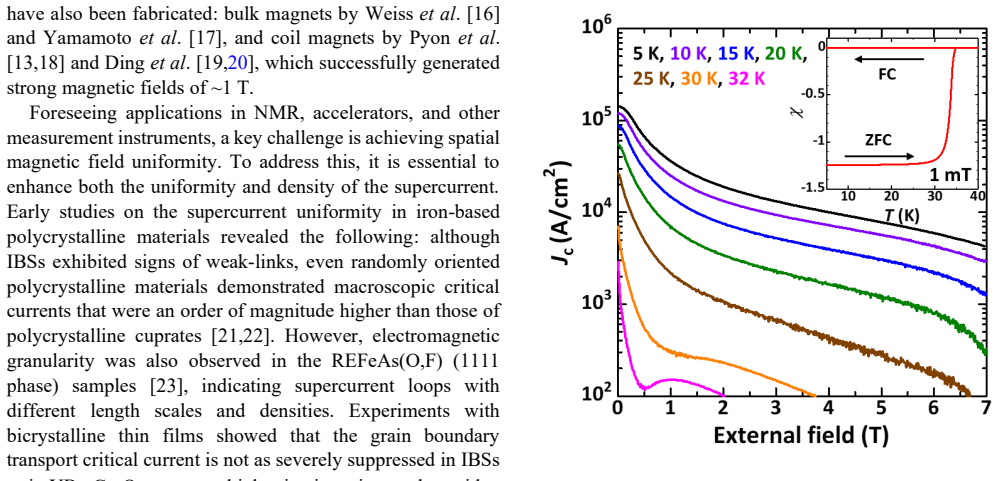
The load-bearing machinery is the combined magneto-optical imaging and a 3D H–Φ finite-element model of the remanent magnetization state. In the H–Φ formulation the magnetic field is solved in the air region and a scalar magnetic potential in the conductor, which reduces the degrees of freedom; modeling one-eighth of the square prism with symmetry boundary conditions makes the computation feasible. The superconductor's nonlinear resistivity is represented by the E–J power law, with $n=35$ taken from earlier work on the same material, and the measured $J_c(B,T)$ curve is fed in by direct interpolation. The comparison that carries the argument is the $B_z(x)$ profile across the sample surface: the slope of that profile is proportional to the local $J_c$, so agreement between the simulated and observed profiles is the operational definition of uniform current flow.
What would settle it
Perform the same zero-field-cooling runs with the applied field raised above 80 mT using a Hall-probe or higher-range indicator: if local flux-density gradients across the surface become position-dependent or patchy, or if the finite-element profile computed from the small-specimen $J_c(B,T)$ falls outside the measured error bars, the uniformity claim fails at those fields. A cheaper check: cut several small specimens from different regions of the same bulk and compare their magnetization $J_c$; disagreement would show the single measured $J_c$ is not the local $J_c$ everywhere.
Extended reading notes
Core claim
The central claim, stated as the authors would state it, is that in this K-doped Ba122 polycrystalline bulk the supercurrent circulates uniformly, so the critical current density obtained from magnetization measurements on a 0.52 × 1.48 × 2.41 mm³ specimen is quantitatively equivalent to the local $J_c$ that produces the flux-density gradients seen in the magneto-optical images. Evidence for the claim: the zero-field-cooled MO images show ideal roof-top patterns and fourfold symmetry up to 32 K, no electromagnetic granularity of the kind seen in earlier 1111-phase and 11-phase iron-based polycrystals, and no magnetic-impurity signal at 40 K. Finite-element simulations using the measured $J_c(B,T)$ with an $E \propto J^n$ power law ($n=35$) reproduce the measured $B_z(x)$ profiles closely enough that the authors attribute the small discrepancies to non-isothermal heating during magnetization rather than to current inhomogeneity. The authors explicitly note that the MO indicator film saturates at 80 mT, so uniformity at higher fields, where flux pinning is stronger, remains untested.
Load-bearing premise
Everything rests on the assumption that the critical current density measured on one small specimen is exactly the local critical current density at every point in the larger magneto-optical sample; if the two pieces carry different currents, the simulation's match to the images proves nothing about uniformity.
Editorial extensions
If this is right
- If the current is uniform at the MO scale, polycrystalline K-doped Ba122 bulks can be treated as homogeneous in trapped-field magnet design, simplifying predictions of field uniformity.
- The limiting factor for $J_c$ sits below a few micrometers, so further gains must come from submicron flux-pinning enhancement and grain-boundary engineering rather than from macroscopic densification.
- A single $J_c(B,T)$ curve plus $n=35$ reproduces the magnetization behavior from 5 K to 32 K, giving magnet designers a compact material law to work with.
- The close-to-$T_c$ uniform circulation at 30 K implies the sample has no low-$T_c$ or weakly superconducting regions at the observation scale.
Reading between the lines
- The paper leaves higher-field behavior untouched; a natural extension is to repeat the MO–FEM comparison above 80 mT, where stronger flux pinning might expose granularity that is invisible at low fields.
- The uniformity result makes a testable prediction: several small specimens cut from different regions of the same bulk should give the same $J_c(B,T)$, and local flux-gradient extractions should agree with that curve everywhere.
- Because natural grain boundaries in untextured polycrystals can exceed 24° misorientation, the uniform flow suggests the bulk current is not globally blocked by such boundaries; comparing local magnetization with transport across artificial boundaries at those angles would sharpen that conclusion.
Editorial analysis
A structured set of objections, weighed in public.
Referee Report
Summary. The manuscript reports a multi-technique study of a polycrystalline K-doped Ba122 bulk sample (square prism, 2.00 × 2.00 × 0.45 mm³) fabricated by high-energy milling and spark plasma sintering. Magneto-optical (MO) imaging at 30 K shows uniform flux penetration and, after removal of a 160 mT field, roof-top remanent flux patterns with approximate fourfold symmetry at temperatures up to 32 K. The authors compare these images with 3D H-Φ finite-element simulations that use the magnetization-derived Jc(B,T) as input together with an E-J power law (n = 35), finding close qualitative and, they argue, quantitative agreement. They conclude that the supercurrent circulates uniformly throughout the sample at the scale of the MO resolution and that the critical-current limitation occurs below this scale, likely at grain boundaries.
Significance. The MO imaging data are of high visual quality and provide strong, direct evidence for the absence of macroscopic electromagnetic granularity: the roof-top patterns, fourfold symmetry, and Meissner shielding near Tc are exactly what would be expected for a homogeneous type-II superconductor. If the quantitative claim were established, this would be a useful result for polycrystalline iron-based superconductors and for trapped-field magnet development. However, the quantitative 'equivalence' between the local supercurrent and the magnetization-derived Jc is not independently established: the FEM calculation is forced by the same Jc(B,T) it is meant to confirm, and the only independent estimate (Eq. (1)) differs by 60% from the magnetization value, without error bars. The qualitative uniformity claim is well supported; the quantitative part needs further work.
major comments (4)
- [§2 (FEM setup) and §3 (Figs. 5–6)] The finite-element model is driven by the same Jc(B,T) data (Fig. 1) that the paper claims are 'quantitatively equivalent' to the local supercurrent. The agreement between simulated and measured Bz(x) profiles is therefore a consistency check, not an independent validation of the local Jc magnitude. The local slope of Bz(x) in Fig. 4 is itself proportional to Jc and could provide an independent estimate from the MO images alone; as written, the comparison cannot falsify a spatially uniform Jc because spatial uniformity was assumed in the FEM input. Please reframe the claim or add an independent extraction of Jc from the MO gradient.
- [§3, Eq. (1)] The two quantitative estimates of Jc differ by 60%: Eq. (1) gives 8.1×10⁴ A/cm² while the magnetization hysteresis gives 1.3×10⁵ A/cm². Attributing this to the thin-strip approximation of Eq. (1) is plausible but unquantified; no error bars are given for the measured width b or for the magnetization Jc. This is too large a discrepancy to call 'good agreement' at the quantitative level. Please provide a sensitivity analysis for Eq. (1), including the finite-thickness geometry, and report uncertainties on all extracted quantities.
- [§2 and §3 (isothermal assumption and n sensitivity)] The FEM assumes isothermal conditions, a flux-creep exponent n = 35 taken from an earlier paper, and a ramp time of 10 s, with no sensitivity study for any of these choices. The authors attribute the slightly deeper flux penetration observed experimentally to flux-flow heating, but this effect is not modeled. The quantitative agreement therefore depends on an unverified assumption. Please test the sensitivity of the simulated profiles to n and to possible temperature excursions, or make the agreement qualitative only.
- [Abstract and §4 (resolution claim)] The conclusion that the supercurrent is 'uniform on the order of MO resolution' is not quantifiable because no spatial resolution of the MO system or iron-garnet indicator film is reported. Please state the pixel-limited resolution and the indicator-film resolution; otherwise the scale at which uniformity is claimed (a few micrometers versus tens of micrometers) is undefined.
minor comments (6)
- [§3] The word 'macrocopic' should be 'macroscopic'.
- [§2, Eq. (1)] The symbols in Eq. (1) are not fully defined: Ha is presumably the applied magnetic field in A/m, but its units and relation to the applied field of 160 mT should be stated explicitly, and the equation should be checked for unit consistency with d and w in centimeters.
- [§3, Fig. 4] The conclusion of smooth homogeneity is based on one line profile per temperature; providing averaged profiles or multiple line traces would strengthen the uniformity claim.
- [§2 (magnetization)] The 'extended Bean model' used to compute Jc from magnetization is not referenced; please cite the specific formula or model version used.
- [Reference list] Reference [20] contains a typo: 'Nati. Sci. Rev.' should be 'Natl. Sci. Rev.'
- [§2 (MO imaging)] The 'sawtooth-shaped bright contrasts' attributed to in-plane domains of the indicator film would be clearer if marked with arrows in Fig. 2 or described with a schematic.
Circularity Check
No significant circularity: FEM-MO comparison is a genuine cross-validation with no parameter fitted to the MO data.
full rationale
The paper's claimed derivation chain is: (1) Jc(B,T) is measured independently via magnetization hysteresis on a small specimen (Fig. 1); (2) MO imaging provides independent spatial flux-density data on a different square specimen; (3) FEM takes the measured Jc(B,T) as input with no free parameters fitted to the MO images, and reproduces the observed Bz(x) profiles. Because the input Jc is not derived from the MO data and the output flux profile is a nontrivial function of geometry, applied field history, and Jc(B), the comparison is a legitimate forward-model test that could have failed. The uniformity conclusion is primarily supported by the MO images themselves (fourfold symmetry, uniform flux penetration, ideal roof-top patterns), which are independent of the FEM assumptions. The only self-citation is the choice n=35 from prior work by overlapping authors [17]; this is a non-load-bearing modeling parameter that does not encode the target result (uniformity) and does not affect the independent MO evidence. The 60% discrepancy in the Eq. (1) estimate is acknowledged and attributed to geometry, so it is not hidden. Thus the central claim is not equivalent to its inputs by construction; the FEM-MO agreement is best characterized as a consistency check, a limitation in inferential strength rather than circularity.
Assumptions & free parameters
free parameters (3)
- Jc(B,T) from magnetization measurements =
1.4 x 10^5 A/cm2 at 5 K self-field; field dependence in Fig. 1
- Flux creep exponent n =
35
- Ramp time tramp =
10 s
assumptions (5)
- domain assumption The E-J power law E proportional to J^n describes the local nonlinear resistivity of the superconductor.
- domain assumption Jc(B,T) measured on a small specimen is representative of the local Jc in the 2x2x0.45 mm3 MO sample.
- domain assumption Isothermal conditions during magnetization, with no heat generation from flux motion.
- domain assumption Equation (1) from the Brandt-Indenbom strip model gives a valid Jc estimate from the Meissner region width in the square sample.
- domain assumption The iron-garnet indicator film's optical contrast is linearly proportional to local Bz over the field range.
Cite this review
Pith. "Pith review of Observation of Uniform Supercurrent Flow in Polycrystalline K-doped Ba122 by Combined Magneto-optical Imaging and Finite-element Modeling." pith.science (2026). https://pith.science/paper/A4KWPS6U
@misc{pith2026250608501,
  author       = {Pith},
  title        = {Pith review of: Observation of Uniform Supercurrent Flow in Polycrystalline K-doped Ba122 by Combined Magneto-optical Imaging and Finite-element Modeling},
  year         = {2026},
  howpublished = {\url{https://pith.science/paper/A4KWPS6U}},
  note         = {Machine review of arXiv:2506.08501}
}
read the original abstract
Macroscopic current uniformity in a (Ba,K)Fe2As2 bulk sample produced by a process that demonstrated high trapped magnetic fields was evaluated through a comparative experimental and modeling approach. The bulk sample, with a well-defined square geometry, exhibited ideal roof-top patterns in magneto-optical (MO) images. Comparison of the magnetic moment, MO images, and finite element modeling results showed good agreement for the critical current density, suggesting that the supercurrent circulates uniformly throughout the sample on the order of MO resolution. These results highlight the importance of enhancing flux pinning strength and microstructural control at the submicron and grain boundary scale in iron-based superconducting polycrystalline materials.
Figures


Figures from the paper (4 more)


Reference graph
Works this paper leans on
-
[1]
Kamihara Y, Watanabe T, Hirano M and Hosono H 2008 J. Am. Chem. Soc. 130 3296
work page 2008
- [2]
-
[3]
Tarantini C, Gurevich A, Jaroszynski J, Balakirev F, Bellingeri E, Pallecchi I, Ferdeghini C, Shen B, Wen H H and Larbalestier D C 2011 Phys. Rev. B 84 184522
work page 2011
-
[4]
Altarawneh M M, Collar K, Mielke C H, Ni N, Bud’ko S L, and Canfield P C 2008 Phys. Rev. B 78 220505
work page 2008
-
[5]
Hänisch J, Iida K, Kurth F, Reich E, Tarantini C, Jaroszynski J, Förster T, Fuchs G, Hühne R, Grinenko V, Schultz L and Holzapfel B 2015 Scientific Reports 5 17363
work page 2015
-
[6]
Ishida S, Song D, Ogino H, Iyo A, Eisaki H, Nakajima M, Shimoyama J and Eisterer M 2017 Phys. Rev. B 95 014517
work page 2017
-
[7]
Vinod K, Satya A T, Sharma S, Sundar C S and Bharathi A 2011 Phys. Rev. B 84 012502
work page 2011
-
[8]
Yamamoto A, Jaroszynski J, Tarantini C, Balicas L, Jiang J, Gurevich A, Larbalestier D C, Jin R, Sefat A S, McGuire M A, Sales B C, Christen D K and Mandrus D 2009 Appl. Phys. Lett. 94 062511
work page 2009
Show all 62 references
-
[9]
Yuan H Q, Singleton J, Balakirev F F, Baily S A, Chen G F, Luo J L and Wang N L 2009 Nature 457 565
2009
-
[10]
Tokuta S, Hasegawa Y, Shimada Y and Yamamoto A 2022 iScience 25 103992
2022
-
[11]
Pak C, Su Y F, Collantes Y, Tarantini C, Hellstrom E E, Larbalestier D C and Kametani F 2020 Supercond. Sci. Technol. 33 084010
2020
-
[12]
Pyon S, Suwa T, Tamegai T, Takano K, Kajitani H, Koizumi N, Awaji S, Zhou N and Shi Z 2018 Supercond. Sci. Technol. 31 055016
2018
-
[13]
Phys.: Conf
Pyon S, Ito T, Tamegai T, Kajitani H, Koizumi N, Awaji S, Kito H, Ishida S and Yoshida Y 2022 J. Phys.: Conf. Ser. 2323 012020
2022
-
[14]
Huang H, Yao C, Dong C, Zhang X, Wang D, Cheng Z, Li J, Awaji S, Wen H H and Ma Y 2018 Supercond. Sci. Technol. 31 015017
2018
-
[15]
Gao Z, Togano K, Zhang Y, Matsumoto A, Kikuchi A and Kumakura H 2017 Supercond. Sci. Technol. 30 095012
2017
-
[16]
Weiss J D, Yamamoto A, Polyanskii A A, Richardson R B, Larbalestier D C and Hellstrom E E 2015 Supercond. Sci. Technol. 28 112001
2015
-
[17]
Yamamoto A, Tokuta S, Ishii A, Yamanaka A, Shimada Y and Ainslie M D 2024 NPG Asia Mater. 16 29
2024
-
[18]
Pyon S, Ito T, Sakagami R, Tamegai T, Awaji S, Kito H, Ishida S, Eisaki H, Yoshida Y and Kajitani H 2023 Supercond. Sci. Technol. 36 015009
2023
-
[19]
Ding H, Zhao H, Huang P, Yu L, Xu J, Fang Z, Chen Z, Wang D, Zhang X and Chen W 2023 Supercond. Sci. Technol. 36 11LT01
2023
-
[20]
Dong C H, Xu Q J, Ma Y W 2024 Nati. Sci. Rev. 11 nwae122
2024
-
[21]
Yamamoto A, Polyanskii A A, Jiang J, Kametani F, Tarantini C, Hunte F, Jaroszynski J, Hellstrom E E, Lee P J, Gurevich A, Larbalestier D C, Ren Z A, Yang J, Dong X L, Lu W and Zhao Z X 2008 Supercond. Sci. Technol. 21 095008
2008
-
[22]
Palenzona A, Sala A, Bernini C, Braccini V, Cimberle M R, Ferdeghini C, Lamura G, Martinelli A, Pallecchi I and Romano G 2012 Supercond. Sci. Technol. 25 115018
2012
-
[23]
Yamamoto A, Jiang J, Kametani F, Polyanskii A, Hellstrom E, Larbalestier D, Martinelli A, Palenzona A, Tropeano M and Putti M 2011 Supercond. Sci. Technol. 24 045010
2011
-
[24]
Lee S, Jiang J, Weiss J D, Folkman C M, Bark C W, Tarantini C, Xu A, Abraimov D, Polyanskii A, Nelson C T, Zhang Y, Baek S H, Jang H W, Yamamoto A, Kametani F, Pan X Q, Hellstrom E E, Gurevich A, Eom C B and Larbalestier D C 2009 Appl. Phys. Lett. 95 212505
2009
-
[25]
Katase T, Ishimaru Y, Tsukamoto A, Hiramatsu H, Kamiya T, Tanabe K and Hosono H 2011 Nat. Commun. 2 409
2011
-
[26]
Luo J Y, Okada T, Awaji S, Liu C and Ma Y W 2023 IEEE Trans. Appl. Supercond. 33 8200405
2023
-
[27]
Hecher J, Baumgartner T, Weiss J D, Tarantini C, Yamamoto A, Jiang J, Hellstrom E E, Larbalestier D C and Eisterer M 2016 Supercond. Sci. Technol. 29 025004
2016
-
[28]
Kametani F, Su Y F, Collantes Y, Pak C, Tarantini C, Larbalestier D C and Hellstrom E E 2020 Appl. Phys. Express 13 113002
2020
-
[29]
Shimada Y, Tokuta S, Yamanaka A, Yamamoto A and Konno T J 2022 J. Alloy. Compd. 923 166358
2022
-
[30]
266 119648
Guo Z M, Muraoka K, Gao H Y, Shimada Y, Harada T, Tokuta S, Hasegawa Y, Yamamoto A and Hata S 2024 Acta Mater. 266 119648
2024
-
[31]
China Mater
Liu S F, Yao C, Huang H, Dong C H, Guo W W, Cheng Z, Zhu Y C, Awaji S and Ma Y W 2021 Sci. China Mater. 64 2530
2021
-
[32]
Kametani F, Su Y, Tarantini C, Hellstrom E, Matsumoto A, Kumakura H, Togano K, Huang H and Ma Y 2024 Appl. Phys. Express 17 013004
2024
-
[33]
Tarantini C, Pak C, Su Y F, Hellstrom E E, Larbalestier D C and Kametani F 2021 Scientific Reports 11 3143
2021
-
[34]
Hirabayashi Y, Iga H, Ogawa H, Tokuta S, Shimada Y and Yamamoto A 2024 NPG Comput. Mater. 10 46
2024
-
[35]
Ishii A, Kikuchi S, Yamanaka A and Yamamoto A 2023 J. Alloy. Compd. 966 171613
2023
-
[36]
Bagni T, Bovone G, Rack A, Mauro D, Barth C, Matera D, Buta F and Senatore C 2021 Scientific Reports 11 7767
2021
-
[37]
Yamamoto A, Yamanaka A, Iida K, Shimada Y and Hata S 2024 Sci. Technol. Adv. Mater. 26 2436347
2024
-
[38]
7 111107
Tokuta S and Yamamoto A 2019 APL Mater. 7 111107
2019
-
[39]
Tokuta S, Shimada Y and Yamamoto A 2020 Supercond. Sci. Technol. 33 094010
2020
-
[40]
Rotter M, Pangerl M, Tegel M and Johrendt D 2008 Angew. Chem. Int. Ed. 47 7949
2008
-
[41]
Nikolo M, Weiss J D, Singleton J, Jiang J and Hellstrom E E 2018 IEEE Trans. Appl. Supercond. 28 7300104
2018
-
[42]
Tamegai T, Pyon S, Tsuchiya Y, Inoue H, Koizumi N and Kajitani H 2015 IEEE Trans. Appl. Supercond. 25 7300504
2015
-
[43]
Yang H, Luo H Q, Wang Z S and Wen H H 2008 Appl. Phys. Lett. 93, 142506
2008
-
[44]
Arsenault A, Sirois F and Grilli F 2021 IEEE Trans. Appl. Supercond. 31 680011
2021
-
[45]
Zhang K, Ainslie M, Calvi M, Kinjo R and Schmidt T 2021 Supercond. Sci. Technol. 34 094002
2021
-
[46]
Ainslie M D, Huang K Y, Fujishiro H, Chaddock J, Takahashi K, Namba S, Cardwell D A and Durrell J H 2019 Supercond. Sci. Technol. 32 034002
2019
-
[47]
Rhyner J 1993 Physica C 212 292 8
1993
-
[48]
Plummer C J G and Evetts J E 1987 IEEE Trans. Magn. 23 1179
1987
-
[49]
Ainslie M D, Fujishiro H, Mochizuki H, Takahashi K, Shi Y-H, Namburi D K, Zou J, Zhou D, Dennis A R and Cardwell D A 2016 Supercond. Sci. Technol. 29 074003
2016
-
[50]
Ding Q P, Mohan S, Tsuchiya Y, Taen T, Nakajima Y and Tamegai T 2011 Supercond. Sci. Technol. 24 075025
2011
-
[51]
Prozorov R, Tillman M E, Mun E D and Canfield P C 2009 New J. Phys. 11 035004
2009
-
[52]
Kametani F, Polyanskii A A, Yamamoto A, Jiang J, Hellstrom E E, Gurevich A, Larbalestier D C, Ren Z A, Yang J, Dong X L, Lu W and Zhao Z X 2009 Supercond. Sci. Technol. 22 015010
2009
-
[53]
Tamegai T, Nakajima Y, Tsuchiya Y, Iyo A, Miyazawa K, Shirage P M, Kito H and Eisaki H 2009 Physica C 469 915
2009
-
[54]
Brandt E H and Indenbom M 1993 Phys. Rev. B 48 12893
1993
-
[55]
Ainslie M and Fujishiro H 2019 Numerical modelling of bulk superconductor magnetisation (IOP Publishing)
2019
-
[56]
Larbalestier D C, Cooley L D, Rikel M O, Polyanskii A A, Jiang J, Patnaik S, Cai X Y, Feldmann D M, Gurevich A, Squitieri A A, Naus M T, Eom C B, Hellstrom E E, Cava R J, Regan K A, Rogado N, Hayward M A, He T, Slusky J S, Khalifah P, Inumaru K and Haas M 2001 Nature 410 186
2001
-
[57]
Yamamoto A, Ishihara A, Tomita M and Kishio K 2014 Appl. Phys. Lett. 105, 032601
2014
-
[58]
Iida K, Qin D Y, Tarantini C, Hatano T, Wang C, Guo Z M, Gao H Y, Saito H, Hata S, Naito M and Yamamoto A 2021 NPG Asia Mater. 13 68
2021
-
[59]
Qin D, Iida K, Guo Z, Wang C, Saito H, Hata S, Naito M and Yamamoto A 2022 Supercond. Sci. Technol. 35 09LT01
2022
-
[60]
Qin D Y, Guo Z M, Tarantini C, Hata S, Naito M and Yamamoto A 2024 Appl. Phys. Lett. 125 182601
2024
-
[61]
Taen T, Ohtake F, Pyon S, Tamegai T and Kitamura H 2015 Supercond. Sci. Technol. 28 085003
2015
-
[62]
Hatano T, Qin D Y, Iida K, Gao H Y, Guo Z M, Saito H, Hata S, Shimada Y, Naito M and Yamamoto A 2024 NPG Asia Mater. 16 41
2024
Reviewed August 7, 2026 · model on record in the stance chip above.
Discussion (0). Sign in to comment.