REVIEW 2 major objections 5 minor 116 references
Fast and Accurate Prediction of Neutron Star Structure with Deep Neural Networks
T0 review · 2 major / 5 minor · reviewed 2026-08-11 · deepseek-v4-flash
Pith's one-line read Neural-network surrogates for the TOV equations predict neutron-star mass, radius, and tidal deformability with R2 above 0.999 and run about 200 times faster than direct numerical integration.
desk verdict Clean benchmark of FFN vs ResNet for TOV surrogates; the accuracy claims are solid, but the headline 200x speedup omits stability detection, so treat that number with caution. read the letter →
The pith
A machine-rendered reading of the paper's core claim, the machinery that carries it, and where it could break.
The reading
What carries the argument
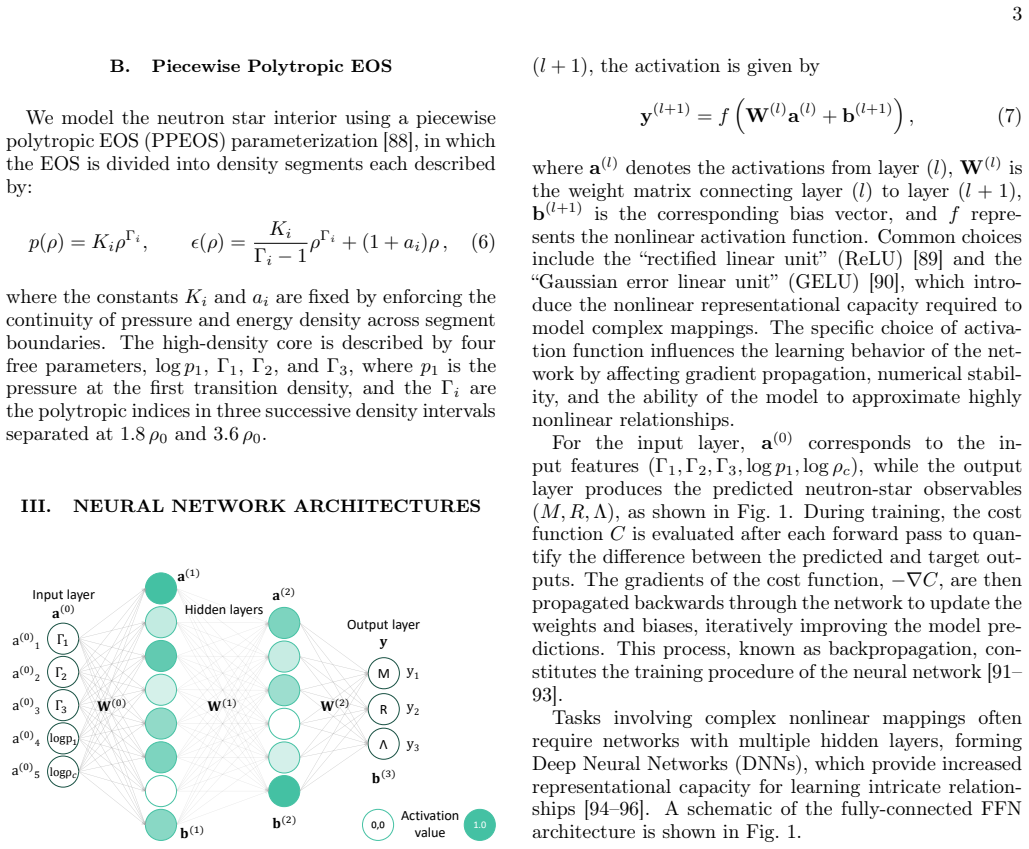
The machinery is the TOV system of ordinary differential equations for hydrostatic equilibrium, coupled to a first-order differential equation for the tidal perturbation variable $y(r)$ whose surface value gives the Love number $k_2$ and hence the tidal deformability $\Lambda$. The paper's models are trained on solutions of this system for a piecewise polytropic EOS, in which the high-density core is described by the pressure at the first transition density and three polytropic indices. The surrogate itself is a fully connected network with GELU activations and 512-dimensional hidden layers, with an optional identity skip connection in each residual block; the skip connection lets the network learn only the residual of the target mapping. Huber loss, the AdamW optimizer, and a cosine-annealed learning rate carry the training, and early stopping is used to avoid overfitting.
What would settle it
Run a complete Bayesian inference or population study in which the sampler proposes arbitrary central densities, and compare the wall-clock time and resulting posterior when the surrogate is paired with a stability detector against the same analysis using direct TOV integration; if the surrogate pipeline is not roughly two orders of magnitude faster, or if the posteriors differ measurably, the practical speedup and accuracy claims as deployed are refuted.
Extended reading notes
Core claim
The paper's central claim is that the forward TOV mapping, including the tidal perturbation equations, is learnable to high accuracy by a compact neural network. Trained on $4.2 \times 10^5$ stable configurations drawn from a piecewise polytropic EOS parameter space, both a four-hidden-layer feedforward network and a four-block residual network predict gravitational mass $M$, radius $R$, and $\log_{10} \Lambda$ simultaneously from the five inputs $\log p_1$, $\Gamma_1$, $\Gamma_2$, $\Gamma_3$, and $\log \rho_c$. Across test grids of unseen EOSs, the coefficient of determination exceeds 0.999 for all three observables, and median inference time is about 3.5 ms per star versus roughly 0.8 s for the numerical solver, giving speedups from about 209 to 239 times. The residual network's accuracy is modestly better than the feedforward network's, but the feedforward network already has enough capacity for this mapping, so the paper positions residual connections as an incremental improvement and a baseline for future, higher-dimensional EOS parameterizations.
Load-bearing premise
The speedup benchmark assumes the user already knows which central densities yield stable stars, so the network never has to detect the maximum mass or reject unstable configurations; if stability must be determined by solving the TOV equations anyway, the end-to-end speedup is smaller.
Editorial extensions
If this is right
- Within the trained piecewise-polytropic parameter ranges, Bayesian EOS inference can draw on a surrogate instead of a TOV solver for each likelihood evaluation, cutting the dominant computational cost by roughly two orders of magnitude.
- Population studies with next-generation detectors that observe around $10^5$ binary neutron star mergers per year become feasible without sacrificing in-domain accuracy.
- Because the feedforward network nearly matches the residual network, a simple feedforward architecture is a sufficient default for this five-input to three-output regression, while the residual network offers a stronger baseline for added input dimensions.
- Accuracy on the stable branch reported as $R^2 > 0.999$ implies that emulator noise is small relative to the spread of observables across the EOS parameter space.
Reading between the lines
- Beyond the paper: the reported speedup does not include the cost of determining whether a proposed central density lies on the stable branch; a real sampler would need a separate stability check or classifier, which would cut into the 209–238 times figure.
- Beyond the paper: because a neural surrogate interpolates smoothly, its errors are correlated across neighboring EOS parameters; in a posterior, those correlated errors could bias the inferred EOS even when per-point $R^2$ is very high, so error-aware likelihoods or conservative noise inflation are worth testing.
- Beyond the paper: the same training pipeline should transfer to tabulated EOS families or temperature-dependent EOSs, but the claimed accuracy is only established for the piecewise-polytropic parameterization, so any such extension requires retraining and re-validation.
Editorial analysis
A structured set of objections, weighed in public.
Referee Report
Summary. The paper develops neural-network surrogates for the forward Tolman-Oppenheimer-Volkoff (TOV) mapping, predicting neutron star mass, radius, and tidal deformability directly from four piecewise-polytropic EOS parameters plus the log central density. Two architectures are compared: a 512-neuron feedforward network with four hidden layers and a residual network with four residual blocks. Training data are 4.2e5 stable configurations generated by a vectorized RK4 solver, and the networks are evaluated on held-out EOSs. The authors report R^2 values exceeding 0.999 for all three observables, with the ResNet slightly more accurate than the FFN, and speedups of roughly 209-238x relative to the numerical solver. The main claim is that these surrogates can replace repeated TOV evaluations in Bayesian EOS inference and population studies.
Significance. If the accuracy and speed claims hold, the paper provides a useful, low-cost emulator for dense-matter EOS inference, and the comparison between FFN and ResNet architectures is a reasonable contribution to the surrogate-modeling literature. The accuracy metrics are reported carefully, with an 80-20 train-validation split, a separate test set of unseen EOSs, and a 1000-EOS reproducibility check, which are strengths. The validation against the same numerical solver that generated the training data is appropriate for an emulator and should not be treated as a flaw; it means the reported accuracy is a measure of fit quality to that solver, not of agreement with independent physical measurements. The speedup claim, however, is not end-to-end: the benchmark evaluates the networks only on TOV-validated stable configurations, and this limitation is explicitly acknowledged in Sec. V.B. The paper does not ship code, trained models, or a data-availability statement, which limits direct reproduction of the reported numbers.
major comments (2)
- [Sec. V.B, Eq. (12), Table III] The reported 209-238x speedup is not a like-for-like replacement cost for a complete inference pipeline. As stated in Sec. V.B, the networks are evaluated only on the stable stellar configurations already identified by the TOV solver, whereas the TOV runtime includes the cost of identifying and validating the stable branch. In Bayesian inference or population synthesis the user does not know in advance which (EOS, log rho_c) pairs are stable, and the network, trained only on stable samples, returns no instability flag or confidence measure. The speedup S = t_TOV / t_model therefore measures inference on a pre-filtered set, not the acceleration of a full evaluation pipeline. The authors should either add a stability surrogate (for example, a classifier or a maximum-mass predictor) and benchmark the complete pipeline, or explicitly restrict the abstract and conclusion claims to "inference on pre-identified stable configurations."
- [Sec. V.B, Table III] The unit of the benchmark times is ambiguous. Table III reports median TOV times of about 824 ms for 100 EOSs and about 760 ms for the ResNet baseline, which are plausible as per-EOS times for evaluating 100 central densities per EOS, but the text states that "direct numerical integration of the TOV equations requires ~0.8 s per evaluation" without specifying whether "evaluation" means one star or one full EOS sequence. The ratio S = 824 ms / 3.5 ms is consistent with per-EOS times, but the current wording prevents the reader from determining the actual workload. Please clarify the unit of the times in Table III and the meaning of "per evaluation" in the text.
minor comments (5)
- [Table II] The caption states that MAE and RMSE values are in units of 10^-3, but the physical units for mass, radius, and tidal deformability are not specified. Please state explicitly that mass is in M_sun, radius in km, and tidal deformability in dimensionless log10 Lambda units (or correct the table if the tidal-deformability metric is computed differently).
- [Sec. IV.B and Sec. IV.D] No code, trained model weights, or data-generation scripts are provided, and there is no data-availability statement. For a machine-learning surrogate paper, releasing the trained models would substantially improve reproducibility and practical uptake.
- [Reference [110]] Reference [110] appears to cite a book review of James et al., not the original source for Z-score standardization. Please replace it with a standard reference for feature normalization or remove the citation.
- [Appendix B] The sentence "The mass-radius and tidal deformability-mass diagrams, shows in figures 10 and 11, compare the network predictions with the solutions generated by the TOV solver" has a grammatical error: "shows" should be "shown."
- [Sec. V.A, Fig. 8] The aggregate percentage-error profiles are interpolated onto a common central-density grid, but the text does not state how many EOSs contribute to the mean and one-standard-deviation band at each grid point after interpolation. Please state clearly whether all 10 unseen EOSs contribute across the full plotted range or whether the sample size shrinks near the maximum stable density.
Circularity Check
No significant circularity: the surrogate accuracy claim is an emulator-fit statement benchmarked against the same TOV solver that generated the training labels, and the speedup caveat is explicitly disclosed.
full rationale
The paper's central claim is that neural networks reproduce numerical TOV solutions for mass, radius, and tidal deformability across a piecewise-polytropic parameter space. This is an interpolation and fit-quality claim, not a first-principles derivation: the training labels and test references both come from the same RK4 TOV plus tidal solver (Secs. IV.B and IV.D), and the paper never claims agreement with independent observational measurements. Validating an emulator against the solver that produced its training data is the standard and non-circular procedure for this type of surrogate. The only caveat is the speedup benchmark in Sec. V.B, where the TOV runtime includes 'the computational cost of identifying and validating the stable branch, whereas the neural network performs inference directly on this validated set of stellar models'; this means the practical end-to-end speedup is smaller when stability must still be determined by solving TOV, but the paper states that assumption explicitly, and the caveat concerns benchmark scope, not equivalence of input and output. No load-bearing self-citation appears: the authors' own works are cited only as background for multimessenger Bayesian inference and a related merger simulation, not to justify the surrogate mapping or to exclude alternative architectures. No uniqueness theorem, ansatz smuggled via citation, or renaming of a known result is present. The 'R2 exceeding 0.999' claim is a measured fit metric within the training domain, so no result is forced by definition or by self-citation. The derivation chain is therefore self-contained for what it claims to do.
Assumptions & free parameters
free parameters (3)
- FFN weights and biases =
not stated; architecture 5-512-512-512-512-256-3
- ResNet weights and biases =
not stated; architecture 5-512 plus 4 residual blocks, output 512-256-3
- Input standardization statistics (mean and standard deviation per feature) =
computed from training set
assumptions (5)
- domain assumption TOV equations and tidal Love number formalism accurately describe neutron star structure.
- domain assumption Piecewise polytropic EOS parameterization (Read et al. 2009) adequately covers the dense-matter EOS parameter space for this surrogate.
- domain assumption The RK4 solver with adaptive step size produces sufficiently accurate reference solutions.
- ad hoc to paper The stable branch of solutions is known in advance when using the surrogate; the network is evaluated only on pre-identified stable configurations.
- standard math Neural networks with GELU activations can approximate the continuous mapping from EOS parameters to observables.
Cite this review
Pith. "Pith review of Fast and Accurate Prediction of Neutron Star Structure with Deep Neural Networks." pith.science (2026). https://pith.science/paper/A5FB2CUH
@misc{pith2026260807698,
  author       = {Pith},
  title        = {Pith review of: Fast and Accurate Prediction of Neutron Star Structure with Deep Neural Networks},
  year         = {2026},
  howpublished = {\url{https://pith.science/paper/A5FB2CUH}},
  note         = {Machine review of arXiv:2608.07698}
}
read the original abstract
Solving the Tolman--Oppenheimer--Volkoff (TOV) equations, together with the tidal perturbation equations, for large numbers of equation-of-state (EOS) samples is a major computational bottleneck in Bayesian inference of the dense-matter EOS, and this will become increasingly limiting as next-generation observatories deliver far larger and more precise datasets. We develop neural-network surrogates for the forward TOV mapping that predict neutron star mass, radius, and tidal deformability simultaneously and directly from the EOS parameters and central density. We train and compare two architectures: a conventional feedforward network and a residual network, the latter of which, to our knowledge, has not previously been explored for TOV surrogate modeling. Trained on a piecewise polytropic EOS parameter space, both networks reproduce the numerical solutions to high accuracy, with the coefficient of determination exceeding 0.999 for all three observables, while accelerating the evaluation of stellar observables by roughly two orders of magnitude relative to direct numerical integration. We find that both architectures achieve excellent predictive accuracy at the network sizes considered here, with the residual network providing a modest improvement in accuracy over the feedforward network at the expense of slightly longer inference times. The overall performance differences remain small, indicating that a feedforward network already has sufficient capacity for this mapping while residual connections offer only incremental gains. Nevertheless, the residual architecture provides a robust baseline for future extensions to richer EOS parameterizations or higher-dimensional regression tasks. The resulting surrogates are well-suited to large-scale Bayesian EOS inference and population studies, where repeated TOV evaluations would otherwise dominate the computational cost.
Figures


Figures from the paper (7 more)


Reference graph
Works this paper leans on
-
[1]
J. M. Lattimer and M. Prakash, Physics Reports621, 127–164 (2016)
2016
-
[2]
Activation layer (GELU) 𝐹(𝑥) Output layer Linear layer (512n) 𝑥 𝑥 Input 5n ResNet BLOCK 3 512n ResNet BLOCK 4 512n + Activation layer (GELU) Linear layer (256n) Figure 4. Architecture of the proposed residual network. Five input features are encoded into a 512-dimensional representa- tion, processed by four residual blocks with identity skip connections, ...
-
[3]
Add residuals: 𝐹(𝑥) + 𝑥 512 + 512 n Output 3n ResNet BLOCK 2 512n + ResNet BLOCK 1 512n Input layer
-
[4]
D. Adhikariet al.(PREX), Phys. Rev. Lett.126, 172502 (2021), arXiv:2102.10767 [nucl-ex]
arXiv 2021
-
[5]
M. Oertel, M. Hempel, T. Klähn, and S. Typel, Reviews of Modern Physics89, 10.1103/revmodphys.89.015007 (2017). 11
-
[6]
G. Baym, T. Hatsuda, T. Kojo, P. D. Powell, Y. Song, and T. Takatsuka, Reports on Progress in Physics81, 056902 (2018)
2018
- [7]
-
[8]
D. Adhikariet al.(CREX), Phys. Rev. Lett.129, 042501 (2022), arXiv:2205.11593 [nucl-ex]
arXiv 2022
Show all 116 references
-
[9]
Danielewicz, R
P. Danielewicz, R. Lacey, and W. G. Lynch, Science 298, 1592 (2002), arXiv:nucl-th/0208016
2002 arXiv
-
[10]
Machleidt and D
R. Machleidt and D. R. Entem, Phys. Rept.503, 1 (2011), arXiv:1105.2919 [nucl-th]
2011 arXiv
-
[11]
Sorensenet al., Prog
A. Sorensenet al., Prog. Part. Nucl. Phys.134, 104080 (2024), arXiv:2301.13253 [nucl-th]
2024 arXiv
-
[12]
E.Epelbaum, H.-W.Hammer,andU.-G.Meissner,Rev. Mod. Phys.81, 1773 (2009), arXiv:0811.1338 [nucl-th]
2009 arXiv
-
[13]
Drischler, J
C. Drischler, J. W. Holt, and C. Wellenhofer, Ann. Rev. Nucl. Part. Sci.71, 403 (2021), arXiv:2101.01709 [nucl- th]
2021 arXiv
-
[14]
Hammer, A
H.-W. Hammer, A. Nogga, and A. Schwenk, Rev. Mod. Phys.85, 197 (2013), arXiv:1210.4273 [nucl-th]
2013 arXiv
-
[15]
K.Hebeler,Phys.Rept.890,1(2021),arXiv:2002.09548 [nucl-th]
2021 arXiv
-
[16]
Abacet al.(ET), JCAP03, 081, arXiv:2503.12263 [gr-qc]
A. Abacet al.(ET), JCAP03, 081, arXiv:2503.12263 [gr-qc]
-
[17]
J. M. Lattimer and M. Prakash, Phys. Rev. Lett.94, 111101 (2005), arXiv:astro-ph/0411280
2005 arXiv
-
[18]
Baiotti, Prog
L. Baiotti, Prog. Part. Nucl. Phys.109, 103714 (2019), arXiv:1907.08534 [astro-ph.HE]
2019 arXiv
-
[19]
R. C. Tolman, Physical Review55, 364 (1939)
1939
-
[20]
Biswas, S
B. Biswas, S. Rosswog, P. Diener, and L. Schnabel, Binary neutron star mergers with SPHINCS_BSSN: temperature-dependent equations of state and damping of constraint violations (2026), arXiv:2601.01402 [astro- ph.HE]
2026
-
[21]
J. R. Oppenheimer and G. M. Volkoff, Physical Review 55, 374 (1939)
1939
-
[22]
Damour and A
T. Damour and A. Nagar, Phys. Rev. D80, 084035 (2009), arXiv:0906.0096 [gr-qc]
2009 arXiv
-
[23]
Hinderer, Astrophys
T. Hinderer, Astrophys. J.677, 1216 (2008), arXiv:0711.2420 [astro-ph]
2008 arXiv
-
[24]
E. E. Flanagan and T. Hinderer, Phys. Rev. D77, 021502 (2008), arXiv:0709.1915 [astro-ph]
2008 arXiv
-
[25]
H. T. Cromartieet al., Nature Astron.4, 72 (2019), arXiv:1904.06759 [astro-ph.HE]
2019 arXiv
-
[26]
Lindblom, Astrophys
L. Lindblom, Astrophys. J.398, 569 (1992)
1992
-
[27]
Demorest, T
P. Demorest, T. Pennucci, S. Ransom, M. Roberts, and J. Hessels, Nature467, 1081 (2010), arXiv:1010.5788 [astro-ph.HE]
2010 arXiv
-
[28]
T. E. Rileyet al., Astrophys. J. Lett.887, L21 (2019), arXiv:1912.05702 [astro-ph.HE]
2019 arXiv
-
[29]
K. C. Gendreau, Z. Arzoumanian, P. W. Adkins, C. L. Albert, J. F. Anders, A. T. Aylward, C. L. Baker, E. R. Balsamo, W. A. Bamford, S. S. Benegalrao, D. L. Berry, S. Bhalwani, J. K. Black, C. Blaurock, G. M. Bronke, G. L. Brown, J. G. Budinoff, J. D. Cantwell, T. Cazeau, P. T....
2016
-
[30]
Bogdanovet al., Astrophys
S. Bogdanovet al., Astrophys. J. Lett.887, L25 (2019), arXiv:1912.05706 [astro-ph.HE]
2019 arXiv
-
[31]
M. C. Milleret al., Astrophys. J. Lett.918, L28 (2021), arXiv:2105.06979 [astro-ph.HE]
2021 arXiv
-
[32]
M. C. Milleret al., Astrophys. J. Lett.887, L24 (2019), arXiv:1912.05705 [astro-ph.HE]
2019 arXiv
-
[33]
T. E. Rileyet al., Astrophys. J. Lett.918, L27 (2021), arXiv:2105.06980 [astro-ph.HE]
2021 arXiv
-
[34]
B. P. Abbottet al.(LIGO Scientific, Virgo), Phys. Rev. Lett.121, 161101 (2018), arXiv:1805.11581 [gr-qc]
2018 arXiv
-
[35]
B. P. Abbottet al.(LIGO Scientific, Virgo, Fermi GBM, INTEGRAL, IceCube, AstroSat Cadmium Zinc Telluride Imager Team, IPN, Insight-Hxmt, ANTARES, Swift, AGILE Team, 1M2H Team, Dark Energy Camera GW-EM, DES, DLT40, GRAWITA, Fermi-LAT, ATCA, ASKAP, Las Cumbres Observa- tory Grou...
2017 arXiv
-
[36]
B. P. Abbottet al.(LIGO Scientific, Virgo), Phys. Rev. X9, 011001 (2019), arXiv:1805.11579 [gr-qc]
2019 arXiv
-
[37]
Xie and B.-A
W.-J. Xie and B.-A. Li, Astrophys. J.883, 174 (2019), arXiv:1907.10741 [astro-ph.HE]
2019 arXiv
-
[38]
Raaijmakerset al., Astrophys
G. Raaijmakerset al., Astrophys. J. Lett.893, L21 (2020), arXiv:1912.11031 [astro-ph.HE]
2020 arXiv
-
[39]
S.Traversi, P.Char,andG.Pagliara,Astrophys.J.897, 165 (2020), arXiv:2002.08951 [astro-ph.HE]
2020 arXiv
-
[40]
Dietrich, M
T. Dietrich, M. W. Coughlin, P. T. H. Pang, M. Bulla, J. Heinzel, L. Issa, I. Tews, and S. Antier, Science370, 1450 (2020), arXiv:2002.11355 [astro-ph.HE]
2020 arXiv
-
[41]
Biswas, P
B. Biswas, P. Char, R. Nandi, and S. Bose, Phys. Rev. D103, 103015 (2021), arXiv:2008.01582 [astro-ph.HE]
2021 arXiv
-
[42]
Al-Mamun, A
M. Al-Mamun, A. W. Steiner, J. Nättilä, J. Lange, R. O’Shaughnessy, I. Tews, S. Gandolfi, C. Heinke, and S. Han, Phys. Rev. Lett.126, 061101 (2021), 12 arXiv:2008.12817 [astro-ph.HE]
2021 arXiv
-
[43]
Biswas and S
B. Biswas and S. Rosswog, Phys. Rev. D112, 023045 (2025), arXiv:2408.15192 [astro-ph.HE]
2025 arXiv
-
[44]
Landry, R
P. Landry, R. Essick, and K. Chatziioannou, Phys. Rev. D101, 123007 (2020), arXiv:2003.04880 [astro-ph.HE]
2020 arXiv
- [45]
-
[46]
Zhanget al.(eXTP), Sci
S.-N. Zhanget al.(eXTP), Sci. China Phys. Mech. As- tron.62, 29502 (2019), arXiv:1812.04020 [astro-ph.IM]
2019 arXiv
-
[47]
Biswas and P
B. Biswas and P. Char, Phys. Rev. D112, 063049 (2025), arXiv:2507.12540 [astro-ph.HE]
2025 arXiv
- [48]
-
[49]
Reitzeet al., Bull
D. Reitzeet al., Bull. Am. Astron. Soc.51, 035 (2019), arXiv:1907.04833 [astro-ph.IM]
2019 arXiv
-
[50]
P. S. Rayet al.(STROBE-X Science Working Group), STROBE-X: X-ray Timing and Spectroscopy on Dy- namical Timescales from Microseconds to Years (2019), arXiv:1903.03035 [astro-ph.IM]
2019 arXiv
-
[51]
Maggioreet al., JCAP03, 050, arXiv:1912.02622 [astro-ph.CO]
M. Maggioreet al., JCAP03, 050, arXiv:1912.02622 [astro-ph.CO]
1912 arXiv
-
[52]
Richter and B.-A
J. Richter and B.-A. Li, Phys. Rev. C108, 055803 (2023), arXiv:2307.05848 [nucl-th]
2023 arXiv
-
[53]
Chatziioannou, Phys
K. Chatziioannou, Phys. Rev. D105, 084021 (2022), arXiv:2108.12368 [gr-qc]
2022 arXiv
-
[54]
Walker, R
K. Walker, R. Smith, E. Thrane, and D. J. Reardon, Phys. Rev. D110, 043013 (2024), arXiv:2401.02604 [astro-ph.HE]
2024
-
[56]
S. M. A. Imam, A. Mukherjee, B. K. Agrawal, and G. Banerjee, Phys. Rev. C109, 025804 (2024), arXiv:2305.11007 [nucl-th]
2024 arXiv
-
[57]
M. á. Ferreira and C. Providência, JCAP07, 011, arXiv:1910.05554 [nucl-th]
1910 arXiv
-
[58]
S. J. Magnall, S. R. Goode, N. Sarin, and P. D. Lasky, Directly inferring cosmology and the neutron-star equa- tion of state from gravitational-wave mergers (2024), arXiv:2410.07754 [gr-qc]
2024 arXiv
-
[59]
Tiwari and A
P. Tiwari and A. Pai, Deep TOV to characterize Neu- tron Stars (2024), arXiv:2405.08163 [astro-ph.HE]
2024 arXiv
-
[60]
B. T. Reed, R. Somasundaram, S. De, C. L. Armstrong, P. Giuliani, C. Capano, D. A. Brown, and I. Tews, As- trophys. J.974, 285 (2024), arXiv:2405.20558 [astro- ph.HE]
2024 arXiv
-
[61]
Lalit, A
S. Lalit, A. C. Semposki, and J. M. Maldonado, Phys. Rev. Res.7, 043037 (2025), arXiv:2411.10556 [astro- ph.HE]
2025
-
[62]
Di Clemente, M
F. Di Clemente, M. Scialpi, and M. Bejger, Mach. Learn. Sci. Tech.6, 025044 (2025), arXiv:2501.15222 [physics.comp-ph]
2025 arXiv
-
[63]
Liodis, E
I. Liodis, E. Smyrniotis, and N. Stergioulas, Physical Review D109, 104008 (2024)
2024
-
[64]
Morawski and M
F. Morawski and M. Bejger, Astron. Astrophys.642, A78 (2020), arXiv:2006.07194 [astro-ph.HE]
2020 arXiv
-
[65]
Fujimoto, K
Y. Fujimoto, K. Fukushima, and K. Murase, Phys. Rev. D98, 023019 (2018), arXiv:1711.06748 [nucl-th]
2018 arXiv
-
[66]
Fujimoto, K
Y. Fujimoto, K. Fukushima, and K. Murase, Phys. Rev. D101, 054016 (2020), arXiv:1903.03400 [nucl-th]
2020 arXiv
- [67]
-
[68]
Traversi and P
S. Traversi and P. Char, Astrophys. J.905, 9 (2020), arXiv:2007.10239 [nucl-th]
2020 arXiv
-
[69]
P. G. Krastev, Galaxies10, 16 (2022), arXiv:2112.04089 [nucl-th]
2022 arXiv
-
[70]
Farrell, P
D. Farrell, P. Baldi, J. Ott, A. Ghosh, A. W. Steiner, A. Kavitkar, L. Lindblom, D. Whiteson, and F. Weber, JCAP02, 016, arXiv:2209.02817 [astro-ph.HE]
-
[71]
S. Soma, L. Wang, S. Shi, H. Stöcker, and K. Zhou, JCAP08, 071, arXiv:2201.01756 [hep-ph]
-
[72]
S. Soma, L. Wang, S. Shi, H. Stöcker, and K. Zhou, Phys. Rev. D107, 083028 (2023), arXiv:2209.08883 [astro-ph.HE]
2023 arXiv
-
[73]
Carvalho, M
V. Carvalho, M. Ferreira, T. Malik, and C. Providên- cia, Phys. Rev. D108, 043031 (2023), arXiv:2306.06929 [nucl-th]
2023 arXiv
-
[74]
Han, S.-P
M.-Z. Han, S.-P. Tang, and Y.-Z. Fan, Astrophys. J. 950, 77 (2023), arXiv:2205.03855 [astro-ph.HE]
2023 arXiv
-
[75]
Ferreira, V
M. Ferreira, V. Carvalho, and C. Providência, Phys. Rev. D106, 103023 (2022), arXiv:2209.09085 [nucl-th]
2022 arXiv
-
[76]
Chatterjee, H
S. Chatterjee, H. Sudhakaran, and R. Mallick, Eur. Phys. J. C84, 1291 (2024), arXiv:2302.13648 [astro- ph.HE]
2024 arXiv
-
[77]
P. G. Krastev, Symmetry15, 1123 (2023), arXiv:2303.17146 [nucl-th]
2023 arXiv
- [78]
-
[79]
Heinrich, A
L.Brandes, C.Modi, A.Ghosh, D.Farrell, L.Lindblom, L. Heinrich, A. W. Steiner, F. Weber, and D. Whiteson, JCAP09, 009, arXiv:2403.00287 [astro-ph.HE]
- [80]
-
[81]
Morawski and M
F. Morawski and M. Bejger, Phys. Rev. C106, 065802 (2022), arXiv:2212.05480 [astro-ph.HE]
2022 arXiv
-
[82]
Biswas and S
B. Biswas and S. Datta, Phys. Rev. D106, 043012 (2022), arXiv:2112.10824 [astro-ph.HE]
2022 arXiv
-
[83]
Q. Hu, J. Irwin, Q. Sun, C. Messenger, L. Suleiman, I. S. Heng, and J. Veitch, Astrophys. J. Lett.987, L17 (2025), arXiv:2412.03454 [gr-qc]
2025 arXiv
-
[84]
Gonçalves, M
G. Gonçalves, M. Ferreira, J. Aveiro, A. Onofre, F. F. Freitas, C. Providência, and J. A. Font, JCAP12, 001, arXiv:2210.08382 [astro-ph.IM]
-
[86]
McGinn, A
J. McGinn, A. Mukherjee, J. Irwin, C. Messenger, M. J. Williams, and I. S. Heng, Rapid neutron star equa- tion of state inference with Normalising Flows (2024), arXiv:2403.17462 [gr-qc]
2024 arXiv
-
[87]
T.Wouters, P.T.H.Pang, H.Koehn, H.Rose, R.Soma- sundaram, I. Tews, T. Dietrich, and C. Van Den Broeck, Phys. Rev. D112, 043037 (2025), arXiv:2504.15893 [astro-ph.HE]
2025
-
[88]
J. S. Read, B. D. Lackey, B. J. Owen, and J. L. Fried- man, Phys. Rev.D79, 124032 (2009), arXiv:0812.2163 [astro-ph]
2009 arXiv
-
[89]
J. S. Read, B. D. Lackey, B. J. Owen, and J. L. Fried- man, Physical Review D79, 124032 (2009)
2009
-
[90]
Binnington and E
T. Binnington and E. Poisson, Phys. Rev. D80, 084018 (2009), arXiv:0906.1366 [gr-qc]
2009 arXiv
-
[91]
Goodfellow, Y
I. Goodfellow, Y. Bengio, A. Courville, and Y. Bengio, Deep learning, Vol. 1 (MIT press Cambridge, 2016)
2016
-
[92]
Nair and G
V. Nair and G. E. Hinton, inProceedings of the 27th international conference on machine learning (ICML- 10)(2010) pp. 807–814
2010
-
[93]
Hendrycks and K
D. Hendrycks and K. Gimpel, arXiv e-prints , arXiv:1606.08415 (2016), arXiv:1606.08415 [cs.LG]. 13
2016 arXiv
-
[94]
Thete, K
A. Thete, K. Banerjee, and T. Malik, Physical Review D108, 063028 (2023), arXiv:2208.13163 [nucl-th]
2023 arXiv
-
[95]
H. Abdi, D. Valentin, and B. Edelman,Neural Networks (SAGE, 1999) google-Books-ID: ZEID3w9STOUC
1999
-
[96]
H. Abdi, D. Valentin, and B. Edelman,Neural Net- works, Neural Networks No. no. 124 (SAGE Publica- tions, 1999)
1999
-
[97]
K. He, X. Zhang, S. Ren, and J. Sun, Deep Residual Learning for Image Recognition (2015), arXiv:1512.03385 [cs]
2015 arXiv
-
[98]
M. H. Farrell, T. Liang, and S. Misra, Econometrica89, 181 (2021), _eprint: https://onlinelibrary.wiley.com/doi/pdf/10.3982/ECTA16901
2021 doi
-
[99]
Szegedy, A
C. Szegedy, A. Toshev, and D. Erhan, inAdvances in Neural Information Processing Systems,Vol.26(Curran Associates, Inc., 2013)
2013
-
[100]
Bengio, P
Y. Bengio, P. Simard, and P. Frasconi, IEEE transac- tions on neural networks5, 157 (1994)
1994
-
[101]
He and J
K. He and J. Sun (IEEE, 2015) p. 580, aDS Bibcode: 2015cvpr.conf..580H
2015
-
[102]
R. K. Srivastava, K. Greff, and J. Schmidhuber, High- way Networks (2015), arXiv:1505.00387 [cs]
2015 arXiv
-
[103]
LeCun, L
Y. LeCun, L. Bottou, G. B. Orr, and K.-R. Müller, in Neural networks: Tricks of the trade(Springer, 2002) pp. 9–50
2002
-
[104]
Glorot and Y
X. Glorot and Y. Bengio, inProceedings of the thir- teenth international conference on artificial intelligence and statistics(JMLR Workshop and Conference Pro- ceedings, 2010) pp. 249–256
2010
-
[105]
Residual block with identity skip connection
can substantially alleviate these issues, residual ar- chitectures remain an attractive alternative for deep re- gression problems.Residual Networks (ResNets) 𝑥 Linear weighted layer Activation function +𝑥 Linear weighted layer Activation function 𝐹(𝑥) Residual: 𝐹 𝑥 + 𝑥 𝐹 𝑥 + ...
-
[106]
K. He, X. Zhang, S. Ren, and J. Sun, inProceedings of the IEEE international conference on computer vision (2015) pp. 1026–1034
2015
-
[107]
A. M. Saxe, J. L. McClelland, and S. Ganguli, arXiv preprint arXiv:1312.6120 (2013)
2013 arXiv
-
[108]
LeCun, B
Y. LeCun, B. Boser, J. S. Denker, D. Henderson, R. E. Howard, W. Hubbard, and L. D. Jackel, Neural compu- tation1, 541 (1989)
1989
-
[109]
C. M. Bishop,Neural networks for pattern recognition (Oxford university press, 1995)
1995
-
[110]
B. D. Ripley,Pattern recognition and neural networks (Cambridge university press, 2007)
2007
-
[111]
W. N. Venables and B. D. Ripley,Modern applied statis- tics with S(Springer Science & Business Media, 2013)
2013
-
[112]
Peterson, International Journal of Computational Science and Engineering4, 296 (2009)
P. Peterson, International Journal of Computational Science and Engineering4, 296 (2009)
2009
-
[113]
Sohil, M
F. Sohil, M. U. Sohali, and J. Shabbir, An introduc- tion to statistical learning with applications in r: By gareth james, daniela witten, trevor hastie, and robert tibshirani, new york, springer science and business me- dia, 2013, $41.98, eisbn: 978-1-4614-7137-7 (2022)
2022
-
[114]
P. J. Huber, The Annals of Mathematical Statistics35, 73 (1964)
1964
-
[115]
Loshchilov and F
I. Loshchilov and F. Hutter, arXiv e-prints , arXiv:1711.05101 (2017), arXiv:1711.05101 [cs.LG]
2017 arXiv
-
[116]
Loshchilov and F
I. Loshchilov and F. Hutter, Sgdr: Stochastic gradi- entdescentwithwarmrestarts(2017),arXiv:1608.03983 [cs.LG]
2017 arXiv
-
[117]
Ying, Journal of Physics: Conference Series1168, 022022 (2019)
X. Ying, Journal of Physics: Conference Series1168, 022022 (2019)
2019
-
[118]
Kastaun, J
W. Kastaun, J. V. Kalinani, and R. Ciolfi, Phys. Rev. D103, 023018 (2021), arXiv:2005.01821 [gr-qc]
2021 arXiv
Reviewed August 11, 2026 · model on record in the stance chip above.
Discussion (0). Continue with ORCID to comment.