REVIEW 3 major objections 5 minor 64 references
Continuum Lambda spectra for a 6Li_Lambda hypernucleus in the 6Li(K-, pi-) reaction
T0 review · 3 major / 5 minor · reviewed 2026-08-15 · deepseek-v4-flash
Pith's one-line read The paper argues that the narrow 13.8 MeV peak in $^{6}_{\Lambda}\mathrm{Li}$ from $^{6}\mathrm{Li}(K^-,\pi^-)$ comes from interference between $^{5}\mathrm{Li}(3/2^+)\otimes(0s_{1/2})_\Lambda$ and…
desk verdict A competent and transparent Green's-function DWIA calculation that makes a plausible new structural claim about the two 1+ peaks in 6ΛLi, but a fitted 3He–d distance and an unquantified channel-decoupling assumption keep the quantitative conclusions from being fully established. read the letter →
The pith
A machine-rendered reading of the paper's core claim, the machinery that carries it, and where it could break.
The reading
What carries the argument
The central object is the coupled-channel Green's function $G_{cc'}(E_B)$ that enters the strength function $S(E_B)=-\frac{1}{\pi}\mathrm{Im}\sum_{cc'}\int dr\,dr'\,F^{\Lambda\dagger}_c(r)G_{cc'}(E_B;r,r')F^\Lambda_{c'}(r')$. It is built by solving the coupled-channel equation with a $\Lambda$-nucleus folding potential derived from $\alpha$-$p$ and $^{3}\mathrm{He}$-$d$ cluster densities, including the $I\cdot S$ spin term. This Green's function automatically contains bound, resonance, and continuum contributions, so no separate bound-state approximation is needed; the $S$-matrix pole locations on the appropriate Riemann sheets then decide whether a peak is a resonance, a virtual state, or a continuum enhancement. The other load-bearing input is the EOFA Fermi-averaged $K^-n\to\pi^-\Lambda$ amplitude, whose magnitude is roughly half the standard Fermi-averaged one and is needed to get the absolute cross section right.
What would settle it
A full coupled-channel calculation that keeps the $\alpha$-$p$-$\Lambda \leftrightarrow {}^{3}\mathrm{He}$-$d$-$\Lambda$ coupling, instead of dropping it, would settle the claim: if the $1^+$ quasi-bound states mix strongly with the $\alpha$-$p$ continuum, the predicted narrow 13.8 MeV peak broadens beyond the observed $\sim1$ MeV width. Experimentally, a proton-coincidence measurement near $E_\Lambda=13.8$ MeV could test the decoupling, since the paper expects the $\alpha$-$p$-$\Lambda$ yield there to be suppressed.
Extended reading notes
Core claim
On the paper's own terms, the central discovery is that the full measured spectrum, not only the bound region, is described by the Green's function calculation with EOFA Fermi averaging and a $\Lambda$-folding potential built from $\alpha$-$p$ and $^{3}\mathrm{He}$-$d$ cluster densities. For $J^P=1^+$, two $S$-matrix poles at $E_\Lambda=13.7$ and 16.3 MeV on the $[++]$ Riemann sheet behave as quasi-bound states below the $^{3}\mathrm{He}+d+\Lambda$ threshold, and the interference term between the $^{5}\mathrm{Li}(3/2^+)\otimes(0s_{1/2})_\Lambda$ and $^{5}\mathrm{Li}(1/2^+)\otimes(0s_{1/2})_\Lambda$ production amplitudes narrows the computed peak to match the observed 13.8 MeV peak. The broad structure near 3.8 MeV, by contrast, comes from $p$-wave poles on the $[--]$ sheet that sit close to threshold or far from the physical axis; the paper concludes it is a continuum state influenced by nearby poles rather than a resonant state. This is the load-bearing shift: continuum and spin structure, not bound-state labels, determine what the spectrum shows.
Load-bearing premise
The load-bearing assumption is that the $\alpha$-$p$-$\Lambda$ and $^{3}\mathrm{He}$-$d$-$\Lambda$ model spaces are effectively decoupled, so the $1^+$ states near the $^{3}\mathrm{He}+d+\Lambda$ threshold stay narrow; if that coupling is substantial, those states would mix with the $\alpha$-$p$ continuum and the calculated narrow 13.8 MeV peak would not survive.
Editorial extensions
If this is right
- The 13.8 MeV peak in $^{6}_{\Lambda}\mathrm{Li}$ should be interpreted as a quasi-bound $1^+$ state just below the $^{3}\mathrm{He}+d+\Lambda$ threshold, with its narrow width produced by interference, not as a simple substitutional shell-model resonance.
- The 3.8 MeV enhancement is a continuum phenomenon: calculations that treat only bound states cannot reproduce it, and a Green's-function or equivalent continuum treatment is required.
- Spin structure, namely the $I\cdot S$ coupling and the relative phase of the $^{5}\mathrm{Li}(3/2^+)$ and $^{5}\mathrm{Li}(1/2^+)$ amplitudes, is essential for the shape of the spectrum.
- The EOFA Fermi-averaged amplitude is necessary for the absolute cross section; standard Fermi averaging overestimates the yield by about a factor of two.
Reading between the lines
- If the paper's decoupling of the $\alpha$-$p$-$\Lambda$ and $^{3}\mathrm{He}$-$d$-$\Lambda$ model spaces is relaxed, the two $1^+$ quasi-bound states could mix with the $\alpha$-$p$ continuum; a full coupled calculation along the lines the paper lists as future work would test whether the narrow 13.8 MeV peak survives.
- The $^{3}\mathrm{He}$-$d$ shrinkage distance $D=1.8$ fm is adjusted to reproduce the $1^+$ spectrum, so part of the 13.8 MeV agreement is built into the input; an independent determination of the $\Lambda$-induced core shrinkage would make the prediction falsifiable.
- A natural experimental extension is a higher-resolution or proton-tagged $(K^-,\pi^-)$ measurement: the paper predicts a second quasi-bound $1^+$ state at $E_\Lambda\simeq16.3$ MeV, only 0.18 MeV below the $^{3}\mathrm{He}+d+\Lambda$ threshold, which should appear as a narrow structure if the interference interpretation is right.
Signed reviews
Editorial analysis
A structured set of objections, weighed in public.
Referee Report
Summary. This paper reports a theoretical analysis of the 6Li(K−,π−) reaction at pK−=790 MeV/c and θlab=0°, aiming to reproduce the inclusive π− spectrum and to interpret the two prominent features at EΛ≈3.8 and 13.8 MeV. The calculation combines the distorted-wave impulse approximation with the extended optimal Fermi-averaging (EOFA) K−n→π−Λ amplitude and a coupled-channel Green's function treatment of the 5Li+Λ system. The 5Li core is described by α-p and 3He-d cluster wave functions, and the Λ-nucleus potential is obtained by folding a Gaussian ΛN interaction over the 5Li densities. The authors find a 1− ground state and a 2− excited state below threshold, they interpret the 3.8 MeV bump as a continuum enhancement influenced by nearby S-matrix poles rather than a broad resonance, and they attribute the 13.8 MeV peak to a quasi-bound 1+ state formed from 5Li(3/2+)⊗0sΛ and 5Li(1/2+)⊗0sΛ components near the 3He+d+Λ threshold, with a narrow width produced by interference between the two amplitudes. The paper concludes that the calculated spectrum agrees well with experiment and that continuum and spin effects are essential for reading (K−,π−) spectra in light hypernuclei.
Significance. If correct, the paper gives a useful demonstration that a Green's function continuum treatment with explicit spin couplings can describe hypernuclear production spectra in a light nucleus, and the interpretation of the 3.8 MeV structure as non-resonant continuum is a valuable corrective to bound-state approximations. The strengths of the manuscript are the explicit inclusion of Λ continuum states, the EOFA treatment of the elementary amplitude, the coupled-channel handling of the spin structure, and the careful comparison with earlier cluster-model calculations. However, the independent-prediction value is limited by two fitted parameters and by an untested decoupling assumption, as detailed below. The paper is therefore a promising phenomenological framework rather than a parameter-free test of the underlying dynamics.
major comments (3)
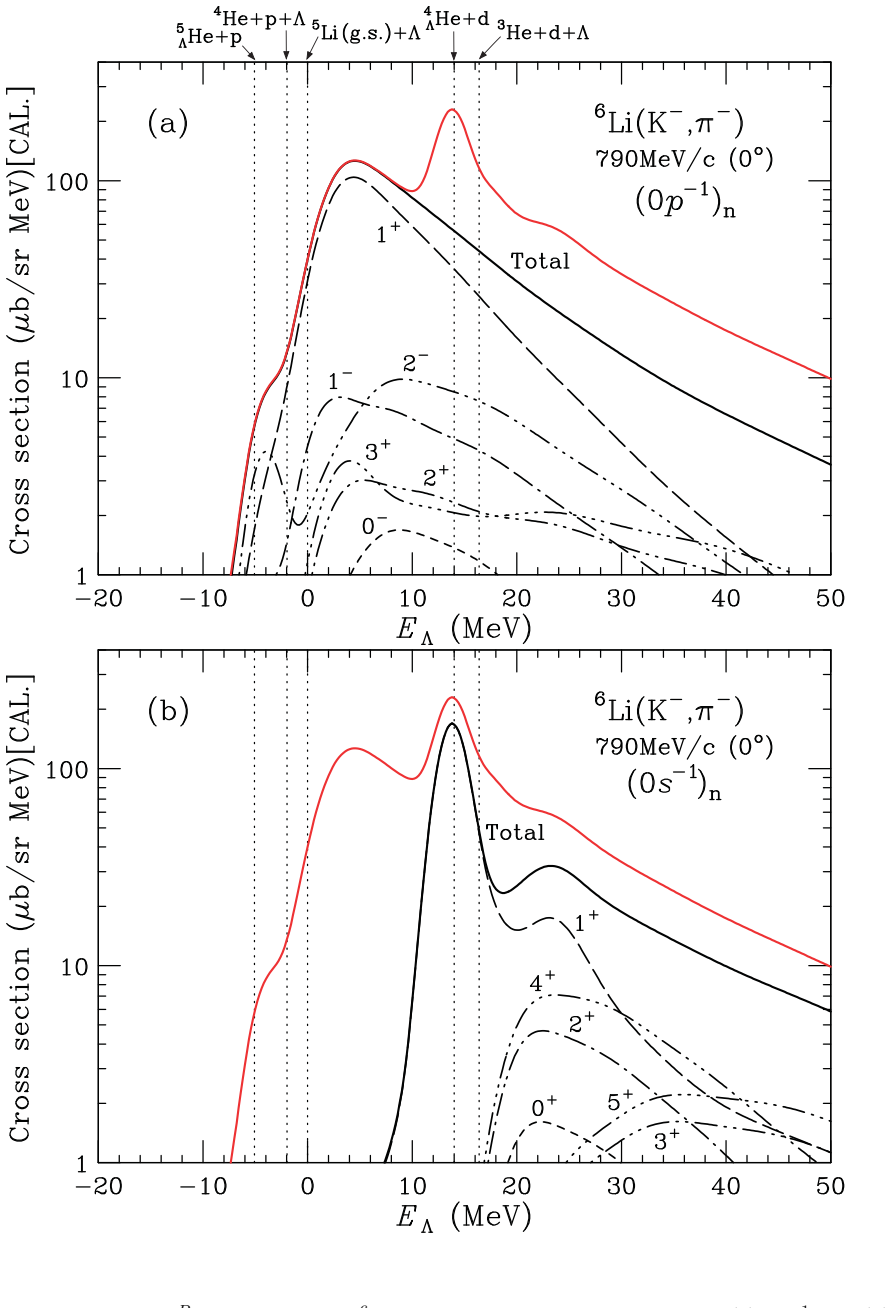
- [Sec. III, Eq. (14), Fig. 7] The inter-cluster distance D in the (3He-d)-Λ space is adjusted to fit the experimental 6ΛLi(1+) spectrum, and the ΛN strength v0_ΛN is adjusted to reproduce the 6ΛLi(g.s.) binding energy. Thus the agreement at EΛ=13.8 MeV in Fig. 7 is partly an input of the calculation rather than an independent prediction. The authors should state this explicitly and provide a sensitivity study, for example by varying D over the range of rms distances quoted from the 3He+d+Λ three-body model (⟨R2⟩1/2 between 2.02 and 2.44 fm) and showing how the position and width of the 13.8 MeV peak change. Without such a study, the central 'agrees well' claim cannot be evaluated as a test of the model.
- [Sec. V.C and Sec. IV.A, Table II] The narrow 1+1 pole at EΛ=13.7−i0.1 MeV and the associated interference-narrowing mechanism depend on neglecting couplings between the (α-p)-Λ and (3He-d)-Λ channel spaces. At EΛ=13.7 MeV the α+p+Λ channels are open (the α+p threshold is only about 1.96 MeV relative to 5Li(g.s.)+Λ), so any finite coupling between the two spaces should generically give the 1+1 state an escape width into α+p+Λ. The paper offers only indirect evidence: the spatial-symmetry argument of Majling et al., the small imaginary part of the t+d optical potential, and the reduction of proton-coincidence events. No estimate of the inter-space coupling matrix elements U_cc' is presented. Please compute or bound these couplings and show that the induced width remains small compared with Γ_exp≈0.7±1.0 MeV; as written, the decoupling is an assumption, not a demonstrated consequence of the model.
- [Sec. IV.B vs. Summary item (3)] The manuscript contains an internal contradiction about the absolute normalization. In Sec. IV.B the calculated magnitude is stated to be 'approximately half smaller than that suggested by the experimental data,' which I read as a factor-of-two underestimate, whereas Summary item (3) states that 'the absolute values of these cross sections agree well with the experimental data.' This is load-bearing because the paper's central assertion is that the calculated spectrum agrees well with experiment. The authors should decide which statement is correct, report the actual calculated-to-experimental normalization ratio as a function of EΛ, and restrict the agreement claim accordingly (e.g., to spectral shape if the absolute scale is off by a factor of two).
minor comments (5)
- [Sec. V.A.2] The text says the narrow 1+ peak appears 'near the 4ΛHe+d threshold,' but Table II and Fig. 2 place the 1+1 pole at EΛ=13.7 MeV, which is 2.7 MeV below the 3He+d+Λ threshold; presumably '3He+d+Λ threshold' is intended.
- [Sec. IV.B] The phrase 'approximately half smaller than that suggested by the experimental data' is awkward and ambiguous; please rephrase as, for example, 'about a factor of two smaller than the experimental data,' and reconcile this wording with the Summary.
- [Fig. 7 caption] The caption lists the curves as 'contributions of the total, 0p−1, and 0s−1,' but 'total' is not a neutron-hole contribution; please reword to 'the total spectrum and the separate 0p−1 and 0s−1 neutron-hole contributions.'
- [Table II and Sec. IV.A] The notation '1+1' and '1+2' for the two 1+ states is easy to confuse with the spin-parity superscript; consider using subscripts written as 1+_1 and 1+_2 in the text and table.
- [Eq. (16) and Fig. 9] The artificial variation of the relative phase φ in Fig. 9 is a useful illustration, but the text should state explicitly that the reported physical spectrum uses the DWIA-determined phase φ0 and that no phase freedom is being fitted to the data.
Circularity Check
The 13.8 MeV 1+ peak is partly a refit: Section III adjusts the 3He-d cluster distance D to the 6ΛLi(1+) spectrum itself, so the later 'agreement' at 13.8 MeV is not an independent prediction.
-
fitted input called prediction
[Section III, 'Λ-NUCLEUS POTENTIALS' (around Eq. 13)]
"When the nuclear shrinkage effect due to the Λ is enhanced in the 3He-d system, the distance D between the 3He and d clusters is expected to decrease upon the addition of a Λ; the value of D should be adjusted to fit the experimental data of 6ΛLi(1+) from the (K−,π−) spectrum. Here, we take D = 1.8 fm using the 3He-d cluster potentials [45], which corresponds to a rms radius of ⟨R2⟩1/2 = 2.18 fm between the 3He and d clusters."
The parameter D enters the 3He-d cluster density ρ(5Li)_s used in the folding-model potential (Eq. 13), which generates the diagonal and coupling potentials for the JP=1+ (3He-d)-Λ channels. Solving the coupled-channel equations (Eq. 8) with these potentials yields the 1+1 pole at EΛ=13.7 MeV (Table II) and the narrow spectral peak near 13.8 MeV (Fig. 7). Because the paper explicitly states that D was adjusted to fit the 6ΛLi(1+) experimental spectrum, the position and narrowness of the 13.8 MeV peak claimed to 'agree well' with data is not a free prediction; it is partly a refit of the very 1+ spectrum being compared. The interference analysis in Section V.A.2 modifies the shape, but the underlying pole location is set by the fit-dependent potential.
full rationale
The clearest circular step is the adjustment of the 3He-d cluster distance D to the 6ΛLi(1+) (K−,π−) spectrum in Section III. That same fitted input controls the (3He-d)-Λ folding potential, and hence the 1+1 pole at EΛ=13.7 MeV and the 13.8 MeV peak presented as the paper's central success. Therefore the 'agreement' at 13.8 MeV is partially built into the model by construction. This matches the fitted-input-called-prediction pattern and warrants a score of 6. By contrast, the paper's other components are largely self-contained: the DWIA/EOFA treatment is anchored to an external elementary amplitude (Gopal et al.) and to prior 12C benchmark comparisons; the neutron-hole widths and spectroscopic factors come from experimental (p,2p) data; and the v0_LambdaN strength is calibrated to the 6ΛLi ground-state binding energy, which is a separate observable from the 13.8 MeV excited-state peak. The 3.8 MeV continuum interpretation is also not circular: the (α-p)-Λ pole structure and the 'continuum state influenced by nearby poles' conclusion are computed from the alpha-p cluster inputs and agree with the earlier full-calculation result of Auerbach and Van Giai, so that part of the paper stands on independent computational content. The decoupling of (α-p)-Λ and (3He-d)-Λ channels is an approximation justified by external works (Majling et al. and t+d optical-potential information); it may be fragile, but it is not circular and no reduction to the paper's own inputs was exhibited. Self-citations in the method sections (e.g., Refs. [25-27]) are not load-bearing circularity because they invoke independently developed machinery with external empirical benchmarks, not a premise that assumes the present result. Finally, the paper contains an internal normalization inconsistency—Section IV.B says the calculated absolute magnitude is 'approximately half smaller' than experiment, while Summary item (3) says absolute values 'agree well'—but this is a correctness/consistency issue, not a circularity step. Overall, the central 13.8 MeV claim is partially forced by the D fit, so the score is 6 rather than 0-2.
Assumptions & free parameters
free parameters (2)
- v0_LambdaN (LambdaN Gaussian strength) =
-21.19 MeV
- D (3He-d cluster distance in 6_Lambda-Li) =
1.8 fm
assumptions (7)
- domain assumption DWIA with eikonal distortions is valid for the (K-,pi-) reaction at p_K- = 700-800 MeV/c
- domain assumption EOFA Fermi averaging correctly treats the in-medium K-n -> pi-Lambda amplitude
- domain assumption The (alpha-p)-Lambda and (3He-d)-Lambda channels are effectively decoupled
- domain assumption The Lambda spin-orbit L-S potential is negligibly small
- domain assumption A single-Gaussian LambdaN effective interaction with eta = -0.072 describes the spin dependence
- domain assumption The 6Li ground state is an alpha+d cluster state from the orthogonality condition model
- standard math S-matrix pole classification on the [++] and [--] Riemann sheets identifies bound versus resonance character
Cite this review
Pith. "Pith review of Continuum Lambda spectra for a 6Li_Lambda hypernucleus in the 6Li(K-, pi-) reaction." pith.science (2026). https://pith.science/paper/A5LWEEXN
@misc{pith2026250506844,
  author       = {Pith},
  title        = {Pith review of: Continuum Lambda spectra for a 6Li_Lambda hypernucleus in the 6Li(K-, pi-) reaction},
  year         = {2026},
  howpublished = {\url{https://pith.science/paper/A5LWEEXN}},
  note         = {Machine review of arXiv:2505.06844}
}
read the original abstract
We theoretically investigate Lambda production via a (K-, pi-) reaction on a 6Li target, using the distorted-wave impulse approximation (DWIA) with a Fermi-averaged K-n --> pi-Lambda amplitude. We calculate Lambda production spectra using the Green's function method for a 5Li nuclear core + Lambda system, employing a Lambda folding-model potential based on the 5Li nuclear density, which is constructed from alpha-p and 3He-d cluster wave functions. The results show that the calculated spectrum, which includes Lambda bound, resonance, and continuum states, agrees well with the experimental data from the (K-, pi-) reaction at p_K- = 790 MeV/c (0 deg.), where substitutional (0p_Lambda, 0p^{-1}_n) and (0s_Lambda, 0s^{-1}_n) configurations dominate in the near-recoilless reactions. A narrow peak corresponds to a high-lying excited state with spin-parity J^P= 1+ at E_Lambda= 13.8 MeV near the 3He + d + Lambda threshold, arising from interference effects between 5Li(3/2+)x(0s1/2)_Lambda and 5Li(1/2+)x(0s1/2)_Lambda components. This study offers a valuable framework for extracting essential information on the structure and production mechanisms of hypernuclear states from experimental data.
Figures


Figures from the paper (6 more)



Reference graph
Works this paper leans on
-
[1]
(α-p)-Λ spectra For low-lying states with (α-p)-Λ configurations, the cross section of the JB = 2−(exc.) state atEΛ =−4.26 MeV dominates below the 5Li(g.s.)+Λ threshold, as shown in Fig. 8(a). In contrast, the cross section of the 1−(g.s.) state at EΛ =−4.51 MeV is negligible in the Λ bound region due to the suppressed Λ production amplitude, resulting fr...
-
[2]
(3He-d)-Λ spectra For high-lying states with (3He-d)-Λ configurations, the cross section for theJB = 1+ state is predominantly populated, which exhibits a narrow peak (Γ exp≃ 0.7±1.0 MeV) near the 4 ΛHe +d threshold, as shown in Fig. 8(b). Other higher-spin JP states are rarely populated. This component withJP = 1+ originates from 5Li(3/2+)⊗(0s1/2)Λ and 5...
-
[3]
4 ΛHe +d spectra It is worthwhile to note that light nuclear targets such as 6Li have played an essential role as a doorway for producing various hyperfragments, including 5 ΛHe, 4 ΛHe, 4 ΛH, and 3 ΛH, via the (K−, π−) reactions [14]. To examine the contribution of a 4 ΛHe +d process, which corresponds to the direct production of a 4 ΛHe hyperfragment [55...
-
[4]
H. Sugimura et al . (J-PARC E10 Collaboration), Phys. Lett. B 729, 39 (2014); R. Honda et al. (J-PARC E10 Collaboration), Phys. Rev. C 96, 014005 (2017)
work page 2014
- [5]
- [6]
- [7]
-
[8]
M. I. Podgoretsky, J.E.T.P. 44, 695 (1963); H. Feshbach and A. Kerman, in Preludes in Theoretical Physics (A. De-Shalit, H. Feshbach, and L. Van Hove, Eds.), North-Holland, Amsterdam, 1966, p. 260
work page 1963
Show all 64 references
-
[9]
A. K. Kerman and H. J. Lipkin, Ann. Phys. 66, 738 (1971)
1971
-
[10]
Povh, Rep
B. Povh, Rep. Prog. Phys. 39, 823 (1976)
1976
-
[11]
Br¨ uckneret al., Phys
W. Br¨ uckneret al., Phys. Lett. B 62, 481 (1976)
1976
-
[12]
Br¨ uckner et al
W. Br¨ uckner et al . (Heidelberg-Saclay-Strasbourg Collaboration), Phys. Lett. B 79, 157 (1978)
1978
-
[13]
Bertini et al
R. Bertini et al. (Heidelberg-Saclay-Strasbourg Collaboration), Nucl. Phys. A 368, 365 (1981)
1981
-
[14]
Bertini et al
R. Bertini et al. (Heidelberg-Saclay-Strasbourg Collaboration), Nucl. Phys. A 360, 315 (1981)
1981
-
[15]
J. J. Szymanski, AIP Conf. Proc. 150, 934 (1986); J. J. Szymanski et al ., Phys. Rev. C 43, 849 (1991)
1986
-
[16]
V. G. Neudatchin and Yu. F. Smirnov, Nucleon clusters in light nuclei, (Nauka, Moscow, 1969); V. G. Neudatchin, V. I. Kukulin, V. N. Pomerantsev, and A. A. Sakharuk, Phys. Lett. B 255, 482 (1991)
1991
-
[17]
Majling, M
L. Majling, M. Sotona, J. ˇZofka, V. N. Fetisov, and R.A. Eramzhyan, Phys. Lett. B 92, 256 (1980)
1980
-
[18]
E. H. Auerbach, A. J. Baltz, C. B. Dover, A. Gal, S. H. Kahana, L. Ludeking, and D. J. Mil- lener, Ann. Phys. (NY) 148, 381 (1983)
1983
-
[19]
Band¯ o, T
H. Band¯ o, T. Motoba, and J. ˇZofka, Int. J. Mod. Phys. A 5, 4021 (1990)
1990
-
[20]
A. Gal, E. V. Hungerford, and D. J. Millener, Rev. Mod. Phys. 88, 035004 (2016)
2016
-
[21]
D. J. Millener, Lecture Notes in Physics, 724 (2007) p. 31
2007
-
[22]
Motoba, H
T. Motoba, H. Band¯ o, and K. Ikeda, Prog. Theor. Phys. 70, 189 (1983); 71, 222 (1984)
1983
-
[23]
Motoba, H
T. Motoba, H. Band¯ o, K. Ikeda, and T. Yamada, Prog. Theor. Phys. SuppI. No.81, 42 (1985)
1985
-
[24]
Ohkura, T
H. Ohkura, T. Motoba, and K. Ikeda, Prog. Theor. Phys. 89, 1437 (1993)
1993
-
[25]
Auerbach and N
N. Auerbach and N. Van Giai, Phys. Lett. B 90, 354 (1980)
1980
-
[26]
Morimatsu and K
O. Morimatsu and K. Yazaki, Prog. Part. Nucl. Phys. 33, 679 (1994), and references therein
1994
-
[27]
H¨ ufner, S
J. H¨ ufner, S. Y. Lee, and H. A. Weidenm¨ uller, Nucl. Phys. A234, 429 (1974)
1974
-
[28]
Harada, Phys
T. Harada, Phys. Rev. Lett. 81, 5287 (1998); Nucl. Phys. A 672, 181 (2000)
1998
-
[29]
Harada and Y
T. Harada and Y. Hirabayashi, Nucl. Phys. A 744, 323 (2004). 26
2004
-
[30]
Harada and Y
T. Harada and Y. Hirabayashi, Phys. Rev. C 105, 064606 (2022)
2022
-
[31]
C. B. Dover and A. Gal, Ann. Phys. (NY) 146, 309 (1983)
1983
-
[32]
Koike and T
T. Koike and T. Harada, Nucl. Phys. A 804, 231 (2008)
2008
-
[33]
Fujiwara et al ., Prog
Y. Fujiwara et al ., Prog. Theor. Phys. Suppl. 68, 29 (1980); H. Furutani et al ., ibid. 68, 193 (1980)
1980
-
[34]
Kanada, T
H. Kanada, T. Kaneko, and Y. C. Tang, Nucl. Phys. A 389, 285 (1982)
1982
-
[35]
Sakuragi, M
Y. Sakuragi, M. Yahiro, and M. Kamimura, Prog. Theor. Phys. Suppl. 89, 136 (1986); Y. Sakuragi, M. Yahiro, and M. Kamimura, Prog. Theor. Phys. 70, 1047 (1983)
1986
-
[36]
de Vries, C
H. de Vries, C. W. de Jager, and C. de Vries, At. Data Nucl. Tables 36, 459 (1987)
1987
-
[37]
D. R. Tilley et al., Nucl. Phys. A 708, 3 (2002)
2002
-
[38]
Tyr´ enet al., Nucl
H. Tyr´ enet al., Nucl. Phys. 79, 321 (1966); G. Jacob and Th. A. Maris, Mod. Phys. 38, 121 (1966); Rev. Mod. Phys. 45, 6 (1973); F. P. Brady et al., Phys. Rev. C 16, 31 (1977)
1966
-
[39]
Ajzenberg-Selove, Nucl
F. Ajzenberg-Selove, Nucl. Phys. A 490, 1 (1988)
1988
-
[40]
N. K. Glendenning, Direct Nuclear Reactions (Academic Press, New York, 1983), p.144
1983
-
[41]
K. T. R. Davies and G. R. Satchler, Nucl. Phys. A 53, 1 (1964)
1964
-
[42]
Tamura, Rev
T. Tamura, Rev. Mod. Phys. 37, 679 (1965)
1965
-
[43]
G. P. Gopal et al., Nucl. Phys. B 119, 362 (1977)
1977
-
[44]
ˇZofka, M
J. ˇZofka, M. Sotona, and V. N. Fetisov, Nucl. Phys. A 431, 603 (1984)
1984
-
[45]
A. S. Rosenthal and F. Tabakin, Phys. Rev. C 22, 711 (1980)
1980
-
[46]
R. E. Chrien et al., Phys. Lett. B 89, 31 (1979)
1979
-
[47]
C. B. Dover, A. Gal, G. E. Walker, and R. H. Dalitz, Phys. Lett. B 89, 26 (1979)
1979
-
[48]
Della Rocca, R
V. Della Rocca, R. Bijker, and F. Iachello, Nucl. Phys. A 966, 158 (2017); V. Della Rocca and F. Iachello, Nucl. Phys. A 973, 1 (2018)
2017
-
[49]
R. H. Dalitz, R. C. Herndon, and Y. C. Tang, Nucl. Phys. B 47, 109 (1972); R. H. Dalitz and G. Rajasekaran, Nucl. Phys. 50, 450 (1964)
1972
-
[50]
Hiyama, M
E. Hiyama, M. Kamimura, T. Motoba, T. Yamada, and Y. Yamamoto, Phys. Rev. C 53, 2075 (1996)
1996
-
[51]
Yamamoto, T
Y. Yamamoto, T. Motoba, and T. A. Rijken, Prog. Theor. Phys. Suppl. 185, 72 (2010), and references therein
2010
-
[52]
Juriˇ cet al., Nucl
M. Juriˇ cet al., Nucl. Phys. B 52, 1 (1973)
1973
-
[53]
Harada and Y
T. Harada and Y. Hirabayashi, Phys. Rev. C 107, 054611 (2023). 27
2023
-
[54]
Harada and Y
T. Harada and Y. Hirabayashi, Phys. Rev. C 89, 054603 (2014)
2014
-
[55]
B. C. Pearce and B. F. Gibson, Phys. Rev. C 40, 902 (1989)
1989
-
[56]
Harada and Y
T. Harada and Y. Hirabayashi, JPS Conf. Proc. 17, 012008 (2017)
2017
-
[57]
Dabrowski, J
J. Dabrowski, J. Phys G: Nucl. Part. Phys. 23, 1539 (1997)
1997
-
[58]
Tamura et al., Phys
H. Tamura et al., Phys. Rev. C 40, R479 (1989)
1989
-
[59]
Harada and Y
T. Harada and Y. Hirabayashi, Phys. Rev. C 100, 024605 (2019)
2019
-
[60]
Harada and Y
T. Harada and Y. Hirabayashi, Nucl. Phys. A 1015, 122301 (2021)
2021
-
[61]
Akaishi, T
Y. Akaishi, T. Harada, S. Shinmura, and Khin Swe Myint, Phys. Rev. Lett. 84, 3539 (2000)
2000
-
[62]
Umeya and T
A. Umeya and T. Harada, Phys. Rev. C 79, 024315 (2009)
2009
-
[63]
Harada, A
T. Harada, A. Umeya, and Y. Hirabayashi, Phys. Rev. C 79, 014603 (2009)
2009
-
[64]
Kurihara, Y
Y. Kurihara, Y. Akaishi, and H. Tanaka, Prog. Theor. Phys. 67, 1483 (1982). 28
1982
Reviewed August 15, 2026 · model on record in the stance chip above.
Discussion (0). Continue with ORCID to comment.