REVIEW 3 major objections 5 minor 24 references
Guiding reverse diffusion with discrete-time barrier and Lyapunov functions, then projecting each step with MPC, yields safer and more successful robot trajectories than prior hybrids.
Reviewed by Pith at T0; open to challenge. T0 means a machine referee read the full paper against a public rubric. the ladder, T0–T4 →
T0 review · grok-4.5
2026-07-14 08:50 UTC pith:A64HXXEA
load-bearing objection Clean engineering hybrid of CoBL-style CBF/CLF guidance and DPCC-style iterative MPC projection; real gains on Franka dynamic cases and code release, but perfect obstacle foresight is load-bearing and untested. the 3 major comments →
D-SafeMPC: Diffusion-Driven Safe Model Predictive Control with Discrete-Time Control Barrier Functions
The pith
A machine-rendered reading of the paper's core claim, the machinery that carries it, and where it could break.
Core claim
The central claim is that coupling discrete-time CBF/CLF gradient guidance inside the reverse diffusion process with an MPC projection performed at every denoising iteration produces trajectories that are both probabilistically safer and hard-constrained feasible, thereby raising safety-compliant goal rates and computational efficiency over pure diffusion, pure guidance, and earlier diffusion-MPC hybrids.
What carries the argument
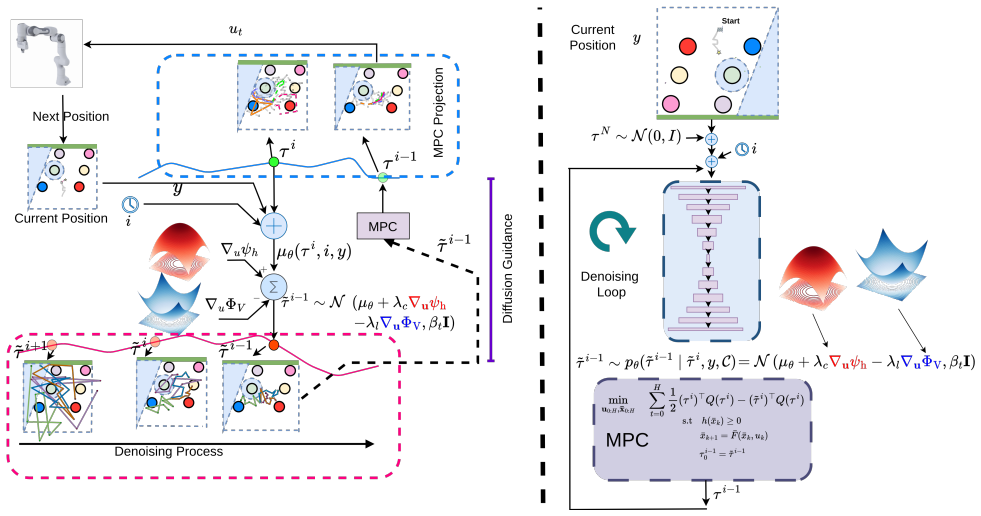
D-SafeMPC: at each denoising step the predicted mean is shifted by the control gradients of a discrete-time CBF (collision avoidance) and CLF (goal attraction); the resulting sample is then projected by an MPC that enforces dynamics and the hard safe set, and the projected trajectory is fed back as the warm start for the next denoising step.
Load-bearing premise
The planner is given the exact future positions of every obstacle over the entire planning horizon; without that perfect foresight the barrier gradients and MPC constraints become incorrect.
What would settle it
Rerun the four Franka scenarios while replacing perfect obstacle foresight with noisy or short-horizon predictions; if safety-compliant success rates fall to or below the DPCC and CoBL baselines, the claimed advantage disappears.
If this is right
- Diffusion planners can be made hard-constraint safe without retraining the generative model.
- CBF/CLF guidance supplies MPC with high-quality warm starts, cutting the number of iterations needed for feasibility.
- The same iterative-projection loop applies to any diffusion policy whose samples can be evaluated by barrier and Lyapunov functions.
- On manipulators facing dynamic obstacles the method raises both goal-reach and safety-compliant rates relative to pure guidance or post-hoc MPC.
Where Pith is reading between the lines
- If obstacle forecasts are imperfect, an online filter that updates the barrier functions each replan could restore most of the safety margin without changing the core architecture.
- The same guided-projection pattern may transfer to other generative planners (score-based, flow-matching) that lack intrinsic constraint handling.
- Error accumulation from early-state conditioning suggests that a receding-horizon replan triggered by barrier violation could further stabilize long-horizon execution.
Editorial analysis
A structured set of objections, weighed in public.
Referee Report
Summary. The paper proposes D-SafeMPC, a hybrid planner that guides reverse diffusion of trajectories with discrete-time CBF and CLF gradients (Eqs. 22–27) and then iteratively projects each partially denoised sample onto a safe, dynamically feasible set via MPC (Eq. 28, Alg. 1). The CBF/CLF guidance is intended to supply high-quality warm starts so that the MPC converges reliably within a fixed budget; the projected trajectory is fed back into the next denoising step. Empirical claims rest on Franka-manipulator simulations in one static and three dynamic obstacle environments (Table I, 20 trials per planner) plus a qualitative sim-to-real demonstration, asserting higher safety-compliant success rates and lower wall-clock time than Diffuser, CoBL-Diffusion, DPCC variants, and post-processing baselines. Source code and configs are released.
Significance. If the reported gains hold under realistic sensing, the work supplies a practical recipe for making offline-trained diffusion planners respect hard safety and dynamics constraints without retraining. The combination of soft CBF/CLF guidance with iterative hard MPC projection is a clear incremental advance over pure guidance (CoBL) and pure projection (DPCC). Strengths that should be credited include the public repository, the multi-seed multi-environment evaluation with standard deviations, the explicit discrete-time CBF/CLF theory, and the honest limitations paragraph on high-dimensional state spaces and error propagation. These elements make the contribution reproducible and useful to the safe-learning community.
major comments (3)
- [§IV-A, Eqs. (22),(28), Table I] §IV-A states that future obstacle states x_{j,t+1},…,x_{j,t+H} are known to the planner. Both the CBF condition ψ_h (Eq. 22) and the MPC constraints (Eq. 28) are evaluated on these oracle positions. All dynamic-environment numbers in Table I therefore rest on perfect foresight. No sensitivity study (constant-velocity predictor, additive noise, delayed observations) is provided, so it is unclear whether the claimed safety and success gains survive realistic prediction error. This assumption is load-bearing for the central dynamic-obstacle claim and must be either relaxed experimentally or elevated to a first-class limitation with quantitative bounds.
- [§V-A, Abstract] The abstract and §V-A advertise a sim-to-real experiment on a physical Franka, yet only a qualitative description is given (relative dynamics factor 0.05, visual comparison with DPCC). No success rates, collision counts, or timing statistics comparable to Table I appear. Without quantitative hardware metrics the hardware claim cannot be assessed and should either be supported by numbers or demoted to a qualitative illustration.
- [Abstract, Table I (Static Env)] In the static environment (Table I) DPCC-C attains a higher safety-compliant rate (0.90 vs 0.80) while CoBL reaches the goal more often. The abstract’s blanket statement that D-SafeMPC “improves … over state-of-the-art baselines” is therefore only partially accurate for the static case. The text should qualify the claim by environment and discuss when the added CBF/CLF guidance helps versus when pure projection already suffices.
minor comments (5)
- [§IV-A] The adaptive rule for λ_c (“increases proportionally as the distance to obstacles decreases”) is never written as an equation or schedule; a precise formula would aid reproducibility.
- [Fig. 3] Fig. 3 reports average computation time only for the static environment; the same plot for the three dynamic settings would strengthen the efficiency claim.
- [§IV, Alg. 1] Notation switches between au^i (projected) and aũ^i (guided) without a single clarifying sentence in the main text; a short glossary or consistent use of tildes would help.
- [§III-A, §V] The class-K function α and the CLF decay rate σ appear in Definitions 1–2 but their concrete choices for the Franka experiments are not listed; they belong in the experimental configuration or appendix.
- [throughout] Minor typographical issues: “Da¸s” and “Açıkme¸se” contain encoding artifacts; “sim-to-real” is hyphenated inconsistently; “burn-in” threshold is justified only by “same as DPCC” without a short ablation.
Circularity Check
No significant circularity; D-SafeMPC is an algorithmic construction whose performance claims rest on independent empirical evaluation against baselines, not on self-referential definitions or fitted-as-prediction reductions.
full rationale
The paper constructs a hybrid planner (CBF/CLF-guided reverse diffusion + iterative MPC projection) and evaluates it on held-out simulation seeds and a sim-to-real Franka trial (Table I, §V). Discrete-time CBF/CLF conditions (Defs. 1–2, Eqs. 22/25) and the MPC projection (Eq. 28) are standard control-theoretic objects applied as soft guidance and hard constraints; their gradients shift the diffusion mean (Eq. 27) but do not redefine the success metrics. Hyperparameters (λ_c, λ_l, burn-in N/2, Q) are free design choices, not fitted to the reported Goal-Reached or Safety-Compliant rates. No equation equates a claimed prediction to an input by construction, no uniqueness theorem is imported from overlapping authors to force the method, and self-citations (e.g., Burdick co-authorships) are incidental background rather than load-bearing premises. The derivation chain is therefore self-contained against external benchmarks.
Axiom & Free-Parameter Ledger
free parameters (4)
- λ_c, λ_l (CBF/CLF guidance weights)
- N = 20 diffusion steps and burn-in threshold N/2
- MPC cost matrix Q and horizon H
- class-K function α and CLF decay rate σ
axioms (4)
- standard math Discrete-time CBF condition (Def. 1 / Thm. 1) guarantees forward invariance of the 0-superlevel set of h under the sampled-data dynamics.
- domain assumption Future obstacle trajectories over the planning horizon are known exactly to the planner.
- domain assumption One-step Euler discretization of the continuous control-affine dynamics is an adequate model for both guidance and MPC.
- domain assumption Expert demonstrations in the D3IL dataset are sufficient to train a conditional diffusion model that captures the robot’s free-space dynamics.
read the original abstract
A key limitation on the use of diffusion models in robotic planning is their inability to inherently enforce safety or dynamical constraints, which often results in physically infeasible or unsafe outputs. Hybrid approaches that employ model predictive control (MPC) to address this problem can be unstable, as poor trajectory initializations from the diffusion model prevent the MPC from converging to a safe and feasible solution. To overcome these challenges, we propose D-SafeMPC, which enhances the interaction between diffusion and control. Our method guides the reverse diffusion process with control barrier functions (CBFs) and control Lyapunov functions (CLFs) and employs an iterative-projection scheme where an MPC refines the trajectory at each denoising step. This steers sampling toward safe, goal-directed regions and provides reliable MPC warm starts. In simulations on a Franka manipulator across four scenarios (one static-obstacle and three dynamic-obstacle settings) and in a sim-to-real experiment on a physical Franka robot, D-SafeMPC improves safety, task success rates, and planning efficiency over state-of-the-art baselines. To facilitate reproducibility, our source code and experimental configurations are available in a repository at https://github.com/erdiphd/D-SafeMPC
Figures


Reference graph
Works this paper leans on
-
[1]
Denoising diffusion probabilistic models,
J. Ho, A. Jain, and P. Abbeel, “Denoising diffusion probabilistic models,” inAdvances in Neural Information Processing Systems, vol. 33. Curran Associates, Inc., 2020, pp. 6840–6851
2020
-
[2]
Planning with diffusion for flexible behavior synthesis,
M. Janner, Y . Du, J. Tenenbaum, and S. Levine, “Planning with diffusion for flexible behavior synthesis,” inICML, 2022
2022
-
[3]
Diffusion policy: Visuomotor policy learning via action diffusion,
C. Chi, Z. Xu, S. Feng, E. Cousineau, Y . Du, B. Burchfiel, R. Tedrake, and S. Song, “Diffusion policy: Visuomotor policy learning via action diffusion,”The International Journal of Robotics Research, 2025
2025
-
[4]
Motion planning diffusion: Learning and planning of robot motions with diffusion models,
J. Carvalho, A. T. Le, M. Baierl, D. Koert, and J. Peters, “Motion planning diffusion: Learning and planning of robot motions with diffusion models,” in2023 IEEE/RSJ International Conference on Intelligent Robots and Systems (IROS). IEEE, 2023, pp. 1916–1923
2023
-
[5]
Motion planning diffusion: Learning and adapting robot motion planning with diffusion models,
J. Carvalho, A. T. Le, P. Kicki, D. Koert, and J. Peters, “Motion planning diffusion: Learning and adapting robot motion planning with diffusion models,”IEEE Transactions on Robotics, 2025
2025
-
[6]
Safediffuser: Safe planning with diffusion probabilistic models,
W. Xiao, T.-H. Wang, C. Gan, R. Hasani, M. Lechner, and D. Rus, “Safediffuser: Safe planning with diffusion probabilistic models,” in The Thirteenth International Conference on Learning Representations, 2023
2023
-
[7]
Equality constrained diffusion for direct trajectory optimization,
V . Kurtz and J. W. Burdick, “Equality constrained diffusion for direct trajectory optimization,” inAmerican Control Conference (ACC). IEEE, 2025, pp. 535–540
2025
-
[8]
CoBL-Diffusion: Diffusion-based conditional robot planning in dynamic environments using control barrier and Lyapunov functions,
K. Mizuta and K. Leung, “CoBL-Diffusion: Diffusion-based conditional robot planning in dynamic environments using control barrier and Lyapunov functions,” in2024 IEEE/RSJ International Conference on Intelligent Robots and Systems (IROS). IEEE, 2024, pp. 13 801–13 808
2024
-
[9]
Control barrier function based quadratic programs for safety critical systems,
A. D. Ames, X. Xu, J. W. Grizzle, and P. Tabuada, “Control barrier function based quadratic programs for safety critical systems,”IEEE Transactions on Automatic Control, vol. 62, no. 8, pp. 3861–3876, 2017
2017
-
[10]
Control barrier functions: Theory and applications,
A. D. Ames, S. Coogan, M. Egerstedt, G. Notomista, K. Sreenath, and P. Tabuada, “Control barrier functions: Theory and applications,” in 2019 18th European Control Conference (ECC), 2019
2019
-
[11]
Model predictive control in aerospace systems: Current state and opportunities,
U. Eren, A. Prach, B. B. Koçer, S. V . Rakovi ´c, E. Kayacan, and B. Açıkme¸ se, “Model predictive control in aerospace systems: Current state and opportunities,”Journal of Guidance, Control, and Dynamics, vol. 40, no. 7, pp. 1541–1566, 2017
2017
-
[12]
Visual tracking nonlinear model predictive control method for autonomous wind turbine inspection,
A. Amer, M. Mehndiratta, J. le Fevre Sejersen, H. X. Pham, and E. Kayacan, “Visual tracking nonlinear model predictive control method for autonomous wind turbine inspection,” in21st International Conference on Advanced Robotics (ICAR), 2023, pp. 431–438
2023
-
[13]
Empowering autonomous underwater vehicles using learning-based model predictive control with dynamic forgetting Gaussian processes,
A. Amer, M. Mehndiratta, Y . Brodskiy, and E. Kayacan, “Empowering autonomous underwater vehicles using learning-based model predictive control with dynamic forgetting Gaussian processes,”IEEE Transac- tions on Control Systems Technology, vol. 33, no. 5, pp. 1913–1920, 2025
1913
-
[14]
Diffusion predictive control with constraints,
R. Römer, A. v. Rohr, and A. Schoellig, “Diffusion predictive control with constraints,” inProceedings of the 7th Annual Learning for Dynamics & Control Conference, vol. 283. PMLR, 2025, pp. 791–803
2025
-
[15]
Diffusion model predictive control,
G. Zhou, S. Swaminathan, R. V . Raju, J. S. Guntupalli, W. Lehrach, J. Ortiz, A. Dedieu, M. Lázaro-Gredilla, and K. Murphy, “Diffusion model predictive control,”arXiv preprint arXiv:2410.05364, 2024
Pith/arXiv arXiv 2024
-
[16]
Aligning optimization trajectories with diffusion models for constrained design generation,
G. Giannone, A. Srivastava, O. Winther, and F. Ahmed, “Aligning optimization trajectories with diffusion models for constrained design generation,”Advances in neural information processing systems, vol. 36, pp. 51 830–51 861, 2023
2023
-
[17]
Safe offline reinforcement learning using trajectory-level diffusion models,
R. Römer, L. Brunke, M. Schuck, and A. P. Schoellig, “Safe offline reinforcement learning using trajectory-level diffusion models,” in ICRA 2024 Workshop—Back to the Future: Robot Learning Going Probabilistic, 2024
2024
-
[18]
Discrete control barrier functions for safety-critical control of discrete systems with application to bipedal robot navigation
A. Agrawal and K. Sreenath, “Discrete control barrier functions for safety-critical control of discrete systems with application to bipedal robot navigation.” inRobotics: Science and Systems, vol. 13. Cambridge, MA, USA, 2017, pp. 1–10
2017
-
[19]
Safe policy synthesis in multi-agent pomdps via discrete-time barrier functions,
M. Ahmadi, A. Singletary, J. W. Burdick, and A. D. Ames, “Safe policy synthesis in multi-agent pomdps via discrete-time barrier functions,” in 2019 IEEE 58th Conference on Decision and Control (CDC). IEEE, 2019, pp. 4797–4803
2019
-
[20]
Improved denoising diffusion prob- abilistic models,
A. Q. Nichol and P. Dhariwal, “Improved denoising diffusion prob- abilistic models,” inInternational conference on machine learning. PMLR, 2021, pp. 8162–8171
2021
-
[21]
Variational infer- ence: A review for statisticians,
D. M. Blei, A. Kucukelbir, and J. D. McAuliffe, “Variational infer- ence: A review for statisticians,”Journal of the American Statistical Association, vol. 112, no. 518, p. 859–877, Apr. 2017
2017
-
[22]
Towards diverse behaviors: A benchmark for imitation learning with human demonstrations,
X. Jia, D. Blessing, X. Jiang, M. Reuss, A. Donat, R. Lioutikov, and G. Neumann, “Towards diverse behaviors: A benchmark for imitation learning with human demonstrations,”arXiv preprint arXiv:2402.14606, 2024
Pith/arXiv arXiv 2024
-
[23]
MuJoCo: A physics engine for model-based control,
E. Todorov, T. Erez, and Y . Tassa, “MuJoCo: A physics engine for model-based control,” inIEEE/RSJ International Conference on Intelligent Robots and Systems. IEEE, 2012, pp. 5026–5033
2012
-
[24]
Diffusion models beat GANs on image synthesis,
P. Dhariwal and A. Nichol, “Diffusion models beat GANs on image synthesis,” inAdvances in Neural Information Processing Systems, vol. 34. Curran Associates, Inc., 2021, pp. 8780–8794. 8
2021
discussion (0)
Sign in with ORCID, Apple, or X to comment. Anyone can read and Pith papers without signing in.