REVIEW 4 major objections 8 minor 93 references
Uniform Reanalysis of JWST MIRI 15{\mu}m Exoplanet Eclipse Observations using Frame-Normalized Principal Component Analysis
T0 review · 4 major / 8 minor · reviewed 2026-08-06 · deepseek-v4-flash
Pith's one-line read Frame-normalized PCA detrends JWST MIRI eclipses and recovers published depths for five rocky exoplanets.
desk verdict A useful methods paper for MIRI time-series photometry, but the central unbiasedness claim needs an injected-signal test before I'd trust it for the Rocky Worlds survey. read the letter →
The pith
A machine-rendered reading of the paper's core claim, the machinery that carries it, and where it could break.
The reading
What carries the argument
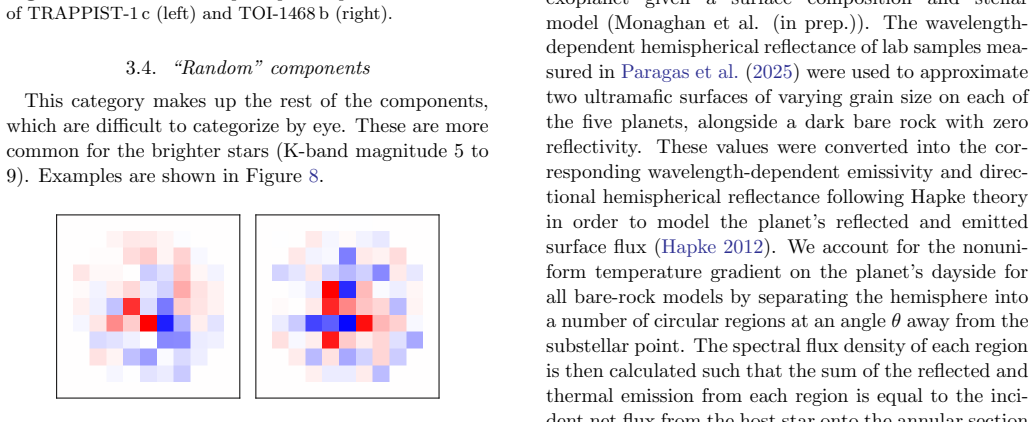
The central object is the FN-PCA decomposition of the background-subtracted, frame-normalized time-series images. Each frame is divided by its own total intensity before principal component analysis, which is the step that prevents the astrophysical eclipse from entering the eigenimages. The systematic model is then built from the eigenvalue time series of the first five principal components, each scaled by a fitted coefficient, multiplied by a linear polynomial in time; this model multiplies the eclipse model during the MCMC fit. The decomposition also yields eigenimages used to categorize detector behavior into detector-settling, centroiding, pixel-dominated, and random components.
What would settle it
Inject a synthetic eclipse of known depth into MIRI-like frames while also introducing a modest PSF shift or shape change that occurs during the eclipse window, run the FN-PCA pipeline, and check whether the recovered depth deviates from the injected value by more than the reported uncertainties.
Extended reading notes
Core claim
The paper's central claim is that FN-PCA, using the top five principal components plus a linear slope as the systematic model, is a viable data-driven way to detrend JWST MIRI 15 µm eclipse light curves. Because each frame is normalized by its total intensity before PCA, the eclipse signal, which is shared by all pixels in the aperture, is expected to drop out of the eigen-decomposition, leaving principal components that represent pixel-level detector systematics. Comparing the resulting eclipse depths for LHS 1478 b, TOI-1468 b, LHS 1140 c, TRAPPIST-1 b, and TRAPPIST-1 c against published values, the authors find agreement within about 1σ for most individual visits and joint fits, with the main exceptions being individual visits of TRAPPIST-1 c and TRAPPIST-1 b. Across all 17 analyzed eclipse observations, the authors identify a recurring exponential 'detector-settling' component present in every visit, and they report that its settling time follows $T_\mathrm{set} = 0.063 e^{0.427 m_K} - 0.657$ hours versus the star's K-band magnitude.
Load-bearing premise
The load-bearing assumption is that the eclipse signal is spatially uniform across the aperture, so normalizing each frame by its total intensity removes the eclipse before PCA; if the eclipse's spatial pattern changes during the observation, the eclipse could leak into the principal components and bias the measured depth.
Editorial extensions
If this is right
- The FN-PCA systematic model requires no parameterized functional form for the detector noise, so it can be applied uniformly across different MIRI 15 µm datasets without per-visit model choices.
- The measured settling-time relation implies that fainter targets need substantially longer integration or pre-settling time, with dim stars requiring several hours and bright stars only minutes.
- The reanalysis confirms most previously published eclipse depths, while flagging specific visits of TRAPPIST-1 c and TRAPPIST-1 b where the recovery is inconsistent and the joint fits still agree within 1σ.
- The categorization of eigenimage components into detector-settling, centroiding, pixel-dominated, and random groups offers a shared vocabulary for future MIRI systematic studies.
Reading between the lines
- A natural testable extension is to inject synthetic eclipses with spatially varying PSF structure; if the recovered depth is biased, the uniform-signal assumption would need to be qualified or the method extended to include PSF-aware normalization.
- The same frame-normalized PCA logic could be applied to MIRI filters other than F1500W, or to transit light curves, provided the astrophysical signal remains spatially uniform across the aperture.
- The exponential settling-time relation suggests that scheduling faint-target eclipse observations may require longer warm-up or baseline integration to avoid partial fitting of the ramp into the eclipse window.
Editorial analysis
A structured set of objections, weighed in public.
Referee Report
Summary. The paper introduces frame-normalized principal component analysis (FN-PCA) as a data-driven detrending method for JWST MIRI F1500W secondary-eclipse photometry, implemented in the new Erebus pipeline. Each background-subtracted frame is normalized by its total intensity before PCA, under the assumption that astrophysical signals such as the eclipse are spatially uniform; the top five principal-component eigenvalue time series plus a linear slope are then fitted simultaneously with the eclipse model. The authors reanalyze 17 eclipse visits of LHS 1478 b, TOI-1468 b, LHS 1140 c, TRAPPIST-1 b, and TRAPPIST-1 c, compare their eclipse depths with published values, categorize the eigenimages into detector-settling, centroiding, pixel-dominated, and random components, and derive an empirical relation between detector settling time and stellar Ks-band magnitude. They then compare the measured depths with atmospheric and bare-rock surface models. The central claims are that FN-PCA is a viable systematic model for MIRI 15 µm data and that detector settling time scales as T_settling = 0.063 exp(0.427 m_K) - 0.657 hours.
Significance. If the unbiasedness of FN-PCA is established, the method is a valuable contribution: it avoids imposing a parametric instrumental model, is uniformly applicable across multiple programs, and is well timed for the planned Rocky Worlds survey. The paper's strengths include the open-source Erebus pipeline, the uniform reduction of a relatively large set of MIRI eclipse observations, a clear categorization of common systematic eigenimages, and a quantitative (if preliminary) settling-time relation. The agreement of the joint-fit eclipse depths with independent literature values, mostly within 1σ, provides empirical support for the method. However, the central unbiasedness claim rests on an assumption of spatial uniformity that is not validated by injected-signal tests, and the per-visit discrepancies for TRAPPIST-1 c and TRAPPIST-1 b show that the pipeline still has unexplained failure modes. The settling-time relation also lacks propagated uncertainties. These gaps are fixable and should be addressed before the method is adopted for survey use.
major comments (4)
- [Section 2, Eq. (1)] The statement that frame normalization 'removes the effects of astrophysical signals' assumes the eclipse produces a spatially uniform fractional change across the PSF after background subtraction. This assumption is not validated. If the PSF shape, centroid, or aperture weighting changes during the eclipse, the eclipse can project onto the top principal components and be partially absorbed by the fitted coefficients, biasing the recovered depth. Please add end-to-end injected-signal recovery tests: inject synthetic eclipses of known depth into real MIRI frames, including cases with pointing drift or PSF variations, and show that the FN-PCA depth is unbiased. This is load-bearing for the claim that FN-PCA is ready for the Rocky Worlds survey.
- [Section 2.5, Table 2] The per-visit results for TRAPPIST-1 c are not consistent with the literature: visit 4 gives 1064±177 ppm with FN-PCA versus 459±185 ppm from Zieba et al. (2023), visit 1 is a non-detection, and a 2nd-degree polynomial is added only for visit 4. The paper attributes these discrepancies to other parts of the data reduction because the exponential fit also disagrees, but that does not resolve the issue: pipeline-level systematics affect both detrending methods, and the central claim of per-visit viability is weakened. Please quantify the agreement across all visits (e.g., a chi-squared statistic or a systematic error term from visit-to-visit scatter) and state explicitly what defines an acceptable match to previous results.
- [Eq. (3), Figure 5] The settling-time relation is an empirical fit, but no uncertainties are reported for the fitted coefficients A=0.063, B=0.427, C=-0.657, and no goodness-of-fit statistic is given. One TRAPPIST-1 c visit is discarded as an outlier without a quantitative criterion, while TOI-175 c is retained as a 'notable outlier' with zero error bar because it has only a single visit. Since this relation is a quantitative result used for planning future observations, please propagate the per-visit exponential-fit uncertainties into the final relation and state the outlier-rejection rule explicitly.
- [Section 2, 'first five principal components'] The choice of five principal components plus a linear slope is presented without a selection criterion or a sensitivity analysis. Because the fitted eclipse depth may depend on how much of the systematic signal is included, please show the stability of the reported depths and residual scatter for a range of component numbers (e.g., 3, 5, 7) and with or without the linear slope. This is necessary to demonstrate that the method is neither overfitting nor underfitting the systematics.
minor comments (8)
- [Eq. (3)] The notation '0.063 exp^{0.427·m_K}' is nonstandard and ambiguous; it should read '0.063 exp(0.427 m_K)'.
- [Section 2] The phrase 'replaced with 2d linearly interpolated data' should specify whether the interpolation is in time, pixel space, or both, and how large an affected region is interpolated.
- [Conclusion] 'For the dimmest starts' should be 'stars'.
- [Section 4.3] The sentence ending '9.177 mJy for LHS 1140 Fortune et al. (2025)' is missing the opening parenthesis before the citation.
- [References] The entries 'Ducrot et al. 2024' and 'Ducrot et al. 2025' list identical journal, volume, and page numbers; please verify that these are distinct papers and correct the citation details.
- [Figure 5] The left panel describes TRAPPIST-1 b, LHS 1478 b, and HD 260655 b as 'high, medium, and low magnitude stars' respectively, which is confusing because magnitude decreases with brightness; please reword to avoid the ambiguity.
- [Section 2.5] The sentence about visits 2 and 3, where the pipeline 'mistakes the eclipse egress for a large positive eclipse depth' unless the depth is forced positive, should be expanded to explain how the eclipse-timing offset was used to select the positive-prior solution; this is an important model-selection step.
- [Table 2] The column labeled 'Exponential (ppm)' should be defined in the caption (exponential-ramp detrending versus an exponential model for the eclipse prior) to avoid confusion.
Circularity Check
No significant circularity: FN-PCA is an independent data-driven detrender, and the settling-time relation is an empirical fit, not a prediction.
full rationale
The central claim—that frame-normalized PCA with five components plus a slope is a viable MIRI 15 micron detrender—is not circular. The PCs are computed from frame-normalized images before eclipse fitting, so the eclipse depth is an independently fitted parameter; the paper's statement that normalization removes astrophysical signals is a stated physical expectation, not an equation that defines the eclipse depth in terms of the PC eigenvalues. Agreement with previously published eclipse depths (Table 2) is an external benchmark, not an input to the fit. The settling-time relation (Eq. 3) is described as a best fit to measured ramp timescales and used only to estimate future observation lengths; it is an empirical scaling, not a prediction derived from the same quantity. Self-citations to Benneke, Coulombe, Radica, and Monaghan support the general utility of PCA detrending and the atmospheric/surface models, but none of these citations is load-bearing in a way that forces the eclipse depths or the settling-time relation; the comparisons with independent literature values are the actual validation. The paper's own admissions of inconsistent TRAPPIST-1 c visits and the ad hoc polynomial for visit 4 are correctness risks, not circularity.
Assumptions & free parameters
free parameters (3)
- Settling-time relation coefficients (A, B, C) in T_settling = A exp(B m_K) + C =
A=0.063, B=0.427, C=-0.657 (hours)
- Number of principal components used for detrending =
5
- Mean detector settling time =
525 +/- 203 integrations
assumptions (5)
- domain assumption The eclipse signal is spatially uniform across the photometric aperture, so frame normalization removes it from the PCA decomposition.
- domain assumption The top five principal components plus a linear slope adequately capture the systematic noise in every visit.
- domain assumption The detector-settling component follows an exponential decay in time.
- domain assumption The 2MASS Ks-band magnitude is the appropriate single proxy for the photon flux driving the settling ramp.
- domain assumption The SCARLET and JESTER model frameworks, along with the Paragas et al. lab reflectance data, are accurate enough for the atmospheric and surface comparison.
Cite this review
Pith. "Pith review of Uniform Reanalysis of JWST MIRI 15{\mu}m Exoplanet Eclipse Observations using Frame-Normalized Principal Component Analysis." pith.science (2026). https://pith.science/paper/A6E6FXM7
@misc{pith2026250702052,
  author       = {Pith},
  title        = {Pith review of: Uniform Reanalysis of JWST MIRI 15\mum Exoplanet Eclipse Observations using Frame-Normalized Principal Component Analysis},
  year         = {2026},
  howpublished = {\url{https://pith.science/paper/A6E6FXM7}},
  note         = {Machine review of arXiv:2507.02052}
}
abstract
JWST MIRI 15 micron time-series eclipse photometry presents a powerful way to probe for the presence of atmospheres on low-temperature rocky exoplanets orbiting nearby stars. Here, we introduce a novel technique, frame-normalized principal component analysis (FN-PCA) to analyze and detrend these MIRI time-series observations. Using the FN-PCA technique, we perform a uniform reanalysis of the published MIRI 15 micron observations of LHS 1478 b, TOI-1468 b, LHS 1140 c, TRAPPIST-1 b, and TRAPPIST-1 c using our new data reduction pipeline (Erebus) and compare them to different potential atmospheric and surface compositions. We also investigate additional public data sets with the sole purpose of understanding the instrument systematics affecting MIRI. We identify and categorize important detector-level systematics in the observations that are generally present across all 17 analyzed eclipse observations, which we illustrate as eigenimage/eigenvalue pairs in the FN-PCA. One of these eigenimage/eigenvalue pairs corresponds to the prominent ramp effect at the beginning of the time-series observations which has widely been reported for JWST and Spitzer photometry. For JWST/MIRI, we show that the detector settling time scales exponentially with the apparent magnitude of the target star $T_\mathrm{set} \mathrm{[hours]} = 0.063\exp^{0.427\cdot m_K} -0.657$. This uniform reanalysis and investigation of JWST/MIRI systematics is done in preparation for the 500 hour Rocky Worlds DDT survey, to demonstrate a data-driven systematic model usable across all MIRI 15 micron datasets.
Figures


Figures from the paper (5 more)



Reference graph
Works this paper leans on
-
[1]
, " * write output.state after.block = add.period write newline
ENTRY address archivePrefix author booktitle chapter doi edition editor eprint howpublished institution journal key month number organization pages publisher school series title misctitle type volume year version url label extra.label sort.label short.list INTEGERS output.state before.all mid.sentence after.sentence after.block FUNCTION init.state.consts ...
-
[2]
write newline
" write newline "" before.all 'output.state := FUNCTION format.url url empty "" new.block "" url * "" * if FUNCTION format.eprint eprint empty "" archivePrefix empty "" archivePrefix "arXiv" = new.block " " eprint * " " * new.block " " eprint * " " * if if if FUNCTION format.doi doi empty "" " " doi * " " * if FUNCTION format.pid doi empty eprint empty ur...
-
[3]
FH p E frcHMq8MܡHt;Q DR> .kBW0 ?5` k:d I` `гډ e c?Hbe <- c
thebibliography [1] 20pt to REFERENCES 6pt =0pt 10pt plus 3pt =0pt =0pt =1pt plus 1pt =0pt =0pt -12pt =13pt plus 1pt =20pt =13pt plus 1pt \@M =10000 =-1.0em =0pt =0pt 0pt =0pt =1.0em @enumiv\@empty 10000 10000 `\.\@m \@noitemerr \@latex@warning Empty `thebibliography' environment \@ifnextchar \@reference \@latexerr Missing key on reference command Each re...
2017
-
[4]
Agol , E., Dorn , C., Grimm , S. L., et al. 2021, , 2, 1, 10.3847/PSJ/abd022
-
[5]
Agol, E., Allen, N. H., Benneke, B., et al. 2024, Updated forecast for TRAPPIST-1 times of transit for all seven exoplanets incorporating JWST data. 2409.11620
arXiv 2024
-
[6]
2025, , 985, L10, 10.3847/2041-8213/add010
Ahrer , E.-M., Radica , M., Piaulet-Ghorayeb , C., et al. 2025, , 985, L10, 10.3847/2041-8213/add010
-
[7]
Argyriou, I., Lage, C., Rieke, G. H., et al. 2023, Astronomy & Astrophysics, 680, A96, 10.1051/0004-6361/202346490
-
[8]
Astropy Collaboration , Robitaille , T. P., Tollerud , E. J., et al. 2013, , 558, A33, 10.1051/0004-6361/201322068
Show all 93 references
-
[9]
M., Sip o cz , B
Astropy Collaboration , Price-Whelan , A. M., Sip o cz , B. M., et al. 2018, , 156, 123, 10.3847/1538-3881/aabc4f
2018 doi
-
[10]
M., Lim , P
Astropy Collaboration , Price-Whelan , A. M., Lim , P. L., et al. 2022, , 935, 167, 10.3847/1538-4357/ac7c74
2022 doi
-
[11]
C., Buchhave, L
August, P. C., Buchhave, L. A., Diamond-Lowe, H., et al. 2024, Hot Rocks Survey I : A shallow eclipse for LHS 1478 b, arXiv. http://arxiv.org/abs/2410.11048
2024 arXiv
-
[12]
C., Buchhave , L
August , P. C., Buchhave , L. A., Rathcke , A., et al. 2025, Confirming a Tentative Terrestrial Atmosphere Detection on LHS 1478 b with JWST/MIRI , JWST Proposal. Cycle 4, ID. \#7675
2025
-
[13]
Bazinet, L., Pelletier, S., Benneke, B., Salinas, R., & Mace, G. N. 2024, The Astronomical Journal, 167, 206, 10.3847/1538-3881/ad3071
2024 doi
-
[14]
J., Ahrer, E.-M., Brande, J., et al
Bell, T. J., Ahrer, E.-M., Brande, J., et al. 2022, Journal of Open Source Software, 7, 4503, 10.21105/joss.04503
2022 doi
-
[15]
J., Kreidberg, L., Kendrew, S., et al
Bell, T. J., Kreidberg, L., Kendrew, S., et al. 2023, A First Look at the JWST MIRI/LRS Phase Curve of WASP-43b. 2301.06350
2023 arXiv
-
[16]
2015, Strict Upper Limits on the Carbon-to-Oxygen Ratios of Eight Hot Jupiters from Self-Consistent Atmospheric Retrieval
Benneke, B. 2015, Strict Upper Limits on the Carbon-to-Oxygen Ratios of Eight Hot Jupiters from Self-Consistent Atmospheric Retrieval. 1504.07655
2015 arXiv
-
[17]
2024, Thermal emission of a cool, potentially volcanically active exo-Earth , JWST Proposal
Benneke , B., Piaulet Ghorayeb , C., & Roy , P.-A. 2024, Thermal emission of a cool, potentially volcanically active exo-Earth , JWST Proposal. Cycle 3, ID. \#6457
2024
-
[18]
2012, , 753, 100, 10.1088/0004-637X/753/2/100
Benneke , B., & Seager , S. 2012, , 753, 100, 10.1088/0004-637X/753/2/100
2012 doi
-
[19]
2013, , 778, 153, 10.1088/0004-637X/778/2/153
---. 2013, , 778, 153, 10.1088/0004-637X/778/2/153
2013 doi
-
[20]
2019 a , , 887, L14, 10.3847/2041-8213/ab59dc
Benneke , B., Wong , I., Piaulet , C., et al. 2019 a , , 887, L14, 10.3847/2041-8213/ab59dc
2019 doi
-
[21]
A., Lothringer , J., et al
Benneke , B., Knutson , H. A., Lothringer , J., et al. 2019 b , Nature Astronomy, 3, 813, 10.1038/s41550-019-0800-5
2019 doi
-
[22]
2024, JWST Reveals CH _4 , CO _2 , and H _2 O in a Metal-rich Miscible Atmosphere on a Two-Earth-Radius Exoplanet
Benneke, B., Roy, P.-A., Coulombe, L.-P., et al. 2024, JWST Reveals CH _4 , CO _2 , and H _2 O in a Metal-rich Miscible Atmosphere on a Two-Earth-Radius Exoplanet. 2403.03325
2024 arXiv
-
[23]
J., Hawley , S
Bochanski , J. J., Hawley , S. L., Covey , K. R., et al. 2010, , 139, 2679, 10.1088/0004-6256/139/6/2679
2010 doi
-
[24]
J., Nesvorn \'y , D., Sasaki , S., & Strazzulla , G
Brunetto , R., Loeffler , M. J., Nesvorn \'y , D., Sasaki , S., & Strazzulla , G. 2015, in Asteroids IV, ed. P. Michel , F. E. DeMeo , & W. F. Bottke (University of Arizona Press), 597--616, 10.2458/azu_uapress_9780816532131-ch031
2015 doi
-
[25]
2022, JWST Calibration Pipeline, 1.8.2, Zenodo, 10.5281/zenodo.7229890
Bushouse, H., Eisenhamer, J., Dencheva, N., et al. 2022, JWST Calibration Pipeline, 1.8.2, Zenodo, 10.5281/zenodo.7229890
2022 doi
-
[26]
2023, New Mass and Radius Constraints on the LHS 1140 Planets -- LHS 1140 b is Either a Temperate Mini-Neptune or a Water World
Cadieux, C., Plotnykov, M., Doyon, R., et al. 2023, New Mass and Radius Constraints on the LHS 1140 Planets -- LHS 1140 b is Either a Temperate Mini-Neptune or a Water World. 2310.15490
2023 arXiv
-
[27]
2011, The Astrophysical Journal, 743, L36, 10.1088/2041-8205/743/2/l36
Castan, T., & Menou, K. 2011, The Astrophysical Journal, 743, L36, 10.1088/2041-8205/743/2/l36
2011 doi
-
[28]
E., Megeath, S
Charbonneau, D., Allen, L. E., Megeath, S. T., et al. 2005, The Astrophysical Journal, 626, 523–529, 10.1086/429991
2005 doi
-
[29]
2022, , 666, A155, 10.1051/0004-6361/202244056
Chaturvedi , P., Bluhm , P., Nagel , E., et al. 2022, , 666, A155, 10.1051/0004-6361/202244056
2022 doi
-
[30]
, Astudillo-Defru, N
Cloutier, R. , Astudillo-Defru, N. , Bonfils, X. , et al. 2019, A&A, 629, A111, 10.1051/0004-6361/201935957
2019 doi
-
[31]
2013, Python and HDF5 (O'Reilly)
Collette, A. 2013, Python and HDF5 (O'Reilly)
2013
-
[32]
2023, , 620, 292, 10.1038/s41586-023-06230-1
Coulombe , L.-P., Benneke , B., Challener , R., et al. 2023, , 620, 292, 10.1038/s41586-023-06230-1
2023 doi
-
[33]
2025, Nature Astronomy, 10.1038/s41550-025-02488-9
Coulombe , L.-P., Radica , M., Benneke , B., et al. 2025, Nature Astronomy, 10.1038/s41550-025-02488-9
2025 doi
-
[34]
P., Ih, J., Kite, E
Coy, B. P., Ih, J., Kite, E. S., et al. 2025, Population-level Hypothesis Testing with Rocky Planet Emission Data: A Tentative Trend in the Brightness Temperatures of M-Earths. 2412.06573
2025 arXiv
-
[35]
V., et al
de Wit, J., Doyon, R., Rackham, B. V., et al. 2024, Nature Astronomy, 8, 810–818, 10.1038/s41550-024-02298-5
2024 doi
-
[36]
M., Buchhave, L
Diamond-Lowe, H., Mendonca, J. M., Buchhave, L. A., et al. 2024. https://www.stsci.edu/jwst/phase2-public/3730.pdf
2024
-
[37]
F., Kouach , D., Moutou , C., et al
Donati , J. F., Kouach , D., Moutou , C., et al. 2020, , 498, 5684, 10.1093/mnras/staa2569
2020 doi
-
[38]
2020, A&A, 640, A112, 10.1051/0004-6361/201937392
Ducrot, E., Gillon, M., Delrez, L., et al. 2020, A&A, 640, A112, 10.1051/0004-6361/201937392
2020 doi
-
[40]
2025, Nature Astronomy, 9, 358–369, 10.1038/s41550-024-02428-z
---. 2025, Nature Astronomy, 9, 358–369, 10.1038/s41550-024-02428-z
2025 doi
-
[41]
2019, , 627, A43, 10.1051/0004-6361/201935457
Dumusque , X., Turner , O., Dorn , C., et al. 2019, , 627, A43, 10.1051/0004-6361/201935457
2019 doi
-
[42]
2024, Astronomy & Astrophysics, 683, A212, 10.1051/0004-6361/202347127
Dyrek, A., Ducrot, E., Lagage, P.-O., et al. 2024, Astronomy & Astrophysics, 683, A212, 10.1051/0004-6361/202347127
2024 doi
-
[43]
J., Rackham, B
Fauchez, T. J., Rackham, B. V., Ducrot, E., Stevenson, K. B., & de Wit, J. 2025, Stellar Models Also Limit Exoplanet Atmosphere Studies in Emission. 2502.19585
2025 arXiv
-
[44]
2020, Earth and Planetary Science Letters, 534, 116089, 10.1016/j.epsl.2020.116089
Ferrari , S., Maturilli , A., Carli , C., et al. 2020, Earth and Planetary Science Letters, 534, 116089, 10.1016/j.epsl.2020.116089
2020
-
[45]
2016, Journal of Open Source Software, 1, 24, 10.21105/joss.00024
Foreman-Mackey, D. 2016, Journal of Open Source Software, 1, 24, 10.21105/joss.00024
2016 doi
-
[46]
W., Lang, D., & Goodman, J
Foreman-Mackey, D., Hogg, D. W., Lang, D., & Goodman, J. 2013, Publications of the Astronomical Society of the Pacific, 125, 306–312, 10.1086/670067
2013 doi
-
[47]
P., Diamond-Lowe, H., et al
Fortune, M., Gibson, N. P., Diamond-Lowe, H., et al. 2025, Hot Rocks Survey III: A deep eclipse for LHS 1140c and a new Gaussian process method to account for correlated noise in individual pixels. 2505.22186
2025 arXiv
-
[48]
Gelman , A., & Rubin , D. B. 1992, Statistical Science, 7, 457, 10.1214/ss/1177011136
1992
-
[49]
P., Bell, T
Greene, T. P., Bell, T. J., Ducrot, E., et al. 2023, Nature, 618, 39, 10.1038/s41586-023-05951-7
2023 doi
-
[50]
L., Demory , B.-O., Gillon , M., et al
Grimm , S. L., Demory , B.-O., Gillon , M., et al. 2018, , 613, A68, 10.1051/0004-6361/201732233
2018 doi
-
[51]
M., Lichtenberg, T., et al
Hammond, M., Guimond, C. M., Lichtenberg, T., et al. 2025, The Astrophysical Journal Letters, 978, L40, 10.3847/2041-8213/ada0bc
2025 doi
-
[52]
2012, Theory of Reflectance and Emittance Spectroscopy, 2nd edn
Hapke, B. 2012, Theory of Reflectance and Emittance Spectroscopy, 2nd edn. (Cambridge University Press)
2012
-
[53]
R., Millman, K
Harris, C. R., Millman, K. J., van der Walt, S. J., et al. 2020, Nature, 585, 357, 10.1038/s41586-020-2649-2
2020 doi
-
[54]
2013, Earth and Planetary Science Letters, 371, 252, 10.1016/j.epsl.2013.03.038
Helbert , J., Nestola , F., Ferrari , S., et al. 2013, Earth and Planetary Science Letters, 371, 252, 10.1016/j.epsl.2013.03.038
2013 doi
-
[55]
Hunter, J. D. 2007, Computing in Science & Engineering, 9, 90, 10.1109/MCSE.2007.55
2007 doi
-
[56]
M.-R., Whittaker, E
Ih, J., Kempton, E. M.-R., Whittaker, E. A., & Lessard, M. 2023, ApJL, 952, L4, 10.3847/2041-8213/ace03b
2023 doi
-
[57]
2024, in AAS/Division for Extreme Solar Systems Abstracts, Vol
Iyer , A., Line , M., Muirhead , P., Fortney , J., & Gharib-Nezhad , E. 2024, in AAS/Division for Extreme Solar Systems Abstracts, Vol. 56, AAS/Division for Extreme Solar Systems Abstracts, 631.03
2024
-
[58]
R., Line, M
Iyer, A. R., Line, M. R., Muirhead, P. S., Fortney, J. J., & Gharib-Nezhad, E. 2023, The Astrophysical Journal, 944, 41, 10.3847/1538-4357/acabc2
2023 doi
-
[59]
G., Fossati, L., Johnstone, C
Kislyakova, K. G., Fossati, L., Johnstone, C. P., et al. 2018, The Astrophysical Journal, 858, 105, 10.3847/1538-4357/aabae4
2018 doi
-
[60]
2023, The Astrophysical Journal Supplement Series, 265, 4, 10.3847/1538-4365/ac9da4
Kokori, A., Tsiaras, A., Edwards, B., et al. 2023, The Astrophysical Journal Supplement Series, 265, 4, 10.3847/1538-4365/ac9da4
2023 doi
-
[61]
Koll, D. D. B. 2022, The Astrophysical Journal, 924, 134, 10.3847/1538-4357/ac3b48
2022 doi
- [62]
-
[63]
2024, High-precision astrometry and photometry with the JWST/MIRI imager
Libralato, M., Argyriou, I., Dicken, D., et al. 2024, High-precision astrometry and photometry with the JWST/MIRI imager. 2311.12145
2024 arXiv
-
[64]
2024, in AAS/Division for Extreme Solar Systems Abstracts, Vol
Lincowski , A., Virtual Planetary Laboratory , Meadows , V., et al. 2024, in AAS/Division for Extreme Solar Systems Abstracts, Vol. 56, AAS/Division for Extreme Solar Systems Abstracts, 627.10
2024
-
[65]
2015, Astrobiology, 15, 119, 10.1089/ast.2014.1231
Luger , R., & Barnes , R. 2015, Astrobiology, 15, 119, 10.1089/ast.2014.1231
2015
-
[66]
Lyu, X., Koll, D. D. B., Cowan, N. B., et al. 2024, The Astrophysical Journal, 964, 152, 10.3847/1538-4357/ad2077
2024 doi
-
[67]
J., Simon-Miller , A
Mackwell , S. J., Simon-Miller , A. A., Harder , J. W., & Bullock , M. A. 2013, Comparative Climatology of Terrestrial Planets (University of Arizona Press), 10.2458/azu_uapress_9780816530595
2013 doi
-
[68]
S., Hu, R., et al
Mansfield, M., Kite, E. S., Hu, R., et al. 2019, The Astrophysical Journal, 886, 141, 10.3847/1538-4357/ab4c90
2019 doi
-
[69]
2011, , 742, L19, 10.1088/2041-8205/742/2/L19
Miguel , Y., Kaltenegger , L., Fegley , B., & Schaefer , L. 2011, , 742, L19, 10.1088/2041-8205/742/2/L19
2011 doi
-
[70]
2025, The Astronomical Journal, 169, 239, 10.3847/1538-3881/adbe75
Monaghan, C., Roy, P.-A., Benneke, B., et al. 2025, The Astronomical Journal, 169, 239, 10.3847/1538-3881/adbe75
2025 doi
-
[71]
E., Dicken, D., Argyriou, I., et al
Morrison, J. E., Dicken, D., Argyriou, I., et al. 2023, Publications of the Astronomical Society of the Pacific, 135, 075004, 10.1088/1538-3873/acdea6
2023 doi
-
[72]
2008, , 120, 317, 10.1086/533420
Nutzman , P., & Charbonneau , D. 2008, , 120, 317, 10.1086/533420
2008 doi
-
[73]
A., Hu, R., et al
Paragas, K., Knutson, H. A., Hu, R., et al. 2025, The Astrophysical Journal, 981, 130, 10.3847/1538-4357/ada9eb
2025 doi
-
[74]
2011, Journal of Machine Learning Research, 12, 2825
Pedregosa, F., Varoquaux, G., Gramfort, A., et al. 2011, Journal of Machine Learning Research, 12, 2825
2011
-
[75]
2021, , 162, 73, 10.3847/1538-3881/ac0428
Pelletier , S., Benneke , B., Darveau-Bernier , A., et al. 2021, , 162, 73, 10.3847/1538-3881/ac0428
2021 doi
-
[76]
2024, The Astronomical Journal, 169, 10, 10.3847/1538-3881/ad8b28
Pelletier, S., Benneke, B., Chachan, Y., et al. 2024, The Astronomical Journal, 169, 10, 10.3847/1538-3881/ad8b28
2024 doi
-
[77]
2024, The Astrophysical Journal Letters, 974, L10, 10.3847/2041-8213/ad6f00
Piaulet-Ghorayeb, C., Benneke, B., Radica, M., et al. 2024, The Astrophysical Journal Letters, 974, L10, 10.3847/2041-8213/ad6f00
2024 doi
-
[78]
R., Dotto , E., et al
Poggiali , G., Brucato , J. R., Dotto , E., et al. 2021, , 354, 114040, 10.1016/j.icarus.2020.114040
2021
-
[79]
V., Apai , D., & Giampapa , M
Rackham , B. V., Apai , D., & Giampapa , M. S. 2018, , 853, 122, 10.3847/1538-4357/aaa08c
2018 doi
-
[80]
2024, , 962, L20, 10.3847/2041-8213/ad20e4
Radica , M., Coulombe , L.-P., Taylor , J., et al. 2024, , 962, L20, 10.3847/2041-8213/ad20e4
2024 doi
-
[81]
2025, , 979, L5, 10.3847/2041-8213/ada381
Radica , M., Piaulet-Ghorayeb , C., Taylor , J., et al. 2025, , 979, L5, 10.3847/2041-8213/ada381
2025 doi
- [82]
-
[83]
2022, The Astrophysical Journal, 941, 89, 10.3847/1538-4357/ac9f18
Roy, P.-A., Benneke, B., Piaulet, C., et al. 2022, The Astrophysical Journal, 941, 89, 10.3847/1538-4357/ac9f18
2022 doi
-
[84]
2023, The Astrophysical Journal Letters, 954, L52, 10.3847/2041-8213/acebf0
---. 2023, The Astrophysical Journal Letters, 954, L52, 10.3847/2041-8213/acebf0
2023 doi
-
[85]
L., Ballard , S., & Johnson , J
Shields , A. L., Ballard , S., & Johnson , J. A. 2016, , 663, 1, 10.1016/j.physrep.2016.10.003
2016 doi
-
[86]
2014, A Tutorial on Principal Component Analysis
Shlens, J. 2014, A Tutorial on Principal Component Analysis. 1404.1100
2014 arXiv
-
[87]
G., Anglada-Escud \'e , G., Dreizler , S., et al
Soto , M. G., Anglada-Escud \'e , G., Dreizler , S., et al. 2021, , 649, A144, 10.1051/0004-6361/202140618
2021 doi
-
[88]
H., Filiberto , J., & Vander Kaaden , K
Treiman , A. H., Filiberto , J., & Vander Kaaden , K. E. 2021, Planetary Science Journal, 2, 43, 10.3847/PSJ/abd546
2021 doi
-
[89]
2018, A&A, 612, A86, 10.1051/0004-6361/201731620
Turbet, Martin , Bolmont, Emeline , Leconte, Jeremy , et al. 2018, A&A, 612, A86, 10.1051/0004-6361/201731620
2018 doi
-
[90]
Valdés, E. A. M., Demory, B. O., Diamond-Lowe, H., et al. 2025, Hot Rocks Survey II: The thermal emission of TOI-1468 b reveals a hot bare rock. 2503.19772
2025 arXiv
-
[91]
A., Gregory , S
Vidotto , A. A., Gregory , S. G., Jardine , M., et al. 2014, , 441, 2361, 10.1093/mnras/stu728
2014 doi
-
[92]
E., et al
Virtanen, P., Gommers, R., Oliphant, T. E., et al. 2020, Nature Methods, 17, 261, 10.1038/s41592-019-0686-2
2020 doi
-
[93]
2023, Nature, 620, 746, 10.1038/s41586-023-06232-z
Zieba, S., Kreidberg, L., Ducrot, E., et al. 2023, Nature, 620, 746, 10.1038/s41586-023-06232-z
2023 doi
-
[94]
Zilinskas, M., van Buchem, C. P. A., Miguel, Y., et al. 2022, Astronomy & Astrophysics, 661, A126, 10.1051/0004-6361/202142984
2022 doi
Reviewed August 6, 2026 · model on record in the stance chip above.
Discussion (0). Sign in to comment.