REVIEW 2 major objections 5 minor 122 references
Data-Driven Discovery and Formulation Refines the Quasi-Steady Model of Flapping-Wing Aerodynamics
T0 review · 2 major / 5 minor · reviewed 2026-08-05 · deepseek-v4-flash
Pith's one-line read Three added mechanisms cut flapping-wing force error from about 29% to 7–16%.
desk verdict Useful data-driven QSM refinement with strong out-of-sample gains for hover and forward flight, but the maneuvering validation rests on a single test where training excluded body rotation, so that part of the claim is extrapolation. read the letter →
The pith
A machine-rendered reading of the paper's core claim, the machinery that carries it, and where it could break.
The reading
What carries the argument
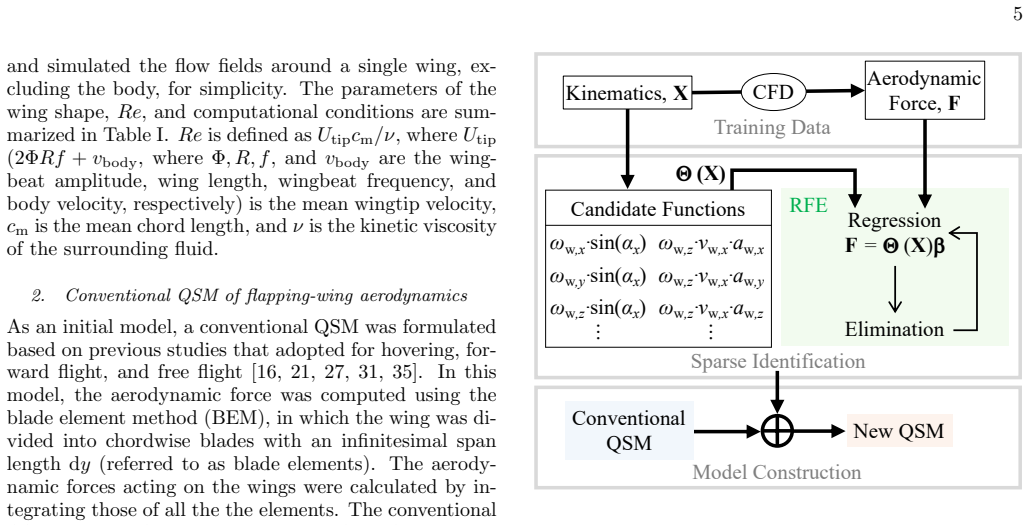
A blade-element quasi-steady model augmented by three formulated mechanisms. The load-bearing device is the decomposition of the wing surface velocity into body-velocity, flapping-velocity, and cross terms for both chordwise and spanwise blade elements, plus a Wagner-style delay term for rotational circulation. The sparse-regression selection from a library of 5,548 candidate functions is what identifies which of these terms the conventional model was missing.
What would settle it
Train the same sparse-regression pipeline on data that include nonzero body roll, pitch, and yaw, then evaluate the resulting model on the fruit-fly evasive maneuver. If error does not fall below the reported 6.7–15.4%—or if a robotic flapping wing in forward flight at advance ratio near 1.1 shows force RMSE no better than the conventional model—the claim that the three mechanisms capture the body-motion effects would be contradicted.
Extended reading notes
Core claim
The central claim is that the failure of conventional quasi-steady models in forward and maneuvering flight is not an inherent limit of the quasi-steady assumption, but a set of three missing kinematic terms. The authors formulate (1) an advance-ratio effect in which translational lift and drag are decomposed into body-velocity, flapping-velocity, and coupling terms with separate coefficients; (2) a spanwise kinematic velocity effect in which blade elements are taken along the span, so the spanwise component of air velocity contributes translational and rotational forces; and (3) a rotational Wagner effect, in which the decay and growth of rotational circulation lag the wing's acceleration,
Load-bearing premise
The training data set body angular velocity to zero, assuming wing-angle variations capture the influence of body rotation, while the fruit-fly test data include strong body turns; if that assumption fails, the reported accuracy on maneuvering flight is overstated.
Editorial extensions
If this is right
- Force estimation errors drop from roughly 29% to 7–16% across hovering, forward, and maneuvering flight for hawkmoth and fruit fly, so the quasi-steady model becomes a fast substitute for CFD in parameter sweeps.
- The advance-ratio decomposition means lift and drag coefficients are no longer constants: they vary with flight speed, changing how thrust and vertical force are predicted in forward flight.
- Spanwise flow contributes over 10% of vertical force at several hawkmoth flight speeds, implying that spanwise blade elements should be included in future quasi-steady analyses.
- The rotational Wagner effect adds a force term during stroke acceleration that is particularly visible in fruit-fly flight, extending the Wagner correction from translation to rotation.
- Residual errors concentrate in upstroke episodes of leading-edge vortex breakdown; the model makes clear that flow-instability forces and wake capture remain outside quasi-steady reach.
Reading between the lines
- The same discovery pipeline could be reused to formulate additional missing terms—wing flexibility, wing-wing interaction, ground effect—by expanding the training data and candidate library; the paper notes the dataset would grow dramatically, so this is a testable extension rather than a demonstrated result.
- Because the model is a linear combination of interpretable kinematic terms, it could be inverted to ask which wing kinematic adjustments produce a desired force change, giving a fast tool for flight-control and neurophysiology hypotheses.
- A direct test of the weakest assumption would be to include body-rotation-induced velocity patterns in training data; if fruit-fly turn errors then fall further, the current model's maneuvering accuracy is partly lucky rather than fully mechanistic.
- The vortex-breakdown residual suggests a hybrid design: quasi-steady model for attached-flow phases plus a stochastic or flow-state correction for breakdown episodes, rather than a purely kinematic quasi-steady model.
Signed reviews
Editorial analysis
A structured set of objections, weighed in public.
Referee Report
Summary. The paper presents a data-driven extension of the quasi-steady model (QSM) for flapping-wing aerodynamics. The authors build a large synthetic training set of 1,200 wingbeats with CFD-computed forces, construct a library of 5,548 candidate kinematic functions, and use a RIDGE/recursive-feature-elimination procedure to identify 100 robust candidate terms. From these, three mechanisms are manually interpreted and formulated: the advance-ratio effect, the spanwise kinematic-velocity effect, and the rotational Wagner effect. Incorporating these into a 34-term QSM, they report substantially reduced prediction errors against CFD for measured hawkmoth (hovering and forward flight) and fruit-fly (evasive maneuvering) kinematics, with RMSE values of 11.0–16.0% (hawkmoth) and 6.7–15.4% (fruit fly), compared with about 29% for the conventional QSM. The authors also provide grid-independence, robot validation, and random-model comparison as supporting evidence.
Significance. If the result holds, the paper makes a useful contribution: it provides explicit algebraic formulations for three mechanisms that were previously recognized only qualitatively, and it demonstrates out-of-sample prediction on measured kinematics that were not used in training. The random-model comparison in Fig. 7(c) is a strong addition, as it shows that the selected functions generalize better across species and flight modes than arbitrary low-order kinematic terms. The validation against robot experiments and the grid-independence study also increase confidence in the CFD ground truth. The main qualification is that the 'maneuvering flight' leg of the headline claim is validated by a single fruit-fly sequence that contains strong body rotation, while the training data deliberately set body angular velocity to zero. This gap does not undermine the forward-flight or hovering results, but it leaves the maneuvering generalization less secure than the abstract implies.
major comments (2)
- [§II B 1, Eqs. (4) and (6), Fig. 4(d)] The training data set body angular velocity to zero (Sec. II B 1), under the assumption that variations in θpos, θele, and θfea sufficiently represent the influence of body rotation. The only maneuvering test, however, is the fruit-fly evasive sequence, which contains large roll, pitch, and yaw (Fig. 4d). At test time the model evaluates Eq. (4) and Eq. (6) with nonzero ωb, so the wing velocity and angular-velocity features that enter the kinematic library are induced by body rotation. No training sample contained such patterns. The spatial structure of the ωb×p term differs from the wing-angle variations used in training, so the assumption is stronger than a mere change of basis. The low reported error on the fruit-fly turn may therefore include an extrapolation component, and the claim of accurate prediction 'across maneuvering flight' is not fully established. I recommend either addin
- [§III C, Fig. 7(c)] The headline error ranges (11.0–16.0% for hawkmoth, 6.7–15.4% for fruit fly) are point estimates over a small number of measured sequences. The random-model comparison in Fig. 7(c) is qualitatively convincing, but no confidence intervals or repeated train/test splits are reported, so the reader cannot assess whether the improvement over the conventional QSM is statistically significant for each flight mode. This is particularly relevant for the fruit-fly maneuver, where only one evasive sequence is used. Additional independent maneuvers or a leave-one-sequence-out analysis would materially strengthen the claim that the model generalizes across maneuvering flight.
minor comments (5)
- [Table II] Only eight of the 100 selected functions are shown; the text refers to the supplementary material for the full list. Please include the complete table in the main text or ensure the supplementary URL is available and clearly referenced, as the reproducibility of the feature-selection step depends on it.
- [Appendix D1, Eq. (D1)] In the definition of ftc,sp,Wg, the final factor is cos(αx), whereas the corresponding spanwise-chord expressions use cos(αy). Please check whether this is a typo; if intentional, clarify why the chordwise angle of attack appears in the spanwise Wagner term.
- [Appendix D3, Eqs. (D10)–(D13)] The derivation of the Wagner correction uses a mean-value argument (introduction of teq) without stating the required smoothness/regularity conditions on Γqs(t). State the assumptions or provide a numerical verification that the approximation is valid over the range of accelerations encountered.
- [Appendix D2, heading] The heading reads 'Coeffecients' and should be 'Coefficients'.
- [Fig. 9(b)] The horizontal axis in Fig. 9(b) is not labeled in the caption; please specify that the error is averaged over wingbeat phase or over successive stroke cycles, as appropriate.
Circularity Check
No significant circularity: the data-driven QSM is fit to CFD training data and evaluated on explicitly held-out measured kinematics; remaining concerns are extrapolation/limitation, not circularity.
full rationale
After walking the derivation chain, I find no circular step that reduces a prediction to its inputs. The paper fits the new QSM (Eq. D1) on CFD-generated training data, but explicitly withholds the measured test kinematics from both sparse identification and coefficient tuning (Sec. II B 3: 'the measured kinematic data used for model evaluation were not included in the training data for either sparse identification or tuning of coefficients'), and reports errors on those out-of-sample cases (hawkmoth [50], fruit fly [3]). The three mechanisms are selected from a candidate library by RFE/SINDy and then manually interpreted; this is standard feature selection, and the random-subset ablation (Fig. 7c) is an additional generalization check across two Re regimes. The advance-ratio decomposition (Eqs. 15–18) is an algebraic identity; giving decomposed terms separate fitted coefficients is a model expansion, not a tautology. The rotational-Wagner formula (Eq. 22) is an explicit ansatz extending van Veen et al. [42]; the signed-square-root library elements were included deliberately (Appendix C 3), so the 'discovery' is partly library engineering, but the coefficients and the teq lag are not determined by the target data by construction. The self-cited QSM baselines [31,35] and CFD solver [60] are validated/independent support and are not load-bearing for the new claim. The paper's own limitations—training with ωb=0 (Sec. II B 1) while the fruit-fly turn test has strong body rotation, and unmodeled vortex breakdown/wake capture (Sec. IV)—are extrapolation and residual-error concerns, not circularity.
Assumptions & free parameters
free parameters (4)
- Force coefficients β for each mechanism term (e.g., βtc,ch,bd1, βtc,ch,bd2, βtd,sp,fl, βrc,ch,Wg, etc.) =
fitted to CFD training data via Levenberg-Marquardt
- Reynolds-number exponents γ (e.g., γtc,ch1, γtc,ch2, γtd,sp1, ...) =
fitted to training data
- Wagner time-delay parameter t_eq =
one-eighth stroke cycle before time t (appendix D3)
- Representative blade-element positions for each mechanism =
optimized per wing morphology to maximize correlation between integrated and pointwise forces (Appendix B)
assumptions (5)
- domain assumption Aerodynamic force is a sparse linear combination of instantaneous kinematic functions (SINDy assumption)
- domain assumption Wing is rigid, flat, and isolated (no body, no wing-wing interaction, no flexibility)
- domain assumption Quasi-steady approximation with added-mass and Wagner corrections is adequate
- ad hoc to paper Body angular velocity can be set to zero in training data
- domain assumption CFD results are ground truth
Cite this review
Pith. "Pith review of Data-Driven Discovery and Formulation Refines the Quasi-Steady Model of Flapping-Wing Aerodynamics." pith.science (2026). https://pith.science/paper/A6SOOXW7
@misc{pith2026250818703,
  author       = {Pith},
  title        = {Pith review of: Data-Driven Discovery and Formulation Refines the Quasi-Steady Model of Flapping-Wing Aerodynamics},
  year         = {2026},
  howpublished = {\url{https://pith.science/paper/A6SOOXW7}},
  note         = {Machine review of arXiv:2508.18703}
}
read the original abstract
Insects control unsteady aerodynamic forces on flapping wings to navigate complex environments. While understanding these forces is vital for biology, physics, and engineering, existing evaluation methods face trade-offs: high-fidelity simulations are computationally or experimentally expensive and lack explanatory power, whereas theoretical models based on quasi-steady assumptions offer insights but exhibit low accuracy. To overcome these limitations and thus enhance the accuracy of quasi-steady aerodynamic models, we applied a data-driven approach involving discovery and formulation of previously overlooked critical mechanisms. Through selection from 5,000 candidate kinematic functions, we identified mathematical expressions for three key additional mechanisms -- the effect of advance ratio, effect of spanwise kinematic velocity, and rotational Wagner effect -- which had been qualitatively recognized but were not formulated. Incorporating these mechanisms considerably reduced the prediction errors of the quasi-steady model using the computational fluid dynamics results as the ground truth, both in hawkmoth forward flight (at high Reynolds numbers) and fruit fly maneuvers (at low Reynolds numbers). The data-driven quasi-steady model enables rapid aerodynamic analysis, serving as a practical tool for understanding evolutionary adaptations in insect flight and developing bio-inspired flying robots.
Figures


Figures from the paper (10 more)


Reference graph
Works this paper leans on
-
[1]
Wing Kinematics Dataset Three wing angles, namely positional θpos, elevation θele, and feathering angle θfea, for the training were synthe- sized based on the measured flight data of various insects and formulation following [27]: θpos = Apos arcsin ϕpos arcsin ϕpos sin 2πf t+ π 2 , (C1) θele = Aele (cos(4πf t) − 1) if ϕele = −1 Aele sin(2πf t...
-
[2]
V alidation and V erification of the Computational Model The wing morphologies and computational domain were discretized using structured O-O grids with 45 × 65 × 101 nodes for the hawkmoth and 55 × 110 × 101 nodes for the fruit fly in the chordwise, spanwise, and outer directions, respectively (Fig. 11). The distance between the wing surface and outermos...
-
[3]
element func- tions
Candidate F unctions The candidate function library was constructed from the first, second, and third polynomials of “element func- tions”. These functions are composed of the wing’s an- gles of attack αx and αy, velocity vw, acceleration aw, angular velocity ωw, angular acceleration ψw, and body velocity vb. Specifically, in the case of angle of attack α...
-
[4]
F eature Elimination Because manual determination of the new aerodynamic mechanisms from thousands of candidate functions is not feasible, we repeated an operation similar to STRidge [70] to identify the important functions, as described in Sec. II B 3. In this study, RIDGE regression minimizes 1 N ∥Θ(X)β − y∥2 2 + λ∥β∥2 2, (C10) where y is the aerodynami...
-
[5]
bd”), flapping velocity term (with the subscript “fl
Data-Driven QSM Incorporating the three identified mechanisms, the new QSM is written as follows: 20 Fz = Fnew(X, β, γ) = β0 + (ftc,ch,bd + ftc,ch,cp + ftc,ch,fl + ftc,ch,Wg) exp(γtc,ch1Reγtc,ch2 x ) + (ftd,ch,bd + ftd,ch,cp + ftd,ch,fl + ftd,ch,Wg) exp(γtd,ch1Reγtd,ch2 x ) + (frc,ch,bd + frc,ch,fl + frc,ch,Wg) exp(γrc,ch1Reγrc,ch2 x ) + frd,ch exp(γrd,ch...
-
[6]
early” condition) and triangles (“steady
Coeffecients The chordwise lift and drag coefficientsCL,ch,bd, CL,ch,cp, CL,ch,fl, CD,ch,bd, CD,ch,cp, and CD,ch,fl are in close agree- ment with those obtained from experiments with revolv- ing wings at the scale of the fruit fly and hawkmoth [16, 113] (Figs. 13(a, b)-(i, iii)). The magnitudes of the coefficients associated with the effects of the body v...
-
[7]
J. Gau, J. Lynch, B. Aiello, E. Wold, N. Gravish, and S. Sponberg, Bridging two insect flight modes in evo- lution, physiology and robophysics, Nature 622, 767 (2023)
2023
-
[8]
rotational Wagner effect
F ormulation of the W agner Effect van Veen et al. [42] proposed a new interpretation of the Wagner effect for flapping wings as an interaction be- tween the velocity and acceleration. They modeled the delay of development and decay of translational circula- tion Γ tc as being proportional to √ca/v (c is the chord length, a is the acceleration, and v is t...
Show all 122 references
-
[9]
J. D. Crall, S. Ravi, A. M. Mountcastle, and S. A. Combes, Bumblebee flight performance in cluttered en- vironments: effects of obstacle orientation, body size and acceleration, J. Exp. Biol. 218, 2728 (2015)
2015
-
[10]
C. G. Johnson, Migration and dispersal of insects by flight (Methuen young books, London, England, 1969)
1969
-
[11]
F. T. Muijres, M. J. Elzinga, J. M. Melis, and M. H. Dickinson, Flies evade looming targets by executing rapid visually directed banked turns, Science 344, 172 (2014)
2014
-
[12]
Le Roy, D
C. Le Roy, D. Amadori, S. Charberet, J. Windt, F. T. Muijres, V. Llaurens, and V. Debat, Adaptive evolution of flight in Morpho butterflies, Science 374, 1158 (2021)
2021
-
[13]
J. H. Marden, Variability in the size, composition, and function of insect flight muscles, Annu. Rev. Physiol. 62, 157 (2000)
2000
-
[14]
B. R. Aiello, M. Tan, U. Bin Sikandar, A. J. Alvey, B. Bhinderwala, K. C. Kimball, J. R. Barber, C. A. Hamilton, A. Y. Kawahara, and S. Sponberg, Adap- tive shifts underlie the divergence in wing morphology in bombycoid moths, Proc. Biol. Sci. 288, 20210677 (2021)
2021
-
[15]
Poletti, A
R. Poletti, A. Calado, L. K. Koloszar, J. Degroote, and M. A. Mendez, On the unsteady aerodynamics of flap- ping wings under dynamic hovering kinematics, Phys. Fluids 36, 081901 (2024)
2024
-
[16]
Horizontal dashed lines in (a, b)-(iii) indicate the maximum value of each drag coeffecient
are shown in (b)-(i, iii) by dashed curves. Horizontal dashed lines in (a, b)-(iii) indicate the maximum value of each drag coeffecient. (v) Coefficients for the rotational lift. bd and fl represent body and flapping respectively. Dashed lines are the rotational lift coefficie...
-
[17]
H. Liu, S. Ravi, D. Kolomenskiy, and H. Tanaka, Biome- chanics and biomimetics in insect-inspired flight sys- tems, Phil. Trans. R. Soc. Lond. B 371 (2016)
2016
-
[18]
H. V. Phan and H. C. Park, Mimicking nature’s flyers: a review of insect-inspired flying robots, Curr. Opin. Insect Sci. 42, 70 (2020)
2020
-
[19]
K. Y. Ma, P. Chirarattananon, S. B. Fuller, and R. J. Wood, Controlled flight of a biologically inspired, insect- scale robot, Science 340, 603 (2013)
2013
-
[20]
Floreano, Flying Insects and Robots , edited by D
D. Floreano, Flying Insects and Robots , edited by D. Floreano, J.-C. Zufferey, M. V. Srinivasan, and C. Ellington (Springer, Berlin, Germany, 2009)
2009
-
[21]
R. J. Bomphrey, T. Nakata, N. Phillips, and S. M. Walker, Smart wing rotation and trailing-edge vortices enable high frequency mosquito flight, Nature 544, 92 (2017)
2017
-
[22]
S. E. Farisenkov, D. Kolomenskiy, P. N. Petrov, T. En- gels, N. A. Lapina, F.-O. Lehmann, R. Onishi, H. Liu, and A. A. Polilov, Novel flight style and light wings boost flight performance of tiny beetles, Nature 602, 96 (2022)
2022
-
[23]
Nakata, Computational physics of insect flight - aerial locomotion and navigation, J
T. Nakata, Computational physics of insect flight - aerial locomotion and navigation, J. Phys. Soc. Jpn. 92 (2023)
2023
-
[24]
M. H. Dickinson, F. O. Lehmann, and S. P. Sane, Wing rotation and the aerodynamic basis of insect flight, Sci- ence 284, 1954 (1999)
1954
-
[25]
Gravish and G
N. Gravish and G. V. Lauder, Robotics-inspired biology, J. Exp. Biol. 221, jeb138438 (2018)
2018
-
[26]
C. P. Ellington, The aerodynamics of hovering insect flight. V. a vortex theory, Phil. Trans. R. Soc. Lond. B 305, 115 (1984)
1984
-
[27]
H. Xuan, J. Hu, Y. Yu, and J. Zhang, Recent progress in aerodynamic modeling methods for flapping flight, AIP Adv. 10, 020701 (2020)
2020
-
[28]
M. R. A. Nabawy and W. J. Crowther, On the quasi- steady aerodynamics of normal hovering flight part I: the induced power factor, J. R. Soc. Interface 11, 20131196 (2014)
2014
-
[29]
Q. Wang, J. F. L. Goosen, and F. van Keulen, A predic- tive quasi-steady model of aerodynamic loads on flap- ping wings, J. Fluid Mech. 800, 688 (2016)
2016
-
[30]
S. A. Ansari, R. ˙Zbikowski, and K. Knowles, Aerody- namic modelling of insect-like flapping flight for micro air vehicles, Prog. Aerosp. Sci. 42, 129 (2006)
2006
-
[31]
S. P. Sane and M. H. Dickinson, The control of flight force by a flapping wing: lift and drag production, J. Exp. Biol. 204, 2607 (2001)
2001
-
[32]
Z. J. Wang, J. M. Birch, and M. H. Dickinson, Unsteady forces and flows in low reynolds number hovering flight: two-dimensional computations vs robotic wing experi- ments, J. Exp. Biol. 207, 449 (2004). 25
2004
-
[33]
Z. A. Khan and S. K. Agrawal, Force and moment char- acterization of flapping wings for micro air vehicle ap- plication, in Proceedings of the 2005, American Control Conference, 2005 (IEEE, 2005) pp. 1515–1520 vol. 3
2005
-
[34]
T. L. Hedrick and T. L. Daniel, Flight control in the hawkmoth manduca sexta: the inverse problem of hov- ering, J. Exp. Biol. 209, 3114 (2006)
2006
-
[35]
G. J. Berman and Z. Jane Wang, Energy-minimizing kinematics in hovering insect flight, J. Fluid Mech. 582, 153 (2007)
2007
-
[36]
W. B. Dickson, A. D. Straw, and M. H. Dickinson, In- tegrative model of drosophila flight, AIAA J. 46, 2150 (2008)
2008
-
[37]
Bierling and M
T. Bierling and M. Patil, Nonlinear dynamics and sta- bility of flapping-wing flight, in International forum on aeroelasticity and structural dynamics (research- gate.net, 2009) pp. 2–5
2009
-
[38]
Q. T. Truong, Q. V. Nguyen, V. T. Truong, H. C. Park, D. Y. Byun, and N. S. Goo, A modified blade element theory for estimation of forces generated by a beetle- mimicking flapping wing system, Bioinspir. Biomim. 6, 036008 (2011)
2011
-
[39]
Nakata, H
T. Nakata, H. Liu, and R. J. Bomphrey, A CFD- informed quasi-steady model of flapping wing aerody- namics, J. Fluid Mech. 783, 323 (2015)
2015
-
[40]
Cheng, B
B. Cheng, B. W. Tobalske, D. R. Powers, T. L. Hedrick, Y. Wang, S. M. Wethington, and Deng, Flight mechan- ics and control of escape manoeuvres in hummingbirds. II. aerodynamic force production, flight control and per- formance limitations, J. Exp. Biol. 219, 3532 (2016)
2016
-
[41]
Y. J. Lee, K. B. Lua, T. T. Lim, and K. S. Yeo, A quasi-steady aerodynamic model for flapping flight with improved adaptability, Bioinspir. Biomim. 11, 036005 (2016)
2016
-
[42]
S. F. Armanini, J. V. Caetano, G. C. H. E. d. Croon, C. C. d. Visser, and M. Mulder, Quasi-steady aerody- namic model of clap-and-fling flapping MA V and val- idation using free-flight data, Bioinspir. Biomim. 11, 046002 (2016)
2016
-
[43]
X. Cai, D. Kolomenskiy, T. Nakata, and H. Liu, A CFD data-driven aerodynamic model for fast and precise pre- diction of flapping aerodynamics in various flight veloc- ities, J. Fluid Mech. 915, A114 (2021)
2021
-
[44]
S. M. Walker and G. K. Taylor, A semi-empirical model of the aerodynamics of manoeuvring insect flight, J. R. Soc. Interface 18, 20210103 (2021)
2021
-
[45]
M. F. M. Osborne, Aerodynamics of flapping flight with application to insects, J. Exp. Biol. 28, 221 (1951)
1951
-
[46]
C. P. Ellington and M. J. Lighthill, The aerodynamics of hovering insect flight. IV. aerodynamic mechanisms, Phil. Trans. R. Soc. Lond. B 305, 79 (1984)
1984
-
[47]
Weis-Fogh, Quick estimates of flight fitness in hov- ering animals, including novel mechanisms for lift pro- duction, J
T. Weis-Fogh, Quick estimates of flight fitness in hov- ering animals, including novel mechanisms for lift pro- duction, J. Exp. Biol. 59, 169 (1973)
1973
-
[48]
S. P. Sane and M. H. Dickinson, The aerodynamic ef- fects of wing rotation and a revised quasi-steady model of flapping flight, J. Exp. Biol. 205, 1087 (2002)
2002
-
[49]
Andersen, U
A. Andersen, U. Pesavento, and Z. Jane Wang, Analysis of transitions between fluttering, tumbling and steady descent of falling cards, J. Fluid Mech. 541, 91 (2005)
2005
-
[50]
W. G. van Veen, J. L. van Leeuwen, B. W. van Oudheus- den, and F. T. Muijres, The unsteady aerodynamics of insect wings with rotational stroke accelerations, a sys- tematic numerical study, J. Fluid Mech. 956 (2023)
2023
-
[51]
S. P. Sane, The aerodynamics of insect flight, J. Exp. Biol. 206, 4191 (2003)
2003
-
[52]
X. Deng, L. Schenato, W. C. Wu, and S. S. Sastry, Flap- ping flight for biomimetic robotic insects: part I-system modeling, IEEE Trans. Rob. 22, 776 (2006)
2006
-
[53]
J. P. Whitney and R. J. Wood, Aeromechanics of pas- sive rotation in flapping flight, J. Fluid Mech. 660, 197 (2010)
2010
-
[54]
C. P. Ellington, The aerodynamics of hovering insect flight. II. morphological parameters, Phil. Trans. R. Soc. Lond. B 305, 17 (1984)
1984
-
[55]
Wagner, ¨Uber die entstehung des dynamischen auftriebes von tragfl¨ ugeln, J
H. Wagner, ¨Uber die entstehung des dynamischen auftriebes von tragfl¨ ugeln, J. Appl. Math. Mech. 5, 17 (1924)
1924
-
[56]
Lentink and M
D. Lentink and M. H. Dickinson, Rotational acceler- ations stabilize leading edge vortices on revolving fly wings, J. Exp. Biol. 212, 2705 (2009)
2009
-
[57]
Calado, R
A. Calado, R. Poletti, L. K. Koloszar, and M. A. Mendez, A robust data-driven model for flapping aero- dynamics under different hovering kinematics, Phys. Fluids 35, 047122 (2023)
2023
-
[58]
A. P. Willmott and C. P. Ellington, The mechanics of flight in the hawkmoth manduca sexta. I. kinematics of hovering and forward flight, J. Exp. Biol. 200, 2705 (1997)
1997
-
[59]
S. L. Brunton, J. L. Proctor, and J. N. Kutz, Discovering governing equations from data by sparse identification of nonlinear dynamical systems, Proc. Natl. Acad. Sci. U. S. A. 113, 3932 (2016)
2016
-
[60]
Bongard and H
J. Bongard and H. Lipson, Automated reverse engineer- ing of nonlinear dynamical systems, Proc. Natl. Acad. Sci. U. S. A. 104, 9943 (2007)
2007
-
[61]
Schmidt and H
M. Schmidt and H. Lipson, Distilling free-form natural laws from experimental data, Science 324, 81 (2009)
2009
-
[62]
Fukami, T
K. Fukami, T. Murata, K. Zhang, and K. Fukagata, Sparse identification of nonlinear dynamics with low- dimensionalized flow representations, J. Fluid Mech. 926, A10 (2021)
2021
-
[63]
J. A. Foster, J. Decuyper, T. De Troyer, and M. Runacres, Estimating a sparse nonlinear dynami- cal model of the flow around an oscillating cylinder in a fluid flow using SINDy, in Conference on Noise and Vibration Engineering ISMA (cris.vub.be, 2022) p. tba
2022
-
[64]
Fasel, E
U. Fasel, E. Kaiser, J. Nathan Kutz, B. W. Brunton, and S. L. Brunton, SINDy with control: A tutorial, in 2021 60th IEEE Conference on Decision and Control (CDC) (IEEE, 2021) pp. 16–21
2021
-
[65]
Hoffmann, C
M. Hoffmann, C. Fr¨ ohner, and F. No´ e, Reactive SINDy: Discovering governing reactions from concen- tration data, J. Chem. Phys. 150, 025101 (2019)
2019
-
[66]
L. d. Anjos, G. T. Naozuka, D. T. Volpatto, W. A. C. Godoy, M. I. d. S. Costa, and R. C. Almeida, A new modelling framework for predator-prey interactions: A case study of an aphid-ladybeetle system, Ecol. Inform. 77, 102168 (2023)
2023
-
[67]
Aono and H
H. Aono and H. Liu, Vortical structure and aerodynam- ics of hawkmoth hovering, J. biomech. sci. eng. 1, 234 (2006)
2006
-
[68]
Liu, Integrated modeling of insect flight: From mor- phology, kinematics to aerodynamics, J
H. Liu, Integrated modeling of insect flight: From mor- phology, kinematics to aerodynamics, J. Comput. Phys. 228, 439 (2009)
2009
-
[69]
Nakata and H
T. Nakata and H. Liu, A fluid-structure interaction model of insect flight with flexible wings, J. Comput. 26 Phys. 231, 1822 (2012)
2012
-
[70]
Heathcote and I
S. Heathcote and I. Gursul, Flexible flapping airfoil propulsion at low reynolds numbers, AIAA J. 45, 1066 (2007)
2007
-
[71]
Heathcote, Z
S. Heathcote, Z. Wang, and I. Gursul, Effect of spanwise flexibility on flapping wing propulsion, J. Fluids Struct. 24, 183 (2008)
2008
-
[72]
K. B. Lua, K. C. Lai, T. T. Lim, and K. S. Yeo, On the aerodynamic characteristics of hovering rigid and flexi- ble hawkmoth-like wings, Exp. Fluids 49, 1263 (2010)
2010
-
[73]
Sun and J
M. Sun and J. Tang, Unsteady aerodynamic force gen- eration by a model fruit fly wing in flapping motion, J. Exp. Biol. 205, 55 (2002)
2002
-
[74]
S. K. Chimakurthi, J. Tang, R. Palacios, C. E. S. Ces- nik, and W. Shyy, Computational aeroelasticity frame- work for analyzing flapping wing micro air vehicles, AIAA J. 47, 1865 (2009)
2009
-
[75]
H. Dai, H. Luo, and J. F. Doyle, Dynamic pitching of an elastic rectangular wing in hovering motion, J. Fluid Mech. 693, 473 (2012)
2012
-
[76]
T. Q. Le, T. Van Truong, S. H. Park, T. Quang Truong, J. H. Ko, H. C. Park, and D. Byun, Improvement of the aerodynamic performance by wing flexibility and elytra–hind wing interaction of a beetle during forward flight, J. R. Soc. Interface 10, 20130312 (2013)
2013
-
[77]
H. Wan, H. Dong, and K. Gai, Computational investi- gation of cicada aerodynamics in forward flight, J. R. Soc. Interface 12, 20141116 (2015)
2015
-
[78]
S. H. Rudy, S. L. Brunton, J. L. Proctor, and J. N. Kutz, Data-driven discovery of partial differential equations, Sci. Adv. 3, e1602614 (2017)
2017
-
[79]
Champion, B
K. Champion, B. Lusch, J. N. Kutz, and S. L. Brun- ton, Data-driven discovery of coordinates and governing equations, Proc. Natl. Acad. Sci. U. S. A. 116, 22445 (2019)
2019
-
[80]
Guyon, J
I. Guyon, J. Weston, S. Barnhill, and V. Vapnik, Gene selection for cancer classification using support vector machines, Mach. Learn. 46, 389 (2002)
2002
-
[81]
A. E. Hoerl and R. W. Kennard, Ridge regression: Bi- ased estimation for nonorthogonal problems, Techno- metrics 12, 55 (1970)
1970
-
[82]
See supplemental material at [url will be inserted by publisher] for the table of all the 100 candidate functions suggested by sparse identification
-
[83]
W. B. Dickson and M. H. Dickinson, The effect of ad- vance ratio on the aerodynamics of revolving wings, J. Exp. Biol. 207, 4269 (2004)
2004
-
[84]
J.-S. Han, A. Nguyen, and J.-H. Han, Aerodynamic characteristics of flapping wings under steady lateral in- flow, J. Fluid Mech. 870, 735 (2019)
2019
-
[85]
C. P. Ellington, C. van den Berg, A. P. Willmott, and A. L. R. Thomas, Leading-edge vortices in insect flight, Nature 384, 626 (1996)
1996
-
[86]
R. R. Harbig, J. Sheridan, and M. C. Thompson, The role of advance ratio and aspect ratio in determining leading-edge vortex stability for flapping flight, J. Fluid Mech. 751, 71 (2014)
2014
-
[87]
Dudley and C
R. Dudley and C. P. Ellington, Mechanics of forward flight in bumblebees: II. QUASI-STEADY LIFT AND POWER REQUIREMENTS, J. Exp. Biol. 148, 53 (1990)
1990
-
[88]
W. Song, S. Jiang, G. Camps-Valls, M. Williams, L. Zhang, M. Reichstein, H. Vereecken, L. He, X. Hu, and L. Shi, Towards data-driven discovery of governing equations in geosciences, Commun. Earth Environ. 5, 1 (2024)
2024
-
[89]
J. M. Melis, I. Siwanowicz, and M. H. Dickinson, Ma- chine learning reveals the control mechanics of an insect wing hinge, Nature 628, 795 (2024)
2024
-
[90]
Lehmann and J
F.-O. Lehmann and J. Bartussek, Neural control and precision of flight muscle activation in drosophila, J. Comp. Physiol. A 203, 1 (2017)
2017
-
[91]
M. H. Dickinson and F. T. Muijres, The aerodynamics and control of free flight manoeuvres in drosophila, Phil. Trans. R. Soc. Lond. B 371 (2016)
2016
-
[92]
M. N. Haque, B. Cheng, B. W. Tobalske, and H. Luo, Hummingbirds use wing inertial effects to improve ma- neuverability, bioRxiv , 2023.07.21.550104 (2023)
2023
-
[93]
Ramamurti and W
R. Ramamurti and W. C. Sandberg, A computational investigation of the three-dimensional unsteady aerody- namics of drosophila hovering and maneuvering, J. Exp. Biol. 210, 881 (2007)
2007
-
[94]
S. N. Fry, R. Sayaman, and M. H. Dickinson, The aero- dynamics of free-flight maneuvers in drosophila, Science 300, 495 (2003)
2003
-
[95]
F. T. Muijres, M. J. Elzinga, N. A. Iwasaki, and M. H. Dickinson, Body saccades of drosophila consist of stereo- typed banked turns, J. Exp. Biol. 218, 864 (2015)
2015
-
[96]
Corban, M
B. Corban, M. Bauerheim, and T. Jardin, Discover- ing optimal flapping wing kinematics using active deep learning, J. Fluid Mech. 974, A54 (2023)
2023
-
[97]
J. Hu, Z. Dou, and W. Zhang, Fast fluid-structure inter- action simulation method based on deep learning flow field modeling, Phys. Fluids 36 (2024)
2024
-
[98]
Lee and D
S. Lee and D. You, Data-driven prediction of unsteady flow over a circular cylinder using deep learning, J. Fluid Mech. 879, 217 (2019)
2019
-
[99]
M. Lino, S. Fotiadis, A. A. Bharath, and C. D. Cantwell, Current and emerging deep-learning methods for the simulation of fluid dynamics, Proc. R. Soc. A 479, 20230058 (2023)
2023
-
[100]
J. M. Birch and M. H. Dickinson, The influence of wing- wake interactions on the production of aerodynamic forces in flapping flight, J. Exp. Biol. 206, 2257 (2003)
2003
-
[101]
Boninsegna, F
L. Boninsegna, F. N¨ uske, and C. Clementi, Sparse learn- ing of stochastic dynamical equations, J. Chem. Phys. 148, 241723 (2017)
2017
-
[102]
J. L. Callaham, J.-C. Loiseau, G. Rigas, and S. L. Brun- ton, Nonlinear stochastic modelling with langevin re- gression, Proc. Math. Phys. Eng. Sci. 477, 20210092 (2021)
2021
-
[103]
J. K. Wang and M. Sun, A computational study of the aerodynamics and forewing-hindwing interaction of a model dragonfly in forward flight, J. Exp. Biol. 208, 3785 (2005)
2005
-
[104]
S.-J. Hsu, H. Deng, J. Wang, H. Dong, and B. Cheng, Wing deformation improves aerodynamic performance of forward flight of bluebottle flies flying in a flight mill, J. R. Soc. Interface 21, 20240076 (2024)
2024
-
[105]
Young, S
J. Young, S. M. Walker, R. J. Bomphrey, G. K. Taylor, and A. L. R. Thomas, Details of insect wing design and deformation enhance aerodynamic function and flight efficiency, Science 325, 1549 (2009)
2009
-
[106]
Kolomenskiy, M
D. Kolomenskiy, M. Maeda, T. Engels, H. Liu, K. Schneider, and J.-C. Nave, Aerodynamic ground effect in fruitfly sized insect takeoff, PLoS One 11, e0152072 (2016)
2016
-
[107]
Bayiz, M
Y. Bayiz, M. Ghanaatpishe, H. Fathy, and B. Cheng, 27 Hovering efficiency comparison of rotary and flapping flight for rigid rectangular wings via dimensionless multi-objective optimization, Bioinspir. Biomim. 13, 046002 (2018)
2018
-
[108]
Zheng, T
L. Zheng, T. Hedrick, and R. Mittal, A comparative study of the hovering efficiency of flapping and revolving wings, Bioinspir. Biomim. 8, 036001 (2013)
2013
-
[109]
B. W. Tobalske, Hovering and intermittent flight in birds, Bioinspir. Biomim. 5, 045004 (2010)
2010
-
[110]
M. C. J. Pennycuick, Modelling the flying bird, edited by C. J. Pennycuick, Theoretical Ecology (Academic Press, 2008)
2008
-
[111]
C. R. Betts and R. Wootton, Wing shape and flight be- haviour in butterflies (lepidoptera: Papilionoidea and hesperioidea): A preliminary analysis, J. Exp. Biol. 138, 271 (1988)
1988
-
[112]
Paoletti and L
P. Paoletti and L. Mahadevan, Intermittent locomotion as an optimal control strategy, Proc. Math. Phys. Eng. Sci. 470, 20130535 (2014)
2014
-
[113]
Deora, N
T. Deora, N. Gundiah, and S. P. Sane, Mechanics of the thorax in flies, J. Exp. Biol. 220, 1382 (2017)
2017
-
[114]
X. G. Meng and M. Sun, Wing and body kinematics of forward flight in drone-flies, Bioinspir. Biomim. 11, 056002 (2016)
2016
-
[115]
Dudley and C
R. Dudley and C. P. Ellington, Mechanics of forward flight in bumblebees: I. kinematics and morphology, J. Exp. Biol. (1990)
1990
-
[116]
H. J. Zhu and M. Sun, Kinematics measurement and power requirements of fruitflies at various flight speeds, Energies 13, 4271 (2020)
2020
-
[117]
A. W. Whitney, A direct method of nonparametric mea- surement selection, IEEE Trans. Comput. C-20, 1100 (1971)
1971
-
[118]
C. P. Ellington, The aerodynamics of hovering insect flight. III. kinematics, Phil. Trans. R. Soc. Lond. B 305, 41 (1984)
1984
-
[119]
M. H. Dickinson and K. G. G¨ otz, Unsteady aerodynamic performance of model wings at low reynolds numbers, J. Exp. Biol. 174, 45 (1993)
1993
-
[120]
A. P. Willmott and C. P. Ellington, The mechanics of flight in the hawkmoth manduca sexta. II. aerodynamic consequences of kinematic and morphological variation, J. Exp. Biol. 200, 2723 (1997)
1997
-
[121]
J. R. Usherwood and C. P. Ellington, The aerodynamics of revolving wings I. model hawkmoth wings, J. Exp. Biol. 205, 1547 (2002)
2002
-
[122]
Y. E. Bayiz and B. Cheng, State-space aerodynamic model reveals high force control authority and pre- dictability in flapping flight, J. R. Soc. Interface 18, 20210222 (2021)
2021
Reviewed August 5, 2026 · model on record in the stance chip above.
Discussion (0). Continue with ORCID to comment.