REVIEW 3 major objections 6 minor 1 cited by
Lessons learned from the detection of wide companions by radial velocity and astrometry
T0 review · 3 major / 6 minor · reviewed 2026-08-11 · deepseek-v4-flash
Pith's one-line read This paper argues that the disputed orbital solutions for wide companions are explained by differences in data, conventions, and sampling rather than by a flawed astrometric method, and that the F19/F23 and orvara pipelines are physically…
desk verdict A solid reanalysis with a genuine out-of-sample check, but the 'methodology vs data' conclusion is broader than the evidence; referee it. read the letter →
The pith
A machine-rendered reading of the paper's core claim, the machinery that carries it, and where it could break.
The reading
What carries the argument
The load-bearing object is the F19/F23 astrometric model: it fits barycentric motion (reference position and proper motion) plus reflex-motion terms, astrometric jitter, and catalog offsets directly to Hipparcos and Gaia catalog data, and in the F23 version fits Hipparcos plus Gaia DR2 and DR3 simultaneously with parallax contributions to GOST-generated abscissae. Its equivalence to orvara rests on the identity $\hat{\boldsymbol{\mu}}_{HG} \equiv (\boldsymbol{r}_G - \boldsymbol{r}_H)/\Delta T = \boldsymbol{\mu}_b + \boldsymbol{\mu}_{HG}$, which shows that a position-based fit and a proper-motion-based fit contain the same physical information. The second key mechanism is the fitted parallax offset $\Delta\varpi$ in the HD 28185 model, which absorbs the annual astrometric signal of the inner planet and converts it into a concrete, testable contribution to the Hipparcos versus Gaia parallax difference. Together these mechanisms let the paper separate genuine physical signals from apparent disagreements caused by conventions, data selection, sampling, and companion modeling.
What would settle it
Fit the HD 28185 system with the F23 model but replace the constant parallax offset $\Delta\varpi$ by an explicit Keplerian orbit for the inner planet evaluated at the individual Hipparcos epoch abscissae and Gaia scan times, keeping the same RV data. If the log-likelihood gain of 8.4 relative to the model without the inner planet vanishes, or if the fitted $\Delta\varpi$ goes to zero while the orbit parameters stay fixed, the claim that the inner planet's annual signal acts as a measurable parallax-like bias would be falsified. A second test: run F23 and orvara on the same synthetic wide-companion dataset with known injected parameters and identical conventions; disagreement beyond the quoted uncertainties would contradict the 'solely parameterization' equivalence.
Extended reading notes
Core claim
The paper's central claim is that the discrepancies between its earlier wide-companion solutions and those of a competing analysis are primarily data-related rather than methodology-related. Concretely, the authors assert that the difference between F19 and orvara lies solely in the parameterization and not in the physical content: both solve for the same reflex motion of the host star, one by fitting Hipparcos/Gaia catalog positions and proper motions together with astrometric jitter and offsets, the other by fitting the calibrated Hipparcos-Gaia proper-motion accelerations, with the identity $\hat{\boldsymbol{\mu}}_{HG} = \boldsymbol{\mu}_b + \boldsymbol{\mu}_{HG}$ connecting the two. For HD 28185 they show that including the astrometric signal of the year-long inner planet, modeled through a fitted parallax-like offset, improves the fit by a log-likelihood of 8.4 (ΔBIC = 12) and resolves the roughly 2–3σ Hipparcos/Gaia parallax discrepancy, and that without this signal their solution matches the competing one. Across the other targets the disagreements are attributed to four named causes: a 180-degree convention difference in the longitude of ascending node, incomplete sampling of the two inclination modes, unmodeled inner companions, and radial-velocity baselines too short to cover the orbital turn-over of decades-long companions. The eps Ind A b case is used to show that with a roughly 29-year RV baseline, F23 and orvara produce consistent orbits and a position matching the JWST/MIRI image.
Load-bearing premise
The worked example for HD 28185 assumes that the astrometric wobble from the inner, roughly one-year planet can be adequately captured by a single constant offset in parallax across the combined Hipparcos and Gaia data; if that shortcut is wrong, the claimed improvement in fit and the explanation of the parallax discrepancy would not hold.
Editorial extensions
If this is right
- The F19/F23 pipeline can be used with confidence on the same data as orvara; reported differences for HD 28185, HD 38529, 14 Her, GJ 229, HD 62364, HD 211847, GJ 680, and HD 111031 are not signs of a methodological flaw.
- For long-period companions, a radial-velocity baseline that does not cover the orbital turn-over leaves a mass-period degeneracy; adding relative astrometry from imaging or extending the baseline is required to break it.
- Multi-modal inclination posteriors are expected for astrometric orbits, so convergence diagnostics like $\hat{R}<1.1$ alone do not guarantee that all modes were found; multiple samplers or chains with different starting points are needed.
- Year-long inner companions can bias parallax measurements at the level of the Hipparcos/Gaia discrepancies, so multi-companion fits should model their astrometric signal rather than averaging it away.
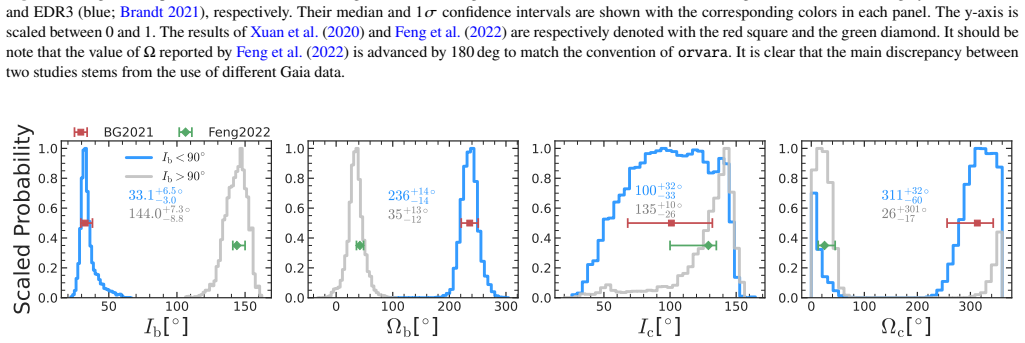
- The longitude of ascending node reported by different studies can differ by 180 degrees purely from convention, so apparent node discrepancies should be checked against the adopted convention before being interpreted physically.
Reading between the lines
- If the HD 28185 mechanism is general, stars with inner planets on roughly one-year orbits should show systematic Hipparcos-versus-Gaia parallax offsets of order 0.1–0.4 mas; Gaia DR4 epoch astrometry could test this by fitting the annual signal explicitly instead of as a constant offset.
- The equivalence between position-based and proper-motion-based astrometric fits suggests a practical diagnostic: whenever two pipelines disagree on the same epochs and weights, the disagreement is a flag for a data or sampling problem, not a reason to discard one method.
- The eps Ind A b result implies that some previously published shorter-period solutions for other long-period companions may be artifacts of short RV baselines, and that reanalysis with a longer baseline or imaging constraints could shift their periods and masses upward.
- Some RV-plus-astrometry-only classifications of wide companions as brown dwarfs may need revisiting with relative astrometry, since without it the mass-period degeneracy allows low-mass stellar companions to be underestimated.
Editorial analysis
A structured set of objections, weighed in public.
Referee Report
Summary. The manuscript reanalyzes a set of wide-orbit systems (HD 28185, GJ 229, HD 62364, HD 38529, 14 Her, eps Ind A, HD 211847, HD 111031, and GJ 680) to address discrepancies between the F19/F22/F23 astrometry-plus-RV pipeline and the orvara/HGCA-based analyses reported by Venner et al. (2024). It argues that the F19 and orvara methods are equivalent (Section 2), that the HD 28185 discrepancy is driven by RV dataset differences and by the astrometric signal of the inner year-long companion (Section 3), and that other discrepancies arise from conventions, posterior sampling, inner companions, and RV baseline coverage (Sections 4 and 5). It also presents an out-of-sample prediction for eps Ind A b's position that is matched by JWST/MIRI imaging (Section 5).
Significance. The paper provides a useful collection of case studies and a clear list of pitfalls for wide-orbit fitting, and it demonstrates that several apparent F22 discrepancies disappear when the same data and conventions are used. The eps Ind A b prediction without imaging data is a genuine, falsifiable out-of-sample test, and the many side-by-side F23/orvara comparisons on real targets are a practical strength. However, the central claim that discrepancies are 'primarily data-related rather than methodology-related' is not fully established: the Section 2 equivalence argument is incomplete, and the paper's own list of causes includes methodological items such as conventions and posterior sampling. A controlled injection test or a more carefully qualified claim would be needed to justify the headline.
major comments (3)
- [Section 2, Eq. (4)] The equality hat-mu_HG = mu_b + mu_HG shows that the mean proper motion modeled by F19 matches the HGCA definition, but it does not establish that the two fitting pipelines are inferentially equivalent. F19/F23 fit catalog positions and proper motions with free astrometric jitter, barycentric offsets, and Gaia error-inflation factors (Table 1), while orvara uses calibrated HGCA proper motions without equivalent freedom; F23 additionally fits GOST epoch data and multiple Gaia releases. Free nuisance parameters can absorb real astrometric signal, so the statement that 'the difference between F19 and orvara lies solely in the parameterization and not in the physical content' is not supported by the derivation alone. The real-data agreements in Sections 4-5 are suggestive but are not a controlled test; the paper should either soften this claim or add a blind injected-signal comparison of the two pipelines on identical data.
- [Abstract / Section 6] The abstract's claim that 'the discrepancies are primarily data-related rather than methodology-related' is in tension with the manuscript's own list of causes, which includes 'clear definitions of conventions' and 'efficient posterior sampling' (abstract, and the first two reasons listed in Section 6). Conventions and posterior sampling are methodological. The categorization should be clarified, or the claim should be qualified so that the headline matches the evidence presented in the paper.
- [Section 3, Table 1 and Figs. 3-4] The claim that the inner companion of HD 28185 induces a 'significant parallax offset' and improves the fit by Delta log-likelihood 8.4 (Delta BIC 12) depends on modeling the year-long companion's astrometric signal as a constant parallax-like offset Delta-vari in the combined Hipparcos/Gaia data. Since the 385.9-day orbital period is not exactly commensurate with the annual parallax cycle, this is an approximation, and the paper does not verify its adequacy (for example, by injecting a synthetic signal at the fitted orbit and checking recovery). Given that Delta-vari is already a fitted parameter and that jitter and error-inflation freedom are present, the BIC improvement alone is not a fully robust demonstration; this point should be checked, or the wording of the 'importance of parallax modeling' lesson should be moderated.
minor comments (6)
- [Figure 1 caption] The caption states that the vectors AD and AF 'denote the observed proper motions at the Gaia and Hipparcos reference epochs,' but AF is labeled r_H,o, which is a reference position; it should presumably be mu_H,o.
- [Section 4.4] The text says 'we added 51 HARPS RVs from the ESO archive' without giving the program IDs or a precise data source; please provide this information for reproducibility.
- [Section 5, paragraph 2] The sentence 'The dataset of HARPSpost2 were released by Barbieri (2023)' has a subject-verb agreement error and should read 'The dataset ... was released.'
- [Figure 8 caption] The phrase 'The shade regions of Panel (a)' should be 'The shaded regions of Panel (a)'.
- [Section 6, final paragraph] The sentence 'First, the use different conventions' should read 'First, the use of different conventions.'
- [References] The Venner et al. (2024) bibliography entry lacks a volume and page range; please complete the reference.
Circularity Check
Minor circularity in the Section 2 equivalence claim; the data-related conclusion is otherwise supported by external orvara comparisons and out-of-sample MIRI data.
-
self definitional
[Section 2, Eq. (4)]
"By setting 𝝁𝐻𝐺 ≡ (𝒓𝑟𝐺 − 𝒓𝑟𝐻)/Δ𝑇, we obtain: ˆ𝝁𝐻𝐺 = 𝝁𝑏 + 𝝁𝐻𝐺 (4), matching the model for observed mean proper motion 𝜇𝐻𝐺,𝑜 as defined by Brandt et al. (2021a). ... Thus, the difference between F19 and orvara lies solely in the parameterization and not in the physical content."
The equality between F19's predicted mean proper motion and orvara's is produced by defining 𝝁𝐻𝐺 as the reflex-motion position difference divided by Δ𝑇, i.e., the same composite quantity orvara uses. The match in Eq. (4) therefore holds by construction and cannot by itself establish that the two pipelines have identical physical content, especially since F19/F23 add free jitter and barycentric offsets that orvara does not. The conclusion that the difference 'lies solely in parameterization' is asserted from a definition rather than derived from independent content. However, the paper's later direct comparisons of F23 and orvara on real targets, and the eps Ind A b MIRI prediction, provide independent support, so this step is only mildly circular.
full rationale
I find no significant circularity overall. The paper's central claim that the discrepancies are 'primarily data-related rather than methodology-related' is supported by reanalyzing the targets with both the authors' F23 pipeline and the independent orvara code, which is an external benchmark written by other groups. The eps Ind A b case is a genuine out-of-sample test: Solution A, made without direct-imaging data, predicts a location that is then compared with the observed JWST/MIRI position. The HD 28185 data-related conclusion is also load-bearingly supported by Model 2, which excludes the inner companion's astrometric signal and reproduces V24's outer orbit when the same RV baseline is used; thus it does not depend on the interpretation of the fitted Δϖ offset. The only constructed step is Section 2's equivalence argument: Eq. (4) matches orvara's mean-proper-motion model by defining 𝝁𝐻𝐺 in the F19 model to be exactly the position-difference quantity orvara uses. That makes the identity true by definition and not a proof of full physical equivalence, but the paper does not rely solely on this identity — it also shows consistent F23/orvara solutions for multiple systems. Self-citations to Feng et al. (2019a, 2019b, 2022, 2023) are used for conventions and methodology, but they are checked against external code and data rather than being the sole justification. A blind injected-signal comparison would strengthen the equivalence claim, but its absence is a methodological limitation, not circularity. Score 2 reflects the mild definitional step in Section 2, while the central conclusions retain independent empirical content.
Assumptions & free parameters
free parameters (5)
- Parallax offset Delta-vari (HD 28185) =
0.280+0.090 mas (Model 1)
- Hipparcos astrometric jitter J_hip =
2.01+0.52-0.54 mas
- Gaia error inflation factor S_gaia =
1.079+0.076-0.054 (Model 1)
- Barycentric offsets and proper-motion offsets =
per system
- Instrumental RV zero-points and jitters =
per instrument per system
assumptions (4)
- domain assumption The astrometric signature of a companion is fully described by stellar reflex motion sharing the same Keplerian parameters as the RV signal.
- domain assumption Hipparcos and Gaia catalog astrometry are unbiased except for the fitted offsets, jitter, and error inflation factors.
- ad hoc to paper A year-long inner companion's astrometric effect can be represented as a constant parallax-like offset in the combined Hipparcos/Gaia data.
- domain assumption The HARPSpost2 and perspective-corrected LC/VLC RV data accurately extend the eps Ind A baseline to about 29 years.
Cite this review
Pith. "Pith review of Lessons learned from the detection of wide companions by radial velocity and astrometry." pith.science (2026). https://pith.science/paper/A7GHIDDO
@misc{pith2026241214542,
  author       = {Pith},
  title        = {Pith review of: Lessons learned from the detection of wide companions by radial velocity and astrometry},
  year         = {2026},
  howpublished = {\url{https://pith.science/paper/A7GHIDDO}},
  note         = {Machine review of arXiv:2412.14542}
}
read the original abstract
The detection and constraint of the orbits of long-period giant planets is essential for enabling their further study through direct imaging. Recently, it has been highlighted that there are discrepancies between different orbital fitting solutions. We address these concerns by reanalyzing the data for HD 28185, GJ 229, HD 62364, HD 38529, 14 Her, eps Ind A, HD 211847, HD 111031, and GJ 680, offering explanations for these discrepancies. Based on the comparison between our direct modeling of the astrometric catalog data and the orvara code, we find the discrepancies are primarily data-related rather than methodology-related. Our re-analysis of HD 28185 highlights many of the data-related issues and particularly the importance of parallax modeling for year-long companions. The case of eps Ind A b is instructive to emphasize the value of an extended RV baseline for accurately determining orbits of long period companions. Our orbital solutions highlight other causes for discrepancies between solutions including the combination of absolute and relative astrometry, clear definitions of conventions, and efficient posterior sampling for the detection of wide-orbit giant planets.
Figures


Figures from the paper (5 more)




Forward citations
Cited by 1 Pith paper
-
JWST Coronagraphic Images of 14 Her c: a Cold Giant Planet in a Dynamically Hot, Multi-planet System
JWST/NIRCam imaging detects 14 Her c at 5.7 sigma and revises the system's orbits, supporting a dynamically hot architecture with a possible cold cloudy atmosphere.
Reference graph
Works this paper leans on
-
[1]
Barbieri M., 2023, @doi [arXiv e-prints] 10.48550/arXiv.2312.06586 , https://ui.adsabs.harvard.edu/abs/2023arXiv231206586B p. arXiv:2312.06586
-
[2]
Bardalez Gagliuffi D. C., Faherty J. K., Li Y., Brandt T. D., Williams L., Brandt G. M., Gelino C. R., 2021, @doi [ ] 10.3847/2041-8213/ac382c , https://ui.adsabs.harvard.edu/abs/2021ApJ...922L..43B 922, L43
-
[3]
Benedict G. F., McArthur B. E., Bean J. L., Barnes R., Harrison T. E., Hatzes A., Martioli E., Nelan E. P., 2010, @doi [ ] 10.1088/0004-6256/139/5/1844 , https://ui.adsabs.harvard.edu/abs/2010AJ....139.1844B 139, 1844
-
[4]
Benedict G. F., McArthur B. E., Nelan E. P., Wittenmyer R., Barnes R., Smotherman H., Horner J., 2022, @doi [ ] 10.3847/1538-3881/ac6ac8 , https://ui.adsabs.harvard.edu/abs/2022AJ....163..295B 163, 295
-
[5]
Benedict G. F., McArthur B. E., Nelan E. P., Bean J. L., 2023, @doi [ ] 10.3847/1538-3881/acd93a , https://ui.adsabs.harvard.edu/abs/2023AJ....166...27B 166, 27
-
[6]
Bernstein R., Shectman S. A., Gunnels S. M., Mochnacki S., Athey A. E., 2003, in Iye M., Moorwood A. F. M., eds, Society of Photo-Optical Instrumentation Engineers (SPIE) Conference Series Vol. 4841, Instrument Design and Performance for Optical/Infrared Ground-based Telescopes. pp 1694--1704, @doi 10.1117/12.461502
-
[7]
Brandt T. D., 2018, @doi [ ] 10.3847/1538-4365/aaec06 , https://ui.adsabs.harvard.edu/abs/2018ApJS..239...31B 239, 31
-
[8]
Brandt T. D., 2021, @doi [ ] 10.3847/1538-4365/abf93c , https://ui.adsabs.harvard.edu/abs/2021ApJS..254...42B 254, 42
Show all 66 references
-
[9]
D., Dupuy T
Brandt T. D., Dupuy T. J., Bowler B. P., 2019, @doi [ ] 10.3847/1538-3881/ab04a8 , https://ui.adsabs.harvard.edu/abs/2019AJ....158..140B 158, 140
2019 doi
-
[10]
D., Dupuy T
Brandt T. D., Dupuy T. J., Bowler B. P., Bardalez Gagliuffi D. C., Faherty J., Brandt G. M., Michalik D., 2020, @doi [ ] 10.3847/1538-3881/abb45e , https://ui.adsabs.harvard.edu/abs/2020AJ....160..196B 160, 196
2020 doi
-
[11]
D., Dupuy T
Brandt T. D., Dupuy T. J., Li Y., Brandt G. M., Zeng Y., Michalik D., Bardalez Gagliuffi D. C., Raposo-Pulido V., 2021a, @doi [ ] 10.3847/1538-3881/ac042e , https://ui.adsabs.harvard.edu/abs/2021AJ....162..186B 162, 186
-
[12]
M., Michalik D., Brandt T
Brandt G. M., Michalik D., Brandt T. D., Li Y., Dupuy T. J., Zeng Y., 2021b, @doi [ ] 10.3847/1538-3881/ac12d0 , https://ui.adsabs.harvard.edu/abs/2021AJ....162..230B 162, 230
-
[13]
M., et al., 2021c, @doi [ ] 10.3847/1538-3881/ac273e , https://ui.adsabs.harvard.edu/abs/2021AJ....162..301B 162, 301
Brandt G. M., et al., 2021c, @doi [ ] 10.3847/1538-3881/ac273e , https://ui.adsabs.harvard.edu/abs/2021AJ....162..301B 162, 301
-
[14]
D., Shectman S
Crane J. D., Shectman S. A., Butler R. P., Thompson I. B., Birk C., Jones P., Burley G. S., 2010, in Ground-based and Airborne Instrumentation for Astronomy III. p. 773553, @doi 10.1117/12.857792
2010 doi
-
[15]
Currie T., et al., 2023, @doi [Science] 10.1126/science.abo6192 , https://ui.adsabs.harvard.edu/abs/2023Sci...380..198C 380, 198
2023 doi
-
[16]
A., et al., 2021, @doi [ ] 10.3847/1538-3881/abd6ed , https://ui.adsabs.harvard.edu/abs/2021AJ....161..123D 161, 123
Dalba P. A., et al., 2021, @doi [ ] 10.3847/1538-3881/abd6ed , https://ui.adsabs.harvard.edu/abs/2021AJ....161..123D 161, 123
2021 doi
-
[17]
F., eds, Vol
Dekker H., D'Odorico S., Kaufer A., Delabre B., Kotzlowski H., 2000, in Iye M., Moorwood A. F., eds, Vol. 4008, Optical and IR Telescope Instrumentation and Detectors. pp 534--545, @doi 10.1117/12.395512
2000 doi
- [18]
-
[19]
u rster M., Els S., Hatzes A. P., Cochran W. D., Dennerl K., D \
Endl M., K \"u rster M., Els S., Hatzes A. P., Cochran W. D., Dennerl K., D \"o bereiner S., 2002, @doi [ ] 10.1051/0004-6361:20020937 , https://ui.adsabs.harvard.edu/abs/2002A&A...392..671E 392, 671
2002 doi
-
[20]
Feng F., Lisogorskyi M., Jones H. R. A., Kopeikin S. M., Butler R. P., Anglada-Escud \' e G., Boss A. P., 2019a, @doi [ ] 10.3847/1538-4365/ab40b6 , 244, 39
-
[21]
Feng F., Anglada-Escud \'e G., Tuomi M., Jones H. R. A., Chanam \'e J., Butler P. R., Janson M., 2019b, @doi [ ] 10.1093/mnras/stz2912 , https://ui.adsabs.harvard.edu/abs/2019MNRAS.490.5002F 490, 5002
-
[22]
Feng F., et al., 2020, @doi [ ] 10.3847/1538-4365/ab5e7c , https://ui.adsabs.harvard.edu/abs/2020ApJS..246...11F 246, 11
2020 doi
-
[23]
Feng F., et al., 2022, @doi [ ] 10.3847/1538-4365/ac7e57 , https://ui.adsabs.harvard.edu/abs/2022ApJS..262...21F 262, 21
2022 doi
-
[24]
P., Vogt S
Feng F., Butler R. P., Vogt S. S., Holden B., Rui Y., 2023, @doi [ ] 10.1093/mnras/stad2297 , https://ui.adsabs.harvard.edu/abs/2023MNRAS.525..607F 525, 607
2023 doi
-
[25]
Franson K., et al., 2023, @doi [ ] 10.3847/2041-8213/acd6f6 , https://ui.adsabs.harvard.edu/abs/2023ApJ...950L..19F 950, L19
2023 doi
-
[26]
Frensch Y. G. C., et al., 2023, @doi [ ] 10.1051/0004-6361/202346203 , https://ui.adsabs.harvard.edu/abs/2023A&A...675A.173F 675, A173
2023 doi
-
[27]
B., 1992, Statistical science, pp 457--472
Gelman A., Rubin D. B., 1992, Statistical science, pp 457--472
1992
-
[28]
J., Crepp J
Gonzales E. J., Crepp J. R., Bechter E. B., Wood C. M., Johnson J. A., Montet B. T., Isaacson H., Howard A. W., 2020, @doi [ ] 10.3847/1538-4357/ab71fb , https://ui.adsabs.harvard.edu/abs/2020ApJ...893...27G 893, 27
2020 doi
-
[29]
O., Corbally C
Gray R. O., Corbally C. J., Garrison R. F., McFadden M. T., Bubar E. J., McGahee C. E., O'Donoghue A. A., Knox E. R., 2006, @doi [ ] 10.1086/504637 , https://ui.adsabs.harvard.edu/abs/2006AJ....132..161G 132, 161
2006 doi
-
[30]
I., Mason B
Hartkopf W. I., Mason B. D., Worley C. E., 2001, @doi [ ] 10.1086/323921 , https://ui.adsabs.harvard.edu/abs/2001AJ....122.3472H 122, 3472
2001 doi
-
[31]
Janson M., et al., 2009, @doi [ ] 10.1111/j.1365-2966.2009.15285.x , https://ui.adsabs.harvard.edu/abs/2009MNRAS.399..377J 399, 377
2009
-
[32]
Jin S., Jiang W., Wu D.-H., 2024, @doi [ ] 10.3847/1538-4365/ad6300 , https://ui.adsabs.harvard.edu/abs/2024ApJS..274...10J 274, 10
2024 doi
-
[33]
Kervella P., Arenou F., Mignard F., Th \'e venin F., 2019, @doi [ ] 10.1051/0004-6361/201834371 , https://ui.adsabs.harvard.edu/abs/2019A&A...623A..72K 623, A72
2019 doi
-
[34]
Kervella P., Arenou F., Th \'e venin F., 2022, @doi [ ] 10.1051/0004-6361/202142146 , https://ui.adsabs.harvard.edu/abs/2022A&A...657A...7K 657, A7
2022 doi
-
[35]
arXiv:2409.16992
Kiefer F., Lagrange A.-M., Rubini P., Philipot F., 2024, @doi [arXiv e-prints] 10.48550/arXiv.2409.16992 , https://ui.adsabs.harvard.edu/abs/2024arXiv240916992K p. arXiv:2409.16992
2024 doi
-
[36]
Li Y., et al., 2021, @doi [ ] 10.3847/1538-3881/ac27ab , https://ui.adsabs.harvard.edu/abs/2021AJ....162..266L 162, 266
2021 doi
-
[37]
C., et al., 2024, @doi [ ] 10.1038/s41586-024-07837-8 , https://ui.adsabs.harvard.edu/abs/2024Natur.633..789M 633, 789
Matthews E. C., et al., 2024, @doi [ ] 10.1038/s41586-024-07837-8 , https://ui.adsabs.harvard.edu/abs/2024Natur.633..789M 633, 789
2024 doi
-
[38]
Mawet D., et al., 2019, @doi [ ] 10.3847/1538-3881/aaef8a , https://ui.adsabs.harvard.edu/abs/2019AJ....157...33M 157, 33
2019 doi
-
[39]
Mesa D., et al., 2023, @doi [ ] 10.1051/0004-6361/202345865 , https://ui.adsabs.harvard.edu/abs/2023A&A...672A..93M 672, A93
2023 doi
-
[40]
P., L \'o pez-Morales M., Shectman S
Minniti D., Butler R. P., L \'o pez-Morales M., Shectman S. A., Adams F. C., Arriagada P., Boss A. P., Chambers J. E., 2009, @doi [ ] 10.1088/0004-637X/693/2/1424 , https://ui.adsabs.harvard.edu/abs/2009ApJ...693.1424M 693, 1424
2009 doi
-
[41]
Moutou C., Vigan A., Mesa D., Desidera S., Th \'e bault P., Zurlo A., Salter G., 2017, @doi [ ] 10.1051/0004-6361/201630173 , https://ui.adsabs.harvard.edu/abs/2017A&A...602A..87M 602, A87
2017 doi
-
[42]
Pathak P., et al., 2021, @doi [ ] 10.1051/0004-6361/202140529 , https://ui.adsabs.harvard.edu/abs/2021A&A...652A.121P 652, A121
2021 doi
-
[43]
F., eds, Society of Photo-Optical Instrumentation Engineers (SPIE) Conference Series Vol
Pepe F., et al., 2000, in Iye M., Moorwood A. F., eds, Society of Photo-Optical Instrumentation Engineers (SPIE) Conference Series Vol. 4008, Optical and IR Telescope Instrumentation and Detectors. pp 582--592, @doi 10.1117/12.395516
2000 doi
-
[44]
M., Rubini P., Kiefer F., Chomez A., 2023a, @doi [ ] 10.1051/0004-6361/202245396 , https://ui.adsabs.harvard.edu/abs/2023A&A...670A..65P 670, A65
Philipot F., Lagrange A. M., Rubini P., Kiefer F., Chomez A., 2023a, @doi [ ] 10.1051/0004-6361/202245396 , https://ui.adsabs.harvard.edu/abs/2023A&A...670A..65P 670, A65
-
[45]
M., Kiefer F., Rubini P., Delorme P., Chomez A., 2023b, @doi [ ] 10.1051/0004-6361/202346612 , https://ui.adsabs.harvard.edu/abs/2023A&A...678A.107P 678, A107
Philipot F., Lagrange A. M., Kiefer F., Rubini P., Delorme P., Chomez A., 2023b, @doi [ ] 10.1051/0004-6361/202346612 , https://ui.adsabs.harvard.edu/abs/2023A&A...678A.107P 678, A107
-
[46]
W., et al., 1998, in Stepp L
Ramsey L. W., et al., 1998, in Stepp L. M., ed., Society of Photo-Optical Instrumentation Engineers (SPIE) Conference Series Vol. 3352, Advanced Technology Optical/IR Telescopes VI. pp 34--42, @doi 10.1117/12.319287
1998 doi
-
[47]
H., et al., 2015, @doi [ ] 10.1086/682252 , https://ui.adsabs.harvard.edu/abs/2015PASP..127..584R 127, 584
Rieke G. H., et al., 2015, @doi [ ] 10.1086/682252 , https://ui.adsabs.harvard.edu/abs/2015PASP..127..584R 127, 584
2015 doi
-
[48]
J., et al., 2021, @doi [ ] 10.3847/1538-4365/abe23c , https://ui.adsabs.harvard.edu/abs/2021ApJS..255....8R 255, 8
Rosenthal L. J., et al., 2021, @doi [ ] 10.3847/1538-4365/abe23c , https://ui.adsabs.harvard.edu/abs/2021ApJS..255....8R 255, 8
2021 doi
-
[49]
Sahlmann J., et al., 2011, @doi [ ] 10.1051/0004-6361/201015427 , https://ui.adsabs.harvard.edu/abs/2011A&A...525A..95S 525, A95
2011 doi
-
[50]
C., Mayor M., Naef D., Pepe F., Queloz D., Udry S., Burnet M., 2001, @doi [ ] 10.1051/0004-6361:20011366 , https://ui.adsabs.harvard.edu/abs/2001A&A...379..999S 379, 999
Santos N. C., Mayor M., Naef D., Pepe F., Queloz D., Udry S., Burnet M., 2001, @doi [ ] 10.1051/0004-6361:20011366 , https://ui.adsabs.harvard.edu/abs/2001A&A...379..999S 379, 999
2001 doi
-
[51]
Snellen I. A. G., Brown A. G. A., 2018, @doi [Nature Astronomy] 10.1038/s41550-018-0561-6 , https://ui.adsabs.harvard.edu/abs/2018NatAs...2..883S 2, 883
2018 doi
-
[52]
G., Collins K
Stassun K. G., Collins K. A., Gaudi B. S., 2017, @doi [ ] 10.3847/1538-3881/aa5df3 , https://ui.adsabs.harvard.edu/abs/2017AJ....153..136S 153, 136
2017 doi
-
[53]
Thompson W., et al., 2023, @doi [ ] 10.3847/1538-3881/acf5cc , https://ui.adsabs.harvard.edu/abs/2023AJ....166..164T 166, 164
2023 doi
-
[54]
G., 1998, in D'Odorico S., ed., Society of Photo-Optical Instrumentation Engineers (SPIE) Conference Series Vol
Tull R. G., 1998, in D'Odorico S., ed., Society of Photo-Optical Instrumentation Engineers (SPIE) Conference Series Vol. 3355, Optical Astronomical Instrumentation. pp 387--398, @doi 10.1117/12.316774
1998 doi
-
[55]
Udry S., Mayor M., Queloz D., Naef D., Santos N., 2000, in Bergeron J., Renzini A., eds, From Extrasolar Planets to Cosmology: The VLT Opening Symposium. p. 571, @doi 10.1007/10720961\_83
2000 doi
-
[56]
X., Brandt T
Venner A., An Q., Huang C. X., Brandt T. D., Wittenmyer R. A., Vanderburg A., 2024, @doi [ ] 10.1093/mnras/stae2336 , https://ui.adsabs.harvard.edu/abs/2024MNRAS.tmp.2278V
2024 doi
-
[57]
Viswanath G., et al., 2021, @doi [ ] 10.1051/0004-6361/202140730 , https://ui.adsabs.harvard.edu/abs/2021A&A...651A..89V 651, A89
2021 doi
-
[58]
D., Farr W
Vousden W. D., Farr W. M., Mandel I., 2016, @doi [ ] 10.1093/mnras/stv2422 , https://ui.adsabs.harvard.edu/abs/2016MNRAS.455.1919V 455, 1919
2016 doi
-
[59]
Ward-Duong K., et al., 2015, @doi [ ] 10.1093/mnras/stv384 , https://ui.adsabs.harvard.edu/abs/2015MNRAS.449.2618W 449, 2618
2015 doi
-
[60]
A., Endl M., Cochran W
Wittenmyer R. A., Endl M., Cochran W. D., Levison H. F., Henry G. W., 2009, @doi [ ] 10.1088/0067-0049/182/1/97 , https://ui.adsabs.harvard.edu/abs/2009ApJS..182...97W 182, 97
2009 doi
-
[61]
Xiao G.-Y., et al., 2023, @doi [Research in Astronomy and Astrophysics] 10.1088/1674-4527/accb7e , https://ui.adsabs.harvard.edu/abs/2023RAA....23e5022X 23, 055022
2023 doi
-
[62]
Xiao G.-Y., et al., 2024, @doi [ ] 10.1093/mnras/stae2151 , https://ui.adsabs.harvard.edu/abs/2024MNRAS.534.2858X 534, 2858
2024 doi
-
[63]
W., Kennedy G
Xuan J. W., Kennedy G. M., Wyatt M. C., Yelverton B., 2020, @doi [ ] 10.1093/mnras/staa3155 , https://ui.adsabs.harvard.edu/abs/2020MNRAS.499.5059X 499, 5059
2020 doi
-
[64]
W., et al., 2024, @doi [ ] 10.1038/s41586-024-08064-x , https://ui.adsabs.harvard.edu/abs/2024Natur.634.1070X 634, 1070
Xuan J. W., et al., 2024, @doi [ ] 10.1038/s41586-024-08064-x , https://ui.adsabs.harvard.edu/abs/2024Natur.634.1070X 634, 1070
2024 doi
-
[65]
Zechmeister M., et al., 2013, @doi [ ] 10.1051/0004-6361/201116551 , https://ui.adsabs.harvard.edu/abs/2013A&A...552A..78Z 552, A78
2013 doi
-
[66]
write newline
" write newline "" before.all 'output.state := FUNCTION fin.entry write newline FUNCTION new.block output.state before.all = 'skip after.block 'output.state := if FUNCTION new.sentence output.state after.block = 'skip output.state before.all = 'skip after.sentence 'output.stat...
Reviewed August 11, 2026 · model on record in the stance chip above.
Discussion (0). Continue with ORCID to comment.