REVIEW 3 major objections 6 minor 48 references
Modeling enzyme temperature stability from sequence segment perspective
T0 review · 3 major / 6 minor · reviewed 2026-08-06 · deepseek-v4-flash
Pith's one-line read A segment-level Transformer predicts enzyme temperature stability from sequence alone, outperforming existing predictors and guiding a cutinase engineering experiment with a 1.64-fold thermostability improvement.
desk verdict A useful dataset and a genuine segment-level architecture, but the headline results are compromised by test-set-based architecture selection and an unspecified mutation-scoring procedure. read the letter →
The pith
A machine-rendered reading of the paper's core claim, the machinery that carries it, and where it could break.
The reading
What carries the argument
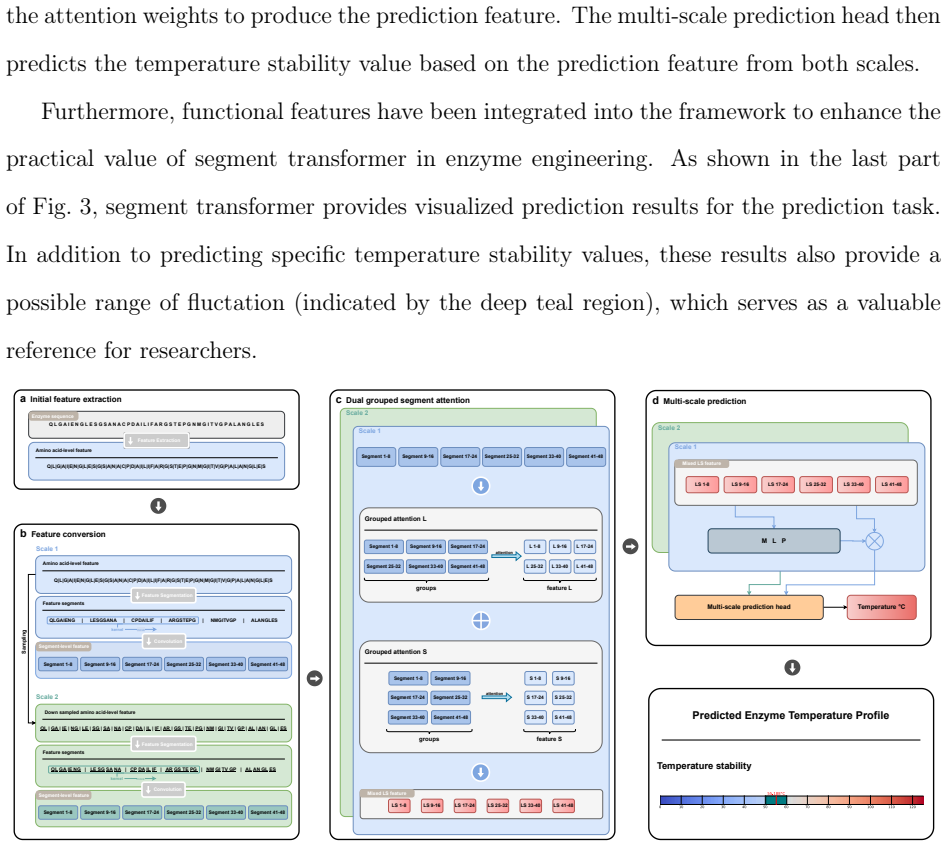
The load-bearing mechanism is the Dual Grouped Segment Attention (DGSA) block, an attention layer that splits a sequence's segment-level features into short-range groups and long-range groups, applies attention independently to each group, and sums the two branches. It operates on segment representations produced by strided down-sampling, fixed-length sequence segmentation, and 2D convolution, so each token corresponds to a short contiguous stretch of amino acids rather than a single residue. The attention weights from multiple scales are averaged into a segment importance profile, which is what the engineering study uses to prioritize mutation sites.
What would settle it
Apply the exact score-extraction procedure used in the cutinase study to a held-out panel of single-point mutants with experimentally measured thermostability changes; if the predicted per-mutation temperature scores fail to rank the mutants' measured effects better than chance, the engineering-guidance claim collapses even if whole-sequence prediction error remains low.
Extended reading notes
Core claim
The central claim is that representing an enzyme as a sequence of short contiguous segments, rather than individual amino acids, captures the unequal contribution of different protein regions to thermal behavior, and that this representation makes a Transformer-based model the best available sequence-only predictor of temperature stability. On its curated test set the Segment Transformer achieves an RMSE of 24.03°C, an MAE of 18.09°C, and Pearson and Spearman correlations of 0.33, outperforming BiLSTM, CNN, Transformer, RNN, Light Attention, TemStaPro, Seq2Topt, and DeepET trained under the same reweighted loss. The paper further claims that the model can guide enzyme engineering: attention-derived segment importance combined with predicted per-position temperature scores identified 17 candidate mutations in a Humicola insolens cutinase, and the best variant, A78E, showed a 1.64-fold increase in relative activity after heat treatment and a half-life of 29.5 minutes versus 6.8 minutes for the wild type, a 3.9-fold improvement, with no loss of catalytic activity.
Load-bearing premise
The model is trained only to predict a whole enzyme's temperature stability, but the engineering experiment assumes that its segment importance scores and per-position temperature scores correctly identify which single amino acid changes will stabilize the enzyme, and the paper itself concedes those mutation-effect predictions are not fully reliable.
Editorial extensions
If this is right
- Enzyme heat tolerance can be ranked from sequence alone at roughly 24°C RMSE, without structure information or source-organism metadata.
- Segment-level representations are more informative than residue-level tokens for thermostability, according to the ablation results, so similar hierarchical designs may help other protein property prediction tasks.
- The model's fluctuation ranges and segment importance scores give researchers a visual, interpretable starting point for choosing mutation targets.
- A small set of predicted mutations (17) produced a 1.64-fold gain in relative activity and a 3.9-fold longer half-life in one cutinase, suggesting the pipeline can shrink experimental screening panels.
- Because mutation-effect predictions are not yet fully reliable, the model is best used to prioritize candidates for experimental validation rather than to certify individual mutations.
Reading between the lines
- If segment-level attention truly marks thermostability-determining regions, fusing it with residue-level encoders could make single-mutation prediction accurate enough to replace parts of directed-evolution screening; the paper names this as future work.
- The curated data are small (3,454 unique entries) and skewed toward 40–59°C enzymes, so the reported error and correlation numbers are likely a conservative floor; larger, balanced mutation-level datasets could raise them substantially.
- A controlled comparison between similarity-clustered and random splitting would separate the architecture's contribution from the evaluation protocol's, since a stricter split tends to depress accuracy for all models.
- The cutinase case is a single enzyme; the three additional cutinase validation panels suggest transferability within one enzyme family, but the value for unrelated enzyme families remains untested.
Editorial analysis
A structured set of objections, weighed in public.
Referee Report
Summary. The manuscript introduces a curated enzyme temperature stability dataset (3,454 entries from BRENDA) and a 'Segment Transformer' that predicts whole-sequence temperature stability from ESM-2 embeddings via multi-scale segment features and dual grouped segment attention. It claims state-of-the-art test performance (RMSE 24.03, MAE 18.09, Pearson/Spearman 0.33) and reports a cutinase engineering study in which a model-selected mutation A78E increased relative activity 1.64-fold and half-life 3.9-fold.
Significance. If the claims were supported, the paper would offer a valuable sequence-only baseline for enzyme thermostability prediction and a practical mutation-selection tool. The curated dataset, public code/data links, and wet-lab validation are concrete assets. However, the headline numerical claims are undermined by test-set architecture selection and an undocumented per-mutation scoring mechanism; with these corrected, the contribution could be meaningful, but as presented the evidence is not reliable.
major comments (3)
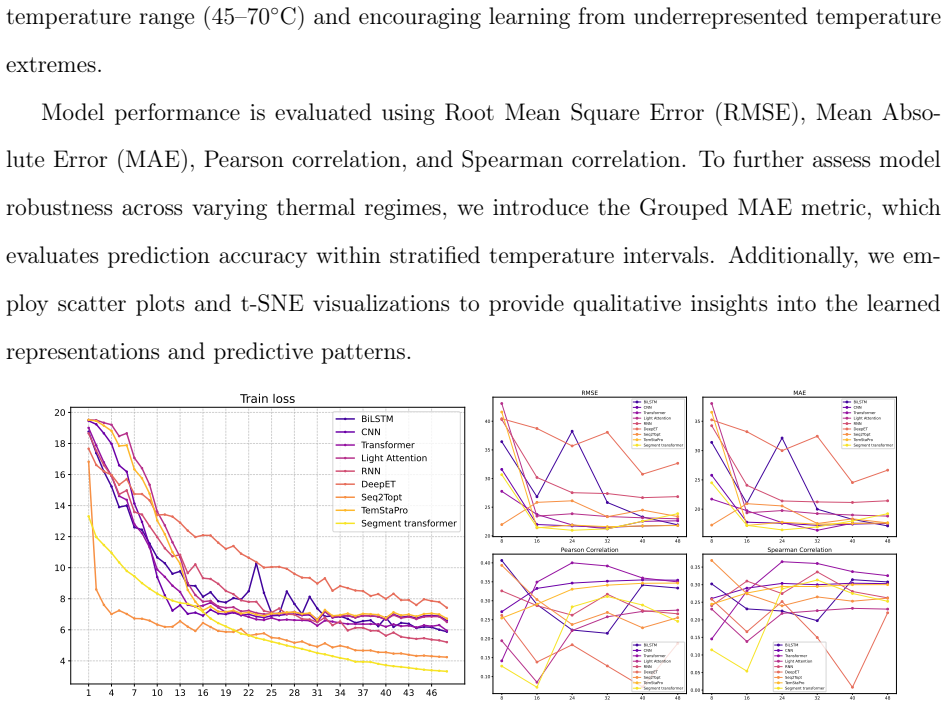
- [Architecture Optimization (Fig. 4); Performance Evaluation (Fig. 6)] Figure 4 is explicitly an architecture search on the temperature stability test set, and the final configuration (two scales, two DGSA blocks) is selected because it achieved the best RMSE, MAE, correlations, and grouped MAE on that test set. The same test set is then used in Figure 6 to claim superiority over all baselines. Consequently, RMSE=24.03 is a selected minimum, not an unbiased generalization estimate, and the comparison to BiLSTM (RMSE 23.96, MAE 18.49) is invalid; on the primary RMSE metric the selected Segment Transformer is numerically worse. Architecture selection must be done on the validation set (or via nested resampling) and the test set used only once.
- [Applications of segment transformer in Thermal Property-Related Enzyme Engineering; Eq. (14)] The mutation-selection protocol relies on per-residue 'temperature scores' (Fig. 9a), but the Methodology defines only a whole-sequence regression target (Eqs. 18-22) and an averaged segment attention vector alpha-bar (Eq. 14). No equation or algorithm is given for converting segment-level attention into per-mutation temperature scores, and because segment lengths differ across scales, the average in Eq. (14) is not well-defined without an alignment or upsampling step. The thresholds (importance >20, temperature score >50) are therefore not reproducible, and the cutinase results cannot be attributed to the model's predictions. This is a load-bearing gap for the paper's proof-of-concept claim.
- [Conclusion; Fig. 9b] The abstract and conclusion state that the model 'successfully guided' the engineering of a cutinase with 'only 17 mutations', but Fig. 9b shows that only two of the seventeen tested mutations (A78E, N79G) improved thermostability, with several others reducing activity, and the Conclusion itself concedes that 'predictions of mutation effects are not yet fully reliable.' Without a defined scoring function, a random or baseline selection comparison, or a prospective test, the engineering experiment does not validate the model; the 3.9-fold half-life improvement refers to a single mutation selected after screening, not to a designed variant produced directly from the model.
minor comments (6)
- [Experimental Setup and Loss Functions, Eq. (18)] The temperature intervals R_k and weights w_k in the weighted RMSE loss are never specified, so the loss function is not reproducible; an ablation of the weighting scheme would strengthen the claim that it mitigates imbalance.
- [Data Collection and Curation, Table 1] The 10% test split was drawn before MMseqs2 clustering, so there is no control for sequence similarity between test and training sequences; this can inflate all reported metrics and should be discussed or corrected.
- [Results and Discussion, Fig. 5] The best validation checkpoint is selected from metrics evaluated every 8 epochs, and only a single run is reported; providing multiple seeds with standard deviations would make the small differences in Fig. 6 (e.g., correlations 0.32 vs 0.33) more convincing.
- [Throughout] Several typos and broken references need correction: 'access model performance' in Evaluation Metrics, 'fluctation' in Fig. 3, 'Gouped' in the TOC, and the empty cross-reference 'see Section' in Performance Evaluation.
- [Application Study, Fig. 9c] The text reports a 3.9-fold increase in half-life, but the stated numbers 29.5 min divided by 6.8 min equal approximately 4.3; please reconcile this discrepancy.
- [Abstract and Conclusion] The phrase 'achieved through only 17 mutations' should be rephrased: 17 mutations were experimentally screened, and the beneficial variant was selected afterward, so the claim of 'only 17' somewhat understates the screening effort.
Circularity Check
Architecture is selected on the same test set used to report the SOTA metrics, making the headline RMSE/MAE/correlations a selected optimum rather than an unbiased prediction.
-
fitted input called prediction
[Results and Discussion, 'Architecture Optimization', Figure 4 and surrounding text]
"Optimization of the Segment Transformer architecture ... for different model configurations on the temperature stability test set. ... Based on a systematic comparison ... we selected a final design incorporating two feature scales and two DGSA blocks (Fig. 4). This configuration, referred to as the Segment Transformer, achieved the best overall performance with an RMSE of 24.03, MAE of 18.09, and both Pearson and Spearman correlations of 0.33."
The figure caption states that the architecture comparison is performed 'on the temperature stability test set,' and the main text says the configuration with 'two feature scales and two DGSA blocks' was selected because it 'achieved the best overall performance' on exactly the RMSE, MAE, Pearson, and Spearman metrics that are later reported as the model's test performance and used for the state-of-the-art claim in Fig. 6. Because the selection criterion is the test-set metric itself, the reported test numbers are a selected optimum over the evaluation set, not an independent generalization estimate. The baseline comparison is also on the same test set, so the claimed advantage over BiLSTM (RMSE 23.96) is assessed on the very metric used to pick the configuration.
full rationale
The central quantitative claim—that Segment Transformer reaches RMSE 24.03, MAE 18.09, and correlations 0.33 on the test set and outperforms baselines—is compromised by the architecture search in Fig. 4, which explicitly ranks candidate configurations (number of scales times DGSA blocks) on the temperature stability test set and then reports the selected configuration's test metrics as its generalization performance. Since the selection criterion is the test metric itself, the reported numbers are an optimistically biased selected optimum; this matches the fitted-input-called-prediction pattern. The same test set is then used in Fig. 6 for the SOTA comparison, including grouped MAE and correlations that were part of the selection criterion. This affects the headline contribution. The rest of the paper does not exhibit definitional circularity: the segment-level architecture is not defined in terms of the target, the BRENDA-derived data are external, and the cutinase wet-lab validation (1.64-fold relative activity, 3.9-fold half-life) is genuinely external evidence, although the mapping from attention/importance scores to per-residue temperature scores is not derived and the paper itself concedes mutation-effect predictions are not fully reliable. That is a completeness and validity concern rather than circularity. The score is therefore 6: the main reported test performance is partially circular due to test-set-driven architecture selection.
Assumptions & free parameters
free parameters (3)
- Weighted RMSE interval weights w_k =
not reported
- Architecture configuration (S scales, DGSA blocks, segment lengths l_i, group sizes GS_i) =
S=2, 2 DGSA blocks
- Mutation selection thresholds =
importance >20, temperature score >50
assumptions (4)
- domain assumption BRENDA temperature stability records are a consistent and valid target for the model, despite the database containing heterogeneous thermal measurements (T_opt, T_m, T_50, etc.).
- domain assumption ESM-2 embeddings encode enough information about the determinants of enzyme thermal stability.
- ad hoc to paper Segment-level attention weights reflect the causal importance of sequence regions for thermostability.
- domain assumption The curated dataset's cluster-based split prevents sequence-similarity leakage.
Cite this review
Pith. "Pith review of Modeling enzyme temperature stability from sequence segment perspective." pith.science (2026). https://pith.science/paper/A7PXFETA
@misc{pith2026250719755,
  author       = {Pith},
  title        = {Pith review of: Modeling enzyme temperature stability from sequence segment perspective},
  year         = {2026},
  howpublished = {\url{https://pith.science/paper/A7PXFETA}},
  note         = {Machine review of arXiv:2507.19755}
}
read the original abstract
Developing enzymes with desired thermal properties is crucial for a wide range of industrial and research applications, and determining temperature stability is an essential step in this process. Experimental determination of thermal parameters is labor-intensive, time-consuming, and costly. Moreover, existing computational approaches are often hindered by limited data availability and imbalanced distributions. To address these challenges, we introduce a curated temperature stability dataset designed for model development and benchmarking in enzyme thermal modeling. Leveraging this dataset, we present the \textit{Segment Transformer}, a novel deep learning framework that enables efficient and accurate prediction of enzyme temperature stability. The model achieves state-of-the-art performance with an RMSE of 24.03, MAE of 18.09, and Pearson and Spearman correlations of 0.33, respectively. These results highlight the effectiveness of incorporating segment-level representations, grounded in the biological observation that different regions of a protein sequence contribute unequally to thermal behavior. As a proof of concept, we applied the Segment Transformer to guide the engineering of a cutinase enzyme. Experimental validation demonstrated a 1.64-fold improvement in relative activity following heat treatment, achieved through only 17 mutations and without compromising catalytic function.
Figures


Figures from the paper (6 more)



Reference graph
Works this paper leans on
-
[1]
Daniel, R. M.; Danson, M. J.; Eisenthal, R. The temperature optima of enzymes: a new perspective on an old phenomenon. Trends in biochemical sciences 2001, 26, 223--225
work page 2001
-
[2]
Daniel, R. M.; Danson, M. J.; Eisenthal, R.; Lee, C. K.; Peterson, M. E. The effect of temperature on enzyme activity: new insights and their implications. Extremophiles 2008, 12, 51--59
work page 2008
-
[3]
Daniel, R. M.; Danson, M. J. A new understanding of how temperature affects the catalytic activity of enzymes. Trends in biochemical sciences 2010, 35, 584--591
work page 2010
-
[4]
Lee, C. K.; Monk, C. R.; Daniel, R. M. Determination of enzyme thermal parameters for rational enzyme engineering and environmental/evolutionary studies. Protein Nanotechnology: Protocols, Instrumentation, and Applications, Second Edition 2013, 219--230
work page 2013
-
[5]
Recent advances in the improvement of enzyme thermostability by structure modification
Xu, Z.; Cen, Y.-K.; Zou, S.-P.; Xue, Y.-P.; Zheng, Y.-G. Recent advances in the improvement of enzyme thermostability by structure modification. Critical reviews in biotechnology 2020, 40, 83--98
work page 2020
-
[6]
Consortium, T. U. UniProt: the Universal Protein Knowledgebase in 2025. Nucleic Acids Research 2024, 53, D609--D617
work page 2025
-
[7]
BRENDA, the ELIXIR core data resource in 2021: new developments and updates
Chang, A.; Jeske, L.; Ulbrich, S.; Hofmann, J.; Koblitz, J.; Schomburg, I.; Neumann-Schaal, M.; Jahn, D.; Schomburg, D. BRENDA, the ELIXIR core data resource in 2021: new developments and updates. Nucleic Acids Research 2020, 49, D498--D508
work page 2021
-
[8]
Prediction of optimal pH and temperature of cellulases using neural network
Yan, S.-M.; Wu, G. Prediction of optimal pH and temperature of cellulases using neural network. Protein and Peptide Letters 2012, 19, 29--39
work page 2012
Show all 48 references
-
[9]
Predictors for predicting temperature optimum in beta-glucosidases
Yan, S.; Wu, G. Predictors for predicting temperature optimum in beta-glucosidases. Journal of Biomedical Science and Engineering 2019, 12, 414--426
2019
-
[10]
Prediction of xylanase optimal temperature by support vector regression
Zhang, G.; Ge, H. Prediction of xylanase optimal temperature by support vector regression. Electronic Journal of Biotechnology 2012, 15, 7--7
2012
-
[11]
Predicting the optimum temperature of -agarase based on the relative solvent accessibility of amino acids
Chu, Y.; Yi, Z.; Zeng, R.; Zhang, G. Predicting the optimum temperature of -agarase based on the relative solvent accessibility of amino acids. Journal of Molecular Catalysis B: Enzymatic 2016, 129, 47--53
2016
-
[12]
H.; Boroomand, A.; Ariaeenejad, S.; Hosseini Salekdeh, G
Foroozandeh Shahraki, M.; Farhadyar, K.; Kavousi, K.; Azarabad, M. H.; Boroomand, A.; Ariaeenejad, S.; Hosseini Salekdeh, G. A generalized machine-learning aided method for targeted identification of industrial enzymes from metagenome: A xylanase temperature dependence case st...
2021
-
[13]
S.; Nielsen, J.; Engqvist, M
Li, G.; Rabe, K. S.; Nielsen, J.; Engqvist, M. K. Machine learning applied to predicting microorganism growth temperatures and enzyme catalytic optima. ACS synthetic biology 2019, 8, 1411--1420
2019
-
[14]
E.; Beckham, G
Gado, J. E.; Beckham, G. T.; Payne, C. M. Improving enzyme optimum temperature prediction with resampling strategies and ensemble learning. Journal of Chemical Information and Modeling 2020, 60, 4098--4107
2020
-
[15]
Artificial Intelligence-Powered Construction of a Microbial Optimal Growth Temperature Database and Its Impact on Enzyme Optimal Temperature Prediction
Wang, X.; Zong, Y.; Zhou, X.; Xu, L.; He, W.; Quan, S. Artificial Intelligence-Powered Construction of a Microbial Optimal Growth Temperature Database and Its Impact on Enzyme Optimal Temperature Prediction. The Journal of Physical Chemistry B 2024, 128, 2281--2292
2024
-
[16]
Li, G.; Buric, F.; Zrimec, J.; Viknander, S.; Nielsen, J.; Zelezniak, A.; Engqvist, M. K. Learning deep representations of enzyme thermal adaptation. Protein Science 2022, 31, e4480
2022
-
[17]
A novel thermophilic chitinase directly mined from the marine metagenome using the deep learning tool Preoptem
Zhang, Y.; Guan, F.; Xu, G.; Liu, X.; Zhang, Y.; Sun, J.; Yao, B.; Huang, H.; Wu, N.; Tian, J. A novel thermophilic chitinase directly mined from the marine metagenome using the deep learning tool Preoptem. Bioresources and Bioprocessing 2022, 9, 54
2022
-
[18]
Seq2Topt: a sequence-based deep learning predictor of enzyme optimal temperature
Qiu, S.; Hu, B.; Zhao, J.; Xu, W.; Yang, A. Seq2Topt: a sequence-based deep learning predictor of enzyme optimal temperature. bioRxiv 2024, 2024--08
2024
-
[19]
ProtTrans: Towards Cracking the Language of Lifes Code Through Self-Supervised Deep Learning and High Performance Computing
Elnaggar, A.; Heinzinger, M.; Dallago, C.; Rehawi, G.; Yu, W.; Jones, L.; Gibbs, T.; Feher, T.; Angerer, C.; Steinegger, M.; Bhowmik, D.; Rost, B. ProtTrans: Towards Cracking the Language of Lifes Code Through Self-Supervised Deep Learning and High Performance Computing. IEEE ...
2021
-
[20]
bioRxiv 2022,
Lin, Z.; Akin, H.; Rao, R.; Hie, B.; Zhu, Z.; Lu, W.; Smetanin, N.; dos Santos Costa, A.; Fazel-Zarandi, M.; Sercu, T.; Candido, S.; others Language models of protein sequences at the scale of evolution enable accurate structure prediction. bioRxiv 2022,
2022
-
[21]
G.; Mutabdzija, L.; Poudel, N.; Papageorgiou, A
Chronopoulou, E. G.; Mutabdzija, L.; Poudel, N.; Papageorgiou, A. C.; Labrou, N. E. A Key Role in Catalysis and Enzyme Thermostability of a Conserved Helix H5 Motif of Human Glutathione Transferase A1-1. International journal of molecular sciences 2023, 24, 3700
2023
-
[22]
Protein thermal stability enhancement by designing salt bridges: a combined computational and experimental study
Lee, C.-W.; Wang, H.-J.; Hwang, J.-K.; Tseng, C.-P. Protein thermal stability enhancement by designing salt bridges: a combined computational and experimental study. PloS one 2014, 9, e112751
2014
-
[23]
Aromatic clusters: a determinant of thermal stability of thermophilic proteins
Kannan, N.; Vishveshwara, S. Aromatic clusters: a determinant of thermal stability of thermophilic proteins. Protein engineering 2000, 13, 753--761
2000
-
[24]
FireProt: web server for automated design of thermostable proteins
Musil, M.; Stourac, J.; Bendl, J.; Brezovsky, J.; Prokop, Z.; Zendulka, J.; Martinek, T.; Bednar, D.; Damborsky, J. FireProt: web server for automated design of thermostable proteins. Nucleic acids research 2017, 45, W393--W399
2017
-
[25]
RosettaDesign server for protein design
Liu, Y.; Kuhlman, B. RosettaDesign server for protein design. Nucleic acids research 2006, 34, W235--W238
2006
-
[26]
Goldenzweig, A.; Goldsmith, M.; Hill, S. E.; Gertman, O.; Laurino, P.; Ashani, Y.; Dym, O.; Unger, T.; Albeck, S.; Prilusky, J.; others Automated structure-and sequence-based design of proteins for high bacterial expression and stability. Molecular cell 2016, 63, 337--346
2016
-
[27]
E.; Knotts, M.; Shaw, A
Gado, J. E.; Knotts, M.; Shaw, A. Y.; Marks, D.; Gauthier, N. P.; Sander, C.; Beckham, G. T. Machine learning prediction of enzyme optimum pH. Nature Machine Intelligence 2025, 1--14
2025
-
[28]
MMseqs2 enables sensitive protein sequence searching for the analysis of massive data sets
Steinegger, M.; S \"o ding, J. MMseqs2 enables sensitive protein sequence searching for the analysis of massive data sets. Nature biotechnology 2017, 35, 1026--1028
2017
-
[29]
Science 2023, 379, 1123--1130
Lin, Z.; Akin, H.; Rao, R.; Hie, B.; Zhu, Z.; Lu, W.; Smetanin, N.; Verkuil, R.; Kabeli, O.; Shmueli, Y.; others Evolutionary-scale prediction of atomic-level protein structure with a language model. Science 2023, 379, 1123--1130
2023
-
[30]
Visualizing Data using t-SNE
van der Maaten, L.; Hinton, G. Visualizing Data using t-SNE. Journal of Machine Learning Research 2008, 9, 2579--2605
2008
-
[31]
Trehalose promotes high-level heterologous expression of 4, 6- -glucanotransferase GtfR2 in Escherichia coli and mechanistic analysis
Rao, D.; Wang, L.; Huo, R.; Su, L.; Guo, Z.; Yang, W.; Wei, B.; Tao, X.; Chen, S.; Wu, J. Trehalose promotes high-level heterologous expression of 4, 6- -glucanotransferase GtfR2 in Escherichia coli and mechanistic analysis. International Journal of Biological Macromolecules 2...
2022
-
[32]
R.; Cheatham III, T
Roe, D. R.; Cheatham III, T. E. PTRAJ and CPPTRAJ: software for processing and analysis of molecular dynamics trajectory data. Journal of chemical theory and computation 2013, 9, 3084--3095
2013
-
[33]
Schuster, M.; Paliwal, K. K. Bidirectional recurrent neural networks. IEEE transactions on Signal Processing 1997, 45, 2673--2681
1997
-
[34]
Natural language processing (almost) from scratch
Collobert, R.; Weston, J.; Bottou, L.; Karlen, M.; Kavukcuoglu, K.; Kuksa, P. Natural language processing (almost) from scratch. 2011,
2011
-
[35]
N.; Kaiser, .; Polosukhin, I
Vaswani, A.; Shazeer, N.; Parmar, N.; Uszkoreit, J.; Jones, L.; Gomez, A. N.; Kaiser, .; Polosukhin, I. Attention is all you need. Advances in neural information processing systems 2017, 30
2017
-
[36]
Light attention predicts protein location from the language of life
St \"a rk, H.; Dallago, C.; Heinzinger, M.; Rost, B. Light attention predicts protein location from the language of life. Bioinformatics Advances 2021, 1, vbab035
2021
-
[37]
Elman, J. L. Finding structure in time. Cognitive science 1990, 14, 179--211
1990
-
[38]
TemStaPro: protein thermostability prediction using sequence representations from protein language models
Pud z iuvelyt \.e , I.; Olechnovi c , K.; Godliauskaite, E.; Sermokas, K.; Urbaitis, T.; Gasiunas, G.; Kazlauskas, D. TemStaPro: protein thermostability prediction using sequence representations from protein language models. Bioinformatics 2024, 40, btae157
2024
-
[39]
Seq2Topt: a sequence-based deep learning predictor of enzyme optimal temperature
Qiu, S.; Hu, B.; Zhao, J.; Xu, W.; Yang, A. Seq2Topt: a sequence-based deep learning predictor of enzyme optimal temperature. Briefings in Bioinformatics 2025, 26, bbaf114
2025
-
[40]
D.; Hauer, B
Koschorreck, K.; Liu, D.; Kazenwadel, C.; Schmid, R. D.; Hauer, B. Heterologous expression, characterization and site-directed mutagenesis of cutinase CUTAB1 from Alternaria brassicicola. Applied microbiology and biotechnology 2010, 87, 991--997
2010
-
[41]
N.; Basore, D.; Butterfoss, G
Shirke, A. N.; Basore, D.; Butterfoss, G. L.; Bonneau, R.; Bystroff, C.; Gross, R. A. Toward rational thermostabilization of Aspergillus oryzae cutinase: insights into catalytic and structural stability. Proteins: Structure, Function, and Bioinformatics 2016, 84, 60--72
2016
-
[42]
T.; de Vlieg, J.; Martinez, C.; Cambillau, C
Longhi, S.; Nicolas, A.; Creveld, L.; Egmond, M.; Verrips, C. T.; de Vlieg, J.; Martinez, C.; Cambillau, C. Dynamics of Fusarium solani cutinase investigated through structural comparison among different crystal forms of its variants. Proteins: Structure, Function, and Bioinfo...
1996
-
[43]
L.; Cox, R
Mannesse, M. L.; Cox, R. C.; Koops, B. C.; Verheij, H. M.; de Haas, G. H.; Egmond, M. R.; van der Hijden, H. T.; de Vlieg, J. Cutinase from Fusarium solani pisi hydrolyzing triglyceride analogs. Effect of acyl chain length and position in the substrate molecule on activity and...
1995
-
[44]
Structure-activity of cutinase, a small lipolytic enzyme
Longhi, S.; Cambillau, C. Structure-activity of cutinase, a small lipolytic enzyme. Biochimica et Biophysica Acta (BBA)-Molecular and Cell Biology of Lipids 1999, 1441, 185--196
1999
-
[45]
R.; de Vlieg, J
Egmond, M. R.; de Vlieg, J. Fusarium solani pisi cutinase. Biochimie 2000, 82, 1015--1021
2000
-
[46]
M.; Casal, M.; Cavaco-Paulo, A
Ara \'u jo, R.; Silva, C.; O’Neill, A.; Micaelo, N.; Guebitz, G.; Soares, C. M.; Casal, M.; Cavaco-Paulo, A. Tailoring cutinase activity towards polyethylene terephthalate and polyamide 6, 6 fibers. Journal of Biotechnology 2007, 128, 849--857
2007
-
[47]
Cutinase: characteristics, preparation, and application
Chen, S.; Su, L.; Chen, J.; Wu, J. Cutinase: characteristics, preparation, and application. Biotechnology advances 2013, 31, 1754--1767
2013
-
[48]
Campbell, S. L. and Gear, C. W
Herrero Acero, E.; Ribitsch, D.; Dellacher, A.; Zitzenbacher, S.; Marold, A.; Steinkellner, G.; Gruber, K.; Schwab, H.; Guebitz, G. M. Surface engineering of a cutinase from Thermobifida cellulosilytica for improved polyester hydrolysis. Biotechnology and Bioengineering 2013, ...
2008
Reviewed August 6, 2026 · model on record in the stance chip above.
Discussion (0). Continue with ORCID to comment.