REVIEW 3 major objections 5 minor 89 references
Charge Regulation Effect on Nanoparticles Interaction Mediated by Polyelectrolyte
T0 review · 3 major / 5 minor · reviewed 2026-08-06 · deepseek-v4-flash
Pith's one-line read Charge regulation turns a polymer-bridging attraction between nanoparticles into a weak osmotic repulsion at low salt.
desk verdict Plausible new CR result, but the CR-vs-CC comparison is confounded by geometry (discrete surface sites versus central point charge, different NP radii) and thin statistics. read the letter →
The pith
A machine-rendered reading of the paper's core claim, the machinery that carries it, and where it could break.
The reading
What carries the argument
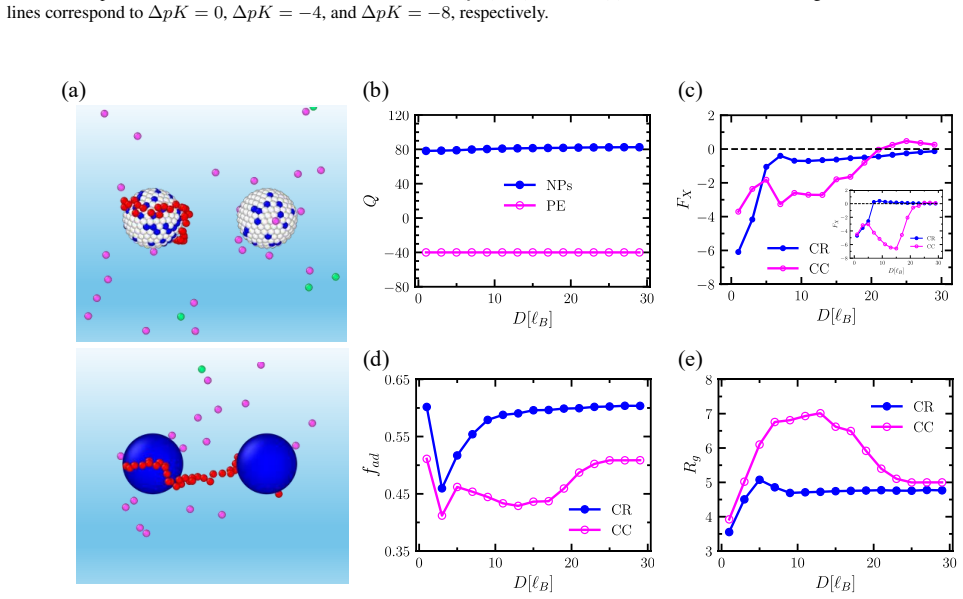
The machinery is a hybrid charge-regulation Monte Carlo/molecular dynamics (CR-MC/MD) scheme in which each of the 256 base groups on a nanoparticle and each acid monomer on the polyelectrolyte is a discrete site that can switch between charged and neutral states via chemical equilibria $A_0 \rightleftharpoons A^- + H^+$ and $B_0 \rightleftharpoons B^+ + OH^-$, sampled by CR-MC moves. The interparticle force is decomposed at a fictitious midplane into osmotic, correlation, direct nanoparticle-nanoparticle, and bridging contributions, with the bridging force obtained from polymer segments whose bond vector crosses the midplane. This decomposition is what allows the paper to attribute the CR/CC difference to the suppression of bridging and the rise of osmotic repulsion.
What would settle it
A colloidal-probe atomic force microscopy force–distance measurement between two charge-regulating colloids in a low-salt solution of an oppositely charged weak polyelectrolyte would settle the claim, because the paper predicts a weak repulsive regime near $D \approx 7\ell_B$ (about 5 nm) whereas the constant-charge picture predicts a stronger bridging attraction at the same separation.
Extended reading notes
Core claim
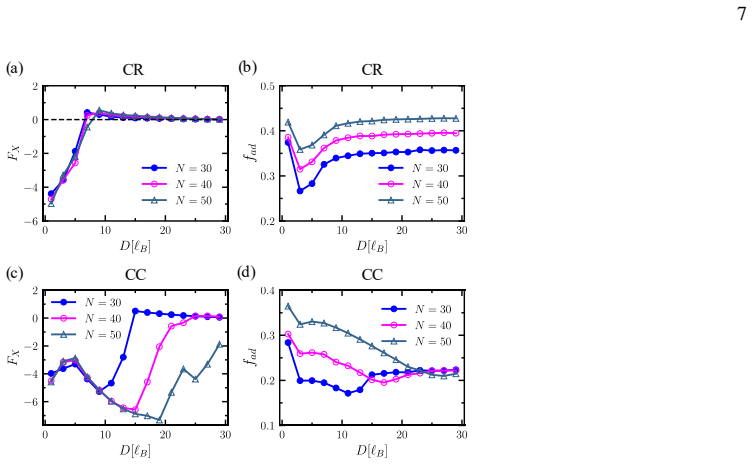
The central claim is that charge regulation flips the qualitative nature of the polyelectrolyte-mediated interaction between two like-charged nanoparticles. In the CR model, the nanoparticle surface charge increases locally to bind the entire PE chain onto one particle, neutralizing that particle's charge and suppressing bridging; the remaining force at intermediate separations is a weak net repulsion of osmotic origin. In the CC model, the fixed charges keep the PE partially adsorbed on both particles, producing a persistent entropic-elastic bridging attraction that is stronger and longer ranged. The paper reports that the CR effect is most pronounced at low salt concentration, where at $D = 15\ell_B$ the force magnitude differs by nearly a factor of six from the CC result, and that CR makes the force largely insensitive to polymer chain length, while CC shows stronger attraction for longer chains. At high salt, screening reduces the difference between the two models, although CR still adsorbs more polymer.
Load-bearing premise
The result stands on the assumption that the charge-regulating and constant-charge simulations differ only in the freedom of surface charge to respond, yet the two models also place charge differently — 256 discrete sites versus one central charge — so geometry could be entangled with the effect being tested.
Editorial extensions
If this is right
- Under low-salt conditions, constant-charge simulations overestimate the attractive bridging force between like-charged nanoparticles, so predictions of aggregation made with fixed charges may be unreliable.
- Charge-regulating nanoparticles that have adsorbed a polyelectrolyte behave as weakly repulsive objects, meaning suspension stability can in principle be controlled by pH and surface-site chemistry rather than by salt alone.
- The CR model predicts that interparticle force is nearly independent of polyelectrolyte chain length, whereas the CC model predicts longer chains give markedly stronger attraction; this is a direct experimental signature of charge regulation.
- At high salt concentration the two models converge, so constant-charge modelling is a safer approximation for strongly screened, high-ionic-strength conditions.
- Because CR adsorbs the polyelectrolyte roughly twice as fast as CC, the choice of boundary condition also matters for the kinetics of surface coating, not just for the equilibrium force.
Reading between the lines
- Inference: The reported CR-versus-CC contrast may not be a pure test of charge regulation, because the CR nanoparticles carry 256 discrete surface sites while the CC charge sits at the nanoparticle centre; a constant-charge run with the same discrete site geometry would separate these effects.
- Inference: If charge regulation suppresses bridging generally, then similar sign reversals should appear for other ionizable colloids or protein patches in weak-polyelectrolyte solutions, and multi-chain systems may show aggregation controlled by osmotic repulsion rather than bridging.
- Inference: The faster adsorption kinetics seen under CR suggest that charge regulation could be exploited dynamically, for example by switching pH to trigger rapid coating or release, an application the paper mentions only in passing.
- Inference: A direct testable extension would be to vary nanoparticle curvature or surface-site density, since the mechanism predicts that the localized-adsorption regime and the crossover near $D \approx 7\ell_B$ should shift with the number of ionizable sites per unit area.
Signed reviews
Editorial analysis
A structured set of objections, weighed in public.
Referee Report
Summary. The manuscript studies how charge regulation (CR) affects the interaction between two nanoparticles (NPs) mediated by an oppositely charged weak polyelectrolyte (PE) in an electrolyte solution. Using a hybrid CR Monte Carlo/molecular dynamics framework, the authors model each NP as a sphere carrying 256 ionizable base groups and the PE as a bead-spring chain of acid groups, then compute the NP-NP force via a midplane decomposition into osmotic, correlation, direct NP-NP, and bridging contributions. For comparison, they run constant-charge (CC) simulations in which the NP and monomer charges are fixed to the average values obtained from the CR runs. The central claim is that at low salt concentration, CR enhances PE adsorption onto a single NP, suppresses bridging, and yields a weak net repulsion near D = 7 ℓB, whereas the CC approximation predicts a stronger bridging attraction that persists over a wide range of separations; at higher salt, the differences diminish.
Significance. If the comparison were a clean test of charge regulation, the paper would provide a valuable and potentially influential demonstration that CR qualitatively changes PE-mediated NP interactions, with direct implications for interpreting colloidal stability and nanoparticle assembly experiments. The study builds on a well-established CR-MC/MD framework, explicitly decomposes the total force into physically meaningful components, and probes several parameter dependencies (chain length, ΔpK, salt concentration), citing experimental AFM work that is qualitatively consistent with the reported trends. The central quantitative inference, however, rests on a CR-versus-CC comparison whose two legs differ not only in charge dynamics but also in the spatial distribution of charge and in surface sterics, so the paper's main conclusion is not yet uniquely supported by the presented data.
major comments (3)
- [Sec. II, Fig. 1] The CR and CC models differ in two ways simultaneously: the CR model places 256 discrete ionizable sites on a spherical shell of radius 3 ℓB, each with excluded volume, while the CC model places the fixed average charge at the center of a smooth NP of radius 4 ℓB. Since polymer adsorption and bridging are known to be sensitive to the local field structure and to surface roughness/patchiness, the observed increases in f_ad and the suppression of bridging in the CR case could be caused by the discrete surface-site geometry rather than by charge-regulation dynamics. The authors should add a control CC simulation that uses the same 256 surface sites carrying the average CR charge, or a uniformly smeared surface charge, to isolate the effect of charge dynamics from the effect of charge placement.
- [Fig. 3c and Fig. 7c] The force curves are presented without error bars, and the captions state that the averages are taken over only 7 (CR) and 30 (CC) equilibrated configurations at low salt, and 5 and 50 at high salt. The claimed weak-repulsion plateau near D = 7 ℓB and the factor-of-six difference at D = 15 ℓB therefore rest on very limited statistics, especially for the CR case where the ionization states evolve slowly. The authors should provide confidence intervals from independent runs or block averaging, and ideally increase the number of equilibrated samples.
- [Sec. II, constant-charge construction] The CC model assigns fixed charges equal to the average charges obtained from the CR simulations. This makes the comparison a test of how much charge fluctuations around the CR mean matter, but it also means that the CC model is not an independent constant-charge model with a prescribed surface chemistry. The authors should state this construction explicitly and discuss whether their qualitative conclusions would survive if the CC charge were instead chosen independently, for example from the nominal pKa/pKb equilibrium values, since the average-charge matching could mask or amplify model-dependent differences.
minor comments (5)
- [Fig. 7 caption] The phrase 'at low higher concentrations' is a typo; it should read 'at higher salt concentrations.'
- [Sec. II and throughout] The notation pIp = pIm is used to denote salt concentration, but the definition of these symbols is never given; the authors should define them explicitly, for instance as log10 of the salt concentration in reduced units.
- [Introduction] The text refers to 'the Ganeshan group' when citing refs. [79,80]; the correct spelling in the citations appears to be Ganesan, and the in-text name should be corrected.
- [Eq. (4)] The symbols ρ1(r) and ρ2(r1,r2) are used in the force expression but are not explicitly defined in the text; a short definition of the one- and two-body densities would improve the self-containedness of the derivation.
- [Fig. 3b] The axis label 'average charge' does not specify units; please state whether charges are reported in units of the elementary charge q.
Circularity Check
No significant circularity: the CR-vs-CC comparison is a controlled simulation test, not a derivation from its own inputs.
full rationale
The paper's central claim is that charge regulation (CR) enhances polyelectrolyte adsorption and suppresses bridging relative to constant charge (CC). This is an emergent simulation result, not a consequence of the model definitions by construction. The CC model is constructed by assigning fixed charges equal to the average ionization states observed in the CR simulations, but the reported quantities—adsorbed fraction, radius of gyration, total force, and force decomposition—are outputs of separately evolved MD trajectories, not re-statements of those input averages. The CR-MC/MD method is cited to prior external work (refs. 19-21, by Yuan, Takae, Tanaka, Curk, and Luijten), not to the present authors' own unverified results. The force decomposition in Eqs. 4-6 is taken from Ref. [30], one of whose authors is a coauthor here, but the paper explicitly re-derives it pedagogically and its role is to interpret the forces, not to assume the conclusion. The paper does not fit parameters to the data it then claims to predict; the CC comparison is a deliberate control isolating charge fluctuations. While one could question the control's geometric consistency (discrete surface sites in CR versus center-placed charge in CC), that is a correctness or modeling concern, not circularity under the defined criteria. No equation or citation chain makes the central result equivalent to its inputs, so no circular step is identified.
Assumptions & free parameters
free parameters (1)
- CC model charge assignments =
Average CR charges (vary with D)
assumptions (4)
- domain assumption CR-MC sampling accurately reproduces acid-base equilibria for surface sites and monomers with specified pKa/pKb and pH.
- domain assumption Implicit-solvent continuum electrostatics with Bjerrum length 0.72 nm and monovalent ions captures PE-NP interactions.
- standard math The midplane force decomposition in Eq. (4), including the harmonic bridging term (Eq. 6), is a valid and sufficient estimator of the true interparticle force.
- ad hoc to paper The CC model with center-placed charges is a fair constant-charge counterpart to the CR model.
Cite this review
Pith. "Pith review of Charge Regulation Effect on Nanoparticles Interaction Mediated by Polyelectrolyte." pith.science (2026). https://pith.science/paper/ACK6W557
@misc{pith2026250700549,
  author       = {Pith},
  title        = {Pith review of: Charge Regulation Effect on Nanoparticles Interaction Mediated by Polyelectrolyte},
  year         = {2026},
  howpublished = {\url{https://pith.science/paper/ACK6W557}},
  note         = {Machine review of arXiv:2507.00549}
}
read the original abstract
The ability to precisely control surface charge using charged polymers is fundamental to many nanotechnology applications, enabling the design and fabrication of materials with tailored properties and functionalities. Here, we study the effect of charge regulation (CR) on the interaction between two nanoparticles (NPs) mediated by an oppositely charged polyelectrolyte (PE) in an electrolyte solution. To this end, we employ a hybrid CR Monte Carlo / molecular dynamics simulation framework to systematically explore the effects of pH, salt concentration, and polymer chain length on NP surface charge behavior. For comparison, we also conduct molecular simulations under constant charge (CC) conditions. Our results reveal that CR enhances PE adsorption onto NP surfaces compared to the CC case, where polymer bridging dominates across a wide range of NP intersurface separations. This enhanced adsorption under CR leads to a weak net repulsion driven by osmotic forces. In contrast, the CC model yields a stronger net attraction due to the bridging force. Furthermore, we find that the CR effects are more pronounced at low salt concentration, whereas at high salt concentration, counterion screening dominates in both CR and CC cases, diminishing the CR effect. These findings highlight the importance of incorporating charge regulation in characterizing nanoparticle interactions within a complex biochemical environment, particularly in low salt concentrations.
Figures


Figures from the paper (4 more)


Reference graph
Works this paper leans on
-
[1]
Deirram, C
N. Deirram, C. Zhang, S. S. Kermaniyan, A. P. R. Johnston, and G. K. Such, Macromol. Rapid Commun. 40, 1800917 (2019)
2019
-
[2]
J. Lin, L. Miao, G. Zhong, C.-H. Lin, R. Dargazangy, and A. Alexander-Katz, Commun Biol 3, 205 (2020)
2020
-
[3]
Ly, K.-N
P.-D. Ly, K.-N. Ly, H.-L. Phan, H. H. T. Nguyen, V .-A. Duong, and H. V . Nguyen, Front. Nanotechnol.6, 1456939 (2024)
2024
-
[4]
M. K. Granfeldt, B. Joensson, and C. E. Woodward, J. Phys. Chem. A 95, 4819–4826 (1991)
1991
-
[5]
Muthukumar, Physics of Charged Macromolecules: Synthetic and Biological Systems (Cambridge University Press, 2023)
M. Muthukumar, Physics of Charged Macromolecules: Synthetic and Biological Systems (Cambridge University Press, 2023)
2023
-
[6]
Mateos-Maroto, I
A. Mateos-Maroto, I. Abelenda-N ´u˜nez, F. Ortega, R. G. Rubio, and E. Guzm´an, Polymers 13, 1221 (2021)
2021
-
[7]
Ulrich, A
S. Ulrich, A. Laguecir, and S. Stoll, Macromolecules 38, 8939–8949 (2005)
2005
-
[8]
Ulrich, M
S. Ulrich, M. Seijo, A. Laguecir, and S. Stoll, J. Phys. Chem. B 110, 20954–20964 (2006)
2006
Show all 89 references
-
[9]
Carnal and S
F. Carnal and S. Stoll, J. Phys. Chem. B 115, 12007–12018 (2011)
2011
-
[10]
G. S. Longo, M. Olvera de la Cruz, and I. Szleifer, ACS Nano 7, 2693–2704 (2013)
2013
-
[11]
Stornes, P
M. Stornes, P. M. Blanco, and R. S. Dias, Colloids Surf. A Physicochem. Eng. Asp. 628, 127258 (2021)
2021
-
[12]
C. Lu, C. Hu, C. L. Ritt, X. Hua, J. Sun, H. Xia, Y . Liu, D.-W. Li, B. Ma, M. Elimelech, and J. Qu, J. Am. Chem. Soc.143, 14242–14252 (2021)
2021
-
[13]
de la Escosura-Mu ˜niz and A
A. de la Escosura-Mu ˜niz and A. Merkoc ¸i, ACS Nano6, 7556–7583 (2012)
2012
-
[14]
Prakash, M
S. Prakash, M. Pinti, and B. Bhushan, Phil. Trans. R. Soc. A. 370, 2269–2303 (2012)
2012
-
[15]
Curtis, D
C. Curtis, D. Toghani, B. Wong, and E. Nance, Colloids Surfaces B Biointerfaces 170, 673 (2018)
2018
-
[16]
Veider, E
F. Veider, E. Sanchez Armengol, and A. Bernkop-Schn¨urch, Small 20, 2304713 (2024)
2024
-
[17]
Karnik, R
R. Karnik, R. Fan, M. Yue, D. Li, P. Yang, and A. Majumdar, Nano Lett.5, 943–948 (2005)
2005
-
[18]
C. L. Ritt, J. P. de Souza, M. G. Barsukov, S. Yosinski, M. Z. Bazant, M. A. Reed, and M. Elimelech, ACS Nano16, 15249–15260 (2022)
2022
-
[19]
J. Yuan, K. Takae, and H. Tanaka, Phys. Rev. Lett.128, 158001 (2022)
2022
-
[20]
T. Curk, J. Yuan, and E. Luijten, J. Chem. Phys. 156, 044122 (2022)
2022
-
[21]
Curk and E
T. Curk and E. Luijten, Phys. Rev. Lett. 126, 138003 (2021)
2021
-
[22]
T. Bian, A. Gardin, J. Gemen, L. Houben, C. Perego, B. Lee, N. Elad, Z. Chu, G. M. Pavan, and R. Klajn, Nat. Chem. 13, 940–949 (2021)
2021
-
[23]
Ruixuan, A
H. Ruixuan, A. Majee, J. Dobnikar, and R. Podgornik, Eur. Phys. J. E 46, 115 (2023)
2023
-
[24]
Kumari and R
S. Kumari and R. Podgornik, J. Chem. Phys. 160, 014905 (2024)
2024
-
[25]
Lund and B
M. Lund and B. J ¨onsson, Q. Rev. Biophys. 46, 265–281 (2013)
2013
-
[26]
Xiong, X
Y . Xiong, X. Liu, and H. Xiong, Sci Rep11, 17386 (2021)
2021
-
[27]
J. N. Israelachvili, ed., Intermolecular and surface forces, 3rd ed. (Academic Press, Burlington, MA, 2011)
2011
-
[28]
˚Akesson, C
T. ˚Akesson, C. Woodward, and B. J¨onsson, J. Chem. Phys. 91, 2461–2469 (1989)
1989
-
[29]
S. J. Miklavic, C. E. Woodward, B. Joensson, and T. Aakesson, Macromolecules 23, 4149–4157 (1990)
1990
-
[30]
Podgornik, T
R. Podgornik, T. ˚Akesson, and B. J¨onsson, J. Chem. Phys. 102, 9423 (1995)
1995
-
[31]
Podgornik, J
R. Podgornik, J. Chem. Phys. 118, 11286–11296 (2003)
2003
-
[32]
Muthukumar, J
M. Muthukumar, J. Chem. Phys. 86, 7230–7235 (1987)
1987
-
[33]
S. F. Edwards, Proc. Phys. Soc. 85, 613–624 (1965)
1965
-
[34]
P. G. d. Gennes, Rep. Prog. Phys. 32, 187–205 (1969)
1969
-
[35]
J. H. J. v. Opheusden, J. Phys. A: Math. Gen. 21, 2739–2751 (1988)
1988
-
[36]
Borukhov, D
I. Borukhov, D. Andelman, and H. Orland, EPL 32, 499–504 (1995)
1995
-
[37]
Borukhov, D
I. Borukhov, D. Andelman, and H. Orland, Phys. Rev. Lett. 79, 435–438 (1997)
1997
-
[38]
Borukhov, D
I. Borukhov, D. Andelman, and H. Orland, J. Phys. Chem. B 103, 5042–5057 (1999)
1999
-
[39]
P. M. Biesheuvel, Eur. Phys. J. E 16, 353–359 (2005)
2005
-
[40]
Gurovitch and P
E. Gurovitch and P. Sens, Phys. Rev. Lett. 82, 339–342 (1999)
1999
-
[41]
Podgornik, J
R. Podgornik, J. Chem. Phys. 99, 7221–7231 (1993)
1993
-
[42]
Podgornik, J
R. Podgornik, J. Phys. Chem. 95, 5249–5255 (1991)
1991
-
[43]
Vagharchakian, B
L. Vagharchakian, B. Desbat, and S. H ´enon, Macromolecules 37, 8715–8720 (2004)
2004
-
[44]
A. V . Dobrynin, A. Deshkovski, and M. Rubinstein, Macromolecules34, 3421–3436 (2001)
2001
-
[45]
A. Y . Grosberg, T. T. Nguyen, and B. I. Shklovskii, Rev. Mod. Phys.74, 329–345 (2002)
2002
-
[46]
Lenz and C
O. Lenz and C. Holm, Eur. Phys. J. E 26, 191–195 (2008)
2008
-
[47]
A. V . Dobrynin, A. Deshkovski, and M. Rubinstein, Phys. Rev. Lett.84, 3101–3104 (2000)
2000
-
[48]
T. T. Nguyen and B. I. Shklovskii, Phys. Rev. Lett. 89, 018101 (2002)
2002
-
[49]
Nguyen and B
T. Nguyen and B. Shklovskii, Physica A 310, 197–211 (2002)
2002
-
[50]
M. A. G. Dahlgren, A. Waltermo, E. Blomberg, P. M. Claesson, L. Sjoestroem, T. Aakesson, and B. Joensson, J. Phys. Chem. 97, 11769–11775 (1993)
1993
-
[51]
Podgornik and M
R. Podgornik and M. Li ˇcer, Curr. Opin. Colloid Interface Sci. 11, 273–279 (2006)
2006
-
[52]
Stornes, B
M. Stornes, B. Shrestha, and R. S. Dias, J. Phys. Chem. B 122, 10237–10246 (2018)
2018
-
[53]
F. A. Africo, A. G. Cherstvy, and S. Jurado de Carvalho, J. Chem. Phys. 161, 194905 (2024)
2024
-
[54]
A. G. Cherstvy and R. G. Winkler, Phys. Chem. Chem. Phys. 13, 11686 (2011). 11
2011
-
[55]
D. A. Anhesini, D. L. Z. Caetano, I. P. Caruso, A. G. Cherstvy, and S. J. de Carvalho, Polymers 17, 10.3390/polym17162205 (2025)
2025 doi
-
[56]
S. J. de Carvalho, R. Metzler, and A. G. Cherstvy, Phys. Chem. Chem. Phys. 16, 15539 (2014)
2014
-
[57]
Szilagyi, G
I. Szilagyi, G. Trefalt, A. Tiraferri, P. Maroni, and M. Borkovec, Soft Matter 10, 2479 (2014)
2014
-
[58]
R. R. Netz and D. Andelman, Phys. Rep. 380, 1–95 (2003)
2003
-
[59]
C. F. Narambuena, P. M. Blanco, A. Rodriguez, D. E. Rodriguez, S. Madurga, J. L. Garc´es, and F. Mas, Polymer 212, 123170 (2021)
2021
-
[60]
Yuan and H
J. Yuan and H. Tanaka, Phys. Rev. Lett. 132, 228101 (2024)
2024
-
[61]
B. W. Ninham and V . Parsegian, J. Theoret. Biol.31, 405 (1971)
1971
-
[62]
Bakhshandeh, D
A. Bakhshandeh, D. Frydel, A. Diehl, and Y . Levin, Phys. Rev. Lett.123, 208004 (2019)
2019
-
[63]
Bakhshandeh, D
A. Bakhshandeh, D. Frydel, and Y . Levin, Phys. Chem. Chem. Phys.22, 24712–24728 (2020)
2020
-
[64]
Bakhshandeh, A
A. Bakhshandeh, A. P. dos Santos, and Y . Levin, J. Phys. Chem. B124, 11762–11770 (2020)
2020
-
[65]
D. A. Gomez, D. Frydel, and Y . Levin, J. Chem. Phys.154, 074706 (2021)
2021
-
[66]
D. Chan, J. W. Perram, L. R. White, and T. W. Healy, J. Chem. Soc., Faraday Trans.71, 1046 (1975)
1975
-
[67]
D. C. Prieve and E. Ruckenstein, J. Theoret. Biol. 56, 205–228 (1976)
1976
-
[68]
von Gr ¨unberg, J
H. von Gr ¨unberg, J. Colloid Interface Sci. 219, 339–344 (1999)
1999
-
[69]
Pericet-Camara, G
R. Pericet-Camara, G. Papastavrou, S. H. Behrens, and M. Borkovec, J. Phys. Chem. B 108, 19467–19475 (2004)
2004
-
[70]
G. S. Longo, M. O. d. l. Cruz, and I. Szleifer, Soft Matter 8, 1344–1354 (2012)
2012
-
[71]
Ad ˇzi´c and R
N. Ad ˇzi´c and R. Podgornik, J. Chem. Phys. 144, 214901 (2016)
2016
-
[72]
Markovich, D
T. Markovich, D. Andelman, and R. Podgornik, EPL 106, 16002 (2014)
2014
-
[73]
Diamant and D
H. Diamant and D. Andelman, J. Phys. Chem. 100, 13732–13742 (1996)
1996
-
[74]
J. C. Everts, S. Samin, and R. van Roij, Phys. Rev. Lett. 117, 098002 (2016)
2016
-
[75]
Koopal, W
L. Koopal, W. Tan, and M. Avena, Adv. Colloid Interface Sci.280, 102138 (2020)
2020
-
[76]
Muthukumar, J
M. Muthukumar, J. Hua, and A. Kundagrami, J. Chem. Phys. 132, 084901 (2010)
2010
-
[77]
P. M. Blanco, S. Madurga, F. Mas, and J. L. Garc´es, Macromolecules 52, 8017–8031 (2019)
2019
-
[78]
Colla, A
T. Colla, A. Bakhshandeh, and Y . Levin, J. Chem. Phys.161, 094103 (2024)
2024
-
[79]
Samanta, A
R. Samanta, A. Halabe, and V . Ganesan, The Journal of Physical Chemistry B124, 4421 (2020)
2020
-
[80]
Samanta and V
R. Samanta and V . Ganesan, Macromolecular Theory and Simulations30, 2000054 (2021)
2021
-
[81]
Huang, X
J. Huang, X. Liu, and E. Thormann, Langmuir 34, 7264 (2018)
2018
-
[82]
I. Popa, G. Gillies, G. Papastavrou, and M. Borkovec, J. Phys. Chem. B 114, 3170 (2010)
2010
-
[83]
D. J. Wales and S. Ulker, Phys. Rev. B 74, 212101 (2006)
2006
-
[84]
Baschnagel, K
J. Baschnagel, K. Binder, P. Doruker, A. A. Gusev, O. Hahn, K. Kremer, W. L. Mattice, F. M¨uller-Plathe, M. Murat, W. Paul, S. Santos, U. W. Suter, and V . Tries, inViscoelasticity, Atomistic Models, Statistical Chemistry (Springer Berlin Heidelberg, 2000) p. 41–156
2000
-
[85]
S. C. Glotzer and W. Paul, Annu. Rev. Mater. Res. 32, 401–436 (2002)
2002
-
[86]
Kroger, Phys
M. Kroger, Phys. Rep. 390, 453–551 (2004)
2004
-
[87]
Peter and K
C. Peter and K. Kremer, Soft Matter 5, 4357 (2009)
2009
-
[88]
Lovett and M
R. Lovett and M. Baus, J. Chem. Phys. 97, 8596–8605 (1992)
1992
-
[89]
A. P. Thompson, H. M. Aktulga, R. Berger, D. S. Bolintineanu, W. M. Brown, P. S. Crozier, P. J. in ’t Veld, A. Kohlmeyer, S. G. Moore, T. D. Nguyen, R. Shan, M. J. Stevens, J. Tranchida, C. Trott, and S. J. Plimpton, Comp. Phys. Comm.271, 108171 (2022)
2022
Reviewed August 6, 2026 · model on record in the stance chip above.
Discussion (0). Continue with ORCID to comment.