REVIEW 4 major objections 5 minor 31 references
EquivPruner: Boosting Efficiency and Quality in LLM-Based Search via Action Pruning
T0 review · 4 major / 5 minor · reviewed 2026-08-07 · deepseek-v4-flash
Pith's one-line read Search-step equivalence pruning cuts LLM math-reasoning tokens by up to 48%.
desk verdict A practical token-reduction method for LLM search with a genuinely useful new dataset, but the efficiency claim needs end-to-end measurements before it holds. read the letter →
The pith
A machine-rendered reading of the paper's core claim, the machinery that carries it, and where it could break.
The reading
What carries the argument
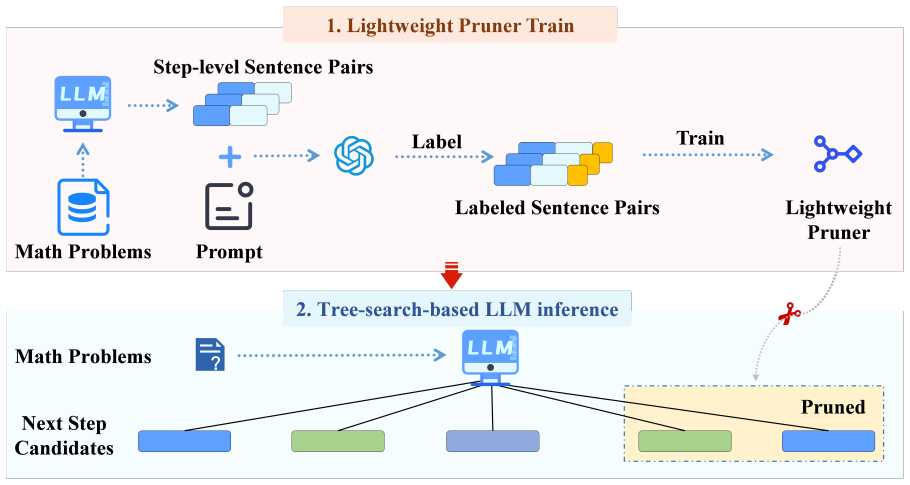
The load-bearing mechanism is the two-stage pruner: a fast Levenshtein-ratio filter forwards only pairs with ratio above 0.75 to a lightweight equivalence detector, a fine-tuned Longformer (an efficient transformer for long documents) that outputs an equivalence probability, and equivalent sibling nodes are collapsed to one representative before expansion. The detector is trained with expectation-maximization on MathEquiv, a new dataset of 100,000 annotated step pairs derived from MATH problems by Qwen2.5-Math-7B-Instruct, so that latent equivalences among sub-sentences inside longer steps are removed during training. This machinery converts search-tree redundancy into a simple pairwise classification problem that can run in real time.
What would settle it
Take a labeled sample of human-annotated equivalent step pairs, compute their Levenshtein ratios, and count how many fall below 0.75; if a substantial fraction are equivalent, the fast filter is discarding the very redundancy the method promises to remove, and EquivPruner's measured token savings would shrink under an oracle filter.
Extended reading notes
Core claim
The central discovery is that textually distinct reasoning steps with the same mathematical content are common in LLM search, and they can be recognized cheaply enough to prune at inference time. EquivPruner treats two steps as equivalent when they agree on concept, logical structure, notation, and method; a fine-tuned Longformer, trained with expectation-maximization on the MathEquiv dataset, makes this call, gated by a Levenshtein-ratio fast filter that only invokes the model for surface-similar pairs. Collapsing equivalent siblings to one representative reduced tokens by 22 to 48 percent while keeping or slightly raising accuracy, for example from 96.44% to 96.59% on GSM8K with Qwen2.5-Math-7B-Instruct. The same pruner also improves the diversity of selected branches in step-level beam search, and ablations show both the task-specific fine-tuning and the EM procedure are needed for the best result.
Load-bearing premise
The method assumes that any two genuinely equivalent reasoning steps will look at least 75% similar on the surface, since pairs below that threshold are never sent to the equivalence detector.
Editorial extensions
If this is right
- On every model and benchmark tested, EquivPruner reduced token consumption, with the largest savings (48.1%) on GSM8K with Qwen2.5-Math-7B-Instruct.
- Accuracy was maintained or improved in most cases, including out-of-distribution settings where neither the model nor the dataset was seen in training.
- In step-level beam search, pruning before top-k selection raises accuracy slightly, showing the mechanism improves search diversity rather than only saving tokens.
- The ablation shows that task-specific fine-tuning and the EM training procedure are both necessary: the off-the-shelf Longformer prunes tokens but hurts accuracy, while the full method improves both.
Reading between the lines
- The 0.75 Levenshtein gate is a place where the method could silently discard equivalent pairs that look different on the surface; a natural extension would measure the gate's recall and replace it with a learned surface-similarity filter if needed.
- If the pruner's equivalence predictions are reliable, the same signal could be used to clean preference-pair construction in search algorithms that learn from intermediate steps, reducing noisy training examples.
- The token savings at fixed accuracy suggest a concrete economic consequence: search-based reasoning becomes more affordable at inference time, so the optimal allocation between model size and test-time compute should shift toward more search.
Editorial analysis
A structured set of objections, weighed in public.
Referee Report
Summary. The paper proposes EquivPruner, a method that prunes semantically equivalent reasoning steps during LLM tree search (MCTS and step-level beam search) to reduce token consumption and, the authors claim, often improve accuracy. The approach consists of a new dataset, MathEquiv, for mathematical statement equivalence, a fine-tuned Longformer-based equivalence detector trained with an EM procedure, and a two-stage pruning gate that first applies a Levenshtein-ratio filter (threshold 0.75) and then invokes the Longformer detector on surviving pairs. Experiments on MATH-500 and GSM8K with Qwen2.5-Math-7B-Instruct, Mistral-7B-SFT, and Qwen2.5-Math-1.5B-Instruct show token reductions of roughly 22–48% in MCTS, with small accuracy changes of −0.30 to +1.28 percentage points, plus a smaller evaluation with SBS.
Significance. The direction is well motivated: redundant exploration of semantically equivalent steps in LLM search is a real source of wasted computation. The token-reduction numbers are large and mechanistically consistent with the pruning mechanism, and the paper ships code and a new dataset, which are useful community assets. If the efficiency claim is validated end-to-end, the contribution would be practically relevant for LLM inference-time search. However, the paper's central efficiency claim is currently supported only for the narrow metric of LLM-generated tokens, not for wall-clock search time or total compute, which is what "searching efficiency" should mean for practitioners.
major comments (4)
- [§4.3 and Table 1] The efficiency metric is defined exclusively as the total number of tokens generated by the LLM (Tokens and Ratio). The computational cost of the pruning machinery itself is never measured: for every node expansion with width 10, up to 45 sibling pairs pass the Levenshtein filter and each surviving pair is fed through a fine-tuned Longformer-base forward pass. Since Longformer-base has roughly 149M parameters and the paper provides no wall-clock time, FLOPs, or latency comparison between the vanilla and EquivPruner pipelines, the headline claim that EquivPruner "improves searching efficiency" is not supported. It is possible that end-to-end compute actually increases. This is load-bearing because the paper's main contribution is efficiency, so the authors should report end-to-end time or an explicit computational-cost model.
- [§4.4, Table 1] The accuracy improvements are small (ranging from −0.30 to +1.28 percentage points) and are reported as single numbers without error bars, multiple runs, or statistical tests. For example, Qwen2.5-Math-7B-Instruct on GSM8K goes from 96.44% to 96.59% (+0.15), and Qwen2.5-Math-1.5B-Instruct on GSM8K goes from 91.05% to 90.75% (−0.30); both are within typical sampling noise for a 1319-problem test set. The abstract's claim that EquivPruner "often bolster[s] reasoning accuracy" is therefore not established. At minimum, the authors should report variance across multiple runs with different seeds or provide a statistical significance test, and they should tone down the accuracy claim accordingly.
- [§4.2.2 and §A.1] The Levenshtein-ratio threshold of 0.75 acts as a hard filter before the Longformer detector: pairs with ratio ≤ 0.75 are never evaluated by the learned model. The paper provides no sensitivity analysis for this threshold and no recall measurement for the gate, even though the MathEquiv test set (10,000 annotated pairs) could support such an evaluation. If the gate misses a substantial fraction of true equivalences, the reported token savings are underestimated (or the accuracy effects are misattributed); if it passes many non-equivalent pairs, the Longformer's precision is the only safeguard. Reporting the pruner's precision/recall and the gate's recall on the MathEquiv test set would make the mechanism more transparent.
- [§3.2 and Figure 4] The MathEquiv labels are produced by GPT-4o with iterative human adjudication, but no inter-annotator agreement is reported, and the final dataset is not evaluated directly (e.g., accuracy of the fine-tuned Longformer on the MathEquiv test set is not given). Since the pruner's quality is central to the method's behavior, the paper should include a basic evaluation of the trained detector itself on the held-out MathEquiv split, including how the five-tier labels are collapsed into the binary decision used for pruning.
minor comments (5)
- [§3.3.2] Typo: "handing the unobserved equivalence status" should be "handling the unobserved equivalence status."
- [Figure 4] In the prompt template, "semanticly" should be "semantically," and the explanation of the 0–4 scale is slightly confusing because the example output uses "result: 0" for a non-equivalent pair, which matches the scale but reads awkwardly next to "return 0: Not equivalent at all."
- [Figure 3] The axis label "T oken Consumption" contains a stray space, and the bar labels use inconsistent phrasing ("T okens Consumed" versus "Token Consumption").
- [§4.4 and Table 1] The text says EquivPruner "significantly reduces token consumption" and then cites the ratio numbers, but the statement "Qwen2.5-Math-7B-Instruct on GSM8K, tokens were reduced by approximately 48.11%" is consistent with the table (Ratio 51.89%); the small discrepancy between the abstract's 48.1% and the table's 48.11% is fine, but the authors should use one decimal place consistently.
- [§3.1] The definition of semantic equivalence requires "Methodological Congruence," meaning two steps that reach the same result via different derivations are not equivalent. This is a strong assumption for a pruning criterion, and it is not empirically validated (e.g., by showing that pruning such pairs hurts or helps downstream accuracy). A brief discussion of the design choice would help.
Circularity Check
No significant circularity: the pruning policy is trained on externally labeled equivalence pairs and evaluated on held-out benchmarks, with no target result used as a fitting input.
full rationale
EquivPruner's derivation chain is self-contained with respect to its efficiency and accuracy claims. The equivalence detector is trained on MathEquiv, whose labels come from GPT-4o with iterative human adjudication (Section 3.2), not from the downstream MCTS token counts or final accuracies that the paper reports. The Levenshtein ratio filter (Section 4.2.2) is a fixed design choice, and the same 0.75 threshold was also used when constructing the training data (Appendix A.1), so the inference-time gate is consistent with the training distribution rather than fitted to the evaluation results. The headline results on GSM8K and MATH-500 use held-out benchmarks, and the paper explicitly treats GSM8K as out-of-distribution for the pruner (Section 4.2.1). The fact that the pruner was trained on steps generated by Qwen2.5-Math-7B-Instruct and then evaluated with that same model is a generalization concern, not circularity, because the trained parameters do not encode the evaluation target values. The skeptic's point that efficiency is measured only by LLM-generated tokens, excluding the Longformer and Levenshtein overhead, is an empirical validity concern about the efficiency metric, not a circularity of the form where a prediction is equivalent to an input by construction. No self-citations are load-bearing: the MCTS/SBS baselines and PRM are cited from external groups, and no uniqueness theorem or prior work by the same authors is invoked to justify the pruning choice. Accordingly, the appropriate finding is no significant circularity.
Assumptions & free parameters
free parameters (4)
- Levenshtein ratio threshold =
0.75
- EM high-confidence probability threshold =
not specified
- Longformer fine-tuning hyperparameters =
Bayesian-optimized learning rate, epochs, weight decay
- MCTS and SBS search hyperparameters =
simulations=20, width=10, depth=50, PUCT=1.25, beam=3
assumptions (5)
- domain assumption Math-Shepherd PRM scores are reliable guides for MCTS value estimates on both MATH and GSM8K.
- domain assumption GPT-4o plus human refinement yields correct labels for mathematical statement equivalence.
- domain assumption Equivalence can be detected from the text of individual reasoning steps without access to the full problem state or future steps.
- ad hoc to paper Levenshtein ratio greater than 0.75 is a necessary condition for semantic equivalence.
- domain assumption Search hyperparameters tuned for vanilla MCTS remain appropriate when the search tree is pruned.
Cite this review
Pith. "Pith review of EquivPruner: Boosting Efficiency and Quality in LLM-Based Search via Action Pruning." pith.science (2026). https://pith.science/paper/ADGWT56J
@misc{pith2026250516312,
  author       = {Pith},
  title        = {Pith review of: EquivPruner: Boosting Efficiency and Quality in LLM-Based Search via Action Pruning},
  year         = {2026},
  howpublished = {\url{https://pith.science/paper/ADGWT56J}},
  note         = {Machine review of arXiv:2505.16312}
}
read the original abstract
Large Language Models (LLMs) excel at complex reasoning through search algorithms, yet current strategies often suffer from massive token consumption due to redundant exploration of semantically equivalent steps. Existing semantic similarity methods struggle to accurately identify such equivalence in domain-specific contexts like mathematical reasoning. To address this, we propose EquivPruner, a simple yet effective approach that identifies and prunes semantically equivalent actions during LLM reasoning search. We also introduce MathEquiv, the first dataset we created for mathematical statement equivalence, which enables the training of a lightweight equivalence detector. Extensive experiments across various models and tasks demonstrate that EquivPruner significantly reduces token consumption, improving searching efficiency and often bolstering reasoning accuracy. For instance, when applied to Qwen2.5-Math-7B-Instruct on GSM8K, EquivPruner reduced token consumption by 48.1\% while also improving accuracy. Our code is available at https://github.com/Lolo1222/EquivPruner.
Figures


Figures from the paper (1 more)

Reference graph
Works this paper leans on
-
[1]
Iz Beltagy, Matthew E Peters, and Arman Cohan. 2020. Longformer: The long-document transformer. arXiv preprint arXiv:2004.05150
arXiv 2020
-
[2]
Maciej Besta, Nils Blach, Ales Kubicek, Robert Gerstenberger, Michal Podstawski, Lukas Gianinazzi, Joanna Gajda, Tomasz Lehmann, Hubert Niewiadomski, Piotr Nyczyk, and 1 others. 2024. Graph of thoughts: Solving elaborate problems with large language models. In Proceedings of the AAAI Conference on Artificial Intelligence, volume 38, pages 17682--17690
2024
-
[3]
Tom Brown, Benjamin Mann, Nick Ryder, Melanie Subbiah, Jared D Kaplan, Prafulla Dhariwal, Arvind Neelakantan, Pranav Shyam, Girish Sastry, Amanda Askell, and 1 others. 2020. Language models are few-shot learners. Advances in neural information processing systems, 33:1877--1901
2020
-
[4]
Guoxin Chen, Minpeng Liao, Chengxi Li, and Kai Fan. 2024. Alphamath almost zero: Process supervision without process. In The Thirty-eighth Annual Conference on Neural Information Processing Systems
work page 2024
-
[5]
Karl Cobbe, Vineet Kosaraju, Mohammad Bavarian, Mark Chen, Heewoo Jun, Lukasz Kaiser, Matthias Plappert, Jerry Tworek, Jacob Hilton, Reiichiro Nakano, and 1 others. 2021. Training verifiers to solve math word problems. arXiv preprint arXiv:2110.14168
arXiv 2021
-
[6]
Nicola Dainese, Matteo Merler, Minttu Alakuijala, and Pekka Marttinen. 2024. Generating code world models with large language models guided by monte carlo tree search. In The Thirty-eighth Annual Conference on Neural Information Processing Systems
work page 2024
-
[7]
Mehul Damani, Idan Shenfeld, Andi Peng, Andreea Bobu, and Jacob Andreas. 2024. Learning how hard to think: Input-adaptive allocation of lm computation. arXiv preprint arXiv:2410.04707
arXiv 2024
-
[8]
Dan Hendrycks, Collin Burns, Saurav Kadavath, Akul Arora, Steven Basart, Eric Tang, Dawn Song, and Jacob Steinhardt. 2021. Measuring mathematical problem solving with the math dataset. arXiv preprint arXiv:2103.03874
arXiv 2021
Show all 31 references
-
[9]
Aaron Hurst, Adam Lerer, Adam P Goucher, Adam Perelman, Aditya Ramesh, Aidan Clark, AJ Ostrow, Akila Welihinda, Alan Hayes, Alec Radford, and 1 others. 2024. Gpt-4o system card. arXiv preprint arXiv:2410.21276
2024 arXiv
-
[10]
Jinhao Jiang, Zhipeng Chen, Yingqian Min, Jie Chen, Xiaoxue Cheng, Jiapeng Wang, Yiru Tang, Haoxiang Sun, Jia Deng, Wayne Xin Zhao, and 1 others. 2024. Technical report: Enhancing llm reasoning with reward-guided tree search. arXiv preprint arXiv:2411.11694
2024 arXiv
-
[11]
Jikun Kang, Xin Zhe Li, Xi Chen, Amirreza Kazemi, Qianyi Sun, Boxing Chen, Dong Li, Xu He, Quan He, Feng Wen, and 1 others. 2024. Mindstar: Enhancing math reasoning in pre-trained llms at inference time. arXiv preprint arXiv:2405.16265
2024 arXiv
-
[12]
Zixuan Ke, Fangkai Jiao, Yifei Ming, Xuan-Phi Nguyen, Austin Xu, Do Xuan Long, Minzhi Li, Chengwei Qin, Peifeng Wang, Silvio Savarese, and 1 others. 2025. A survey of frontiers in llm reasoning: Inference scaling, learning to reason, and agentic systems. arXiv preprint arXiv:2...
2025
-
[13]
Hunter Lightman, Vineet Kosaraju, Yuri Burda, Harrison Edwards, Bowen Baker, Teddy Lee, Jan Leike, John Schulman, Ilya Sutskever, and Karl Cobbe. 2023. Let's verify step by step. In The Twelfth International Conference on Learning Representations
2023
-
[14]
Jieyi Long. 2023. Large language model guided tree-of-thought. arXiv preprint arXiv:2305.08291
2023 arXiv
-
[15]
Liangchen Luo, Yinxiao Liu, Rosanne Liu, Samrat Phatale, Meiqi Guo, Harsh Lara, Yunxuan Li, Lei Shu, Yun Zhu, Lei Meng, and 1 others. 2024. Improve mathematical reasoning in language models by automated process supervision. arXiv preprint arXiv:2406.06592
2024 arXiv
-
[16]
Goutam Majumder, Partha Pakray, Alexander Gelbukh, and David Pinto. 2016. Semantic textual similarity methods, tools, and applications: A survey. Computaci \'o n y Sistemas , 20(4):647--665
2016
-
[17]
Shuai Peng, Ke Yuan, Liangcai Gao, and Zhi Tang. 2021. Mathbert: A pre-trained model for mathematical formula understanding. arXiv preprint arXiv:2105.00377
2021 arXiv
-
[18]
Nils Reimers and Iryna Gurevych. 2019. Sentence-bert: Sentence embeddings using siamese bert-networks. In Proceedings of the 2019 Conference on Empirical Methods in Natural Language Processing and the 9th International Joint Conference on Natural Language Processing (EMNLP-IJC...
2019
-
[19]
Zhihong Shao, Peiyi Wang, Qihao Zhu, Runxin Xu, Junxiao Song, Xiao Bi, Haowei Zhang, Mingchuan Zhang, YK Li, Y Wu, and 1 others. 2024. Deepseekmath: Pushing the limits of mathematical reasoning in open language models. arXiv preprint arXiv:2402.03300
2024 arXiv
-
[20]
Charlie Snell, Jaehoon Lee, Kelvin Xu, and Aviral Kumar. 2024. Scaling llm test-time compute optimally can be more effective than scaling model parameters. arXiv preprint arXiv:2408.03314
2024 arXiv
-
[21]
Christian Steinfeldt and Helena Mihaljevi \'c . 2024. Evaluation and domain adaptation of similarity models for short mathematical texts. In International Conference on Intelligent Computer Mathematics, pages 241--260. Springer
2024
-
[22]
Jason Wei, Xuezhi Wang, Dale Schuurmans, Maarten Bosma, Fei Xia, Ed Chi, Quoc V Le, Denny Zhou, and 1 others. 2022. Chain-of-thought prompting elicits reasoning in large language models. Advances in neural information processing systems, 35:24824--24837
2022
-
[23]
Yuxi Xie, Anirudh Goyal, Wenyue Zheng, Min-Yen Kan, Timothy P Lillicrap, Kenji Kawaguchi, and Michael Shieh. 2024. Monte carlo tree search boosts reasoning via iterative preference learning. arXiv preprint arXiv:2405.00451
2024 arXiv
-
[24]
An Yang, Baosong Yang, Beichen Zhang, Binyuan Hui, Bo Zheng, Bowen Yu, Chengyuan Li, Dayiheng Liu, Fei Huang, Haoran Wei, and 1 others. 2024. Qwen2. 5 technical report. arXiv preprint arXiv:2412.15115
2024 arXiv
-
[25]
Shunyu Yao, Dian Yu, Jeffrey Zhao, Izhak Shafran, Tom Griffiths, Yuan Cao, and Karthik Narasimhan. 2023. Tree of thoughts: Deliberate problem solving with large language models. Advances in neural information processing systems, 36:11809--11822
2023
-
[26]
Li Yujian and Liu Bo. 2007. A normalized levenshtein distance metric. IEEE transactions on pattern analysis and machine intelligence, 29(6):1091--1095
2007
-
[27]
Dan Zhang, Sining Zhoubian, Ziniu Hu, Yisong Yue, Yuxiao Dong, and Jie Tang. 2024 a . Rest-mcts*: Llm self-training via process reward guided tree search. Advances in Neural Information Processing Systems, 37:64735--64772
2024
-
[28]
Di Zhang, Jianbo Wu, Jingdi Lei, Tong Che, Jiatong Li, Tong Xie, Xiaoshui Huang, Shufei Zhang, Marco Pavone, Yuqiang Li, and 1 others. 2024 b . Llama-berry: Pairwise optimization for o1-like olympiad-level mathematical reasoning. arXiv preprint arXiv:2410.02884
2024 arXiv
-
[29]
Shun Zhang, Zhenfang Chen, Yikang Shen, Mingyu Ding, Joshua B Tenenbaum, and Chuang Gan. 2023. Planning with large language models for code generation. In The Eleventh International Conference on Learning Representations
2023
-
[30]
online" 'onlinestring :=
ENTRY address archivePrefix author booktitle chapter edition editor eid eprint eprinttype howpublished institution journal key month note number organization pages publisher school series title type volume year doi pubmed url lastchecked label extra.label sort.label short.list...
-
[31]
write newline
" write newline "" before.all 'output.state := FUNCTION n.dashify 't := "" t empty not t #1 #1 substring "-" = t #1 #2 substring "--" = not "--" * t #2 global.max substring 't := t #1 #1 substring "-" = "-" * t #2 global.max substring 't := while if t #1 #1 substring * t #2 gl...
Reviewed August 7, 2026 · model on record in the stance chip above.
Discussion (0). Sign in to comment.