REVIEW 3 major objections 4 minor 13 references
Importance Analysis for Dynamic Control of Balancing Parameter in a Simple Knowledge Distillation Setting
T0 review · 3 major / 4 minor · reviewed 2026-08-15 · deepseek-v4-flash
Pith's one-line read In a simple knowledge-distillation setting, the balancing parameter between distillation and classification losses should change during training rather than stay fixed.
desk verdict Short WiP whose algebra is fine but whose headline conclusion doesn't follow from it; no experiments or algorithm, and the only novel-sounding claim is unearned. read the letter →
The pith
A machine-rendered reading of the paper's core claim, the machinery that carries it, and where it could break.
The reading
What carries the argument
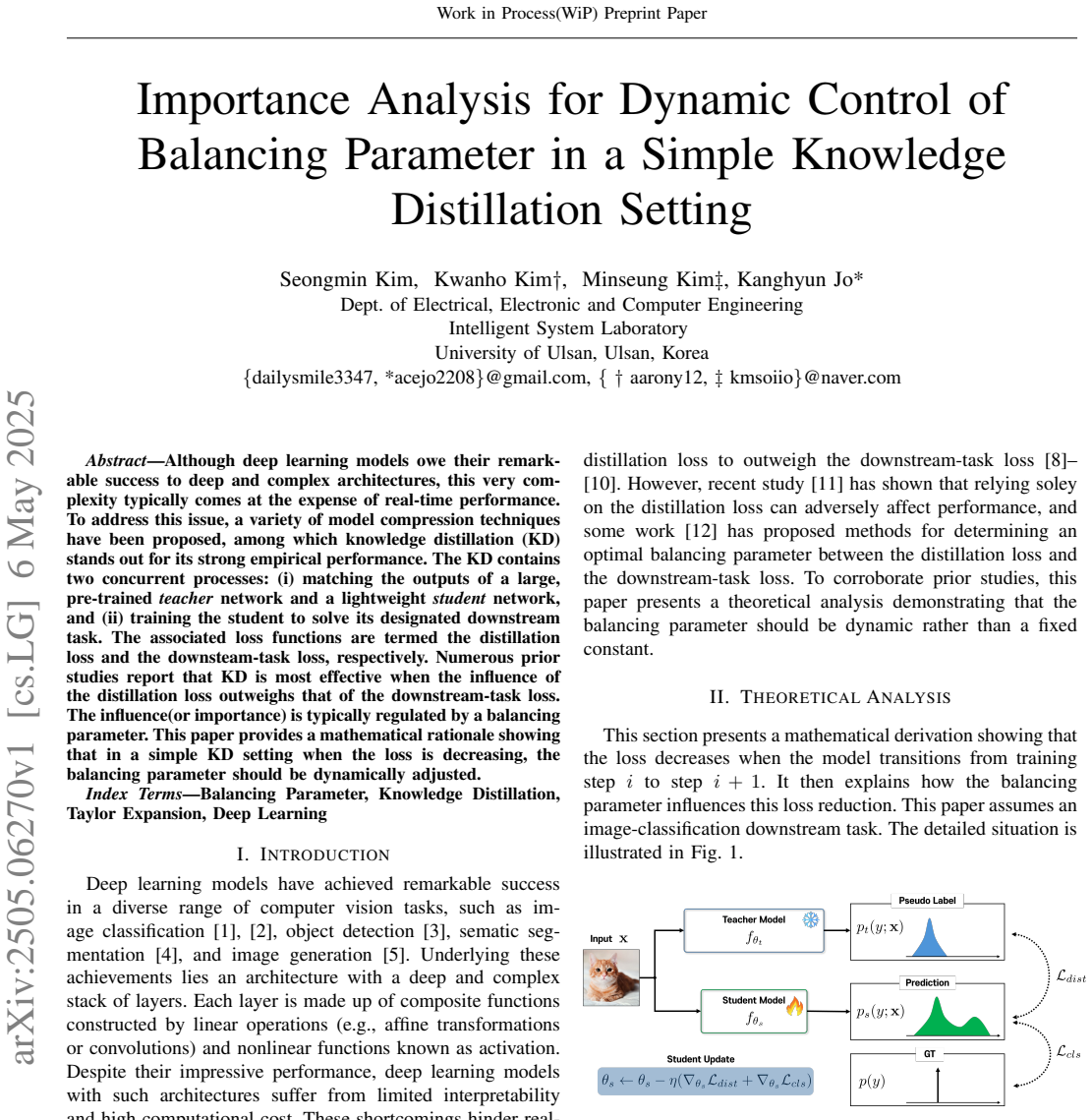
The central object is the total loss $L(\theta_s) = \lambda L_{\text{dist}}(\theta_s) + (1-\lambda)L_{\text{cls}}(\theta_s)$ and its one-step update under gradient descent. The argument's workhorse is the first-order Taylor expansion of $L(\theta_s - \eta(g_{\text{dist}} + g_{\text{cls}}))$, following the stiffness-based expansion used in [13]. Expanding the squared norm of the weighted gradient sum gives $$\$\Delta$ L_{i+1} \approx -\eta\big[\$lambda^{2}$\|\nabla L_{\text{dist}}\|^2 + 2\$\lambda$(1-\$\lambda$)\|\nabla L_{\text{dist}}\|\|\nabla L_{\text{cls}}\|\cos\varphi + (1-\$\lambda$)^2\|\nabla L_{\text{cls}}\|^2\big],$$ where $\varphi$ is the angle between the two gradient vectors. This quadratic-in-$\lambda$ expression is the component that carries the conclusion: the size of the loss decrease is controlled by $\lambda$ through a quantity that changes with the gradient geometry.
What would settle it
Train a tiny student with two fixed quadratic losses for a single gradient step at several learning rates; if there is a learning rate and gradient configuration where the exact total loss increases even though the quadratic expression in Eq. (10) is positive, then the first-order approximation that carries the conclusion has failed.
Extended reading notes
Core claim
The paper's central claim is that in a simple knowledge-distillation setup, where a student is trained by a weighted sum of a distillation loss and a classification loss, the balancing parameter lambda should change from step to step rather than stay fixed. The claim is grounded in a first-order Taylor expansion of the total loss after one gradient step. The resulting formula expresses the one-step loss change as minus eta times a quadratic polynomial in lambda whose coefficients are the gradient norms of the two losses and the cosine of the angle between them. Because those geometric quantities evolve during training, the lambda that gives a fast loss decrease at one step is not generally the best at the next. The paper therefore concludes that a dynamic lambda, chosen from the current gradients and the desired rate of learning, is needed for effective knowledge distillation.
Load-bearing premise
The calculation keeps only the first-order term of the loss change and drops the remainder without stating when the learning rate is small enough for that remainder to be negligible; if the remainder is not small, the predicted sign and size of the loss decrease can be wrong.
Editorial extensions
If this is right
- A fixed lambda is, on this account, a compromise: it will be too aggressive at some steps and too timid at others as gradient magnitudes and the angle between the two losses evolve.
- The lambda that gives the largest one-step loss decrease is the one that maximizes the quadratic bracket in the derived expression, so per-step lambda selection reduces to a scalar optimization once the two gradients are known.
- When the distillation and classification gradients point in the same direction, the cross term contributes positively to the loss drop, so weighting both terms matters differently than when the gradients oppose each other.
- Comparing fixed-lambda schedules only by final accuracy can hide their different loss-decrease paths, since each lambda produces a different per-step loss curve.
Reading between the lines
- Beyond the paper's explicit claim, the quadratic form in lambda points toward an explicit per-step optimizer the paper does not derive: setting the derivative of the bracket to zero gives the lambda that maximizes one-step loss decrease from the current gradient norms and cos(phi).
- A testable extension beyond the paper's scope is to run the same student on the same data with a fixed lambda and with a per-step lambda chosen from this formula, then compare the loss curves; the dynamic schedule should dominate at every step if the approximation is reliable.
- The same quadratic structure may apply to any two-term training objective, not just knowledge distillation, so dynamic weighting might be a general multi-task training principle rather than a distillation-specific fix.
Signed reviews
Editorial analysis
A structured set of objections, weighed in public.
Referee Report
Summary. This manuscript analyzes a simple knowledge-distillation objective L = λL_dist + (1−λ)L_cls and uses a first-order Taylor expansion (Eqs. (5)–(6)) to express the per-step loss decrease as −η times the squared norm of the weighted gradient combination (Eq. (14)). The authors conclude from this expression that the balancing parameter λ should be dynamically adjusted during training. No experiments, baselines, or update rules for λ are presented; the Conclusion defers such an algorithm to future work.
Significance. The algebraic derivation is transparent and appears internally consistent; it correctly captures the first-order dependence of the loss decrease on λ. If the normative claim were supported, it would give a theoretical justification for time-varying KD loss weights. However, as argued below, the conclusion does not follow from the equations, and no evidence is provided that dynamic adjustment outperforms any fixed λ. The practical significance in its current form is therefore limited.
major comments (3)
- [Abstract and Section III] The conclusion that 'more effective knowledge distillation requires dynamic adjustment of λ at each step' is a non sequitur relative to Eq. (14). That equation only shows that the magnitude of a single first-order loss decrease depends on λ; it does not compare fixed versus dynamic schedules, specify an objective (e.g., final loss, convergence speed, generalization) with respect to which dynamic adjustment is optimal, or rule out the possibility that some fixed λ is optimal throughout training. Without such an optimality argument or an empirical comparison, the central claim is unsupported.
- [Section II-B, Eqs. (5)–(6)] The first-order Taylor expansion discards the O(η²) remainder without stating any smallness condition on η or any bound on the Hessian of L. The subsequent sign and magnitude statements for ∆L_{i+1} (Eqs. (7)–(14)) are therefore not guaranteed for finite learning rates used in practice; the second-order term could change the sign of the loss difference. The paper must either state and justify a small-η assumption or bound the remainder.
- [Section IV (Conclusion)] The paper acknowledges that 'future work focuses and investigates an algorithm' for dynamically adjusting λ. Since no update rule for λ is proposed and no objective for 'desired learning behavior' (Section III) is formalized, the manuscript does not deliver a testable prediction or method; the stated contribution is only a heuristic motivation.
minor comments (4)
- [Abstract] There is a typo: 'downsteam-task loss' should be 'downstream-task loss'.
- [Section II-B, after Eq. (14)] The phrase 'the term in square brackets equals the squared sum of the two gradients' is inaccurate; the term equals the squared norm of the weighted sum λ∇L_dist + (1−λ)∇L_cls, not the sum of the two squared-norm terms.
- [Figure 2 caption] The caption does not specify how the plotted curves are computed from Eq. (14) or what exactly the red and green curves represent beyond 'cases'.
- [References] Reference [10] is cited for 'methods for determining an optimal balancing parameter', but [10] concerns gradient surgery in multi-task learning; the intended reference may be [12] or another work.
Circularity Check
No circularity: the derivation is a self-contained Taylor expansion of the defined loss; the dynamic-adjustment conclusion is an unsupported inference, not a circular reduction.
full rationale
This paper's mathematical core is Section II-B. It defines L(θ_i^s)=λL_dist+(1−λ)L_cls and the weighted gradients g_dist=λ∇L_dist, g_cls=(1−λ)∇L_cls, then applies a first-order Taylor expansion to L(θ_i^s−η(g_dist+g_cls)). Equation (7) is exactly the first-order Taylor approximation of the loss difference, and Equations (9)–(14) are algebraic rewritings of −η∥g_dist+g_cls∥² in terms of λ, the gradient norms, and the angle between the gradients. No parameter is fitted to data, no external benchmark is needed, and no prior work of the authors is invoked as load-bearing evidence; the only external citation, Fort et al., is for a standard Taylor-expansion step that is not being used as unverified self-supporting evidence. The paper's central normative sentence—that 'more effective knowledge distillation requires dynamic adjustment of λ at each step'—does not follow from the equations, but a non sequitur is not a circular reduction: the conclusion is not identical to the definition of L, nor is it constructed from the definition alone. The derivation's actual output, that the one-step loss decrease is a quadratic function of λ, is distinct from the input definition and is obtained by ordinary calculus. Accordingly, the circularity score is 0.
Assumptions & free parameters
assumptions (3)
- standard math The total loss L is differentiable and its gradient is the weighted sum of the distillation and classification gradients.
- domain assumption The Taylor expansion of L around θ_s^i can be truncated at first order, neglecting O(η²).
- domain assumption The student parameters are updated by one step of SGD with learning rate η using the full gradient of L.
Cite this review
Pith. "Pith review of Importance Analysis for Dynamic Control of Balancing Parameter in a Simple Knowledge Distillation Setting." pith.science (2026). https://pith.science/paper/AE46AS25
@misc{pith2026250506270,
  author       = {Pith},
  title        = {Pith review of: Importance Analysis for Dynamic Control of Balancing Parameter in a Simple Knowledge Distillation Setting},
  year         = {2026},
  howpublished = {\url{https://pith.science/paper/AE46AS25}},
  note         = {Machine review of arXiv:2505.06270}
}
read the original abstract
Although deep learning models owe their remarkable success to deep and complex architectures, this very complexity typically comes at the expense of real-time performance. To address this issue, a variety of model compression techniques have been proposed, among which knowledge distillation (KD) stands out for its strong empirical performance. The KD contains two concurrent processes: (i) matching the outputs of a large, pre-trained teacher network and a lightweight student network, and (ii) training the student to solve its designated downstream task. The associated loss functions are termed the distillation loss and the downsteam-task loss, respectively. Numerous prior studies report that KD is most effective when the influence of the distillation loss outweighs that of the downstream-task loss. The influence(or importance) is typically regulated by a balancing parameter. This paper provides a mathematical rationale showing that in a simple KD setting when the loss is decreasing, the balancing parameter should be dynamically adjusted
Figures

Reference graph
Works this paper leans on
-
[1]
An introduction to convolutional neural networks
Keiron O’shea and Ryan Nash. An introduction to convolutional neural networks. arXiv preprint arXiv:1511.08458 , 2015
arXiv 2015
-
[2]
An image is worth 16x16 words: Transformers for image recognition at scale
Alexey Dosovitskiy, Lucas Beyer, Alexander Kolesnikov, Dirk Weis- senborn, Xiaohua Zhai, Thomas Unterthiner, Mostafa Dehghani, Matthias Minderer, Georg Heigold, Sylvain Gelly, et al. An image is worth 16x16 words: Transformers for image recognition at scale. arXiv preprint arXiv:2010.11929, 2020
arXiv 2010
-
[3]
Yolov9: Learning what you want to learn using programmable gradient infor- mation
Chien-Yao Wang, I-Hau Yeh, and Hong-Yuan Mark Liao. Yolov9: Learning what you want to learn using programmable gradient infor- mation. In Ale ˇs Leonardis, Elisa Ricci, Stefan Roth, Olga Russakovsky, Torsten Sattler, and G ¨ul Varol, editors, Computer Vision – ECCV 2024 , pages 1–21, Cham, 2025. Springer Nature Switzerland
work page 2024
-
[4]
Berg, Wan-Yen Lo, Piotr Dollar, and Ross Girshick
Alexander Kirillov, Eric Mintun, Nikhila Ravi, Hanzi Mao, Chloe Rolland, Laura Gustafson, Tete Xiao, Spencer Whitehead, Alexander C. Berg, Wan-Yen Lo, Piotr Dollar, and Ross Girshick. Segment anything. In Proceedings of the IEEE/CVF International Conference on Computer Vision (ICCV), pages 4015–4026, October 2023
2023
-
[5]
Score-based generative modeling through stochastic differential equations
Yang Song, Jascha Sohl-Dickstein, Diederik P Kingma, Abhishek Ku- mar, Stefano Ermon, and Ben Poole. Score-based generative modeling through stochastic differential equations. In International Conference on Learning Representations , 2021
work page 2021
-
[6]
Distilling the knowledge in a neural network
Geoffrey Hinton, Oriol Vinyals, and Jeff Dean. Distilling the knowledge in a neural network. arXiv preprint arXiv:1503.02531 , 2015
arXiv 2015
-
[7]
Knowledge distillation: A survey
Jianping Gou, Baosheng Yu, Stephen J Maybank, and Dacheng Tao. Knowledge distillation: A survey. International Journal of Computer Vision, 129(6):1789–1819, 2021
2021
-
[8]
Towards understanding knowl- edge distillation
Mary Phuong and Christoph Lampert. Towards understanding knowl- edge distillation. In International conference on machine learning, pages 5142–5151. PMLR, 2019
work page 2019
Show all 13 references
-
[9]
Knowledge distilla- tion performs partial variance reduction
Mher Safaryan, Alexandra Peste, and Dan Alistarh. Knowledge distilla- tion performs partial variance reduction. Advances in Neural Information Processing Systems, 36:75229–75258, 2023
2023
-
[10]
Gradient surgery for multi-task learning
Tianhe Yu, Saurabh Kumar, Abhishek Gupta, Sergey Levine, Karol Hausman, and Chelsea Finn. Gradient surgery for multi-task learning. Advances in neural information processing systems , 33:5824–5836, 2020
2020
-
[11]
Can students beyond the teacher? distilling knowledge from teacher’s bias
Jianhua Zhang, Yi Gao, Ruyu Liu, Xu Cheng, Houxiang Zhang, and Shengyong Chen. Can students beyond the teacher? distilling knowledge from teacher’s bias. In Proceedings of the AAAI Conference on Artificial Intelligence, volume 39, pages 22434–22442, 2025
2025
-
[12]
Even your teacher needs guidance: Ground-truth targets dampen regularization imposed by self-distillation
Kenneth Borup and Lars N Andersen. Even your teacher needs guidance: Ground-truth targets dampen regularization imposed by self-distillation. Advances in Neural Information Processing Systems , 34:5316–5327, 2021
2021
-
[13]
Stiffness: A new perspective on generalization in neural networks
Stanislav Fort, Paweł Krzysztof Nowak, Stanislaw Jastrzebski, and Srini Narayanan. Stiffness: A new perspective on generalization in neural networks. arXiv preprint arXiv:1901.09491 , 2019
1901 arXiv
Reviewed August 15, 2026 · model on record in the stance chip above.
Discussion (0). Continue with ORCID to comment.