REVIEW 5 major objections 6 minor 1 cited by
Prototype Augmented Hypernetworks for Continual Learning
T0 review · 5 major / 6 minor · reviewed 2026-08-15 · deepseek-v4-flash
Pith's one-line read A hypernetwork fed with learnable class prototypes generates task-specific heads on demand, cutting continual-learning forgetting to under 2% on Split-CIFAR100.
desk verdict Plausible and interesting hypernetwork-plus-prototypes idea for task-incremental learning, but the SOTA claim is not yet supported: no code, a semantically odd logit-distillation term, and a prototype-distillation objective that smells like a moving-target artifact. read the letter →
The pith
A machine-rendered reading of the paper's core claim, the machinery that carries it, and where it could break.
The reading
What carries the argument
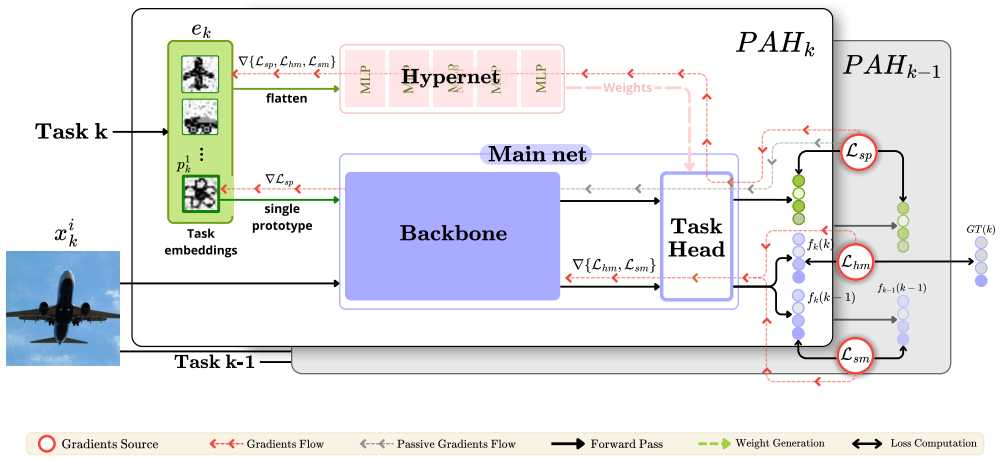
The central object is the task embedding: for each task, a compact 10x10 prototype per class, flattened and concatenated into the vector $e_k$ that conditions the hypernetwork. The prototype-level distillation loss $L_{sp}$ is the load-bearing mechanism: when a new task arrives, old prototypes are re-optimized so that the current frozen model's predictions on them with old heads match the old model's predictions, adapting the embedding to the evolving backbone. Because gradients flow only into the prototypes during this step, the embedding space is what moves, not the head generator, preserving the mapping from task identity to usable heads.
What would settle it
Take a PAH model trained on Split-CIFAR100 and, after the last task, feed each learned prototype $p^c_j$ through the frozen backbone and measure whether prototypes of different classes separate in feature space (e.g., nearest-neighbor accuracy against held-out class features). If that separation is no better than for random 10x10 noise, or if retraining the final heads with all prototypes frozen to their post-task-1 values reproduces the same ~74.5% accuracy and ~1.7% forgetting, then the low forgetting is an artifact of the KL objective rather than evidence that the prototypes carry class knowledge.
Extended reading notes
Core claim
PAH treats the classifier head as a generated artifact rather than a stored object. A hypernetwork $\Upsilon$ maps a task embedding $e_k$ (the flattened prototypes of that task's classes) to head weights $\theta^\tau_k = \Upsilon(e_k)$. Two distillation losses protect old tasks: logit-level $L_{sm}$ on current inputs evaluated under old task heads, and prototype-level $L_{sp}$ that updates only the old prototypes while the backbone and hypernetwork remain frozen. The paper's central claim is that this prototype-augmented conditioning, together with the dual distillation, resolves the representation drift that causes most classifier-level forgetting, achieving state-of-the-art accuracy with near-zero forgetting while storing neither samples nor heads.
Load-bearing premise
The method's low forgetting rests on the premise that the prototype-alignment loss keeps prototypes genuinely class-informative as they are updated, instead of merely driving them to inputs where the old and new models both happen to agree; the paper provides no analysis or ablation showing that prototypes remain class-semantic after these updates.
Editorial extensions
If this is right
- Deploying PAH requires no replay buffer and no stored classifier heads; each head is regenerated at inference from the task embedding, so memory grows only with the number of classes, not with the number of tasks.
- The design concentrates protection on the classifier layer: if the prototype-alignment loss $L_{sp}$ is removed, accuracy drops by about 1.5 points, indicating that prototype alignment is what keeps old heads useful as features drift.
- With approximately 1.7% forgetting on Split-CIFAR100, the method makes head regeneration a practical substitute for per-task weight storage in task-incremental deployments.
- Semantic prototype initialization (starting from real class images) is worth about 2% accuracy over random initialization, so the information content of the embedding, not just network capacity, drives the result.
Reading between the lines
- Pith inference: the same conditioning could be applied to class-incremental learning by generating all task heads at test time and aggregating predictions, but inference under unknown task identity is not addressed in the paper.
- Pith inference: the prototype-alignment loss is self-referential, since the objective's target and input both move with the prototypes; a stress test that freezes prototypes after the first task and measures the accuracy drop would isolate whether adaptation or simply conditioning carries the result.
- Pith inference: because prototypes are only 10x10 grids, they could serve as interpretable records of each class's learned representation, an opportunity the paper does not exploit.
Signed reviews
Editorial analysis
A structured set of objections, weighed in public.
Referee Report
Summary. The paper proposes Prototype-Augmented Hypernetworks (PAH) for task-incremental continual learning. A single hypernetwork is conditioned on learnable task prototypes (concatenated 2D prototype grids) and generates task-specific classifier heads on demand. Training combines cross-entropy with two KL distillation losses: one aligning the current model's predictions with the old model on current-task inputs under previous-task heads (Lsm, Eq. 5), and one adapting previous-task prototypes to the current feature space (Lsp, Eq. 6). The authors report state-of-the-art results on Split-CIFAR100 (74.46% accuracy, 1.71% forgetting) and TinyImageNet (63.65% accuracy, 4.43% forgetting) and include ablations over prototype shape, stability weight, Lsp weight, and initialization.
Significance. If the results hold, PAH would be a notable contribution: it combines hypernetwork-generated heads with prototype-based task embeddings and achieves very low forgetting without a replay buffer, which is attractive for memory-constrained continual learning. The paper also has a clean high-level idea with clear ablations. However, the central mechanism is currently underspecified and potentially flawed: the prototype distillation loss in Eq. (6) has a moving-target structure, the logit distillation in Eq. (5) is applied on out-of-distribution inputs, the main results table is internally inconsistent, and the ablation in Table 2(c) contradicts the text's claim that Lsp is vital. Because these issues bear directly on the reported state-of-the-art numbers, the paper needs substantial revision before the claims can be accepted.
major comments (5)
- [Sec. 4.1, Eq. (6)] The prototype distillation loss Lsp is a moving-target objective. Gradients flow only into the prototype p_c^j, but p_c^j appears as the input to both f_{k-1} and f_k and also as part of the task embedding e_j = Flatten(p_1^j,...,p_C^j) that conditions the current hypernetwork, so the generated head θτ_j = Υ(e_j) changes as p_c^j changes. Thus both sides of the KL depend on the optimized variable: f_{k-1}(p_c^j|j) moves because the input moves, and f_k(p_c^j|j) moves because both the input and the conditioning change. The loss can be driven to zero by moving prototypes to inputs where the two heads happen to agree, without preserving class semantics. The paper provides no analysis or ablation showing that adapted prototypes remain class-informative; Table 2(c) only reports end-task accuracy and forgetting, which cannot distinguish genuine retention from a degenerate alignment. I request either a reformulation that fixes a reference (e.g., stop-gradient on the old-model output or a detached copy of the prototypes for f_{k-1}) or a direct evaluation of prototype quality after training.
- [Sec. 4.1, Eq. (5)] The soft main loss Lsm uses f_{k-1}(x_k|j), the old model's output on current-task data with a previous-task head. Since the old model never saw data from task T_k during its training, this term is a distillation on out-of-distribution inputs, not on the old task's data distribution. The paper does not justify why aligning predictions on current-task inputs under old-task heads stabilizes old-task knowledge. Please clarify the intended role of this term, and consider evaluating a variant that applies Lsm to data from the current task through all old heads versus a variant that applies it to prototypes or other in-distribution reference points.
- [Table 1] The main results table is internally inconsistent. The caption says models marked with † are evaluated on the 10-task TinyImageNet setting, while the rest use the 20-task setting, but the row 'PAH (Ours)† 60.48±0.148 3.24±0.6' appears under the Split-CIFAR100 columns, and the row does not show TinyImageNet values. It is unclear what benchmark this row corresponds to and why it reports much lower accuracy than the unmarked PAH row (74.46). Additionally, baseline numbers are collected from different source papers with different buffer sizes and protocols, making the comparison potentially unfair or non-uniform; please provide a unified evaluation protocol or clearly tabulate the exact setting for every row.
- [Sec. 6.1, Table 2(c)] The ablation over the Lsp weight does not support the claim that Lsp is vital for forgetting. With Lsp weight 0.0, forgetting is 1.56%, which is lower than the 1.71% at the default weight 1.0; accuracy improves from 72.93% to 74.46%, a modest gain. The sentence 'performance significantly dropped when its weight was 0' is therefore not supported by the table. This is important because Lsp is presented as a core component of PAH. Please either correct the interpretation or provide additional evidence, such as prototype-quality metrics, that Lsp contributes beyond a small accuracy boost.
- [Sec. 5] The paper does not report sufficient experimental details to reproduce the results. Missing items include the optimizer and learning rate schedule, number of training epochs and batch size, the architecture and parameter count of the hypernetwork, how λsm and λsp were selected, and the precise evaluation protocol (e.g., whether task identity is given at test time, and which of the two TinyImageNet configurations is used for the unmarked PAH row). I strongly encourage releasing code or, at minimum, a complete hyperparameter table; without these, the state-of-the-art claim cannot be independently verified.
minor comments (6)
- [Abstract] The abstract claims PAH works 'without storing samples or heads', but the method stores and updates a set of learnable prototypes for every class of every task. Please qualify this claim, e.g., 'without storing raw samples or classifier heads'.
- [Eq. (5)] The notation f_k(x_k|j) is confusing because the subscript on f refers to the training stage while the vertical-bar argument refers to the task whose head is used. Please define the indexing explicitly and use a consistent notation throughout.
- [Sec. 5.1] The TinyImageNet description mentions two configurations (10 tasks with 20 classes and 20 tasks with 10 classes), but the results and ablations do not clearly report which configuration is used for each row. Please state this explicitly and report both configurations if claimed.
- [Table 2] The table caption says 'Default settings marked in gray', but the grayscale highlighting is not visible in the text. Please indicate the default values directly, e.g., with boldface or an explicit 'default' label.
- [References] Reference [12] cites Krizhevsky et al. for ImageNet, but the AlexNet paper is not the standard citation for TinyImageNet; please cite the appropriate TinyImageNet source.
- [Figure 1] The figure label 'single prototype' conflicts with the text, which says the task embedding is formed by concatenating multiple class prototypes. Please adjust the figure to match the description.
Circularity Check
No significant circularity: the reported benchmark numbers are externally measured, and the moving-target KL in Eq. (6) is an optimization concern, not a tautology.
full rationale
PAH's central claims are empirical: the paper introduces a hypernetwork conditioned on learnable prototypes and reports average accuracy and forgetting on Split-CIFAR100 and TinyImageNet. There is no derivation chain in which a fitted parameter is relabeled as a prediction. Equations (4)-(6) define training losses; Eq. (6) does use the previous-task prototype p_c^j both as the input to f_{k-1} and f_k and as part of the task embedding e_j that generates the current head, so minimizing this KL is a moving-target objective. However, the reported forgetting (FM) is not defined as this KL; it is the standard benchmark metric from [2] computed on test data. Low Lsp could in principle be achieved by prototype drift without preserving class semantics, but that would be a correctness or optimization failure, not a circularity making the headline numbers true by construction. The comparisons are against external baselines (GCR, DER, CCLIS, SI, A-GEM, PNN, HN-2/HN-3) with results taken from their respective papers, and no load-bearing argument rests on a self-citation or an imported uniqueness theorem. The ablations in Table 2 are design choices measured on the same benchmark, not fitted parameters presented as predictions. Therefore no circular step is exhibited.
Assumptions & free parameters
free parameters (3)
- lambda_sm (stability coefficient) =
0.5 (default)
- lambda_sp (Lsp weight) =
1.0 (default)
- prototype grid size =
10x10
assumptions (3)
- domain assumption Task identity is available during both training and inference in task-incremental learning.
- domain assumption Catastrophic forgetting mainly affects final classifier layers due to representation drift.
- ad hoc to paper A hypernetwork conditioned on concatenated prototypes can generate classifier heads of sufficient quality.
Cite this review
Pith. "Pith review of Prototype Augmented Hypernetworks for Continual Learning." pith.science (2026). https://pith.science/paper/AF5ZWFNR
@misc{pith2026250507450,
  author       = {Pith},
  title        = {Pith review of: Prototype Augmented Hypernetworks for Continual Learning},
  year         = {2026},
  howpublished = {\url{https://pith.science/paper/AF5ZWFNR}},
  note         = {Machine review of arXiv:2505.07450}
}
read the original abstract
Continual learning (CL) aims to learn a sequence of tasks without forgetting prior knowledge, but gradient updates for a new task often overwrite the weights learned earlier, causing catastrophic forgetting (CF). We propose Prototype-Augmented Hypernetworks (PAH), a framework where a single hypernetwork, conditioned on learnable task prototypes, dynamically generates task-specific classifier heads on demand. To mitigate forgetting, PAH combines cross-entropy with dual distillation losses, one to align logits and another to align prototypes, ensuring stable feature representations across tasks. Evaluations on Split-CIFAR100 and TinyImageNet demonstrate that PAH achieves state-of-the-art performance, reaching 74.5 % and 63.7 % accuracy with only 1.7 % and 4.4 % forgetting, respectively, surpassing prior methods without storing samples or heads.
Figures
Forward citations
Cited by 1 Pith paper
-
Aligning Generalisation Between Humans and Machines
A perspective paper maps how humans and machines generalize differently and argues that aligning these generalization behaviors is essential for human-AI teaming.
Reference graph
Works this paper leans on
-
[1]
Dark experience for general continual learning: a strong, simple baseline
Pietro Buzzega, Matteo Boschini, Angelo Porrello, Davide Abati, and SIMONE CALDERARA. Dark experience for general continual learning: a strong, simple baseline. In Advances in Neural Information Processing Systems, pages 15920–15930. Curran Associates, Inc., 2020. 1, 3, 4
work page 2020
-
[2]
Riemannian walk for incremental learning: Understanding forgetting and intransigence
Arslan Chaudhry, Puneet K Dokania, Thalaiyasingam Ajan- than, and Philip HS Torr. Riemannian walk for incremental learning: Understanding forgetting and intransigence. In Proceedings of the European conference on computer vision (ECCV), pages 532–547, 2018. 3
work page 2018
-
[3]
Efficient lifelong learning with a-gem, 2018
Arslan Chaudhry, Marc’Aurelio Ranzato, Marcus Rohrbach, and Mohamed Elhoseiny. Efficient lifelong learning with a-gem, 2018. 3, 4
work page 2018
-
[4]
Probing representation forgetting in supervised and unsupervised continual learning
MohammadReza Davari, Nader Asadi, Sudhir Mudur, Ra- haf Aljundi, and Eugene Belilovsky. Probing representation forgetting in supervised and unsupervised continual learning. In Proceedings of the IEEE/CVF Conference on Computer Vision and Pattern Recognition, pages 16712–16721, 2022. 1
work page 2022
-
[5]
Robert M. French. Catastrophic forgetting in connectionist networks. Trends in Cognitive Sciences, 3(4):128–135, 1999. 1
work page 1999
-
[6]
Resurrecting old classes with new data for exemplar-free con- tinual learning
Dipam Goswami, Albin Soutif-Cormerais, Yuyang Liu, Sandesh Kamath, Bart Twardowski, Joost van de Weijer, et al. Resurrecting old classes with new data for exemplar-free con- tinual learning. In Proceedings of the IEEE/CVF Conference on Computer Vision and Pattern Recognition, pages 28525– 28534, 2024. 1
work page 2024
- [7]
-
[8]
Partial hypernetworks for continual learning
Hamed Hemati, Vincenzo Lomonaco, Davide Bacciu, and Damian Borth. Partial hypernetworks for continual learning. In Conference on Lifelong Learning Agents, pages 318–336. PMLR, 2023. 1, 3, 4
work page 2023
Show all 28 references
-
[9]
Selective experience replay for lifelong learning
David Isele and Akansel Cosgun. Selective experience replay for lifelong learning. Proceedings of the AAAI Conference on Artificial Intelligence, 32, 2018. 1
2018
-
[10]
Rusu, Kieran Milan, John Quan, Tiago Ramalho, Agnieszka Grabska-Barwinska, Demis Hassabis, Claudia Clopath, Dharshan Kumaran, and Raia Hadsell
James Kirkpatrick, Razvan Pascanu, Neil Rabinowitz, Joel Veness, Guillaume Desjardins, Andrei A. Rusu, Kieran Milan, John Quan, Tiago Ramalho, Agnieszka Grabska-Barwinska, Demis Hassabis, Claudia Clopath, Dharshan Kumaran, and Raia Hadsell. Overcoming catastrophic forgetting i...
2017
-
[11]
Learning multiple layers of features from tiny images
Alex Krizhevsky, Geoffrey Hinton, et al. Learning multiple layers of features from tiny images. 2009. 3
2009
-
[12]
Im- agenet classification with deep convolutional neural networks
Alex Krizhevsky, Ilya Sutskever, and Geoffrey E Hinton. Im- agenet classification with deep convolutional neural networks. Advances in neural information processing systems, 25, 2012. 3
2012
-
[13]
Lifelong learning gets better with mixup and unsupervised continual representation
Prashant Kumar and Durga Toshniwal. Lifelong learning gets better with mixup and unsupervised continual representation. Applied Intelligence, 54(7):5235–5252, 2024. 3
2024
-
[14]
Contrastive continual learning with importance sampling and prototype-instance relation distillation
Jiyong Li, Dilshod Azizov, LI Yang, and Shangsong Liang. Contrastive continual learning with importance sampling and prototype-instance relation distillation. In Proceedings of the AAAI Conference on Artificial Intelligence, pages 13554– 13562, 2024. 3, 4
2024
-
[15]
Learning without forget- ting
Zhizhong Li and Derek Hoiem. Learning without forget- ting. IEEE Transactions on Pattern Analysis and Machine Intelligence, PP:1–1, 2017. 1
2017
-
[16]
Representational continuity for unsu- pervised continual learning
Divyam Madaan, Jaehong Yoon, Yuanchun Li, Yunxin Liu, and Sung Ju Hwang. Representational continuity for unsu- pervised continual learning. In International Conference on Learning Representations, 2022. 3
2022
-
[17]
Elastic feature consolida- tion for cold start exemplar-free incremental learning
Simone Magistri, Tomaso Trinci, Albin Soutif, Joost van de Weijer, and Andrew D Bagdanov. Elastic feature consolida- tion for cold start exemplar-free incremental learning. In The Twelfth International Conference on Learning Representa- tions. 1
-
[18]
Michael McCloskey and Neal J. Cohen. Catastrophic inter- ference in connectionist networks: The sequential learning problem. pages 109–165. Academic Press, 1989. 1
1989
-
[19]
Ramasesh, Ethan Dyer, and Maithra Raghu
Vinay V . Ramasesh, Ethan Dyer, and Maithra Raghu. Anatomy of catastrophic forgetting: Hidden representations and task semantics, 2020. 1
2020
-
[20]
icarl: Incremental classifier and rep- resentation learning
Sylvestre-Alvise Rebuffi, Alexander Kolesnikov, and Christoph Lampert. icarl: Incremental classifier and rep- resentation learning. 2016. 1
2016
-
[21]
Progressive neural networks
Andrei Rusu, Neil Rabinowitz, Guillaume Desjardins, Hubert Soyer, James Kirkpatrick, Koray Kavukcuoglu, Razvan Pas- canu, and Raia Hadsell. Progressive neural networks. 2016. 1, 3, 4
2016
-
[22]
Prototypical networks for few-shot learning
Jake Snell, Kevin Swersky, and Richard Zemel. Prototypical networks for few-shot learning. 2017. 1
2017
-
[23]
Gcr: Gradient coreset based replay buffer selection for continual learning
Rishabh Tiwari, Krishnateja Killamsetty, Rishabh Iyer, and Pradeep Shenoy. Gcr: Gradient coreset based replay buffer selection for continual learning. In Proceedings of the IEEE/CVF Conference on Computer Vision and Pattern Recognition (CVPR), pages 99–108, 2022. 1, 3, 4
2022
-
[24]
Continual learning: Applications and the road forward
Eli Verwimp, Rahaf Aljundi, Shai Ben-David, Matthias Bethge, Andrea Cossu, Alexander Gepperth, Tyler L Hayes, Eyke H¨ullermeier, Christopher Kanan, Dhireesha Ku- dithipudi, et al. Continual learning: Applications and the road forward. arXiv preprint arXiv:2311.11908, 2023. 1
2023 arXiv
-
[25]
Continual learning with hypernetworks
Johannes von Oswald, Christian Henning, and Jo ˜ao Sacra- mento. Continual learning with hypernetworks. 2019. 1
2019
-
[26]
Semantic drift compensation for class-incremental learning
Lu Yu, Bartlomiej Twardowski, Xialei Liu, Luis Herranz, Kai Wang, Yongmei Cheng, Shangling Jui, and Joost van de Weijer. Semantic drift compensation for class-incremental learning. In Proceedings of the IEEE/CVF conference on computer vision and pattern recognition, pages 6982–6991,
-
[27]
Contin- ual learning through synaptic intelligence
Friedemann Zenke, Ben Poole, and Surya Ganguli. Contin- ual learning through synaptic intelligence. In International conference on machine learning, pages 3987–3995. PMLR,
-
[28]
Prototype augmentation and self-supervision for incremental learning
Fei Zhu, Xu-Yao Zhang, Chuang Wang, Fei Yin, and Cheng- Lin Liu. Prototype augmentation and self-supervision for incremental learning. In Proceedings of the IEEE/CVF con- ference on computer vision and pattern recognition , pages 5871–5880, 2021. 1
2021
Reviewed August 15, 2026 · model on record in the stance chip above.
Discussion (0). Continue with ORCID to comment.