REVIEW 3 major objections 6 minor 47 references
Scaling of soft QGP signatures in relativistic lead, xenon and oxygen collisions in EPOS4
T0 review · 3 major / 6 minor · reviewed 2026-08-12 · deepseek-v4-flash
Pith's one-line read The paper claims that EPOS4, with a single parameter set, describes soft observables from Pb-Pb down to O-O collisions, and predicts an elliptic flow of about 0.06 in oxygen-oxygen collisions, evidence that collective QGP-like expansion…
desk verdict Solid three-system EPOS4 benchmark with useful O-O predictions; the geometric centrality proxy for Xe-Xe and O-O is the main caveat but is explicitly acknowledged. read the letter →
The pith
A machine-rendered reading of the paper's core claim, the machinery that carries it, and where it could break.
The reading
What carries the argument
The carrying mechanism is EPOS4's core-corona separation combined with a 3D viscous hydrodynamic evolution of the dense core and microcanonical hadronization, followed by a UrQMD hadronic afterburner. The core-corona picture acts as the scaling device: dense string segments thermalize into a core that expands hydrodynamically and generates radial and anisotropic flow, while dilute segments fragment as corona strings and contribute mostly at high transverse momentum. The model implements event-by-event dynamical saturation scales, which preserve a generalized AGK cancellation so that particle production in the corona region recovers binary scaling at high $p_{\mathrm{T}}$, while the soft sector is governed by the hydrodynamic response of the core. In this way, the same parameter set, including a shear viscosity-to-entropy ratio $\eta/s \approx 0.08$, is carried from Pb-Pb to O-O, making the O-O prediction a direct consequence of the model's internal scaling logic.
What would settle it
Measure the charged-particle elliptic flow $v_{2}\{2\}$ in O-O collisions at $\sqrt{s_{\mathrm{NN}}} = 5.36$ TeV with ALICE's standard V0 centrality selection and compare with the EPOS4 prediction of $\approx 0.06$; a significantly smaller value or a different centrality dependence would falsify the scaling claim. Alternatively, re-run the EPOS4 Xe-Xe calculations using multiplicity-based centrality instead of impact-parameter slicing and compare against the published ALICE data to test whether the geometric proxy is the load-bearing ingredient.
Extended reading notes
Core claim
The central claim is that EPOS4 provides a unified, quantitative description of soft observables from Pb-Pb down to O-O at LHC energies, and that the same physics mechanisms operate at all system sizes. In particular, the model predicts a finite and sizable elliptic flow in O-O collisions, $v_{2}\{2\} \approx 0.06$–$0.07$, driven predominantly by event-by-event fluctuations of the initial nucleon positions rather than by the average almond-shaped overlap geometry. The paper further finds that the hadronic afterburner (UrQMD) is essential for reproducing baryon yields through baryon-antibaryon annihilation, and that $p_{\mathrm{T}}$ fluctuations and flow harmonics scale continuously with system size. The authors present this as evidence that the core-corona separation in EPOS4 — where a hydrodynamically expanding core forms whenever the local density exceeds a threshold — naturally accounts for the transition from large to small systems without changing parameters.
Load-bearing premise
The comparison and predictions depend on defining Xe-Xe and O-O centrality classes by slicing the simulated impact-parameter distribution into geometric percentiles (Section III A) instead of using experimental V0-multiplicity-based selection; if this geometric proxy is biased for small systems, the reported agreement and the O-O predictions could be misleading. The paper also assumes the same EPOS4 parameter set, including $\eta/s \approx 0.08$, transfers unchanged from Pb-Pb to O-O.
Editorial extensions
If this is right
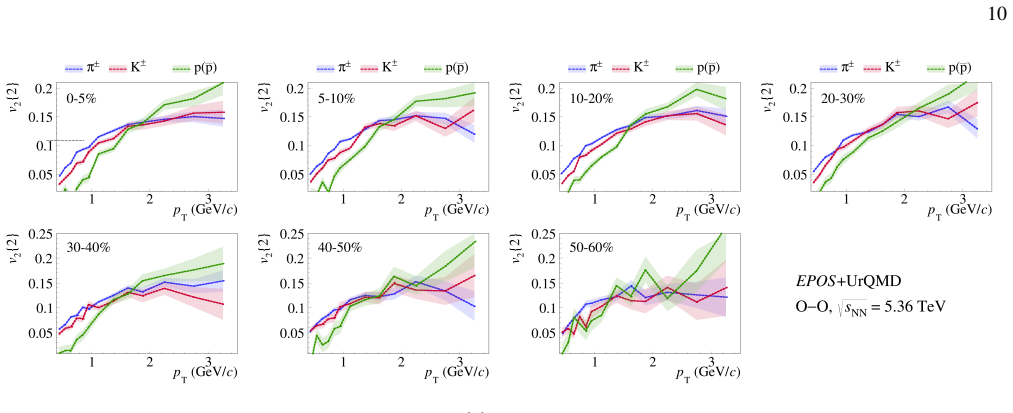
- The oxygen-oxygen system is predicted to show a measurable elliptic flow of $v_{2}\{2\} \approx 0.06$–$0.07$, with a weaker centrality dependence than in heavy-ion collisions, so LHC experiments can use O-O runs as a direct test of small-system collectivity.
- The success of a single parameter set implies that QGP transport properties, in particular a small $\eta/s \approx 0.08$, can be constrained simultaneously by large- and small-system data without ad hoc adjustments.
- The hadronic afterburner is required to describe proton yields in all three systems, meaning final-state baryon annihilation is a general feature even in small collisions, and any quantitative model must include it.
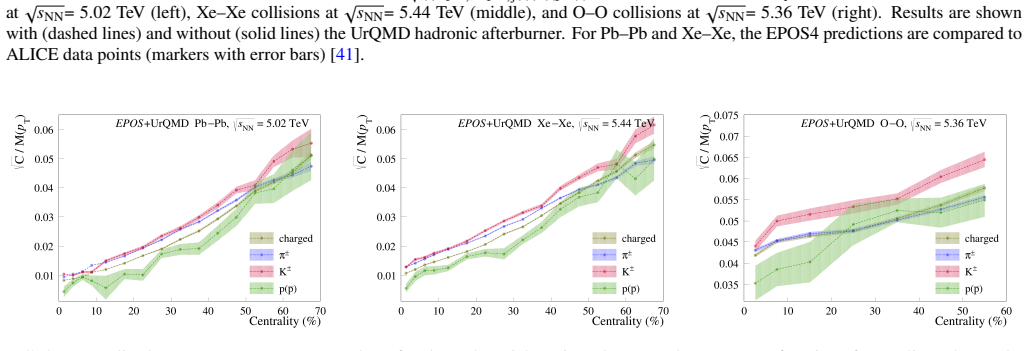
- The normalized $p_{\mathrm{T}}$ correlator in O-O follows the same trend as peripheral Pb-Pb/Xe-Xe at similar multiplicities, indicating that initial-state density fluctuations, processed by hydrodynamics, are the common source of momentum correlations across systems.
- If the predicted $v_{3}$ in O-O is confirmed, it would corroborate the fluctuation-driven origin of triangular flow and further support a hydrodynamic response in small systems.
Reading between the lines
- The O-O predictions rely on impact-parameter slicing rather than V0-multiplicity centrality, so a direct test would be to compare EPOS4 O-O results against ALICE data selected with the experimental centrality estimator; disagreement in the centrality dependence would reveal where the geometric proxy breaks down.
- The same setup could be extended to p-Pb and p-p collisions, and checking whether the predicted O-O v2 interpolates smoothly to measured small-system flow would sharpen the question of whether all small-system collectivity shares one mechanism.
- Varying $\eta/s$ around 0.08 in the O-O runs would show how strongly the predicted $v_{2}$ depends on viscosity; a strong sensitivity would turn the O-O measurement into a direct viscosity constraint for small droplets.
- A finer centrality binning and a larger O-O sample could quantify how much of the predicted 10–15% afterburner enhancement of integrated flow is genuinely hadronic, which is a concrete target for experimental systematics.
Editorial analysis
A structured set of objections, weighed in public.
Referee Report
Summary. This manuscript uses the EPOS4 event generator, with and without the UrQMD hadronic afterburner, to compute charged-particle pseudorapidity densities, identified transverse-momentum spectra, the normalized transverse-momentum correlator, and elliptic/triangular flow harmonics for Pb–Pb collisions at 5.02 TeV, Xe–Xe at 5.44 TeV, and O–O at 5.36 TeV. The Pb–Pb and Xe–Xe results are compared with ALICE data; the O–O results are presented as predictions. The central claim is that EPOS4 provides a consistent, unified description of soft observables from Pb–Pb down to O–O, and predicts a nonzero elliptic flow v2{2} ≈ 0.06–0.07 in O–O collisions, suggesting that collective expansion scales continuously to small systems.
Significance. The paper is a useful model-benchmark contribution: no parameters are fitted in this work, large event samples are generated (0.5M for Pb–Pb and Xe–Xe, 1M for O–O), and the controlled comparison with and without the UrQMD afterburner cleanly exposes the role of late-stage hadronic effects such as baryon-antibaryon annihilation. The O–O prediction is concrete and falsifiable, and the study directly addresses the open question of small-system collectivity. The significance is conditional, however: the Xe–Xe and O–O centrality classes are defined by geometric impact-parameter slicing rather than by the experimental V0-multiplicity selection, and the acknowledged ~20% deviations in the pT correlator and in low-pT flow are not quantified against data uncertainties. If the centrality bias is assessed and the agreement statements are made precise, this would be a solid contribution to the field.
major comments (3)
- [Section III A, Figures 1–13] The centrality classes for Xe–Xe and O–O are defined by directly slicing the simulated impact-parameter distribution into geometric percentiles, whereas the ALICE data and the eventual O–O measurement use percentiles of the V0 multiplicity signal. In small systems, where multiplicity fluctuations are large, these two selections need not contain the same events, and the manuscript's own statement that the geometric selection yields 'a narrower and more idealized event sample' indicates a bias that is never quantified. Since every comparison in Figures 1–13 is centrality-differential, and since v2{2} rises strongly from central to peripheral events, a mismatch could distort the apparent agreement and, crucially, the O–O prediction v2{2} ≈ 0.06 in Figure 13. I request a quantitative estimate of the bias: for example, define a V0-like multiplicity estimator in EPOS4 and compare geometric-bin observables with multiplicity-percentile-bin observables for Xe–Xe and O–O, or convert the O–O predictions to V0-multiplicity centrality classes.
- [Section III C, Figure 7] The text states that the EPOS4 calculation 'show[s] good agreement' with the ALICE pT-correlator data, but in the next sentence acknowledges 'an underestimation of 20% at more central and a similar overestimation towards peripheral region.' A 20% centrality-dependent deviation is a substantial model-data discrepancy that should be discussed explicitly, quantified with respect to the data uncertainties, and propagated into the claim of a 'consistent description' across systems. This is especially relevant because the O–O prediction in the same figure is presented as continuous scaling from the larger systems.
- [Section III D, Figures 9–13] The paper claims that EPOS4 'reproduces the experimental data' and 'successfully describes' the differential flow harmonics, yet the ratio panels in Figure 12 show a suppression for pT ≲ 0.6 GeV/c and a difference of about 20% for pT ≳ 0.6 GeV/c in Pb–Pb and Xe–Xe. Please provide a more precise statement of the level of agreement (e.g., where deviations exceed data uncertainties) and reconcile this with the strong wording. In addition, the sentence 'the hadronic afterburner suppresses the magnitude of v2 at low pT, particularly for kaons and protons. This enhancement is attributed to ...' is internally inconsistent and should be corrected.
minor comments (6)
- [Section III C] The sentence 'An underestimation of 20% at more central and a similar overestimation towards peripheral region' is missing a finite verb and should be integrated into the preceding sentence.
- [Figure 8 caption] The caption contains 'for for Pb–Pb collisions'; the duplicated word should be removed.
- [Section I] The introduction contains the typo 'behaviuor'; it should read 'behavior' or 'behaviour'.
- [Figure 13 caption] The caption cites reference [45] for both Pb–Pb and Xe–Xe integrated flow, but Pb–Pb data at 5.02 TeV are from reference [44]; please correct the citation.
- [Section III D, Eq. (2)] The figures use the notation v_n{2} while Eq. (2) defines the scalar-product estimator; please clarify the relation between the two notations (e.g., state explicitly that v_n{2} denotes the scalar-product result in this paper).
- [Section III A and figure captions] The text lists centrality classes ending at 50–60%, while the captions of Figures 4 and 5 mention 60–70%; the class definitions should be made consistent across the paper.
Circularity Check
No circularity: the paper uses EPOS4 as an externally developed model and benchmarks its output against ALICE data without fitting parameters in this work.
full rationale
The paper's comparisons are external benchmarks rather than circular derivations. EPOS4 is a Monte Carlo event generator with parameters (notably eta/s ~ 0.08) that were fixed in prior publications by the EPOS4 authors, not fitted in this paper to the ALICE data shown. The Pb-Pb and Xe-Xe comparisons therefore test the model against independent measurements, and the O-O predictions are genuine extrapolations under the same parameter set. The geometric centrality proxy for Xe-Xe and O-O, obtained by slicing the simulated impact-parameter distribution into percentiles, is a methodological caveat about matching experimental V0-based centrality; the paper explicitly acknowledges that this 'can correspond to a narrower and more idealized event sample.' That concern affects the interpretability of centrality-dependent comparisons, but it does not constitute circularity, because the model's observables are not defined in terms of the data they are compared with, and no fitted parameter is relabeled as a prediction. Citations to prior EPOS4 papers are references to the model's construction, not a self-citation chain that forces the conclusions. Overall, the derivation chain is self-contained as a model-benchmark study.
Assumptions & free parameters
free parameters (3)
- eta/s (shear viscosity to entropy density ratio) =
~0.08
- Core density threshold for core-corona separation =
not specified
- Saturation scale parameters (Q_s^2 dependence on N_conn) =
not specified
assumptions (4)
- domain assumption EPOS4 is a valid model for particle production and collective dynamics in Pb-Pb, Xe-Xe and O-O collisions.
- domain assumption UrQMD correctly describes late-stage hadronic rescattering and baryon-antibaryon annihilation.
- ad hoc to paper Geometric impact-parameter centrality is a faithful proxy for experimental V0-based centrality in Xe-Xe and O-O.
- domain assumption The scalar product method with |Delta eta| > 2.0 suppresses non-flow correlations.
Cite this review
Pith. "Pith review of Scaling of soft QGP signatures in relativistic lead, xenon and oxygen collisions in EPOS4." pith.science (2026). https://pith.science/paper/AGD6PAK5
@misc{pith2026260810578,
  author       = {Pith},
  title        = {Pith review of: Scaling of soft QGP signatures in relativistic lead, xenon and oxygen collisions in EPOS4},
  year         = {2026},
  howpublished = {\url{https://pith.science/paper/AGD6PAK5}},
  note         = {Machine review of arXiv:2608.10578}
}
abstract
The collective expansion and hydrodynamic evolution in heavy-ion collisions is well-established. However, whether femtometer-scale droplets of QGP are produced in small systems at high energies remains a fundamental open question. Analysis of Pb$-$Pb collisions at $\sqrt{s_{\mathrm{NN}}}$ = 5.02 TeV, Xe$-$Xe at $\sqrt{s_{\mathrm{NN}}}$ = 5.44 TeV and O$-$O collisions at $\sqrt{s_{\mathrm{NN}}}$ = 5.36 TeV using EPOS4 is reported to make predictions and postdictions. The results are compared with ALICE data for Pb$-$Pb and Xe$-$Xe collisions. Charged particle multiplicity (d$N_{\mathrm{ch}}$/d$\eta$), transverse-momentum ($p_{\mathrm{T}}$) spectra for pions ($\pi^{\pm}$), kaons ($K^{\pm}$), and protons ($\text{p}(\overline{\text{p}})$) are studied. The inclusion of hadronic afterburner, UrQMD (Ultra-relativistic Quantum Molecular Dynamics) is found to be necessary to correctly describe baryon yields. $p_{\mathrm{T}}$-fluctuations are also studied via normalized $p_{\mathrm{T}}$ correlator, $\sqrt{\langle \langle \Delta p_{\mathrm{T},i}\Delta p_{\mathrm{T},j} \rangle \rangle}\mathrm{/} \langle \langle p_{\mathrm{T}} \rangle \rangle$. Lastly, anisotropic flow harmonics ($v_{\mathrm{2}} \{2\}$, $v_{\mathrm{3}} \{2\}$) are computed as a function of $p_{\mathrm{T}}$ and centrality. Since EPOS4 has not been extensively studied for flow observables, this study thereby provides a non-trivial assessment of its collective dynamics. The results are compared with experiment wherever data is available. Taken together, this study provides a unified description of soft observables from Pb$-$Pb through Xe$-$Xe down to O$-$O and offer quantitative guidance on how such collisions may inform of the properties of the QGP.
Figures


Figures from the paper (10 more)






Reference graph
Works this paper leans on
-
[1]
L. Evans and P. Bryant, LHC Machine, Journal of Instrumenta- tion08, S08001 (2008)
work page 2008
-
[2]
E. V. Shuryak, Quark-Gluon Plasma and Hadronic Production of Leptons, Photons and Psions, Phys. Lett. B78, 150 (1978)
1978
- [3]
-
[4]
J. W. Harris and B. M¨ uller, ”QGP Signatures” Revisited, Eur. Phys. J. C84, 247 (2024), arXiv:2308.05743 [hep-ph]
arXiv 2024
-
[5]
Disentangle contributions to small-system collectivity via scans of light nucleus-nucleus collisions
S. Huang, Z. Chen, J. Jia, and W. Li, Disentangling contributions to small-system collectivity via scans of light nucleus-nucleus collisions, Phys. Rev. C101, 021901 (2020), arXiv:1904.10415 [nucl-ex]
work page Pith review arXiv 2020
-
[6]
Soft Probes of the Quark-Gluon Plasma with ALICE at LHC
R. Vernet (ALICE), Soft Probes of the Quark-Gluon Plasma with ALICE at LHC, in24th Lake Louise Winter Institute: Fun- damental Interactions(2009) arXiv:0906.1171 [nucl-ex]
work page Pith review arXiv 2009
-
[7]
Transverse momentum spectra of hadrons in pp, pA and AA collisions
B. Mohanty, Transverse momentum spectra of hadrons in pp, pA and AA collisions, (2003), arXiv:nucl-th/0307086
work page Pith review arXiv 2003
-
[8]
S. Jeon and V. Koch, Event by event fluctuations, inQuark- gluon plasma 3, edited by R. C. Hwa and X. N. Wang (2004) pp. 430–490, arXiv:hep-ph/0304012
arXiv 2004
Show all 47 references
-
[9]
M. D. Oldenburg (STAR), Anisotropic flow in ultra-relativistic heavy-ion collisions, in19th Lake Louise Winter Institute: Fundamental Interactions(2004) pp. 254–258, arXiv:nucl- ex/0405009
2004
-
[10]
Preghenella (ALICE), Identified-particle production and spectra with the ALICE detector in pp and Pb-Pb collisions at the LHC, Acta Phys
R. Preghenella (ALICE), Identified-particle production and spectra with the ALICE detector in pp and Pb-Pb collisions at the LHC, Acta Phys. Polon. B43, 555 (2012), arXiv:1111.7080 [hep-ex]
2012 arXiv
-
[11]
Fowler, F
G. Fowler, F. Navarra, M. Pl¨ umer, A. Vourdas, R. Weiner, and G. Wilk, Initial energy density distribution in high energy heavy ion reactions, Physics Letters B214, 657 (1988)
1988
-
[12]
C. Zampolli (ALICE), Charged Particle Multiplicity and Pseu- dorapidity Density Measurements in pp collisions with ALICE at the LHC, PoSEPS-HEP2013, 472 (2013), arXiv:1310.7430 [hep-ex]
2013 arXiv
-
[13]
Cleymans and D
J. Cleymans and D. Worku, Relativistic Thermodynamics: Transverse Momentum Distributions in High-Energy Physics, Eur. Phys. J. A48, 160 (2012), arXiv:1203.4343 [hep-ph]
2012 arXiv
-
[14]
Capella and E
A. Capella and E. G. Ferreiro, Radial flow in a final state inter- action model, (2006), arXiv:hep-ph/0605137
2006 arXiv
-
[15]
U. W. Heinz and B. V. Jacak, Two particle correlations in rela- tivistic heavy ion collisions, Ann. Rev. Nucl. Part. Sci.49, 529 (1999), arXiv:nucl-th/9902020
1999 arXiv
-
[16]
C. M. Hung and E. Shuryak, Equation of state, radial flow, and freeze-out in high energy heavy ion collisions, Phys. Rev. C57, 1891 (1998)
1998
-
[17]
Danielewicz, Effects of compression and collective expansion on particle emission from central heavy ion reactions, Phys
P. Danielewicz, Effects of compression and collective expansion on particle emission from central heavy ion reactions, Phys. Rev. 13 C51, 716 (1995), arXiv:nucl-th/9408018
1995 arXiv
-
[18]
Braun-Munzinger and J
P. Braun-Munzinger and J. Stachel, The quest for the quark- gluon plasma, Nature448, 302 (2007)
2007
-
[19]
Z. Tang, L. Yi, L. Ruan, M. Shao, H. Chen, C. Li, B. Mo- hanty, P. Sorensen, A. Tang, and Z. Xu, Statistical Origin of Constituent-Quark Scaling in the QGP hadronization, Chin. Phys. Lett.30, 031201 (2013), arXiv:1101.1912 [nucl-ex]
2013 arXiv
-
[20]
Huovinen and P
P. Huovinen and P. V. Ruuskanen, Hydrodynamic Models for Heavy Ion Collisions, Ann. Rev. Nucl. Part. Sci.56, 163 (2006), arXiv:nucl-th/0605008
2006 arXiv
-
[21]
A. P. Santos, F. I. M. Pereira, R. Silva, and J. S. Alcaniz, Consis- tent nonadditive approach and nuclear equation of state, Journal of Physics G: Nuclear and Particle Physics41, 055105 (2014)
2014
-
[22]
Bleicheret al., Relativistic hadron hadron collisions in the ultrarelativistic quantum molecular dynamics model, J
M. Bleicheret al., Relativistic hadron hadron collisions in the ultrarelativistic quantum molecular dynamics model, J. Phys. G 25, 1859 (1999), arXiv:hep-ph/9909407
1999 arXiv
-
[23]
Werner and B
K. Werner and B. Guiot, Perturbative QCD concerning light and heavy flavor in the EPOS4 framework, Phys. Rev. C108, 034904 (2023), arXiv:2306.02396 [hep-ph]
2023 arXiv
-
[24]
H. J. Drescher, M. Hladik, S. Ostapchenko, T. Pierog, and K. Werner, Parton based Gribov-Regge theory, Phys. Rept.350, 93 (2001), arXiv:hep-ph/0007198
2001 arXiv
-
[25]
Koplik and A
J. Koplik and A. H. Mueller, On the Abramovskii-Kancheli- Gribov Reggeon Cutting Rules, Phys. Lett. B58, 166 (1975)
1975
-
[26]
K. Werner, Parallel scattering, saturation, and generalized Abramovskii-Gribov-Kancheli (AGK) theorem in the EPOS4 framework, with applications for heavy-ion collisions at sNN of 5.02 TeV and 200 GeV, Phys. Rev. C109, 034918 (2024), arXiv:2310.09380 [hep-ph]
2024 arXiv
-
[27]
Pierog and K
T. Pierog and K. Werner, Epos model and ultra high energy cosmic rays, Nuclear Physics B - Proceedings Supplements196, 102 (2009), proceedings of the XV International Symposium on Very High Energy Cosmic Ray Interactions (ISVHECRI 2008)
2009
-
[28]
Werner, Flow in small systems in the EPOS4 approach for high-energy scattering, Phys
K. Werner, Flow in small systems in the EPOS4 approach for high-energy scattering, Phys. Rev. C113, 014911 (2026), arXiv:2508.07417 [hep-ph]
2026 arXiv
-
[29]
K. Werner, Revealing a deep connection between factorization and saturation: New insight into modeling high-energy proton- proton and nucleus-nucleus scattering in the epos4 framework, Phys. Rev. C108, 064903 (2023)
2023
-
[30]
Werner, Core-corona procedure and microcanonical hadronization to understand strangeness enhancement in proton- proton and heavy ion collisions in the EPOS4 framework, Phys
K. Werner, Core-corona procedure and microcanonical hadronization to understand strangeness enhancement in proton- proton and heavy ion collisions in the EPOS4 framework, Phys. Rev. C109, 014910 (2024), arXiv:2306.10277 [hep-ph]
2024 arXiv
-
[31]
Werner, I
K. Werner, I. Karpenko, T. Pierog, M. Bleicher, and K. Mikhailov, Event-by-Event Simulation of the Three- Dimensional Hydrodynamic Evolution from Flux Tube Initial Conditions in Ultrarelativistic Heavy Ion Collisions, Phys. Rev. C82, 044904 (2010), arXiv:1004.0805 [nucl-th]
2010 arXiv
-
[32]
Kovtun, D
P. Kovtun, D. T. Son, and A. O. Starinets, Viscosity in strongly interacting quantum field theories from black hole physics, Phys. Rev. Lett.94, 111601 (2005), arXiv:hep-th/0405231
2005 arXiv
-
[33]
S. A. Basset al., Microscopic models for ultrarelativistic heavy ion collisions, Prog. Part. Nucl. Phys.41, 255 (1998), arXiv:nucl-th/9803035
1998 arXiv
-
[34]
Adamet al.(ALICE), Centrality dependence of the pseu- dorapidity density distribution for charged particles in Pb-Pb collisions at√𝑠NN =5.02 TeV, Phys
J. Adamet al.(ALICE), Centrality dependence of the pseu- dorapidity density distribution for charged particles in Pb-Pb collisions at√𝑠NN =5.02 TeV, Phys. Lett. B772, 567 (2017), arXiv:1612.08966 [nucl-ex]
2017 arXiv
-
[35]
Acharyaet al.(ALICE), Centrality and pseudorapidity de- pendence of the charged-particle multiplicity density in Xe–Xe collisions at √𝑠NN =5.44TeV, Phys
S. Acharyaet al.(ALICE), Centrality and pseudorapidity de- pendence of the charged-particle multiplicity density in Xe–Xe collisions at √𝑠NN =5.44TeV, Phys. Lett. B790, 35 (2019), arXiv:1805.04432 [nucl-ex]
2019 arXiv
-
[36]
Acharyaet al.(ALICE), Production of charged pions, kaons, and (anti-)protons in Pb-Pb and inelastic𝑝𝑝collisions at √𝑠𝑁 𝑁 = 5.02 TeV, Phys
S. Acharyaet al.(ALICE), Production of charged pions, kaons, and (anti-)protons in Pb-Pb and inelastic𝑝𝑝collisions at √𝑠𝑁 𝑁 = 5.02 TeV, Phys. Rev. C101, 044907 (2020), arXiv:1910.07678 [nucl-ex]
2020 arXiv
-
[37]
Acharyaet al.(ALICE), Production of pions, kaons, (anti- )protons and𝜙mesons in Xe–Xe collisions at√𝑠NN = 5.44 TeV, Eur
S. Acharyaet al.(ALICE), Production of pions, kaons, (anti- )protons and𝜙mesons in Xe–Xe collisions at√𝑠NN = 5.44 TeV, Eur. Phys. J. C81, 584 (2021), arXiv:2101.03100 [nucl-ex]
2021 arXiv
-
[38]
J. Adam, D. Adamova, M. Aggarwal,et al.(AL- ICE), Centrality Dependence of the Charged-Particle Mul- tiplicity Density at Midrapidity in Pb-Pb Collisions at√𝑠NN = 5.02 TeV, Phys. Rev. Lett.116, 222302 (2016), figures at http://aliceinfo.cern.ch/ArtSubmission/node/2215, arXiv:1...
2016 arXiv
-
[39]
Abbaset al.(ALICE), Performance of the ALICE VZERO system, JINST8, P10016, arXiv:1306.3130 [nucl-ex]
E. Abbaset al.(ALICE), Performance of the ALICE VZERO system, JINST8, P10016, arXiv:1306.3130 [nucl-ex]
-
[40]
Steinheimer, J
J. Steinheimer, J. Aichelin, M. Bleicher, and H. St ¨ocker, In- fluence of the hadronic phase on observables in ultrarelativis- tic heavy ion collisions, Phys. Rev. C95, 064902 (2017), arXiv:1703.06638 [nucl-th]
2017 arXiv
-
[41]
Acharyaet al.(ALICE), System size and energy dependence of the mean transverse momentum fluctuations at the LHC, Eur
S. Acharyaet al.(ALICE), System size and energy dependence of the mean transverse momentum fluctuations at the LHC, Eur. Phys. J. C85, 776 (2025), arXiv:2411.09334 [nucl-ex]
2025 arXiv
-
[42]
Acharyaet al.(ALICE), Anisotropic flow of identified par- ticles in Pb-Pb collisions at √𝑠NN =5.02 TeV, JHEP09, 006, arXiv:1805.04390 [nucl-ex]
S. Acharyaet al.(ALICE), Anisotropic flow of identified par- ticles in Pb-Pb collisions at √𝑠NN =5.02 TeV, JHEP09, 006, arXiv:1805.04390 [nucl-ex]
-
[43]
Acharyaet al.(ALICE), Anisotropic flow of identified hadrons in Xe-Xe collisions at √𝑠NN = 5.44 TeV, JHEP10, 152, arXiv:2107.10592 [nucl-ex]
S. Acharyaet al.(ALICE), Anisotropic flow of identified hadrons in Xe-Xe collisions at √𝑠NN = 5.44 TeV, JHEP10, 152, arXiv:2107.10592 [nucl-ex]
-
[44]
Adamet al.(ALICE), Anisotropic flow of charged particles in Pb-Pb collisions at√𝑠NN =5.02 TeV, Phys
J. Adamet al.(ALICE), Anisotropic flow of charged particles in Pb-Pb collisions at√𝑠NN =5.02 TeV, Phys. Rev. Lett.116, 132302 (2016), arXiv:1602.01119 [nucl-ex]
2016 arXiv
-
[45]
Acharyaet al.(ALICE), Anisotropic flow in Xe-Xe col- lisions at √sNN=5.44TeV, Phys
S. Acharyaet al.(ALICE), Anisotropic flow in Xe-Xe col- lisions at √sNN=5.44TeV, Phys. Lett. B784, 82 (2018), arXiv:1805.01832 [nucl-ex]
2018 arXiv
-
[46]
S. A. Voloshin, A. M. Poskanzer, and R. Snellings, Collective phenomena in non-central nuclear collisions, Landolt-Bornstein 23, 293 (2010), arXiv:0809.2949 [nucl-ex]
2010 arXiv
-
[47]
Adleret al.(STAR), Elliptic flow from two and four particle correlations in Au+Au collisions at s(NN)**(1/2) = 130-GeV, Phys
C. Adleret al.(STAR), Elliptic flow from two and four particle correlations in Au+Au collisions at s(NN)**(1/2) = 130-GeV, Phys. Rev. C66, 034904 (2002), arXiv:nucl-ex/0206001
2002 arXiv
Reviewed August 12, 2026 · model on record in the stance chip above.
Discussion (0). Continue with ORCID to comment.