REVIEW 3 major objections 5 minor 26 references
GAN Path Finder: Preliminary results
T0 review · 3 major / 5 minor · reviewed 2026-08-14 · deepseek-v4-flash
Pith's one-line read A conditional GAN solves 91 percent of unseen 64x64 grid path-finding instances at 20 percent obstacle density after post-processing.
desk verdict A short, honest preliminary study where a pix2pix-style GAN with a path-only discriminator reaches 91.4% success on 64x64 pathfinding, but only after Bresenham gap-filling: the raw generator output is weaker than the headline metric suggests. read the letter →
The pith
A machine-rendered reading of the paper's core claim, the machinery that carries it, and where it could break.
The reading
What carries the argument
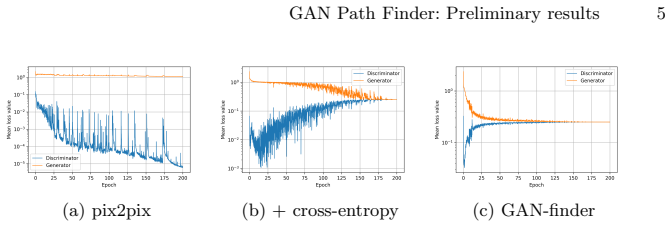
The carrying mechanism is the modified conditional GAN pipeline the paper calls GAN-finder. Its generator follows the U-Net-based variant of pix2pix and is trained with a cross-entropy classification loss, so each pixel is labeled free, blocked, or path instead of being matched to a ground-truth color. The discriminator receives only the one-channel path mask, is trained without conditioning on the input image, and uses a gradient penalty, which together push it to judge whether the path pixels form a plausible connected sequence of cells rather than whether they match a particular expert path. Finally, the post-processing stage restores the original blocked pixels and uses line-drawing to fill small gaps in the generated path; the success metric is defined on the post-processed image, so the reported results describe the generator plus this repair step.
What would settle it
On the same test set, disable the gap-filling step and count only the generated images whose path pixels already form a single connected curve from start to goal; if that raw connectedness rate is far below the reported 91.4 percent, or no better than a trivial baseline, then the claim that the network learned path-finding basics is not supported.
Extended reading notes
Core claim
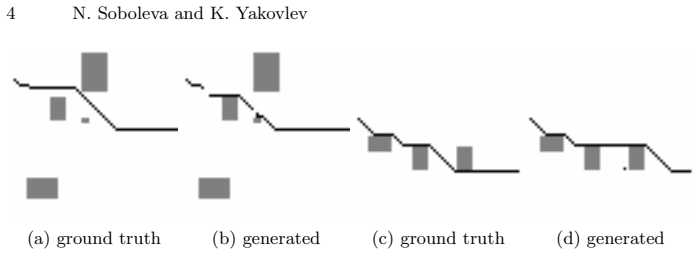
GAN-finder is a conditional GAN built on the pix2pix architecture: a U-Net-shaped generator maps a grayscale grid image with start and goal into a three-class image (free, blocked, path), while the discriminator sees only the path channel and is trained unconditionally with a gradient penalty. Two changes matter most: the generator's pixel loss is cross-entropy over the three classes rather than L1 distance, and post-processing copies blocked cells back into the output and fills gaps with line segments. With this setup, the pipeline solves 91.4 percent of unseen 64x64 instances at 20 percent rectangular-obstacle density, 73.1 percent at 30 percent density, and 65.1 percent on maps with random obstacle shapes and densities. The baseline pix2pix scores 65, 57, and 32 percent on the same test regimes. The authors interpret the much smaller gap counts and the nonzero generalization to harder maps as evidence that the model learned a feasible-path pattern, not just memorized training images.
Load-bearing premise
The load-bearing assumption is that counting an instance as solved after the line-drawing gap-filling step connects the generated path segments is fair evidence of learned path finding; if the gap-filling is doing most of the connectivity work, the high success rates would not show that the network itself learned to plan.
Editorial extensions
If this is right
- At 20 percent obstacle density on 64x64 grids, more than nine out of ten unseen instances are solved after post-processing, so a trained generator can serve as a preliminary path planner at this scale.
- The model transfers to 30 percent obstacle density without retraining and keeps about 73 percent success, so the learned representation is not locked to a single obstacle density.
- The average number of gaps per generated path drops by roughly an order of magnitude compared with the pix2pix baseline, indicating that the loss and discriminator changes improve the structural coherence of generated paths.
- Because success is measured only after line-drawing gap-filling, the reported rates are properties of the combined generator-plus-post-processor system, not of the neural network in isolation.
Reading between the lines
- If the line-drawing gap-filling were disabled, the success rates would probably drop; a natural extension is to report the fraction of raw generated images whose path pixels already form a single connected start-to-goal curve.
- The path-only, unconditional discriminator suggests the model learns a distribution over feasible paths, so the same architecture could be used to sample multiple distinct valid paths for one start-goal pair, not just a single answer.
- The drop in success on random-shaped obstacles (65 percent) compared with rectangular ones (91 percent) suggests obstacle geometry, not just density, is the harder generalization axis; separating rectangle, circle, and diamond obstacles in training would test this directly.
- The authors' stated future step of using GAN-finder to bias a classical heuristic search could be tested immediately by feeding generated path pixels as a corridor weight to a grid search and measuring how much expansion it saves.
Signed reviews
Editorial analysis
A structured set of objections, weighed in public.
Referee Report
Summary. The paper proposes GAN-finder, a conditional generative adversarial network based on pix2pix with cross-entropy generator loss and a Wasserstein-trained discriminator, which solves 2D grid path finding by generating a path image conditioned on an input grid with start and goal cells. The authors train on 64x64 grids with 20% rectangular obstacle density and evaluate on held-out 20% density maps, 30% density maps, and randomly generated maps with mixed obstacle shapes and densities. The reported metrics are MSE, number of gaps in the raw generator output, and a success rate measured after Bresenham gap-filling post-processing. The main result is that GAN-finder achieves 91.4% post-processed success on 20% density maps, 73.1% on 30% density maps, and 65.1% on random maps, substantially outperforming the pix2pix baseline. The paper concludes that these preliminary results are convincing enough to warrant further exploration of GAN-based path planning.
Significance. If the central claim holds, the paper provides preliminary evidence that a conditional GAN can learn a general notion of feasible grid paths well enough to serve as a path planner or as a heuristic source for classical search. The strengths of the work include a clear problem formulation, a held-out evaluation on unseen instances, a useful gap metric for raw generator output, and an honest statement that the results are preliminary. The main weakness is that the headline success metric is defined after a deterministic gap-filling post-process, so the reported numbers do not by themselves establish that the generator alone has learned path finding. With additional ablations and statistical rigor, the paper could support a more defensible claim about the viability of the approach.
major comments (3)
- [Section 4, 'Image post-processing' and 'Success metrics'; Table 1] The reported success rates are defined only for the post-processed output: an instance counts as solved when the Bresenham gap-filled path connects start and goal. Because Table 1 lists a mean of 1.49 gaps at 20% density, most raw GAN-finder outputs are not complete paths; the headline 91.4% is therefore a property of the generator-plus-gap-filler system, not of the generator alone. Please report the success rate before gap-filling and add control baselines that isolate the post-processor, e.g., apply the same gap-filling procedure to an all-free image or to a straight start-goal segment, so the reader can judge how much connectivity work the post-processor performs.
- [Table 1 and Section 5 (Evaluation)] All success metrics are reported as single point estimates with no error bars, no number of test instances, and no multiple training seeds. Without these, the reported differences between conditions (e.g., 91.4% vs. 73.1% vs. 65.1%) cannot be distinguished from run-to-run or sample-to-sample variance, and the generalization claims are not statistically supported. Please state the test-set size and report means and standard deviations over at least several independent training runs.
- [Section 4 (Architectural choices) and Table 1] GAN-finder differs from the pix2pix baseline by several simultaneous changes: a U-Net generator with skip connections, cross-entropy instead of L1 loss, an unconditional discriminator, and Wasserstein gradient penalty. Since the paper attributes the improved success to GAN-finder, an ablation study isolating which of these components drives the gap reduction and success improvement is needed to support that attribution; without it, the comparison in Table 1 conflates multiple design decisions and the reader cannot determine which modification is load-bearing.
minor comments (5)
- [Figure 1 caption] The caption contains a typo: 'image-ouput' should be 'image-output'.
- [Section 5, Dataset description] The 'Random' dataset is not precisely defined in the text or table header; please specify the obstacle density range, obstacle shapes, and the number of instances used for the random evaluation.
- [Figure 3] The training curves lack axis labels and legend clarity; please specify what is plotted on each axis and identify the loss curves for the generator and discriminator more clearly.
- [Section 4, Grid-to-image conversion and Section 5] The paper states that 8-connected grids are used but does not specify whether the Bresenham gap-filling procedure always produces 8-connected paths; please clarify the connectivity conventions used in both the path definition and the post-processing.
- [General reproducibility] No code, data-generation scripts, or hyperparameter settings are provided; for a machine learning paper, including these details would substantially improve reproducibility.
Circularity Check
No significant circularity: the reported success rates are held-out empirical evaluations, not quantities forced by construction or by self-citation.
full rationale
The paper's central claim is an empirical success rate of a trained conditional GAN (pix2pix variant) on held-out 64x64 grid path-finding instances. The model is trained on ground-truth A* path images, and success is measured on test data not used for training, so the headline numbers are not fitted outputs of the method's own assumptions. The only potentially load-bearing choice is the Bresenham gap-filling post-processor in Section 4 ('Image post-processing', 'Success metrics'), where success is counted only after gaps are filled and the path connects start to goal. This is an evaluation-design concern rather than circularity: the paper explicitly reports the number of gaps before post-processing and states that success is defined for the post-processed result, so the metric is transparently a property of the full system (generator plus fixed gap-filler), not a hidden re-use of the training labels. No equation in the paper defines the prediction in terms of the measured outcome, no fitted parameter is renamed as a prediction, and no load-bearing claim rests on a self-citation or an imported uniqueness theorem. Accordingly, there is no circular step to exhibit, and the correct finding is 'no significant circularity' (score 0).
Assumptions & free parameters
assumptions (3)
- domain assumption Grid paths use 8-connectivity between adjacent cells.
- domain assumption The environment is static and fully known through the grid image.
- domain assumption A* paths used as ground truth are valid and representative of feasible paths.
Cite this review
Pith. "Pith review of GAN Path Finder: Preliminary results." pith.science (2026). https://pith.science/paper/AGJ2Y7KC
@misc{pith2026190801499,
  author       = {Pith},
  title        = {Pith review of: GAN Path Finder: Preliminary results},
  year         = {2026},
  howpublished = {\url{https://pith.science/paper/AGJ2Y7KC}},
  note         = {Machine review of arXiv:1908.01499}
}
read the original abstract
2D path planning in static environment is a well-known problem and one of the common ways to solve it is to 1) represent the environment as a grid and 2) perform a heuristic search for a path on it. At the same time 2D grid resembles much a digital image, thus an appealing idea comes to being -- to treat the problem as an image generation task and to solve it utilizing the recent advances in deep learning. In this work we make an attempt to apply a generative neural network as a path finder and report preliminary results, convincing enough to claim that this direction of research is worth further exploration.
Figures

Figures from the paper (1 more)

Reference graph
Works this paper leans on
-
[1]
IBM Systems Journal 4(1), 25–30 (1965)
Bresenham, J.E.: Algorithm for computer control of a digital plotter. IBM Systems Journal 4(1), 25–30 (1965)
1965
-
[2]
Artificial Intelligence 173(14), 1310–1342 (2009)
Ebendt, R., Drechsler, R.: Weighted A* search – Unifying View and Application. Artificial Intelligence 173(14), 1310–1342 (2009)
work page 2009
- [3]
-
[4]
Com- puter 22(6), 46–57 (1989)
Elfes, A.: Using occupancy grids for mobile robot perception and navigation. Com- puter 22(6), 46–57 (1989)
work page 1989
-
[5]
In: Pro- ceedings of The 2017 IEEE International Conference on Robotics and Automation (ICRA 2017)
Finn, C., Levine, S.: Deep visual foresight for planning robot motion. In: Pro- ceedings of The 2017 IEEE International Conference on Robotics and Automation (ICRA 2017). pp. 2786–2793 (2017)
work page 2017
-
[6]
In: Advances in Neural Information Processing Systems 27
Goodfellow, I., Pouget-Abadie, J., Mirza, M., Xu, B., Warde-Farley, D., Ozair, S., Courville, A., Bengio, Y.: Generative adversarial nets. In: Advances in Neural Information Processing Systems 27. pp. 2672–2680 (2014)
work page 2014
-
[7]
In: Proceedings of the 32nd International Conference on MachineLearning (ICML 2015) (2015)
Gregor, K., Danihelka, I., Graves, A., Rezende, D.J., Wierstra, D.: Draw: A recur- rent neural network for image generation. In: Proceedings of the 32nd International Conference on MachineLearning (ICML 2015) (2015)
work page 2015
-
[8]
In: Proceedings of the 31st International Conference on Neural Information Processing Systems
Gulrajani, I., Ahmed, F., Arjovsky, M., Dumoulin, V., Courville, A.: Improved training of wasserstein gans. In: Proceedings of the 31st International Conference on Neural Information Processing Systems. pp. 5769–5779. NIPS’17, Curran As- sociates Inc., USA (2017)
work page 2017
Show all 26 references
-
[9]
In: Proceedings of The 30th IEEE Conference on Computer Vision and Pattern Recognition (CVPR 2017) (2017)
Gupta, S., Davidson, J., Levine, S., Sukthankar, R., Malik, J.: Cognitive mapping and planning for visual navigation. In: Proceedings of The 30th IEEE Conference on Computer Vision and Pattern Recognition (CVPR 2017) (2017)
2017
-
[10]
In: Proceedings of The 25th AAAI Conference on Artificial Intelligence (AAAI 2011)
Harabor, D., Grastien, A.: Online graph pruning for pathfinding on grid maps. In: Proceedings of The 25th AAAI Conference on Artificial Intelligence (AAAI 2011). pp. 1114–1119 (2011)
2011
-
[11]
IEEE transactions on Systems Science and Cybernet- ics 4(2), 100–107 (1968)
Hart, P.E., Nilsson, N.J., Raphael, B.: A formal basis for the heuristic determina- tion of minimum cost paths. IEEE transactions on Systems Science and Cybernet- ics 4(2), 100–107 (1968)
1968
-
[12]
2017 IEEE Conference on Computer Vision and Pattern Recognition (CVPR) pp
Isola, P., Zhu, J.Y., Zhou, T., Efros, A.A.: Image-to-image translation with con- ditional adversarial networks. 2017 IEEE Conference on Computer Vision and Pattern Recognition (CVPR) pp. 5967–5976 (2017)
2017
-
[13]
Krizhevsky, A., Sutskever, I., Hinton, G.E.: Imagenet classification with deep con- volutional neural networks. Commun. ACM 60, 84–90 (2012) GAN Path Finder: Preliminary results 9
2012
-
[14]
In: Proceedings of the 25th International Conference on Machine Learning (ICML 2018)
Lee, L., Parisotto, E., Chaplot, D.S., Xing, E., Salakhutdinov, R.: Gated path plan- ning networks. In: Proceedings of the 25th International Conference on Machine Learning (ICML 2018). pp. 2953–2961 (2018)
2018
-
[15]
In: Proceedings of the 23rd AAAI Conference on Artificial Intelligence (AAAI-2008) (2008)
Likhachev, M., Stentz, A.: R* search. In: Proceedings of the 23rd AAAI Conference on Artificial Intelligence (AAAI-2008) (2008)
2008
-
[16]
In: Advances in Neural Information Processing Sys- tems
Mirowski, P., Grimes, M., Malinowski, M., Hermann, K.M., Anderson, K., Teplyashin, D., Simonyan, K., Zisserman, A., Hadsell, R., et al.: Learning to nav- igate in cities without a map. In: Advances in Neural Information Processing Sys- tems. pp. 2419–2430 (2018)
2018
-
[17]
CoRR abs/1411.1784 (2014), http://arxiv.org/abs/1411.1784
Mirza, M., Osindero, S.: Conditional generative adversarial nets. CoRR abs/1411.1784 (2014), http://arxiv.org/abs/1411.1784
2014 arXiv
-
[18]
Procedia computer science123, 347–353 (2018)
Panov, A.I., Yakovlev, K.S., Suvorov, R.: Grid path planning with deep reinforce- ment learning: Preliminary results. Procedia computer science123, 347–353 (2018)
2018
-
[19]
In: 2016 IEEE Conference on Computer Vision and Pattern Recognition (CVPR)
Pathak, D., Kr¨ ahenb¨ uhl, P., Donahue, J., Darrell, T., Efros, A.A.: Context en- coders: Feature learning by inpainting. In: 2016 IEEE Conference on Computer Vision and Pattern Recognition (CVPR). pp. 2536–2544 (2016)
2016
-
[20]
In: Navab, N., Hornegger, J., Wells, W.M., Frangi, A.F
Ronneberger, O., Fischer, P., Brox, T.: U-net: Convolutional networks for biomed- ical image segmentation. In: Navab, N., Hornegger, J., Wells, W.M., Frangi, A.F. (eds.) Medical Image Computing and Computer-Assisted Intervention – MICCAI
-
[21]
In: Proceedings of Robotics: Science and Systems (RSS-2019)
Schleich, D., Klamt, T., Behnke, S.: Value iteration networks on multiple levels of abstraction. In: Proceedings of Robotics: Science and Systems (RSS-2019)
2019
-
[22]
IEEE Transactions on Computational Intelligence and AI in Games 4(2), 144–148 (2012)
Sturtevant, N.R.: Benchmarks for grid-based pathfinding. IEEE Transactions on Computational Intelligence and AI in Games 4(2), 144–148 (2012)
2012
-
[23]
In: Advances in Neural Information Processing Systems 29 (NIPS 2016)
Tamar, A., Wu, Y., Thomas, G., Levine, S., Abbeel, P.: Value iteration networks. In: Advances in Neural Information Processing Systems 29 (NIPS 2016). pp. 2154– 2162 (2016)
2016
-
[24]
Autonomous robots 15(2), 111–127 (2003)
Thrun, S.: Learning occupancy grid maps with forward sensor models. Autonomous robots 15(2), 111–127 (2003)
2003
-
[25]
In: 2017 IEEE international conference on robotics and automation (ICRA 2017)
Zhu, Y., Mottaghi, R., Kolve, E., Lim, J.J., Gupta, A., Fei-Fei, L., Farhadi, A.: Target-driven visual navigation in indoor scenes using deep reinforcement learning. In: 2017 IEEE international conference on robotics and automation (ICRA 2017). pp. 3357–3364 (2017)
2017
-
[2015]
pp. 234–241. Springer International Publishing, Cham (2015)
2015
Reviewed August 14, 2026 · model on record in the stance chip above.
Discussion (0). Continue with ORCID to comment.