REVIEW 2 major objections 5 minor 41 references
Efficient Feedback Gate Network for Hyperspectral Image Super-Resolution
T0 review · 2 major / 5 minor · reviewed 2026-08-06 · deepseek-v4-flash
Pith's one-line read This paper proposes EFGN, a group-based hyperspectral super-resolution network, and reports the best PSNR, SSIM, SAM, RMSE, and ERGAS on Chikusei, Pavia Centre, and Harvard at x4 and x8, with the lowest FLOPs and memory among compared…
desk verdict Solid but incremental SHSR architecture with a glaring loss-function typo that must be corrected before the reported spectral gains are reproducible. read the letter →
The pith
A machine-rendered reading of the paper's core claim, the machinery that carries it, and where it could break.
The reading
What carries the argument
The load-bearing object is the SPDFM-to-SSRGM feedback chain. SPDFM (shuffled and progressive dilated fusion module) creates two guidance streams for each spectral subgroup: a parameter-free channel shuffle of the neighboring group's raw bands, carrying spectral-channel information, and dilated convolutions of the previous subgroup's enhanced feature, carrying hierarchical spatial information. SSRGM (spatial–spectral reinforcement gate module) is the feature extractor: a wide-bound perception gate block (WPGB) decomposes a large kernel into horizontal and vertical strip convolutions, multiplies their outputs as a gate, and applies partial convolution; a spectrum enhancement gate block (SEGB) then multiplies vertical strip convolution by pointwise convolution and passes through channel attention. The 3D-SSRGM replaces the strip convolutions with three directional 3D strip convolutions and refines the concatenated groups. These components work together to give each group an enlarged receptive field and cross-band mixing while keeping parameters and memory low.
What would settle it
Open the released EFGN repository and inspect or run the loss exactly as Eq. (13) is written (positive cosine similarity divided by $\pi$, without a $1-\cdot$ term). If the network still trains to the reported SAM values, the equation is a typo but the reported benefit is real; if training diverges or SAM degrades, then the paper's central spectral-fidelity claim depends on an unstated correction and would need that correction to be verified.
Extended reading notes
Core claim
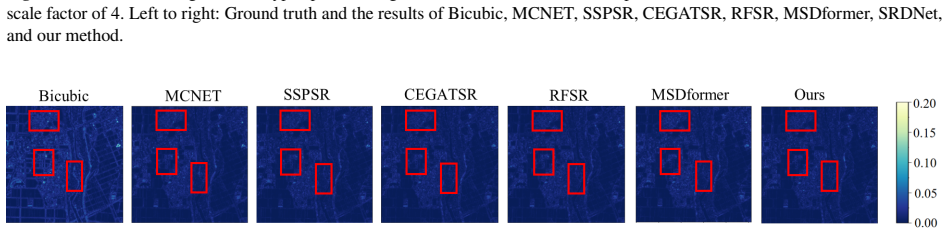
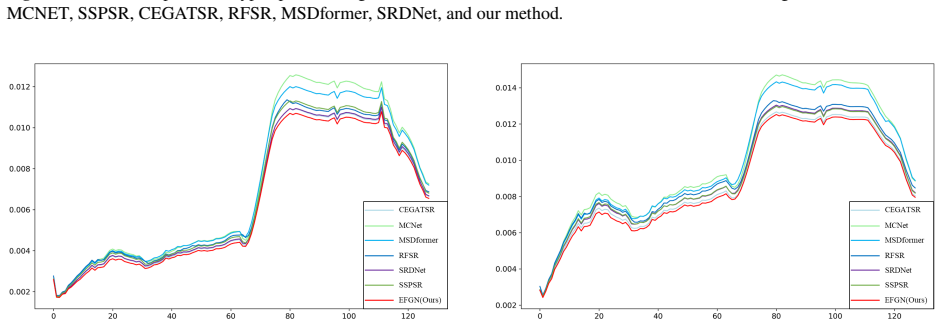
The paper's central claim is that spectral coherence between neighboring band groups can be supplied cheaply by feedback rather than by processing the whole cube with 3D convolutions. Specifically, EFGN's shuffled and progressive dilated fusion module (SPDFM) takes the adjacent group's raw bands, channel-shuffles them, and also passes the previous group's enhanced feature through progressively dilated convolutions; both streams are concatenated with the current group's input to produce a guided input. The spatial–spectral reinforcement gate module (SSRGM) then multiplies vertical and horizontal large-kernel strip convolution outputs as a gate, feeds the result through partial convolution and channel attention, and the 3D-SSRGM repeats this in three directions on the merged feature. The paper reports that this combination yields the best scores on all three datasets and both scales, e.g., PSNR about 0.15 dB higher than CEGATSR at x4 and 0.32 dB higher at x8 on Chikusei, and spectral angle mapper (SAM) 0.12 and 0.2 lower, and that it does so with lower FLOPs and memory than every comparison method. Ablations attribute the gains to both the feedback guidance and the gate blocks, and to adding spectral, gradient, and spectral-spatial total variation losses to the L1 loss.
Load-bearing premise
The result's spectral-fidelity advantage rests on the spectral loss being implemented as a similarity that the network can minimize; as printed, Eq. (13) sums positive cosine similarities, so a literal implementation would reward disagreement with the ground-truth spectrum.
Editorial extensions
If this is right
- Group-based SHSR can reach state-of-the-art accuracy with lower FLOPs and memory than 3D-convolution or transformer-based alternatives.
- Feeding feedback from the previous subgroup—both raw shuffled bands and dilated enhanced features—improves spectral coherence between adjacent groups without extra parameters in the shuffle stream.
- Gated large-kernel strip convolutions give an enlarged effective receptive field while avoiding the full cost of a large 2D kernel.
- The 3D gate refinement after subgroup merging adds consistent spatial–spectral gains, supporting the paper's claim that holistic refinement benefits the final cube.
- The full four-term loss, including spectral angle and gradient terms, is what the paper credits for its best spectral-fidelity numbers.
Reading between the lines
- Readers who reuse EFGN should verify the sign of the spectral loss in the released code, because Eq. (13) as printed would penalize spectral similarity rather than reward it; the reported SAM gains would follow only from an implementation such as $1 - \cos(\theta)/\pi$.
- Because the channel-shuffle feedback stream is parameter-free, a natural test is whether inserting SPDFM into other group-based backbones, such as CEGATSR, transfers a similar gain, which would isolate the feedback mechanism from the gate blocks.
- The authors' own conclusion notes that grouping adjacent similar bands can yield redundant features and that fixed kernels limit object-specific extraction; these acknowledged limitations suggest the reported margins may be dataset-dependent and that adding distant bands or deformable kernels, their stated future work, is the next place to look for gains.
- At x8 the absolute improvements over the second-best method are around 0.1–0.3 dB PSNR; whether that translates to visually or application-relevant gains, such as classification or unmixing accuracy, is not tested in the paper and would be a natural follow-up.
Editorial analysis
A structured set of objections, weighed in public.
Referee Report
Summary. The manuscript proposes the Efficient Feedback Gate Network (EFGN), a group-based single hyperspectral image super-resolution (SHSR) method. The network uses a Shuffled and Progressive Dilated Fusion Module (SPDFM) to propagate channel and spatial guidance between adjacent spectral groups, and a Spatial–Spectral Reinforcement Gate Module (SSRGM) built from wide-bound perception and spectrum enhancement gate blocks, followed by a 3D-SSRGM refinement. The training loss combines L1, a spectral loss L_spe, a gradient loss L_gra, and a spatial–spectral total variation loss. Experiments on Chikusei, Pavia Centre, and Harvard at scale factors 4 and 8 compare against six SOTA methods, reporting PSNR, SSIM, SAM, RMSE, and ERGAS, with EFGN claiming the best results on nearly all metrics and datasets. The paper also reports efficiency (Params, FLOPs, Memory) and ablation studies for each component and loss term.
Significance. If the reported results are correct, EFGN is a meaningful advance for group-based SHSR: it achieves consistent SOTA on three public datasets at both scale factors, while using the lowest FLOPs and memory among the compared models. The architectural ideas — inter-group feedback with channel shuffle and dilated convolution, gated large-kernel strip convolutions, spectral channel attention, and a 3D refinement stage — are plausible and well-motivated by prior work. The manuscript includes thorough ablation experiments and makes code publicly available, which are strengths. However, the spectral loss as written in Eq. (13) is internally inconsistent with the reported ablation behavior and the stated goal of spectral fidelity; because the spectral-fidelity claims in Tables 1–3 and 6 depend directly on this term, the central empirical claim is not reproducible from the manuscript without an unstated correction. The significance is therefore contingent on a fix to the loss definition and clarification of the implementation.
major comments (2)
- [§3.4, Eq. (13)] The spectral loss L_spe is defined as the mean cosine similarity between the ground-truth and reconstructed spectra divided by pi. Since the total loss L_total in Eq. (17) minimizes L1 + 0.5 L_spe + ..., minimizing L_spe drives the cosine similarity toward its minimum of zero (orthogonality), which penalizes spectral similarity rather than enforcing it. This contradicts the stated purpose of the loss ('to constrain the spectral structure') and the ablation in Table 6, where adding L_spe reduces SAM by 0.08 and improves PSNR. The reported improvements therefore cannot be produced by the formula as written; the implementation evidently uses a monotone transformation such as 1 minus cosine similarity or arccos(cosine similarity)/pi. The equation must be corrected and the exact loss formula reported, otherwise the spectral-fidelity component of the headline result is not reproducible from the manuscript.
- [§4.5, Table 3] The text states that 'For the ×8 scale factor, RFSR possesses the best spectral fidelity,' but Table 3 shows EFGN with a lower SAM (3.6123) than RFSR (3.6599) at ×8 on Harvard. This statement is internally inconsistent and should be corrected, since it undermines the narrative that EFGN achieves the best spectral fidelity across datasets and scales.
minor comments (5)
- [§4.3–4.5, Tables 1–3] All quantitative comparisons are reported as single-run values without error bars or multi-seed statistics. Given that several improvements over the second-best method are small (e.g., 0.15 dB PSNR on Chikusei ×4), reporting variance or confidence intervals would strengthen the claim of consistent SOTA performance.
- [§4.8, Table 5] In the ablation subsection 'Effectiveness of the SPDFM', the sentence 'SC denotes spectral channel guidance, and represents hierarchical spatial guidance' is missing the acronym HS before 'represents'. This makes the table header and the corresponding text harder to follow.
- [§3.4, Eq. (16)] The loss term is written as L_SSV T in Eq. (16) but referred to as L_sstv elsewhere in the text; the notation should be made consistent.
- [Abstract and code link] The code repository is mentioned as https://github.com/X-F-Wang/EFGN.git, but no commit hash or version is provided, making exact reproduction dependent on the repository's current state; adding a commit hash or release tag would be helpful.
- [§1 and §4.7] There are a few typographical issues, such as 'SPDF' versus 'SPDFM' usage and the expansion of the acronym WPGB in the receptive-field evaluation paragraph, where the full name is given as 'Weighted Progressive Gating Block' while the earlier definition is 'wide-bound perception gate block'. These should be harmonized.
Circularity Check
No significant circularity: the EFGN claims rest on empirical comparisons against external baselines and public datasets, with no fitted parameter or self-citation chain disguised as a prediction.
full rationale
The paper's central claims are architectural and empirical: EFGN is a new network whose PSNR/SSIM/SAM/RMSE/ERGAS results are measured against six external SHSR baselines on Chikusei, Pavia Centre, and Harvard. No component is derived from the benchmark numbers, and no fitted constant is renamed as a prediction. The hyperparameters (lambda values, group size, kernel size) are stated as following prior work or are ordinary training settings, not fitted to the test sets. There is no load-bearing self-citation: the most relevant prior group-based works (RFSR, GSSR, SSPSR, CEGATSR) are authored by different groups, and the present authors' own prior work is not invoked to justify the central result. No uniqueness theorem or ansatz is imported via self-citation. The only notable internal issue is the spectral loss in Eq. (13), which is written as a positive cosine similarity divided by pi, so that minimizing L_total would penalize spectral similarity to the ground truth; this contradicts the stated purpose and the Table 6 ablation. However, this is an internal inconsistency or reproducibility defect in the training objective, not a circular derivation: it does not make the reported SOTA results equivalent to the paper's inputs by construction. The paper is self-contained against external benchmarks, so the appropriate circularity score is 0.
Assumptions & free parameters
free parameters (7)
- Loss weight lambda1 for L_spe =
0.5
- Loss weight lambda2 for L_gra =
0.1
- Loss weight lambda3 for L_sstv =
1e-3
- Bands per group =
4
- Channel shuffle piece =
4
- Strip convolution kernel size =
15
- SSRGM block number =
1 (2D), 6 (3D)
assumptions (4)
- domain assumption Group-based processing along the spectral dimension preserves band coherence sufficiently for SR reconstruction.
- domain assumption Public benchmark test splits and the authors' re-tuning of baselines yield a fair comparison.
- domain assumption The L1, gradient, and total-variation losses are appropriate for spatial fidelity.
- domain assumption The Adam optimizer with the stated schedule converges to a performance representative of the architecture.
Cite this review
Pith. "Pith review of Efficient Feedback Gate Network for Hyperspectral Image Super-Resolution." pith.science (2026). https://pith.science/paper/AGL4UC2H
@misc{pith2026250617361,
  author       = {Pith},
  title        = {Pith review of: Efficient Feedback Gate Network for Hyperspectral Image Super-Resolution},
  year         = {2026},
  howpublished = {\url{https://pith.science/paper/AGL4UC2H}},
  note         = {Machine review of arXiv:2506.17361}
}
read the original abstract
Even without auxiliary images, single hyperspectral image super-resolution (SHSR) methods can be designed to improve the spatial resolution of hyperspectral images. However, failing to explore coherence thoroughly along bands and spatial-spectral information leads to the limited performance of the SHSR. In this study, we propose a novel group-based SHSR method termed the efficient feedback gate network, which uses various feedbacks and gate operations involving large kernel convolutions and spectral interactions. In particular, by providing different guidance for neighboring groups, we can learn rich band information and hierarchical hyperspectral spatial information using channel shuffling and dilatation convolution in shuffled and progressive dilated fusion module(SPDFM). Moreover, we develop a wide-bound perception gate block and a spectrum enhancement gate block to construct the spatial-spectral reinforcement gate module (SSRGM) and obtain highly representative spatial-spectral features efficiently. Additionally, we apply a three-dimensional SSRGM to enhance holistic information and coherence for hyperspectral data. The experimental results on three hyperspectral datasets demonstrate the superior performance of the proposed network over the state-of-the-art methods in terms of spectral fidelity and spatial content reconstruction.
Figures


Figures from the paper (12 more)




Reference graph
Works this paper leans on
-
[1]
Hyperspectralimagesuper-resolutionviadual-domain network based on hybrid convolution
Liu,Tingting,Liu,Yuan,Zhang,Chuncheng,Yuan,Liyin,Sui,Xiubao,Chen,Qian,2024. Hyperspectralimagesuper-resolutionviadual-domain network based on hybrid convolution. IEEE Transactions on Geoscience and Remote Sensing 62, 3370107
work page 2024
-
[2]
Hyperspectral anomaly detection based on machine learning: An overview
Xu, Yichu, Zhang, Lefei, Du, Bo, Zhang, Liangpei, 2022. Hyperspectral anomaly detection based on machine learning: An overview. IEEE Journal of Selected Topics in Applied Earth Observations and Remote Sensing 15, 3351–3364
work page 2022
-
[3]
Single image super-resolution based on progressive fusion of orientation-aware features
He, Zewei, Chen, Du, Cao, Yanpeng, Yang, Jiangxin, Cao, Yanlong, Li, Xin, Tang, Siliang, Zhuang, Yueting, Lu, Zhe-ming, 2023. Single image super-resolution based on progressive fusion of orientation-aware features. Pattern Recognition 133, 109038
work page 2023
-
[4]
Wang, Yao, Chen, Xi’ai, Han, Zhi, He, Shiying, 2017. Hyperspectral image super-resolution via nonlocal low-rank tensor approximation and total variation regularization. Remote Sensing 9, 1286
work page 2017
-
[5]
Single image super-resolution based on trainable feature matching attention network
Chen, Qizhou, Shao, Qing, 2024. Single image super-resolution based on trainable feature matching attention network. Pattern Recognition 149, 110289
work page 2024
-
[6]
Image super-resolution using deep convolutional networks
Dong, Chao, Loy, Chen Change, He, Kaiming, Tang, Xiaoou, 2015. Image super-resolution using deep convolutional networks. IEEE transactions on pattern analysis and machine intelligence 38, 295–307
work page 2015
-
[7]
Lim, Bee, Son, Sanghyun, Kim, Heewon, Nah, Seungjun, Mu Lee, Kyoung, 2017. Enhanced deep residual networks for single image super-resolution, in: Proceedings of the IEEE conference on computer vision and pattern recognition workshops, pp. 136–144
work page 2017
-
[8]
Lu,Xiaochen,Yang,Dezheng,Zhang,Junping,Jia,Fengde,2021. Hyperspectralimagesuper-resolutionbasedonspatialcorrelation-regularized unmixing convolutional neural network. Remote Sensing 13, 4074
work page 2021
Show all 41 references
-
[9]
Hyperspectral image spatial super-resolution via 3d full convolutional neural network
Mei, Shaohui, Yuan, Xin, Ji, Jingyu, Zhang, Yifan, Wan, Shuai, Du, Qian, 2017. Hyperspectral image spatial super-resolution via 3d full convolutional neural network. Remote Sensing 9, 1139
2017
-
[10]
Interactformer: Interactive transformer and cnn for hyperspectral image super-resolution
Liu, Yaoting, Hu, Jianwen, Kang, Xudong, Luo, Jing, Fan, Shaosheng, 2022. Interactformer: Interactive transformer and cnn for hyperspectral image super-resolution. IEEE Transactions on Geoscience and Remote Sensing 60, 1–15
2022
-
[11]
Learning spatial-spectral prior for super-resolution of hyperspectral imagery
Jiang, Junjun, Sun, He, Liu, Xianming, Ma, Jiayi, 2020. Learning spatial-spectral prior for super-resolution of hyperspectral imagery. IEEE Transactions on Computational Imaging 6, 1082–1096
2020
-
[12]
Hyperspectral image super-resolution via recurrent feedback embedding and spatial–spectral consistency regularization
Wang, Xinya, Ma, Jiayi, Jiang, Junjun, 2022. Hyperspectral image super-resolution via recurrent feedback embedding and spatial–spectral consistency regularization. IEEE Transactions on Geoscience and Remote Sensing 60, 1–13
2022
-
[13]
Cnn-enhanced graph attention network for hyperspectral image super-resolution using non-local self-similarity
Liu, Cong, Dong, Yaxin, 2022. Cnn-enhanced graph attention network for hyperspectral image super-resolution using non-local self-similarity. International Journal of Remote Sensing 43, 4810–4835
2022
-
[14]
Hyperspectral image superresolution using spectrum and feature context
Wang, Qi, Li, Qiang, Li, Xuelong, 2020. Hyperspectral image superresolution using spectrum and feature context. IEEE Transactions on Industrial Electronics 68, 11276–11285
2020
-
[15]
Group shuffle and spectral-spatial fusion for hyperspectral image super-resolution
Wang, Xinya, Cheng, Yingsong, Mei, Xiaoguang, Jiang, Junjun, Ma, Jiayi, 2023. Group shuffle and spectral-spatial fusion for hyperspectral image super-resolution. IEEE Transactions on Computational Imaging 8, 1223–1236
2023
-
[16]
Blueprint separable residual network for efficient image super-resolution, in: Proceedings of the IEEE/CVF conference on computer vision and pattern recognition, pp
Li, Zheyuan, Liu, Yingqi, Chen, Xiangyu, Cai, Haoming, Gu, Jinjin, Qiao, Yu, Dong, Chao, 2022. Blueprint separable residual network for efficient image super-resolution, in: Proceedings of the IEEE/CVF conference on computer vision and pattern recognition, pp. 833–843
2022
-
[17]
Single image super-resolution based on directional variance attention network
Behjati, Parichehr, Rodriguez, Pau, Fernández, Carles, Hupont, Isabelle, Mehri, Armin, Gonzalez, Jordi, 2023. Single image super-resolution based on directional variance attention network. Pattern Recognition 133, 108997
2023
-
[18]
Hyperspectral image super-resolution using deep convolutional neural network
Li, Yunsong, Hu, Jing, Zhao, Xi, Xie, Weiying, Li, JiaoJiao, 2017. Hyperspectral image super-resolution using deep convolutional neural network. Neurocomputing 266, 29–41
2017
-
[19]
Hyperspectral image superresolution by transfer learning
Yuan, Yuan, Zheng, Xiangtao, Lu, Xiaoqiang, 2017. Hyperspectral image superresolution by transfer learning. IEEE Journal of Selected Topics in Applied Earth Observations and Remote Sensing 10, 1963–1974
2017
-
[20]
3dfcnn: Real-time action recognition using 3d deep neural networks with raw depth information
Sanchez-Caballero, Adrian, de López-Diz, Sergio, Fuentes-Jimenez, David, Losada-Gutiérrez, Cristina, Marrón-Romera, Marta, Casillas-Perez, David, Sarker, Mohammad Ibrahim, 2022. 3dfcnn: Real-time action recognition using 3d deep neural networks with raw depth information. Mult...
2022
-
[21]
Mixed 2d/3d convolutional network for hyperspectral image super-resolution
Li, Qiang, Wang, Qi, Li, Xuelong, 2020. Mixed 2d/3d convolutional network for hyperspectral image super-resolution. Remote sensing 12, 1660
2020
-
[22]
Hyperspectralimagesuper-resolutionviadual-domain network based on hybrid convolution
Liu,Tingting,Liu,Yuan,Zhang,Chuncheng,Yuan,Liyin,Sui,Xiubao,Chen,Qian,2024. Hyperspectralimagesuper-resolutionviadual-domain network based on hybrid convolution. IEEE Transactions on Geoscience and Remote Sensing 62, 1–18
2024
-
[23]
Single hyperspectral image super-resolution with grouped deep recursive residual network, in: 2018 IEEE Fourth International Conference on Multimedia Big Data (BigMM), IEEE
Li, Yong, Zhang, Lei, Dingl, Chen, Wei, Wei, Zhang, Yanning, 2018. Single hyperspectral image super-resolution with grouped deep recursive residual network, in: 2018 IEEE Fourth International Conference on Multimedia Big Data (BigMM), IEEE. pp. 1–4
2018
-
[24]
A spectral grouping and attention-driven residual dense network for hyperspectral image super-resolution
Liu, Denghong, Li, Jie, Yuan, Qiangqiang, 2021. A spectral grouping and attention-driven residual dense network for hyperspectral image super-resolution. IEEE Transactions on Geoscience and Remote Sensing 59, 7711–7725
2021
-
[25]
Msdformer: Multiscale deformable transformer for hyperspectral image super-resolution
Chen, Shi, Zhang, Lefei, Zhang, Liangpei, 2023a. Msdformer: Multiscale deformable transformer for hyperspectral image super-resolution. IEEE Transactions on Geoscience and Remote Sensing 61, 1–14
-
[26]
Msdformer: Multiscale deformable transformer for hyperspectral image super-resolution
Chen, Shi, Zhang, Lefei, Zhang, Liangpei, 2023b. Msdformer: Multiscale deformable transformer for hyperspectral image super-resolution. IEEE Transactions on Geoscience and Remote Sensing 61, 1–14
-
[27]
Hyperspectral image super-resolution meets deep learning: A survey and perspective
Wang, Xinya, Hu, Qian, Cheng, Yingsong, Ma, Jiayi, 2023a. Hyperspectral image super-resolution meets deep learning: A survey and perspective. IEEE/CAA Journal of Automatica Sinica 10, 1668–1691
-
[28]
Remotesensingimagesuper-resolutionviamultiscaleenhancement network
Wang,Yu,Shao,Zhenfeng,Lu,Tao,Wu,Changzhi,Wang,Jiaming,2023b. Remotesensingimagesuper-resolutionviamultiscaleenhancement network. IEEE Geoscience and Remote Sensing Letters 20, 1–5
-
[29]
Ssir:Spatialshufflemulti-headself-attentionforsingleimagesuper-resolution
Zhao,Liangliang,Gao,Junyu,Deng,Donghu,Li,Xuelong,2024. Ssir:Spatialshufflemulti-headself-attentionforsingleimagesuper-resolution. Pattern Recognition 148, 110195
2024
-
[30]
Dense extreme inception network for edge detection
Soria, Xavier, Sappa, Angel, Humanante, Patricio, Akbarinia, Arash, 2023. Dense extreme inception network for edge detection. Pattern Recognition 139, 109461. : Preprint submitted to Elsevier Page 17 of 19
2023
-
[31]
Focal modulation networks
Yang, Jianwei, Li, Chunyuan, Dai, Xiyang, Gao, Jianfeng, 2022. Focal modulation networks. Advances in Neural Information Processing Systems 35, 4203–4217
2022
-
[32]
On the relationship between self-attention and convolutional layers
Cordonnier, Jean-Baptiste, Loukas, Andreas, Jaggi, Martin, 2019. On the relationship between self-attention and convolutional layers. arXiv preprint arXiv:1911.03584
2019 arXiv
-
[33]
Hyperspectral image classification via multiscale multiangle attention network
Hu, Jianghong, Tu, Bing, Ren, Qi, Liao, Xiaolong, Cao, Zhaolou, Plaza, Antonio, 2024. Hyperspectral image classification via multiscale multiangle attention network. IEEE Transactions on Geoscience and Remote Sensing 62, 1–18
2024
-
[34]
Owrt-detr: A novel real-time transformer network for small-object detection in open-water search and rescue from uav aerial imagery
Ma, Shuai, Zhang, Yihong, Peng, Ling, Sun, Chen, Ding, Baolong, Zhu, Yongdong, 2025. Owrt-detr: A novel real-time transformer network for small-object detection in open-water search and rescue from uav aerial imagery. IEEE Transactions on Geoscience and Remote Sensing 63, 1–13
2025
-
[35]
Spatio-spectral feature classification combining 3d-convolutionalneuralnetworkswithlongshort-termmemoryformotormovement/imagery
Huang, Wenqie, Chang, Wenwen, Yan, Guanghui, Zhang, Yuchan, Yuan, Yueting, 2023. Spatio-spectral feature classification combining 3d-convolutionalneuralnetworkswithlongshort-termmemoryformotormovement/imagery. EngineeringApplicationsofArtificialIntelligence 120, 105862
2023
-
[36]
Combining global receptive field and spatial spectral information for single-image hyperspectral super-resolution
Wu, Yiming, Cao, Ronghui, Hu, Yikun, Wang, Jin, Li, Kenli, 2023. Combining global receptive field and spatial spectral information for single-image hyperspectral super-resolution. Neurocomputing 542, 126277
2023
-
[37]
A spatial–spectral transformer network with total variation loss for hyperspectral image denoising
Wang, Mengyuan, He, Wei, Zhang, Hongyan, 2023. A spatial–spectral transformer network with total variation loss for hyperspectral image denoising. IEEE Geoscience and Remote Sensing Letters 20, 1–5
2023
-
[38]
Asymmetric content-aided transformer for efficient image super-resolution
Wang, Qian, Mao, Yanyu, Guo, Ruilong, Tang, Yao, Wei, Jing, Quan, Bo, 2025. Asymmetric content-aided transformer for efficient image super-resolution. Knowledge-Based Systems 315, 113246
2025
-
[39]
Beyondself-attention:Deformablelargekernelattentionformedicalimagesegmentation,in:ProceedingsoftheIEEE/CVF winter conference on applications of computer vision, pp
Azad, Reza, Niggemeier, Leon, Hüttemann, Michael, Kazerouni, Amirhossein, Aghdam, Ehsan Khodapanah, Velichko, Yury, Bagci, Ulas, Merhof,Dorit,2024. Beyondself-attention:Deformablelargekernelattentionformedicalimagesegmentation,in:ProceedingsoftheIEEE/CVF winter conference on a...
2024
-
[40]
Patch loss: A generic multi-scale perceptual loss for single image super-resolution
An, Tai, Mao, Binjie, Xue, Bin, Huo, Chunlei, Xiang, Shiming, Pan, Chunhong, 2023. Patch loss: A generic multi-scale perceptual loss for single image super-resolution. Pattern Recognition 139, 109510
2023
-
[41]
IEEE Transactions on Circuits and Systems for Video Technology 33, 6331–6346
Wang,Heng,Wang,Cong,Yuan,Yuan,2023.Asymmetricdual-directionquasi-recursivenetworkforsinglehyperspectralimagesuper-resolution. IEEE Transactions on Circuits and Systems for Video Technology 33, 6331–6346. Xufei Wangreceived the B. S. degree from QingDao University in 2022, and ...
2023
Reviewed August 6, 2026 · model on record in the stance chip above.
Discussion (0). Continue with ORCID to comment.