REVIEW 4 major objections 5 minor 26 references
Eikonal Regularisation in Physics-Informed Neural Networks for Three-Dimensional Level-Set Advection: Transferability of Two-Dimensional Design Principles
T0 review · 4 major / 5 minor · reviewed 2026-08-12 · deepseek-v4-flash
Pith's one-line read A single tuning rule for PINN level-set solvers survives the move from two to three dimensions, but the specific weight values do not.
desk verdict A careful, honest empirical study whose headline mechanism claim is plausible but confounded by protocol differences across the four benchmarks. read the letter →
The pith
A machine-rendered reading of the paper's core claim, the machinery that carries it, and where it could break.
The reading
What carries the argument
The eikonal regulariser is the loss term $L_{\mathrm{eik}} = \frac{1}{N_f}\sum_i (\|\nabla\hat\phi(x_i,\tau_i)\|-1)^2$ added to the composite PINN loss with weight $w_{\mathrm{eik}}$, and it is the mechanism that carries the argument. It enforces the signed-distance property that advection destroys, and its weight is the single dominant hyperparameter of the protocol. The paper's core evidence is the monotone relation between the selected weight and a geometrically diagnosable quantity, namely how far the exact solution departs from $\|\nabla\phi\|=1$, a departure that can be assessed from the initial geometry and the velocity field before any training is performed. The supporting machinery is the fixed protocol, eight hidden layers of 256 tanh units with Adam followed by L-BFGS, residual-based adaptive sampling, and causal weighting, which makes the across-benchmark comparison meaningful.
What would settle it
Run the same protocol and six-weight sweep on a rigidly transported smooth ellipsoid, whose exact solution is an exact signed distance function at every time, and check whether any weight at or below $10^{-3}$ wins; if so, the claimed ordering fails. Conversely, a stretching benchmark that selects a weight near $10^{-1}$ would falsify it from the other side. The paper itself names exactly this test in its limitations section.
Extended reading notes
Core claim
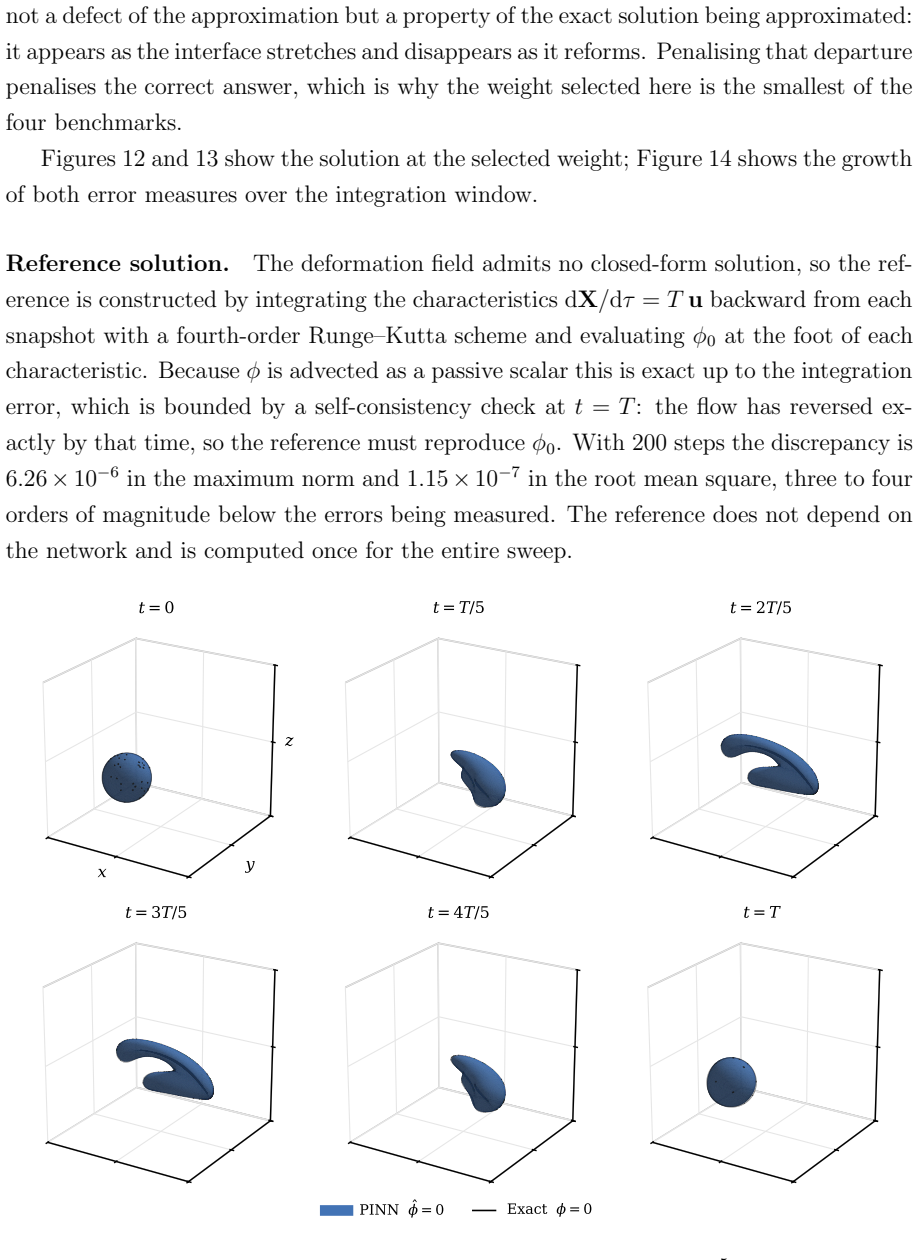
The central claim is that the design principle for eikonal regularisation established in two dimensions transfers to three: the selected weight $w_{\mathrm{eik}}$ is governed not by the spatial dimension but by how far the exact solution departs from a signed-distance function, and the same four-decade ordering appears in both settings. Concretely, the sweep selects $10^{-1}$ for the translating and rotating spheres, where $\|\nabla\phi\|=1$ holds exactly for all time; $10^{-3}$ for the slotted sphere, where the property fails locally near the slot's reentrant edges; and $10^{-5}$ for the reversed vortex, where stretching makes the property fail globally. The ordering is preserved while the values are not: the translating-sphere optimum moves a decade from its two-dimensional value and the reversed-vortex optimum shifts from $10^{-4}$ to $10^{-5}$. The paper further claims that the weight remains the dominant hyperparameter in three dimensions, since varying it over four decades changes the relative $L_2$ error by up to a factor of 31 and the volume conservation error by up to a factor of 40, with a non-monotone response and a well-defined interior optimum on every benchmark, and that the regulariser reduces seed-to-seed variance by more than an order of magnitude at small weights. A like-for-like comparison against fifth-order WENO finds the classical solver more accurate on all four benchmarks, by two orders of magnitude on smooth rigid advection, with a margin that narrows monotonically with geometric difficulty and is considerably smaller in volume conservation than in the field norm.
Load-bearing premise
The inherited eight-layer, 256-unit tanh architecture and the fixed training protocol (Adam schedule, sample counts, adaptive-sampling and causality settings) remain adequate in three dimensions, so that the measured eikonal-weight ordering reflects the regulariser's effect rather than capacity or convergence failure; the paper itself concedes that transfer to substantially different networks is untested.
Editorial extensions
If this is right
- The eikonal weight must be re-selected per problem: with only two of four benchmarks inheriting their two-dimensional optimum unchanged, assuming transfer is unreliable and verification is required.
- The weight sweep is worth its cost: since varying $w_{\mathrm{eik}}$ over four decades changes the relative $L_2$ error by up to 31 times and the volume conservation error by up to 40 times, the 18-run sweep per benchmark is the price of a trustworthy configuration.
- Single-seed experiments should be treated with suspicion in this setting: at small weights the seed-to-seed standard deviation equals the error itself, and one nominal tie between weights reported in the paper is an artefact of that variance rather than a genuine equivalence.
- A neural solver is not the efficient choice for prescribed-flow advection on a uniform grid: the matched WENO5 comparison is more accurate everywhere, with the margin falling from a factor of 122 to a factor of 4.3 as geometric difficulty increases.
- Global norms cannot certify thin features: on the slotted sphere, substituting a sphere with no slot at all changes the relative $L_2$ error by about one percentage point, so studies of interfaces with fine structure should report the paper's feature-restricted, sign-based classification measures.
Reading between the lines
- Because the signed-distance departure is computable from the problem specification, the ordering suggests a cheap pre-training diagnostic: estimate the departure from the initial geometry and velocity field, pick a starting $w_{\mathrm{eik}}$ from the four-decade ladder, and run a single verification sweep instead of the full grid.
- The narrowing WENO margin hints that the network's relative standing improves exactly where the level-set solution is least smooth; a stretching benchmark with more reversals or thinner filamentation would test whether the trend continues or reverses.
- The variance-reduction result implies that even where accuracy does not demand a large eikonal weight, reproducibility does, a consideration that adaptive weighting schemes should be checked against for recovered optima rather than only for final error.
- The feature-restricted measure is a natural default report for any physics-informed study claiming thin-structure preservation, including the sparse and noisy interface-data regimes this paper explicitly leaves untested.
Editorial analysis
A structured set of objections, weighed in public.
Referee Report
Summary. The paper reports a systematic three-dimensional extension of earlier two-dimensional work on choosing the eikonal regularisation weight in PINNs for level-set advection. Four benchmarks (translating sphere, rotating sphere, Zalesak slotted sphere, reversed vortex) are each swept over six eikonal weights with three seeds under a pre-registered selection rule; the selected weights are then interpreted as tracking the extent to which the exact solution departs from a signed-distance function (10^-1 for rigid smooth advection, 10^-3 for local departure, 10^-5 for global stretching). The paper also documents seed-to-seed variance reduction from the regulariser, compares the PINN against a WENO5 reference on identical grids and metrics, and introduces a feature-restricted classification error for thin geometric features.
Significance. The experimental protocol is a strength: full training budget per run, three seeds, pre-registered selection rule with the eikonal deviation demoted to a tiebreak, disclosed tie artefacts, stratified L-BFGS analysis, quantified reference error for the reversed vortex, and identical error definitions for the WENO comparison. Reproducible code is promised via Zenodo. If the central ordering claim survives a controlled test, the paper would give practitioners a transferable rule for setting w_eik based on the problem geometry rather than per-benchmark sweeps, and the feature-restricted measure is a useful methodological contribution for thin-interface problems.
major comments (4)
- [§4.6 and Table 1] The central ordering claim is confounded by protocol differences between the benchmarks. TR3D and RO3D use uniform collocation, no causal weighting, no Fourier features, and Nf=10^4; ZD3D and RV3D use RAD/RAR adaptive sampling, causal chunk weighting, and (for ZD3D) Fourier features and Nf=2x10^4 in the reported configuration. The selected weights partition exactly along these lines: the two benchmarks without adaptive/causal machinery select 10^-1, and the two with it select 10^-3 and 10^-5. Since adaptive sampling and causal weighting can alter the optimal eikonal weight independently of the signed-distance departure of the exact solution, the observed correlation is not yet evidence of the proposed mechanism. The authors should run a controlled comparison that holds the protocol fixed across benchmarks (for example, re-sweeping TR3D or RO3D with RAD/RAR and causal weighting, or ZD3D and RV3D without them), or explicitly restrict the ordering claim to the protocol family used here.
- [Abstract and §4.3] The claim that the regulariser reduces seed-to-seed standard deviation by more than an order of magnitude is only demonstrated for TR3D. For RO3D, Table 3 shows the relative L2 error standard deviation falling from 0.593 at w_eik=0 to 0.205 at the selected 10^-1, a factor of about 2.9, and the 10^-3 row has a standard deviation of 0.557. The unqualified statement in the abstract is therefore not supported by the reported data; the variance-reduction result should be presented per benchmark or restricted to the benchmarks where the effect is actually of that size.
- [§6.3] The proposed falsifiability criterion tests only the SDF-departure mechanism and not the protocol confound. The reversed-vortex prediction (small selected weight) is also what the protocol hypothesis would predict, because RV3D is one of the two benchmarks with adaptive sampling and causal weighting. The authors should state explicitly what observation would distinguish 'the optimum tracks the exact solution's departure from signed distance' from 'the optimum is shifted by the adaptive/causal training machinery'.
- [§4.6 and §3.1] The explanatory variable in the ordering, 'the extent to which the exact solution departs from a signed distance function', is never directly measured or reported. The paper reports the eikonal deviation of the trained network, which is not the same quantity as the SDF departure of the exact solution. Reporting a quantitative measure of the exact solution's departure (for example, the mean or maximum of ||grad phi_exact| - 1| in a band around the interface, or the fraction of the domain where it exceeds a threshold) would make the ordering testable and would allow the reader to verify that ZD3D and RV3D are indeed ordered by this property rather than by other differences.
minor comments (5)
- [Equation (6)] The dimension of the random matrix B is not stated; specify B in R^{128 x 3} (or the number of input spatial coordinates) so that the Fourier feature output dimension is unambiguous.
- [Figures 4, 7, 11, 14] The axis label 'relative L2 volume' is ambiguous and could be read as a single quantity; label the vertical axes explicitly as 'relative L2 error (%)' and 'volume MAPE (%)', with the axis for each line identified in the caption.
- [References [7] and [8]] References [7] and [8] are cited as 2026 works without a journal, volume, or DOI; if they are preprints, please state the repository or arXiv identifier.
- [§4.8] The statement that varying w_eik changes relative L2 error by 'up to a factor of 31' should identify the specific weight pair producing that ratio, since the reader must otherwise infer the comparison from Tables 2-5.
- [§4.1] The word 'pre-registered' suggests an external time-stamped registration; consider rewording to 'the selection rule was fixed before the sweeps were run' to avoid an unintended stronger implication.
Circularity Check
No significant circularity: the eikonal-weight sweep is scored on independent error metrics, the selection rule explicitly demotes the regularised quantity to a tiebreak, and the central ordering claim is tested against new three-dimensional sweeps rather than assumed from the self-cited two-dimensional study.
full rationale
The paper's derivation chain is an empirical hyperparameter sweep, not a reduction of a predicted quantity to a fitted input. The selection rule (Section 4.1) ranks configurations by seed-averaged relative L2 error, then volume conservation, and only thirdly eikonal deviation, with the explicit statement that ranking by eikonal deviation 'would recover the sweep by construction and select the largest weight irrespective of solution accuracy.' The claimed ordering of selected weights against the exact solution's departure from signed-distance status is therefore a measured correlation, not a quantity defined by that departure. The reversed-vortex 'prediction' that a globally stretched interface should select a near-zero weight is a hypothesis from the mechanism, and the reported sweep outcome (10^-5) is not statistically forced by the hypothesis; it is an independent experimental result, and the paper even notes 0 and 10^-5 are tied on the primary metric and separated only by volume conservation. Self-citation of the two-dimensional study [10] supplies the hypothesis and the inherited architecture, but the central transferability claim is established by new three-dimensional sweeps with three seeds under a fixed pre-registered rule, and the two-dimensional values are treated as data to be verified rather than as proof. Reference solutions for the reversed vortex are built by backward characteristic integration with a self-consistency check at T, independent of the network. The WENO5 comparison is an external benchmark on identical grids and error measures. The strongest reservations about the paper are empirical validity threats, not circularity: the four benchmarks differ in protocol (RAD/RAR, causal weighting, Fourier features, doubled sampling for ZD3D), and those protocol differences align with the selected-weight ordering. That is a possible confound concerning whether the ordering is caused by SDF departure or by training-protocol differences; it does not make any claimed result equivalent to its inputs by construction. No equation in the paper defines the eikonal weight in terms of the error it predicts, no fitted parameter is renamed as a prediction, and no load-bearing argument reduces to an unverified self-citation.
Assumptions & free parameters
free parameters (10)
- eikonal weight w_eik (TR3D) =
1e-1
- eikonal weight w_eik (RO3D) =
1e-1
- eikonal weight w_eik (ZD3D) =
1e-3
- eikonal weight w_eik (R V3D) =
1e-5
- residual and initial-condition weights wpde, wic =
1, 10
- network architecture =
8 hidden layers x 256 tanh units, Xavier init
- optimizer settings =
Adam 2e4 iterations, cosine 1e-3 to 1e-5; L-BFGS 500-2000 iterations
- collocation and initial-condition sample counts =
Nf=1e4, Ni=5e3; ZD3D Nf=2e4, Ni=1e4
- adaptive sampling and causal weighting settings =
RAD/RAR, epsilon=1, chunks M=32 or 10
- Fourier feature encoding =
128 features, sigma=5
assumptions (6)
- domain assumption Level-set transport by a prescribed velocity is the correct model for the benchmarks.
- domain assumption The 8x256 tanh network is expressive enough in 3D.
- domain assumption Characteristic backtracing gives the R V3D reference solution.
- domain assumption WENO5 without reinitialisation is a fair classical baseline.
- ad hoc to paper Qualitative SDF departure (none/local/global) is a priori assessable and causal.
- domain assumption Cell-counting volume estimator floor is acceptable.
Cite this review
Pith. "Pith review of Eikonal Regularisation in Physics-Informed Neural Networks for Three-Dimensional Level-Set Advection: Transferability of Two-Dimensional Design Principles." pith.science (2026). https://pith.science/paper/AGQSSHW7
@misc{pith2026260808322,
  author       = {Pith},
  title        = {Pith review of: Eikonal Regularisation in Physics-Informed Neural Networks for Three-Dimensional Level-Set Advection: Transferability of Two-Dimensional Design Principles},
  year         = {2026},
  howpublished = {\url{https://pith.science/paper/AGQSSHW7}},
  note         = {Machine review of arXiv:2608.08322}
}
abstract
Physics-informed neural networks applied to the level-set formulation of interface advection commonly augment the residual and initial-condition losses with an eikonal regulariser, penalising the deviation of $\|\nabla\phi\|$ from unity. A previous two-dimensional study identified this weight as the dominant hyperparameter and found its optimum shifts by four orders of magnitude between rigid-body and deforming flows, but left open whether these principles transfer to three dimensions and whether single-seed results survive run-to-run variability. We answer both by repeating the weight selection across four 3D benchmarks (translating sphere, rotating sphere, slotted sphere, reversed vortex), sweeping six weights with three seeds at full training budget under a pre-registered selection rule. The ordering transfers: the selected weight tracks how far the exact solution departs from the signed-distance property, spanning four decades from $10^{-1}$ where it holds exactly to $10^{-5}$ where the interface is stretched. Values transfer only benchmark by benchmark; two of four carry over unchanged and two do not, so inheritance must be verified. The multi-seed protocol reveals that at small weights the seed-to-seed standard deviation equals the error itself, and the regulariser reduces it by more than an order of magnitude, buying reproducibility as well as accuracy. We benchmark against a fifth-order WENO solver on identical grids and error measures; the classical scheme is more accurate on all four problems, by two orders of magnitude on smooth rigid advection, with a margin that narrows with geometric difficulty and is smaller in volume conservation than in the field norm. Finally, we show that the relative $L_2$ error cannot certify the preservation of thin features, and report a feature-restricted measure that can.
Figures


Figures from the paper (11 more)




Reference graph
Works this paper leans on
-
[1]
Stanley Osher and James A Sethian. Fronts propagating with curvature-dependent speed: Algorithms based on Hamilton-Jacobi formulations.Journal of Computational Physics, 79(1):12–49, 1988. doi: 10.1016/0021-9991(88)90002-2
-
[2]
Mark Sussman, Peter Smereka, and Stanley Osher. A Level Set Approach for Com- puting Solutions to Incompressible Two-Phase Flow.Journal of Computational Physics, 114(1):146–159, 1994. doi: 10.1006/jcph.1994.1155
arXiv 1994
-
[3]
Mark Sussman and Emad Fatemi. An Efficient, Interface-Preserving Level Set Re- distancing Algorithm and Its Application to Interfacial Incompressible Fluid Flow. SIAM Journal on Scientific Computing, 20(4):1165–1191, 1999. doi: 10.1137/ S1064827596298245
work page 1999
-
[4]
M. Raissi, P. Perdikaris, and G.E. Karniadakis. Physics-informed neural networks: A deep learning framework for solving forward and inverse problems involving nonlinear partial differential equations.Journal of Computational Physics, 378:686–707, 2019. doi: 10.1016/j.jcp.2018.10.045
-
[5]
Krishnapriyan, Amir Gholami, Shandian Zhe, Robert M
Aditi S. Krishnapriyan, Amir Gholami, Shandian Zhe, Robert M. Kirby, and Michael W. Mahoney. Characterizing possible failure modes in physics-informed neu- ral networks.Advances in neural information processing systems, 34:26548–26560, 2021
work page 2021
-
[6]
Mathieu Mullins, Hamza Kamil, Adil Fahsi, and Azzeddine Soula ¨ ımani. Physics- informed neural networks for solving moving interface flow problems using the level set approach.Physics of Fluids, 37(10):107124, 2025. doi: 10.1063/5.0289386
-
[7]
Extended Interface Physics-Informed Neural Networks Method for Moving Interface Problems, 2026
Ran Bi, Weibing Deng, and Yameng Zhu. Extended Interface Physics-Informed Neural Networks Method for Moving Interface Problems, 2026. 34
work page 2026
-
[8]
Physics-informed neural networks for solving two-phase flow problems with moving interfaces, 2026
Qijia Zhai, Pengtao Sun, Xiaoping Xie, Xingwen Zhu, and Chen-Song Zhang. Physics-informed neural networks for solving two-phase flow problems with moving interfaces, 2026
work page 2026
Show all 26 references
-
[9]
Physics-Informed Machine Learning for Two-Phase Moving-Interface and Stefan Problems, 2025
Che-Chia Chang, Te-Sheng Lin, and Ming-Chih Lai. Physics-Informed Machine Learning for Two-Phase Moving-Interface and Stefan Problems, 2025
2025
-
[10]
A systematic study of physics-informed neural networks for the level-set interface advection.Machine Learning: Science and Technology, 7(4):045032, 2026
Muhammad Akbar Khan and Fahim Raees. A systematic study of physics-informed neural networks for the level-set interface advection.Machine Learning: Science and Technology, 7(4):045032, 2026. doi: 10.1088/2632-2153/ae8b74
2026 doi
-
[11]
Chenxi Wu, Min Zhu, Qinyang Tan, Yadhu Kartha, and Lu Lu. A comprehensive study of non-adaptive and residual-based adaptive sampling for physics-informed neural networks.Computer Methods in Applied Mechanics and Engineering, 403: 115671, 2023. doi: 10.1016/j.cma.2022.115671
2023
-
[12]
DeepXDE: A Deep Learning Library for Solving Differential Equations.SIAM Review, 63(1):208–228,
Lu Lu, Xuhui Meng, Zhiping Mao, and George Em Karniadakis. DeepXDE: A Deep Learning Library for Solving Differential Equations.SIAM Review, 63(1):208–228,
-
[13]
Understanding and Mitigating Gra- dient Flow Pathologies in Physics-Informed Neural Networks.SIAM Journal on Scientific Computing, 43(5):A3055–A3081, 2021
Sifan Wang, Yujun Teng, and Paris Perdikaris. Understanding and Mitigating Gra- dient Flow Pathologies in Physics-Informed Neural Networks.SIAM Journal on Scientific Computing, 43(5):A3055–A3081, 2021. doi: 10.1137/20M1318043
2021 doi
-
[14]
Inverse Dirichlet weighting enables reliable training of physics informed neural networks.Machine Learning: Science and Technology, 3(1):015026, 2022
Suryanarayana Maddu, Dominik Sturm, Christian L M¨ uller, and Ivo F Sbalzarini. Inverse Dirichlet weighting enables reliable training of physics informed neural networks.Machine Learning: Science and Technology, 3(1):015026, 2022. doi: 10.1088/2632-2153/ac3712
2022 doi
-
[15]
McClenny and Ulisses M
Levi D. McClenny and Ulisses M. Braga-Neto. Self-adaptive physics-informed neural networks.Journal of Computational Physics, 474:111722, 2023. doi: 10.1016/j.jcp. 2022.111722
2023
-
[16]
Self-adaptive loss balanced Physics- informed neural networks.Neurocomputing, 496:11–34, 2022
Zixue Xiang, Wei Peng, Xu Liu, and Wen Yao. Self-adaptive loss balanced Physics- informed neural networks.Neurocomputing, 496:11–34, 2022. doi: 10.1016/j.neucom. 2022.05.015
2022 doi
-
[17]
Efficient Implementation of Weighted ENO Schemes.Journal of Computational Physics, 126(1):202–228, 1996
Guang-Shan Jiang and Chi-Wang Shu. Efficient Implementation of Weighted ENO Schemes.Journal of Computational Physics, 126(1):202–228, 1996. doi: 10.1006/ jcph.1996.0130
1996
-
[18]
Efficient implementation of essentially non- oscillatory shock-capturing schemes.Journal of Computational Physics, 77(2):439– 471, 1988
Chi-Wang Shu and Stanley Osher. Efficient implementation of essentially non- oscillatory shock-capturing schemes.Journal of Computational Physics, 77(2):439– 471, 1988. doi: 10.1016/0021-9991(88)90177-5. 35
1988 doi
-
[19]
Srinivasan, Ben Mildenhall, Sara Fridovich-Keil, Nithin Raghavan, Utkarsh Singhal, Ravi Ramamoorthi, Jonathan T
Matthew Tancik, Pratul P. Srinivasan, Ben Mildenhall, Sara Fridovich-Keil, Nithin Raghavan, Utkarsh Singhal, Ravi Ramamoorthi, Jonathan T. Barron, and Ren Ng. Fourier Features Let Networks Learn High Frequency Functions in Low Dimensional Domains.Advances in neural information...
2020
-
[20]
Respecting causality for training physics-informed neural networks.Computer Methods in Applied Mechanics and Engineering, 421:116813, 2024
Sifan Wang, Shyam Sankaran, and Paris Perdikaris. Respecting causality for training physics-informed neural networks.Computer Methods in Applied Mechanics and Engineering, 421:116813, 2024. doi: 10.1016/j.cma.2024.116813
2024
-
[21]
A Hybrid Parti- cle Level Set Method for Improved Interface Capturing.Journal of Computational Physics, 183(1):83–116, 2002
Douglas Enright, Ronald Fedkiw, Joel Ferziger, and Ian Mitchell. A Hybrid Parti- cle Level Set Method for Improved Interface Capturing.Journal of Computational Physics, 183(1):83–116, 2002. doi: 10.1006/jcph.2002.7166
2002
-
[22]
Springer New York, 2003
Stanley Osher and Ronald Fedkiw.Level Set Methods and Dynamic Implicit Surfaces, volume 153 ofApplied Mathematical Sciences. Springer New York, 2003. doi: 10. 1007/b98879
2003
-
[23]
When and why PINNs fail to train: A neural tangent kernel perspective.Journal of Computational Physics, 449:110768,
Sifan Wang, Xinling Yu, and Paris Perdikaris. When and why PINNs fail to train: A neural tangent kernel perspective.Journal of Computational Physics, 449:110768,
-
[24]
Eikonal regularization in physics-informed neural networks for three-dimensional level-set advection: Transferability of two-dimensional design principles — Source Code, 2026
Muhammad Akbar Khan. Eikonal regularization in physics-informed neural networks for three-dimensional level-set advection: Transferability of two-dimensional design principles — Source Code, 2026. doi: 10.5281/zenodo.21852144. 36
2026 doi
-
[2021]
doi: 10.1137/19M1274067
-
[2022]
doi: 10.1016/j.jcp.2021.110768
2021
Reviewed August 12, 2026 · model on record in the stance chip above.
Discussion (0). Continue with ORCID to comment.