Chemical tuning of magnetic ordering and cryogenic magnetocaloric response in zircon-type Gd1-xErxVO4
Pith reviewed 2026-06-30 10:50 UTC · model grok-4.3
The pith
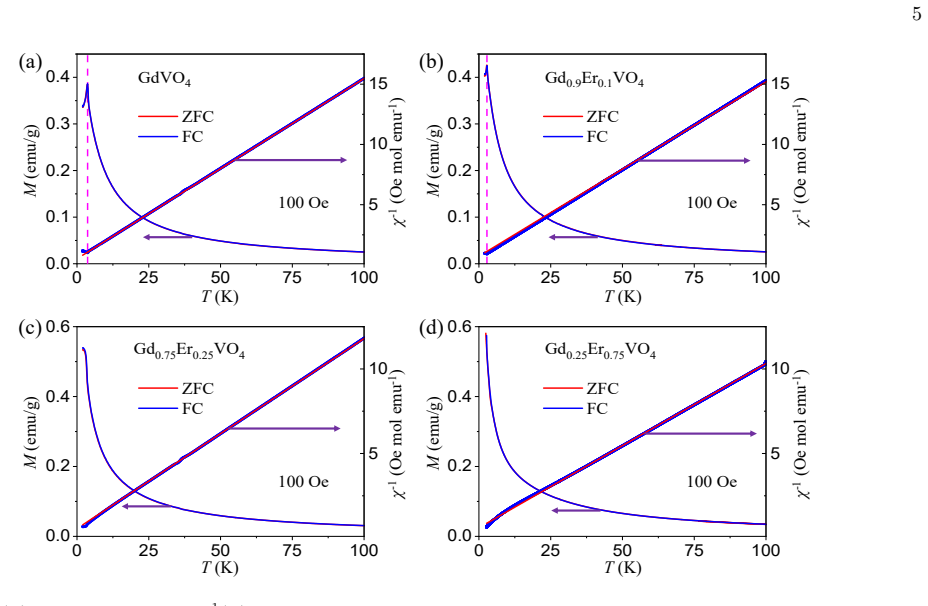
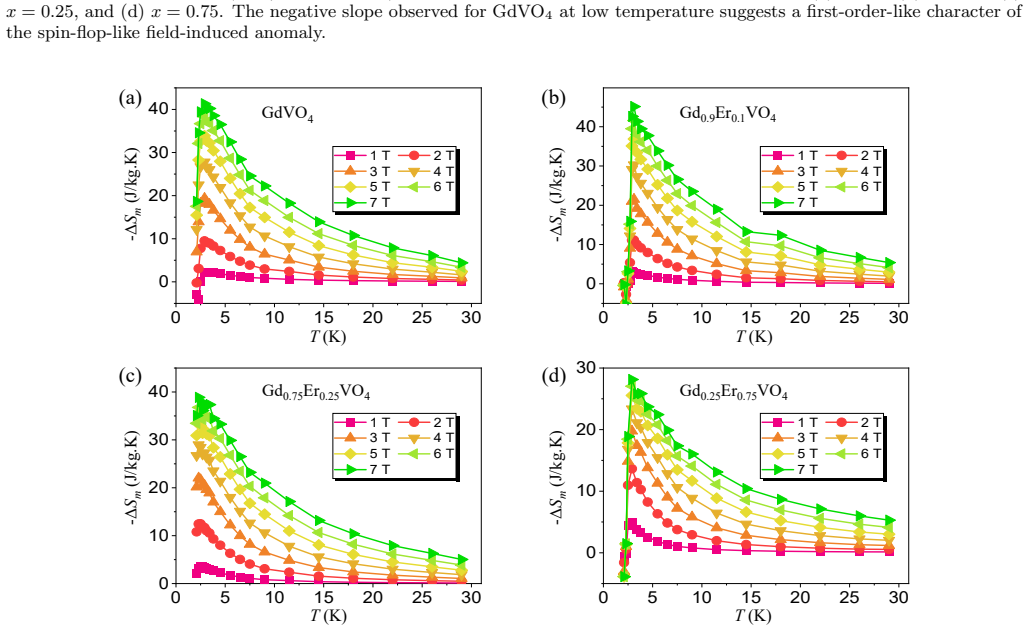
Substituting 10% erbium for gadolinium in GdVO4 lowers the magnetic ordering temperature to 2.76 K and raises the peak entropy change to 45.1 J kg^{-1} K^{-1} under 7 T.
A machine-rendered reading of the paper's core claim, the machinery that carries it, and where it could break.
Core claim
Weak Er substitution in Gd1-xErxVO4 tunes the competition among exchange interactions, dipolar coupling, and magnetic anisotropy in the rare-earth sublattice of the zircon structure, suppressing the ordering temperature to 2.76(2) K at x=0.1 while optimizing available spin entropy to produce a maximum magnetic entropy change of 45.1 J kg^{-1} K^{-1} for a 7 T field change.
What carries the argument
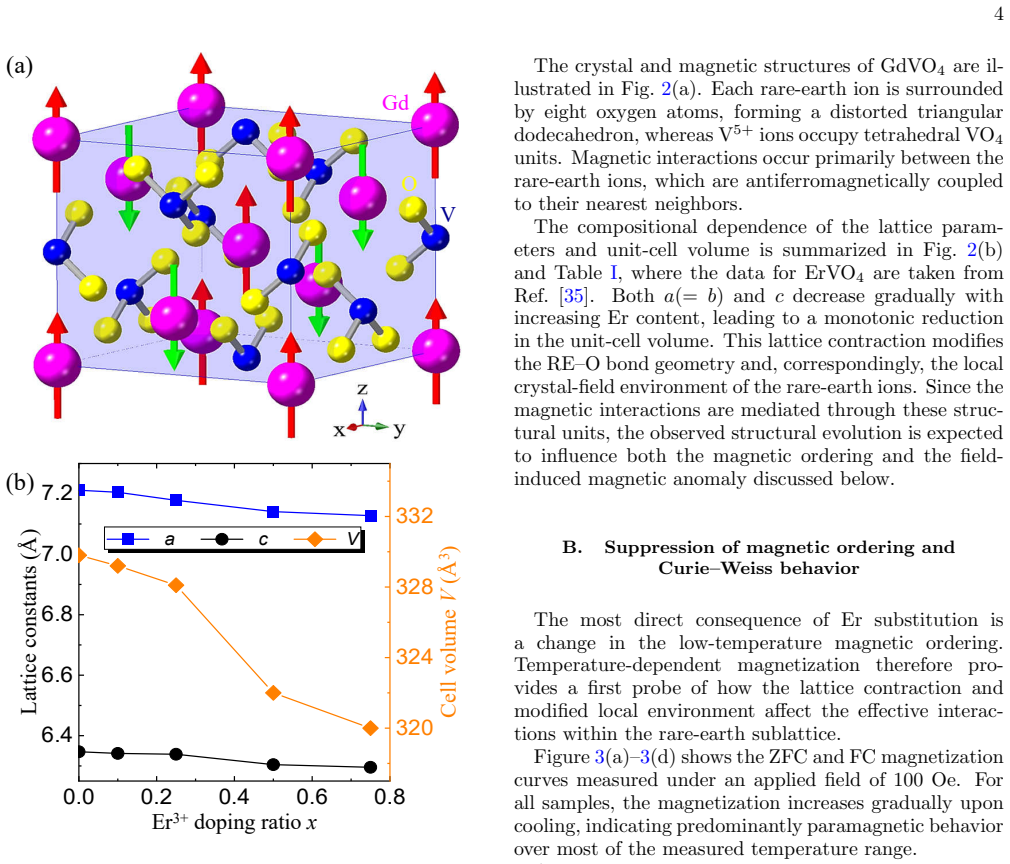
Er3+ substitution for Gd3+ in the tetragonal zircon lattice, which contracts the unit cell and modifies the rare-earth sublattice magnetic behavior.
If this is right
- Magnetic ordering temperature drops from 3.65 K to 2.76 K already at 10% Er substitution.
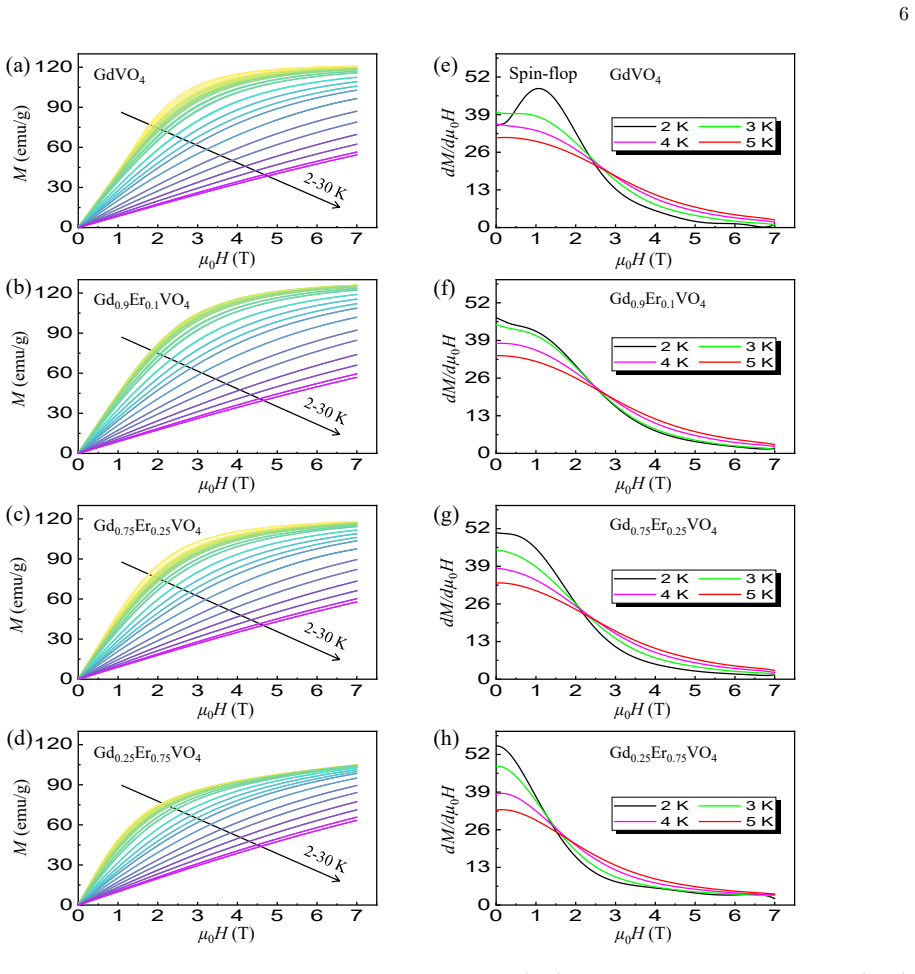
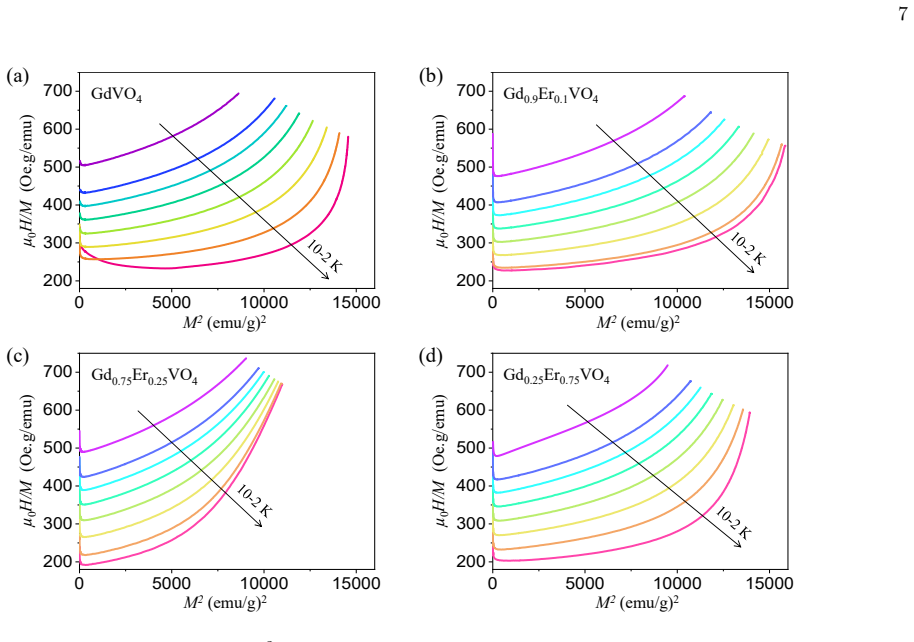
- The field-induced spin-flop anomaly observed in pure GdVO4 weakens with Er addition.
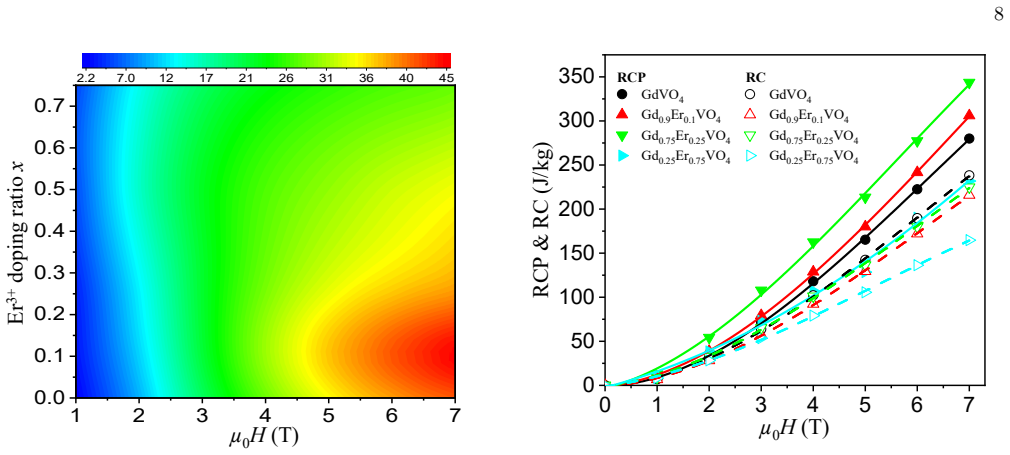
- Maximum magnetic entropy change reaches its highest reported value of 45.1 J kg^{-1} K^{-1} at x=0.1 under 7 T.
- The same substitution strategy tunes the balance of magnetic interactions to favor larger low-temperature entropy changes in this family of vanadates.
Where Pith is reading between the lines
- The same doping level could be tried in isostructural vanadates or phosphates to shift ordering temperatures closer to specific cryogenic operating points.
- Single-crystal measurements would separate the intrinsic anisotropy contribution from any polycrystalline averaging effects on the entropy change.
- If the entropy gain persists after accounting for lattice contraction alone, the method supplies a parameter-free route to adjust dipolar versus exchange strengths.
Load-bearing premise
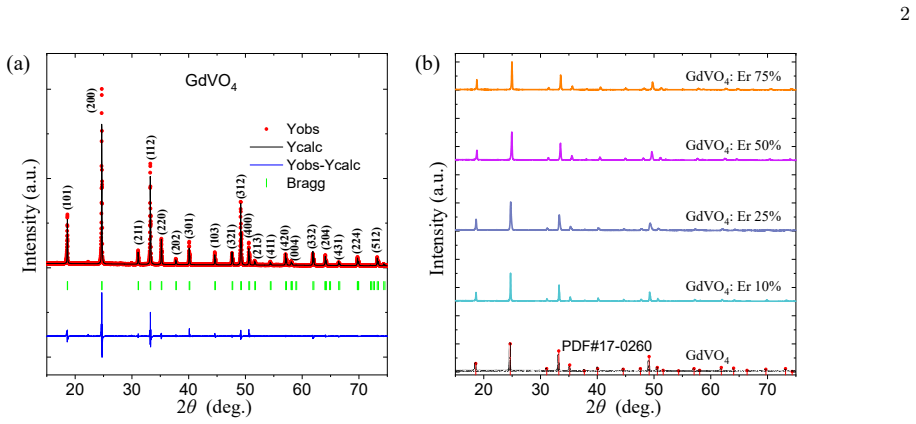
The polycrystalline samples are chemically homogeneous and contain no undetected impurities or secondary phases that affect the measured ordering temperatures or entropy changes, as checked only by powder X-ray diffraction.
What would settle it
Higher-resolution local chemical mapping or neutron diffraction that reveals secondary phases whose volume fraction scales with the reported changes in ordering temperature or entropy change.
Figures
read the original abstract
Chemical substitution offers an effective route to tune magnetic ordering and magnetocaloric performance in rare-earth oxides for cryogenic refrigeration. Here we investigate the structural evo lution, magnetic properties, and magnetocaloric effect of polycrystalline zircon-type Gd1-xErxVO4 (x=0, 0.1, 0.25, 0.5, and 0.75). Powder X-ray diffraction confirms that all samples crystallize in the tetragonal zircon structure without detectable impurity phases. Substitution of Gd3+ by the smaller Er3+ ion produces a systematic lattice contraction and modifies the magnetic behavior of the rare-earth sublattice. In particular, the magnetic ordering temperature is suppressed from 3.65(2) K in GdVO4 to 2.76(2) K in Gd0.9Er0.1VO4 , accompanied by a weakening of the spin-flop-like field-induced anomaly observed in the parent compound. A low Er concentration correspondingly improves the low-temperature magnetocaloric performance, with Gd0.9Er0.1VO4 exhibiting a max imum magnetic entropy change of 45.1 J kg-1 K-1 for mu_0 Delta H=7T. These results demonstrate that weak Er substitution effectively tunes the competition among exchange interactions, dipolar coupling, and magnetic anisotropy, optimizing the balance between magnetic ordering and available spin entropy in zircon-type rare-earth vanadates, which is crucial for developing efficient cryogenic refrigeration materials.
Editorial analysis
A structured set of objections, weighed in public.
Referee Report
Summary. The manuscript examines polycrystalline zircon-type Gd_{1-x}Er_xVO_4 (x = 0, 0.1, 0.25, 0.5, 0.75) prepared by solid-state reaction. Powder XRD confirms the tetragonal structure with lattice contraction upon Er substitution. Magnetic measurements show suppression of the ordering temperature from 3.65(2) K (x=0) to 2.76(2) K (x=0.1), weakening of the spin-flop anomaly, and an increase in the maximum magnetic entropy change to 45.1 J kg^{-1} K^{-1} at μ_0 ΔH = 7 T for the x=0.1 composition, attributed to tuned competition between exchange, dipolar, and anisotropy terms.
Significance. If the reported entropy values and ordering temperatures are intrinsic to the zircon phase, the work shows that dilute Er substitution can simultaneously lower T_N while increasing low-T |ΔS_m|, offering a practical chemical knob for optimizing cryogenic magnetocaloric materials in the rare-earth vanadate family.
major comments (2)
- [Structural characterization] Structural characterization section: the assertion that all samples are phase-pure rests solely on laboratory powder XRD showing 'no detectable impurity phases.' This sensitivity limit (~1-3 wt%) is insufficient to exclude trace secondary phases or nanoscale compositional gradients that can dominate low-T magnetization integrals and the Maxwell-derived ΔS_m peak of 45.1 J kg^{-1} K^{-1}.
- [Magnetic properties and magnetocaloric effect] Magnetic properties and magnetocaloric effect sections: the entropy change is obtained via the Maxwell relation from M(H,T) data, yet the manuscript provides no explicit statement on the temperature/field grid density, numerical integration method, or demagnetization-factor corrections. These details are load-bearing for the quantitative claim that x=0.1 outperforms the parent compound.
minor comments (1)
- [Abstract] Abstract contains typographical spacing errors ('evo lution', 'max imum') that should be corrected in the final version.
Simulated Author's Rebuttal
We thank the referee for the constructive comments on our manuscript. We address each major point below and will revise the manuscript to incorporate clarifications and additional details where appropriate.
read point-by-point responses
-
Referee: [Structural characterization] Structural characterization section: the assertion that all samples are phase-pure rests solely on laboratory powder XRD showing 'no detectable impurity phases.' This sensitivity limit (~1-3 wt%) is insufficient to exclude trace secondary phases or nanoscale compositional gradients that can dominate low-T magnetization integrals and the Maxwell-derived ΔS_m peak of 45.1 J kg^{-1} K^{-1}.
Authors: We acknowledge that laboratory powder XRD has a practical detection limit of ~1-3 wt% and cannot fully rule out trace impurities or nanoscale inhomogeneities that might influence low-temperature magnetic integrals. In the revised manuscript we will explicitly state this sensitivity limit and note that the observed monotonic lattice contraction, the continuous suppression of T_N, and the systematic variation of the magnetocaloric response across the series remain consistent with a homogeneous zircon-type solid solution. We will also indicate that complementary techniques (e.g., neutron diffraction or local-probe methods) would be valuable for future work to confirm phase purity at higher sensitivity. revision: yes
-
Referee: [Magnetic properties and magnetocaloric effect] Magnetic properties and magnetocaloric effect sections: the entropy change is obtained via the Maxwell relation from M(H,T) data, yet the manuscript provides no explicit statement on the temperature/field grid density, numerical integration method, or demagnetization-factor corrections. These details are load-bearing for the quantitative claim that x=0.1 outperforms the parent compound.
Authors: We agree that these experimental and computational details are essential for assessing the reliability of the reported ΔS_m values. In the revised manuscript we will add a dedicated paragraph (or subsection) describing (i) the temperature and field grid used for the isothermal magnetization measurements, (ii) the numerical procedure employed to evaluate the Maxwell integral, and (iii) whether demagnetization corrections were applied to the raw M(H) data. These additions will allow readers to reproduce and evaluate the quantitative improvement observed for the x = 0.1 composition. revision: yes
Circularity Check
No significant circularity; experimental reporting of measured quantities
full rationale
This is a purely experimental materials science paper reporting structural characterization via XRD, magnetic ordering temperatures, and magnetocaloric entropy changes extracted from measured M(H,T) isotherms via the Maxwell relation. No equations, ansatze, or predictions are presented that reduce reported values to inputs by construction. No self-citations are invoked as load-bearing uniqueness theorems or to justify fitted forms. The central claims rest on direct experimental data rather than any derivation chain. Phase-purity statements from XRD are experimental assertions (potentially limited) but do not create circularity in any mathematical sense.
Axiom & Free-Parameter Ledger
axioms (2)
- domain assumption Powder XRD is sufficient to confirm phase purity and zircon structure in polycrystalline rare-earth vanadates.
- domain assumption Magnetic entropy change extracted from magnetization isotherms accurately reflects the intrinsic magnetocaloric response.
Reference graph
Works this paper leans on
-
[1]
Driver, The challenge of measuring and mapping the missing baryons, Nature Astronomy5, 852 (2021)
S. Driver, The challenge of measuring and mapping the missing baryons, Nature Astronomy5, 852 (2021)
2021
-
[2]
Y. Zhu, D. Peng, E. Zhang, B. Pan, X. Chen, L. Chen, H. Ren, F. Liu, Y. Hao, N. Li,et al., Superconductivity in pressurized trilayer La 4Ni3O10−δ single crystals, Nature 631, 531 (2024)
2024
-
[3]
J. Y. Huang, R. Y. Su, W. H. Lim, M. Feng, B. Van Straaten, B. Severin, W. Gilbert, N. Du- moulin Stuyck, T. Tanttu, S. Serrano,et al., High-fidelity spin qubit operation and algorithmic initialization above 1 K, Nature627, 772 (2024)
2024
-
[4]
Doiron-Leyraud, I
N. Doiron-Leyraud, I. R. Walker, L. Taillefer, M. J. Steiner, S. R. Julian, and G. G. Lonzarich, Fermi-liquid breakdown in the paramagnetic phase of a pure metal, Nature425, 595 (2003)
2003
-
[5]
Hu and J
Z. Hu and J. Li, A review of helium resources and devel- opment, Natural Gas Industry B12, 356 (2025)
2025
-
[6]
Rosen, Impending US helium sale worries researchers, Science382, 624 (2023)
J. Rosen, Impending US helium sale worries researchers, Science382, 624 (2023)
2023
-
[7]
Ma˜ nosa and A
L. Ma˜ nosa and A. Planes, Solid-state cooling by stress: A perspective, Applied Physics Letters116, 050501 (2020)
2020
-
[8]
Lloveras and J.-L
P. Lloveras and J.-L. Tamarit, Advances and obsta- cles in pressure-driven solid-state cooling: A review of barocaloric materials, MRS Energy & Sustainability8, 3 (2021)
2021
-
[9]
J. Li, A. Torell´ o, V. Kovacova, U. Prah, A. Aravind- han, T. Granzow, T. Usui, S. Hirose, and E. Defay, High cooling performance in a double-loop electrocaloric heat pump, Science382, 801 (2023)
2023
-
[10]
F. Du, S. Yang, T. Yao, D. Han, Q. Li, S. Zheng, R. Luo, C. Huang, Y. Zhao, Y. Lin, Z. Ma, H. Chen, C. Guo, H. Qiu, T. Yang, X. Chen, and X. Qian, In- finitesimal amount of perovskite quantum dots enhances electrocaloric cooling performances in diluted nanocom- posites, Joule9(2025)
2025
-
[11]
Zheng, F
S. Zheng, F. Du, L. Zheng, D. Han, Q. Li, J. Shi, J. Chen, X. Shi, H. Huang, Y. Luo,et al., Colossal electrocaloric effect in an interface-augmented ferroelectric polymer, Science382, 1020 (2023)
2023
-
[12]
M. Zeng, C. Escorihuela-Sayalero, T. Ikeshoji, S. Tak- agi, S. Kim, S.-i. Orimo, M. Barrio, J.-L. Tamarit, P. Lloveras, C. Cazorla,et al., Colossal reversible barocaloric effects in a plastic crystal mediated by lat- tice vibrations and ion diffusion, Advanced Science11, 2306488 (2024)
2024
-
[13]
M. Zeng, M. Romanini, I. Gorican, S. Drnovsek, H. Ur- sic, A. Salvatori, M. Barrio, S. Loehle, N. Obrecht, C. Escorihuela-Sayalero,et al., Simultaneous shifts in pressure and electric field boost the caloric response in ferroelectrics, Materials Horizons12, 8460 (2025)
2025
-
[14]
Weiss, Le ph´ enom` ene magn´ eto-calorique, Journal de Physique et le Radium2, 161 (1921)
P. Weiss, Le ph´ enom` ene magn´ eto-calorique, Journal de Physique et le Radium2, 161 (1921)
1921
-
[15]
W. F. Giauque and D. P. MacDougall, Attainment of temperatures below 1 absolute by demagnetization of Gd2(SO4)3·8H 2O, Physical Review43, 768 (1933)
1933
-
[16]
Q. Guo, W. Ren, P. Liu, J. Yao, J. Xiang, K. Zhang, Y. Wang, L. S. R. Kumara, X. Wang, W. Li,et al., Gi- ant low-field magnetocaloric effect at sub-kelvin temper- atures in ferromagnetic NH 4GdF4, Journal of the Amer- ican Chemical Society147, 34862 (2025)
2025
-
[17]
B. Wang, X. Liu, F. Hu, J.-t. Wang, J. Xiang, P. Sun, J. Wang, J. Sun, T. Zhao, Z. Mo,et al., A record-high cryogenic magnetocaloric effect discovered in EuCl2 com- pound, Journal of the American Chemical Society146, 35016 (2024)
2024
-
[18]
Q. Xu, B. Liu, M. Ye, G. Zhuang, L. Long, and L. Zheng, Gd(OH)F2: a promising cryogenic magnetic refrigerant, Journal of the American Chemical Society144, 13787 (2022)
2022
-
[19]
Zhang, Y
Y. Zhang, Y. Na, X. Liu, J. Xiang, F. Chen, H.-F. Li, P. Sun, S. Zhou, X. Zhang, and L. Li, Refrigeration down to 0.16 K using a frustrated magnet Gd2B2MoO9, Nature Communications17, 1554 (2026)
2026
-
[20]
W. Chen, J. Lin, Z. Zhang, and L. Li, Structural and magnetic characterizations of antiferromagnetic RE3PO7 (RE = Gd, Tb, Dy, Ho) phosphates featuring large con- ventional and inverse cryogenic magnetocaloric effects, Journal of Rare Earths (2025)
2025
-
[21]
Z. Mo, J. Jiang, L. Tian, H. Xie, Y. Li, X. Zheng, L. Zhang, X. Gao, Z. Li, G. Liu,et al., Ferromag- netic Eu2SiO4 compound with a record low-field magne- tocaloric effect and excellent thermal conductivity near liquid helium temperature, Journal of the American Chemical Society147, 14684 (2025)
2025
-
[22]
P. Liu, D. Yuan, C. Dong, G. Lin, E. G. V´ ıllora, J. Qi, X. Zhao, K. Shimamura, J. Ma, J. Wang,et al., Ultralow- field magnetocaloric materials for compact magnetic re- frigeration, NPG Asia Materials15, 41 (2023)
2023
-
[23]
L¨ unser, E
K. L¨ unser, E. Kavak, K. G¨ urpinar, B. Emre, O. Atakol, E. Stern-Taulats, M. Porta, A. Planes, P. Lloveras, J.- L. Tamarit,et al., Elastocaloric, barocaloric and mag- netocaloric effects in spin crossover polymer composite films, Nature Communications15, 6171 (2024). 11
2024
-
[24]
Xiang, C
J. Xiang, C. Zhang, Y. Gao, W. Schmidt, K. Schmalzl, C.-W. Wang, B. Li, N. Xi, X.-Y. Liu, H. Jin,et al., Giant magnetocaloric effect in spin supersolid candidate Na2BaCo(PO4)2, Nature625, 270 (2024)
2024
-
[25]
M. Shu, X. Xu, N. Xi, M. He, J. Xiang, G. Qu, D. Khalyavin, P. Manuel, J. G. Nakamura, J. Jiao, Y. Liu, G. Wu, K. Guo, H. Zhao, W. Xu, Q. Duan, R. Zhong, X. Wang, Y. Han, L. Ling, X. Sun, D. Song, Y. Gao, Z. Wang, X. Chen, T. Qian, S. Jia, H. Du, G. Su, W. Li, J. Ma, and Z. Qu, Giant magnetocaloric effect and spin supersolid in a metallic dipolar magnet, ...
2026
-
[26]
Zhang, W
Y. Zhang, W. Hao, J. Lin, H.-F. Li, and L. Li, Geo- metrically frustrated Gd 2Ti2O7 oxide: A comprehensive exploration of structural, magnetic, and magnetocaloric properties for cryogenic magnetic cooling applications, Acta Materialia272, 119946 (2024)
2024
-
[27]
J. Lin, S. Wu, K. Sun, H.-F. Li, W. Chen, Y. Zhang, and L. Li, Structural, magnetic, and magnetocaloric charac- terizations of geometrically-frustrated SrRE 2O4 (RE = Gd, Dy, Ho, Er) oxides for low-temperature cooling ap- plications, Ceramics International50, 51269 (2024)
2024
-
[28]
Zhang, A
Y. Zhang, A. Li, W. Hao, H.-F. Li, and L. Li, Apatite- type gadolinium-based dense MGd 4Si3O13 ceramics (M = Mg, Ca, and Sr): An emerging class of sub-liquid he- lium temperature magnetic refrigerant, Acta Materialia 292, 121033 (2025)
2025
-
[29]
I. Fita, R. Puzniak, and A. Wisniewski, Pressure-tuned spin switching in compensated GdCrO 3 ferrimagnet, Physical Review B103, 054423 (2021)
2021
-
[30]
W. Yang, H. Chen, H. Peng, Z. Lin, Y. Zheng, X. Ma, R. Jia, B. Kang, Z. Feng, and S. Cao, Metamagnetic phase transition induced large magnetocaloric effect in a Dy 0.5Ho0.5MnO3 single crystal, Physical Chemistry Chemical Physics26, 20820 (2024)
2024
-
[31]
Rodr´ ıguez-Carvajal, Recent advances in magnetic structure determination by neutron powder diffraction, Physica B: Condensed Matter192, 55 (1993)
J. Rodr´ ıguez-Carvajal, Recent advances in magnetic structure determination by neutron powder diffraction, Physica B: Condensed Matter192, 55 (1993)
1993
-
[32]
Li,Synthesis of CMR manganites and ordering phenomena in complex transition metal oxides, Vol
H. Li,Synthesis of CMR manganites and ordering phenomena in complex transition metal oxides, Vol. 4 (Forschungszentrum J¨ ulich, 2008)
2008
-
[33]
H. F. Li, Y. Su, J. Persson, P. Meuffels, J. M. Walter, R. Skowronek, and T. Br¨ uckel, Correla- tion between structural and magnetic properties of La7/8Sr1/8Mn1−γO3+δ with controlled nonstoichiometry, Journal of Physics: Condensed Matter19, 016003 (2007)
2007
-
[34]
Palacios, M
E. Palacios, M. Evangelisti, R. S´ aez-Puche, A. J. Dos Santos-Garc´ ıa, F. Fern´ andez-Mart´ ınez, C. Cascales, M. Castro, R. Burriel, O. Fabelo, and J. A. Rodr´ ıguez- Velamaz´ an, Magnetic structures and magnetocaloric ef- fect in RVO 4 (R = Gd, Nd), Physical Review B97, 214401 (2018)
2018
-
[35]
B. C. Chakoumakos, M. M. Abraham, and L. A. Boatner, Crystal structure refinements of zircon-type MVO4 (M = Sc, Y, Ce, Pr, Nd, Tb, Ho, Er, Tm, Yb, Lu), Journal of Solid State Chemistry109, 197 (1994)
1994
-
[36]
Szczeszak, T
A. Szczeszak, T. Grzyb, Z. ´Sniadecki, N. Andrzejew- ska, S. Lis, M. Matczak, G. Nowaczyk, S. Jurga, and B. Idzikowski, Structural, spectroscopic, and magnetic properties of Eu 3+-doped GdVO 4 nanocrystals synthe- sized by a hydrothermal method, Inorganic Chemistry 53, 12243 (2014)
2014
-
[37]
K. Dey, A. Indra, S. Majumdar, and S. Giri, Cryogenic magnetocaloric effect in zircon-type RVO4 (R = Gd, Ho, Er, and Yb), Journal of Materials Chemistry C5, 1646 (2017)
2017
-
[38]
M. J. Metcalfe and H. M. Rosenberg, The magnetother- mal resistivity of antiferromagnetic crystals at low tem- peratures. III. ErVO 4, a new antiferromagnet, Journal of Physics C: Solid State Physics5, 474 (1972)
1972
-
[39]
Li, Possible ground states and parallel magnetic- field-driven phase transitions of collinear antiferromag- nets, npj Computational Materials2, 16032 (2016)
H.-F. Li, Possible ground states and parallel magnetic- field-driven phase transitions of collinear antiferromag- nets, npj Computational Materials2, 16032 (2016)
2016
-
[40]
J. R. Everts, G. G. G. King, N. J. Lambert, S. Kocsis, S. Rogge, and J. J. Longdell, Ultrastrong coupling be- tween a microwave resonator and antiferromagnetic res- onances of rare-earth ion spins, Physical Review B101, 214414 (2020)
2020
-
[41]
chemical tuning of mag- netic ordering and cryogenic magnetocaloric response in zircon-type Gd 1−xErxVO4
Supplementary information for “chemical tuning of mag- netic ordering and cryogenic magnetocaloric response in zircon-type Gd 1−xErxVO4”, see Supplemental Material at [URL] for additional data and analysis
-
[42]
B. Wang, F. Hu, J. Wang, J. Sun, T. Zhao, and B. Shen, Cryogenic magnetocaloric effect of rare-earth halide perovskites CsEuCl3 and CsEuBr3, Journal of Ap- plied Physics137, 103902 (2025)
2025
-
[43]
Y. Wang, J. Xiang, L. Zhang, J. Gong, W. Li, Z. Mo, and J. Shen, Giant low-field cryogenic magnetocaloric effect in a polycrystalline EuB 4O7 compound, Journal of the American Chemical Society146, 3315 (2024)
2024
-
[44]
Daudin, R
B. Daudin, R. Lagnier, and B. Salce, Thermodynamic properties of the gadolinium gallium garnet, Gd3Ga5O12, between 0.05 and 25 K, Journal of Magnetism and Mag- netic Materials27, 315 (1982)
1982
-
[45]
Y. Zhu, P. Zhou, T. Li, J. Xia, S. Wu, Y. Fu, K. Sun, Q. Zhao, Z. Li, Z. Tang, Y. Xiao, Z. Chen, and H.-F. Li, Enhanced magnetocaloric effect and magnetic phase diagrams of single-crystal GdCrO 3, Physical Review B 102, 144425 (2020)
2020
-
[46]
Z. Hao, X. Wang, G. Zhu, Y. Liu, T. Zhong, L. Zhang, C. Yuan, L. Xiao, H. Liu, J. Zhang, and J. Qiu, Inves- tigation of the structure, magnetic properties, and mag- netocaloric effect of Gd 2WO6 compound, Journal of Ap- plied Physics138, 213902 (2025)
2025
-
[47]
Mahana, U
S. Mahana, U. Manju, and D. Topwal, Giant magne- tocaloric effect in GdAlO3 and a comparative study with GdMnO3, Journal of Physics D: Applied Physics50, 035002 (2017)
2017
-
[48]
Mukherjee, Y
P. Mukherjee, Y. Wu, G. I. Lampronti, and S. E. Dutton, Magnetic properties of monoclinic lanthanide orthobo- rates, LnBO 3, Ln = Gd, Tb, Dy, Ho, Er, Yb, Materials Research Bulletin98, 173 (2018)
2018
-
[49]
N. Xu, W. Chen, Y.-S. Ding, and Z. Zheng, A cubic tinkertoy-like heterometallic cluster with a record mag- netocaloric effect, Journal of the American Chemical So- ciety146, 9506 (2024)
2024
-
[50]
Chemical tuning of magnetic ordering and cryogenic magnetocaloric response in zircon-type Gd 1−xErxVO4
X.-M. Luo, Z.-B. Hu, Q.-f. Lin, W. Cheng, J.-P. Cao, C.- H. Cui, H. Mei, Y. Song, and Y. Xu, Exploring the perfor- mance improvement of magnetocaloric effect based Gd- exclusive cluster Gd60, Journal of the American Chemical Society140, 11219 (2018). Supplementary information for “Chemical tuning of magnetic ordering and cryogenic magnetocaloric response ...
2018
discussion (0)
Sign in with ORCID, Apple, or X to comment. Anyone can read and Pith papers without signing in.