REVIEW 4 major objections 4 minor 52 references
On Integrating Large Language Models and Scenario-Based Programming for Improving Software Reliability
T0 review · 4 major / 4 minor · reviewed 2026-08-04 · deepseek-v4-flash
Pith's one-line read A hybrid LLM-and-scenario-based workflow produced a Connect4 agent that defeated three online opponents and is provably winning from six fixed openings.
desk verdict Honest and structured LLM+SBP case study with real partial verification, but the 'beats strong opponents' claim sits on uncalibrated online baselines. read the letter →
The pith
A machine-rendered reading of the paper's core claim, the machinery that carries it, and where it could break.
The reading
What carries the argument
Scenario-Based Programming (SBP), a paradigm where a system's behavior is specified as concurrent scenario objects (b-threads) that request, wait for, or block events at synchronization points. The paper's central extension is event-specific priorities: each request and block can carry a numerical priority, with infinity as hard blocking and finite values as soft blocking, implemented through multi-sync statements. This machinery carries the argument because it keeps the LLM's contributions small and independently inspectable, and it gives the human a way to encode strategic trade-offs that standard blocking semantics cannot express.
What would settle it
Run a known-strong or perfect Connect4 solver against the three online opponents used as benchmarks; if any opponent loses to a simple heuristic, the claim that defeating them shows state-of-the-art performance collapses. Separately, replay any of the six formally verified opening sequences with a fresh referee—if red ever wins from one, the verification claim is false.
Extended reading notes
Core claim
At the center of the paper is a workflow: state the system's rules and strategies as discrete scenario objects, teach the LLM the SBP paradigm, then query it to generate one scenario object at a time, inspect and refine each output, and verify key properties with model checking. Applied to Connect4, this produced an agent (playing yellow) that beat three online AI opponents in all test games, and a model checker proved the agent wins from six constrained openings against any red replies. To make the approach work, the authors extended SBP with per-event priorities and soft blocking—an event can be blocked with a finite priority and still fire if requested with higher priority—which lets stra
Load-bearing premise
The results depend on the three online opponents being genuinely strong Connect4 programs; the paper provides no measurement of their strength.
Editorial extensions
If this is right
- Following the workflow, LLM-generated code for reactive systems can be produced in small verifiable increments rather than as one opaque whole.
- The event-priority extension gives SBP a general mechanism for soft constraints and trade-offs, potentially useful outside games in any system that must balance conflicting event requests.
- Using 'scenarios as regression tests'—forcing a trace by blocking other events—gives a low-cost way to lock in fixes found during verification.
- Partial formal verification from restricted starting states can provide meaningful guarantees for LLM-built agents when full state-space verification is infeasible.
- The iterative query-review-refine loop was workable with a clear learning curve, suggesting the methodology's main cost is up-front scenario decomposition, not the LLM interaction itself.
Reading between the lines
- Beyond the paper: the same one-module-at-a-time, verify-as-you-go pattern could be layered onto other modular paradigms (e.g., actor models or plugin architectures), not just SBP; a direct test would apply the workflow to a second domain such as a robot controller.
- A reader-level inference: the strength of the three benchmark opponents is unmeasured; if they are not actually strong, the headline performance claim reduces to the narrower, still meaningful, formal guarantees on the six openings.
- The six verified openings could serve as a reusable benchmark suite for future LLM-generated Connect4 agents, enabling head-to-head comparison of correctness rather than only win rates.
- The priority-extension semantics suggests a more general design principle: when LLMs generate code, allowing 'soft' overrides that are explicit and numerically ordered may be safer than hard static blocks, because verification can then check the ordering constraints.
Editorial analysis
A structured set of objections, weighed in public.
Referee Report
Summary. The paper proposes a methodology for integrating LLM-based code generation with Scenario-Based Programming (SBP), aiming to make LLM-generated software more reliable through modular, human-guided development and formal verification. The methodology is evaluated on a Connect4 case study: the resulting agent plays yellow, was tested against three online opponents, and was partially verified with BPpy's explicit model checker. The paper reports wins against all three opponents, formal guarantees that the agent wins from six fixed opening configurations, and a qualitative assessment of the developer experience. It also introduces extensions to SBP (event-specific request/block priorities and multi-sync statements) that were motivated by the case study. The authors are careful to state that the agent is not perfect and that verification is partial.
Significance. If the results are valid, the paper makes a modest but useful contribution: it demonstrates a concrete workflow where SBP modularity helps an LLM build a non-trivial system and where at least some properties of the resulting agent can be formally checked. The formal verification results, though limited to six hand-picked openings, are concrete and falsifiable, and the authors deserve credit for bounding their correctness claims. The proposed SBP extensions are also interesting, though their semantics are not fully formalized. However, the performance claim that the agent is 'highly-capable' and 'comparable with state-of-the-art' is not supported by the evaluation as presented: the online opponents are not measured, the sample size is tiny, and the agent always plays as the first player, who has a known theoretical advantage in Connect4. The paper's significance therefore rests mainly on the methodology narrative and the narrow formal guarantees, not on the demonstrated competitive strength.
major comments (4)
- [Section 5.1, RQ2] The claim that the agent 'repeatedly defeat[s] advanced opponents' and achieves results 'comparable with state-of-the-art solutions' is not supported by the evidence. The three opponents are described only as 'strong, AI-based opponents available online'; no objective measure of their strength is given. One opponent is explicitly noted to merely 'boldly claim the title' 'Unbeatable AI'. Playing as the first player (yellow) in Connect4 is a significant advantage, since the first player can force a win with perfect play. To substantiate RQ2, the authors should benchmark against known-strength agents, e.g., a well-studied solver or a range of minimax agents with varying depths, and report win/loss/draw statistics over many games, ideally with the agent also playing as red. Without this, the abstract's 'defeat various strong existing agents' overstates what the 12 games show.
- [Section 5.2] The six fixed opening sequences used for formal verification appear to be selected because they match the agent's own strategies: the text explicitly states that the sequences are 'quite plausible in a real match' and 'occurs in practice due to our agent's strategies'. This is a selection bias: the verification shows that the agent wins from states that the developers already believed were favorable and that the agent's own heuristics tend to reach. It does not show that the agent reliably creates such states or that it is generally strong. The authors should clearly separate the existence of verified winning states from the agent's ability to reach them, and should temper claims like 'a significant subset of the strategy is provably correct.' The abstract's 'in some cases, we were able to formally verify the correctness of our agent' is defensible, but the introduction's 'results compar
- [Sections 4.3 and Appendix B] The proposed event-specific priority and soft/hard block extension changes the core SBP event-selection semantics, yet no formal semantics are given for the extended formalism. Appendix B describes the multi-sync mechanism and provides a code snippet, but it does not define precisely how priorities interact with hardBlock, softBlock, waitFor, and multiSync in all cases, nor how the BPPy model checker was extended to handle this new semantics. Since the formal verification guarantees in Section 5.2 are obtained with a model checker running on this extended runtime, the trustworthiness of the 'guaranteed to win' statements depends on an unstated formalization. The authors should supply a rigorous definition of the extended selection rule and, ideally, machine-checkable artifacts of the verification.
- [Section 5.1] The empirical evidence for the agent's performance is extremely limited: 10 games against the one nondeterministic opponent and 1 game each against the two deterministic opponents. With two of the three baselines, a single game is insufficient to demonstrate robustness, and with only 12 total games there is no statistical assurance. For the Pro Player, which has 'some small degree of non-determinism', the authors should report how many distinct opening moves actually occurred in the 10 matches and the margin of victory. As written, 'win every single match, with no losses or draws' is a thin basis for the RQ2 conclusion.
minor comments (4)
- [Throughout] There are typographical errors that should be corrected: 'enviornment' (Section 2.2), 'posses' (Section 4.1), 'implementaiton' (Appendix A), 'Drae' (Appendix A), 'verifably' (Section 5.2), and inconsistent capitalization of 'BPpy' (e.g., 'BPPy' in Sections 5.2 and 6).
- [Section 5.2] The paper says six fixed opening sequences were verified, but only three are shown (Figures 6–8). Please list all six configurations so the claim is reproducible, or state where the full set can be found.
- [Section 5.1] When describing the deployment, the statement that 'members of our team found it difficult to defeat it' is anecdotal and should be marked as such, or removed from the RQ2 evidence.
- [Section 6 / References] Reference [9] credits 'J. Doe' as the author of 'Unbeatable AI', which appears to be a placeholder name. Please verify and correct the citation.
Circularity Check
No significant circularity: the formal guarantees are genuine model-checking results and the performance comparison is an empirical measurement, not a derivation from fitted inputs.
full rationale
The paper's central claims rest on two kinds of evidence. First, Section 5.2 reports model-checking results: 'From each such configuration, we successfully verified that our agent (yellow) was guaranteed to win, regardless of the subsequent moves played by its opponent.' This is an independent computation over the final agent program; the six openings are admittedly chosen because they match the agent's own strategies ('Both of these are strategies employed by our agent'), but the verified property is not defined as the input—it is a separate model-checking outcome. Second, Section 5.1 reports actual game results against three online opponents ('Our agent was able to win every single match'). The strength of those baselines is unmeasured, and the paper's 'state-of-the-art' language may overstate the evidence, but that is an external-validity / calibration concern, not circularity: the wins are empirical observations, not quantities fitted to the same data and then renamed as predictions. Self-citations in the related work (e.g., [25], [26], [29]) are contextual and do not carry any load-bearing derivation; no uniqueness theorem or ansatz is imported from the authors' prior work. The SBP extension in Appendix B is defined directly in the paper. Accordingly, no circular step can be exhibited with a specific reduction, and the appropriate finding is 'no significant circularity.'
Assumptions & free parameters
free parameters (2)
- Strategy priority constants =
BLOCK_BELOW_THREAT=19800, BLOCK_THREAT=19900, WIN=20000, POTENTIAL_WIN_P1 value not given
- Parity-based priority adjustments =
Not disclosed; qualitative parity adjustments described in code comments
assumptions (5)
- domain assumption SBP/BPpy event selection semantics, as extended with soft-block and multi-sync, behave as specified
- domain assumption DFSBProgramVerifier correctly enumerates all reachable states from the fixed openings
- domain assumption The three online opponents are strong, state-of-the-art Connect4 agents
- domain assumption Allis' solved-game theorem and the odd/even row parity heuristics are applicable and correctly extracted
- domain assumption LLM-generated scenario objects, after human review, are correct implementations of the intended behaviors
invented entities (1)
-
Event-specific priority and soft-block extension to SBP (softBlock, hardBlock, requestPriority, blockPriority, multiSync)
Cite this review
Pith. "Pith review of On Integrating Large Language Models and Scenario-Based Programming for Improving Software Reliability." pith.science (2026). https://pith.science/paper/AH72FUNY
@misc{pith2026250909194,
  author       = {Pith},
  title        = {Pith review of: On Integrating Large Language Models and Scenario-Based Programming for Improving Software Reliability},
  year         = {2026},
  howpublished = {\url{https://pith.science/paper/AH72FUNY}},
  note         = {Machine review of arXiv:2509.09194}
}
read the original abstract
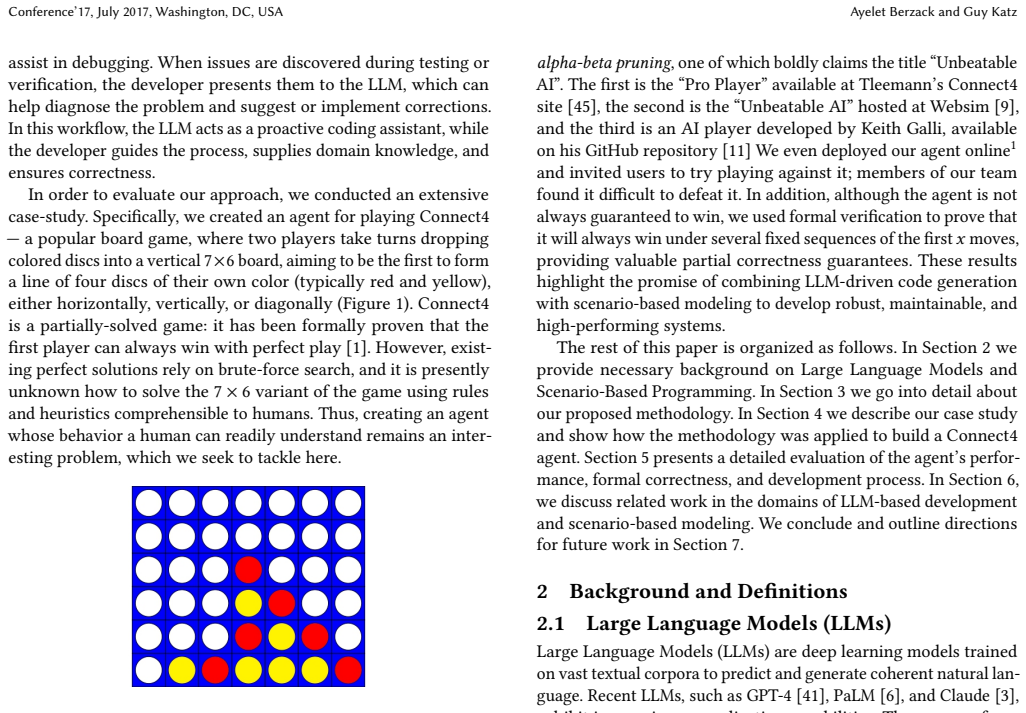
Large Language Models (LLMs) are fast becoming indispensable tools for software developers, assisting or even partnering with them in crafting complex programs. The advantages are evident -- LLMs can significantly reduce development time, generate well-organized and comprehensible code, and occasionally suggest innovative ideas that developers might not conceive on their own. However, despite their strengths, LLMs will often introduce significant errors and present incorrect code with persuasive confidence, potentially misleading developers into accepting flawed solutions. In order to bring LLMs into the software development cycle in a more reliable manner, we propose a methodology for combining them with ``traditional'' software engineering techniques in a structured way, with the goal of streamlining the development process, reducing errors, and enabling users to verify crucial program properties with increased confidence. Specifically, we focus on the Scenario-Based Programming (SBP) paradigm -- an event-driven, scenario-based approach for software engineering -- to allow human developers to pour their expert knowledge into the LLM, as well as to inspect and verify its outputs. To evaluate our methodology, we conducted a significant case study, and used it to design and implement the Connect4 game. By combining LLMs and SBP we were able to create a highly-capable agent, which could defeat various strong existing agents. Further, in some cases, we were able to formally verify the correctness of our agent. Finally, our experience reveals interesting insights regarding the ease-of-use of our proposed approach. The full code of our case-study will be made publicly available with the final version of this paper.
Figures


Figures from the paper (5 more)


Reference graph
Works this paper leans on
-
[1]
V. Allis. 1988.A Knowledge-Based Approach of Connect-Four — The Game is Solved: White Wins. Master’s thesis. Vrije Universiteit Amsterdam
1988
-
[2]
V. Allis. 2025. How to Win Connect 4. Technical Report. https://www.rd.com/ article/how-to-win-connect-4/
2025
-
[3]
Anthropic. 2023. Introducing Claude. https://www.anthropic.com/index/ introducing-claude
2023
-
[4]
Ashrov and G
A. Ashrov and G. Katz. 2023. Enhancing Deep Learning with Scenario-Based Override Rules: a Case Study. InProc. 11th Int. Conf. on Model-Driven Engineering and Software Development (MODELSW ARD). 253–268
2023
-
[5]
Ashrov, A
A. Ashrov, A. Sturm, A. Elyasaf, and G. Katz. 2025. A Study on the Comprehensi- bility of Behavioral Programming Variants. InProc. 20th Int. Conf. on Evaluation of Novel Approaches to Software Engineering (ENASE). 252–267
2025
-
[6]
A. Chowdhery, S. Narang, J. Devlin, et al. 2022. PaLM: Scaling Language Modeling with Pathways. Technical Report. https://arxiv.org/abs/2204.02311
arXiv 2022
-
[7]
Corsi, R
D. Corsi, R. Yerushalmi, G. Amir, A. Farinelli, D. Harel, and G. Katz. 2024. Enforc- ing Specific Behaviours via Constrained DRL and Scenario-Based Programming. InProc. 31st Int. Conf. on Neural Information Processing (ICONIP). 284–302
2024
-
[8]
Cursor. 2023. Cursor: The IDE that helps you Code with AI. https://www.cursor. com
2023
Show all 52 references
-
[9]
J. Doe. 2025. Unbeatable AI — Connect4. https://websim.com/@Ch13fB1gT4lk/ connect-4-unbeatable-ai
2025
-
[10]
X. Du, M. Liu, K. Wang, H. Wang, J. Liu, Y. Chen, J. Feng, C. Sha, X. Peng, and Y. Lou. 2024. Evaluating Large Language Models in Class-Level Code Generation. InProc. 46th Int. Conf. on Software Engineering (ICSE)
2024
-
[11]
K. Galli. 2025. Connect4 Python GitHub Repository. https://github.com/ KeithGalli
2025
-
[12]
Greenyer, D
J. Greenyer, D. Gritzner, T. Gutjahr, F. König, N. Glade, A. Marron, and G. Katz
-
[13]
Greenyer, D
J. Greenyer, D. Gritzner, G. Katz, and A. Marron. 2016. Scenario-Based Modeling and Synthesis for Reactive Systems with Dynamic System Structure in Scenari- oTools. InProc. 19th ACM/IEEE Int. Conf. on Model Driven Engineering Languages and Systems (MODELS). 16–23
2016
-
[14]
Greenyer, D
J. Greenyer, D. Gritzner, G. Katz, A. Marron, N. Glade, T. Gutjahr, and F. König
-
[15]
M. Haque. 2025. LLMs: A Game-Changer for Software Engineers? Technical Report. https://arxiv.org/abs/2411.00932
2025 arXiv
-
[16]
Harel, A
D. Harel, A. Kantor, and G. Katz. 2013. Relaxing Synchronization Constraints in Behavioral Programs. InProc. 19th Int. Conf. on Logic for Programming, Artificial Intelligence and Reasoning (LPAR). 355–372
2013
-
[17]
Harel, A
D. Harel, A. Kantor, G. Katz, A. Marron, L. Mizrahi, and G. Weiss. 2013. On Composing and Proving the Correctness of Reactive Behavior. InProc. 13th Int. Conf. on Embedded Software (EMSOFT). 1–10
2013
-
[18]
Harel, A
D. Harel, A. Kantor, G. Katz, A. Marron, G. Weiss, and G. Wiener. 2015. Towards Behavioral Programming in Distributed Architectures.Journal of Science of Computer Programming (J. SCP)98 (2015), 233–267
2015
-
[19]
Harel and G
D. Harel and G. Katz. 2014. Scaling-Up Behavioral Programming: Steps from Basic Principles to Application Architectures. InProc. 4th SPLASH Workshop on Programming based on Actors, Agents and Decentralized Control (AGERE!). 95–108
2014
-
[20]
Harel, G
D. Harel, G. Katz, R. Lampert, A. Marron, and G. Weiss. 2015. On the Succinctness of Idioms for Concurrent Programming. InProc. 26th Int. Conf. on Concurrency Theory (CONCUR). 85–99
2015
-
[21]
Harel, G
D. Harel, G. Katz, R. Marelly, and A. Marron. 2016. An Initial Wise Development Environment for Behavioral Models. InProc. 4th Int. Conf. on Model-Driven Engineering and Software Development (MODELSW ARD). 600–612
2016
-
[22]
Harel, G
D. Harel, G. Katz, R. Marelly, and A. Marron. 2016. First Steps Towards a Wise Development Environment for Behavioral Models.Int. Journal of Information System Modeling and Design (IJISMD)7(3) (2016), 1–22
2016
-
[23]
Harel, G
D. Harel, G. Katz, R. Marelly, and A. Marron. 2018. Wise Computing: Toward Endowing System Development with Proactive Wisdom.IEEE Computer51(2) (2018), 14–26
2018
-
[24]
Harel, G
D. Harel, G. Katz, A. Marron, A. Sadon, and G. Weiss. 2020. Executing Scenario- Based Specification with Dynamic Generation of Rich Events.Communications in Computer and Information Science (CCIS)1161 (2020), 246–274
2020
-
[25]
Harel, G
D. Harel, G. Katz, A. Marron, and S. Szekely. 2024. On Augmenting Scenario- Based Modeling with Generative AI. InProc. 12th Int. Conf. on Model-Driven Engineering and Software Development (MODELSW ARD). 235–246
2024
-
[26]
Harel, G
D. Harel, G. Katz, A. Marron, and S. Szekely. 2025. Enhancing Scenario-Based Modeling using Large Language Models.Communications in Computer and Information Science (CCIS)2547 (2025), 43–68
2025
-
[27]
Harel, G
D. Harel, G. Katz, A. Marron, and G. Weiss. 2012. Non-Intrusive Repair of Reactive Programs. InProc. 17th IEEE Int. Conf. on Engineering of Complex Computer Systems (ICECCS). 3–12
2012
-
[28]
Harel, G
D. Harel, G. Katz, A. Marron, and G. Weiss. 2014. Non-Intrusive Repair of Safety and Liveness Violations in Reactive Programs.Transactions on Computational Collective Intelligence (TCCI)16 (2014), 1–33
2014
-
[29]
Harel, G
D. Harel, G. Katz, A. Marron, and G. Weiss. 2015. The Effect of Concurrent Programming Idioms on Verification. InProc. 3rd Int. Conf. on Model-Driven Engineering and Software Development (MODELSW ARD). 363–369
2015
-
[30]
Harel, R
D. Harel, R. Lampert, A. Marron, and G. Weiss. 2011. Model-Checking Behavioral Programs. InProc. 11th Int. Conf. on Embedded Software (EMSOFT). 279–288
2011
-
[31]
Harel, A
D. Harel, A. Marron, and G. Weiss. 2012. Behavioral Programming.Commun. ACM55, 7 (2012), 90–100
2012
-
[32]
G. Katz. 2013. On Module-Based Abstraction and Repair of Behavioral Pro- grams. InProc. 19th Int. Conf. on Logic for Programming, Artificial Intelligence and Reasoning (LPAR). 518–535
2013
-
[33]
G. Katz. 2020. Guarded Deep Learning using Scenario-Based Modeling. InProc. 8th Int. Conf. on Model-Driven Engineering and Software Development (MODEL- SW ARD). 126–136
2020
-
[34]
G. Katz. 2021. Augmenting Deep Neural Networks with Scenario-Based Guard Rules.Communications in Computer and Information Science (CCIS)1361 (2021), 147–172
2021
-
[35]
G. Katz. 2021. Towards Repairing Scenario-Based Models with Rich Events. InProc. 9th Int. Conf. on Model-Driven Engineering and Software Development (MODELSW ARD). 362–372
2021
-
[36]
G. Katz, C. Barrett, and D. Harel. 2015. Theory-Aided Model Checking of Concur- rent Transition Systems. InProc. 15th Int. Conf. on Formal Methods in Computer- Aided Design (FMCAD). 81–88
2015
-
[37]
Katz and A
G. Katz and A. Elyasaf. 2021. Towards Combining Deep Learning, Verification, and Scenario-Based Programming. InProc. 1st Workshop on Verification of Autonomous and Robotic Systems (V ARS). 1–3
2021
-
[38]
G. Katz, A. Marron, A. Sadon, and G. Weiss. 2019. On-the-Fly Construction of Composite Events in Scenario-Based Modeling Using Constraint Solvers. InProc. 7th Int. Conf. on Model-Driven Engineering and Software Development (MODEL- SW ARD). 143–156
2019
-
[39]
Y. Li, J. Parsert, and E. Polgreen. 2024. Guiding Enumerative Program Syn- thesis with Large Language Models. Proc. 36th Int. Conf. on Computer Aided Verification (CAV)
2024
-
[40]
Marron, Y
A. Marron, Y. Hacohen, D. Harel, A. Mülder, and A. Terfloth. 2018. Embedding Scenario-based Modeling in Statecharts. InProc. 5th Int. Workshop on Model-driven Robot Software Engineering (MORSE). 443–452
2018
-
[41]
OpenAI. 2023. GPT-4. Technical Report. https://openai.com/research/gpt-4
2023
-
[42]
Steinberg, J
S. Steinberg, J. Greenyer, D. Gritzner, D. Harel, G. Katz, and A. Marron. 2017. Distributing Scenario-Based Models: A Replicate-and-Project Approach. InProc. 5th Int. Conf. on Model-Driven Engineering and Software Development (MODEL- SW ARD). 182–195
2017
-
[43]
Steinberg, J
S. Steinberg, J. Greenyer, D. Gritzner, D. Harel, G. Katz, and A. Marron. 2018. Efficient Distributed Execution of Multi-Component Scenario-Based Models. Communications in Computer and Information Science (CCIS)880 (2018), 449–483
2018
-
[44]
C. Sun, Y. Sheng, O. Padon, and C. Barrett. 2024. Clover: Closed-Loop Verifiable Code Generation. InProc. 1st Int. Symposium on AI Verification (SAIV). 134–155
2024
-
[45]
Tleemann
T. Tleemann. 2025. Pro Player — Connect4. https://tleemann.de/four.html
2025
-
[46]
T. Yaacov. 2023. BPpy: Behavioral Programming in Python.SoftwareX24 (2023)
2023
-
[47]
Yaacov, A
T. Yaacov, A. Elyasaf, and G. Weiss. 2024. Boosting LLM-Based Software Genera- tion by Aligning Code with Requirements. Proc. IEEE 32nd Int. Requirements Engineering Conference Workshops (REW)
2024
-
[48]
Yaacov, G
T. Yaacov, G. Weiss, A. Ashrov, G. Katz, and H. Zisser. 2025. Exploring and Evaluating Interplays of BPpy with Deep Reinforcement Learning and Formal Methods. InProc. 20th Int. Conf. on Evaluation of Novel Approaches to Software Engineering (ENASE). 27–40
2025
-
[49]
Yerushalmi, G
R. Yerushalmi, G. Amir, A. Elyasaf, D. Harel, G. Katz, and A. Marron. 2022. Scenario-Assisted Deep Reinforcement Learning. InProc. 10th Int. Conf. on Model- Driven Engineering and Software Development (MODELSW ARD). 310–319
2022
-
[50]
Yerushalmi, G
R. Yerushalmi, G. Amir, A. Elyasaf, D. Harel, G. Katz, and A. Marron. 2023. En- hancing Deep Reinforcement Learning with Scenario-Based Modeling.Springer Nature Computer Science (SNCS)4 (2023), 1–13
2023
-
[2016]
Distributed Execution of Scenario-Based Specifications of Structurally Dynamic Cyber-Physical Systems. InProc. 3rd Int. Conf. on System-Integrated Intelligence: New Challenges for Product and Production Engineering (SYSINT). 552–559
-
[2017]
SCP)149 (2017), 15–27
ScenarioTools — A Tool Suite for the Scenario-based Modeling and Analysis of Reactive Systems.Journal of Science of Computer Programming (J. SCP)149 (2017), 15–27
2017
Reviewed August 4, 2026 · model on record in the stance chip above.
Discussion (0). Sign in to comment.